
Life, 1923-11-15 · page 22 of 40
Life — November 15, 1923 — page 22: what you’re looking at
What you’re looking at
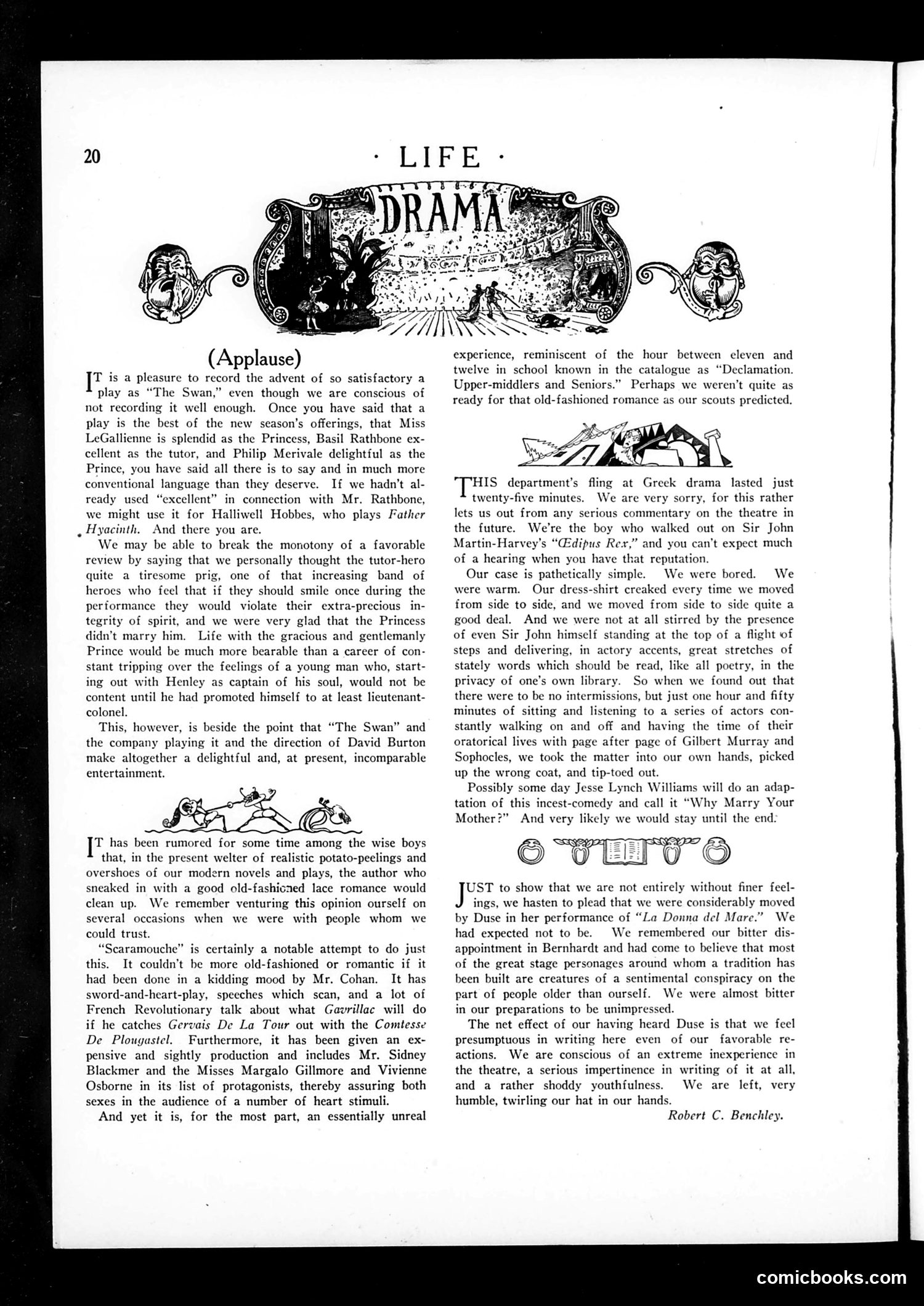
This page reviews three theatrical productions: *The Swan*, *Scaramouche*, and an unnamed Greek drama adaptation. The reviewer praises *The Swan* starring Eva Le Gallienne and Basil Rathbone, though finds the male lead ("tutor-hero") an irritating prig—too self-serious and self-important to be likable. *Scaramouche* is critiqued as old-fashioned romance with sword-fighting and French Revolutionary melodrama. The reviewer notes such "good old-fashioned lace romance" was expected to succeed commercially against modern "realistic potato-peelings" (naturalistic plays), but confesses boredom despite its expense and star power (Sidney Blackmer, Margalo Gillmore). The Greek drama—likely a classical adaptation—receives dismissal: the reviewer sat through 25 minutes of uncomfortable heat and creaking dress-shirt before abandoning it, admitting no credibility to critique it given prior walkouts from Sir John Martin-Harvey's productions. The tone is wry, self-aware theater criticism for sophisticated readers.
📄 Transcribed text from this page (OCR, searchable)
Machine-transcribed from the original scan — historical spelling and the odd misread are preserved.
(Applause) T is a pleasure to record the advent of so satisfactory a play as “The Swan,” even though we are conscious of not recording it well enough. Once you have said that a play is the best of the new season’s offerings, that Miss LeGallienne is splendid as the Princess, Basil Rathbone ex- cellent as the tutor, and Philip Merivale delightful as the Prince, you have said all there is to say and in much more conventional language than they deser If we hadn't al- ready used “excellent” in connection with Mr. Rathbone, we might use it for Halliwell Hobbes, who plays Father «Hyacinth. And there you are. We may be able to break the monotony of a favorable review by saying that we personally thought the tutor-hero quite a tiresome prig, one of that increasing band of heroes who feel that if they should smile once during the performance they would violate their extra-precious in- tegrity of spirit, and we were very glad that the Princess didn’t marry him. Life with the gracious and gentlemanly Prince would be much more bearable than a career of con- stant tripping over the feelings of a young man who, start- ing out with Henley as captain of his soul, would not be content until he had promoted himself to at least lieutenant- colonel. This, however, is beside the point that “The Swan” and the company playing it and the direction of David Burton make altogether a delightful and, at present, incomparable entertainment. % i has been rumored for some time among the wise boys that, in the present welter of realistic potato-peelings and overshoes of our modern novels and plays, the author who sneaked in with a good old-fashioned lace romance would clean up. We remember venturing this opinion ourself on several occasions when we were with people whom we could trust. “Scaramouche” is certainly a notable attempt to do just this. It couldn't be more old-fashioned or romantic if it had been done in a kidding mood by Mr. Cohan. It has sword-and-heart-play, speeches which scan, and a lot of French Revolutionary talk about what Gavrillac will do if he catches Gervais De La Tour out with the Comtesse De Plougastel. Furthermore, it has been given an ex- pensive and sightly production and includes Mr. Sidney Blackmer and the Misses Margalo Gillmore and Vivienne Osborne in its list of protagonists, thereby assuring both sexes in the audience of a number of heart stimuli. And yet it is, for the most part, an essentially unreal experience, reminiscent of the hour betw eleven and twelve in school known in the catalogue as “Declamation. Upper-middlers and Seniors.” Perhaps we weren't quite as ready for that old-fashioned romance as our scouts predicted. 'HIS department’s fling at Greek drama twenty-five minutes. lasted just We are very sorry, for this rather lets us out from any serious commentary on the theatre in the future. We're the boy who walked out on Sir John Martin-Harvey’s “CEdipus Re and you can’t expect much of a hearing when you have that reputation. Our case is pathetically simple. We were bored. We were warm. Our dress-shirt creaked every time we moved from side to side, and we moved from side to side quite a good deal. And we were not at all stirred by the presence of even Sir John himself standing at the top of a flight of steps and delivering, in actory accents, great stretches of stately words which should be read, like all poetry, in the privacy of one’s own library. So when we found out that there were to be no intermissions, but just one hour and fifty minutes of sitting and listening to a series of actors con- stantly walking on and off and having the time of their oratorical lives with page after page of Gilbert Murray and Sophocles, we took the matter into our own hands, picked up the wrong coat, and tip-toed out. Possibly some day Jesse Lynch Williams will do an adap- tation of this incest-comedy and call it “Why Marry Your Mother?” And very likely we would stay until the end: UST to show that we are not entirely without finer feel- ings, we hasten to plead that we were considerably moved by Duse in her performance of “La Donna del Mare.” We had expected not to be. We remembered our bitter dis- appointment in Bernhardt and had come to believe that most of the great stage personages around whom a tradition has been built are creatures of a sentimental conspiracy on the part of people older than ourself. We were almost bitter in our preparations to be unimpressed. The net effect of our having heard Duse is that we feel presumptuous in writing here even of our favorable re- actions. We are conscious of an extreme inexperience in the theatre, a serious impertinence in writing of it at all, and a rather shoddy youthfulness. We are left, very humble, twirling our hat in our hands. Robert C. Benchley. comicbooks.com