
A complete issue · 36 pages · 1923
Life — July 19, 1923
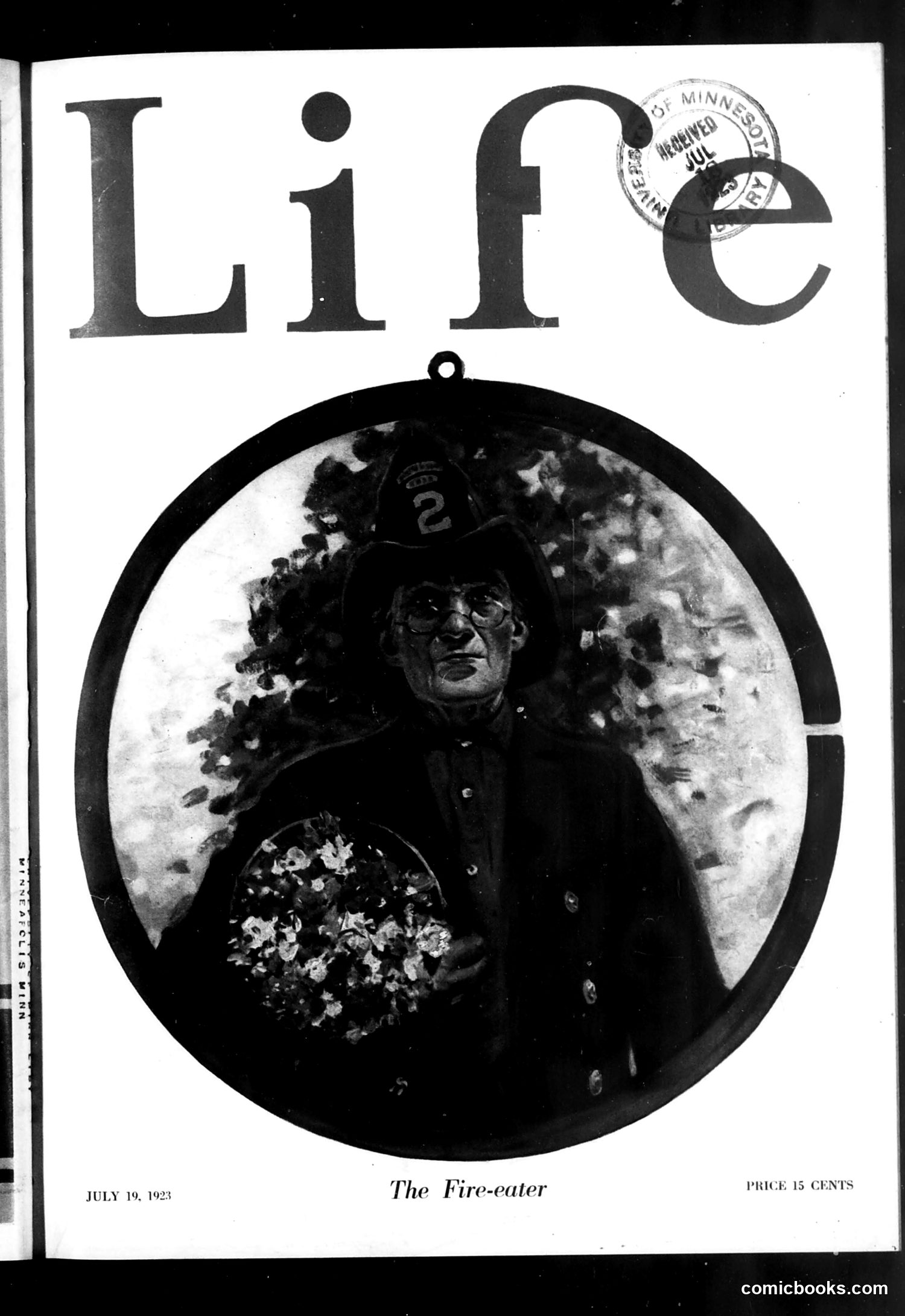
This cover depicts a man wearing glasses and a firefighter's helmet labeled "2," holding a bouquet of flowers while standing before a large moon or circular backdrop. The title "The Fire-eater" suggests political satire, likely referencing a public figure known for inflammatory rhetoric or aggressive policies during the early 1920s. Without additional context identifying the specific individual caricatured, I cannot definitively name the target. However, the juxtaposition of martial imagery (firefighter's gear) with peaceful imagery (flowers and glasses-wearing intellectualism) suggests irony—mocking someone who presents themselves as fierce or combative while actually being gentler or less imposing than their public persona suggests. The magazine cost 15 cents.
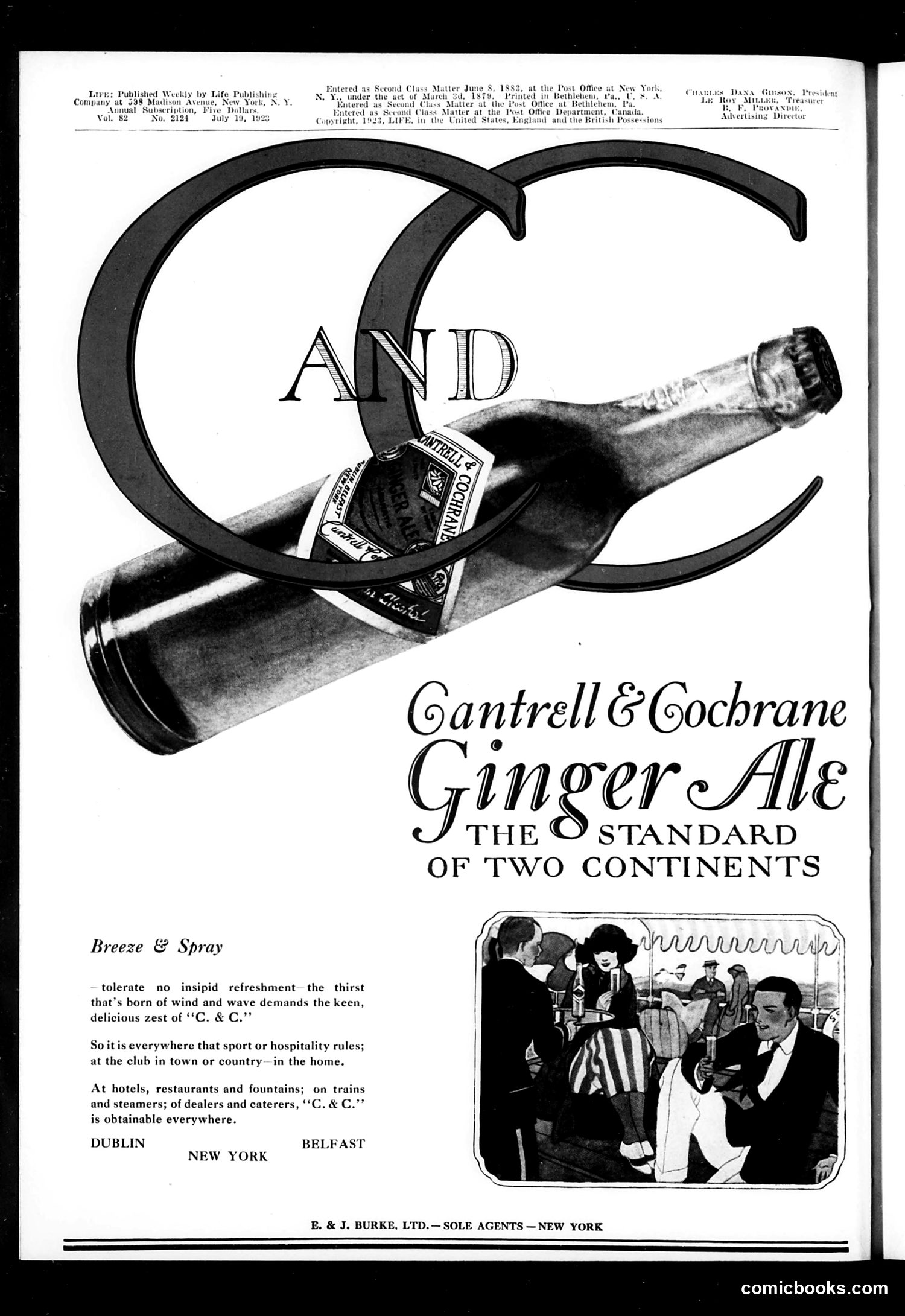
This page is **primarily an advertisement**, not political satire. It advertises Cantrell & Cochrane Ginger Ale, marketed as "The Standard of Two Continents." The ad uses a large decorative "C" (for Cantrell & Cochrane) shaped like clasped hands holding a ginger ale bottle. The tagline "Breeze & Spray" emphasizes refreshment. Below is a photograph showing well-dressed people socializing, presumably at a club or social gathering, drinking the product. The text emphasizes that C&C ginger ale is available "at the club in town or country in the home" and at "hotels, restaurants and steamers." The ad lists distribution cities: Dublin, New York, and Belfast. E. & J. Burke Ltd. are identified as sole agents in New York. This is a straightforward commercial advertisement with no discernible political or satirical content.
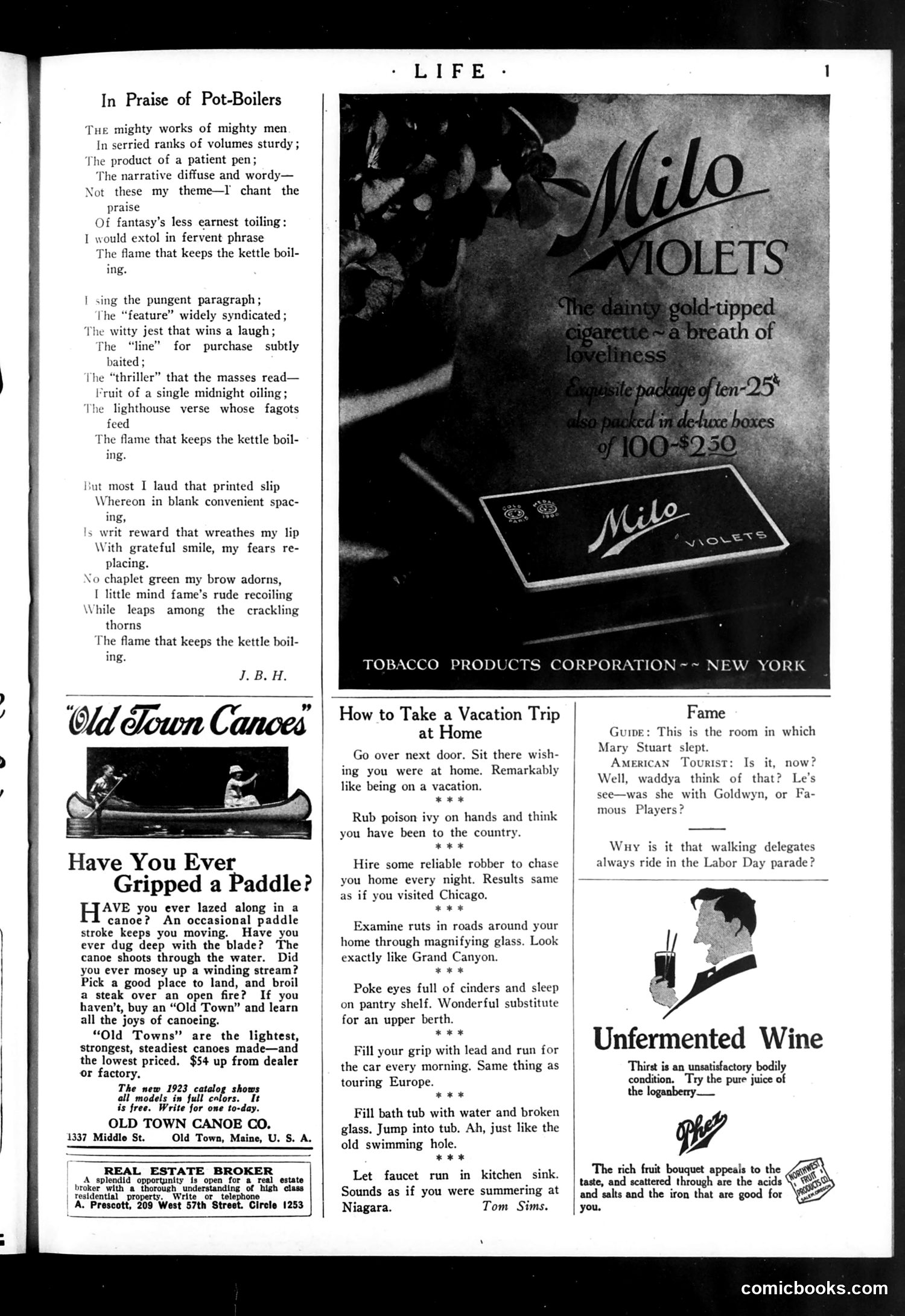
This page is primarily **advertising and humor content** rather than political satire. The main elements include: **Advertisements:** - Milo Violets cigarettes (top right) - Old Town Canoes (left side) - Unfermented Wine/Porzay loganberry drink (bottom right) **Satirical Content:** The left column contains "In Praise of Pot-Boilers," a poem mocking hack writing—the repetitive, commercial prose churned out for mass consumption. The recurring refrain "The flame that keeps the kettle boiling" sarcastically celebrates mediocre but profitable work. **Humor Articles:** "How to Take a Vacation Trip at Home" offers absurdist suggestions for simulating travel experiences without leaving (rubbing poison ivy, hiring a robber, etc.). The tone is light, domestic satire typical of 1920s Life magazine's humor. No specific political figures or events are referenced here.
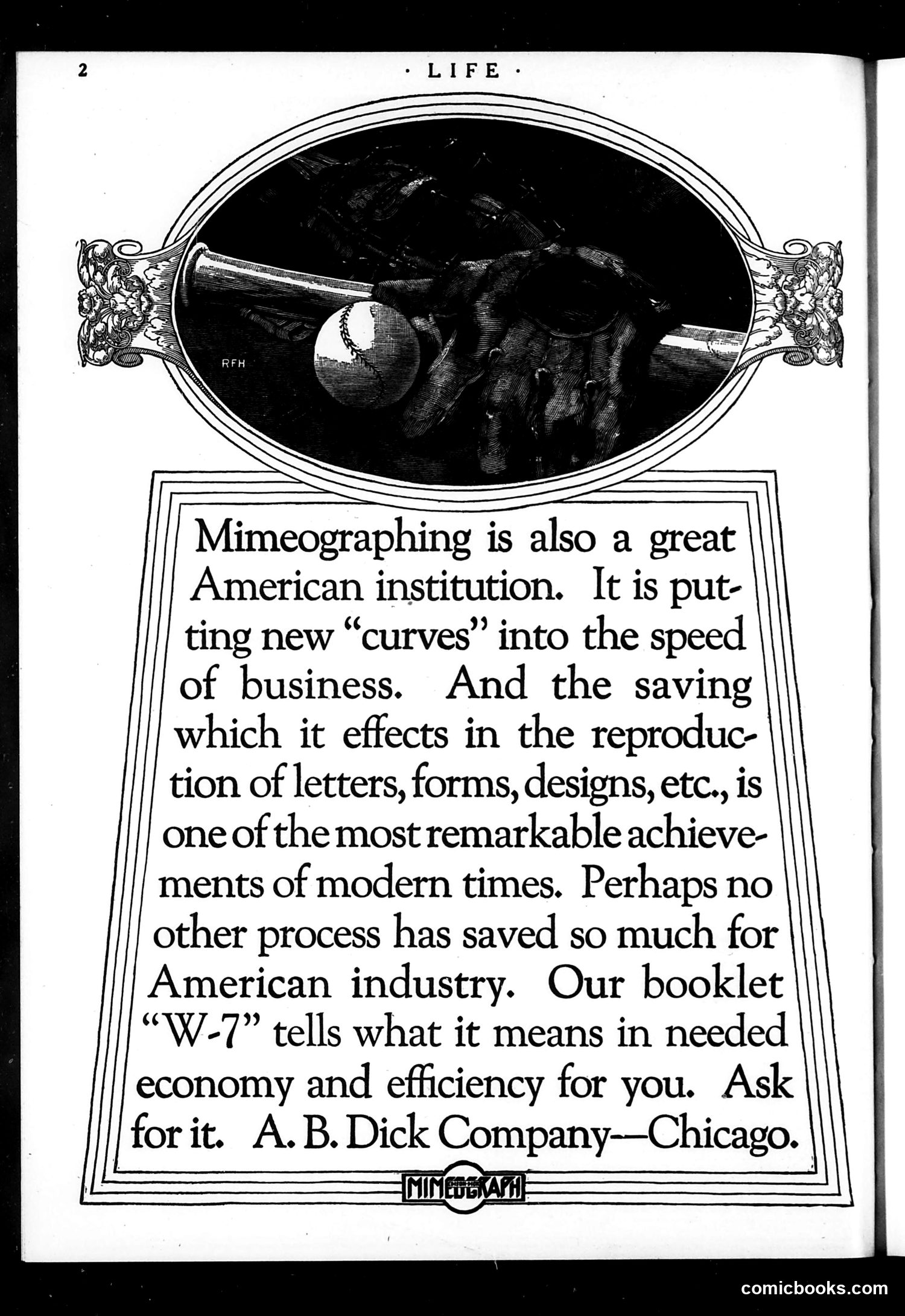
This page is primarily an **advertisement for A.B. Dick Company's mimeographing technology**, not satirical content. The ornate oval illustration at top shows a mimeograph machine in operation. The text promotes mimeographing as a modern American business innovation that increases efficiency by reproducing letters, forms, and designs economically. The ad claims this technology has delivered remarkable savings to American industry. The company references their booklet "W-7" as educational material about mimeographing's practical benefits, encouraging readers to request it. **No political satire or caricature is present here.** This is straightforward early-20th-century industrial advertising, appearing in *Life* magazine to reach a business-minded readership interested in modernizing their operations through new copying technology.
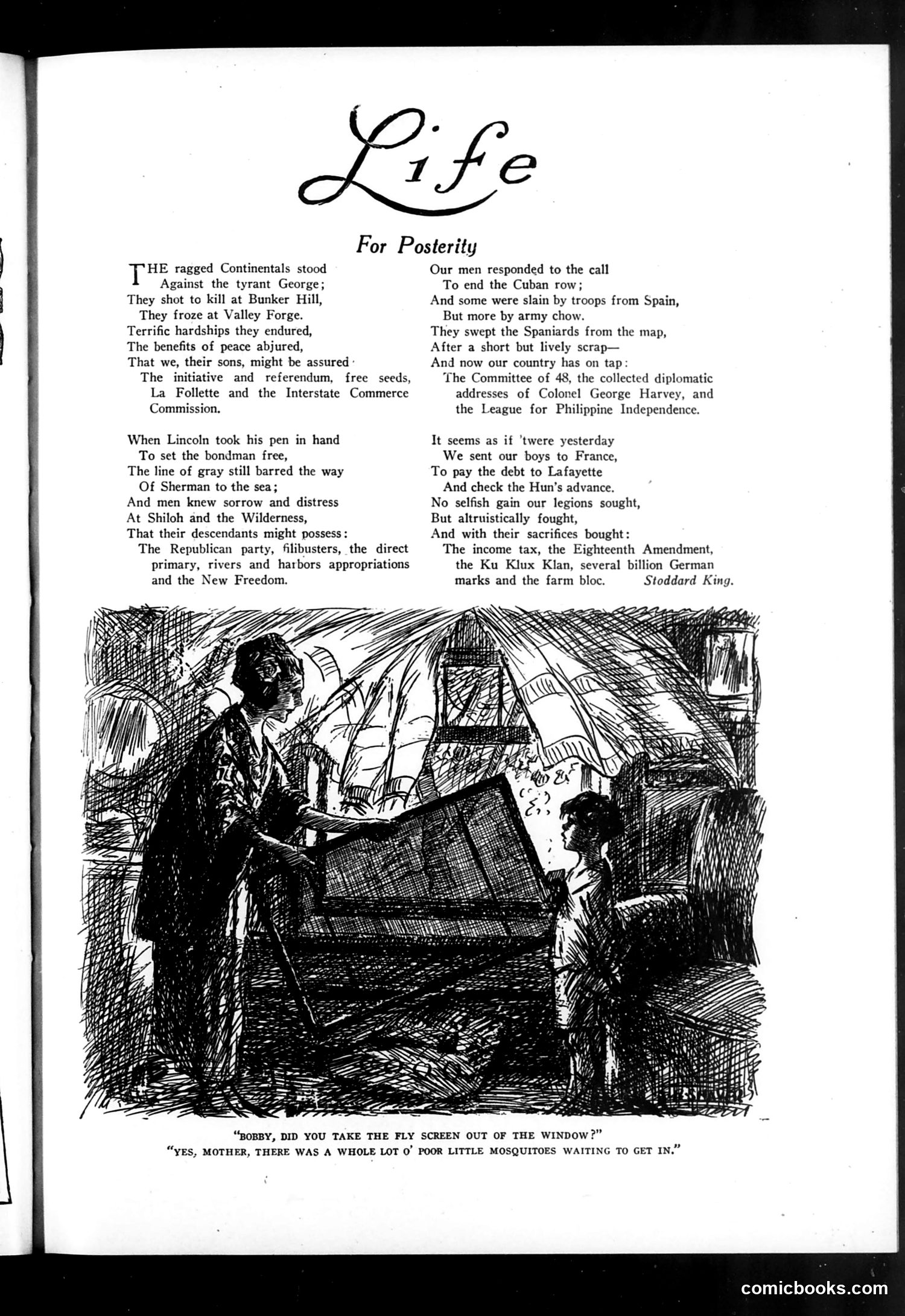
This page from *Life* magazine satirizes post-WWI American politics and foreign policy. The poem "Life For Posterity" mocks the idealistic justifications for American intervention—freeing enslaved people, establishing commerce, protecting democracy—while the actual results prove cynical and disappointing. The illustration shows a mother and child, with dialogue about removing a fly screen to let mosquitoes inside—a metaphor for allowing undesirable consequences through protective measures. References include Lincoln's emancipation, Sherman's campaign, and contemporary post-war entanglements (Cuba, Spain, France, Lafayette debt). The poem's bitter conclusion—mentioning the Ku Klux Klan, the Eighteenth Amendment (Prohibition), and German reparations—suggests America's grand war rhetoric produced only divisive domestic policies and failed international outcomes.
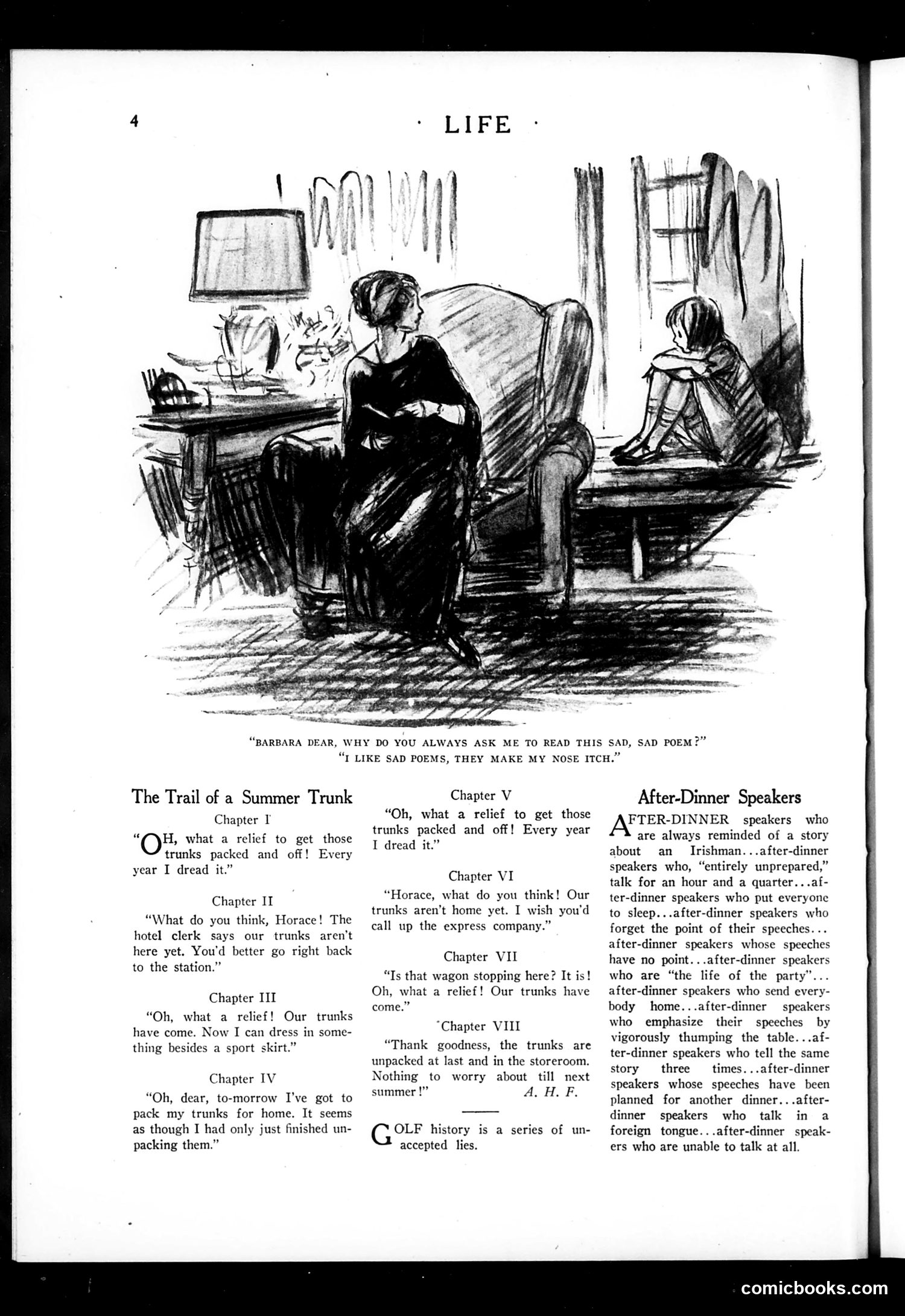
This page contains a satirical cartoon and humorous text pieces, not political commentary. The cartoon depicts a domestic scene: a woman sitting in a chair while a child sits nearby. The caption reads: "BARBARA DEAR, WHY DO YOU ALWAYS ASK ME TO READ THIS SAD, SAD POEM?" / "I LIKE SAD POEMS, THEY MAKE MY NOSE ITCH." The humor relies on the child's innocent, illogical reasoning—she enjoys sad poems not for emotional depth but for the physical sensation they produce. This is gentle domestic humor about children's peculiar logic. Below are three humor sections: "The Trail of a Summer Trunk" (dialogue about packing), and "After-Dinner Speakers" (a satirical description of various types of tedious public speakers). These are observational humor pieces about common social annoyances rather than political satire.
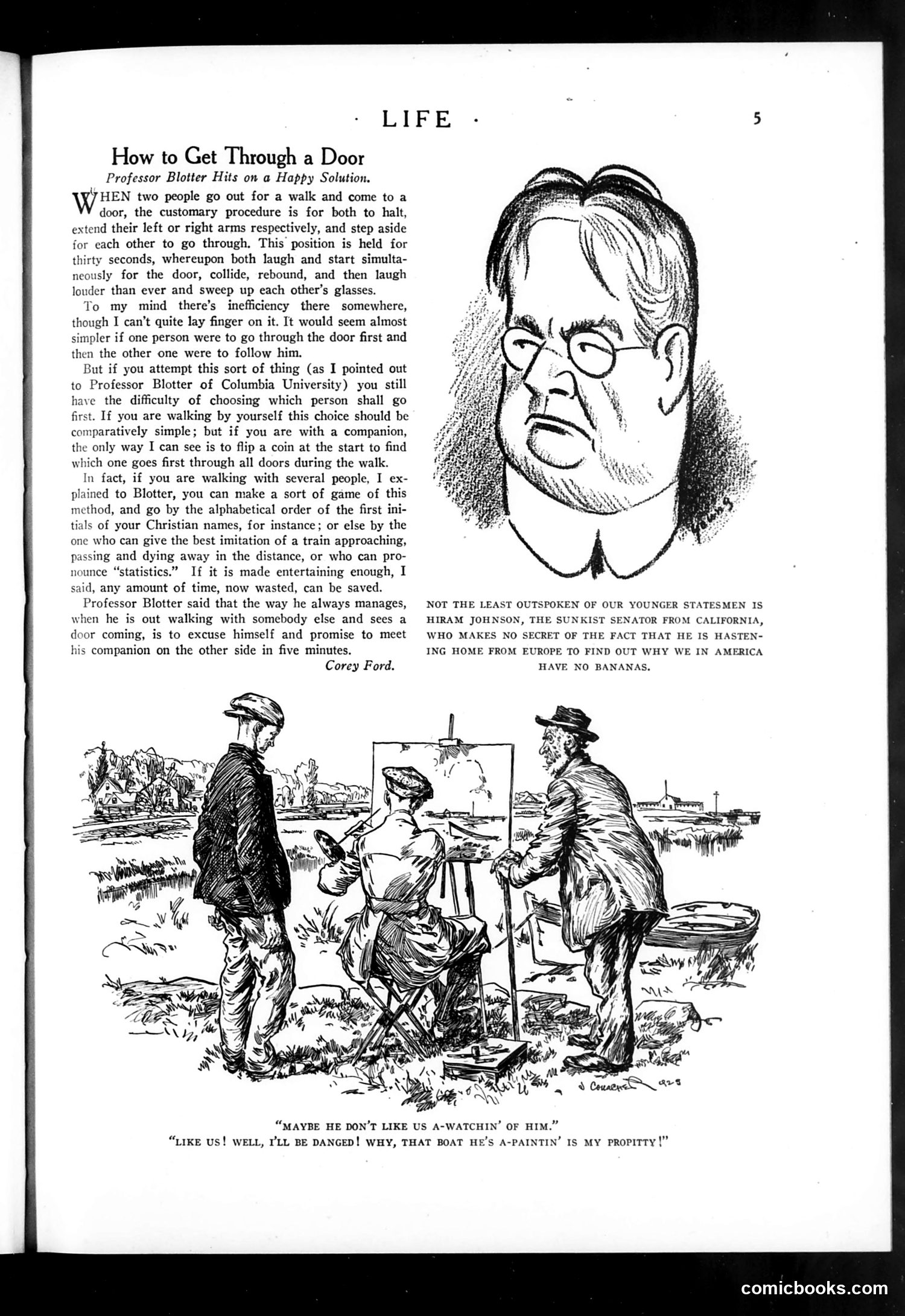
This page contains two distinct pieces: **"How to Get Through a Door"** is a humorous essay by Corey Ford about social etiquette when two people encounter a doorway. Professor Blotter of Columbia University proposes solutions, including coin-flipping or alphabetizing companions by first initials to decide passage order. The piece satirizes overcomplicated social conventions. **The caricature** (top right) depicts Hiram Johnson, identified as California's U.S. Senator. The caption notes his quirk about bananas—he "makes no secret of the fact that he is hastening home from Europe to find out why we in America have no bananas." This references a popular 1923 song; the satire mocks his apparently trivial concern given post-WWI circumstances. **The cartoon below** shows three figures outdoors (possibly artists or workers), with one claiming ownership of a boat used for painting, illustrating disputes over artistic property.
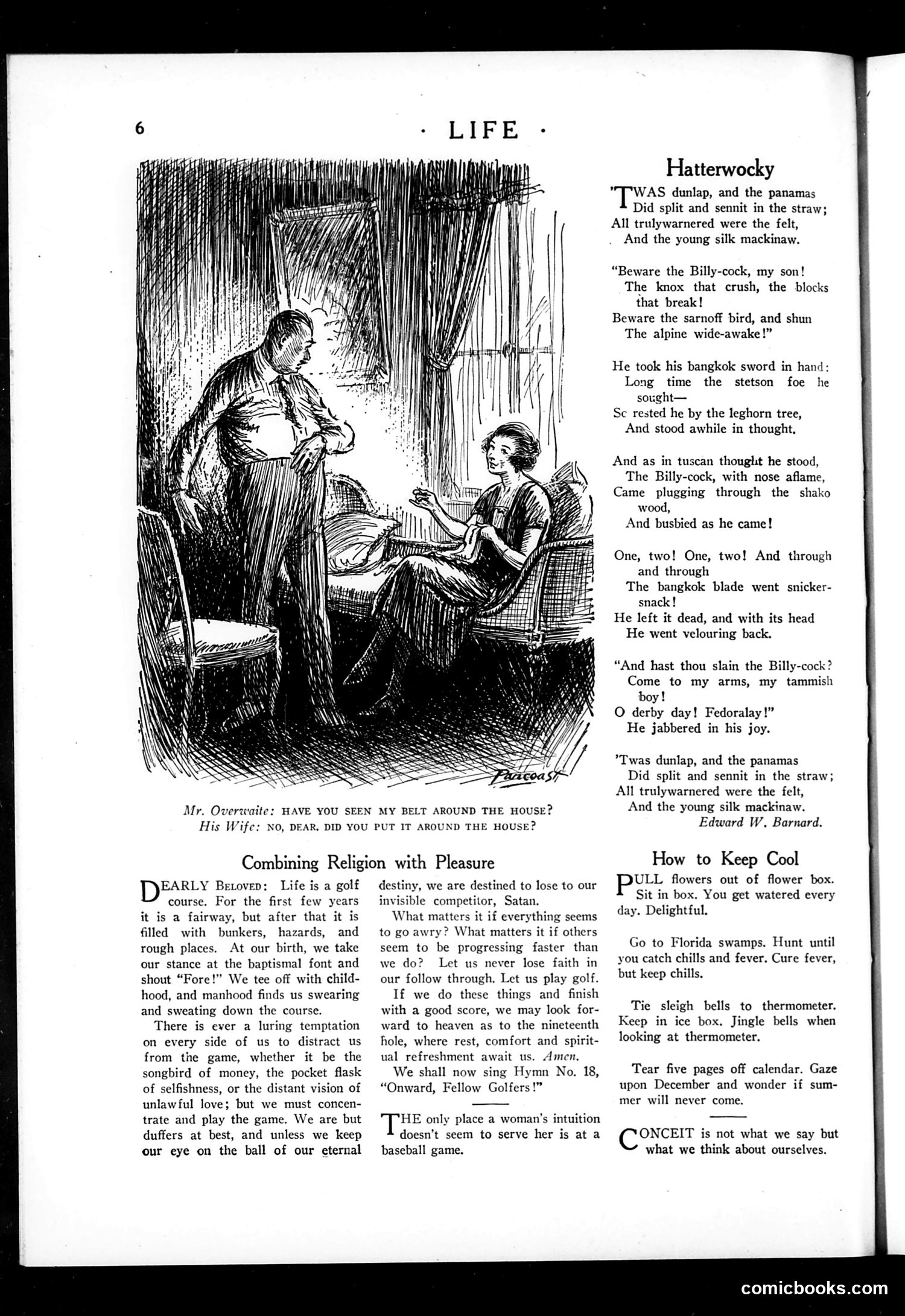
The main cartoon shows a man standing while a woman sits, with the caption "Mr. Overwrite: HAVE YOU SEEN MY BELT AROUND THE HOUSE? HIS WIFE: NO, DEAR. DID YOU PUT IT AROUND THE HOUSE?" This is a domestic humor joke playing on the phrase "around the house"—the wife deliberately misinterprets her husband's question about his belt's location as him asking if he wrapped the belt around the exterior of their house. It's a pun-based gag typical of early 20th-century magazine humor. The page also contains unrelated satirical content about religion, pleasure, and social commentary, but the main visual joke relies solely on this simple wordplay misunderstanding.
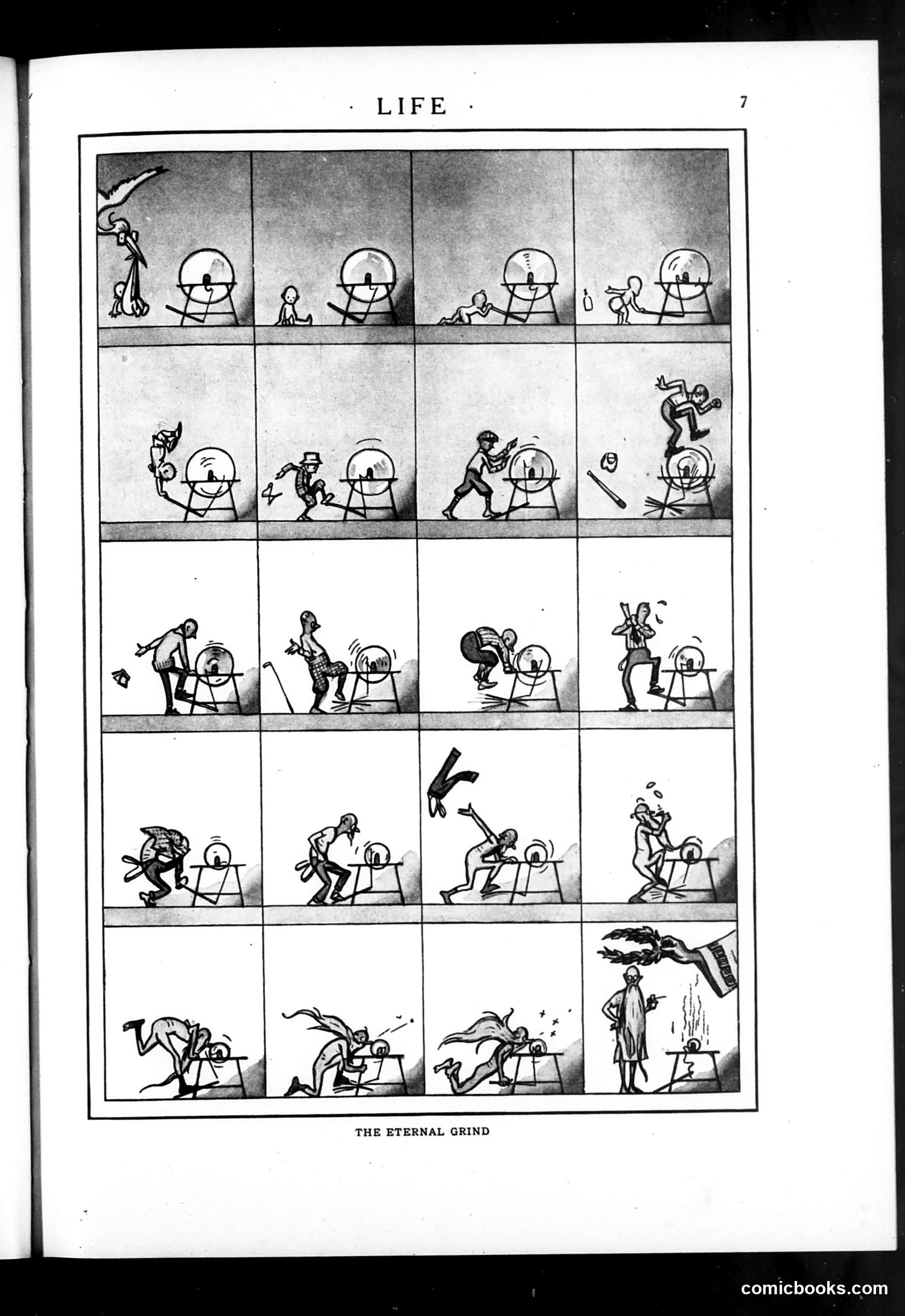
This is a satirical comic strip titled "The Eternal Grind" depicting the repetitive cycle of human labor and struggle. The cartoon shows a figure repeatedly pushing against or operating some kind of mechanical apparatus (possibly a grindstone or mill). Across five rows, the character's actions become increasingly frantic and desperate—jumping, flailing, contorting—while the machine remains constant and immovable. The satire critiques the monotonous, exhausting nature of work and industrial labor. Despite the worker's escalating efforts and emotional distress, nothing changes; the grind continues endlessly. This commentary on the dehumanizing aspects of repetitive labor was a common theme in early 20th-century American satire, particularly during periods of labor unrest and industrialization. The title itself emphasizes the inescapable, circular nature of this predicament.
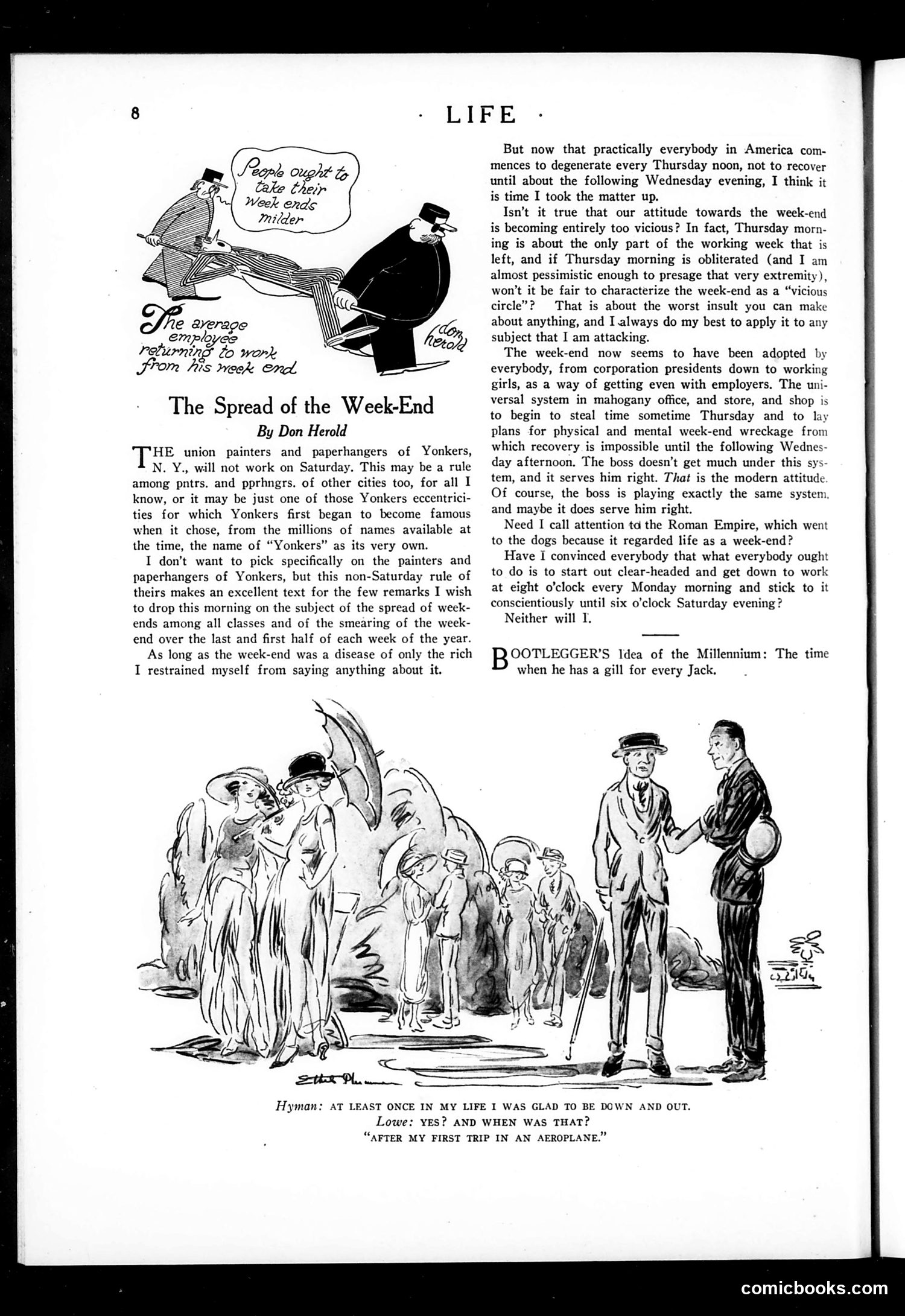
This satirical article critiques the American obsession with the "week-end" lifestyle. Herold argues that Thursday afternoons have become dedicated to mental recovery from work rather than actual work, making the weekend concept absurdly dominant in contemporary culture. The cartoon depicts a wealthy businessman ("The average employee") collapsing exhausted as he leaves work, suggesting that anticipation of the weekend ruins productive work time. The second cartoon shows a disheveled man boasting to a well-dressed companion about once being "down and out"—specifically after an airplane trip—mocking the frivolity of leisure activities among the privileged. Herold's satire targets how pervasive week-end culture had become across all social classes by the 1920s, affecting work ethic and attitudes toward labor itself.
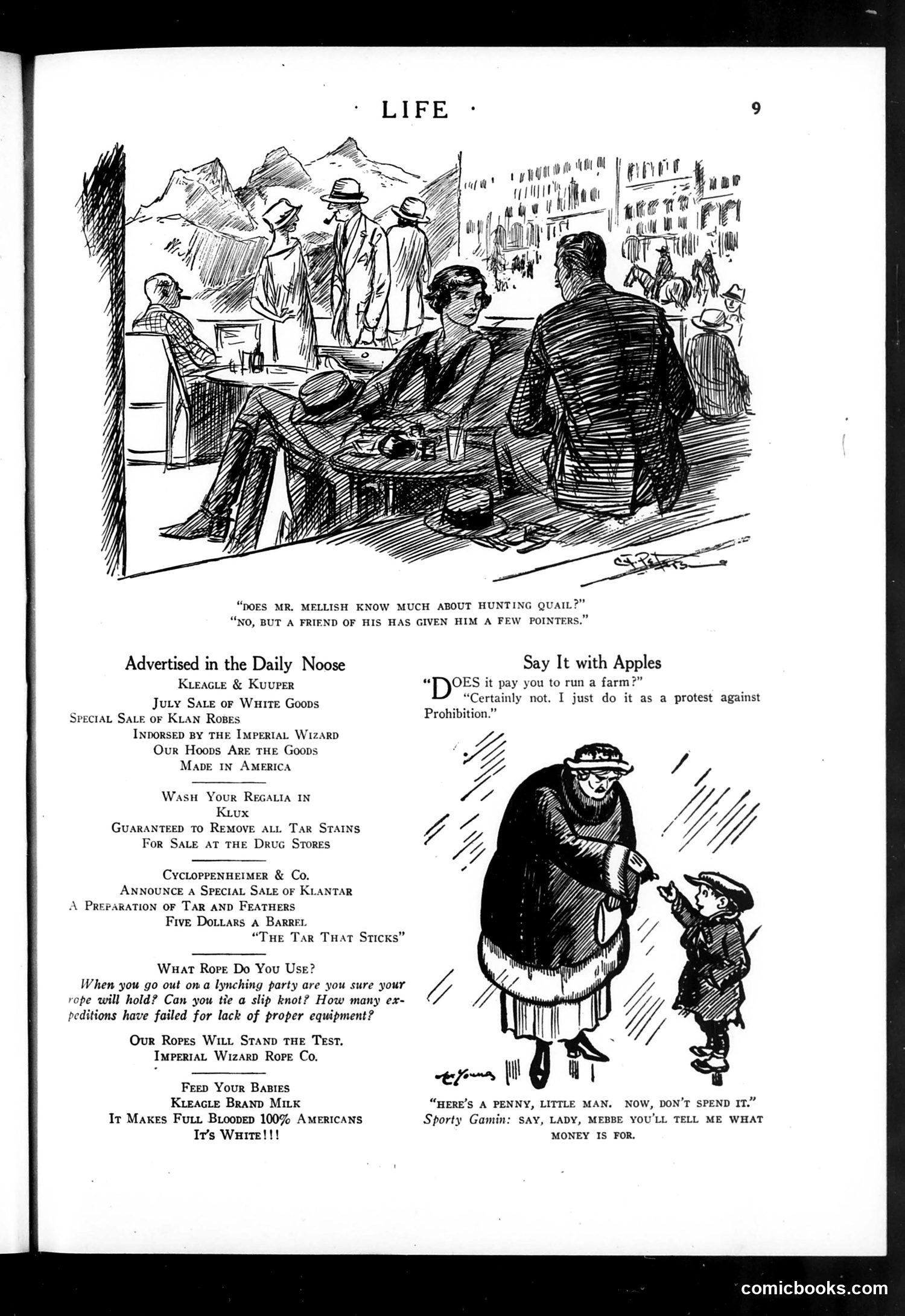
This page from *Life* magazine contains a main cartoon and period advertisements. **The Main Cartoon** depicts two men in conversation at what appears to be a social gathering, with mountains and a city visible in the background. The caption reads: "DOES MR. MELLISH KNOW MUCH ABOUT HUNTING QUAIL?" / "NO, BUT A FRIEND OF HIS HAS GIVEN HIM A FEW POINTERS." This is a genteel joke about social pretension—Mr. Mellish apparently lacks hunting expertise but has received advice, suggesting he's attempting to participate in an upper-class sport without genuine knowledge. **The Secondary Comic** titled "Say It with Apples" shows an elderly woman giving a penny to a child, with dialogue about running a farm as protest against Prohibition, referencing the then-recent constitutional amendment banning alcohol. The advertisements promote various period products including rope, milk, and tar removal treatments.
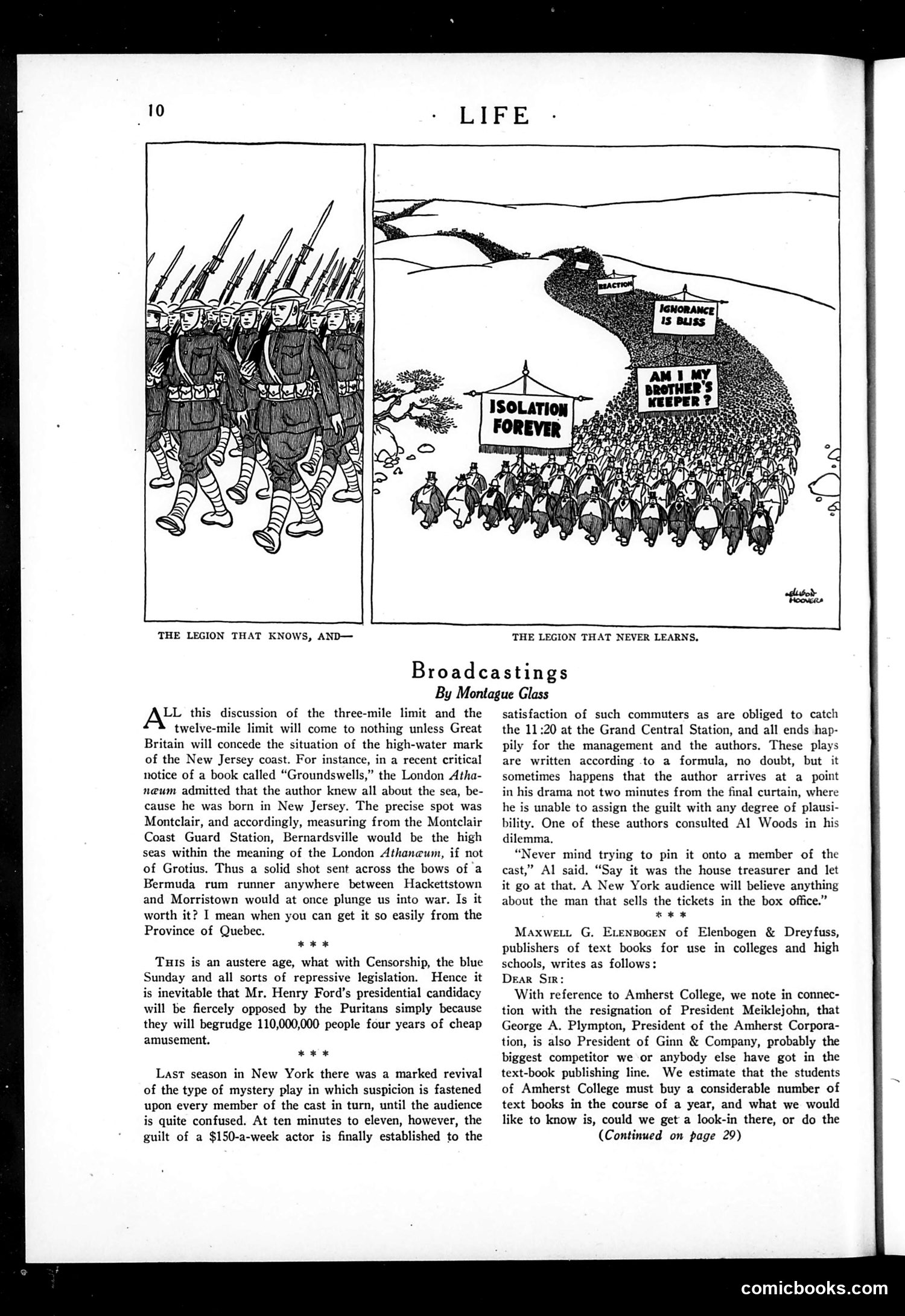
This page contains two contrasting cartoons about isolationism during what appears to be the interwar period. **Left panel:** "The Legion That Knows, And—" depicts marching soldiers with bayonets, representing military preparedness and interventionist thinking. **Right panel:** "The Legion That Never Learns" shows a crowd beneath signs reading "Isolation Forever" and "Am I My Brother's Keeper?"—satirizing isolationists as willfully ignorant, depicted as a large mass moving mindlessly toward a cliff. The cartoons argue that isolationism represents dangerous naivety while military strength reflects wisdom. The contrast suggests that those opposing U.S. military engagement are foolish and headed toward disaster, while prepared forces represent enlightened leadership—a critique of American non-interventionist sentiment, likely from the 1930s-early 1940s period.
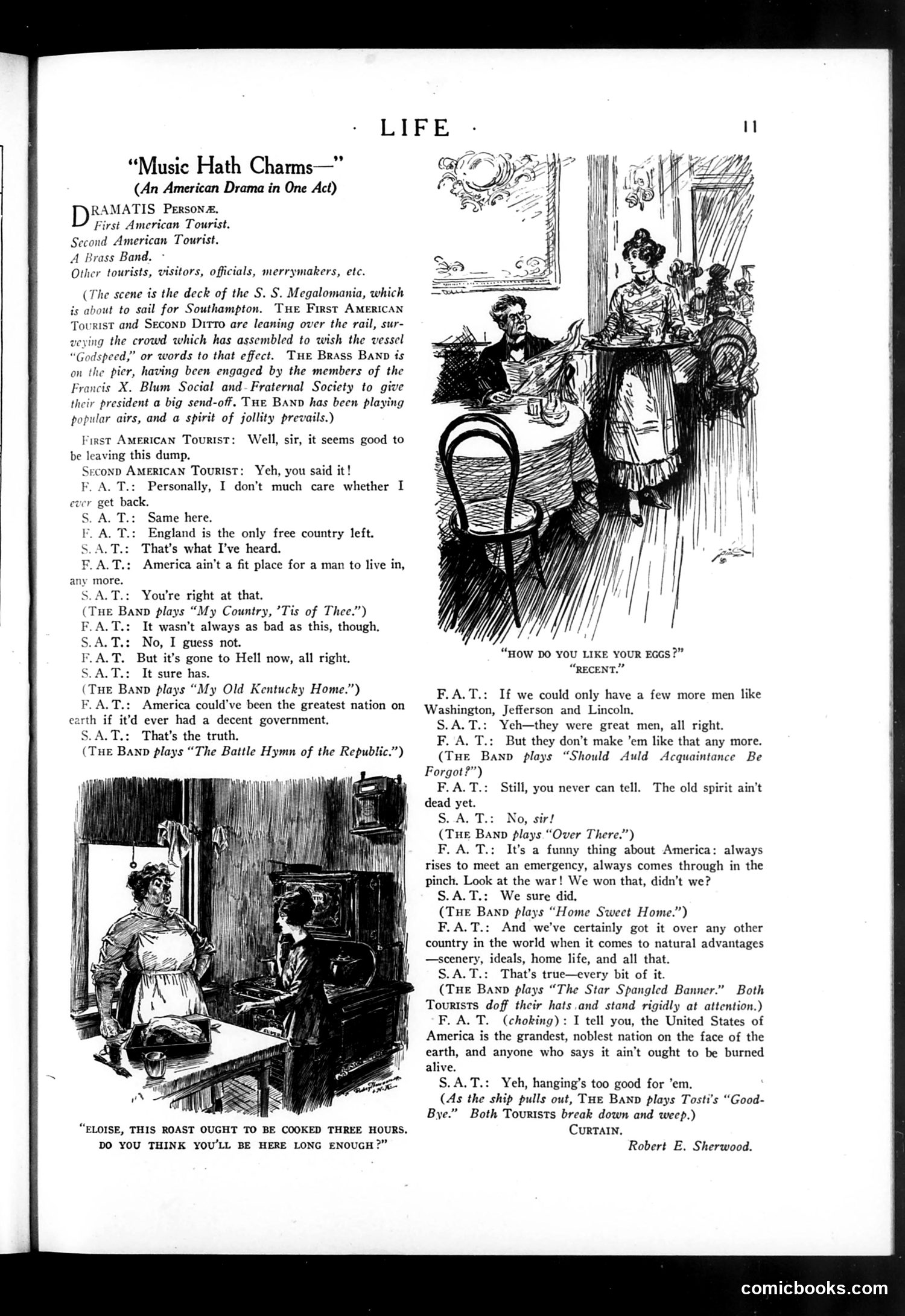
This is a satirical one-act drama set on a ship's deck before departure. Two American tourists debate whether America remains great, with a brass band playing patriotic songs in the background. The satire targets American jingoism and nostalgia. The "First American Tourist" expresses pessimism about America's future, claiming "England is the only free country left" and "America ain't fit place for a man to live in anymore." The "Second American Tourist" counters with nationalist fervor, invoking Washington and Lincoln, praising American exceptionalism despite hardships. The illustrations show tourists conversing while crew prepares the ship. The play mocks both blind nationalism and defeatist pessimism—suggesting Americans flip between extremes of self-congratulation and self-doubt, often triggered merely by patriotic music.
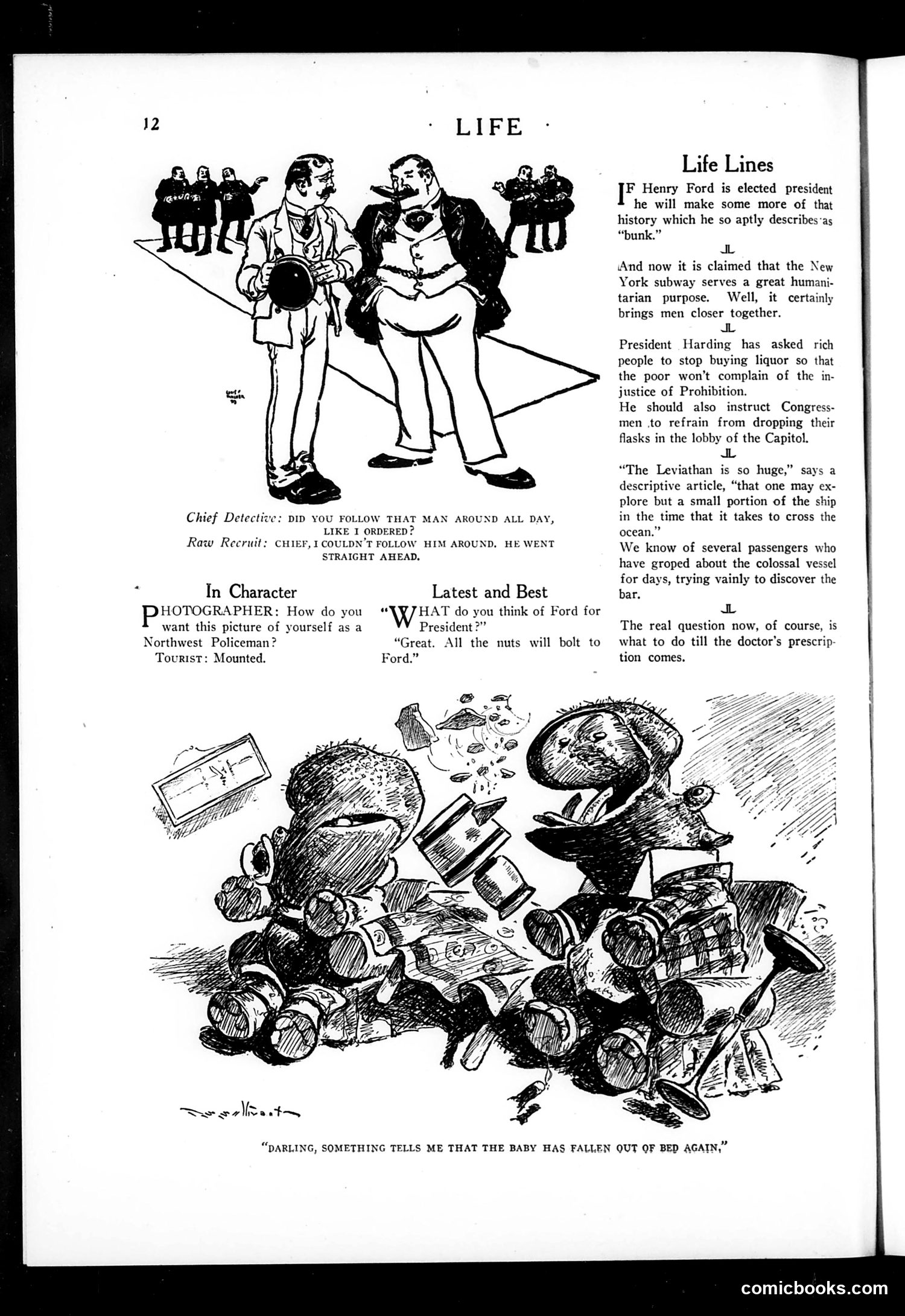
The top cartoon mocks police detective work, showing a chief detective unable to follow a suspect ("he went straight ahead"), while a raw recruit easily succeeds—satirizing institutional incompetence. The "Life Lines" column references Henry Ford's potential presidential election, joking he'd add to his reputation for describing things as "bunk." It also comments on President Harding's Prohibition enforcement request to wealthy citizens and Congress members. The bottom cartoon depicts a messy household scene with scattered bottles and baby items, captioned about a baby falling from bed. This appears to satirize domestic chaos, possibly commenting on American home life or family disorder—though the specific social reference remains unclear without additional historical context about contemporary domestic debates.
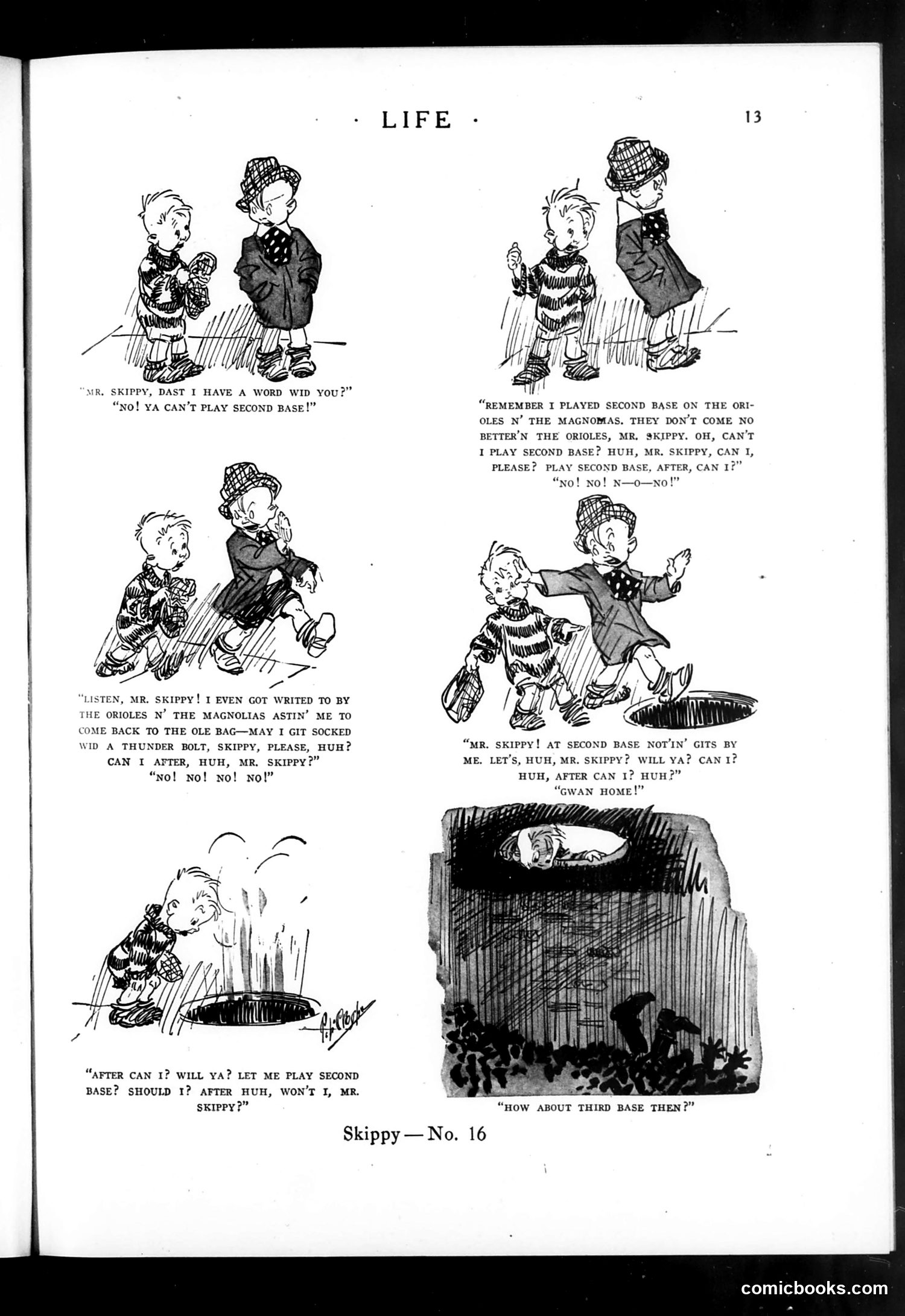
This is a comic strip titled "Skippy — No. 16" featuring a young boy named Skippy persistently pestering an adult (Mr. Skippy) about playing second base in baseball. **The joke:** Skippy repeatedly asks to play second base, receiving constant refusals. Each time he's told "no," he finds a new angle to convince Mr. Skippy, citing his credentials (a letter from the Orioles' magnates, past experience). The humor derives from the child's relentless, creative negotiation tactics and Mr. Skippy's escalating exasperation. **The satire:** This appears to be gentle satire about childhood persistence, adult authority, and baseball culture. The final panel shows Skippy finally pushed into a mud puddle—comedic consequences for his tireless pestering. The strip reflects early 20th-century American childhood experiences and baseball's prominence in popular culture.
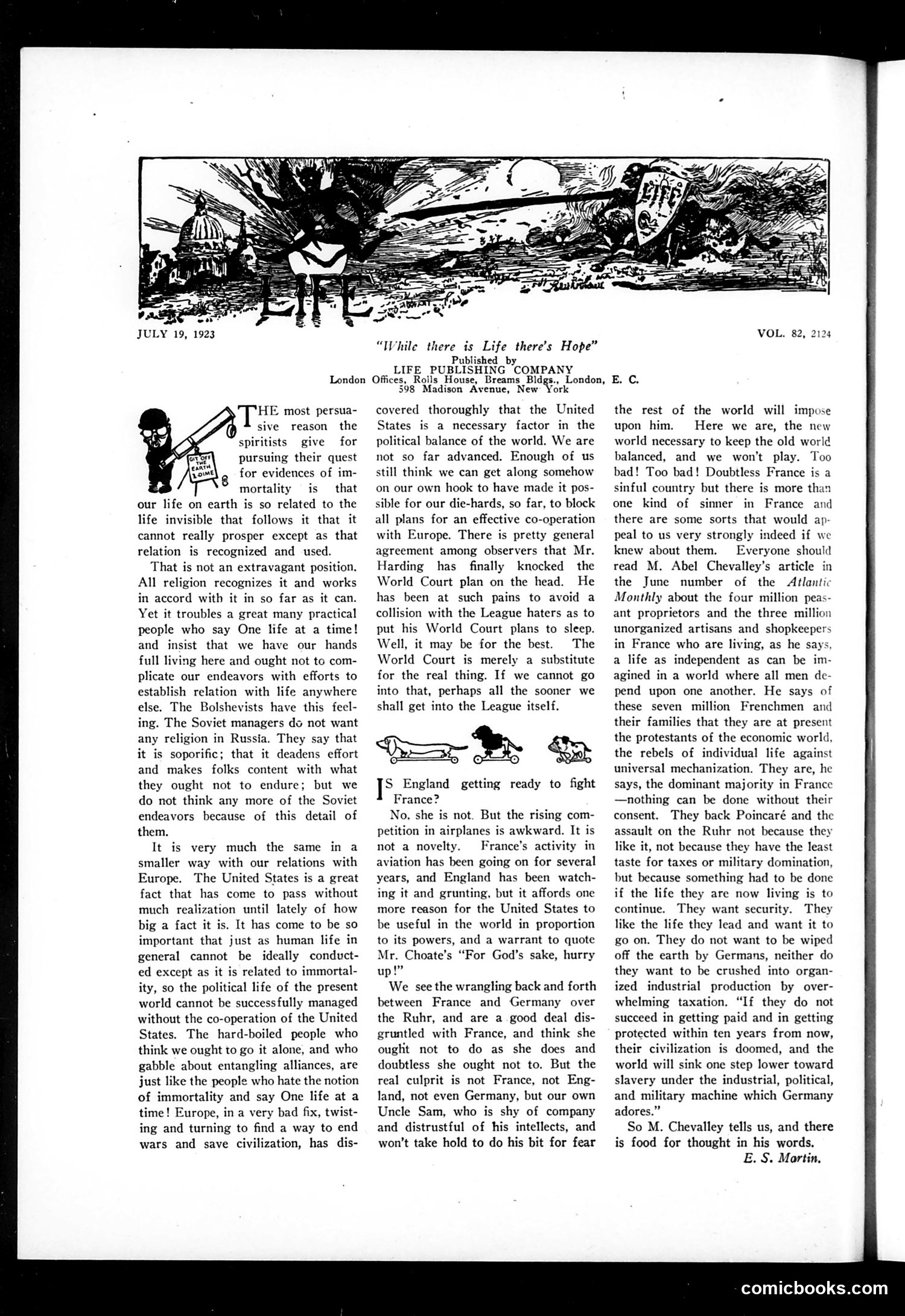
The page features a philosophical editorial titled "While there is Life there's Hope," arguing that American cooperation is essential for world political balance. The small cartoon at top shows a figure with a megaphone addressing a chaotic European landscape, symbolizing America's role as an outside observer of European conflicts. The text discusses ongoing tensions between France and Germany over the Ruhr region, references England's military preparedness, and criticizes what appears to be isolationist American attitudes. The author (E.S. Martin) argues the U.S. cannot remain detached from European instability, and that American involvement is necessary for lasting peace—a debate central to 1920s American foreign policy following World War I.
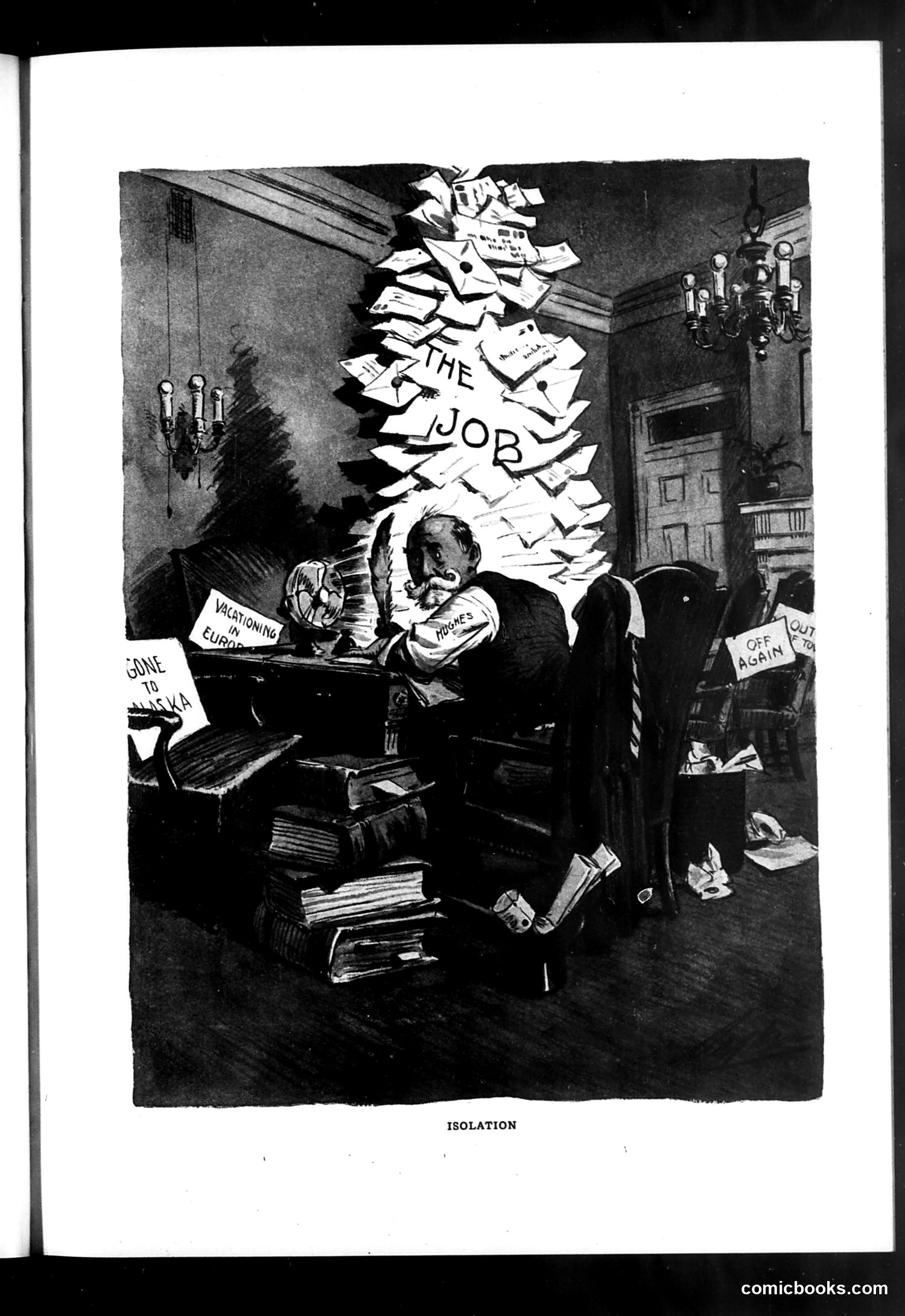
This cartoon critiques American isolationism, likely from the interwar or early WWII period. A figure (appears to be a U.S. politician or the nation itself) sits at a desk buried under an avalanche of papers labeled "THE JOB"—representing mounting national and international problems demanding attention. Visible signs reference specific concerns: "VACATIONING EUROPE," "GONE TO ALASKA," "TROUBLES," and "OUT AGAIN" suggest responsibilities being ignored or postponed. The overwhelming pile of paperwork symbolizes consequences of withdrawal from world affairs. The satire argues that isolationism creates more problems rather than solving them—you cannot escape mounting crises simply by refusing engagement. The cartoon mocks the futility of avoidance as a policy approach.
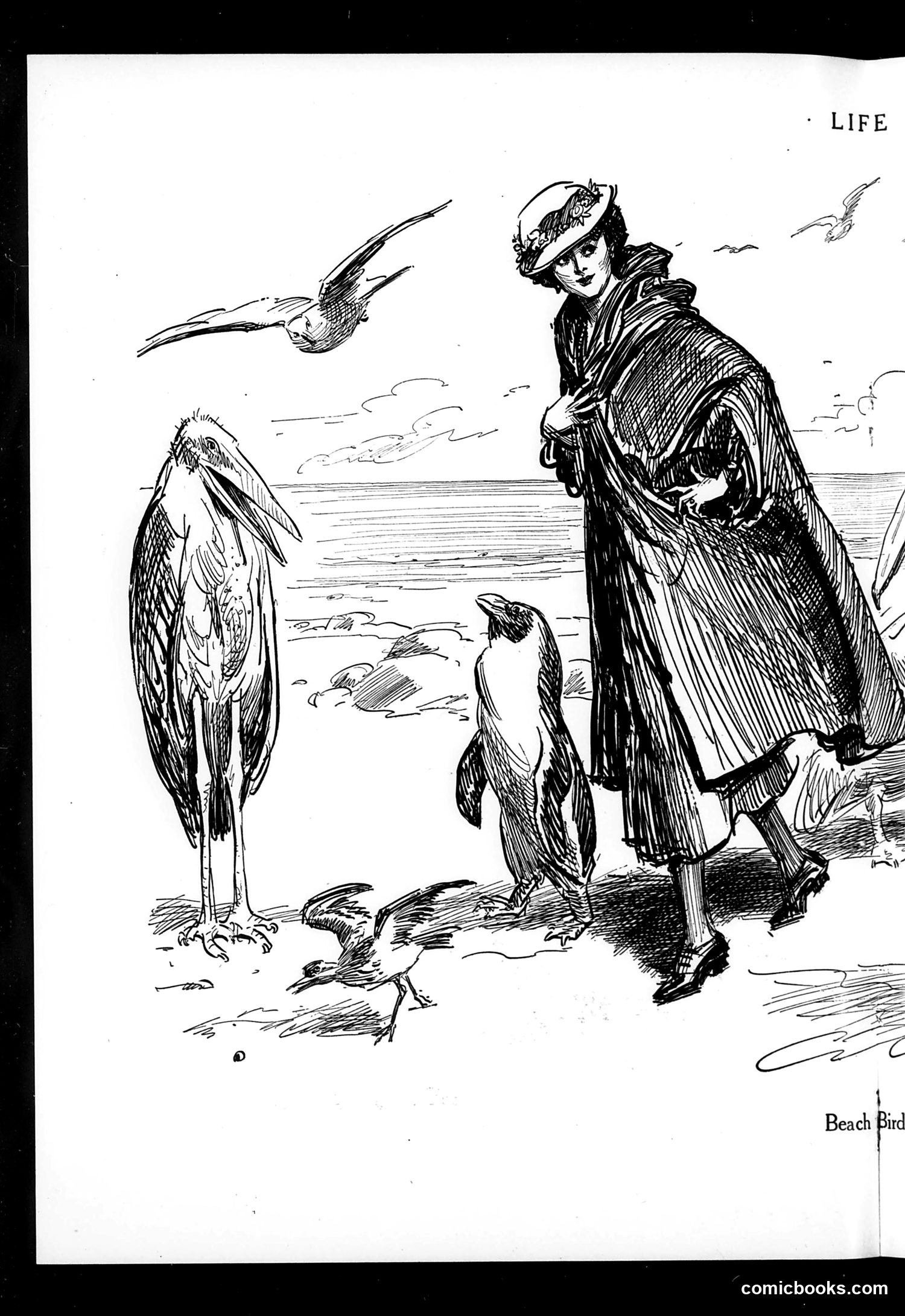
This appears to be a humorous illustration from *Life* magazine titled "Beach Bird." It depicts a well-dressed woman in a fashionable coat and hat standing on a beach, observing various seabirds—including a tall wading bird (possibly a heron or crane) on the left, a penguin in the center, and flying birds above. The joke likely plays on the double meaning of "bird"—a slang term for an attractive woman. The cartoon humorously presents actual birds as if the fashionable woman were observing members of her own "species" on the beach. It's a lighthearted visual pun typical of *Life*'s satirical humor, with no apparent political content—simply social satire about women, fashion, and casual beach encounters.
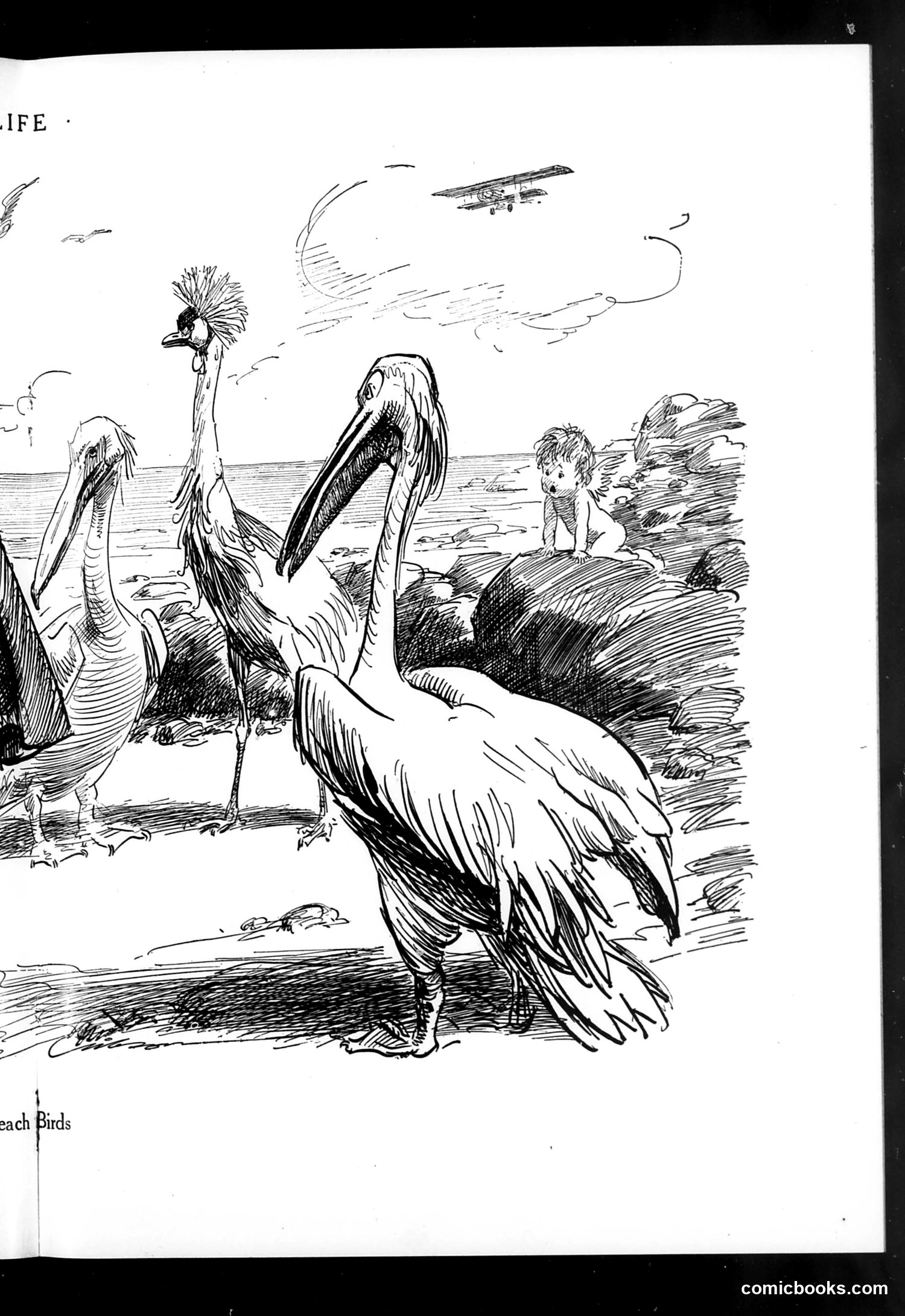
This satirical illustration depicts several large pelicans on a beach alongside a small human child. An airplane flies overhead, and a kite strings across the sky. The page heading reads "Beach Birds," suggesting this is likely humorous commentary on beach wildlife or vacation scenes. The satire appears to work through scale and juxtaposition—the oversized pelicans dwarf the human child, inverting the typical hierarchy where humans dominate nature. This could comment on human insignificance in nature, tourism's intrusion into wildlife habitats, or simply present an absurdist beach scenario for comedic effect. The detailed cross-hatching style is typical of early-to-mid 20th century magazine illustration. Without additional context or visible artist attribution, the specific satirical target remains unclear.
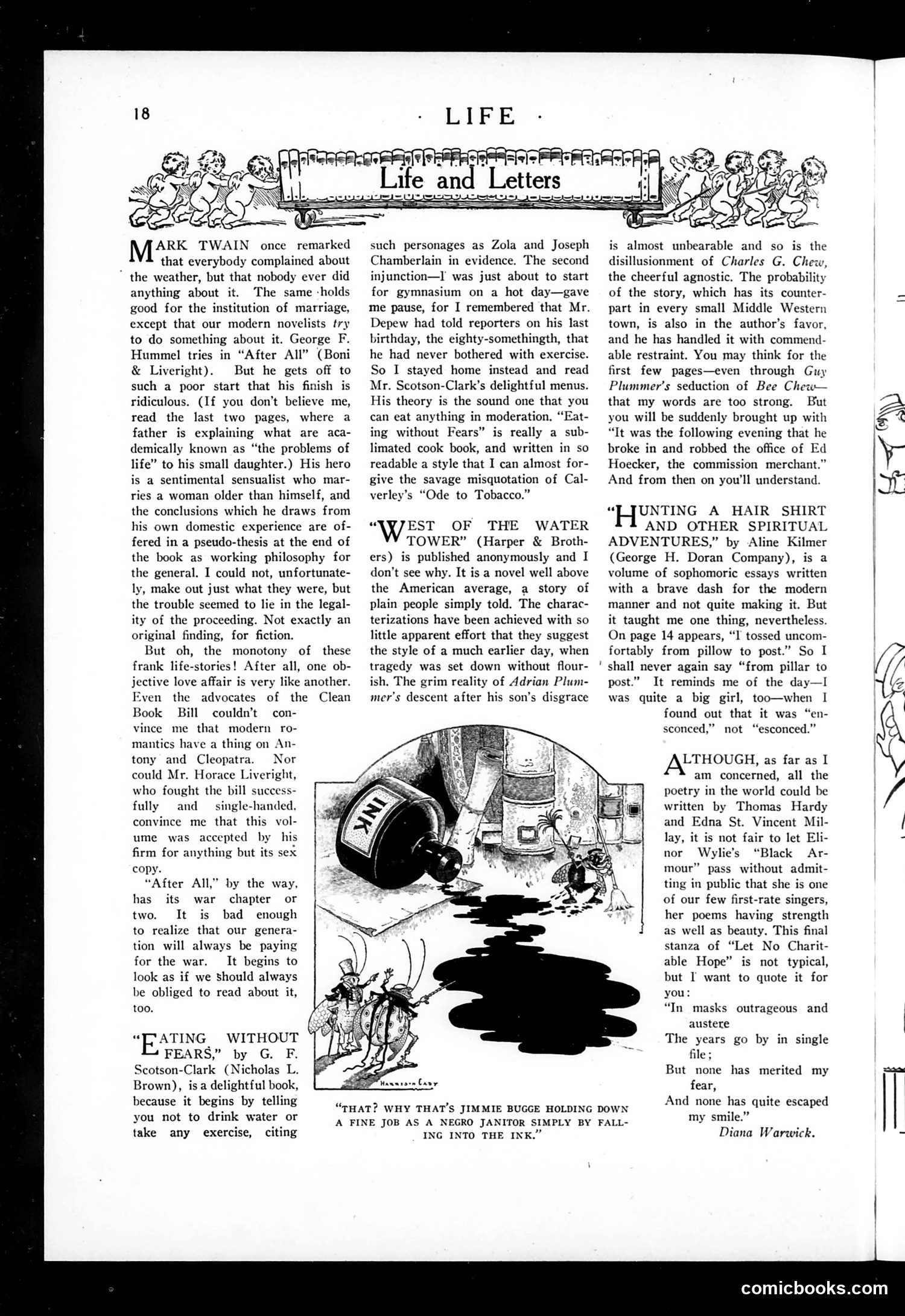
This is a **book review column** from *Life* magazine, not primarily political satire. The page discusses several contemporary novels, including critiques of "After All" by George F. Hummel (criticized for melodramatic "problems of life" discussions) and "Eating Without Fears" by G.F. Scotson-Clark. The **cartoon** illustrates a joke about employment: it shows an ink bottle spilled, with the caption explaining that "Jimmie Bugge" got hired as a janitor by literally falling into ink—implying he's now dark-skinned enough for the job. This reflects the **racist hiring practices of the era**, where Black workers were relegated to menial positions. The "joke" relies on crude racial stereotyping typical of 1920s-era *Life* magazine humor. The page demonstrates both genuine literary criticism alongside casual racism normalized in period publications.
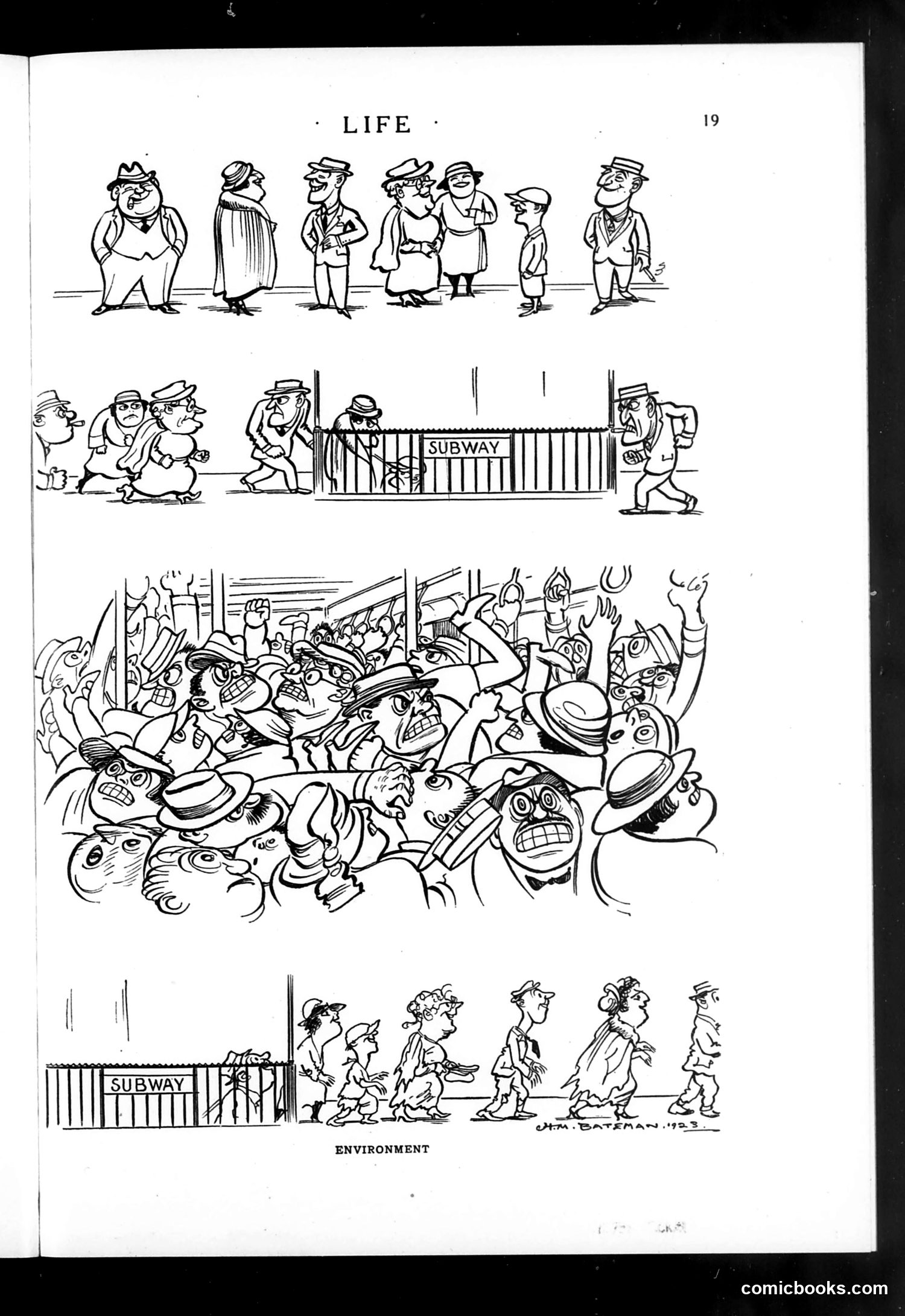
This Life magazine cartoon uses exaggeration to mock overpopulation in early 20th-century cities. The top panel shows a diverse cross-section of urban society—working-class and middle-class New Yorkers. The middle panel depicts a chaotic subway car packed with angry, aggressive commuters, their faces contorted in rage and frustration. The bottom panel, titled "ENVIRONMENT," shows the same group of people now appearing diminished and defeated as they exit the subway. The satire's point: urban mass transit transforms ordinary citizens into aggressive, dehumanized versions of themselves. The "environment" of crowded subway conditions corrupts character. This reflects contemporary anxiety about industrialization, immigration, and rapid urban growth reshaping American society and individual behavior.
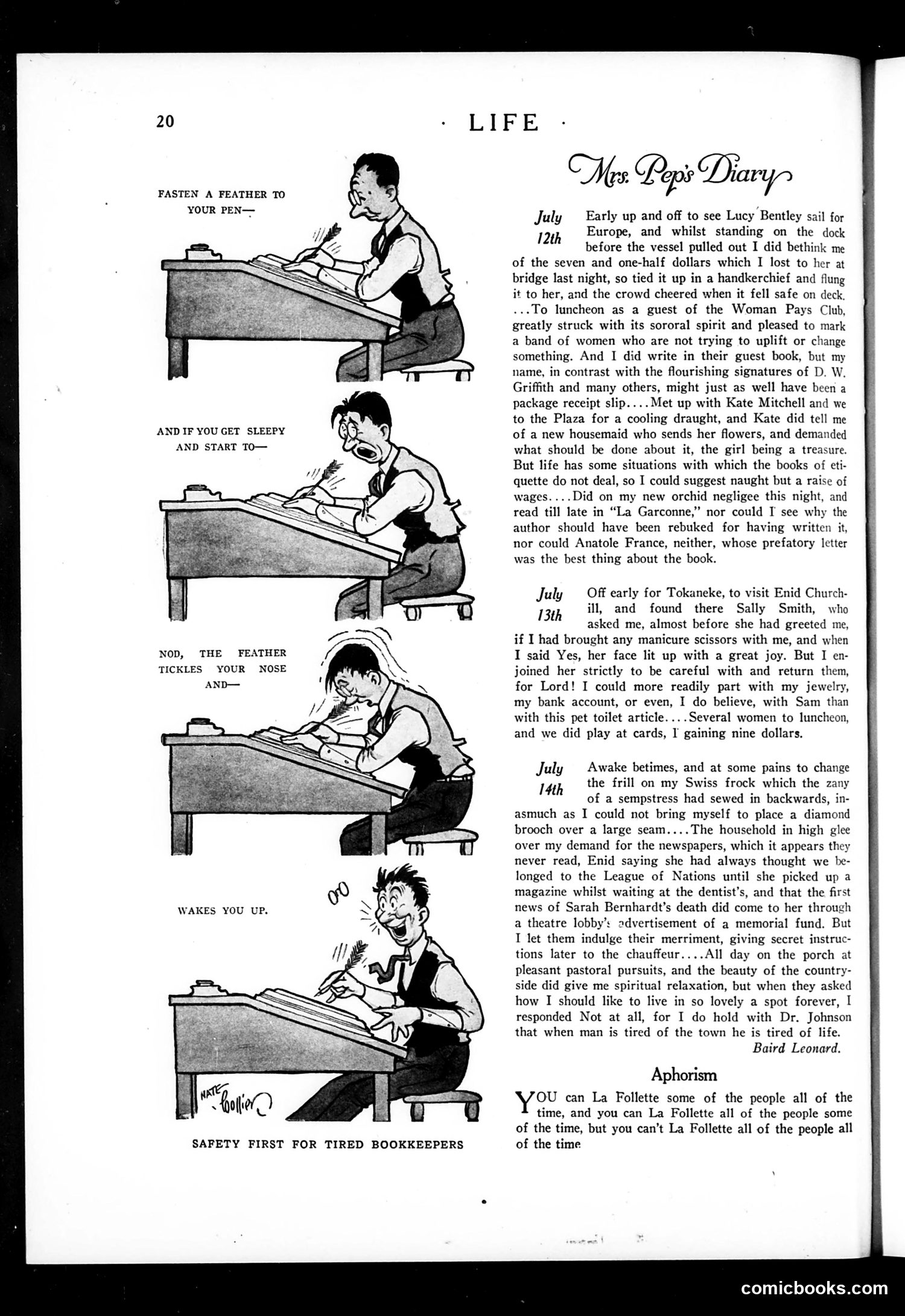
**Left Side - Cartoon:** A humorous "safety tip" for tired bookkeepers: fastening a feather to one's pen so that if the writer nods off while working, the feather tickles their nose and wakes them up. This is practical office humor about the tedium of bookkeeping work. **Right Side - "Mrs. Pepsi's Diary":** A satirical society column (July 12-14) documenting the frivolous activities of an upper-class woman. References include: D.W. Griffith (famous film director), *La Garconne* (a controversial French novel), Anatole France (French author), Sarah Bernhardt (famous actress), and the League of Nations. The diary mocks wealthy women's shallow concerns—manicure scissors, negligees, card games, and indifference to world events—while name-dropping cultural figures. **Bottom - "Aphorism":** A political joke replacing "fool" with "La Follette" (likely Senator Robert La Follette, a progressive politician), suggesting he appeals to different people at different times but never achieves universal support.
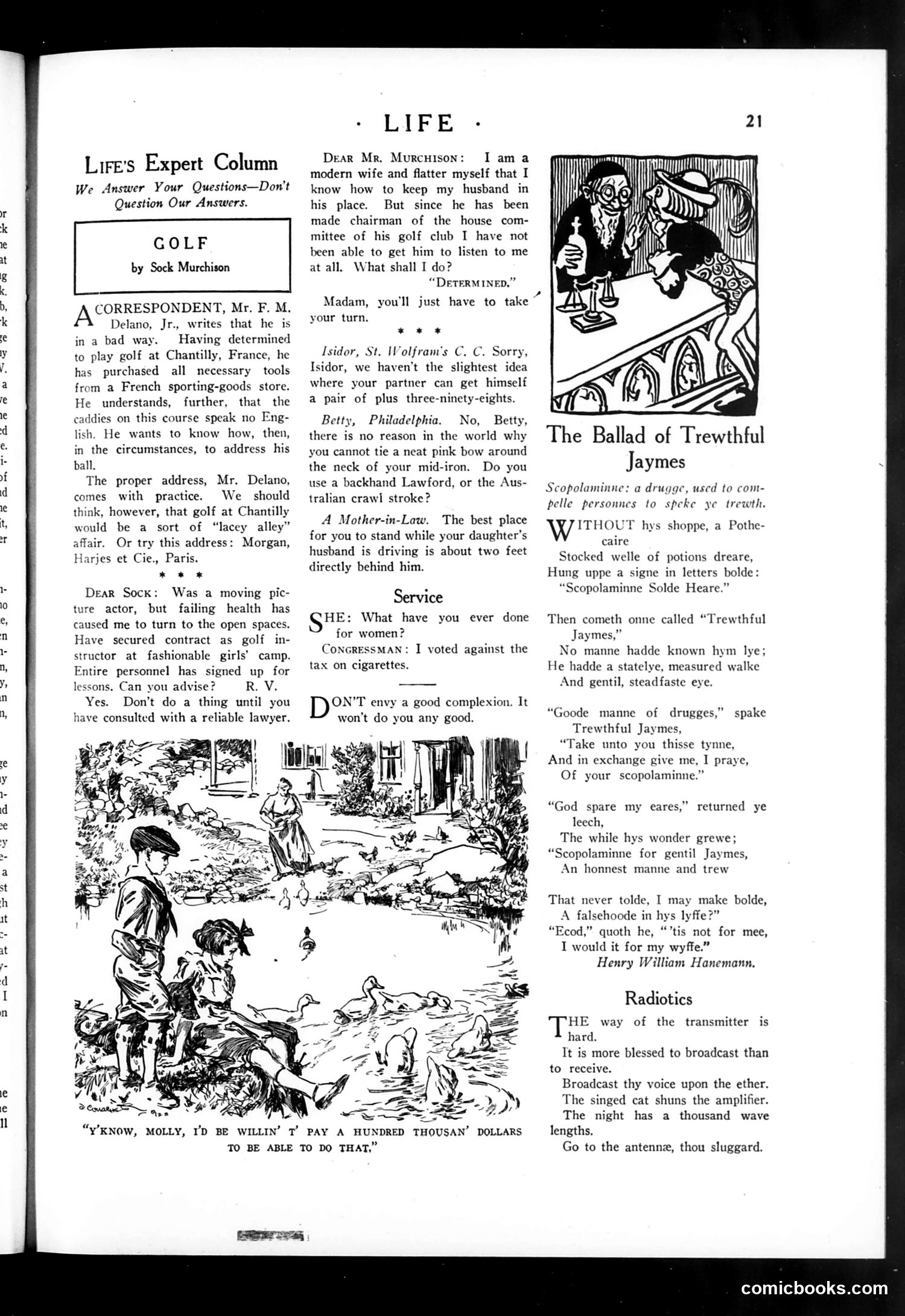
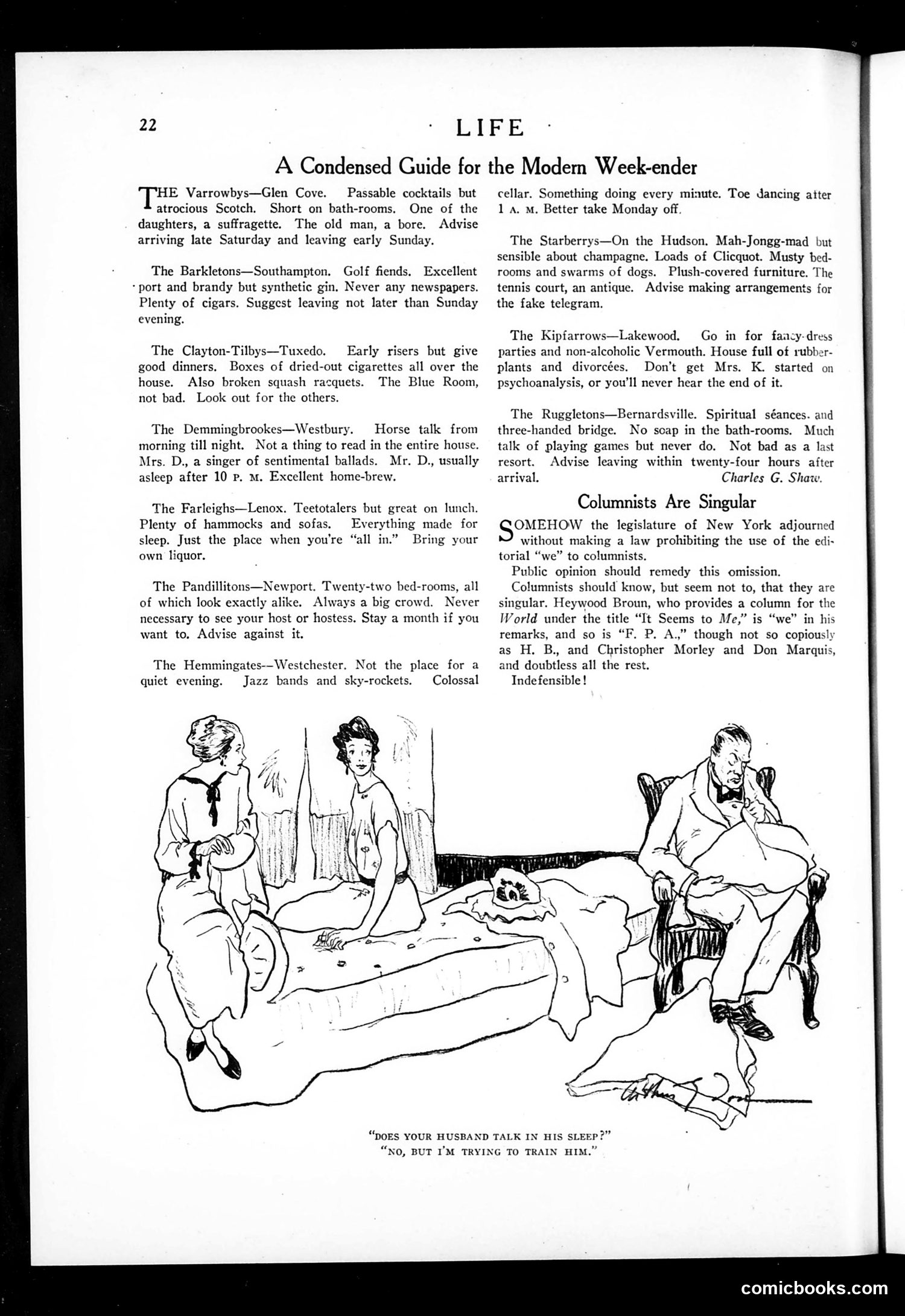
This page contains two distinct pieces of satirical content targeting upper-class American leisure culture (circa 1920s). **"A Condensed Guide for the Modern Week-ender":** A humorous directory mocking wealthy families' country estates, rating them as weekend destinations. Each entry catalogs the host family's flaws—boring conversation, poor liquor, sleeping habits, or eccentric interests (mah-jongg, spiritualism, psychoanalysis). The satire targets both the pretensions of the social elite and the exhausting obligation to visit these homes. The final entry suggests arranging a fake telegram to escape a particularly tedious household. **"Columnists Are Singular":** A brief editorial complaint about newspaper columnists (specifically naming Heywood Broun and F.P.A.) who use the royal "we" instead of "I" when writing personal opinion columns. The writer argues this grammatical affectation is indefensible and should be prohibited by law. **The cartoon** depicts a married couple in bed; the wife explains she's "training" her husband to talk in his sleep—likely satirizing domestic management and marital dynamics of the era.
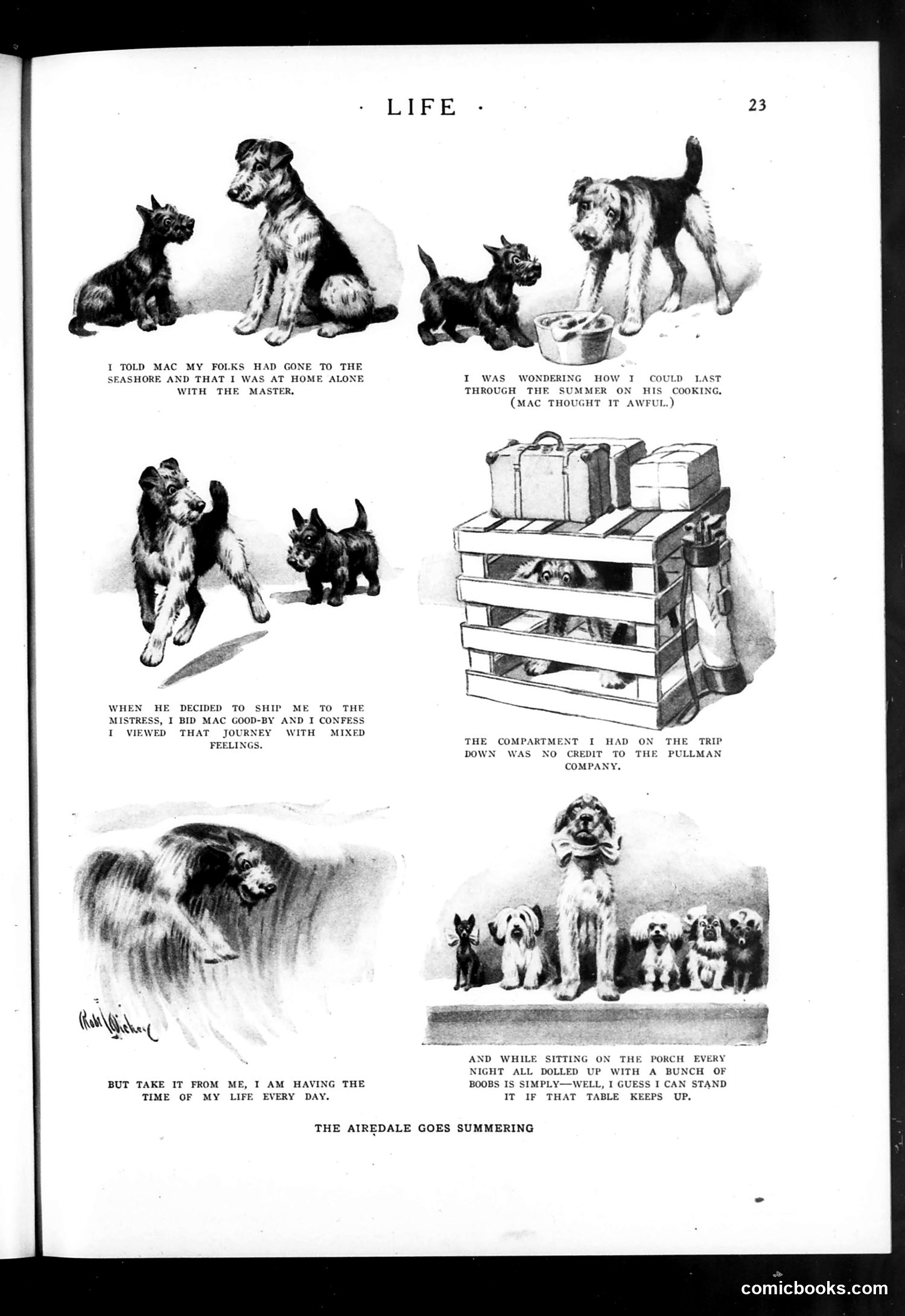
This is a humorous illustrated narrative about a dog's summer experience, told from the dog's perspective. The Airedale (a terrier breed) recounts being separated from his master when the family goes to the seashore, then shipped to stay with the mistress instead. The joke centers on the dog's complaints about his accommodations—a shabby train compartment—contrasted with his claim to be "having the time of my life." The final panel reveals the punchline: he's surrounded by attractive female dogs on the porch, though he jokes about needing the table to support his weight. This is straightforward sentimental humor about a dog's romantic summer, using anthropomorphization (the dog narrating his feelings and social observations) typical of early 20th-century Life magazine's dog-themed humor. There are no apparent political references—it's simply a lighthearted story about canine summer adventures and romance.
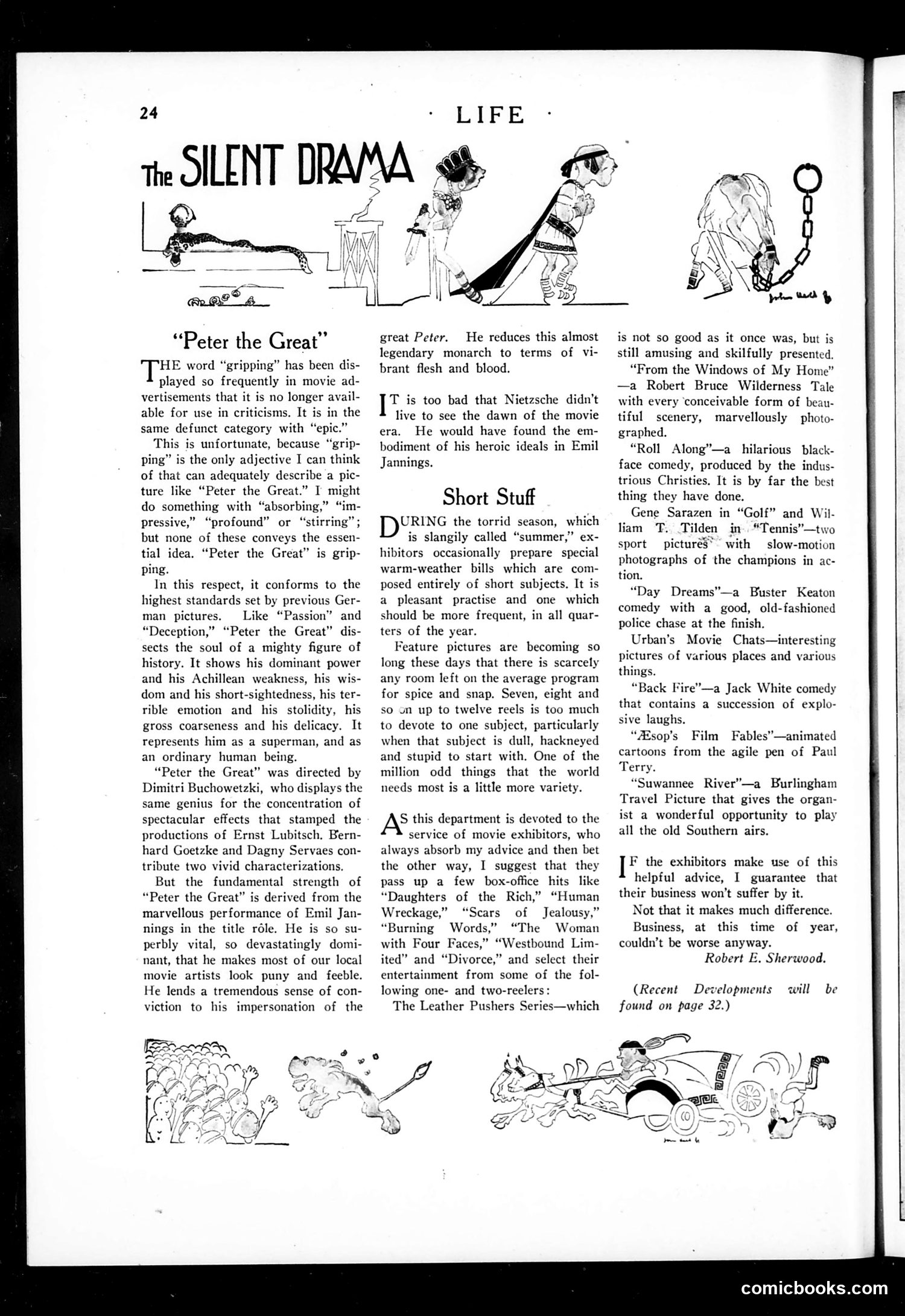
This page reviews "Peter the Great," a German-directed silent film starring Emil Jannings in the title role. The critic praises Jannings's performance as powerfully vital, comparing him to Nietzsche's concept of the superman—a "mighty figure of history" embodying both dominance and human vulnerability. The "Short Stuff" section critiques the film industry's tendency toward overly long feature films (7-12 reels), arguing for more variety through short subjects. The critic sarcastically notes that exhibitors ignore his advice while recommending specific shorts: sports footage of golfer Gene Sarazen and tennis champion William T. Tilden, Buster Keaton comedies, and various travelogues. The cartoons at top illustrate silent film's physical comedy and exaggerated acting style typical of the era.
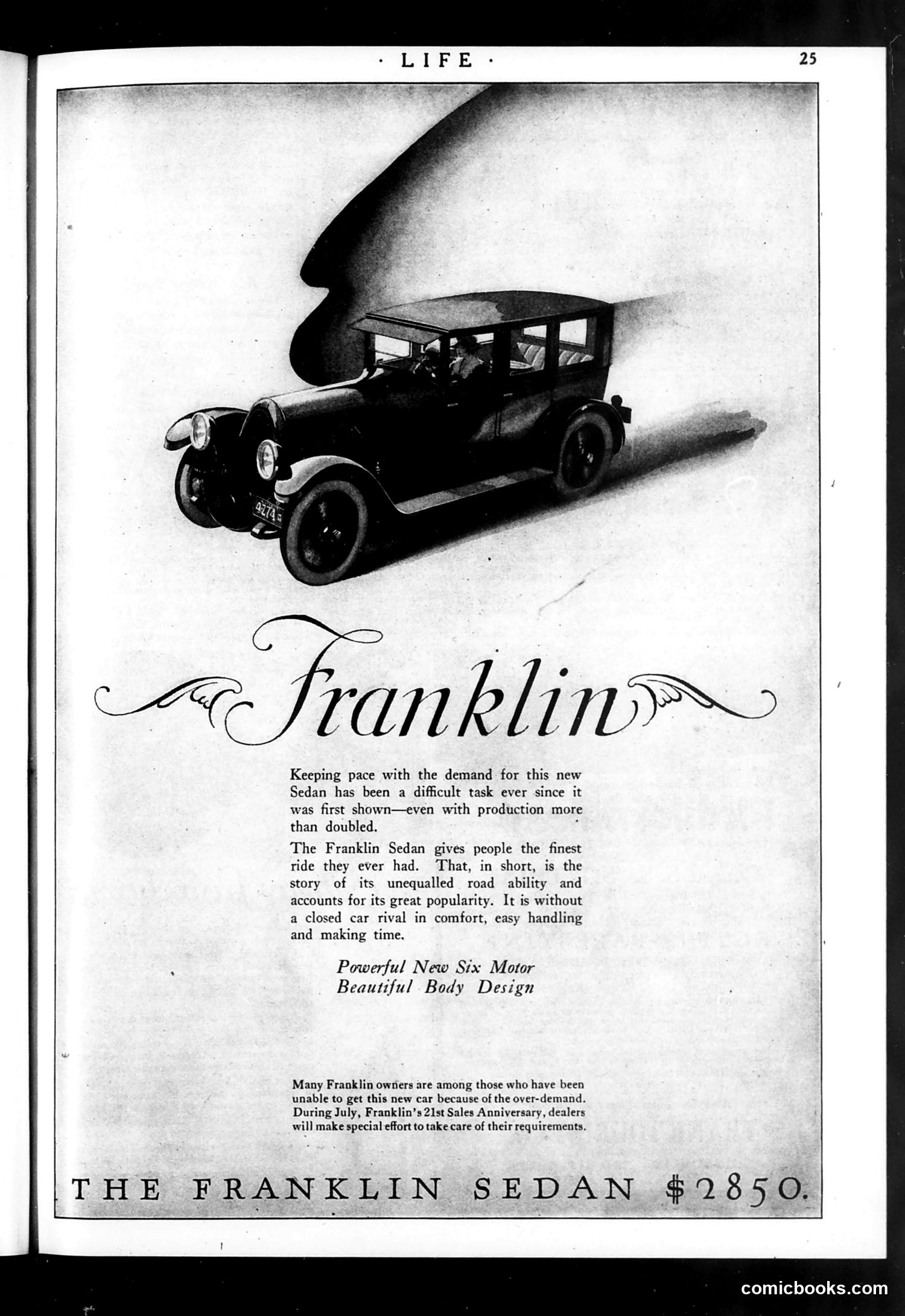
This is a **full-page automobile advertisement**, not political satire. It promotes the Franklin Sedan, priced at $2,850, emphasizing its "Powerful New Six Motor" and "Beautiful Body Design." The ad addresses a real commercial problem: extreme demand exceeding supply. The text notes that even with doubled production, the company struggles to meet customer demand. This was typical during the 1920s automotive boom, when cars were luxury goods and certain models became status symbols. The dramatic illustration—showing the car's shadow looming large—visually communicates the car's impressive presence and desirability. The mention of Franklin's "21st Sales Anniversary" in July suggests this ad ran during a promotional campaign. For modern readers: this reflects an era when owning a specific car model was genuinely difficult due to production constraints and high demand—a condition reversed in today's buyer's market.
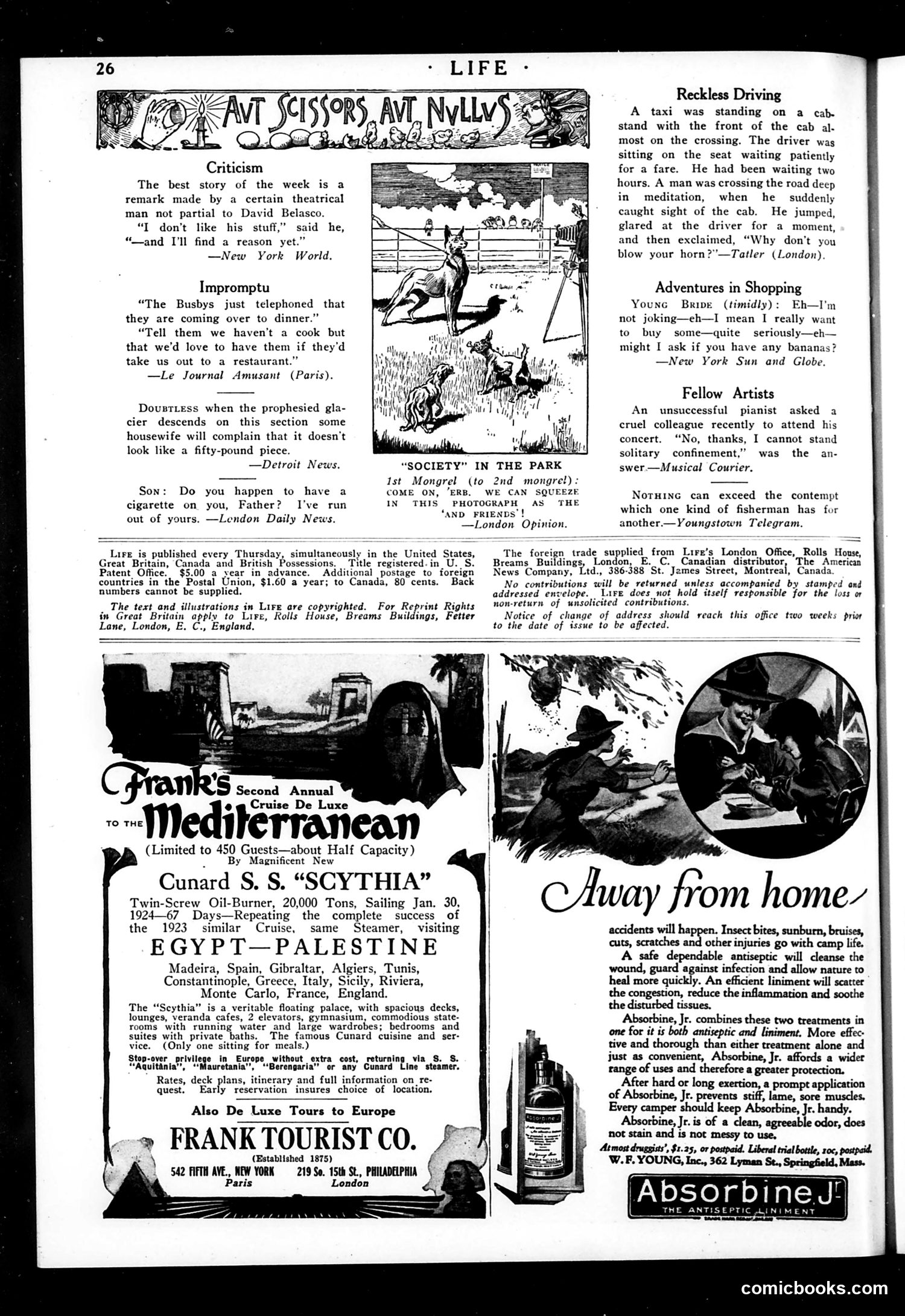
This page contains brief satirical humor pieces and advertisements, not political cartoons. The content reflects early 1920s social observations: **"Reckless Driving"** mocks a distracted pedestrian who, deep in thought while crossing, suddenly spots a taxi and angrily blames the driver for nearly hitting him—despite the driver's two-hour patient wait. **"Fellow Artists"** jokes about a pianist's unsuccessful concert invitation, with the colleague refusing to attend "solitary confinement"—a dig at small, poorly-attended performances. **"Adventures in Shopping"** depicts an awkwardly shy customer struggling to ask a shopkeeper for bananas, suggesting social anxiety in commercial transactions. The page is primarily advertising-heavy, featuring cruises and antiseptic liniment products typical of the era. The humor reflects genteel, urbane observations about modern urban life, traffic etiquette, professional jealousy, and consumer culture—concerns recognizable to contemporary middle-class readers.
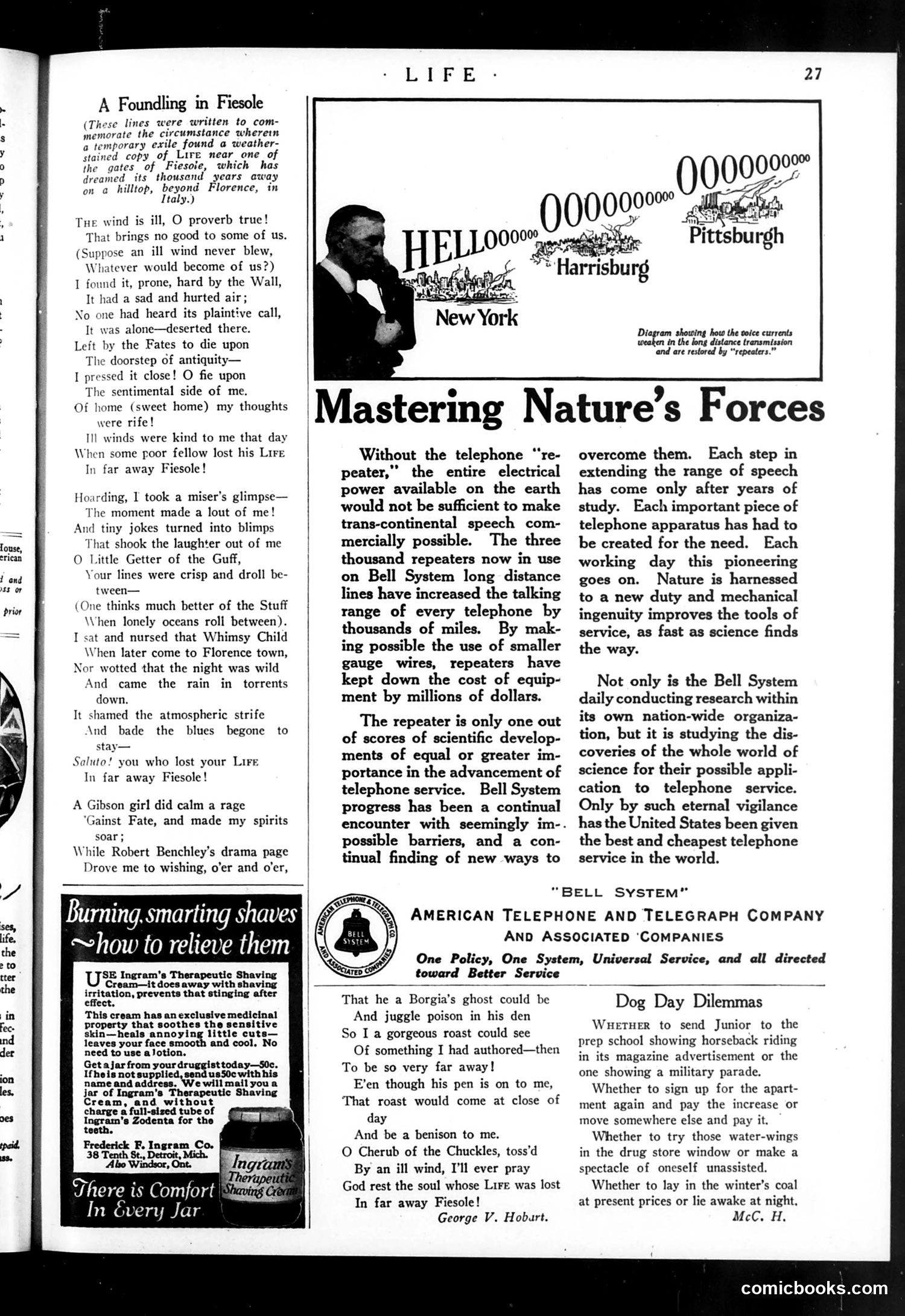
This page contains two distinct elements: **Left side:** A sentimental poem titled "A Foundling in Fiesole" about finding an abandoned copy of *Life* magazine in the Italian town of Fiesole. The poet humorously reflects on how this lost magazine brought him comfort during travels—a self-referential joke celebrating the magazine itself. **Right side:** A Bell Telephone System advertisement claiming that telephone "repeaters" (signal amplification devices) are essential scientific innovations enabling long-distance calls. The advertisement features a diagram showing voice transmission between Pittsburgh, Harrisburg, and New York, illustrating how signal strength degrades and is restored. **The satire/context:** This represents early-20th-century corporate advertising in a satirical magazine—*Life* was selling advertising space while simultaneously poking fun at commercial culture. The juxtaposition of sentimental poetry about the magazine with corporate propaganda is itself somewhat ironic, though the Bell ad appears presented straightforwardly rather than as satire. The bottom contains unrelated ads for shaving cream and other products typical of period magazine pages.
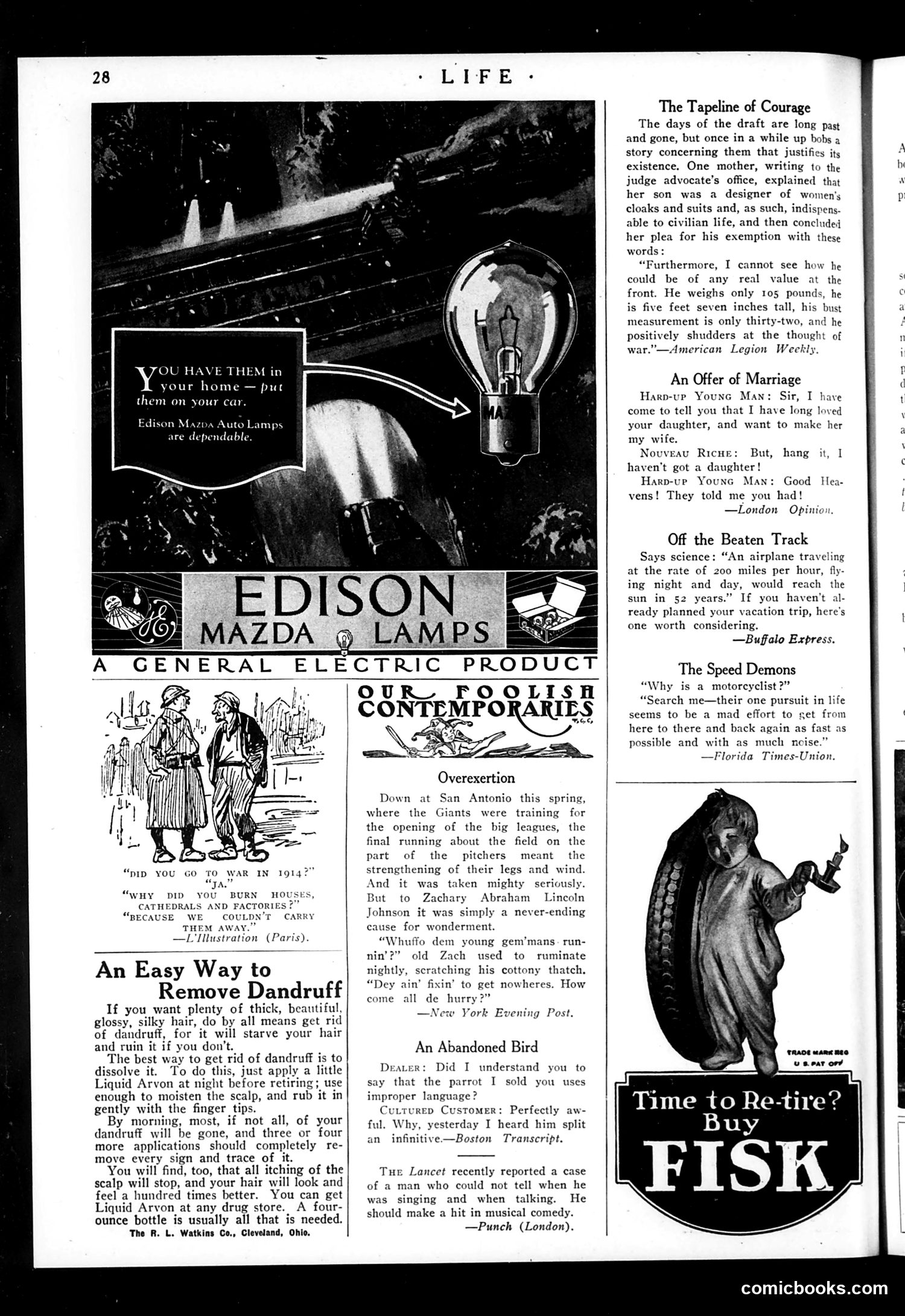
This page from *Life* magazine contains **humorous anecdotes and advertisements** rather than political cartoons. The content reflects early 20th-century American humor: The **Paris cartoon** references **WWI**, quoting a German soldier explaining wartime destruction—dark satire on military brutality. **"Our Foolish Contemporaries"** section mocks everyday absurdities: a baseball player's confusion about training drills; a parrot owner's complaint about "improper language" (the joke being the bird split an infinitive—grammatical pedantry). The **draft exemption letter** satirizes a mother's desperate plea to keep her frail son home, using measurements to prove his unfitness for service. Other brief jokes target motorcyclists' reckless speed, an aspiring suitor's embarrassment, and unrealistic scientific claims about space travel. The **advertisements** (Edison lamps, dandruff remedy, Fisk tires) represent typical contemporary product marketing. This reflects *Life*'s role as a general-interest humor magazine mixing commentary on current events with everyday comedic observations.
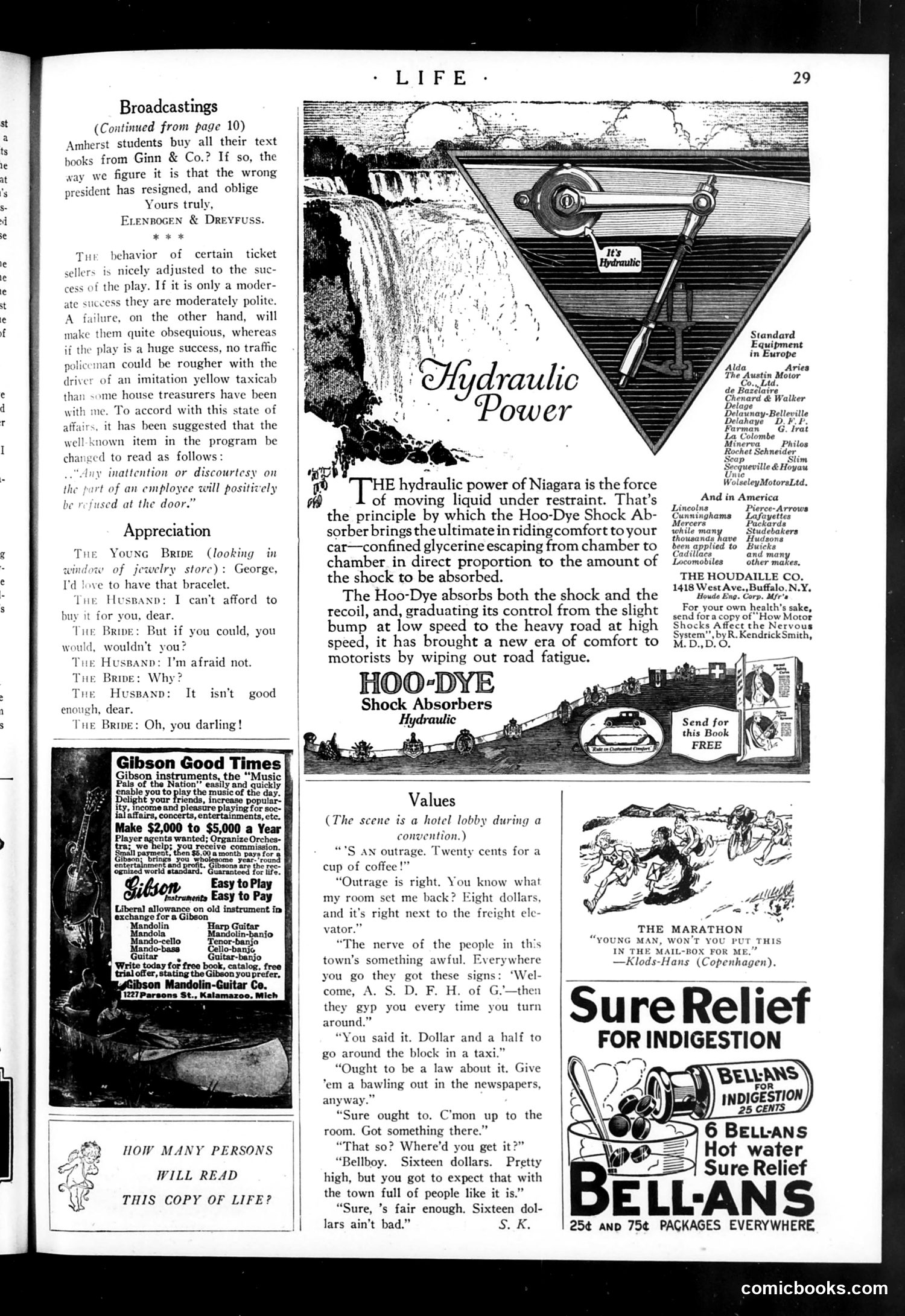
This page contains **multiple advertisements and brief satirical content**, not political cartooning. The main items are: 1. **"Broadcastings" section**: Reader letters complaining about textbook monopolies at Amherst College and rude theater staff behavior. 2. **"Appreciation" dialogue**: A Gibson Instruments ad disguised as a joke about a husband refusing to buy his wife jewelry because it's "not good enough." 3. **"Values" scene**: A satirical hotel-lobby conversation mocking convention-town price gouging. Guests complain about 20-cent coffee, $8 hotel rooms, $1.50 taxi rides, and $16 bootleg liquor—all inflated convention prices. The joke critiques both greedy local merchants and tourists' resigned acceptance of exploitation. 4. **Advertisements**: Hood-Dye shock absorbers, Gibson musical instruments, and Bellans indigestion remedy dominate the page. The "Values" dialogue is the page's only genuine satirical content, reflecting early 1920s convention-economy complaints.
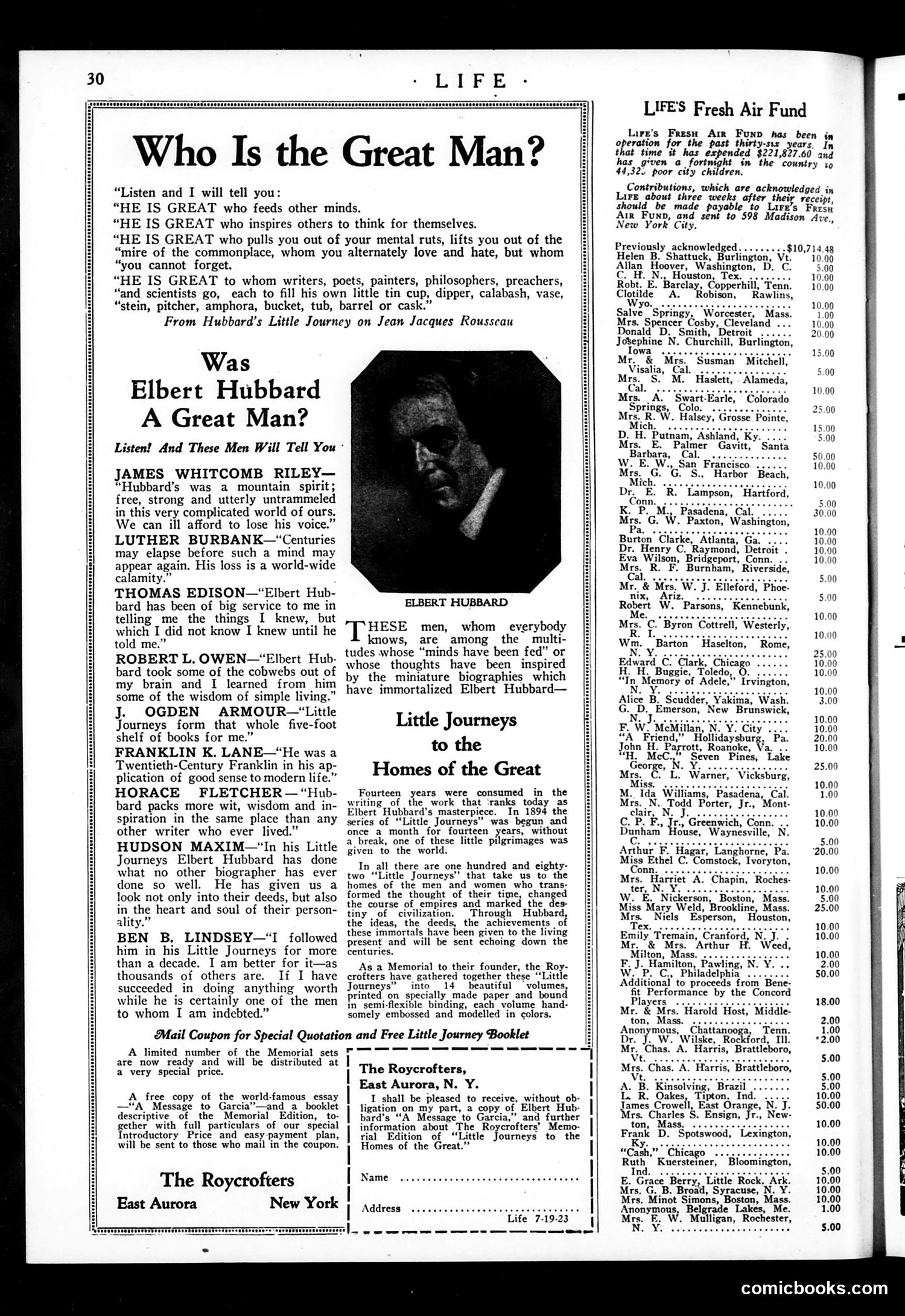
This page commemorates Elbert Hubbard, a prominent early 20th-century writer and publisher who founded the Roycroft movement. The portrait shows Hubbard himself. The page presents testimonials from famous contemporaries—Edison, Burbank, Riley, and others—praising Hubbard's intellectual influence through his "Little Journeys," a series of biographical essays about historical figures. The satire appears subtle but pointed: the page advertises Hubbard's *work* while asking whether *he* was great, using prominent figures' praise as marketing copy. For modern readers, this represents early celebrity endorsement advertising disguised as genuine tribute. The irony—asking "Was he great?" while showing testimonials answering "yes"—suggests the question itself is rhetorical salesmanship rather than genuine inquiry. The right column lists donations to "Life's Fresh Air Fund," mixing charitable work with commercial promotion, typical of Progressive Era self-promotion.
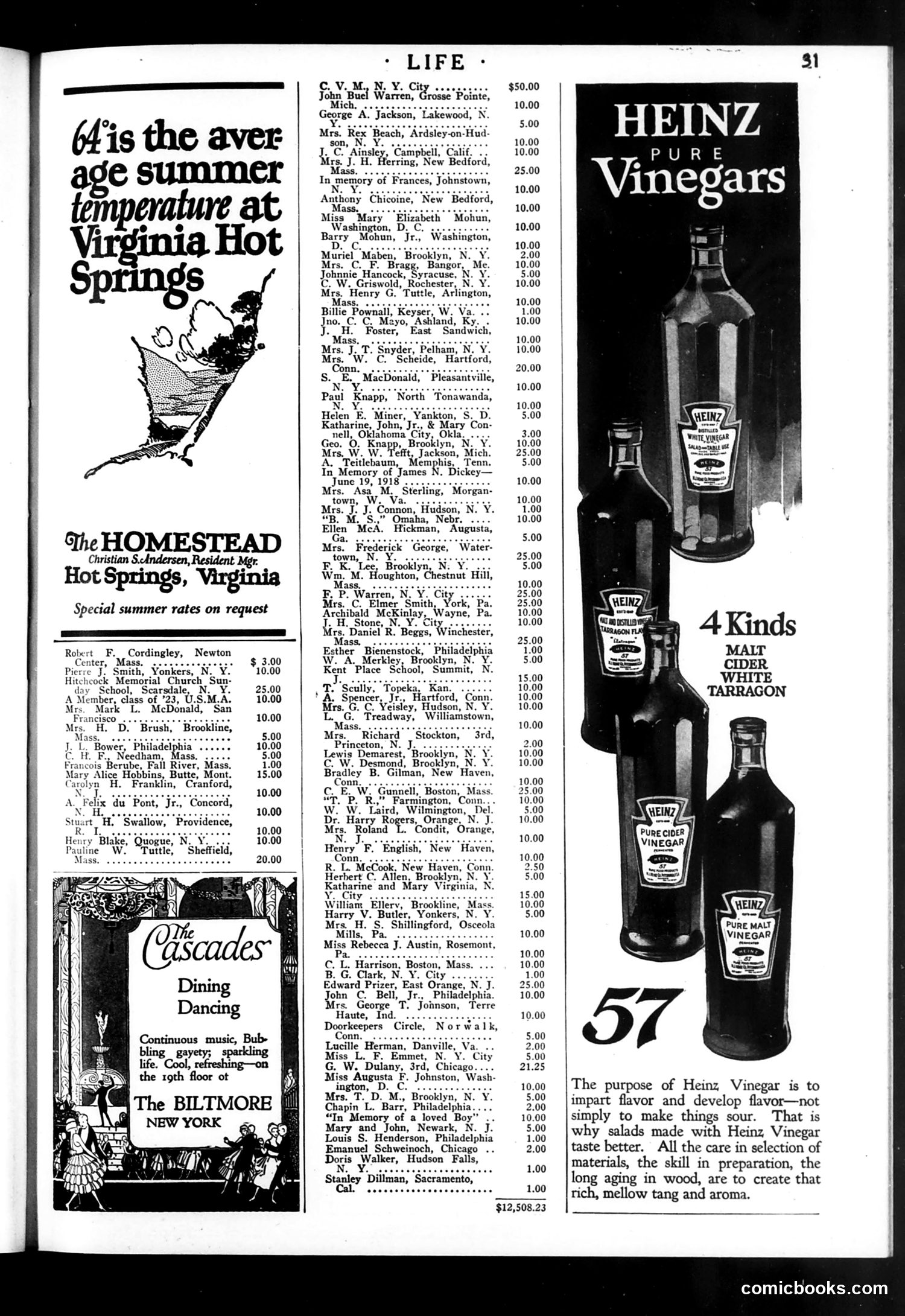
This page contains **no political cartoons or satire**—it's primarily a **donations/memorial page** and **advertising**. The left side lists monetary contributions to what appears to be a charitable cause or memorial fund (totaling $12,508.23), including a tribute to "James N. Dickey" dated June 19, 1918—likely a WWI memorial, given the date. The right side features a **Heinz Vinegar advertisement** showcasing four bottle varieties (Malt, Cider, White, Tarragon). The ad emphasizes vinegar's purpose as a flavor enhancer, not merely a souring agent, highlighting Heinz's manufacturing care. There's also a small advertisement for **The Homestead** in Hot Springs, Virginia, and **The Cascades** restaurant in New York (featuring dining and dancing). Modern readers should note: the memorial contributions suggest this reflects early 1920s patriotic remembrance, while the vinegar ad represents typical period kitchen product marketing emphasizing quality craftsmanship.
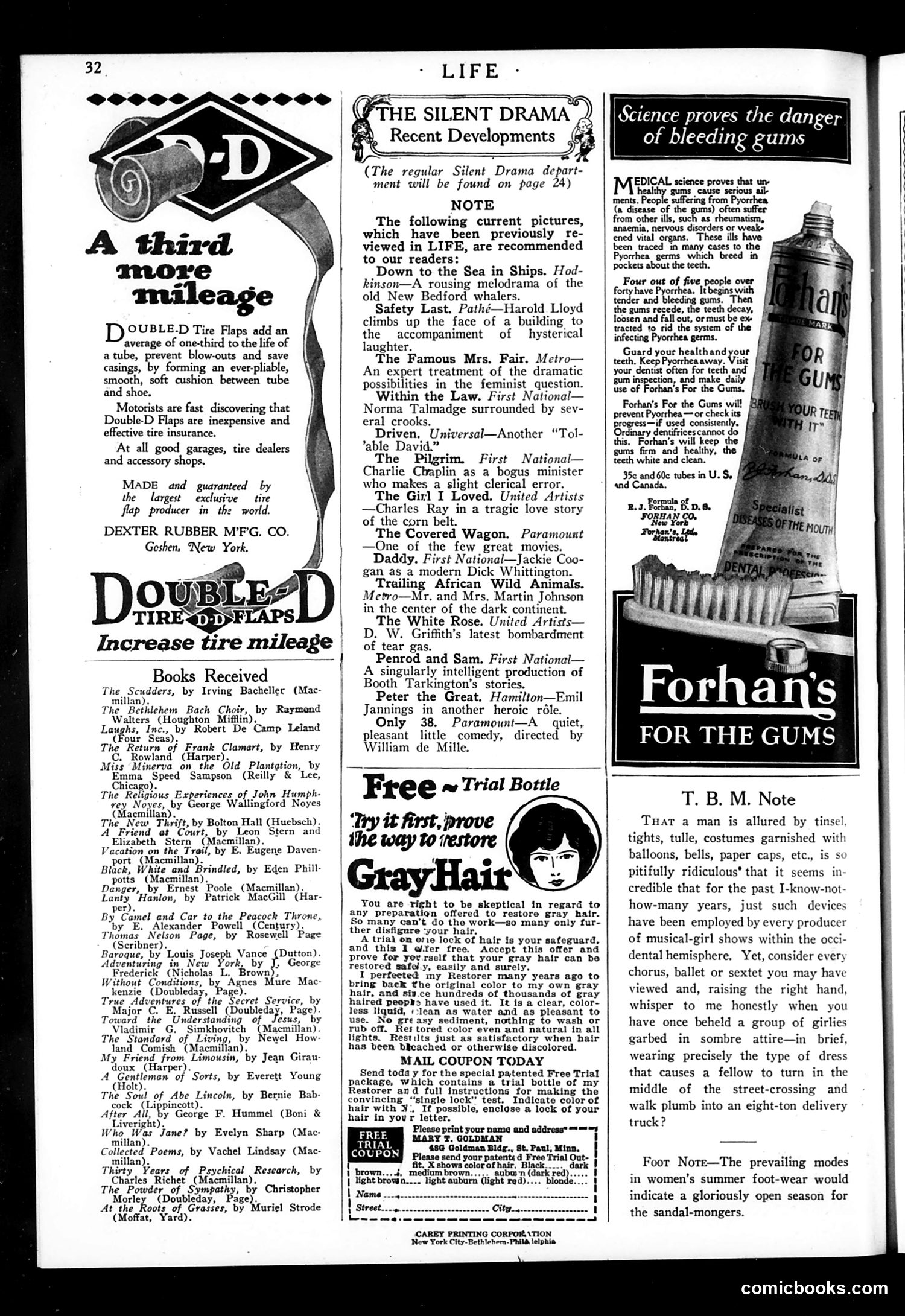
This page features a "Silent Drama" column recommending current motion pictures to readers. The content is straightforward film criticism rather than satire or cartoon commentary. The section lists approximately fifteen silent films with brief, often witty descriptions. Notable entries include Harold Lloyd's "Safety Last" (climbing a building), Charlie Chaplin's "The Pilgrim" (playing a bogus minister making "a slight clerical error"), and D.W. Griffith's "The White Rose" described sardonically as his "latest bombardment of tear gas"—a jab at Griffith's melodramatic emotional manipulation. The tone is gossipy and sometimes caustic toward filmmaking conventions. References to "another 'Tolable David'" and Jackie Coogan as "a modern Dick Whittington" assume reader familiarity with popular films and literary characters. This represents 1920s film criticism aimed at urbane magazine readers navigating the rapidly expanding silent film industry.
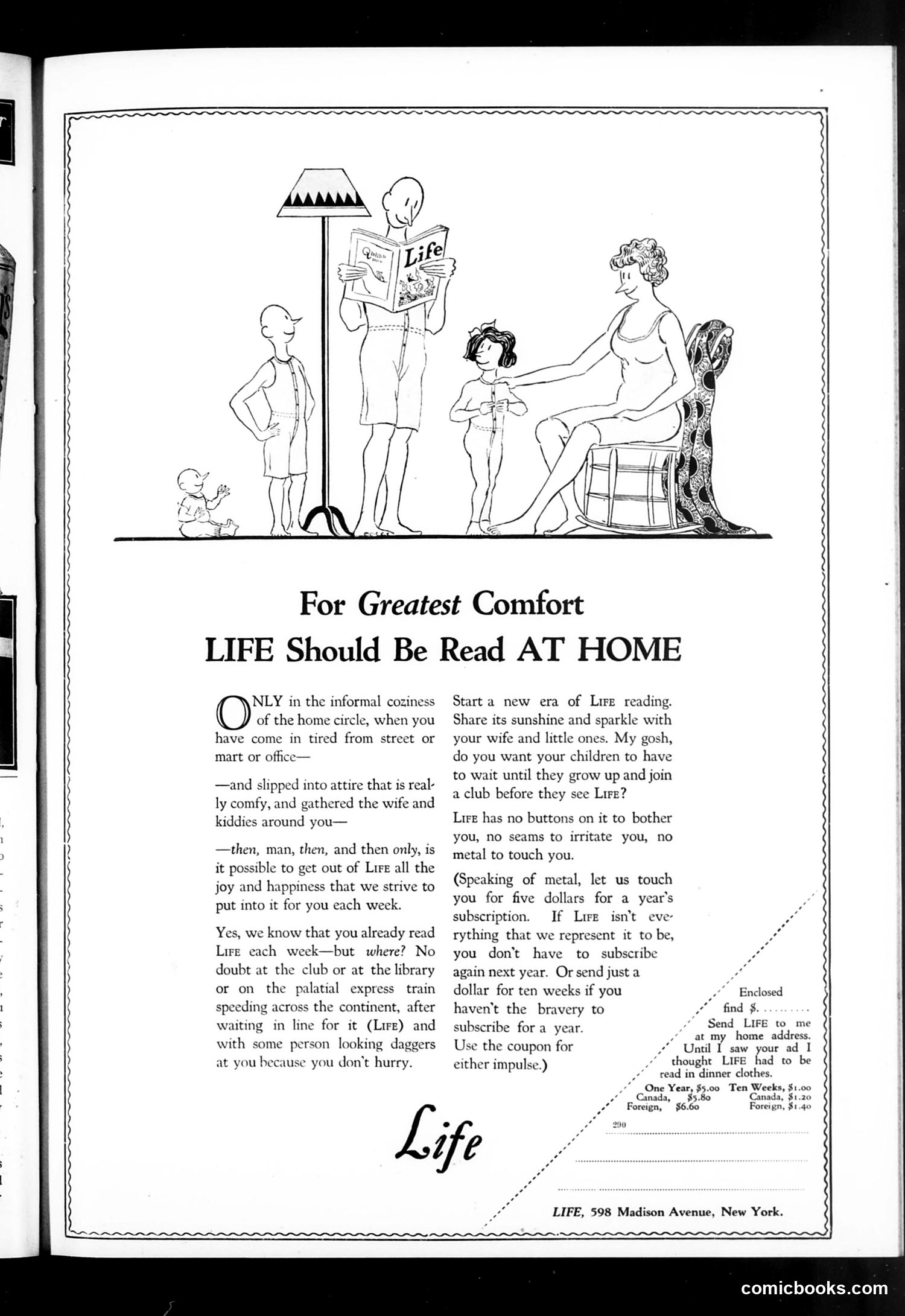
This is a **subscription advertisement** for *Life* magazine, not a political cartoon. The illustration depicts an idealized domestic scene: a man reading *Life* while surrounded by his wife and children in a comfortable home setting, with a snake coiled nearby (likely representing domestic contentment). The ad's argument: *Life* should be read at home in comfort, not in public spaces like clubs, libraries, or trains where one must wait for copies and faces impatient fellow readers. The copy appeals to middle-class domesticity and family values—suggesting that sharing *Life* with one's wife and children is preferable to solitary public reading. The humor is gentle and self-promotional: the magazine jokingly pleads for home subscriptions while satirizing the inconveniences of shared public reading. The pricing structure ($5 yearly or $1 for ten weeks) and the casual tone ("My gosh, do you want your children to have to wait...?") suggest this targets aspirational middle-class readers.

This is a **1923 advertisement**, not satire or political commentary. It promotes Woodbury's Facial Soap using marketing techniques common to the era. The page features three photographs of women's faces presenting an idealized beauty standard of the 1920s (bobbed hair, defined features). The ad's central claim—that "thousands of girls" have achieved "fresh, clear skin" through product use—is presented as testimonial evidence, though the women are likely models, not actual customers. The "special treatments" differentiate between skin types (oily vs. sensitive), a novel marketing approach suggesting scientific legitimacy. The copy emphasizes daily skin renewal ("each day your skin is changing") to create urgency and justify repeated purchases. By modern standards, the ad's claims are unsubstantiated and the imagery promotes narrow beauty ideals. However, historically, this represents early consumer advertising targeting women's insecurities about appearance as a sales strategy.