
Life, 1923-07-19 · page 10 of 36
Life — July 19, 1923 — page 10: what you’re looking at
What you’re looking at
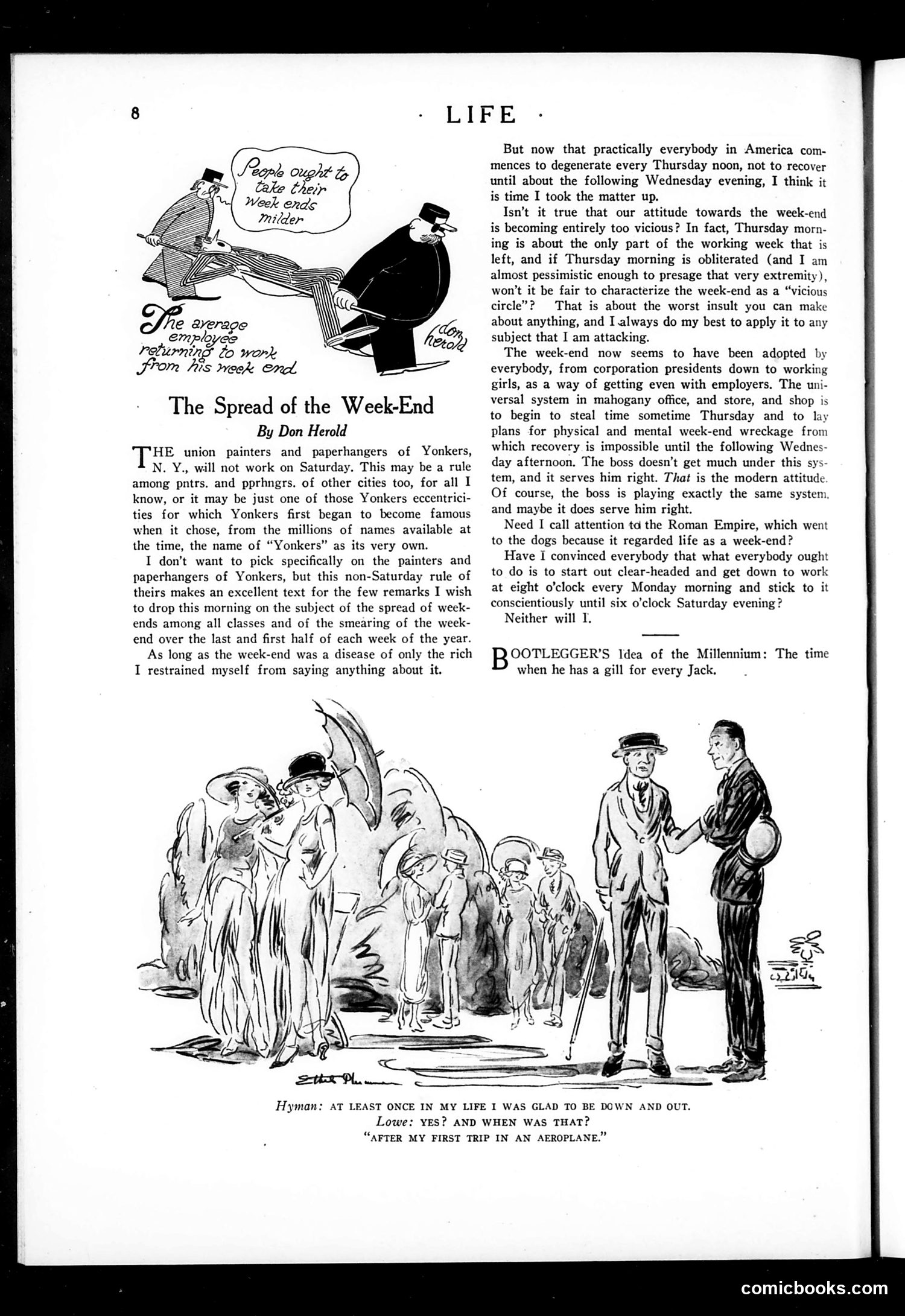
This satirical article critiques the American obsession with the "week-end" lifestyle. Herold argues that Thursday afternoons have become dedicated to mental recovery from work rather than actual work, making the weekend concept absurdly dominant in contemporary culture. The cartoon depicts a wealthy businessman ("The average employee") collapsing exhausted as he leaves work, suggesting that anticipation of the weekend ruins productive work time. The second cartoon shows a disheveled man boasting to a well-dressed companion about once being "down and out"—specifically after an airplane trip—mocking the frivolity of leisure activities among the privileged. Herold's satire targets how pervasive week-end culture had become across all social classes by the 1920s, affecting work ethic and attitudes toward labor itself.
📄 Transcribed text from this page (OCR, searchable)
Machine-transcribed from the original scan — historical spelling and the odd misread are preserved.
LIFE De average employee Petirning to wa Pa eee ed The Spread of the Week-End By Don Herold HE union painters and paperhangers of Yonkers, N. Y., will not work on Saturday. This may be a rule among pntrs. and pprhngrs. of other cities too, for all I know, or it may be just one of those Yonkers eccentrici- ties for which Yonkers first began to become famous when it chose, from the millions of names available at the time, the name of “Yonkers” as its very own. I don’t want to pick specifically on the painters and paperhangers of Yonkers, but this non-Saturday rule of theirs makes an excellent text for the few remarks I wish to drop this morning on the subject of the spread of week- ends among all classes and of the smearing of the week- end over the last and first half of each week of the year. As long as the week-end was a disease of only the rich I restrained myself from saying anything about it. But now that practically everybody in America com- mences to degenerate every Thursday noon, not to recover until about the following Wednesday evening, I think it is time I took the matter up. Isn’t it true that our attitude towards the week-end is becoming entirely too vicious? In fact, Thursday morn- ing is about the only part of the working week that is left, and if Thursday morning is obliterated (and I am almost pessimistic enough to presage that very extremity), won't it be fair to characterize the week-end as a “vicious circle’? That is about the worst insult you can make about anything, and I always do my best to apply it to any subject that I am attacking. The week-end now seems to have been adopted by everybody, from corporation presidents down to working girls, as a way of getting even with employers, The uni- versal system in mahogany office, and store, and shop is to begin to steal time sometime Thursday and to lay plans for physical and mental week-end wreckage from which recovery is impossible until the following Wednes- day afternoon. The boss doesn’t get much under this sys- tem, and it serves him right. That is the modern attitude Of course, the boss is playing exactly the same system and maybe it does serve him right. Need I call attention td the Roman Empire, which went to the dogs because it regarded life as a week-end? Have I convinced everybody that what everybody ought to do is to start out clear-headed and get down to work at eight o’clock every Monday morning and stick to it conscientiously until six o'clock Saturday evening? Neither will I. OOTLEGGER’S Idea of the Millennium: The time when he has a gill for every Jack. Hyman: AT LEAST ONCE IN MY LIFE I WAS GLAD TO BE DOWN AND OUT. Lowe: YES? AND WHEN WAS THAT? “AFTER MY FIRST TRIP IN AN AEROPLANE.” comicbooks.com