
Life, 1923-07-19 · page 16 of 36
Life — July 19, 1923 — page 16: what you’re looking at
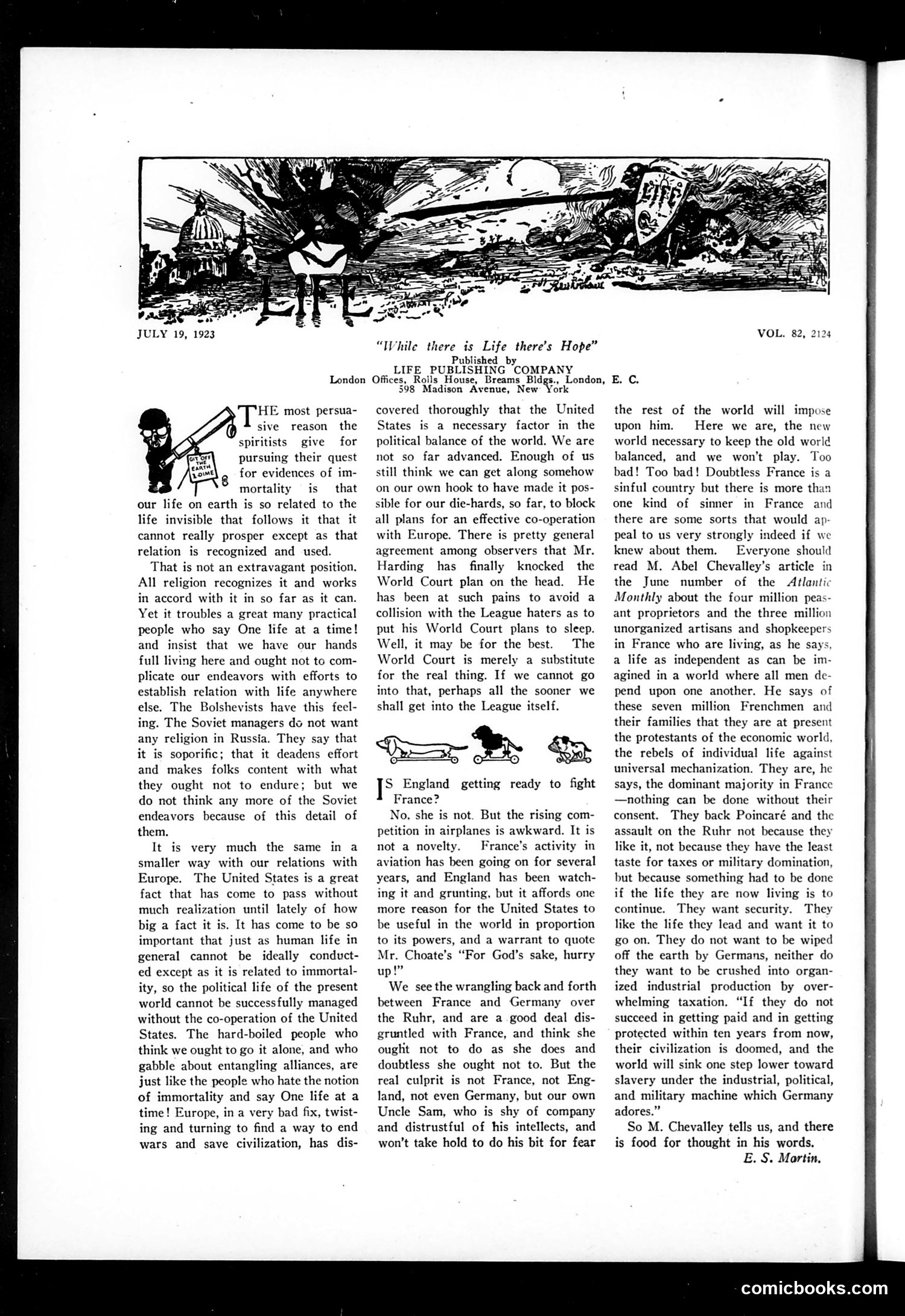
What you’re looking at
The page features a philosophical editorial titled "While there is Life there's Hope," arguing that American cooperation is essential for world political balance. The small cartoon at top shows a figure with a megaphone addressing a chaotic European landscape, symbolizing America's role as an outside observer of European conflicts. The text discusses ongoing tensions between France and Germany over the Ruhr region, references England's military preparedness, and criticizes what appears to be isolationist American attitudes. The author (E.S. Martin) argues the U.S. cannot remain detached from European instability, and that American involvement is necessary for lasting peace—a debate central to 1920s American foreign policy following World War I.
📄 Transcribed text from this page (OCR, searchable)
Machine-transcribed from the original scan — historical spelling and the odd misread are preserved.
JULY 19, 1923 London Offices, HE most persua- @ * sive reason the spiritists give for pursuing their quest for evidences of im- mortality is that our life on earth is so related to the life invisible that follows it that it cannot really prosper except as that relation is recognized and used. That is not an extravagant position. All religion recognizes it and works in accord with it in so far as it can. Yet it troubles a great many practical people who say One life at a time! and insist that we have our hands full living here and ought not to com- plicate our endeavors with efforts to establish relation with life anywhere else. The Bolshevists have this feel- ing. The Soviet managers do not want any religion in Russia. They say that it is soporific; that it deadens effort and makes folks content with what they ought not to endure; but we do not think any more of the Soviet endeavors because of this detail of them. It is very much the same in a smaller way with our relations with Europe. The United States is a great fact that has come to pass without much realization until lately of how big a fact it is. It has come to be so important that just as human life in general cannot be ideally conduct- ed except as it is related to immortal- ity, so the political life of the present world cannot be successfully managed without the co-operation of the United States. The hard-boiled people who think we ought to go it alone, and who gabble about entangling alliances, are just like the people who hate the notion of immortality and say One life at a time! Europe, in a very bad fix, twist- ing and turning to find a way to end wars and save civilization, has dis- ve sor fos, “While there is Life there’s Hope” Published by LIFE PUBLISHING COMPANY 598 Madison Avenue, New York covered thoroughly that the United States is a necessary factor in the political balance of the world. We are not so far advanced. Enough of us still think we can get along somehow on our own hook to have made it pos- sible for our die-hards, so far, to block all plans for an effective co-operation with Europe. There is pretty general agreement among observers that Mr. Harding has finally knocked the World Court plan on the head. He has been at such pains to avoid a collision with the League haters as to put his World Court plans to sleep. Well, it may be for the best. The World Court is merely a substitute for the real thing. If we cannot go into that, perhaps all the sooner we shall get into the League itself. far By & Is England getting ready to fight France? No, she is not. But the rising com- petition in airplanes is awkward. It is not a novelty. France’s activity in aviation has been going on for several years, and England has been watch- ing it and grunting, but it affords one more reason for the United States to be useful in the world in proportion to its powers, and a warrant to quote Mr. Choate’s “For God’s sake, hurry up!” We see the wrangling back and forth between France and Germany over the Ruhr, and are a good deal dis- gruntled with France, and think she ought not to do as she does and doubtless she ought not to. But the real culprit is not France, not Eng- land, not even Germany, but our own Uncle Sam, who is shy of company and distrustful of his intellects, and won't take hold to do his bit for fear VOL, 82, 2124 Rolls House, Breams Bldgs., London, E. C. the rest of the world will impose upon him. Here we are, the new world necessary to keep the old world balanced, and we won't play. Too bad! Too bad! Doubtless France is a sinful country but there is more than one kind of sinner in France and there are some sorts that would ap: peal to us very strongly indeed if we knew about them. Everyone should read M. Abel Chevalley’s article in the June number of the Aflantic Monthly about the four million peas- ant proprietors and the three million unorganized artisans and shopkeepers in France who are living, as he says, a life as independent as can be im- agined in a world where all men de- pend upon one another. He says of these seven million Frenchmen and their families that they are at present the protestants of the economic world, the rebels of individual life against universal mechanization. They are, he says, the dominant majority in France —nothing can be done without their consent. They back Poincaré and the assault on the Ruhr not because they like it, not because they have the least taste for taxes or military domination, but because something had to be done if the life they are now living is to continue. They want security. They like the life they lead and want it to go on. They do not want to be wiped off the earth by Germans, neither do they want to be crushed into organ- ized industrial production by over- whelming taxation. “If they do not succeed in getting paid and in getting protected within ten years from now, their civilization is doomed, and the world will sink one step lower toward slavery under the industrial, political, and military machine which Germany adores.” So M. Chevalley tells us, and there is food for thought in his words. E. S. Martin, comicbooks.com