
Life, 1923-07-19 · page 26 of 36
Life — July 19, 1923 — page 26: what you’re looking at
What you’re looking at
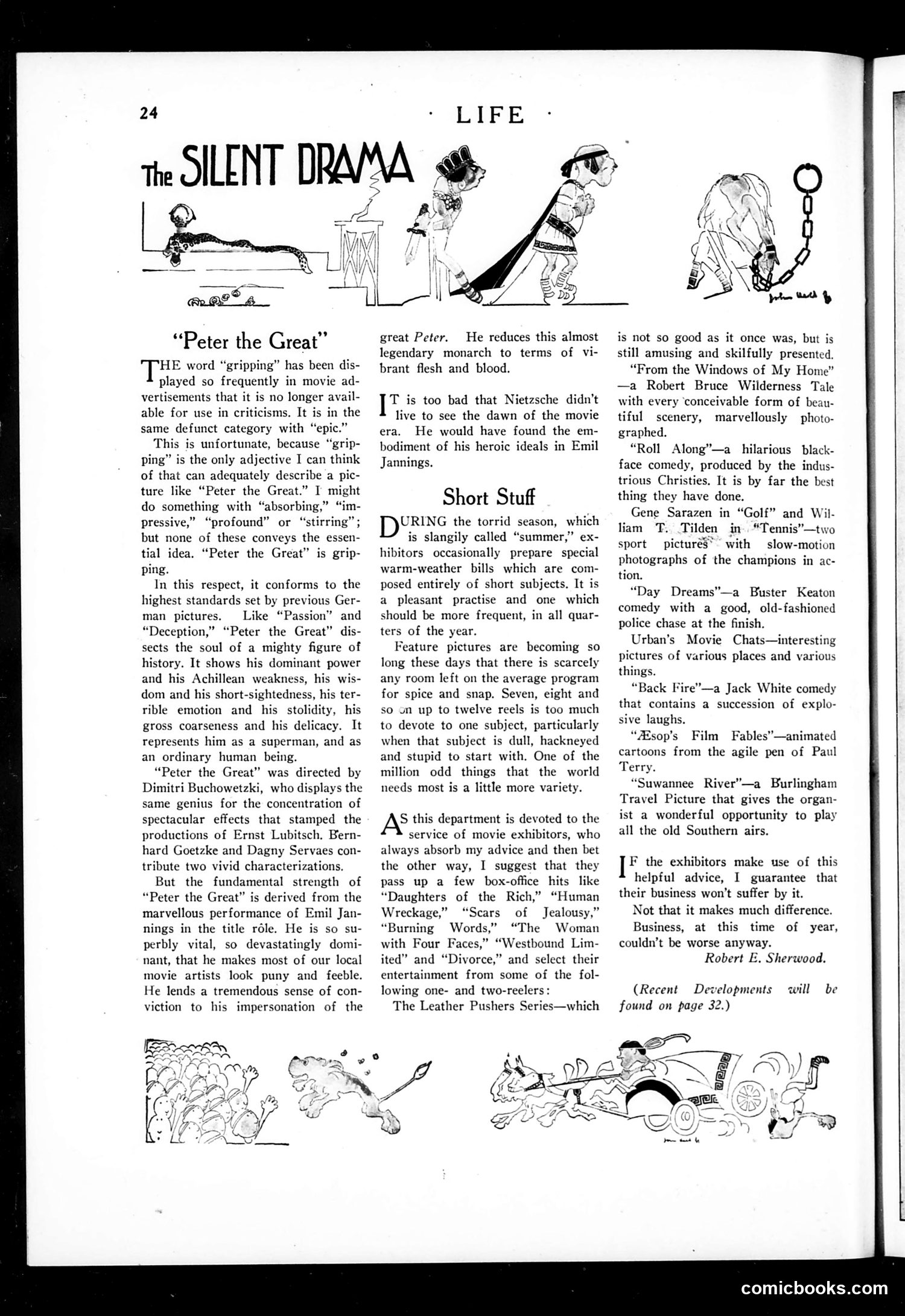
This page reviews "Peter the Great," a German-directed silent film starring Emil Jannings in the title role. The critic praises Jannings's performance as powerfully vital, comparing him to Nietzsche's concept of the superman—a "mighty figure of history" embodying both dominance and human vulnerability. The "Short Stuff" section critiques the film industry's tendency toward overly long feature films (7-12 reels), arguing for more variety through short subjects. The critic sarcastically notes that exhibitors ignore his advice while recommending specific shorts: sports footage of golfer Gene Sarazen and tennis champion William T. Tilden, Buster Keaton comedies, and various travelogues. The cartoons at top illustrate silent film's physical comedy and exaggerated acting style typical of the era.
📄 Transcribed text from this page (OCR, searchable)
Machine-transcribed from the original scan — historical spelling and the odd misread are preserved.
24 “Peter the Great” HE word “gripping” has been dis- played so frequently in movie ad- vertisements that it is no longer avail- able for use in criticisms. It is in the same defunct category with “epic.” This is unfortunate, because “grip- ping” is the only adjective I can think of that can adequately describe a pic- ture like “Peter the Great.” I might do something with “absorbing,” “im- pressive,” “profound” or “stirring”; but none of these conveys the essen- tial idea. “Peter the Great” is grip- ping. In this respect, it conforms to the highest standards set by previous Ger- man _ pictures. Like “Passion” and “Deception,” “Peter the Great” dis- sects the soul of a mighty figure of history. It shows his dominant power and his Achillean weakness, his wis- dom and his short-sightedness, his ter- rible emotion and his stolidity, his gross coarseness and his delicacy. It represents him as a superman, and as an ordinary human being. “Peter the Great” was directed by Dimitri Buchowetzki, who displays the same genius for the concentration of spectacular effects that stamped the productions of Ernst Lubitsch. Bern- hard Goetzke and Dagny Servaes con- tribute two vivid characterizations. But the fundamental strength of “Peter the Great” is derived from the marvellous performance of Emil Jan- nings in the title rdle. He is so su- perbly vital, so devastatingly domi- nant, that he makes most of our local movie artists look puny and feeble. He lends a tremendous sense of con- viction to his impersonation of the great Peter. He reduces this almost legendary monarch to terms of vi- brant flesh and blood. T is too bad that Nietzsche didn’t live to see the dawn of the movie era. He would have found the em- bodiment of his heroic ideals in Emil Jannings. Short Stuff URING the torrid season, which is slangily called “summer,” ex- hibitors occasionally prepare special warm-weather bills which are com- posed entirely of short subjects. It is a pleasant practise and one which should be more frequent, in all quar- ters of the year. Feature pictures are becoming so long these days that there is scarcely any room left on the average program for spice and snap. Seven, eight and so un up to twelve reels is too much to devote to one subject, particularly when that subject is dull, hackneyed and stupid to start with. One of the million odd things that the world needs most is a little more variety. S this department is devoted to the service of movie exhibitors, who always absorb my advice and then bet the other way, I suggest that they pass up a few box-office hits like “Daughters of the Rich,” “Human Wreckage,” “Scars of Jealousy,” “Burning Words,” “The Woman with Four Faces,” “Westbound Lim- ited” and “Divorce,” and select their entertainment from some of the fol- lowing one- and two-reelers: The Leather Pushers Series—which is not so good as it once was, but is still amusing and skilfully presented. “From the Windows of My Home” —a Robert Bruce Wilderness Tale with every ‘conceivable form of beau- tiful scenery, marvellously photo- graphed. “Roll Along”—a_ hilarious black- face comedy, produced by the indus- trious Christies. It is by far the best thing they have done. Gene Sarazen in “Golf” and Wil- liam T. Tilden in. “Tennis”—two sport pictures with slow-motion photographs of the champions in ac- tion. “Day Dreams”—a Buster Keaton comedy with a good, old-fashioned police chase at the finish. Urban’s Movie Chats—interesting pictures of various places and various things. “Back Fire’—a Jack White comedy that contains a succession of explo- sive laughs. “ZEsop’s Film Fables”—animated cartoons from the agile pen of Paul Terry. “Suwannee River’—a Burlingham Travel Picture that gives the organ- ist a wonderful opportunity to play all the old Southern airs. Ie the exhibitors make use of this helpful advice, I guarantee that their business won’t suffer by it. Not that it makes much difference. Business, at this time of year, couldn’t be worse anyway. Robert E, Sherwood. (Recent Developments will be found on page 32.) comicbooks.com