
Life, 1923-07-19 · page 20 of 36
Life — July 19, 1923 — page 20: what you’re looking at
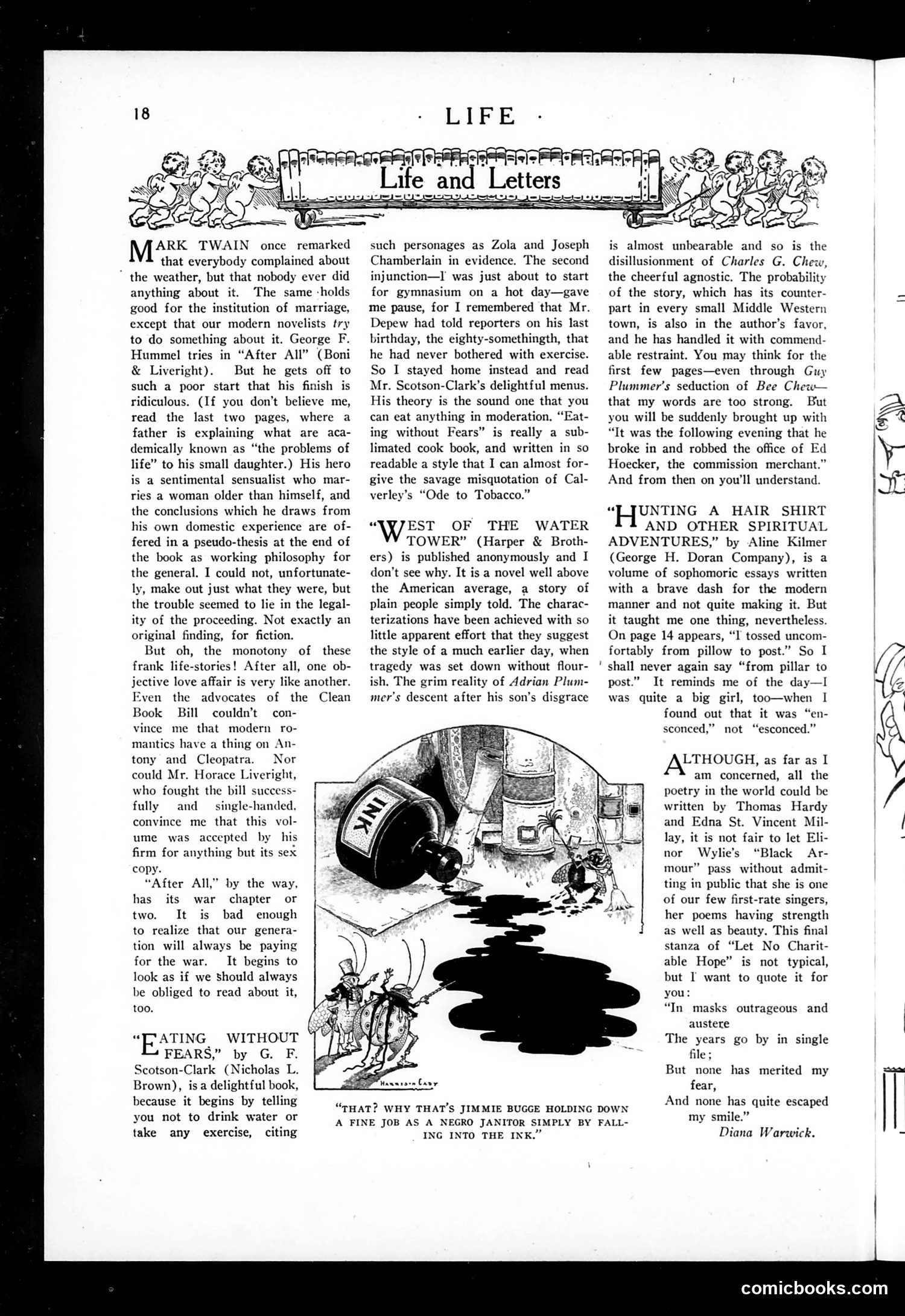
What you’re looking at
This is a **book review column** from *Life* magazine, not primarily political satire. The page discusses several contemporary novels, including critiques of "After All" by George F. Hummel (criticized for melodramatic "problems of life" discussions) and "Eating Without Fears" by G.F. Scotson-Clark. The **cartoon** illustrates a joke about employment: it shows an ink bottle spilled, with the caption explaining that "Jimmie Bugge" got hired as a janitor by literally falling into ink—implying he's now dark-skinned enough for the job. This reflects the **racist hiring practices of the era**, where Black workers were relegated to menial positions. The "joke" relies on crude racial stereotyping typical of 1920s-era *Life* magazine humor. The page demonstrates both genuine literary criticism alongside casual racism normalized in period publications.
📄 Transcribed text from this page (OCR, searchable)
Machine-transcribed from the original scan — historical spelling and the odd misread are preserved.
ARK TWAIN once remarked that everybody complained about the weather, but that nobody ever did anything about it. The same -holds good for the institution of marriage, except that our modern novelists try to do something about it. George F. Hummel tries in “After All” (Boni & Liveright). But he gets off to such a poor start that his finish is ridiculous. (If you don’t believe me, read the last two pages, where a father is explaining what are aca- demically known as “the problems of life” to his small daughter.) His hero is a sentimental sensualist who mar- ries a woman older than himself, and the conclusions which he draws from his own domestic experience are of- fered in a pseudo-thesis at the end of the book as working philosophy for the general. I could not, unfortunate- ly, make out just what they were, but the trouble seemed to lie in the legal- ity of the proceeding. Not exactly an original finding, for fiction. But oh, the monotony of these frank life-stories! After all, one ob- jective love affair is very like another. Even the advocates of the Clean Book Bill couldn't con- vince me that modern ro- mantics have a thing on An- tony and Cleopatra. Nor could Mr. Horace Liveright, who fought the bill success- fully and _— single-handed, convince me that this vol- ume was accepted by his firm for anything but its sex copy. “After All,” by the way, has its war chapter or two. It is bad enough to realize that our genera- tion will always be paying for the war. It begins to look as if we Should always be obliged to read about it, too. “EATING WITHOUT FEARS,” by G. F. Scotson-Clark (Nicholas L. Brown), isa delightful book, because it begins by telling you not to drink water or take any exercise, citing such personages as Zola and Joseph Chamberlain in evidence. The second injunction—I was just about to start for gymnasium on a hot day—gave me pause, for I remembered that Mr. Depew had told reporters on his last birthday, the eighty-somethingth, that he had never bothered with exercise. So I stayed home instead and read Mr. Scotson-Clark’s delightful menus. His theory is the sound one that you can eat anything in moderation. ‘‘Eat- ing without Fears” is really a sub- limated cook book, and written in so readable a style that I can almost for- give the savage misquotation of Cal- verley’s “Ode to Tobacco.” st EST OF THE WATER TOWER” (Harper & Broth- ers) is published anonymously and I don’t see why. It is a novel well above the American average, a story of plain people simply told. The charac- terizations have been achieved with so little apparent effort that they suggest the style of a much earlier day, when tragedy was set down without flour- ish. The grim reality of Adrian Plum- mer’s descent after his son’s disgrace “THAT? WHY THAT'S JIMMIE BUGGE HOLDING DOWN A FINE JOB AS A NEGRO JANITOR SIMPLY BY FALL- ING INTO THE INK.” is almost unbearable and so is the disillusionment of Charles G. Chew, the cheerful agnostic. The probabili of the story, which has its counter- part in every small Middle Western town, is also in the author’s favor, and he has handled it with commend- able restraint. You may think for the first few pages—even through Guy Plummer’s seduction of Bee Chew— that my words are too strong. But you will be suddenly brought up with “It was the following evening that he broke in and robbed the office of Ed Hoecker, the commission merchant.” And from then on you'll understand. “LJUNTING A HAIR SHIRT AND OTHER SPIRITUAL ADVENTURES,” by Aline Kilmer (George H. Doran Company), is a volume of sophomoric essays written with a brave dash for the modern manner and not quite making it. But it taught me one thing, nevertheless. On page 14 appears, “I tossed uncom- fortably from pillow to post.” So I shall never again say “from pillar to post.” It reminds me of the day—I was quite a big girl, too—when I found out that it was “en- sconced,” not “esconced.” LTHOUGH, as far as I am concerned, all the poetry in the world could be written by Thomas Hardy and Edna St. Vincent Mil- lay, it is not fair to let Eli- nor Wylie’s “Black Ar- mour” pass without admit- ting in public that she is one of our few first-rate singers, her poems having strength as well as beauty. This final stanza of “Let No Charit- able Hope” is not typical, but I want to quote it for you: “In masks outrageous and austere The years go by in single file ; But none has merited my fear, And none has quite escaped my smile.” Diana Warwick. ty) f comicbooks.com