
A complete issue · 40 pages · 1923
Life — July 12, 1923
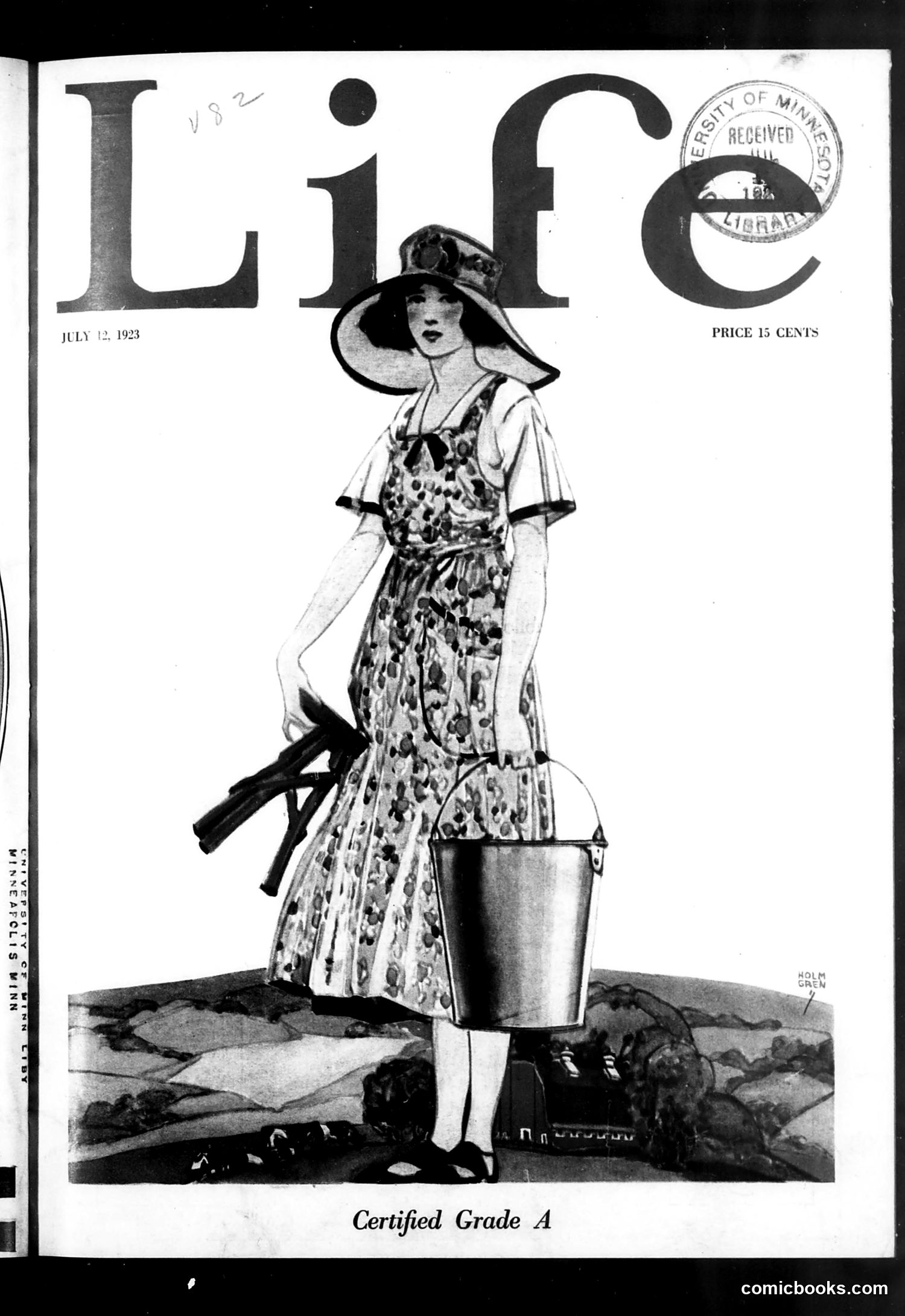
This is a cover illustration rather than a political cartoon. It depicts a fashionable woman in 1920s attire—a patterned day dress with short sleeves, wide-brimmed hat, and holding a bucket and shovel—standing in a beach or seaside setting. The image likely satirizes or comments on women's changing roles and leisure activities during the 1920s. The "Certified Grade A" caption suggests commentary on modern standardization or quality assessment, possibly ironizing how women's fashion and social activities were becoming increasingly commercialized and standardized during this era of consumer culture. The artwork is credited to "Holm Green" (visible in lower right).
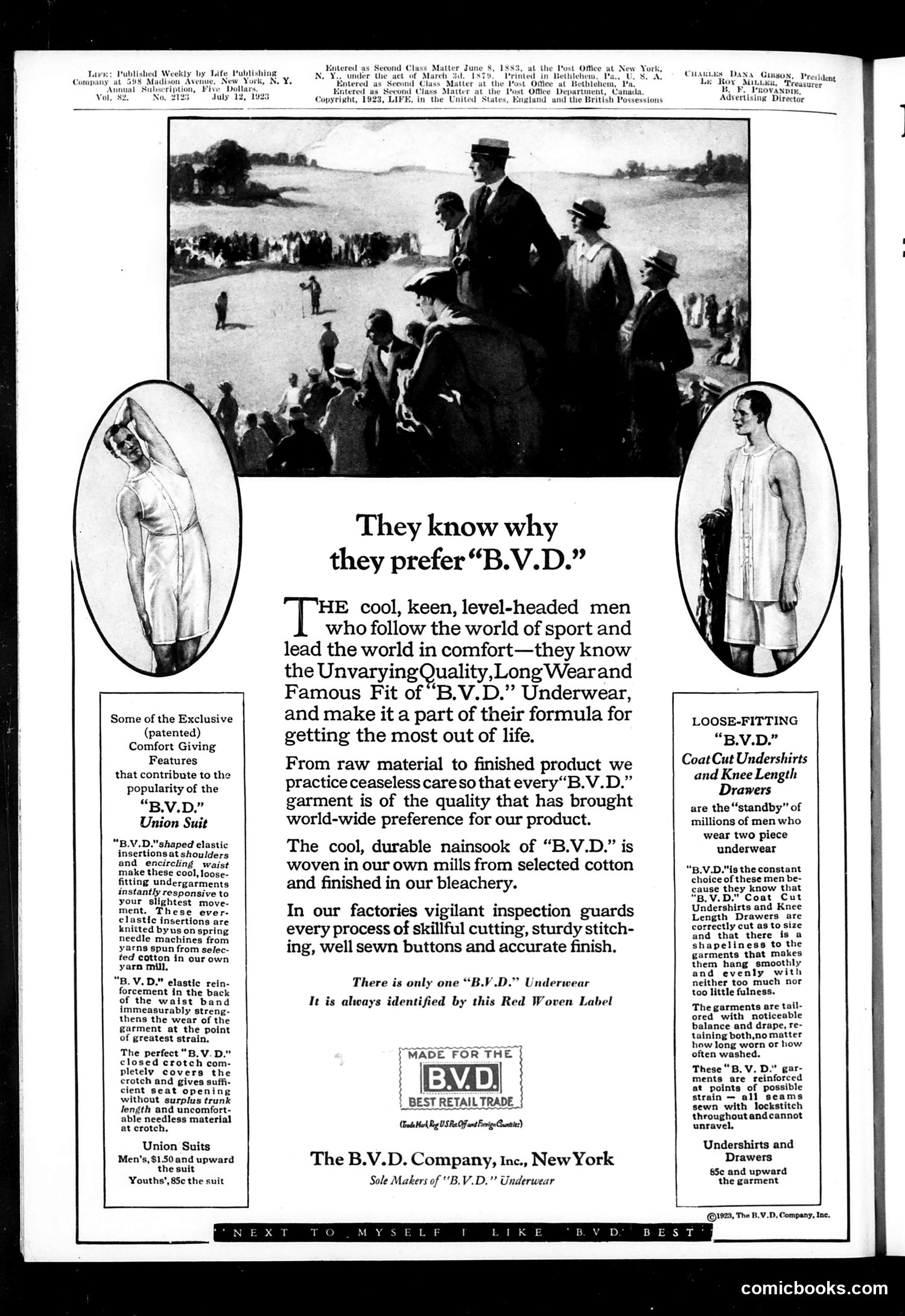
This page is **primarily an advertisement**, not satirical content. It promotes B.V.D. brand underwear, marketed to "cool, keen, level-headed men who follow the world of sport." The advertisement features two illustrations of men in underwear flanking a central photograph of what appears to be a sporting event with crowds. The text emphasizes the product's quality, durability, comfort, and "famous fit." There is **no political satire or cartoon** on this page. It's a straightforward early-20th-century commercial advertisement using appeals to masculine athleticism and social status to sell men's undergarments. The "Red Woven Label" serves as the brand identifier. This represents typical Life magazine advertising from this era, though Life was primarily known for satirical content.
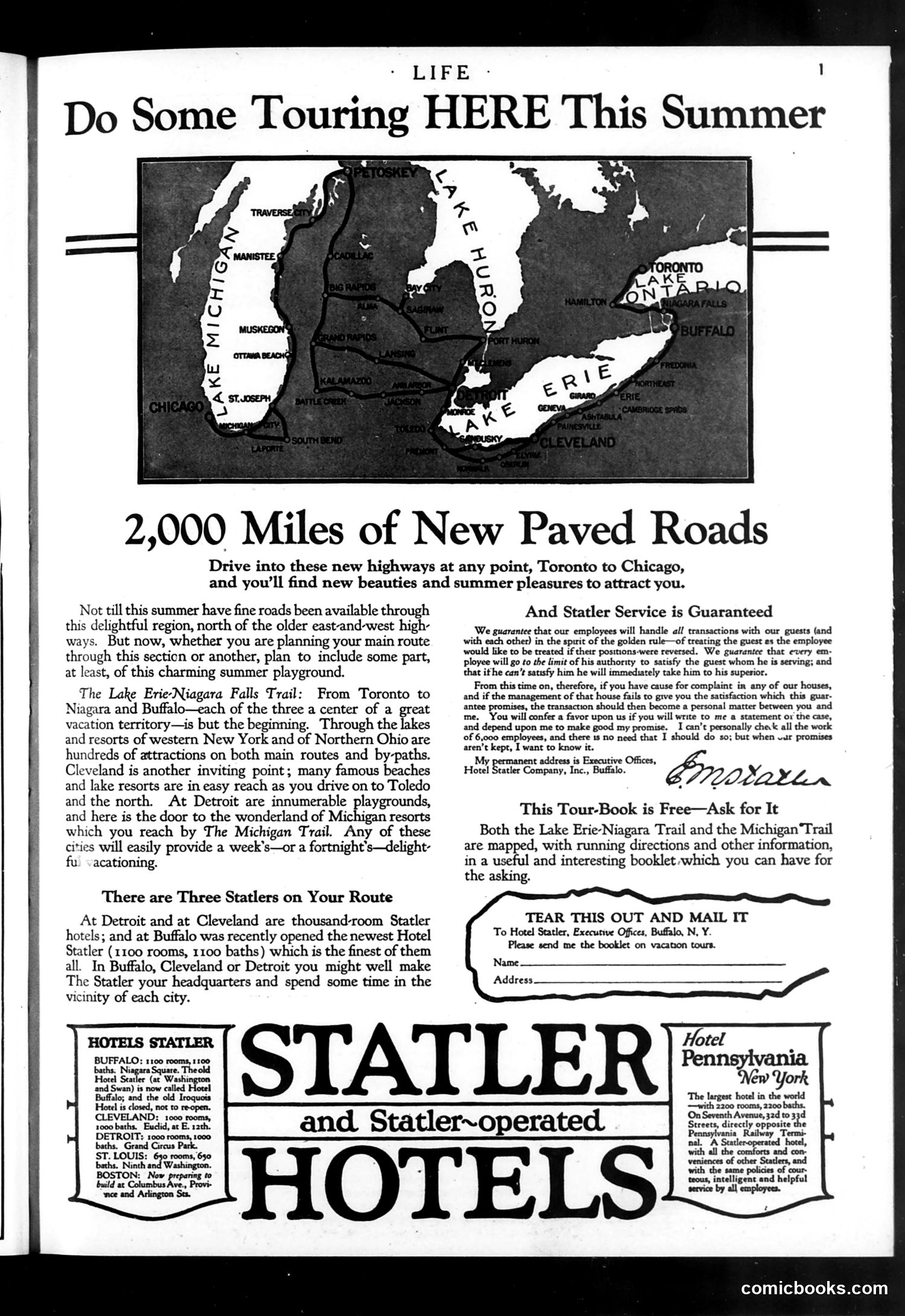
This page is primarily **advertising, not satire or cartoon content**. It promotes Statler Hotels and new paved roads in the Great Lakes region (Ontario, Michigan, Ohio, and New York). The advertisement targets summer tourists, encouraging road trips via newly constructed highways connecting Toronto, Chicago, Buffalo, and Cleveland. It emphasizes modern infrastructure and hospitality—three Statler Hotels serve as "headquarters" along the routes. There is a signed letter (signature appears to be from Hotel Statler management) guaranteeing quality service and employee conduct, addressing customer concerns about how travelers would be treated. The "tear-out" coupon offers a free tour booklet mapping the Lake Erie-Niagara Trail and Michigan Trail. This reflects early-20th-century American optimism about automotive tourism and commercial hotel chains as markers of progress and civilization.
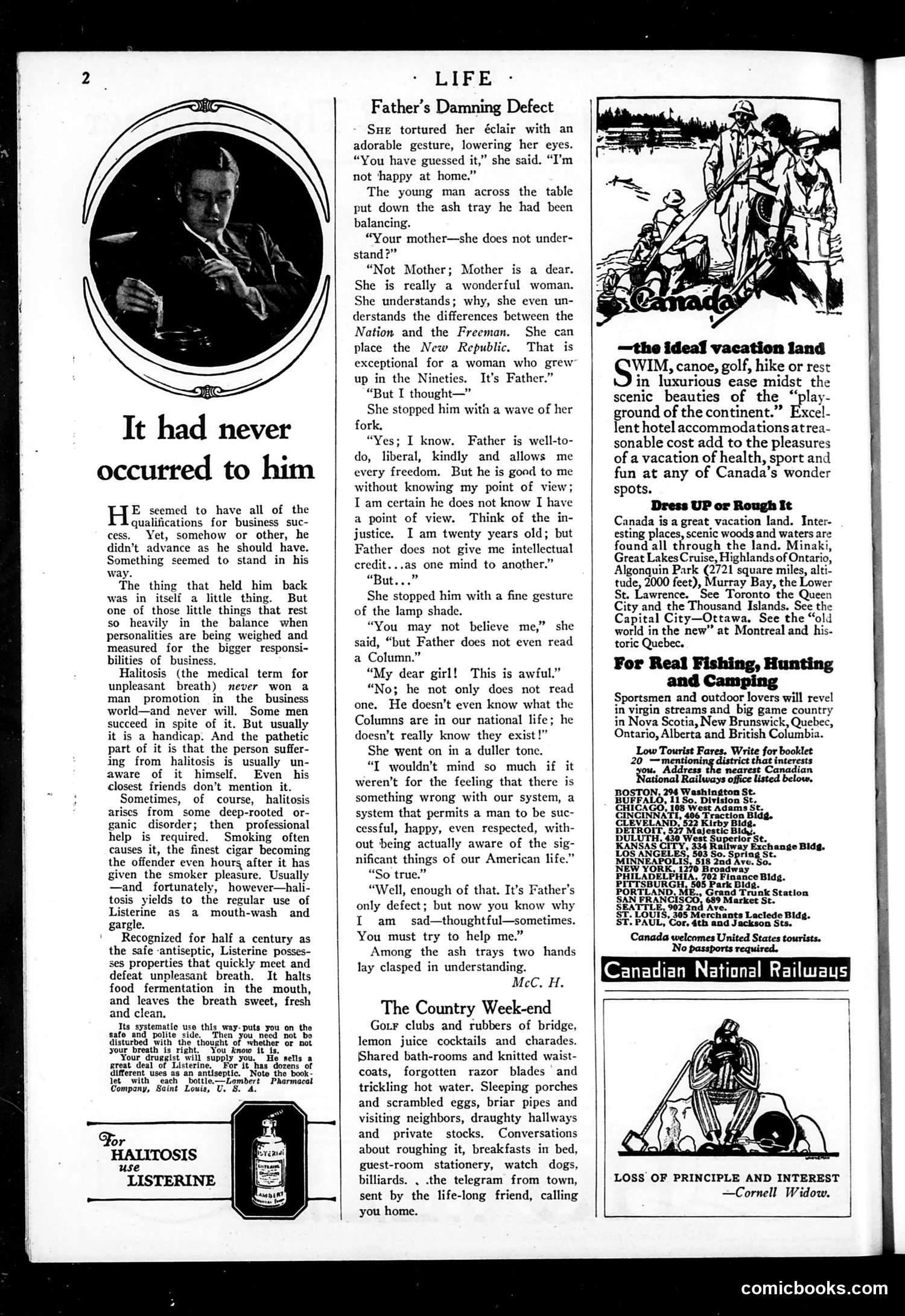
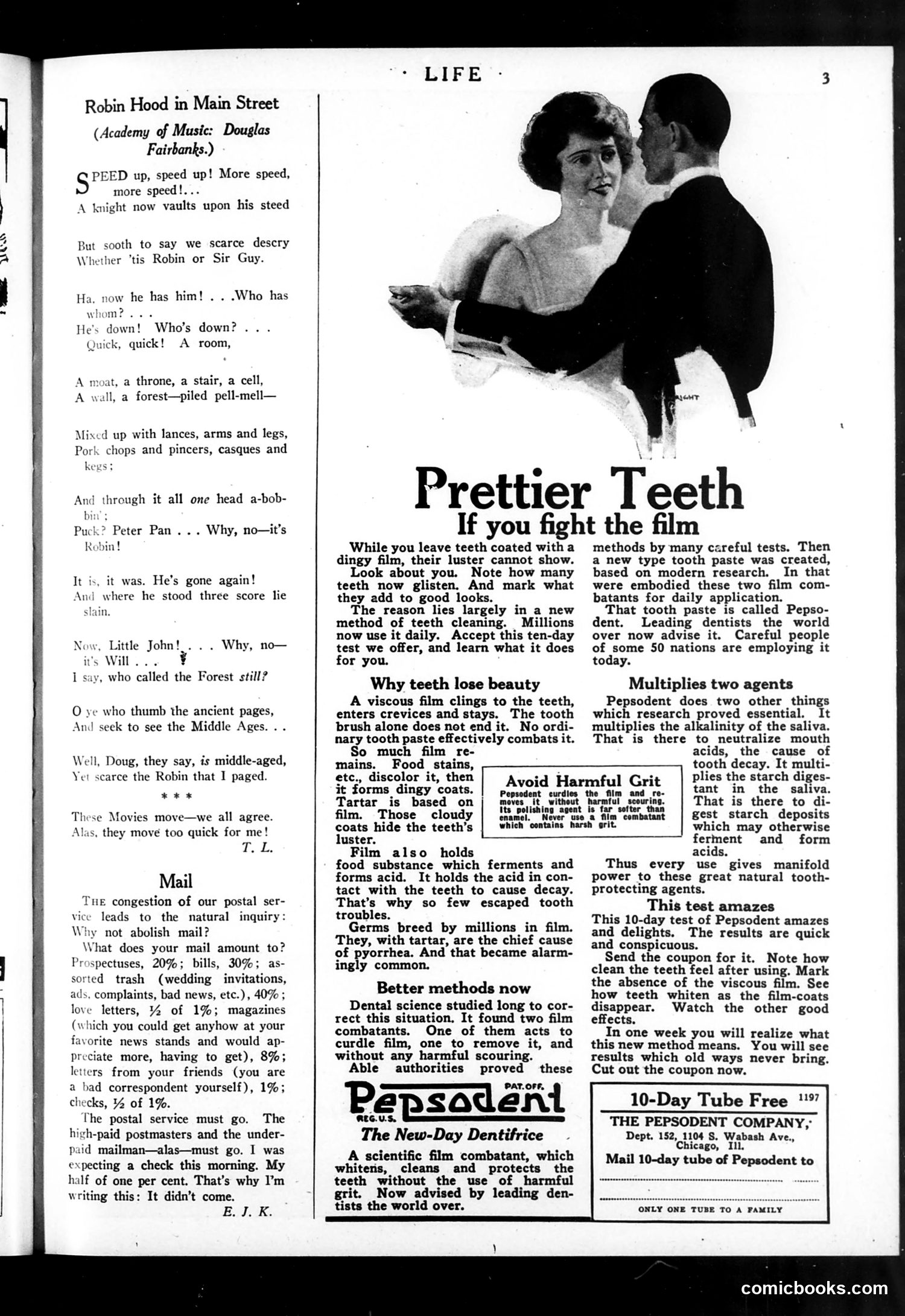
This page contains two distinct sections: **Left side:** A poem titled "Robin Hood in Main Street" by Douglas Fairbanks (Academy of Music). The verse satirizes a modern film adaptation, punning on the Robin Hood legend while mocking its cinematic interpretation. References to "Little John" and the "Forest" suggest commentary on how Hollywood adapted classic stories. **Right side:** This is primarily a **Pepsodent toothpaste advertisement** disguised as educational content. It uses pseudo-scientific language about tooth film and tartar to promote their product, featuring a couple and endorsement from dental authorities. The "10-Day Tube Free" offer appears below. The page juxtaposes literary satire with commercial advertising—typical of Life magazine's format blending humor with marketing.

This page is primarily **advertising, not satire or political commentary**. It's a Republic Tires advertisement from Life magazine promoting their "Grande Cords" tires as "the world's finest." The illustration shows various vehicles (trucks, cars, and what appears to be a bus or transport vehicle) in an isometric view, demonstrating the range of automobiles that use Republic Tires. The ad emphasizes quality construction, superior materials, and reliable dealer service marked by an "Eagle Sign." The only potentially humorous element is the phrase "How Republic built" preceding the sales pitch—a light, promotional tone rather than satire. This appears to be a straightforward vintage advertisement highlighting tire manufacturing and distribution, with no political or social commentary intended.
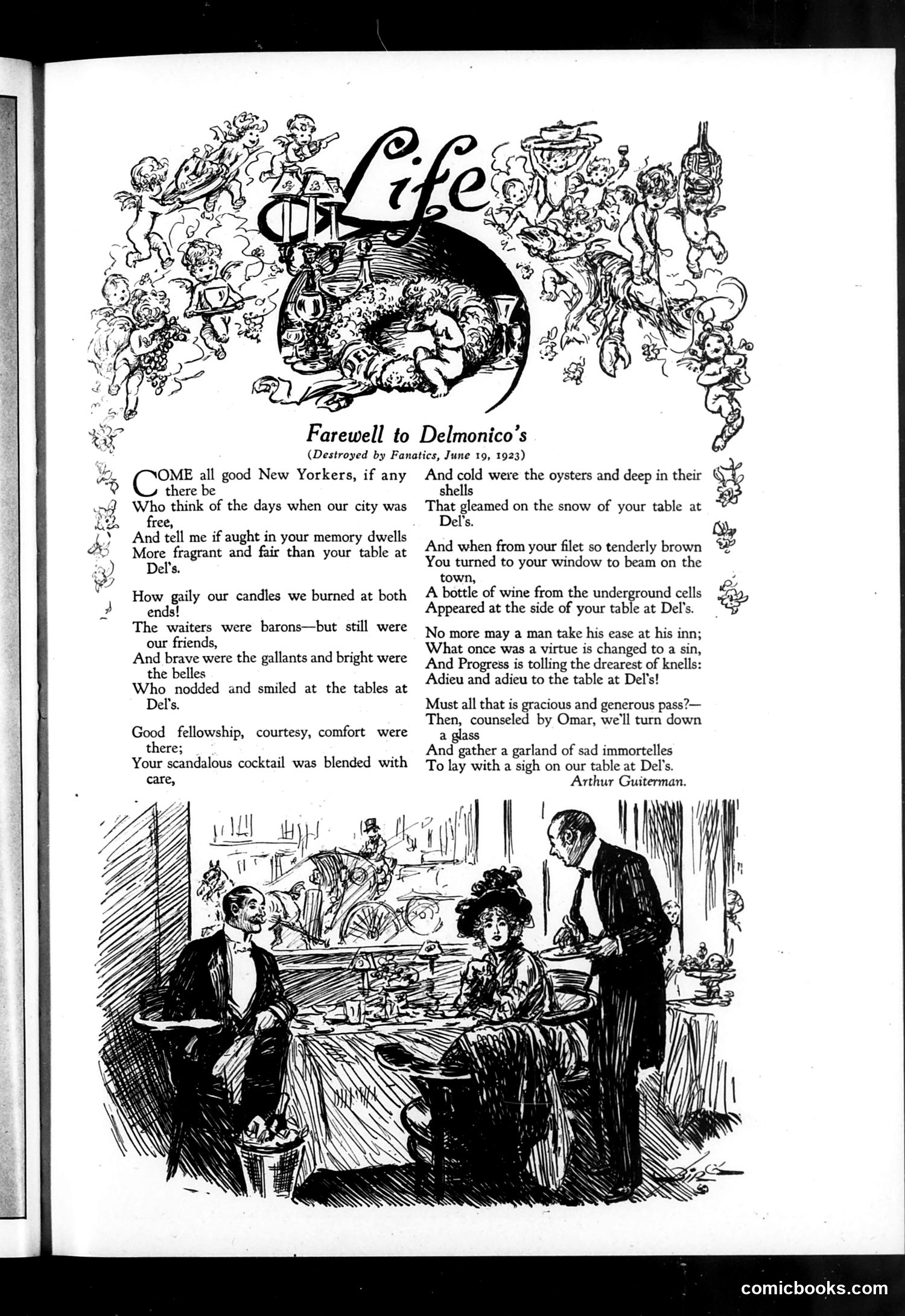
This is a farewell poem to **Delmonico's**, a famous New York restaurant destroyed by fire on June 19, 1923. The subtitle states: "(Destroyed by Fanatics, June 19, 1923)"—referring to Prohibition enforcement agents who raided speakeasies. The poem, by Arthur Guiterman, nostalgically recalls Delmonico's as a place of elegance and sociability. It mourns the loss of fine dining, oysters, wine from "underground cells" (illegal liquor), and the restaurant's courteous service. The illustration shows well-dressed diners enjoying a final meal. The celebratory cherub border and satirical tone suggest the author views Prohibition—which criminalized alcohol and forced closures of establishments like this—as an affront to civilization and pleasure. The reference to "Fanatics" criticizes zealous Prohibition enforcers.
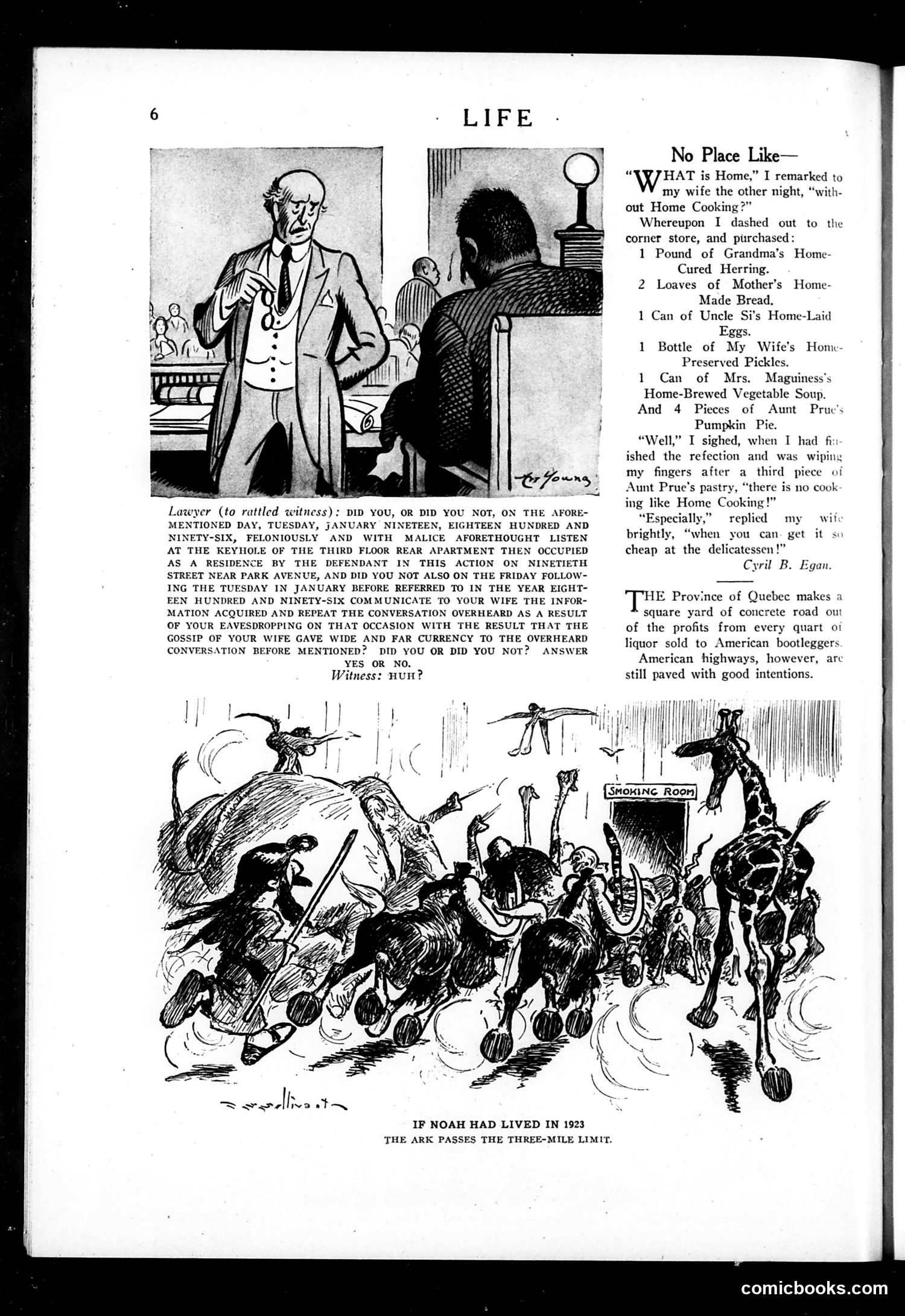
**Top Cartoon:** A lawyer cross-examines a witness about whether he overheard an apartment building conversation regarding eavesdropping. The satire targets the legal absurdity of proving someone listened to gossip—a circular logic problem. The joke criticizes overly technical courtroom procedures. **Bottom Cartoon:** Titled "If Noah Had Lived in 1923: The Ark Passes the Three-Mile Limit," this references Prohibition (1920-1933). Animals stampede from the ark toward a "Smoking Room," satirizing how Americans rushed to consume alcohol just outside U.S. territorial waters, where federal law didn't apply. Bootleggers famously operated from ships beyond the three-mile limit. The cartoon mocks both Prohibition's ineffectiveness and Americans' desperation for contraband liquor.
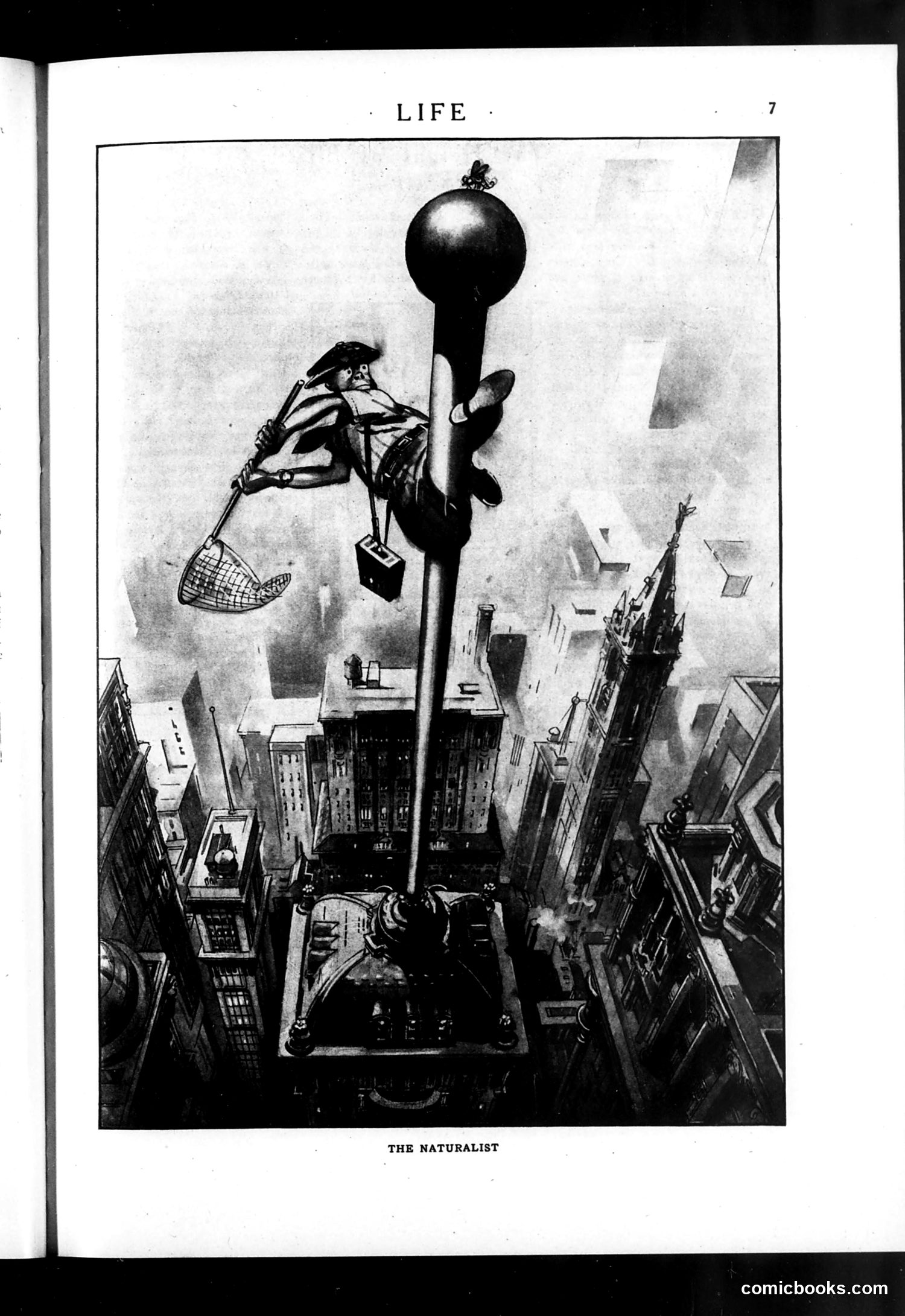
This cartoon depicts a figure perched atop a tall pole in an urban cityscape, holding a large spherical object aloft while appearing to observe the city below through binoculars or a similar instrument. The title "The Naturalist" suggests ironic commentary on scientific observation. The satirical point appears to critique someone studying or documenting urban life—likely a social scientist, journalist, or observer claiming objectivity while positioned above the city. The elevated, somewhat precarious stance and the exaggerated pose suggest the pretension or absurdity of such detached "study" of city life and its inhabitants. The naturalist claims scientific distance but is comically removed from actual reality, making this likely commentary on early 20th-century social science or journalism's claims to objective authority.
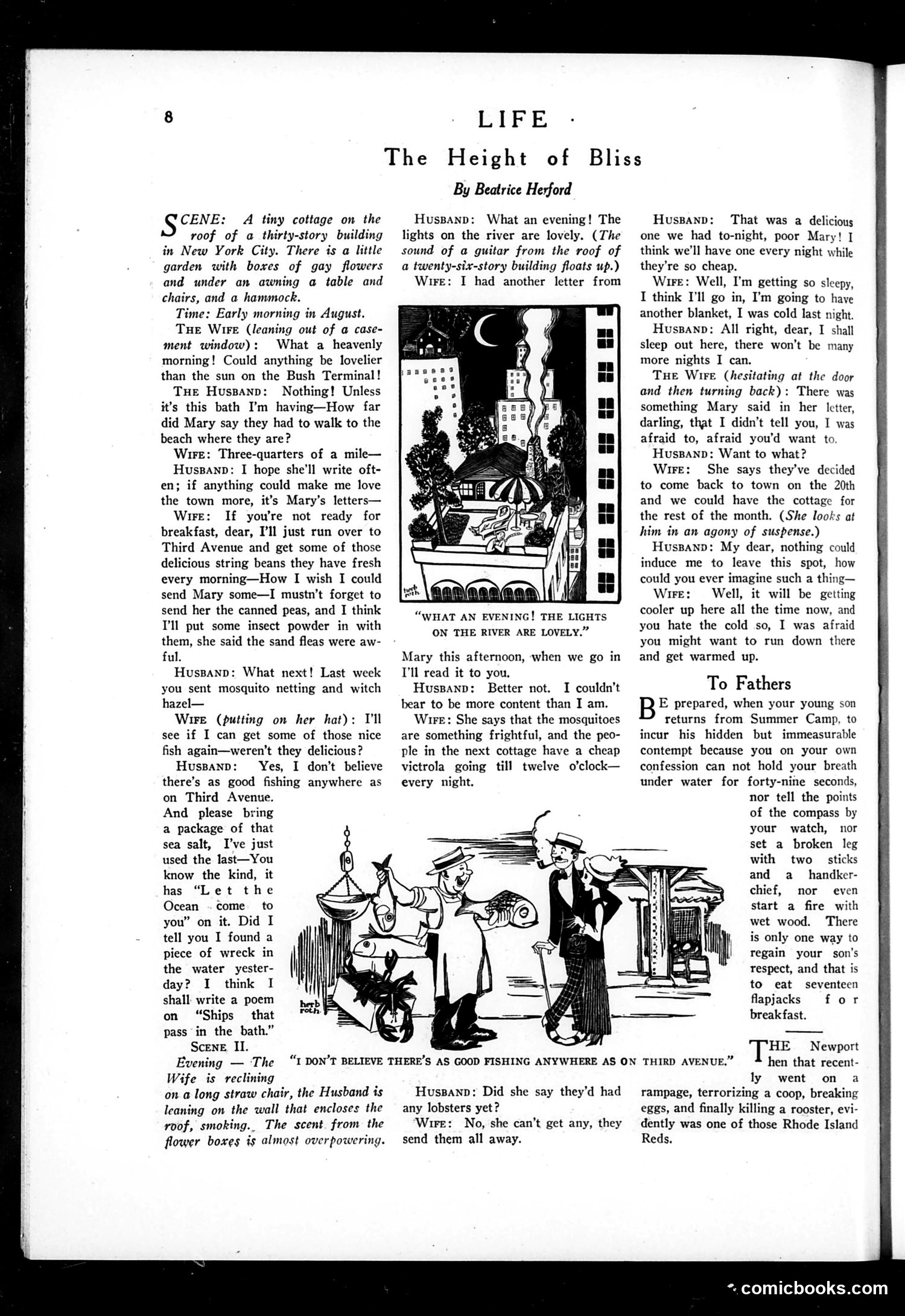
This page contains a domestic comedy sketch titled "The Height of Bliss" by Beatrice Herford. The narrative depicts a husband and wife negotiating their vacation plans in a New York City rooftop cottage. The husband wants to stay put to fish and enjoy the river views; the wife wants to return to town on the 20th for social engagements. The satire targets middle-class marital dynamics: the husband's contentment with simple pleasures versus the wife's social obligations and restlessness. A secondary illustration labeled "To Fathers" offers humorous advice on parenting during summer camp season. The humor relies on recognizable domestic tensions and gender stereotypes typical of early 20th-century American comedy—the husband prioritizing relaxation while the wife prioritizes social calendar and modern conveniences (mentioning mosquitoes and lack of amenities).
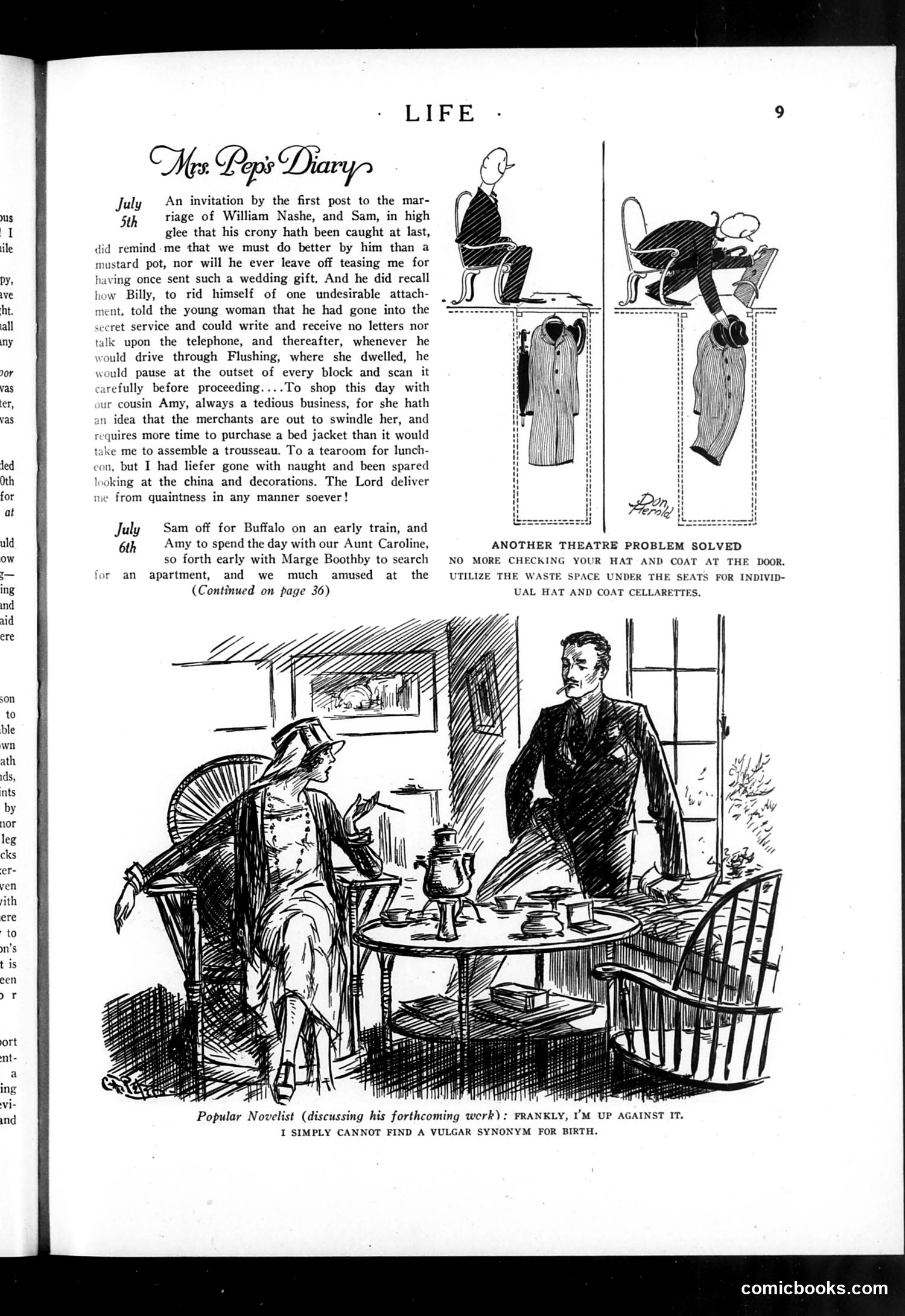
This page from *Life* magazine presents a satirical domestic diary entry and two illustrations mocking early-20th-century upper-class social conventions. **The Diary Section** humorously chronicles a woman's frustrations with shopping for wedding gifts and theater outings—typical leisure activities of wealthy society women. **Top Illustration** satirizes theater etiquette, specifically the impractical problem of hat and coat storage during performances. The solution shown—hanging garments under theater seats—lampoons both the fashion of large women's hats that obstructed views and the inadequate facilities at theaters. **Bottom Illustration** depicts a popular novelist struggling to find a "vulgar synonym for birth" in his work. This satirizes Victorian-era prudishness about discussing bodily functions, even in literature—a common target of *Life*'s social satire during the early 1900s.
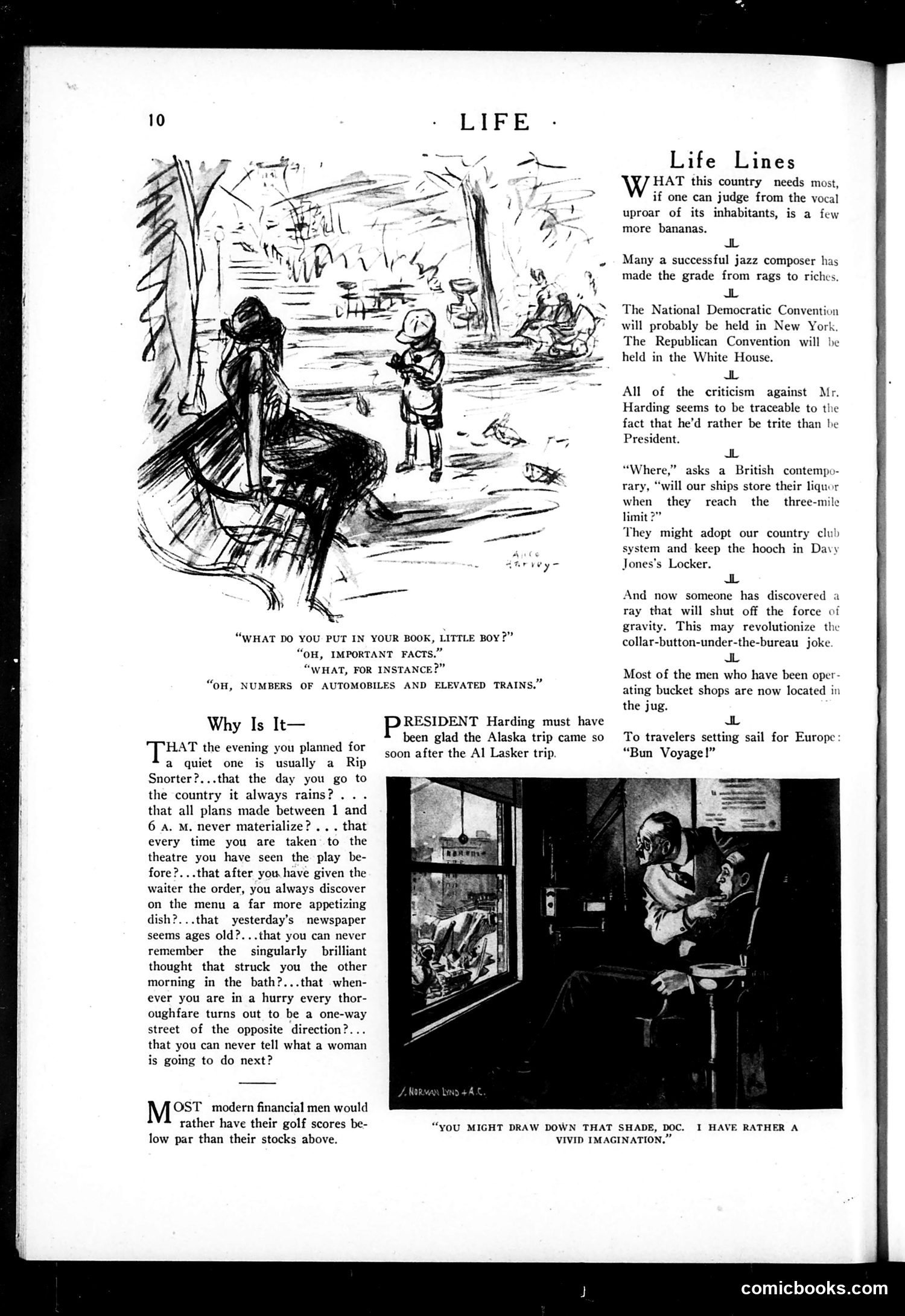
The main cartoon depicts a child showing an adult a book, with dialogue about "important facts" including "numbers of automobiles and elevated trains." The accompanying essay "Why Is It—" satirizes modern urban life's unpredictability: canceled plans, materialized theater dates, menu surprises, and directional confusion in cities. The "Life Lines" section contains brief satirical observations, including a reference to President Harding preferring "trite" behavior to presidential dignity, and jokes about jazz composers, political conventions, and Prohibition (the "three-mile limit" for storing liquor on ships). The lower photograph shows someone drawing window shades, captioned about "vivid imagination," likely satirizing escapism or creative daydreaming during mundane moments. This reflects 1920s urban anxieties and the era's social transitions.
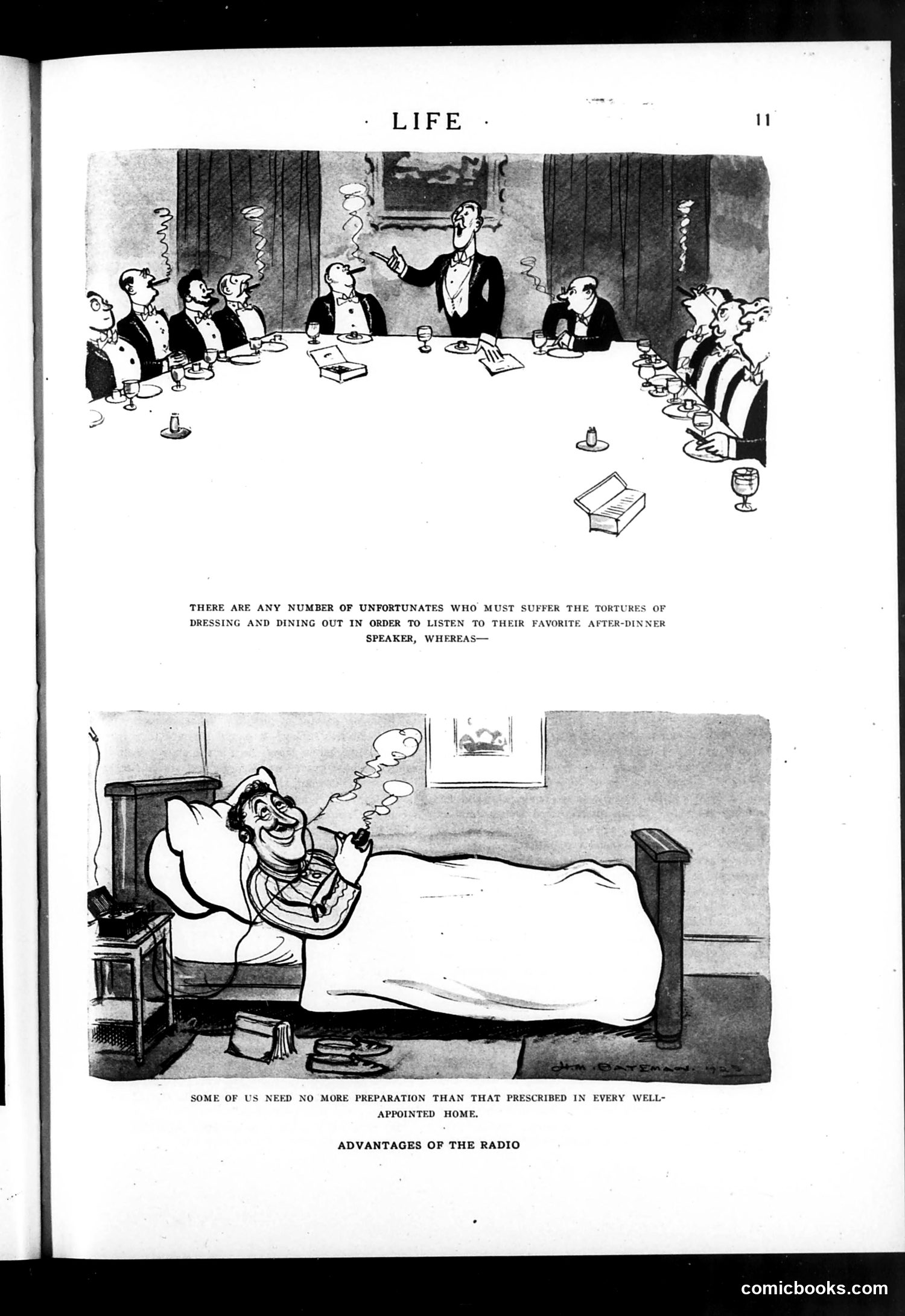
This page satirizes radio as a social escape from formal obligations. The top cartoon shows well-dressed men at a formal dinner table, with the caption noting that unfortunate guests must "suffer the tortures of dressing and dining out in order to listen to their favorite after-dinner speaker." The bottom cartoon presents the satirical "solution": a slovenly man lounging in bed in casual undress, smoking and listening to the radio—requiring "no more preparation than that prescribed in every well-appointed home." The satire contrasts the tedium of formal social dining with radio listening's convenience and comfort. Radio allows people to enjoy entertainment without dressing up or leaving home—presented both as liberation and as a commentary on declining standards of formality in modern society.
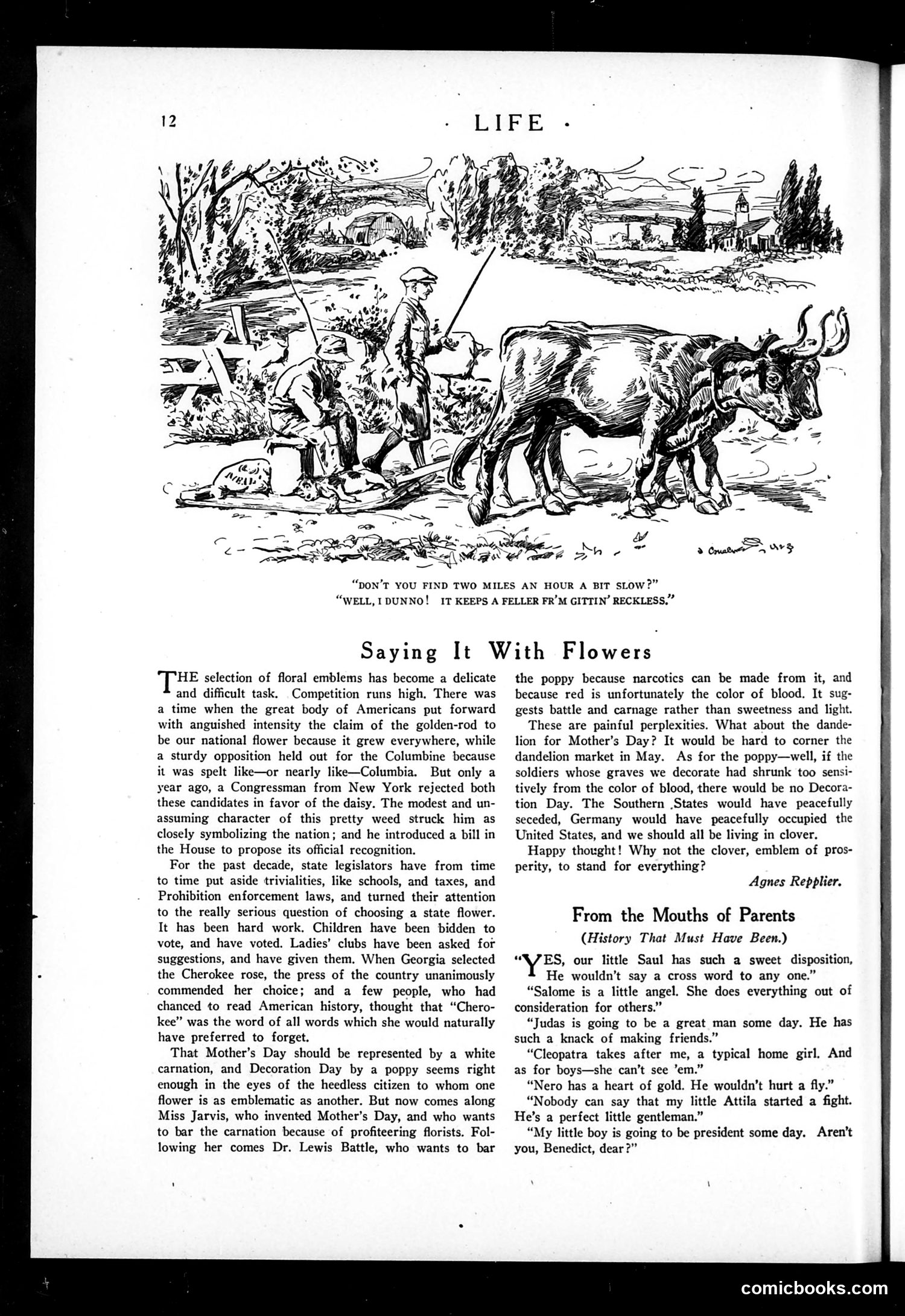
The main cartoon depicts a farmer with oxen, addressing another man: "Don't you find two miles an hour a bit slow?" The response, "Well, I dunno! It keeps a feller fr'm gittin' reckless," is a rural humor joke about the deliberately slow pace of ox-drawn farming—suggesting that slowness, while inefficient, prevents dangerous accidents or recklessness. Below, the article "Saying It With Flowers" discusses the contentious debate over selecting a national flower, mentioning Congressional proposals for the golden-rod versus the Columbine. The text satirizes the difficulty of this "delicate task" and references ongoing political disagreements about floral symbolism for Mother's Day and Decoration Day. The subsequent section presents parents' quotations about their children's character traits—apparently humorous observations of parental perspective.
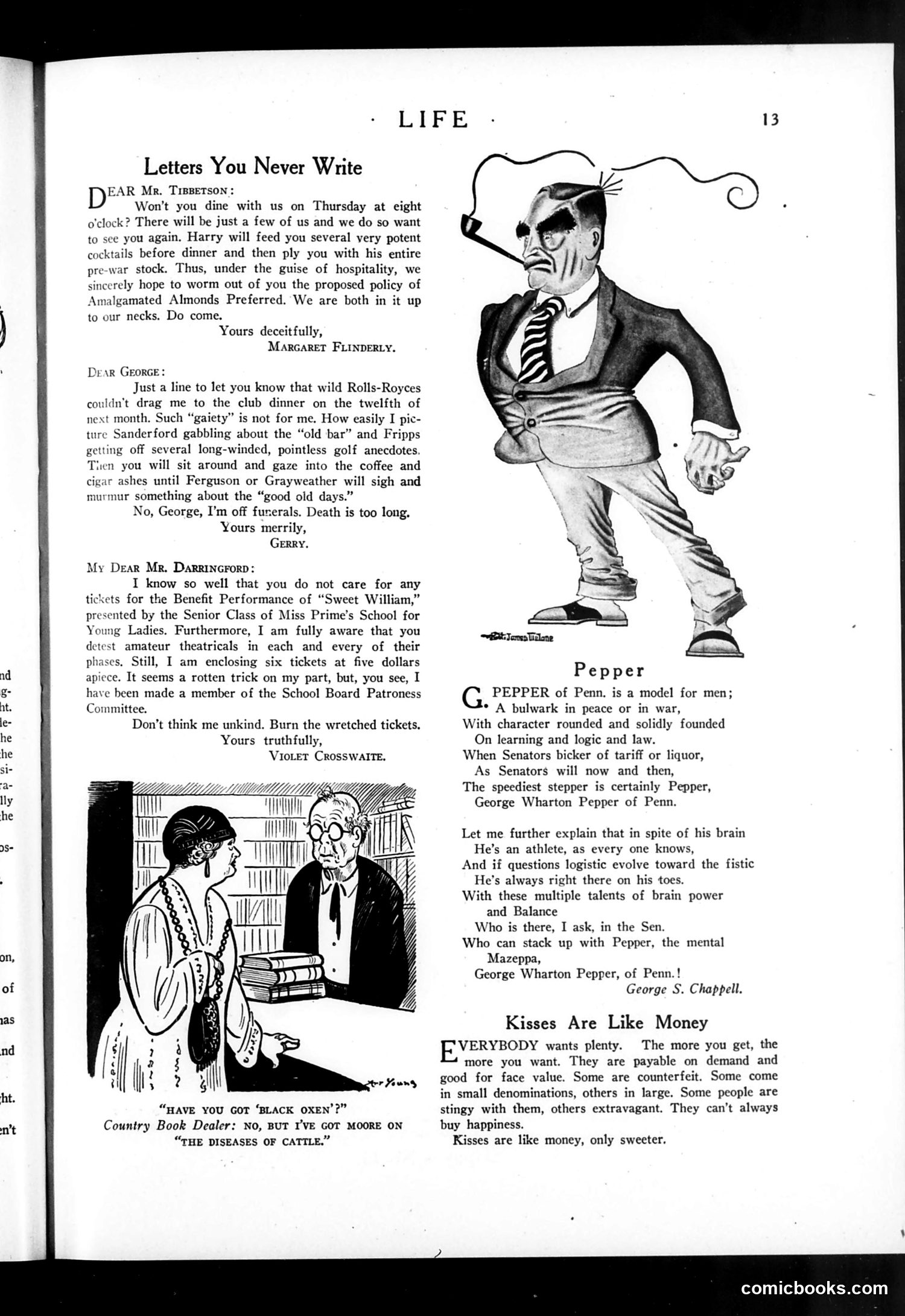
This page contains satirical "Letters You Never Write" and illustrations mocking social conventions. The main cartoon depicts "Pepper" of Penn (likely George Wharton Pepper, a Pennsylvania public figure), shown as a bombastic, gesturing man in business attire—caricatured as someone who talks excessively about his own importance. The bottom illustration shows a woman presenting books to an elderly man, captioned "Have you got 'black oxen'?"—referencing a 1920s play about aging and rejuvenation, satirizing dated literary tastes. The letters mock polite social refusals: declining a dinner invitation, avoiding a club event, and rejecting charity ticket sales. The satire targets how people construct excuses rather than simply declining social obligations. The final section, "Kisses Are Like Money," compares romantic affection to currency—some valuable, some counterfeit.
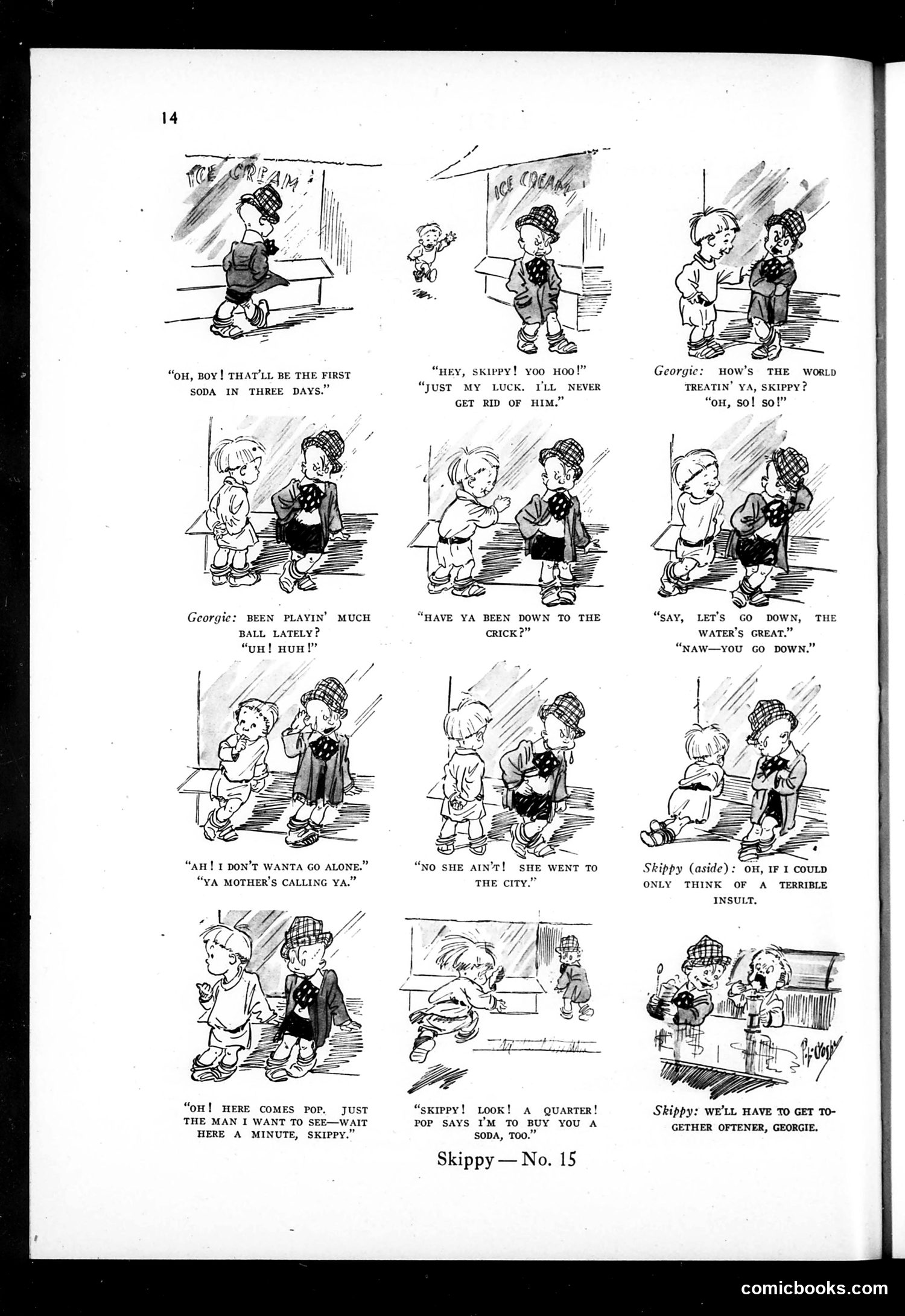
This is a children's comic strip featuring two young boys named Skippy and Georgie. The narrative follows Skippy's scheme to acquire soda by promising Georgie he'll be "first" to get one within three days. Georgie pursues Skippy relentlessly, seeking the promised soda. The humor derives from: - **Children's persistence**: Georgie's dogged pursuit of Skippy despite repeated deflections - **Social dynamics**: Skippy's attempts to escape his friend's company, culminating in his mother's intervention - **Economic reality**: The boys' eagerness for small treats (soda) and eventual need to pool resources The strip reflects early 20th-century childhood culture where modest treats were genuine treasures and neighborhood friendships involved playful schemes and obligations.
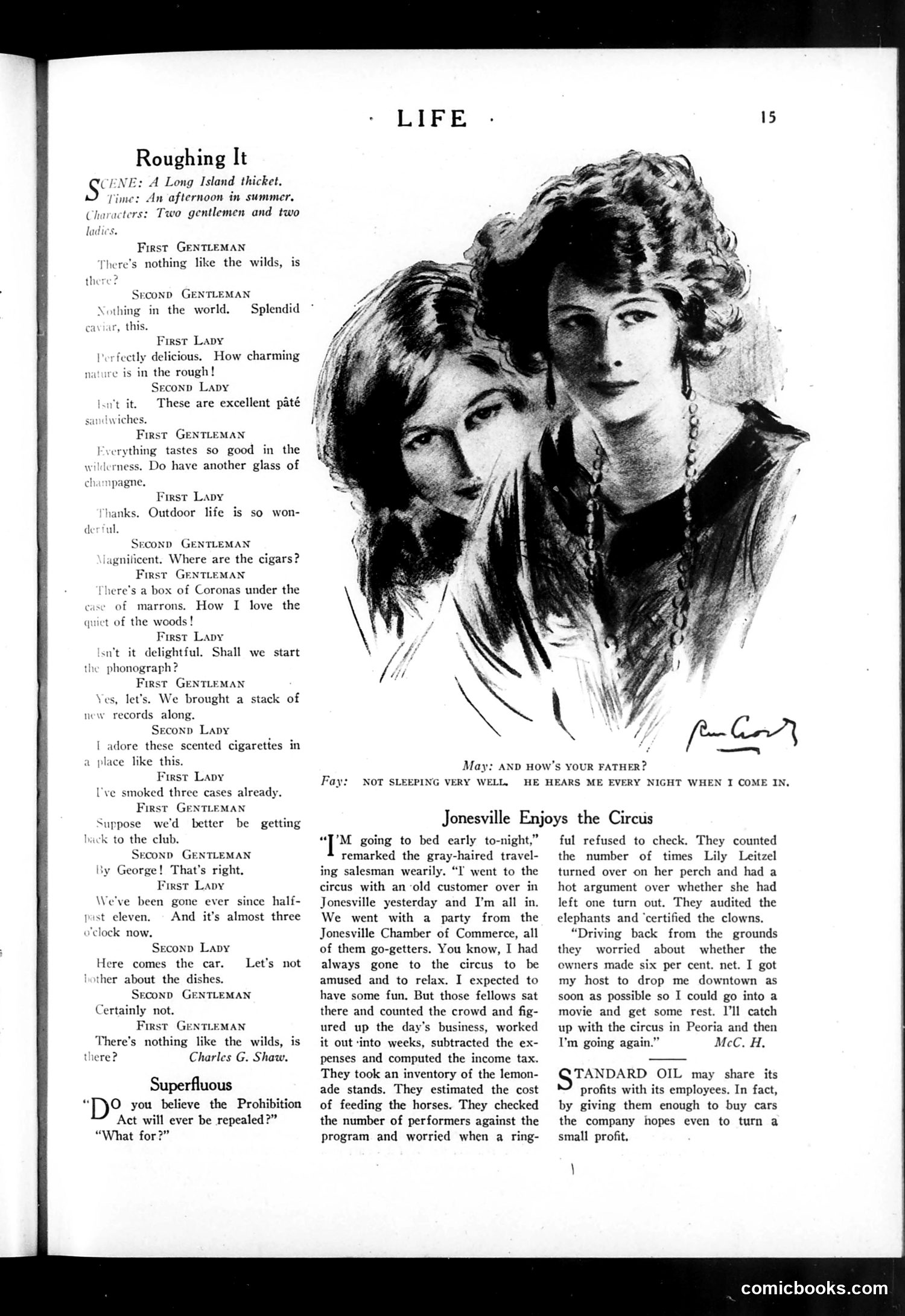
This cartoon mocks wealthy New Yorkers who claim to love "roughing it" in nature while bringing all their urban luxuries along. The joke: the couple discusses the wilderness's charms while enjoying champagne, pâté sandwiches, cigars (Coronas), a phonograph with records, and scented cigarettes. They abandon their "outdoor adventure" after just three hours to return to their club. The satirical point is the contradiction between romanticizing rustic simplicity and their complete inability—or unwillingness—to actually rough it. They've brought civilization's comforts into nature and call it authentic. The final line from Charles G. Shaw drives this home: "There's nothing like the wilds, is there?"—exposing their self-delusion. This reflects Jazz Age anxiety about authenticity and class pretension among the wealthy.
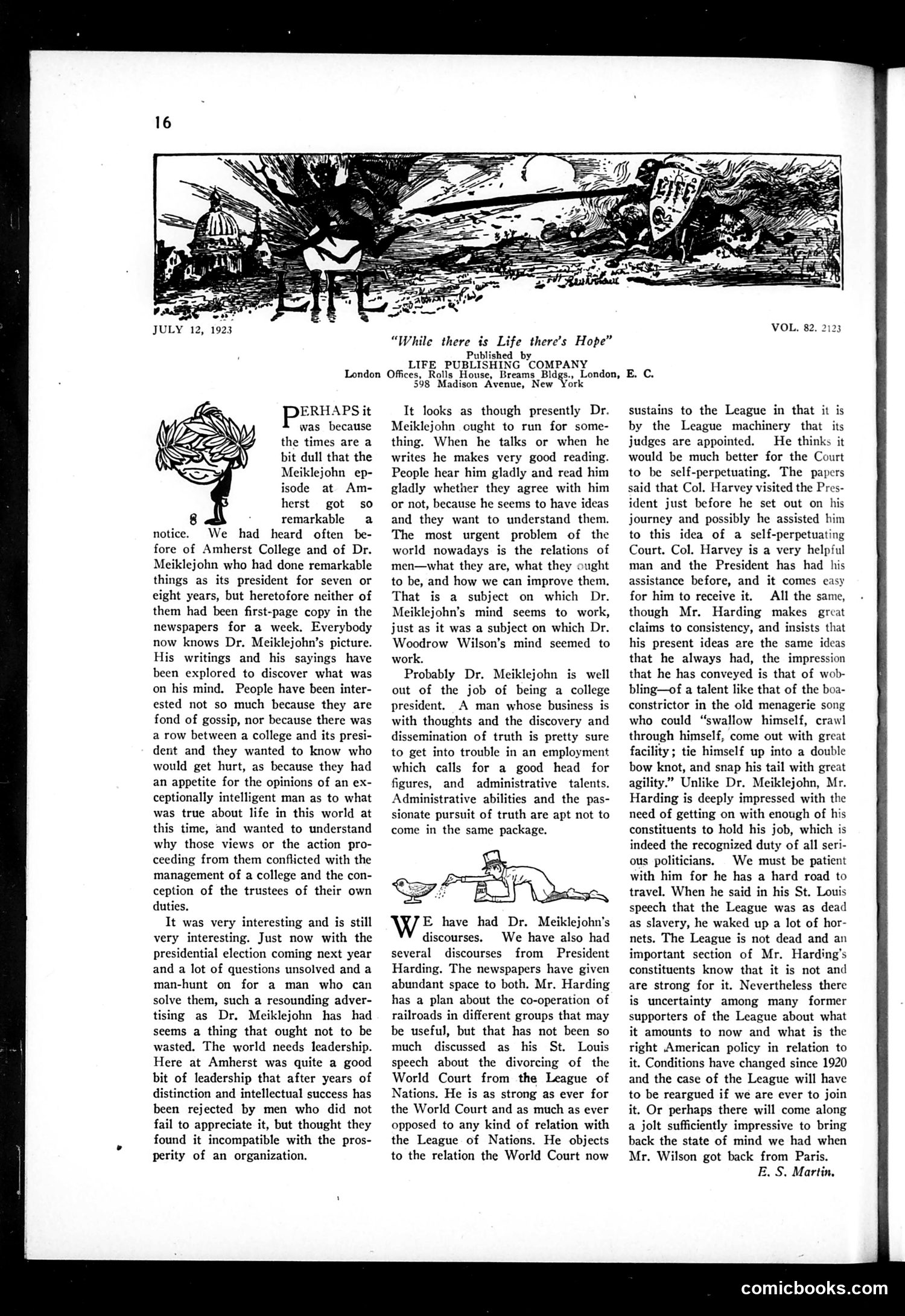
This editorial page discusses Dr. Alexander Meiklejohn's recent departure from Amherst College, which generated significant media attention. The writer argues Meiklejohn—an intellectual known for thoughtful discourse on human relations and social problems—was poorly suited to college administration, which requires different skills (financial management, figures). The piece suggests Meiklejohn should enter politics, comparing him favorably to Woodrow Wilson as a thinker addressing urgent world problems. The editorial then pivots to President Harding, contrasting his practical railroad cooperation plan (little discussed) with his more publicized St. Louis speech opposing the League of Nations' control over the World Court's judicial appointments. The cartoons appear to be decorative headers typical of Life's satirical format. The overall satire critiques how the public and press engage with ideas: intellectual discourse captures attention while practical policy goes unnoticed, and politicians like Harding face less scrutiny than academics like Meiklejohn.
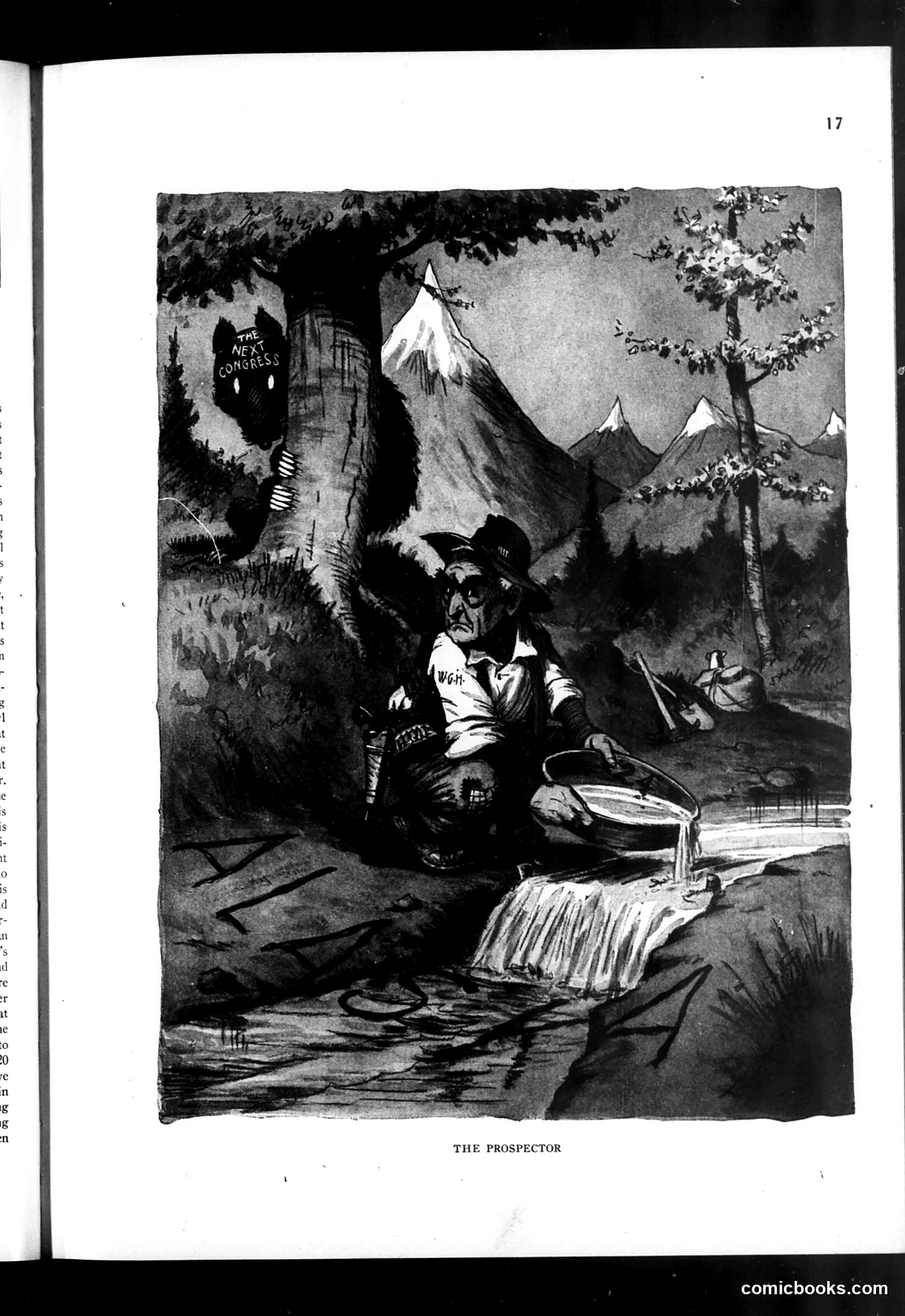
This political cartoon depicts a weary prospector seated by a stream in a mountainous landscape, examining what appears to be mining pans or equipment. A tree nearby bears a sign reading "CONGRESS," suggesting the cartoon uses the prospector as a metaphor for Congress or politicians engaged in resource extraction. The image likely satirizes Congressional efforts to exploit natural resources or public lands—a common theme in Life magazine's social commentary. The prospector's exhausted posture and isolated setting suggest futility or disillusionment with such ventures. The specific historical context—whether referencing mining legislation, conservation debates, or resource conflicts—remains unclear without additional publication date or caption information, but the cartoon clearly critiques some aspect of Congressional economic or environmental policy.
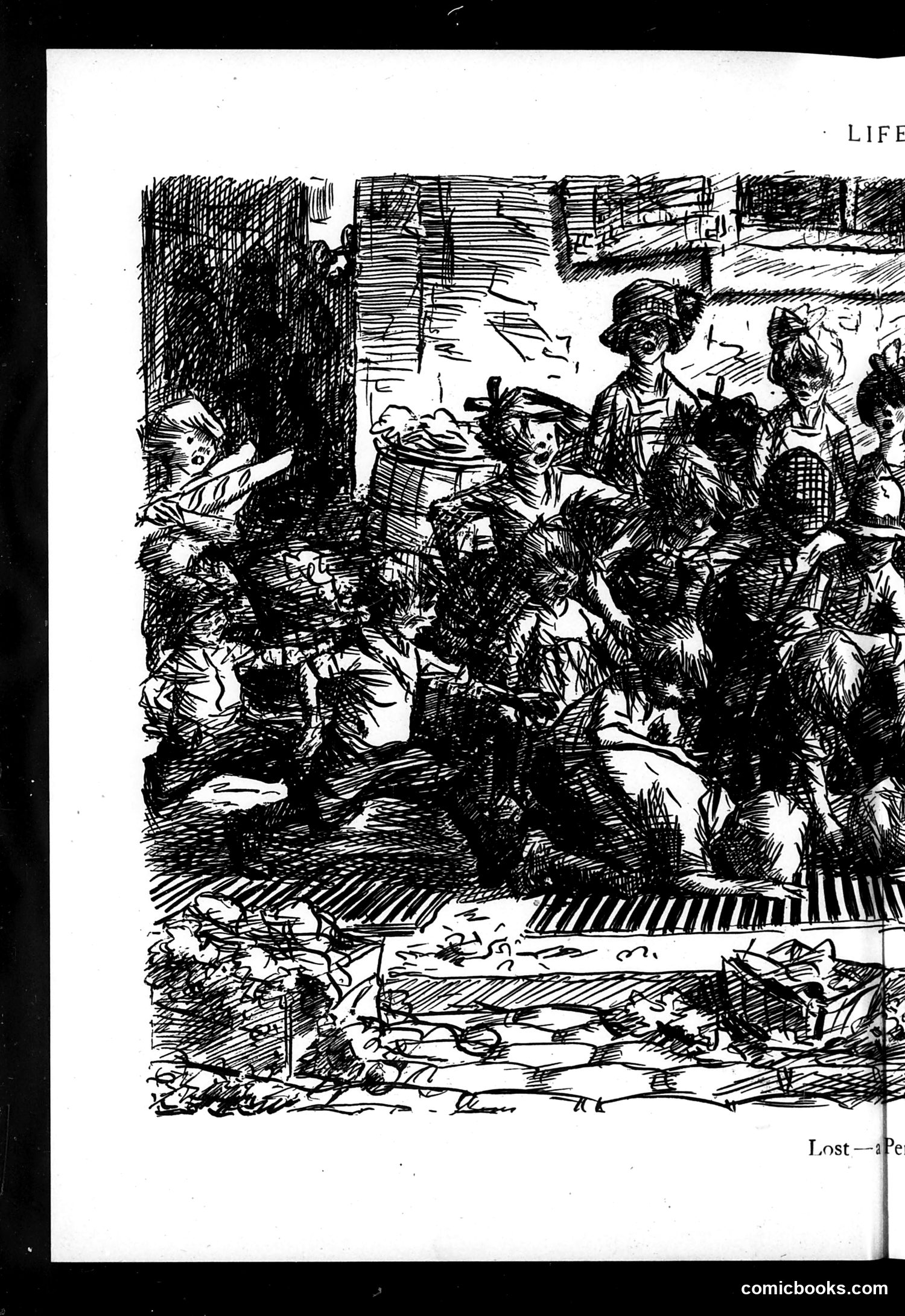
This appears to be a satirical sketch from Life magazine titled "Lost—a Pe[rson]" (the title is cut off). The heavily cross-hatched ink drawing depicts a chaotic scene with multiple figures in what appears to be a public or institutional setting, with wooden structures visible in the background. The composition is crowded and energetic, suggesting confusion or disorder. However, the OCR text is too corrupted to identify specific political figures or events. The sketch's style and the magazine's satirical nature suggest social or political commentary, but **without clearer text or visible identifying details**, I cannot definitively explain what specific situation, person, or scandal this cartoon references. The "lost" theme might address a missing public figure or a missing solution to a contemporary problem, but this remains unclear from the available information.
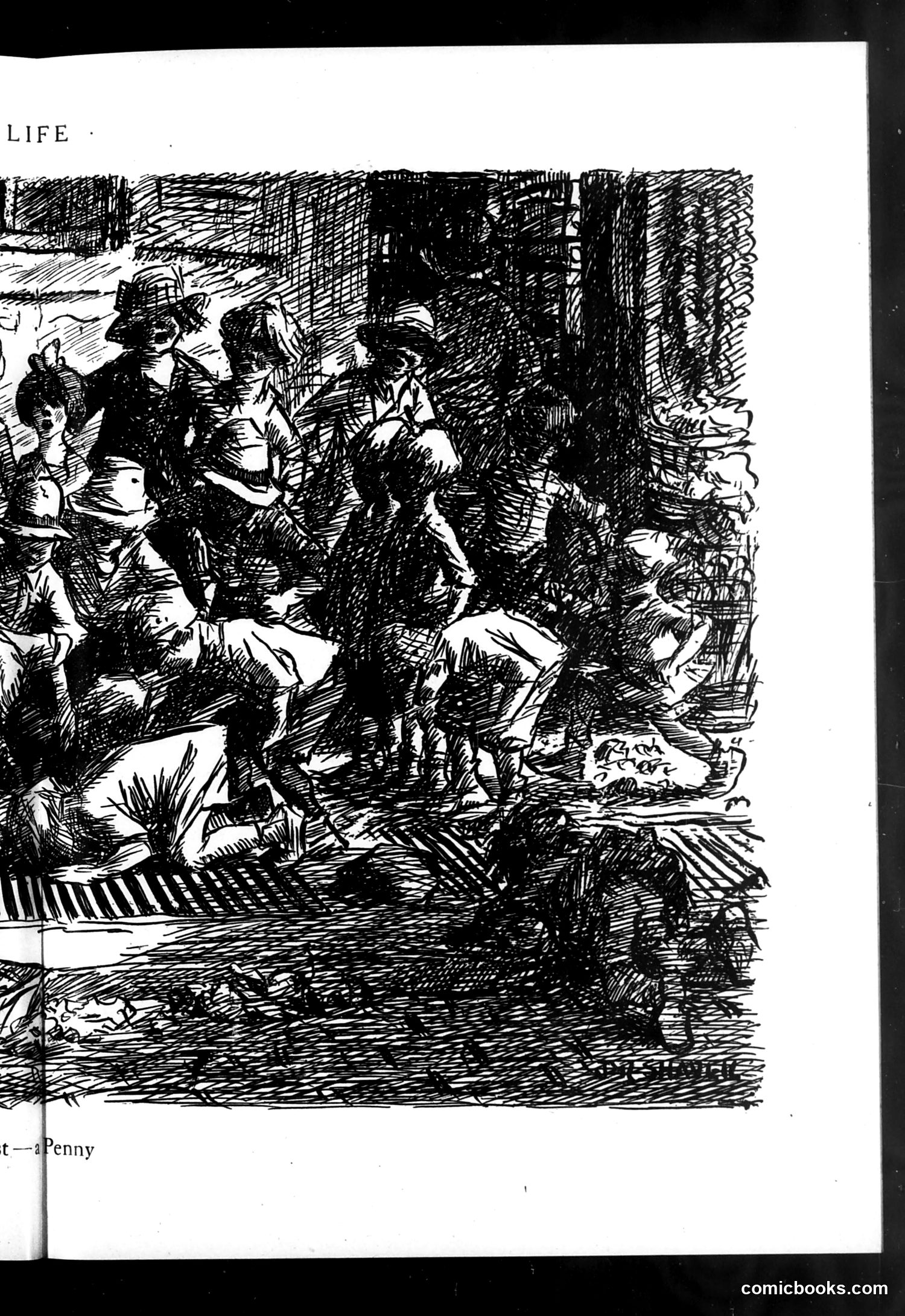
This page from *Life* magazine shows a crowded interior scene rendered in bold black-ink cross-hatching. The word "LIFE" appears at the top, and "Penny" is visible at the bottom left, suggesting this may be a caption or section heading related to working-class or modest-income life. The image depicts what appears to be a crowded public space—possibly a tenement, boarding house, or public gathering—with numerous figures in period clothing (hats, coats suggest early 20th century). The dense, chaotic composition and heavy inking style emphasize the overcrowding and social conditions. Without additional text visible, the specific satirical point remains unclear, though the subject matter suggests social commentary on urban poverty, immigration, or working-class living conditions—common themes in *Life* magazine's satirical coverage.
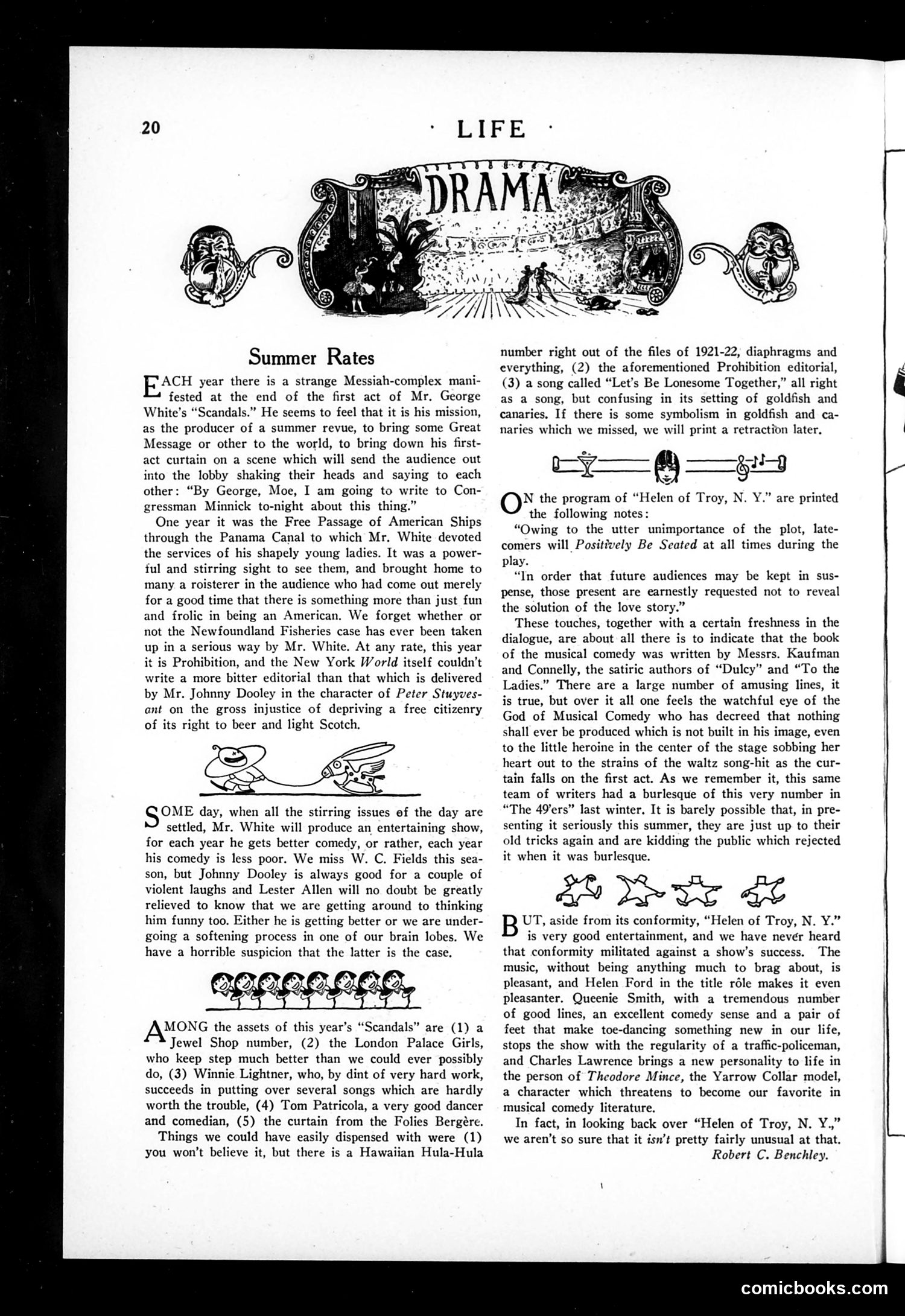
This page reviews George White's theatrical revue "Scandals," criticizing its producer's tendency to inject heavy social messaging into entertainment. The critic notes White uses his show's finale to make political points—previously about Panama Canal shipping rights, now about **Prohibition** (the 1920-33 alcohol ban). Actor **Johnny Dooley** delivers a bitter editorial-style monologue as Peter Stuyvesant, lamenting citizens' lost right to "beer and light Scotch." The reviewer finds this preachy approach tedious, arguing White should focus on comedy rather than moral crusades. The piece also reviews "Helen of Troy, N.Y.," praising its witty program notes but noting the musical follows formulaic conventions despite being written by clever satirists (Kaufman and Connelly). The criticism reflects Jazz Age skepticism toward Prohibition—treating it as an absurd government intrusion on personal freedom worth mocking on stage.
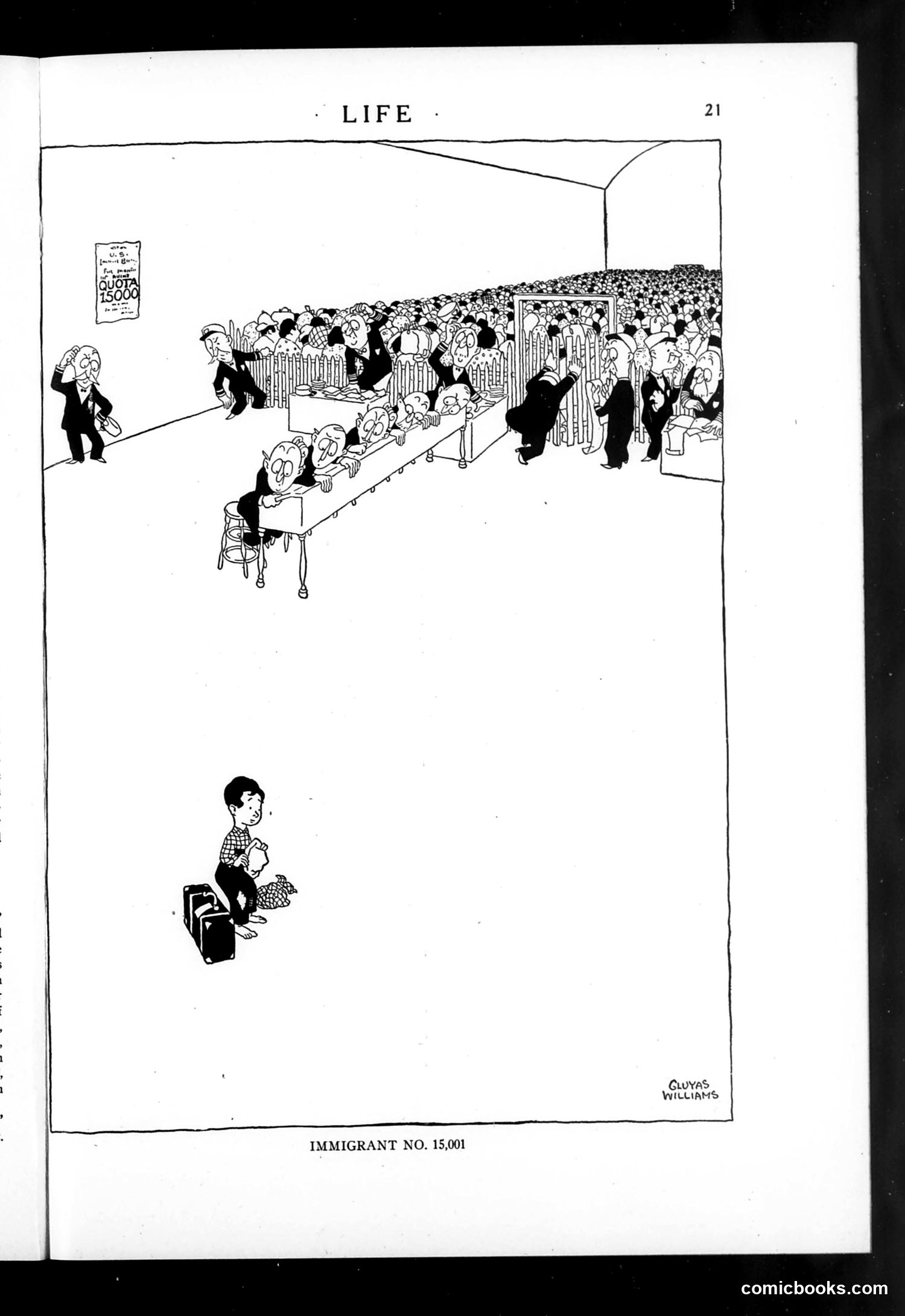
This cartoon by Clayas Williams satirizes immigration processing and quotas in early 20th-century America. A lone child immigrant sits isolated in the foreground with a suitcase, marked as "Immigrant No. 15,001"—suggesting bureaucratic dehumanization through numbering systems. Behind them, a massive crowded facility processes countless immigrants through orderly queues and gates. The scale contrast emphasizes how individual human stories are reduced to statistics within an industrial immigration system. The "quota" poster visible on the wall likely references restrictive immigration laws of the 1920s-1930s that limited newcomers by nationality. The cartoon critiques both the depersonalizing machinery of immigration bureaucracy and America's increasingly restrictive immigration policies during this era.
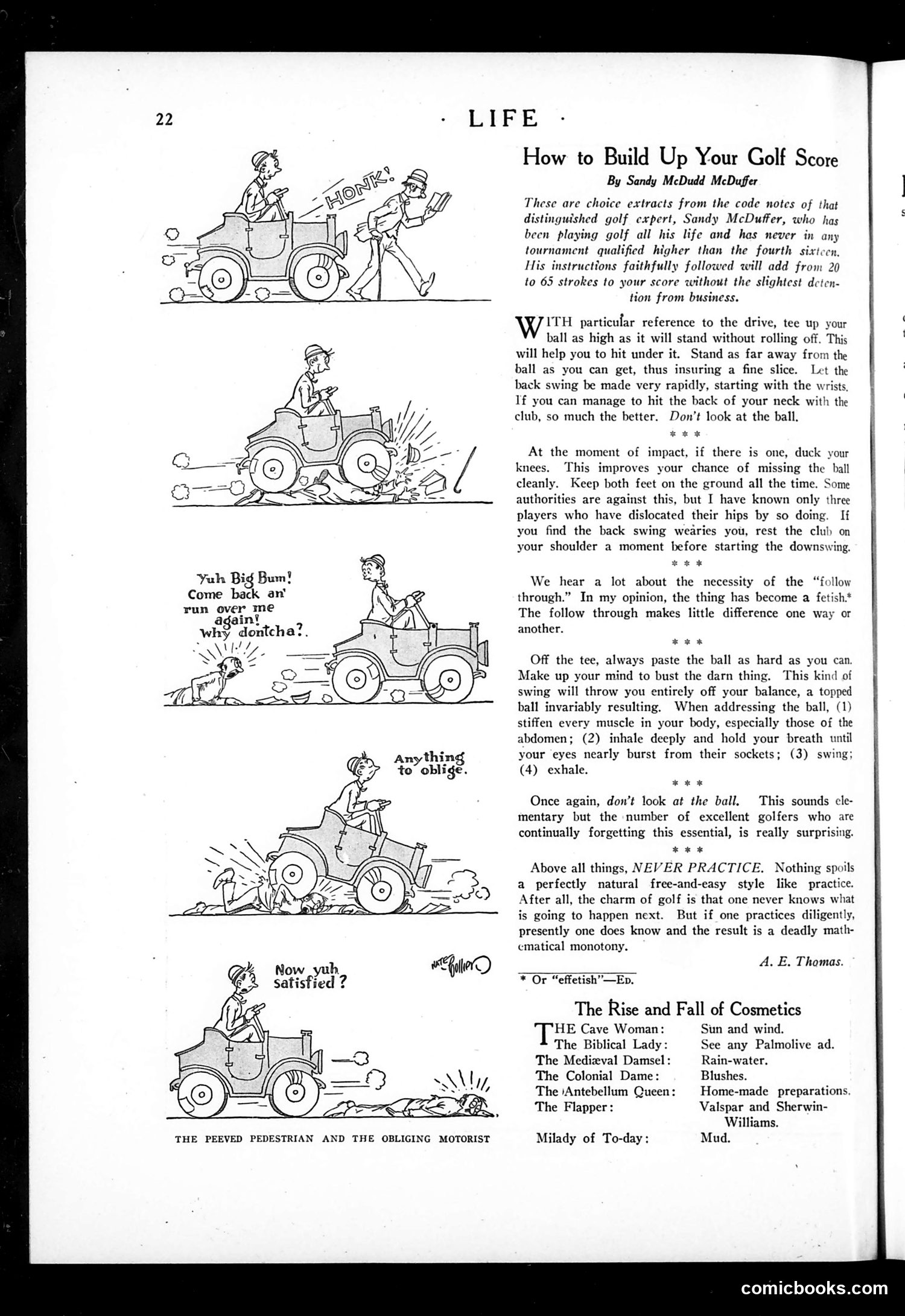
This page contains humorous golf advice and a historical sidebar. The main content is a satirical instructional article by "Sandy McDuff McDuffer," a fictional incompetent golfer who deliberately gives terrible advice—standing too far from the ball, hitting oneself in the neck, never looking at the ball, never practicing. The joke is that following these instructions would add 20-65 strokes to one's score. The cartoons show a hapless motorist repeatedly hitting a pedestrian, illustrating the absurdist consequences of bad technique. The accompanying sidebar, "The Rise and Fall of Cosmetics," humorously traces women's beauty practices from cave times to the present day, ending with "Mud"—suggesting 1920s flappers (the "Milady of To-day") used minimal or no makeup compared to previous eras, a cultural shift reflecting changing beauty standards of that era. The humor relies on the reader understanding how dramatically cosmetic practices had shifted in recent decades.
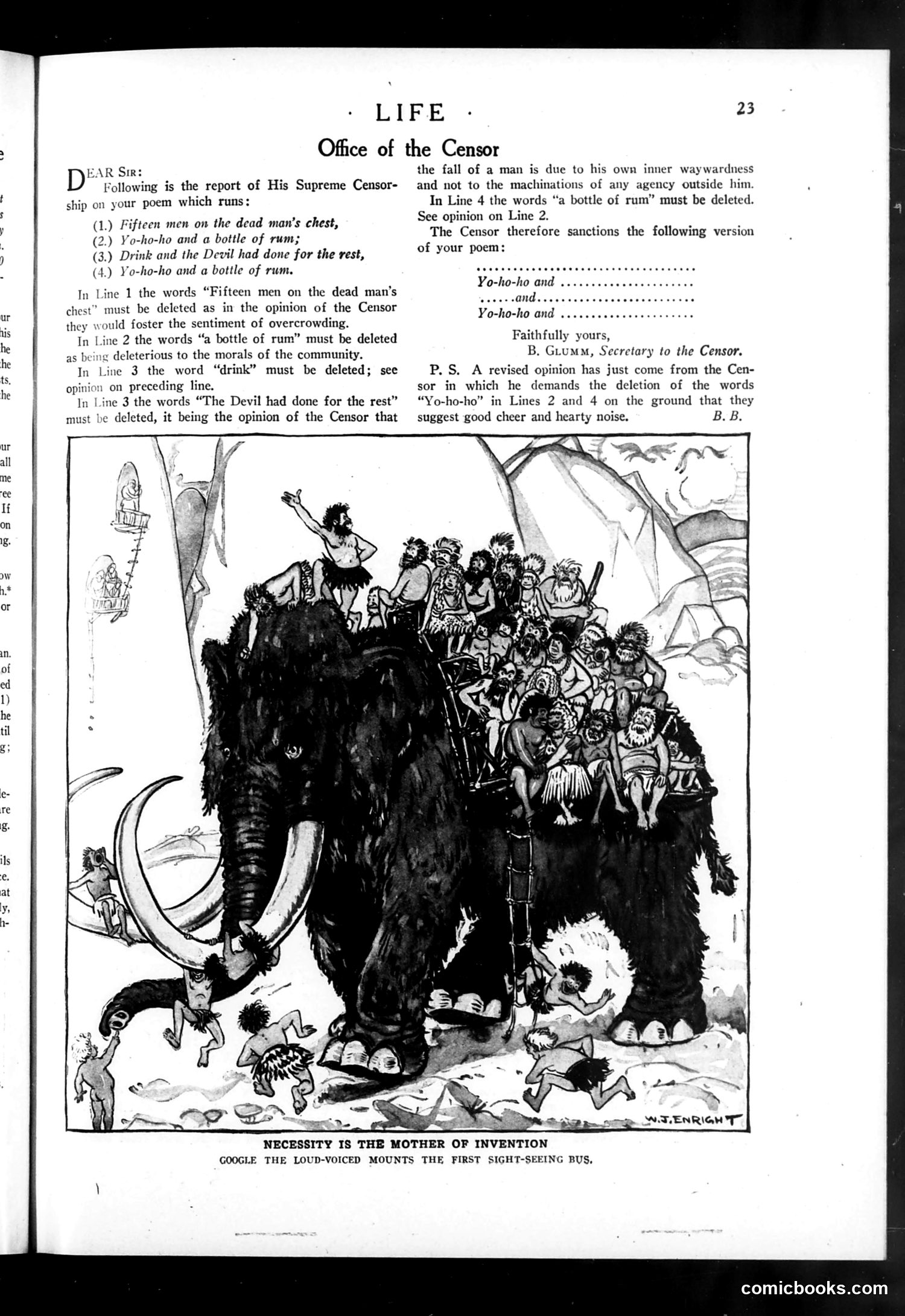
This page satirizes wartime censorship through two pieces: **Text Section**: A mock letter from a "Supreme Censor" absurdly censoring the pirate song "Fifteen Men on a Dead Man's Chest." Each stanza is gutted for ridiculous reasons: "fifteen men" fosters "overcrowding," "rum" corrupts morals, "drink" is deleted, and even "the Devil" is removed because the censor believes humans fail through personal weakness, not external evil. A postscript adds that cheerful noises like "Yo-ho-ho" must go. This mocks heavy-handed wartime censorship that eliminated anything deemed immoral or damaging to morale. **Cartoon Below**: Titled "Necessity Is the Mother of Invention," it shows a massive elephant packed with sightseers labeled "Google the Loud-Voiced Mounts the First Sight-Seeing Bus." This appears to satirize creative wartime solutions or the absurdity of adapting to resource scarcity—likely referencing transportation rationing or innovations during WWI (the likely period based on Life's prominence then). Both mock government overreach and wartime restrictions on everyday life.
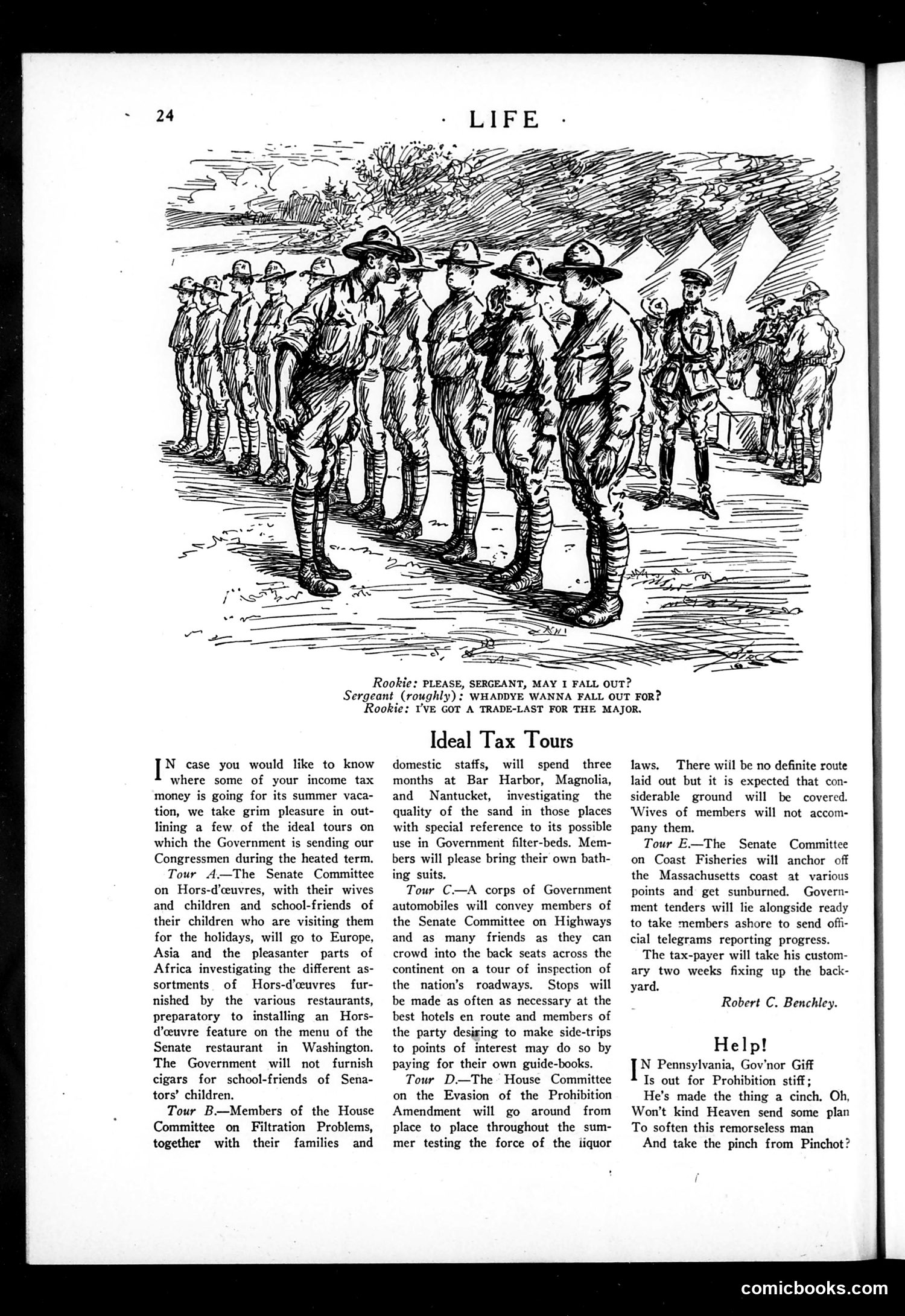
This is a satirical piece by Robert C. Benchley mocking Congressional extravagance during summer recess. The cartoon above depicts soldiers or military personnel, likely illustrating the absurdity of government-funded leisure disguised as official business. Benchley's text ridicules five fictional "Tours" where Congress members take taxpayer-funded vacations under pretense of investigation: - **Tour A**: Senators touring Europe/Asia studying "hors d'oeuvres" for a Senate restaurant - **Tour B**: House members examining sand quality at luxury resorts - **Tour C**: Cross-country highway inspection via best hotels - **Tour D**: A Prohibition Committee "testing" liquor laws nationwide - **Tour E**: Coastal "fishing research" with government support The joke: Congress wastes tax money on lavish trips justified by trivial official purposes. The final item mentions Pennsylvania Governor Giff (likely Gifford Pinchot) enforcing Prohibition—contrasting ordinary citizens' restricted two-week vacations fixing their yards versus politicians' extended government-funded trips.
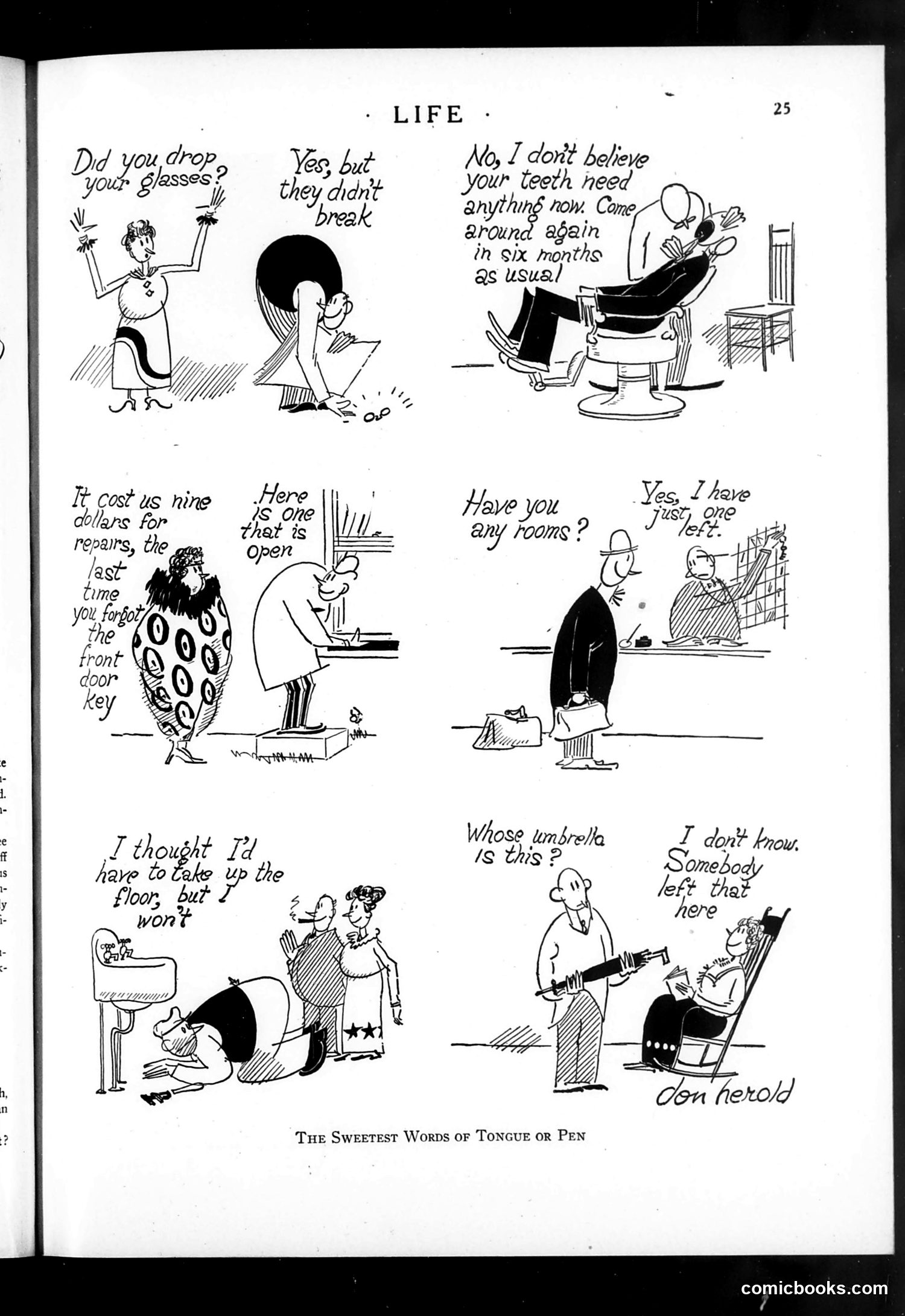
This page presents six domestic humor vignettes satirizing everyday married life and household frustrations: 1. **Dropped glasses**: A wife asks if her husband broke his glasses; he denies it despite obvious damage. 2. **Dentist visit**: A dentist dismissively tells a patient to return in six months—standard procrastination. 3. **Repair costs**: A wife complains about expensive home repairs while her husband hides the front door key. 4. **Apartment hunting**: A landlord claims only one room remains available. 5. **Flooring complaint**: A wife mentions floor repairs; her husband avoids responsibility by lying on the ground. 6. **Umbrella mystery**: Someone questions whose umbrella is present; no one claims it. The title suggests these are "sweet words" of domestic life—ironic, since the comics depict deception, avoidance, and marital bickering. This reflects early-20th-century humor about the gap between romantic ideals and mundane married reality.
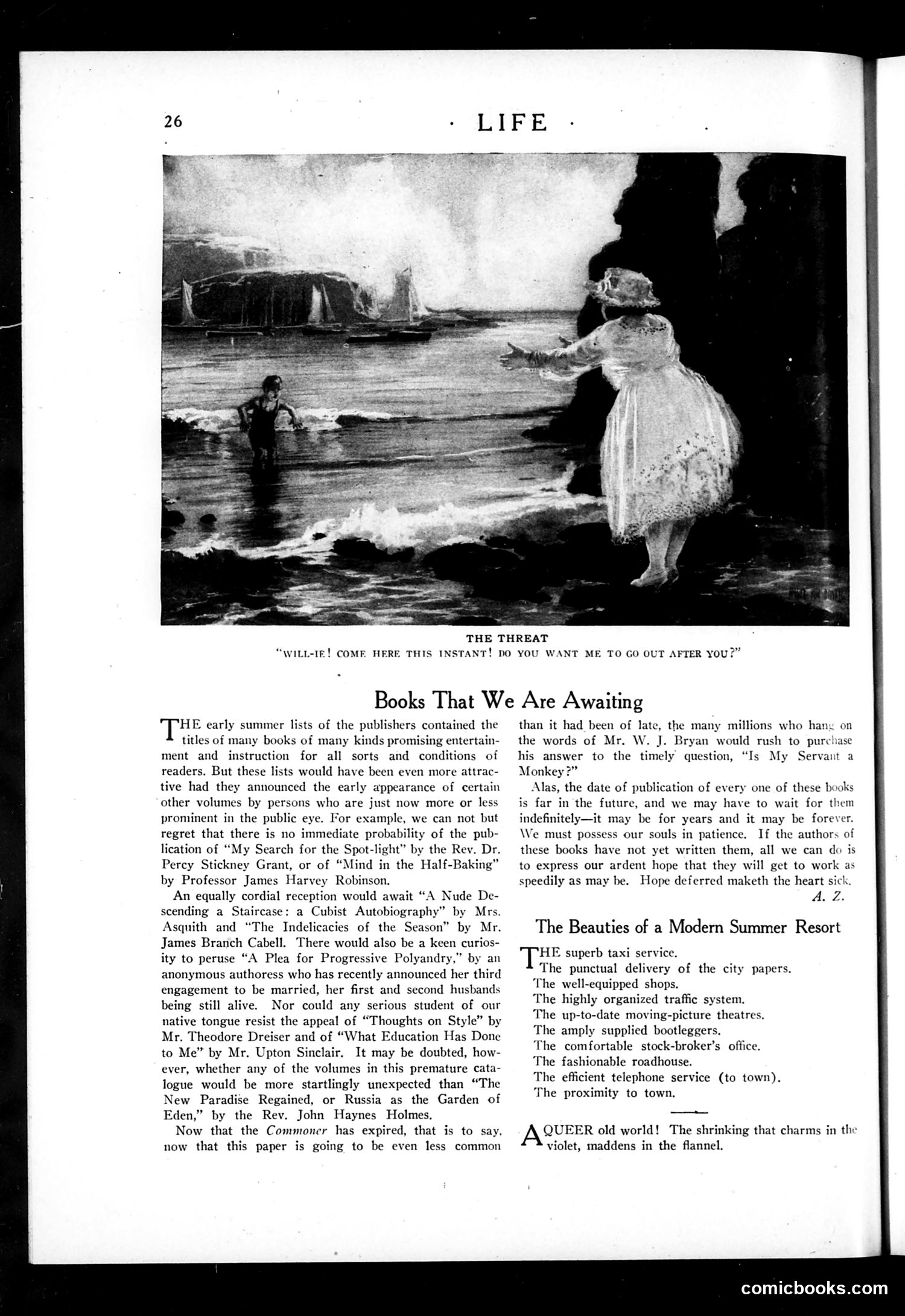
**"The Threat" Cartoon:** Shows a woman at a beach calling to a boy ("Willie") in the water, threatening to fetch him herself if he doesn't come immediately. This depicts a common domestic scenario—parental discipline and child obedience—rendered as gentle social satire about authority and childhood independence. **"Books That We Are Awaiting":** This satirical essay mocks prominent public figures by imagining absurd books they might write. It references real contemporaries like Rev. Percy Stickney Grant, Mrs. Asquith (wife of British PM), Theodore Dreiser, Upton Sinclair, and W.J. Bryan. The jokes target their known controversies or quirks—Dreiser's writing style, Sinclair's radical views, Bryan's dated agrarianism. The piece implies these figures are so self-absorbed or problematic that their memoirs would be unintentionally ridiculous. **"Summer Resort" Section:** Lists the supposed attractions of modern resorts, sarcastically including "amply supplied bootleggers" during Prohibition—the joke being that illegal liquor was essential to resort life despite legal prohibition. The page demonstrates Life's characteristic blend of visual and literary satire targeting contemporary public figures and social hypocrisy.
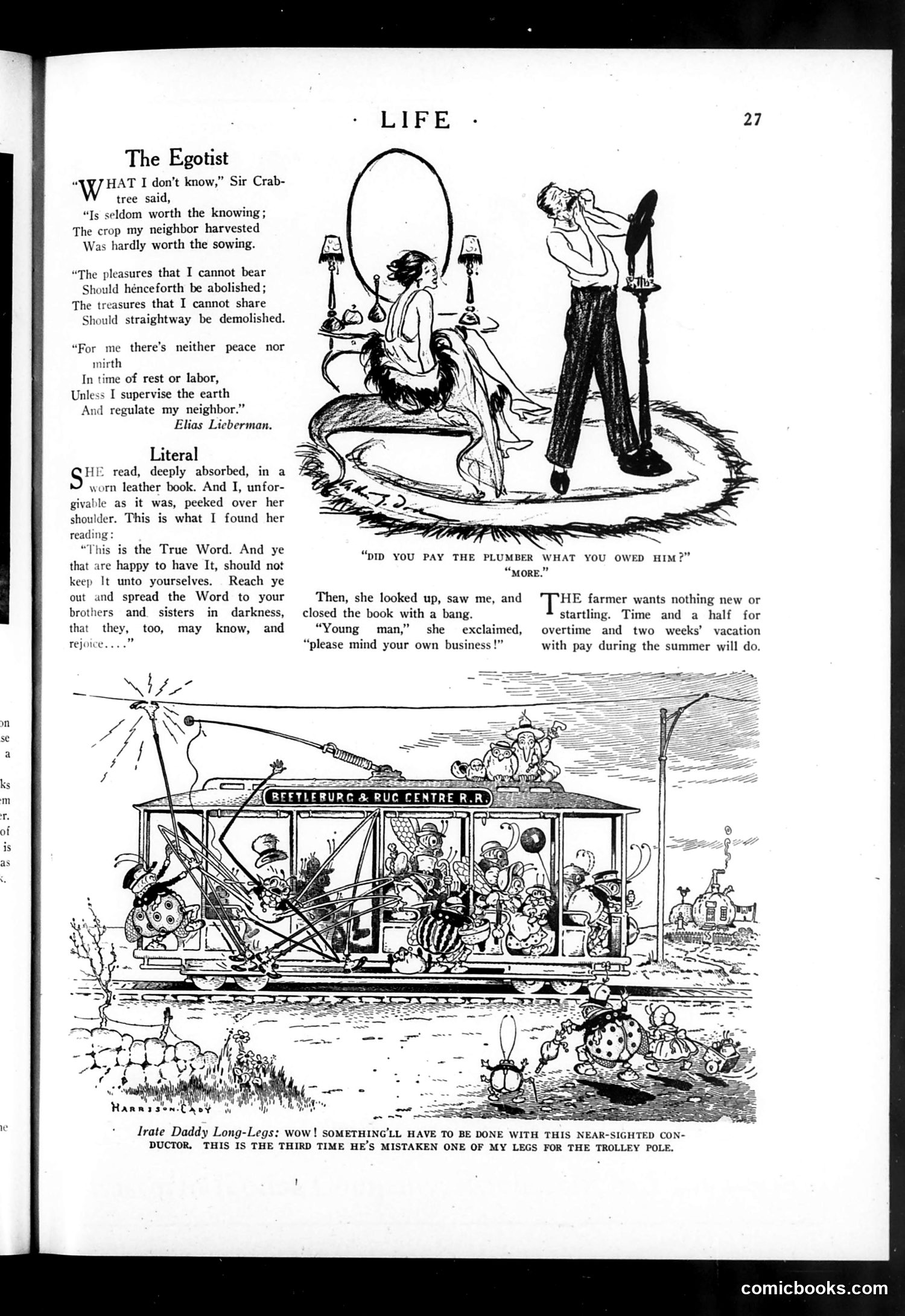
This page contains three distinct satirical pieces: **"The Egotist"** (poem by Elias Lieberman): Mocks self-centered people who believe only their knowledge matters and feel compelled to control others' affairs—"regulate my neighbor." The satire targets busybodies and those who can't tolerate others' autonomy. **"Literal"** (short story): Jokes about religious hypocrisy. A woman reads scripture about spreading "the Word" to others, but angrily tells the narrator to "mind your own business" when he looks over her shoulder. The humor lies in her failing to practice the very evangelism she preaches. **"Irate Daddy Long-Legs"** (cartoon caption): A visual gag about a nearsighted streetcar conductor repeatedly mistaking a tall passenger's long legs for the trolley pole. This plays on physical comedy and the hazards of inattentive public transportation workers. All three pieces share a theme: social criticism of inconsistency, self-absorption, and incompetence in everyday American life.
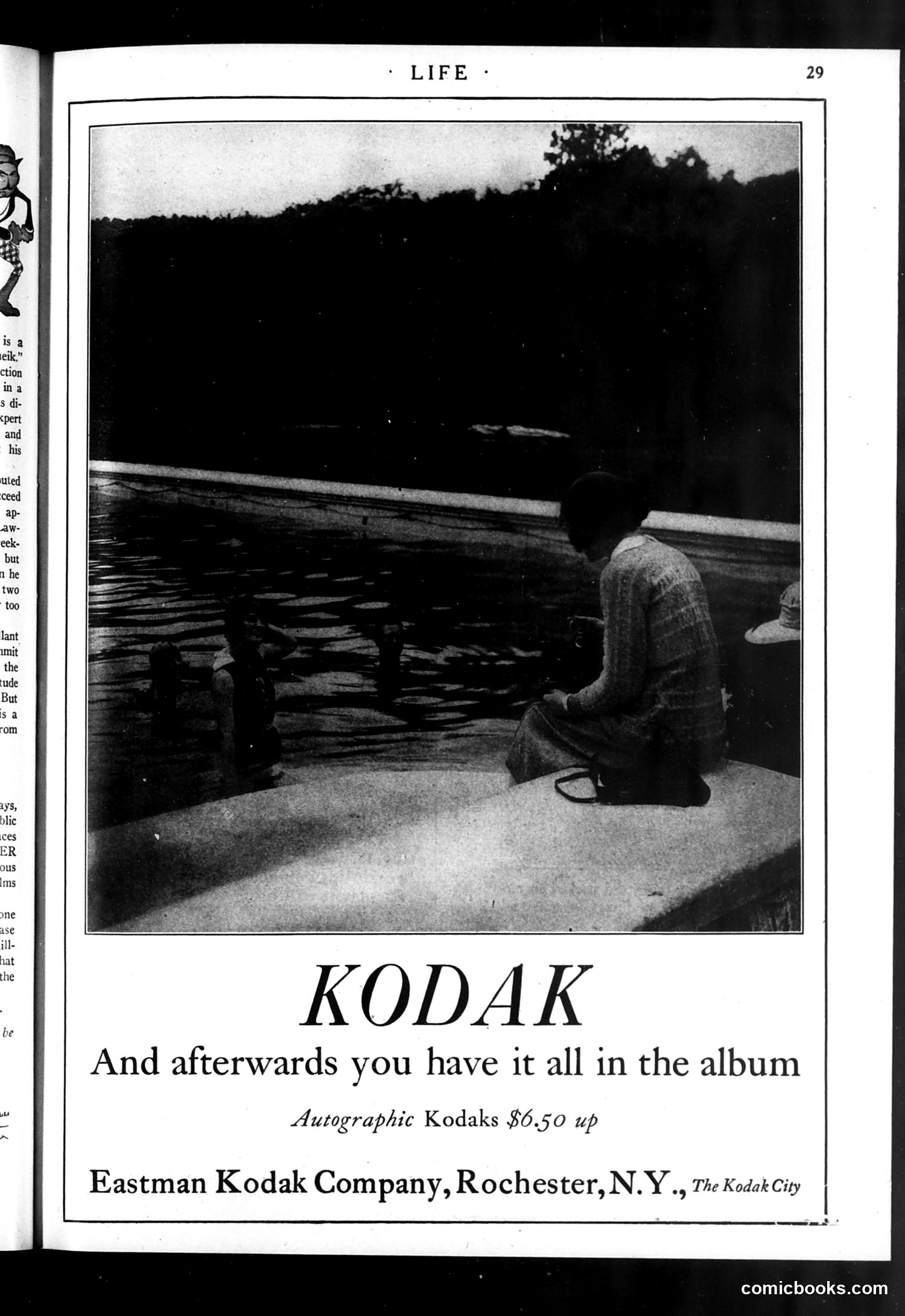
This is a **Kodak camera advertisement**, not political satire. The image shows a person photographing a scenic waterfront landscape with trees and water. The ad's tagline—"And afterwards you have it all in the album"—promotes the convenience of Autographic Kodak cameras (priced at $6.50 and up), which allowed users to add written notes directly onto film. The appeal is straightforward: ordinary people could capture and preserve memories of their outings and travels. This represents early 20th-century consumer marketing emphasizing personal photography as accessible leisure activity. The "Kodak City" reference identifies Rochester, New York as Eastman Kodak's headquarters, then the world's dominant camera manufacturer.
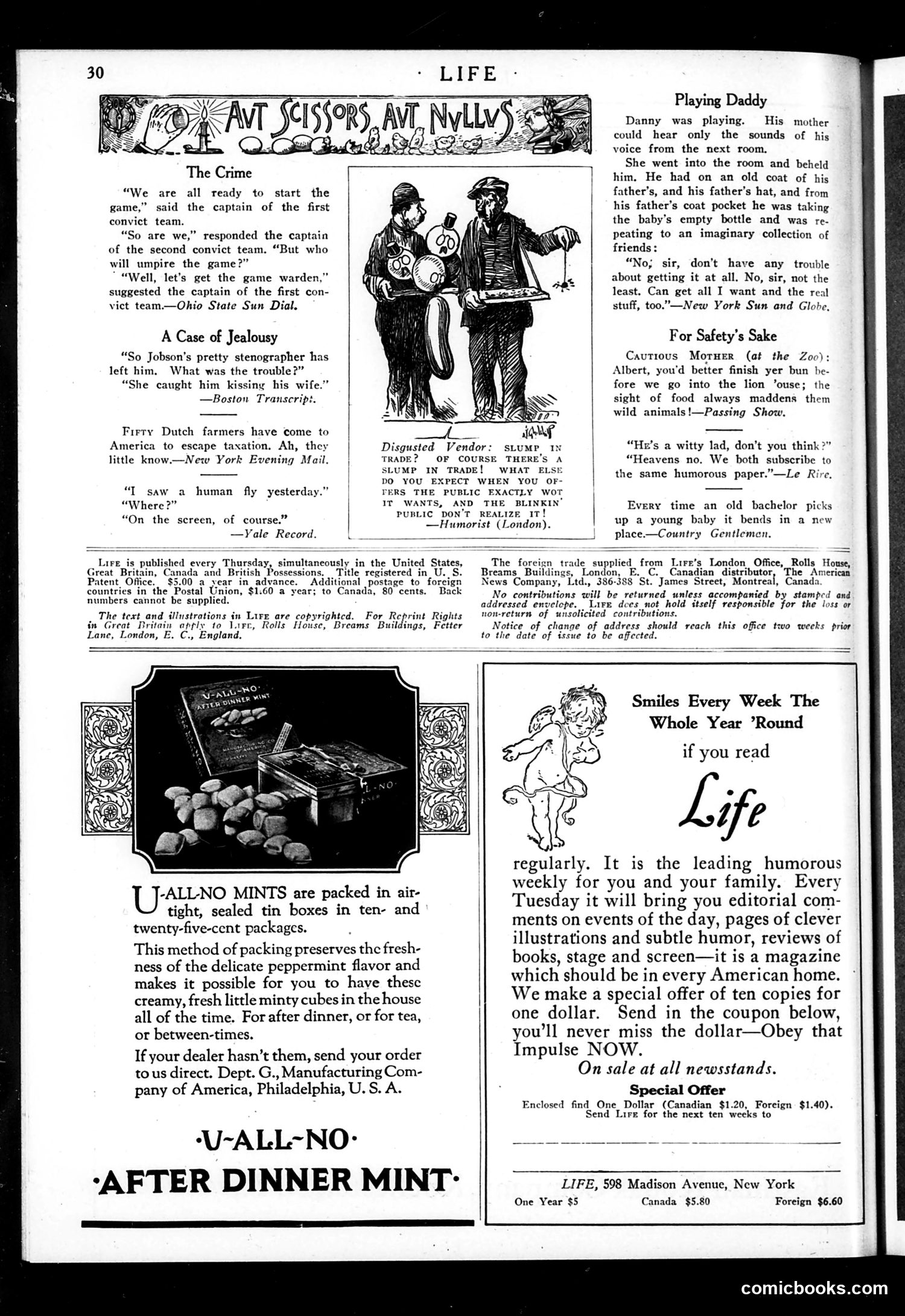
This page contains multiple short satirical jokes typical of early 20th-century Life magazine humor: **"Playing Daddy"** shows a child imitating his father by pretending to offer a baby bottle to friends, mimicking adult conversation about obtaining alcohol. This satirizes Prohibition-era culture, where adults speak euphemistically about obtaining liquor ("the real stuff"). **"A Case of Jealousy"** jokes that a stenographer left her employer after catching him kissing his own wife—inverting expected scandal by suggesting marital fidelity is grounds for dismissal. **"Slump in Trade"** depicts a vendor complaining that the public won't buy his products because they can't perceive their actual quality, blaming consumer ignorance rather than merchandise. Other brief jokes mock: convicts as baseball umpires, Dutch farmers escaping taxation only to face American taxes, and a movie theater "human fly." The page is primarily advertising for U-All-No mints and Life magazine subscriptions, with the humor serving as editorial content to attract readers.
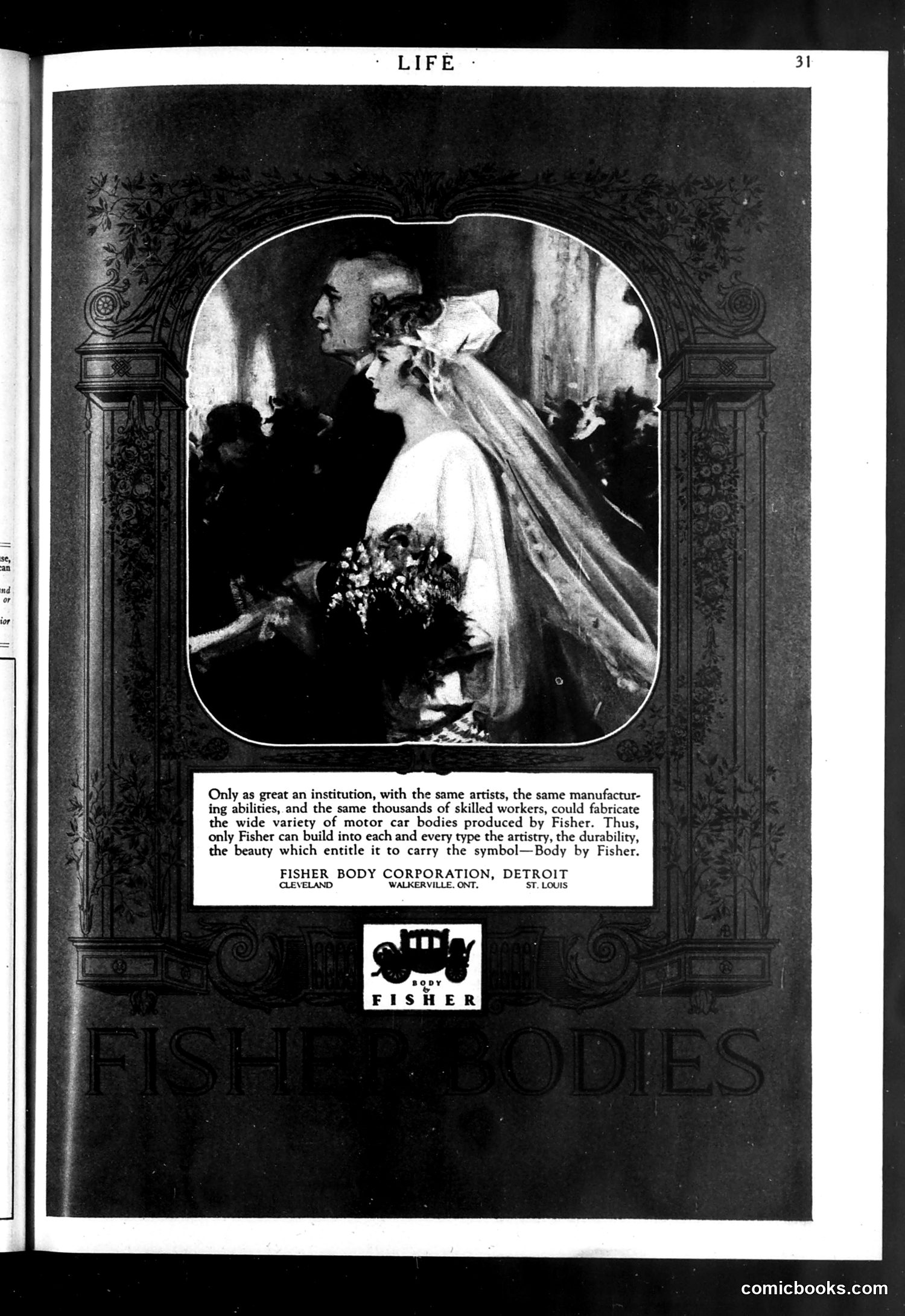
This is **advertising content**, not satire or political commentary. The page features a Fisher Body Corporation advertisement for automobile bodies. The image shows a formal scene—apparently a wedding or elegant social occasion—with a man and woman in formal dress. The photograph illustrates luxury and sophistication, positioning Fisher car bodies as high-end products worthy of refined taste. The text argues that only a major institution like Fisher, with extensive manufacturing capabilities and skilled workers, can produce the variety and quality of car bodies needed across different vehicle types. The slogan "Body by Fisher" is presented as a mark of artistry and durability. This represents typical early automotive advertising strategy: associating mass-produced car bodies with elegance, craftsmanship, and social status to appeal to consumers' aspirations.
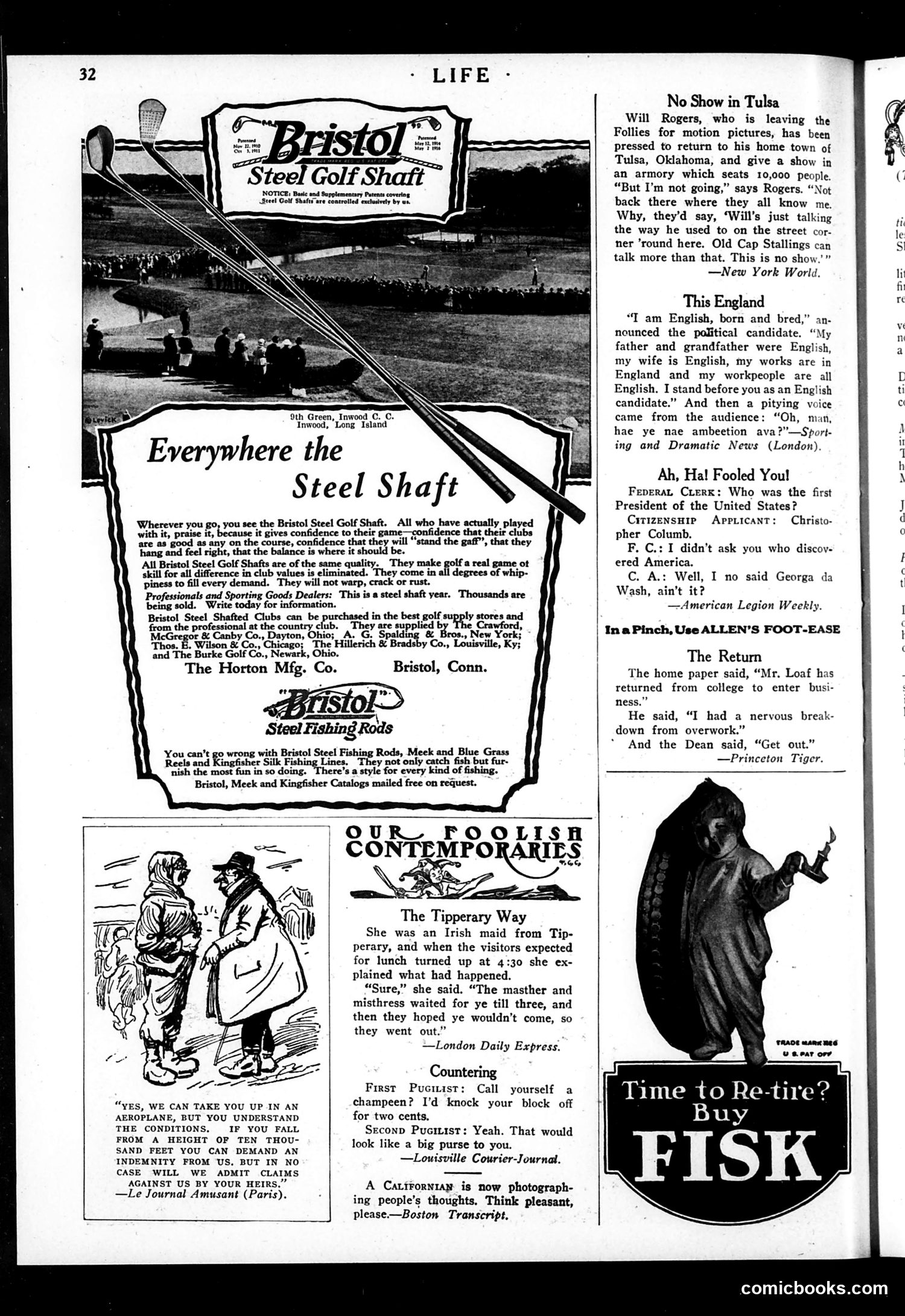
This page contains several brief satirical items typical of *Life* magazine's humor format: **"No Show in Tulsa"** references Will Rogers, the famous comedian leaving Broadway's Follies for motion pictures. The joke: Rogers refuses to perform in his Oklahoma hometown because locals would dismiss his stage act, saying even local barber Cap Stallings talks better than that. **"This England"** mocks an overly patriotic political candidate who emphasizes his English heritage so heavily that an audience member—likely Scottish, based on the dialect—asks if he has no ambition whatsoever. **"Ah, Ha! Fooled You!"** is a simple ethnic humor joke where an Italian immigrant, asked who discovered America, answers Christopher Columbus, then defensively adds "George Washington"—missing the expected answer. The remaining items ("The Tipperary Way," "Countering") are brief anecdotes with punchlines about Irish maids and prizefighters. The page is primarily advertisements for Bristol Steel Golf Shafts and Fisk tires interspersed with these humor columns.
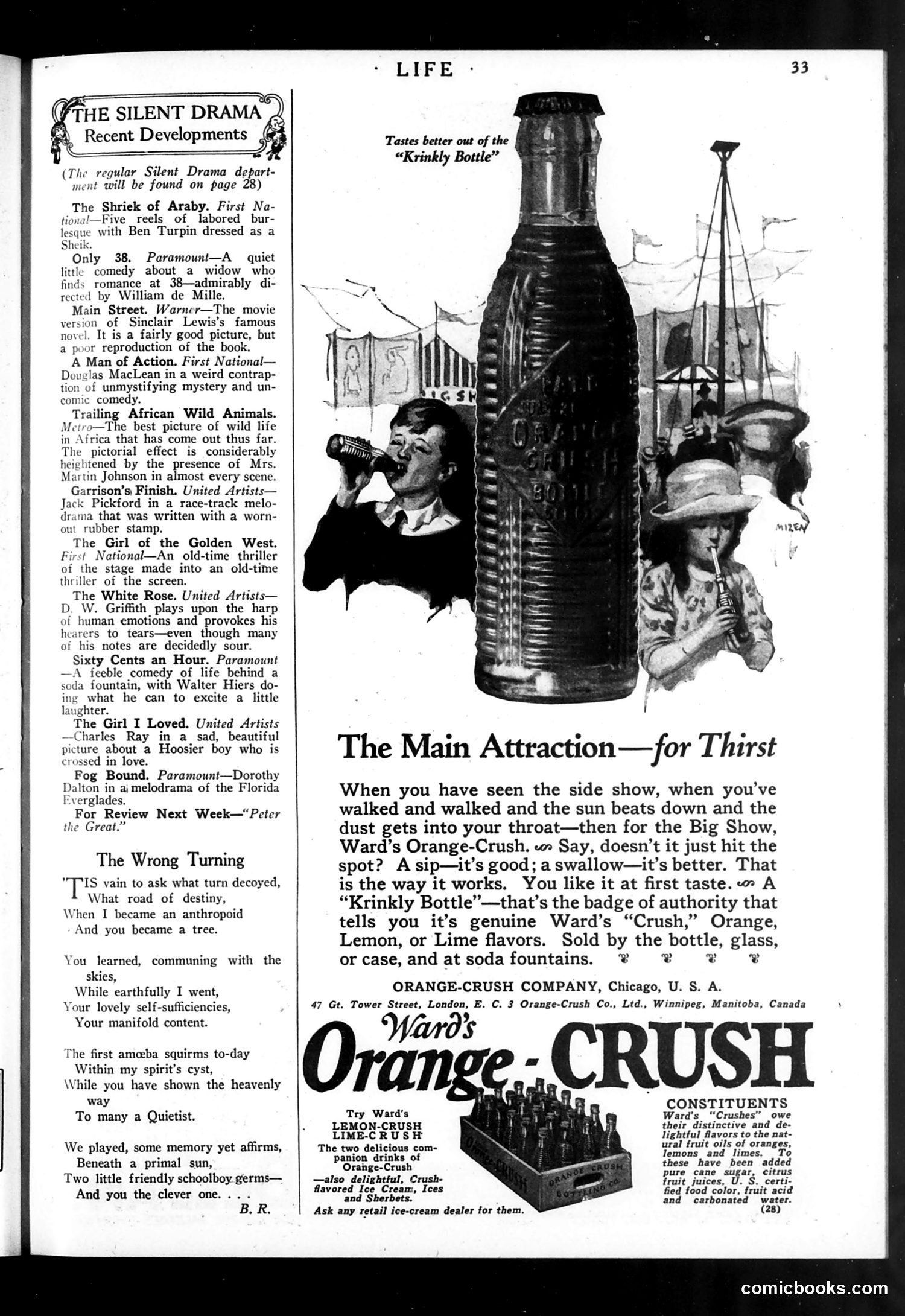
This page is primarily **advertising and entertainment reviews**, not political satire. The left column contains **film reviews** of silent movies from major studios (Paramount, Warner, Metro, etc.), assessing recent releases with brief critical commentary—most dismissive. Notable is the review of "Main Street," adapting Sinclair Lewis's famous novel about small-town American life, criticized as a "poor reproduction of the book." The poem "The Wrong Turning" appears to be **romantic/philosophical verse** about evolutionary separation—one figure becoming "an anthropoid," the other "a tree"—suggesting divergent life paths from a shared origin. **The dominant content is a Ward's Orange-Crush advertisement** featuring a large bottle illustration and testimonial copy emphasizing the drink's refreshment at outdoor events. The "Krinkly Bottle" serves as a brand identifier. This occupies roughly half the page, typical for Life's revenue model blending editorial and advertising. No political cartoons or satire are present on this page.
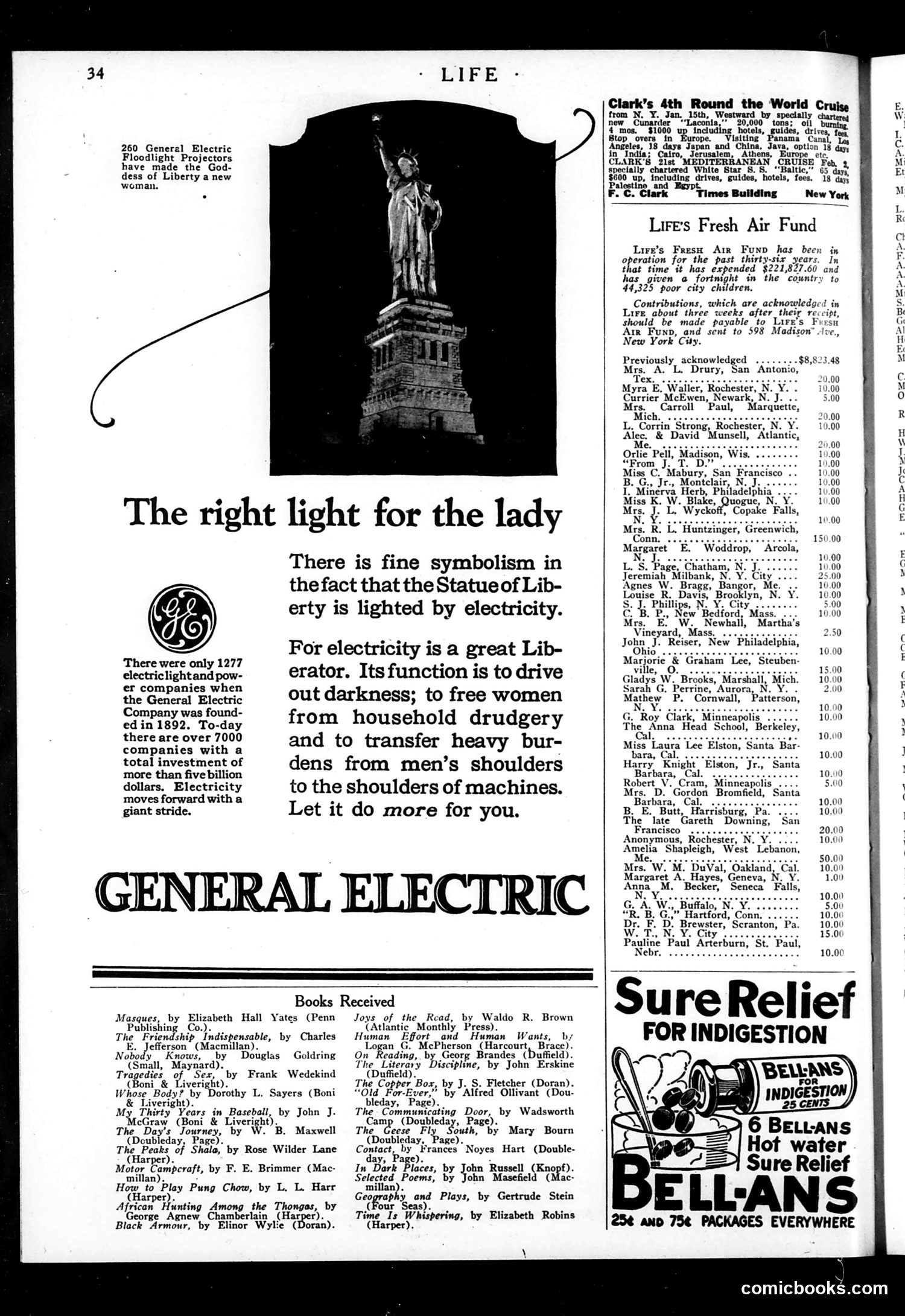
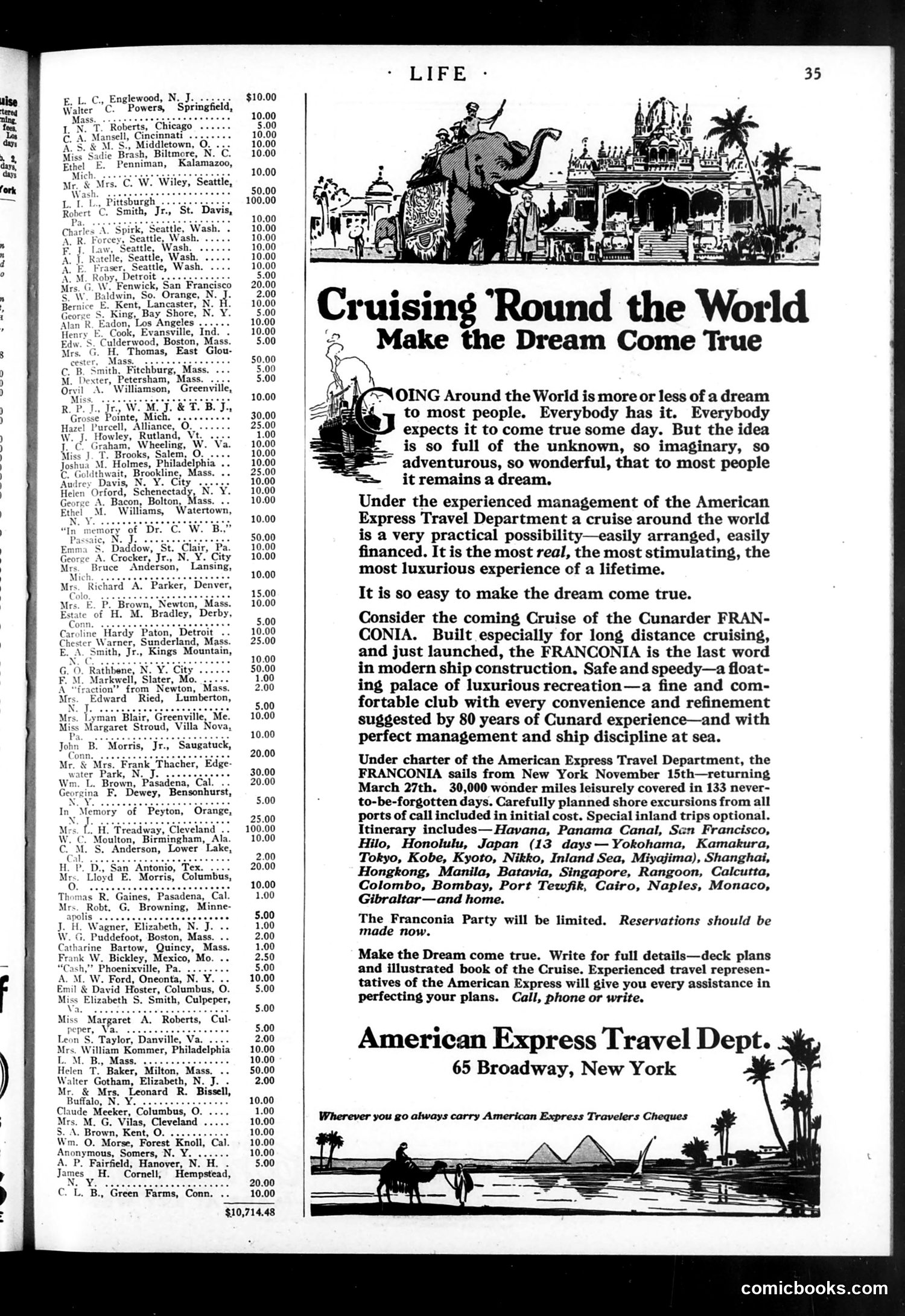
This page is primarily a full-page advertisement for the American Express Travel Department, promoting a world cruise aboard the Cunard liner *Franconia*. The ad uses aspirational language, positioning world travel as a universal dream made practical through American Express's services. It emphasizes luxury, safety, and comprehensive planning—appealing to wealthy early-20th-century Americans. The decorative header illustration depicts an exotic port scene with an elephant and Eastern architecture, reinforcing the adventure and romance of distant travel. The bottom illustration shows colonial-style figures (possibly suggesting the "exotic other"), contrasting with modern traveler comfort. The left column lists subscription names and amounts, indicating this is a *Life* magazine donor/subscription page. The total ($10,714.48) suggests readers were solicited to fund the publication. There is no political satire here—this is straightforward travel marketing in a magazine known for humor elsewhere.
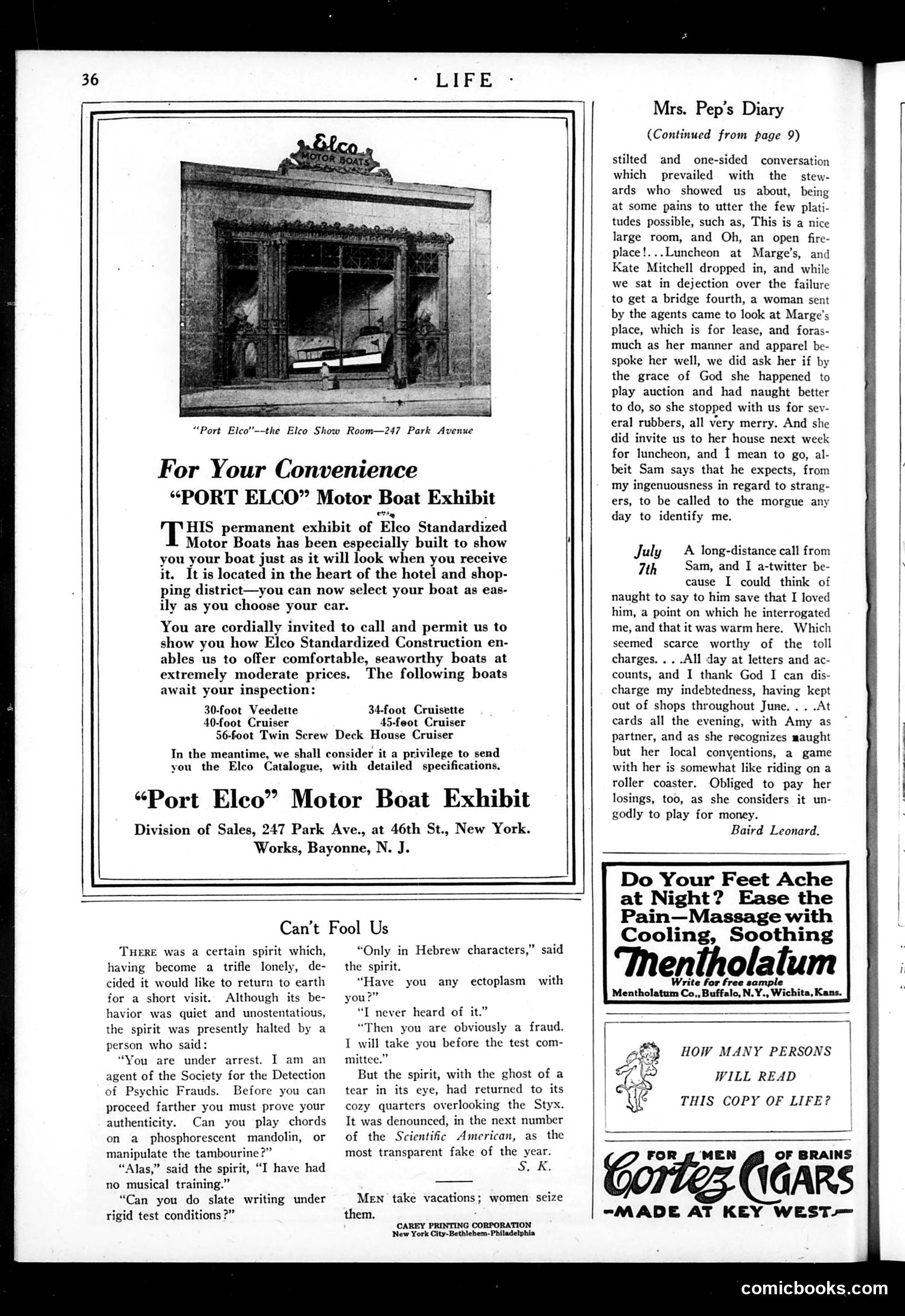
This page is primarily **advertising and lifestyle content** rather than political satire. The main advertisement promotes the **"Port Elco" motor boat exhibit**—a luxury motorboat showroom at 247 Park Avenue in Manhattan. It's pitched as convenient shopping for the wealthy, comparing boat selection to choosing a car. The humor piece titled **"Can't Fool Us"** satirizes spiritualist fraud detection. A ghost attempting to return to Earth is arrested by a "Society for the Detection of Psychic Frauds" agent who demands it perform typical séance tricks (chord-playing on phosphorescent mandolins, ectoplasm production, slate writing). The spirit's inability to meet these absurd requirements results in it being labeled a fraud in *Scientific American*—the joke being that even genuine supernatural phenomena can't satisfy skeptical investigators' arbitrary standards. **"Mrs. Pep's Diary"** is a serialized humor column about mundane upper-class social life and anxieties. The page reflects 1920s concerns: spiritualism's popularity, consumer goods marketing to the affluent, and domestic social comedy.
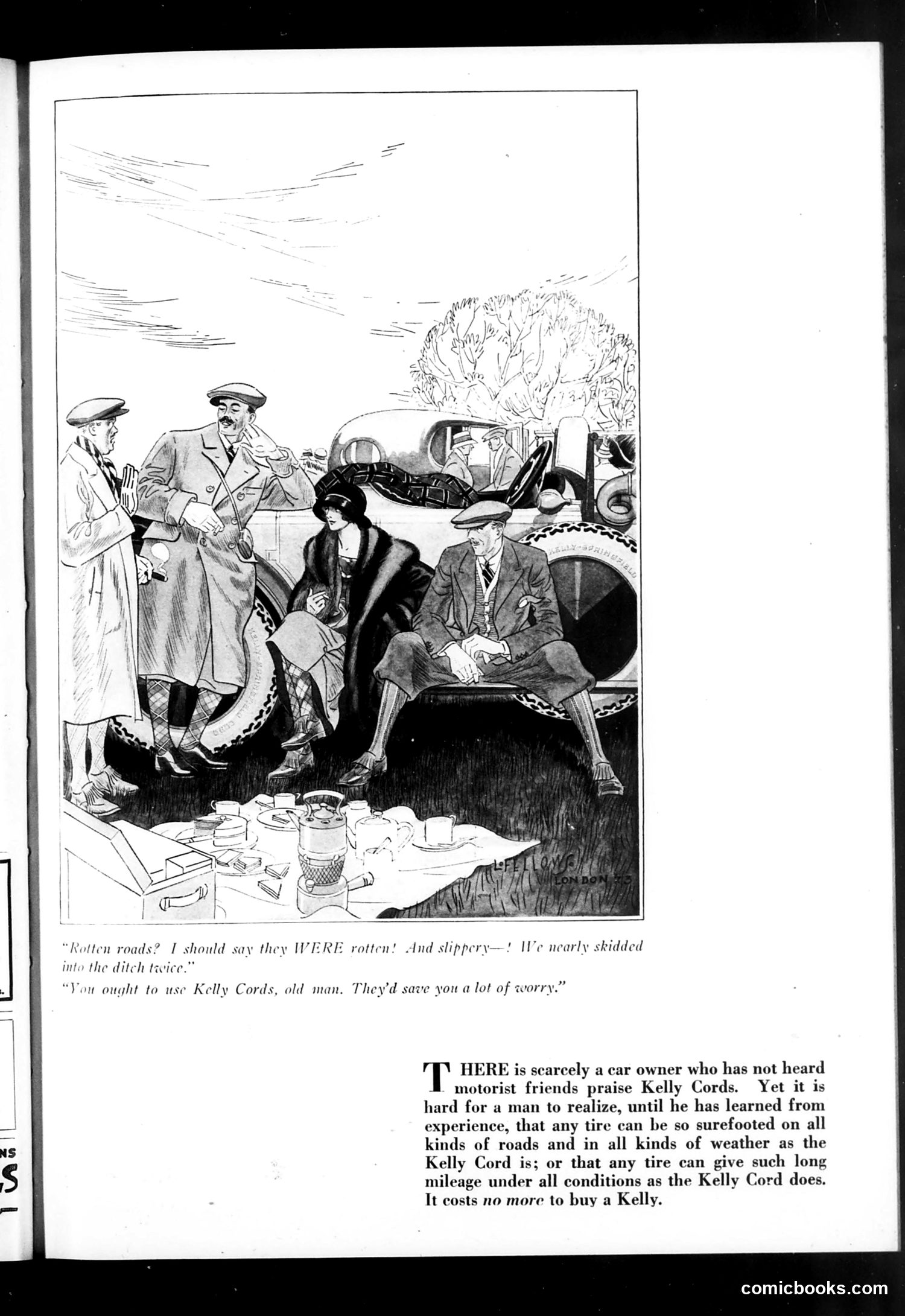
This is a **Kelly Cords tire advertisement disguised as editorial content** in Life magazine. The cartoon depicts a social scene where well-dressed motorists discuss a recent car mishap. One man complains about dangerous road conditions and near-accidents; another responds by recommending Kelly Cord tires as the solution. The "joke" is that this dangerous driving experience becomes an opportunity for product placement. The accompanying text then makes the sales pitch explicitly: Kelly Cords perform reliably in all weather and road conditions, yet cost no more than competitors. **Context for modern readers:** This represents early automotive advertising strategy—using relatable scenarios (bad roads, accidents) to demonstrate product superiority. The phrase "It costs *no more* to buy a Kelly" was the key sales argument: same price, better performance. The piece blurs advertising and editorial content in ways that would now require clear labeling as sponsored material.
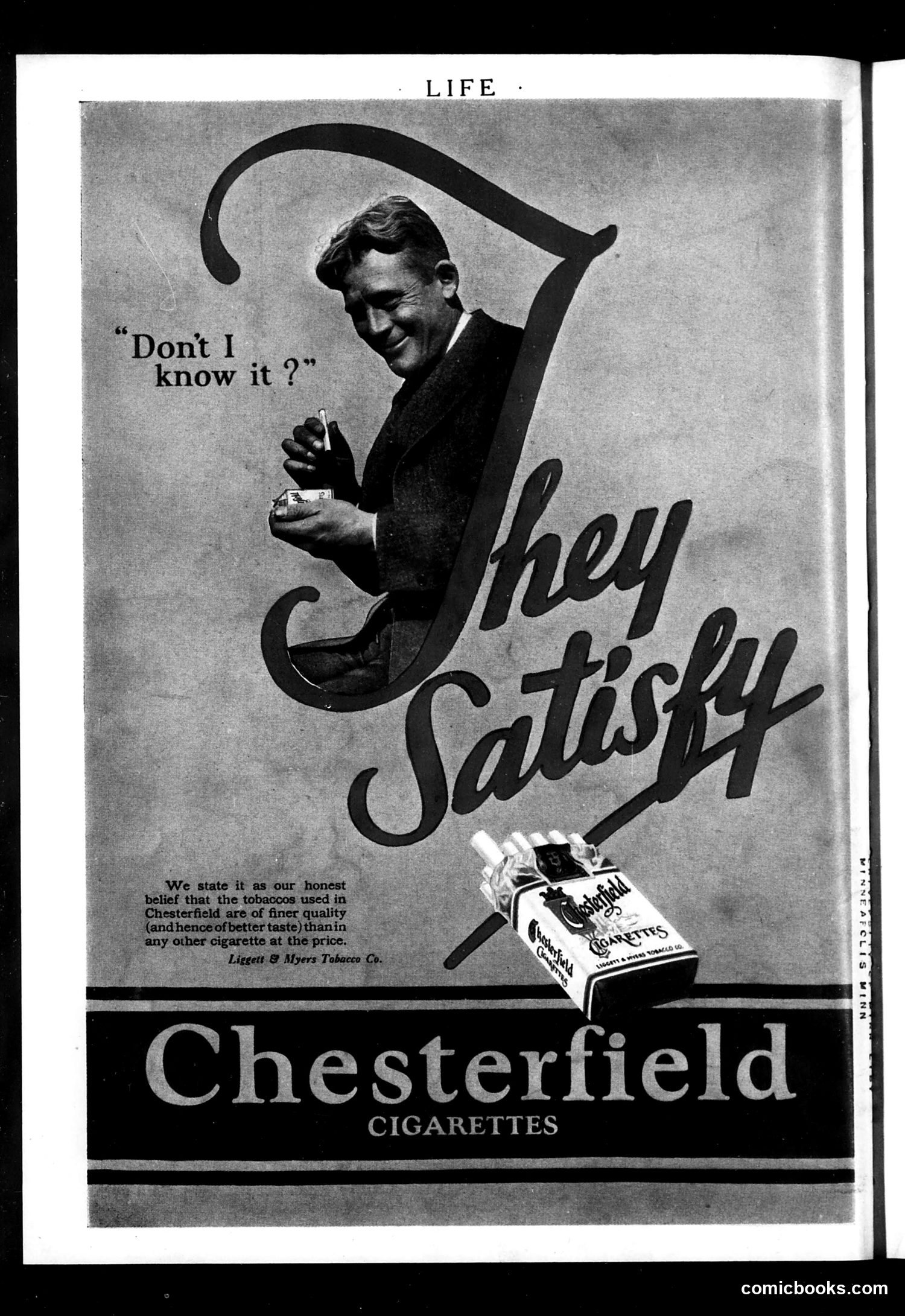
This is a **cigarette advertisement**, not a political cartoon. It appeared in *Life* magazine and promotes Chesterfield cigarettes. The ad features a man in a suit saying "Don't I know it?" while holding a cigarette. The large decorative "S" frames the composition. A pack of Chesterfield cigarettes is displayed at bottom. The manufacturer's claim (Liggett & Myers Tobacco Co.) states their tobacco is "finer quality (and hence of better taste) than in any other cigarettes at the price." The humor is mild—the man's knowing expression and casual phrase suggest satisfied confidence in the product. This represents typical mid-20th century cigarette advertising that made quality claims and associated smoking with sophistication and contentment, before health warnings became standard.