
Life, 1923-07-12 · page 22 of 40
Life — July 12, 1923 — page 22: what you’re looking at
What you’re looking at
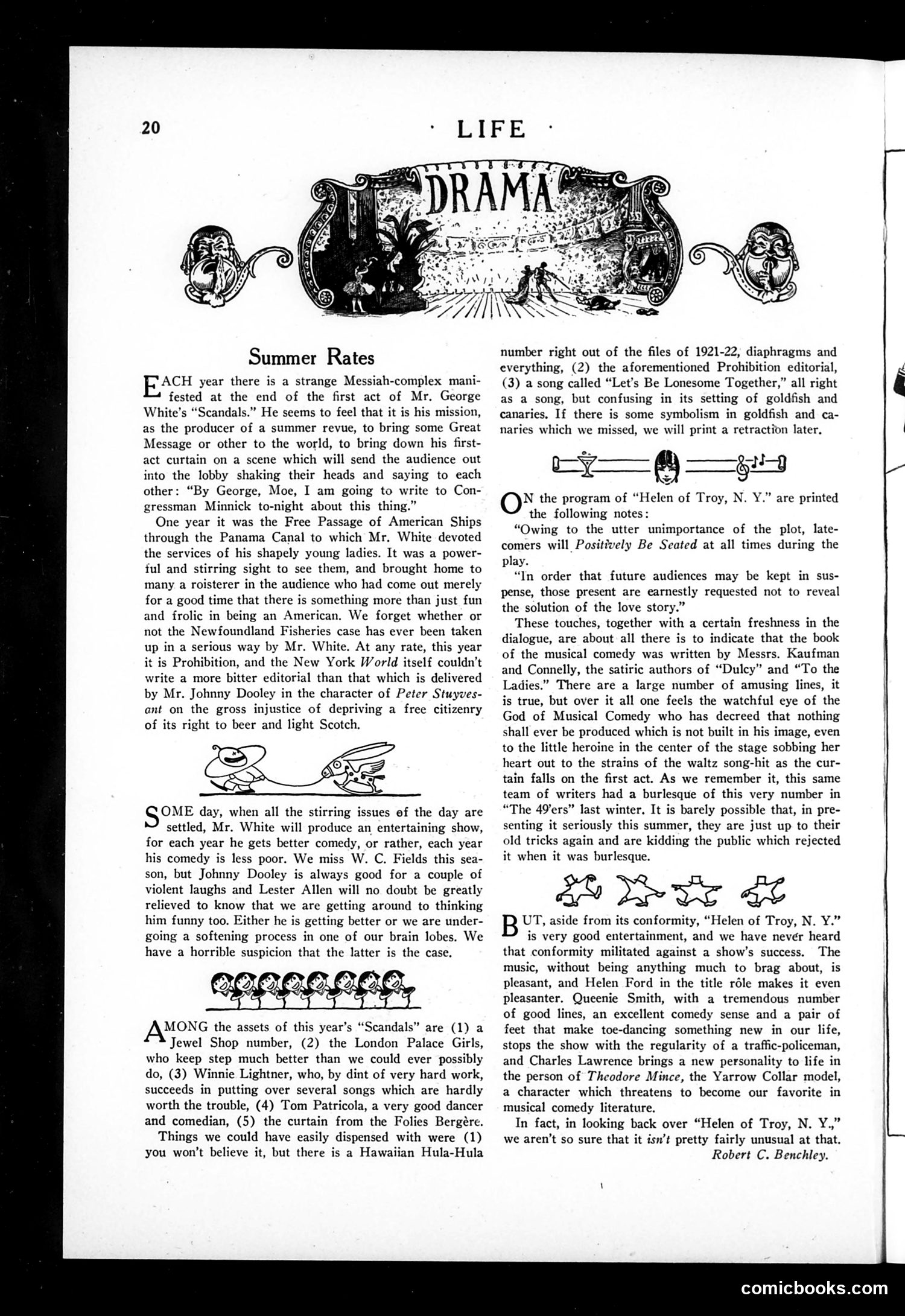
This page reviews George White's theatrical revue "Scandals," criticizing its producer's tendency to inject heavy social messaging into entertainment. The critic notes White uses his show's finale to make political points—previously about Panama Canal shipping rights, now about **Prohibition** (the 1920-33 alcohol ban). Actor **Johnny Dooley** delivers a bitter editorial-style monologue as Peter Stuyvesant, lamenting citizens' lost right to "beer and light Scotch." The reviewer finds this preachy approach tedious, arguing White should focus on comedy rather than moral crusades. The piece also reviews "Helen of Troy, N.Y.," praising its witty program notes but noting the musical follows formulaic conventions despite being written by clever satirists (Kaufman and Connelly). The criticism reflects Jazz Age skepticism toward Prohibition—treating it as an absurd government intrusion on personal freedom worth mocking on stage.
📄 Transcribed text from this page (OCR, searchable)
Machine-transcribed from the original scan — historical spelling and the odd misread are preserved.
Summer Rates BAH year there is a strange Messiah-complex mani- fested at the end of the first act of Mr. George White's “Scandals.” He seems to feel that it is his mission, as the producer of a summer revue, to bring some Great Message or other to the world, to bring down his first- act curtain on a scene which will send the audience out into the lobby shaking their heads and saying to each other: “By George, Moe, I am going to write to Con- gressman Minnick to-night about this thing.” One year it was the Free Passage of American Ships through the Panama Canal to which Mr. White devoted the services of his shapely young ladies. It was a power- ful and stirring sight to see them, and brought home to many a roisterer in the audience who had come out merely for a good time that there is something more than just fun and frolic in being an American. We forget whether or not the Newfoundland Fisheries case has ever been taken up in a serious way by Mr. White. At any rate, this year it is Prohibition, and the New York World itself couldn't write a more bitter editorial than that which is delivered by Mr. Johnny Dooley in the character of Peter Stuyves- ant on the gross injustice of depriving a free citizenry of its right to beer and light Scotch. OME day, when all the stirring issues ef the day are settled, Mr. White will produce an entertaining show, for each year he gets better comedy, or rather, each year his comedy is less poor. We miss W. C. Fields this sea- son, but Johnny Dooley is always good for a couple of violent laughs and Lester Allen will no doubt be greatly relieved to know that we are getting around to thinking him funny too. Either he is getting better or we are under- going a softening process in one of our brain lobes. We have a horrible suspicion that the latter is the case. AMONG the assets of this year’s “Scandals” are (1) a Jewel Shop number, (2) the London Palace Girls, who keep step much better than we could ever possibly do, (3) Winnie Lightner, who, by dint of very hard work, succeeds in putting over several songs which are hardly worth the trouble, (4) Tom Patricola, a very good dancer and comedian, (5) the curtain from the Folies Bergére. Things we could have easily dispensed with were (1) you won’t believe it, but there is a Hawaiian Hula-Hula number right out of the files of 1921-22, diaphragms and everything, (2) the aforementioned Prohibition editorial, (3) a song called “Let's Be Lonesome Together,” all right as a song, but confusing in its setting of goldfish and canaries. If there is some symbolism in goldfish and ca- naries which we missed, we will print a retraction later. yo & —— eh 9 N the program of “Helen of Troy, N. Y.” are printed the following notes: “Owing to the utter unimportance of the plot, late- comers will Positively Be Seated at all times during the play. “In order that future audiences may be kept in sus- pense, those present are earnestly requested not to reveal the solution of the love story.” These touches, together with a certain freshness in the dialogue, are about all there is to indicate that the book of the musical comedy was written by Messrs. Kaufman and Connelly, the satiric authors of “Dulcy” and “To the Ladies.” There are a large number of amusing lines, it is true, but over it all one feels the watchful eye of the God of Musical Comedy who has decreed that nothing shall ever be produced which is not built in his image, even to the little heroine in the center of the stage sobbing her heart out to the strains of the waltz song-hit as the cur- tain falls on the first act. As we remember it, this same team of writers had a burlesque of this very number in “The 49’ers” last winter. It is barely possible that, in pre- senting it seriously this summer, they are just up to their old tricks again and are kidding the public which rejected it when it was burlesque. 84 True at UT, aside from its conformity, “Helen of Troy, N. Y.” is very good entertainment, and we have nevér heard that conformity militated against a show’s success. The music, without being anything much to brag about, is pleasant, and Helen Ford in the title réle makes it even pleasanter. Queenie Smith, with a tremendous number of good lines, an excellent comedy sense and a pair of feet that make toe-dancing something new in our life, stops the show with the regularity of a traffic-policeman, and Charles Lawrence brings a new personality to life in the person of Theodore Mince, the Yarrow Collar model, a character which threatens to become our favorite in musical comedy literature. In fact, in looking back over “Helen of Troy, N. Y.,” we aren’t so sure that it isn’t pretty fairly unusual at that. Robert C. Benchley. comicbooks.com