
Life, 1923-07-12 · page 18 of 40
Life — July 12, 1923 — page 18: what you’re looking at
What you’re looking at
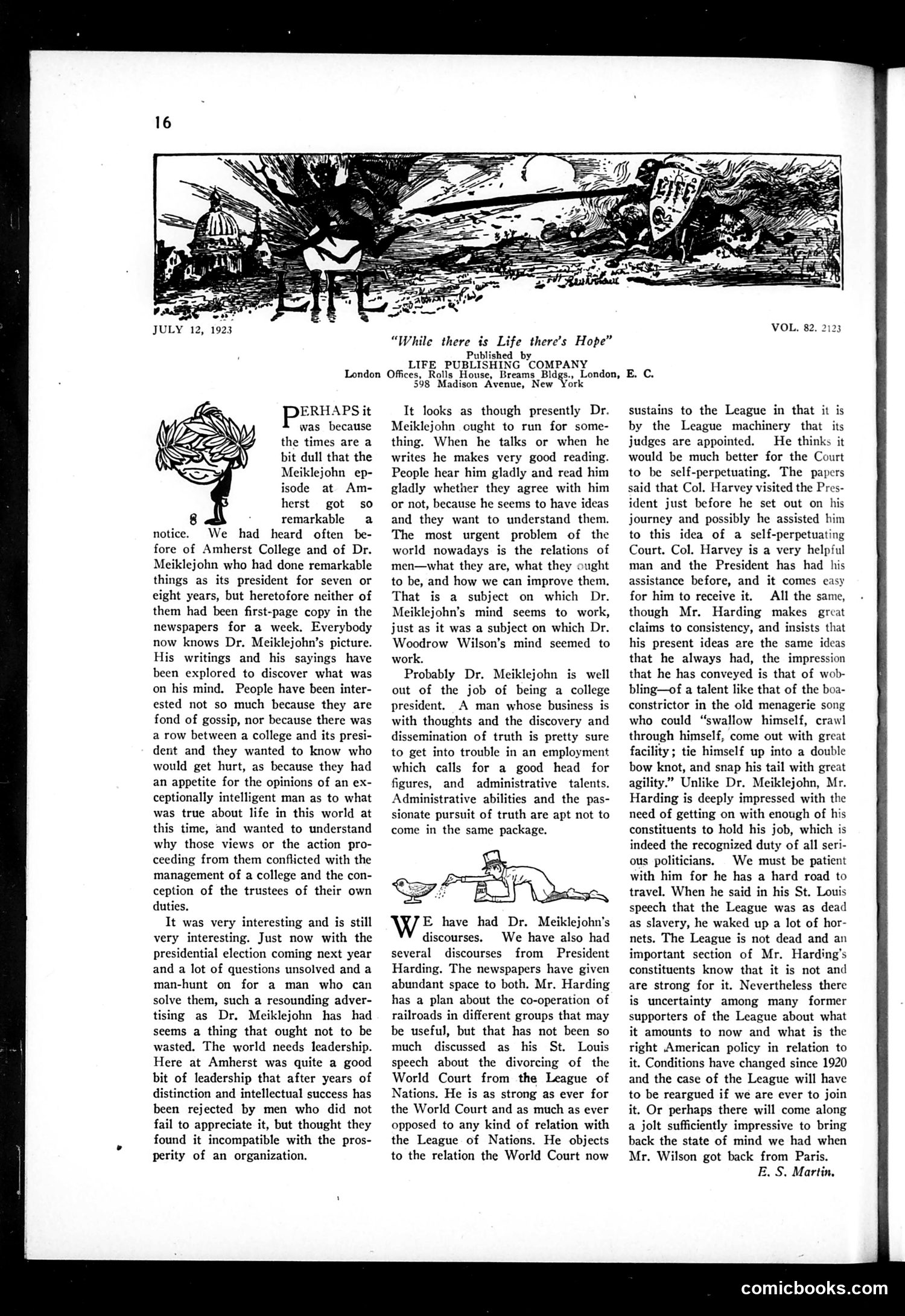
This editorial page discusses Dr. Alexander Meiklejohn's recent departure from Amherst College, which generated significant media attention. The writer argues Meiklejohn—an intellectual known for thoughtful discourse on human relations and social problems—was poorly suited to college administration, which requires different skills (financial management, figures). The piece suggests Meiklejohn should enter politics, comparing him favorably to Woodrow Wilson as a thinker addressing urgent world problems. The editorial then pivots to President Harding, contrasting his practical railroad cooperation plan (little discussed) with his more publicized St. Louis speech opposing the League of Nations' control over the World Court's judicial appointments. The cartoons appear to be decorative headers typical of Life's satirical format. The overall satire critiques how the public and press engage with ideas: intellectual discourse captures attention while practical policy goes unnoticed, and politicians like Harding face less scrutiny than academics like Meiklejohn.
📄 Transcribed text from this page (OCR, searchable)
Machine-transcribed from the original scan — historical spelling and the odd misread are preserved.
JULY 12, 1923 “While there is Life there’s Hope” Published by LIFE PUBLISHING COMPANY VOL. 82. 2123 London Offices, Rolls House, reams Bldgs, London, E. C. ERHAPS it was because the times are a bit dull that the Meiklejohn ep- isode at Am- herst got so remarkable a notice. We had heard often be- fore of Amherst College and of Dr. Meiklejohn who had done remarkable things as its president for seven or eight years, but heretofore neither of them had been first-page copy in the newspapers for a week. Everybody now knows Dr. Meiklejohn’s picture. His writings and his sayings have been explored to discover what was on his mind. People have been inter- ested not so much because they are fond of gossip, nor because there was a row between a college and its presi- dent and they wanted to know who would get hurt, as because they had an appetite for the opinions of an ex- ceptionally intelligent man as to what was true about life in this world at this time, and wanted to understand why those views or the action pro- ceeding from them conflicted with the management of a college and the con- ception of the trustees of their own duties. It was very interesting and is still very interesting. Just now with the presidential election coming next year and a lot of questions unsolved and a man-hunt on for a man who can solve them, such a resounding adver- tising as Dr. Meiklejohn has had seems a thing that ought not to be wasted. The world needs leadership. Here at Amherst was quite a good bit of leadership that after years of distinction and intellectual success has been rejected by men who did not fail to appreciate it, but thought they found it incompatible with the pros- perity of an organization. 598 Madison Avenue, New Yor! It looks as though presently Dr. Meiklejohn ought to run for some- thing. When he talks or when he writes he makes very good reading. People hear him gladly and read him gladly whether they agree with him or not, because he seems to have ideas and they want to understand them. The most urgent problem of the world nowadays is the relations of men—what they are, what they ought to be, and how we can improve them, That is a subject on which Dr. Meiklejohn’s mind seems to work, just as it was a subject on which Dr. Woodrow Wilson’s mind seemed to work. Probably Dr. Meiklejohn is well out of the job of being a college president. A man whose business is with thoughts and the discovery and dissemination of truth is pretty sure to get into trouble in an employment which calls for a good head for figures, and administrative talents. Administrative abilities and the pas- sionate pursuit of truth are apt not to come in the same package. E have had Dr. Meiklejohn’s discourses. We have also had several discourses from President Harding. The newspapers have given abundant space to both. Mr. Harding has a plan about the co-operation of railroads in different groups that may be useful, but that has not been so much discussed as his St. Louis speech about the divorcing of the World Court from the League of Nations. He is as strong as ever for the World Court and as much as ever opposed to any kind of relation with the League of Nations. He objects to the relation the World Court now sustains to the League in that it is by the League machinery that its judges are appointed. He thinks it would be much better for the Court to be self-perpetuating. The papers said that Col. Harvey visited the Pres- ident just before he set out on his journey and possibly he assisted him to this idea of a self-perpetuating Court. Col. Harvey is a very helpful man and the President has had his assistance before, and it comes easy for him to receive it. All the same, though Mr. Harding makes great claims to consistency, and insists that his present ideas are the same ideas that he always had, the impression that he has conveyed is that of wob- bling—of a talent like that of the boa- constrictor in the old menagerie song who could “swallow himself, crawl through himself, come out with great facility; tie himself up into a double bow knot, and snap his tail with great agility.” Unlike Dr. Meiklejohn, Mr. Harding is deeply impressed with the need of getting on with enough of his constituents to hold his job, which is indeed the recognized duty of all seri- ous politicians. We must be patient with him for he has a hard road to travel. When he said in his St. Louis speech that the League was as dead as slavery, he waked up a lot of hor- nets. The League is not dead and an important section of Mr. Harding’s constituents know that it is not and are strong for it. Nevertheless there is uncertainty among many former supporters of the League about what it amounts to now and what is the right American policy in relation to it. Conditions have changed since 1920 and the case of the League will have to be reargued if we are ever to join it. Or perhaps there will come along a jolt sufficiently impressive to bring back the state of mind we had when Mr. Wilson got back from Paris. E, S, Martin, comicbooks.com