
Life, 1923-07-12 · page 30 of 40
Life — July 12, 1923 — page 30: what you’re looking at
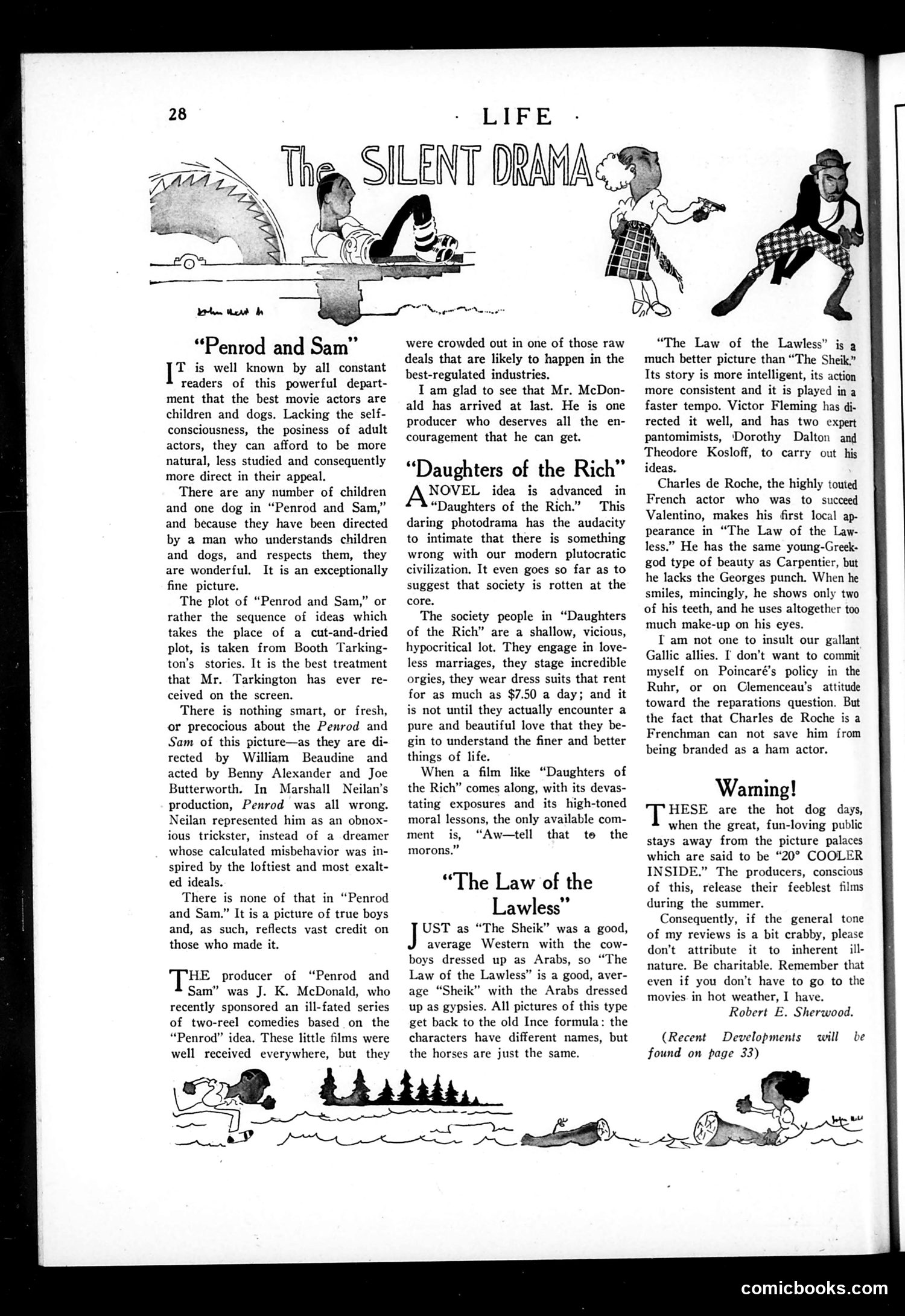
A restored page from Life, 1923-07-12. Page through the whole issue in the reader above.
📄 Transcribed text from this page (OCR, searchable)
Machine-transcribed from the original scan — historical spelling and the odd misread are preserved.
“Penrod and Sam” I* is well known by all constant readers of this powerful depart- ment that the best movie actors are children and dogs. Lacking the self- consciousness, the posiness of adult actors, they can afford to be more natural, less studied and consequently more direct in their appeal. There are any number of children and one dog in “Penrod and Sam,” and because they have been directed by a man who understands children and dogs, and respects them, they are wonderful. It is an exceptionally fine picture. The plot of “Penrod and Sam,” or rather the sequence of ideas which takes the place of a cut-and-dried plot, is taken from Booth Tarking- ton’s stories. It is the best treatment that Mr. Tarkington has ever re- ceived on the screen. There is nothing smart, or fresh, or precocious about the Penrod and Sam of this picture—as they are di- rected by William Beaudine and acted by Benny Alexander and Joe Butterworth. In Marshall Neilan’s production, Penrod was all wrong. Neilan represented him as an obnox- ious trickster, instead of a dreamer whose calculated misbehavior was in- spired by the loftiest and most exalt- ed ideals. There is none of that in “Penrod and Sam.” It is a picture of true boys and, as such, reflects vast credit on those who made it. HE producer of “Penrod and Sam” was J. K. McDonald, who recently sponsored an ill-fated series of two-reel comedies based on the “Penrod” idea. These little films were well received everywhere, but they eM, Shadils were crowded out in one of those raw deals that are likely to happen in the best-regulated industries. I am glad to see that Mr. McDon- ald has arrived at last. He is one producer who deserves all the en- couragement that he can get. “Daughters of the Rich” NOVEL idea is advanced in “Daughters of the Rich.” This daring photodrama has the audacity to intimate that there is something wrong with our modern plutocratic civilization. It even goes so far as to suggest that society is rotten at the core, The society people in “Daughters of the Rich” are a shallow, vicious, hypocritical lot. They engage in love- less marriages, they stage incredible orgies, they wear dress suits that rent for as much as $7.50 a day; and it is not until they actually encounter a pure and beautiful love that they be- gin to understand the finer and better things of life. When a film like “Daughters of the Rich” comes along, with its devas- tating exposures and its high-toned moral lessons, the only available com- ment is, “Aw—tell that te the morons.” “The Law of the ” Lawless UST as “The Sheik” was a good, average Western with the cow- boys dressed up as Arabs, so “The Law of the Lawless” is a good, aver- ge “Sheik” with the Arabs dressed up as gypsies. All pictures of this type get back to the old Ince formula: the characters have different names, but the horses are just the same. gga “The Law of the Lawless” is q much better picture than “The Sheik.” Its story is more intelligent, its action more consistent and it is played ina faster tempo. Victor Fleming has di- rected it well, and has two expert pantomimists, ‘Dorothy Dalton and Theodore Kosloff, to carry out his ideas. Charles de Roche, the highly touted French actor who was to succeed Valentino, makes his first local ap- pearance in “The Law of the Law- less.” He has the same young-Greek- god type of beauty as Carpentier, but he lacks the Georges punch. When he smiles, mincingly, he shows only two of his teeth, and he uses altogether too much make-up on his eyes. T am not one to insult our gallant Gallic allies. [ don’t want to commit myself on Poincaré’s policy in the Ruhr, or on Clemenceau’s attitude toward the reparations question. But the fact that Charles de Roche is a Frenchman can not save him from being branded as a ham actor. Waming! HESE are the hot dog days, when the great, fun-loving public stays away from the picture palaces which are said to be “20° COOLER INSIDE.” The producers, conscious of this, release their feeblest films during the summer. Consequently, if the general tone of my reviews is a bit crabby, please don’t attribute it to inherent ill- nature. Be charitable. Remember that even if you don’t have to go to the movies. in hot weather, I have. Robert E. Sherwood. (Recent Developments will be found on page 33) comicbooks.com