
A complete issue · 40 pages · 1923
Life — July 5, 1923
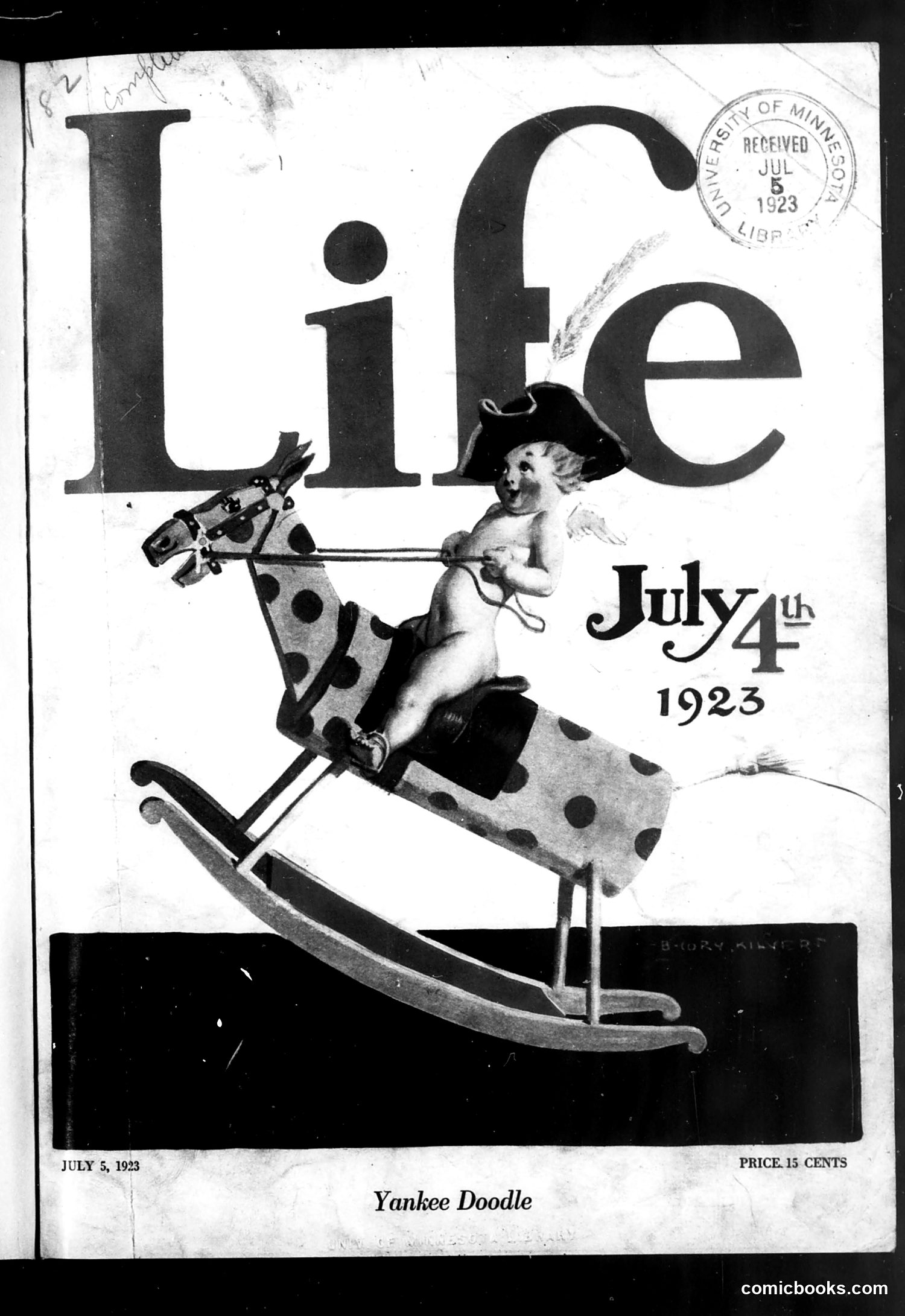
This is a "Yankee Doodle" themed Independence Day cover featuring a cherub (cupid-like figure) riding a rocking horse decorated with patriotic polka dots. The figure wields a riding crop while mounted on the toy horse, which rocks on curved wooden runners. The satire appears to mock American patriotism or national pride during the 1920s—suggesting that American nationalism is childish, whimsical, or even frivolous. The "Yankee Doodle" reference invokes the colonial-era song, but presenting it through infantile imagery creates ironic commentary. The July 4th, 1923 date marks a post-World War I period when American attitudes toward intervention and patriotism were contested. The price (15 cents) indicates this was mainstream popular satire.
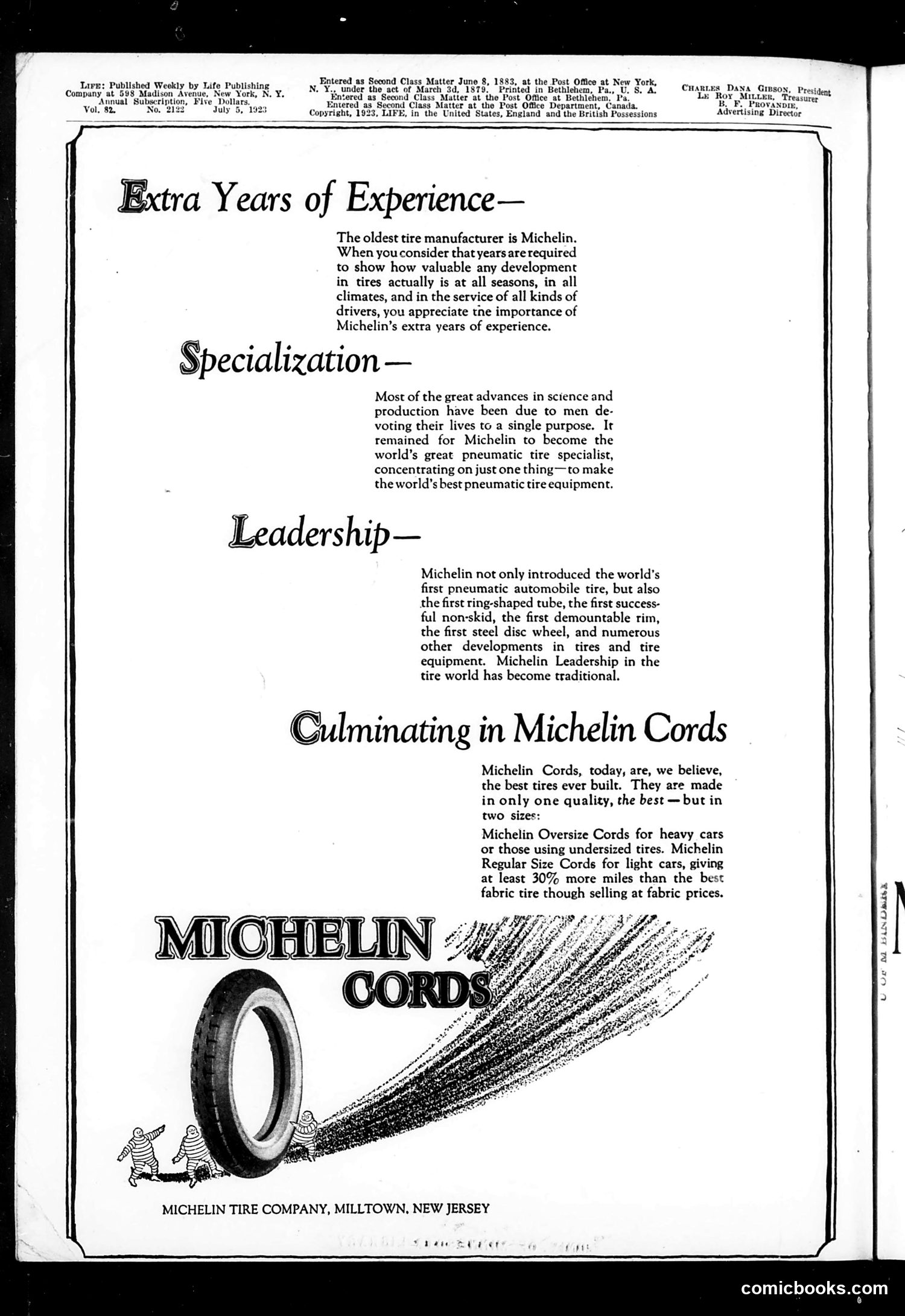
This page is primarily **advertising, not satire or political content**. It's a Michelin tire company advertisement from Life magazine (dated July 9, 1923). The ad promotes Michelin's market position through four sections: "Extra Years of Experience," "Specialization," "Leadership," and "Culminating in Michelin Cords." The text emphasizes Michelin's history as "the oldest tire manufacturer" and claims various tire innovations. The only visual element besides text is **the Michelin Man** (Bibendum)—the company's mascot—depicted as a rotund figure made of tire treads, shown at bottom left next to a large tire. The small figures beside the tire appear to be the Michelin Man in different poses, a recurring feature of the brand's advertising imagery. This is straightforward commercial marketing, not editorial commentary.
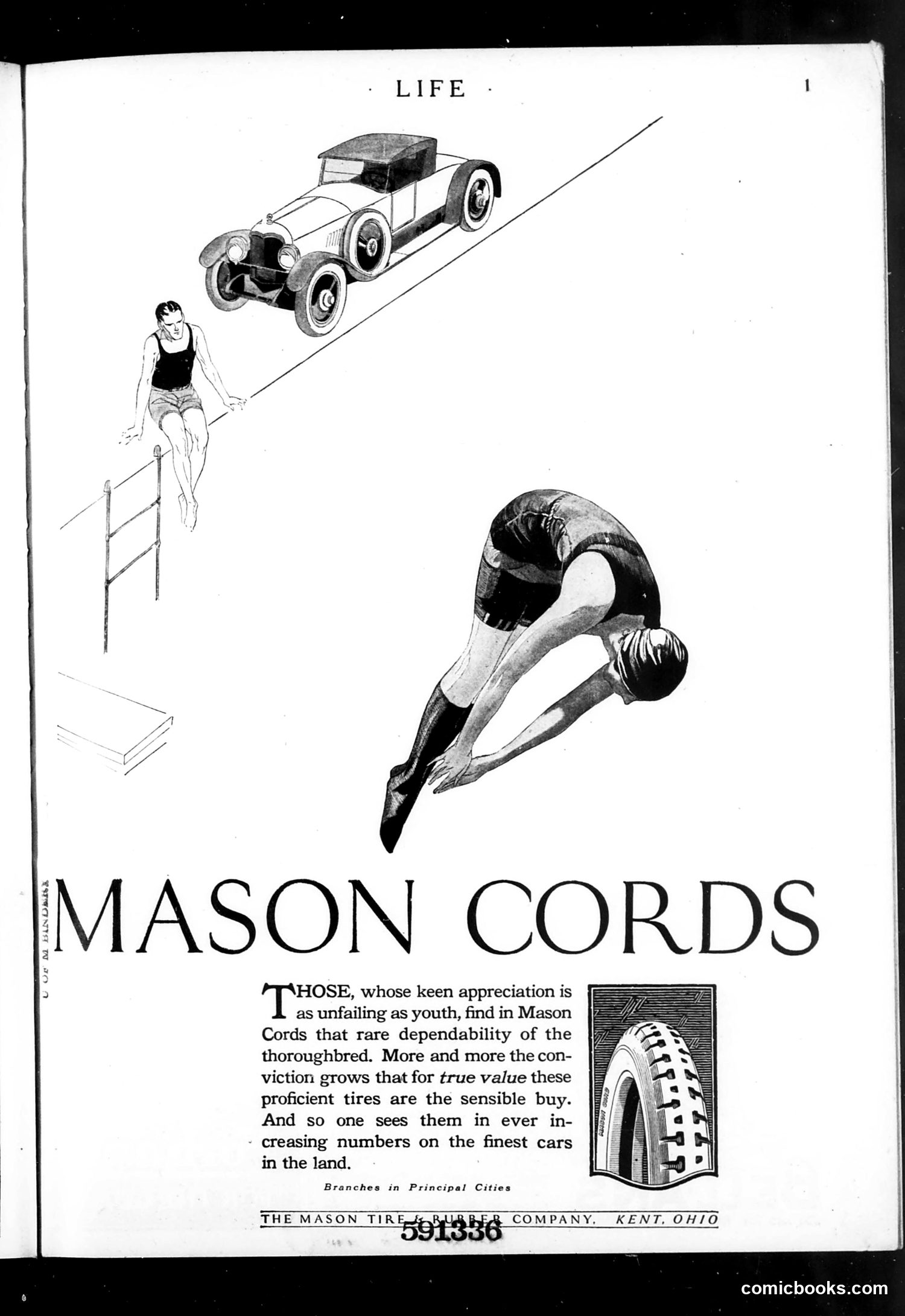
This is **not satire or political commentary** — it's a straightforward advertisement for Mason Cords tires, published in *Life* magazine during the early automotive era. The ad uses three lifestyle vignettes to appeal to active, youthful consumers: a man diving into water, a woman in a swimming suit, and a vintage automobile ascending an incline. These images emphasize vitality, modernity, and adventure — qualities associated with the product. The text promotes Mason Cords as reliable tires for "those whose keen appreciation is as unfailing as youth," positioning quality tires as markers of sound judgment and good taste. The "Branches in Principal Cities" notation indicates the Mason Tire Company's widespread distribution from their Kent, Ohio headquarters. This represents typical early-20th-century automobile advertising strategy: linking consumer products to aspirational lifestyles.
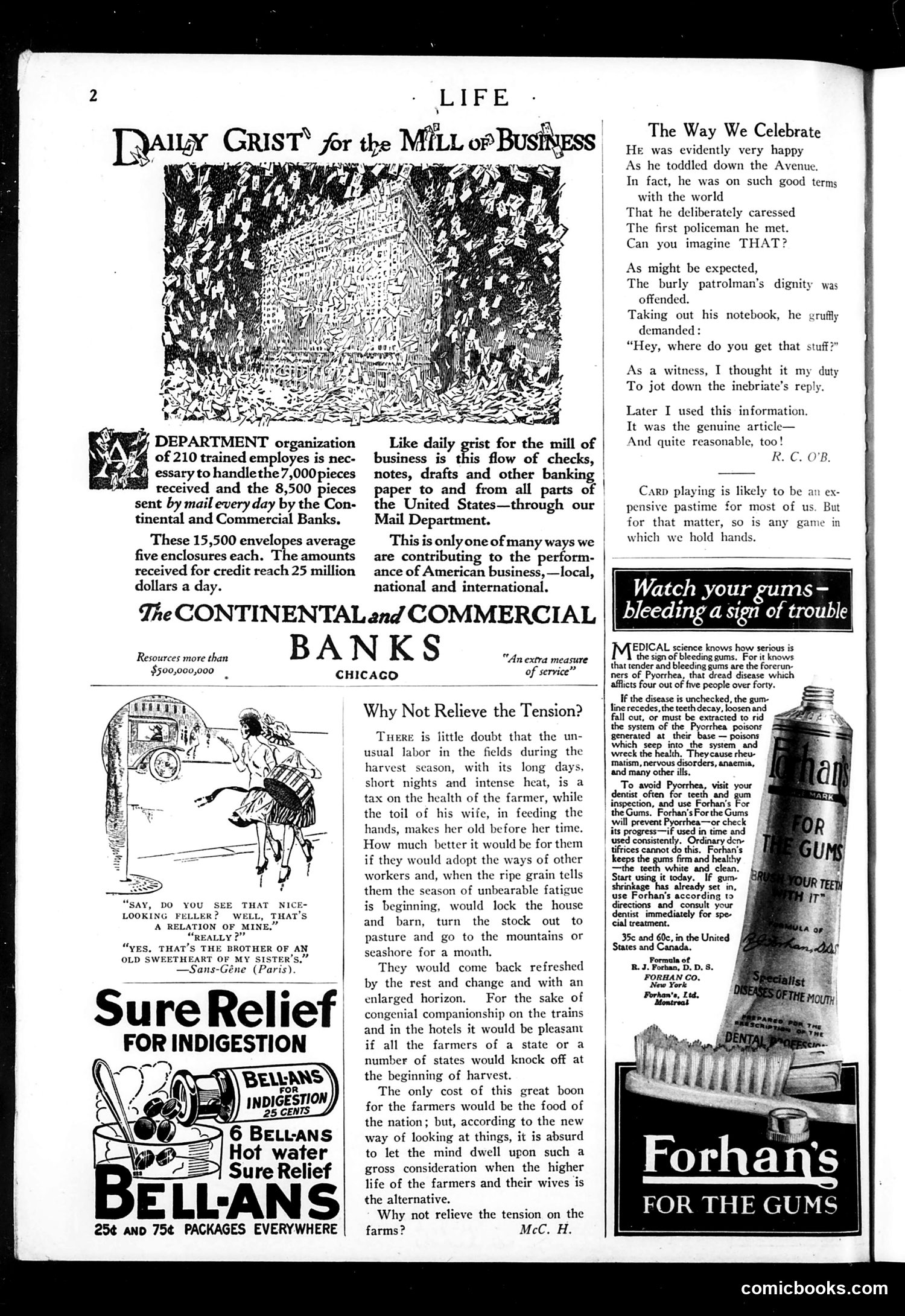
This page is primarily **advertising and light humor** rather than political satire. The main cartoon shows a farmer operating farm equipment, with a caption about "a relation of mine" and "old sweetheart of my sister's." It's a gentle joke about rural courtship or family connections—the humor relies on recognizing the figure as a farmer, not identifying a specific person. The page includes ads for **Bell-Ans indigestion remedy**, **Forhan's toothpaste**, and the **Continental and Commercial Banks** of Chicago. A feature article titled "Why Not Relieve the Tension?" discusses farm labor hardships during harvest season, suggesting vacations as relief. The "Daily Crust for the Mill of Business" heading and banking content reflect this being a business-oriented publication page, circa early 20th century.
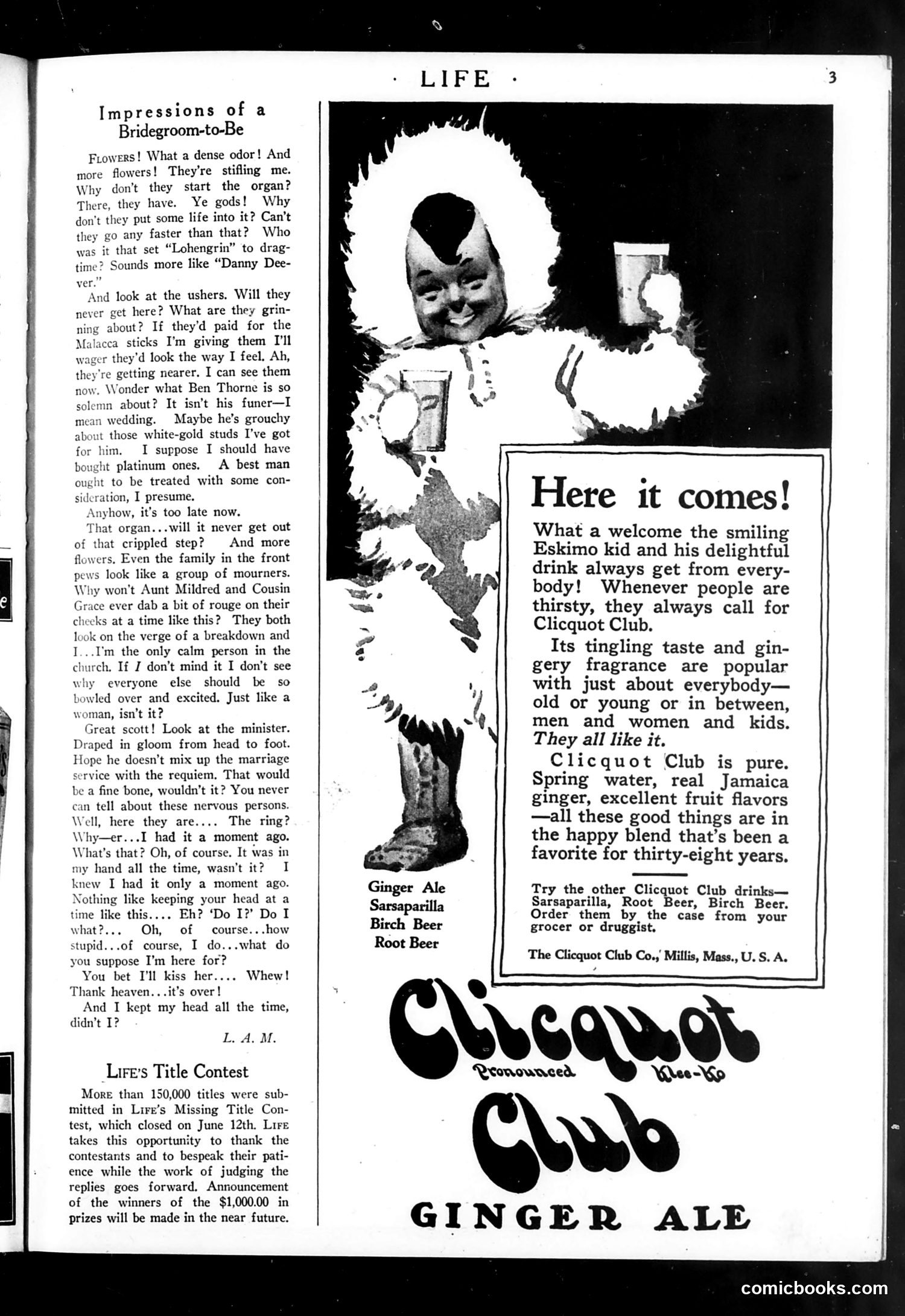
This page contains two distinct elements: **Left side:** "Impressions of a Bridegroom-to-Be" is a humorous monologue by someone named L.A.M. about pre-wedding jitters. The narrator anxiously catalogs wedding details—flowers, ushers, the minister's appearance—while questioning whether he's ready. It's a comedic anxiety piece rather than political satire, capturing universal bridegroom nervousness through exaggerated internal complaints. **Right side:** A Clicquot Club advertisement featuring a smiling child holding a bottle. The ad promotes ginger ale and other soft drinks, claiming they're universally popular. **Below:** "Life's Little Contest" announces results from a missing-title contest with 150,000+ submissions and upcoming prize announcements. This is primarily **advertising-driven content** with light humor rather than political commentary or caricature satire.
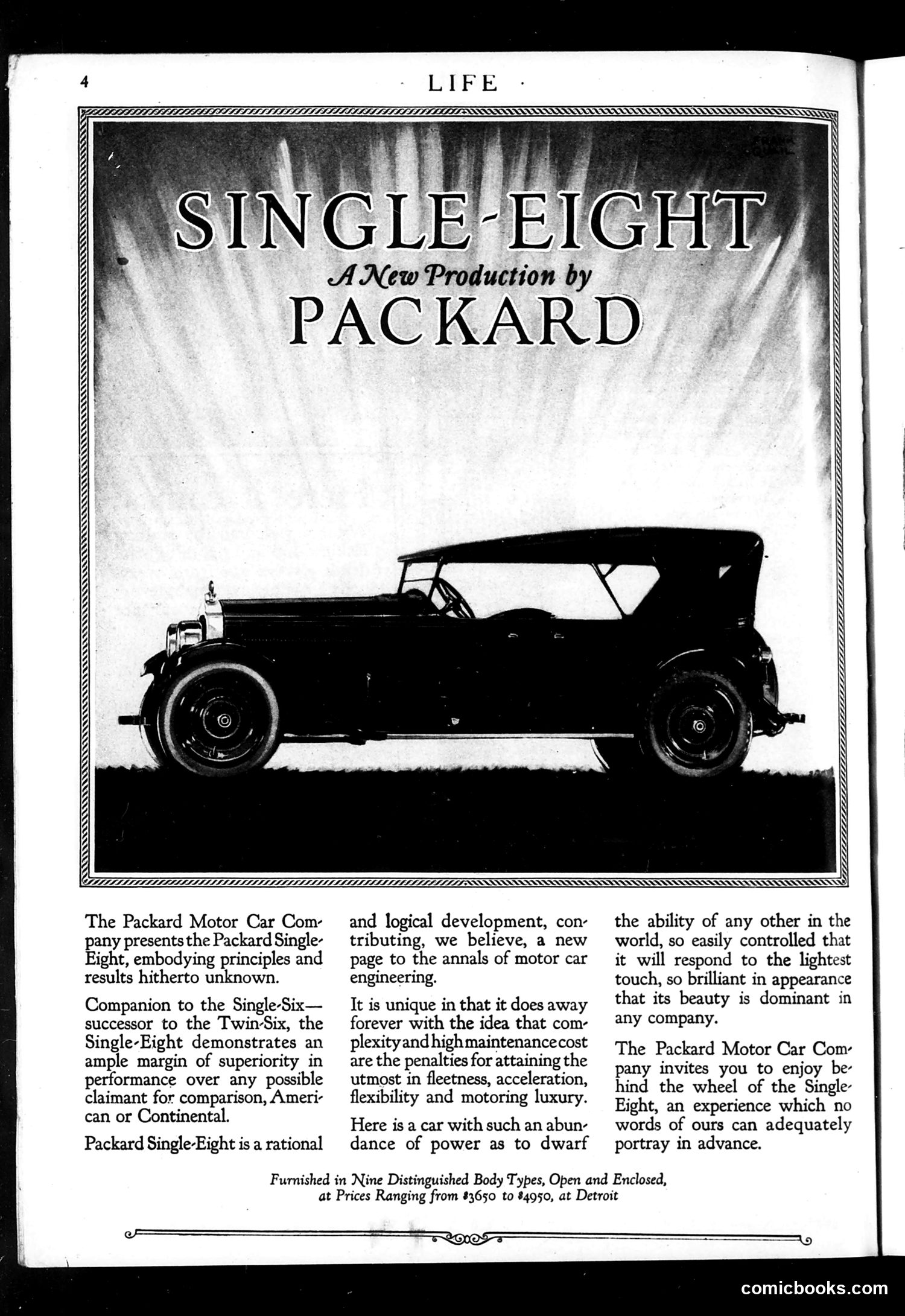
This is **not a political cartoon or satire**—it's a straightforward automobile advertisement from *Life* magazine. The page advertises the **Packard Single-Eight**, described as "a new production by Packard." The image shows a side-profile silhouette of the luxury car. The ad copy emphasizes Packard's engineering superiority over competitors (mentioning the "Single-Six" and "Twin-Six" models), claiming the Single-Eight combines high performance with low maintenance costs—positioning it as the rational choice for luxury car buyers. The text invites readers to experience "the wheel of the Single-Eight" and notes the car came in nine body styles, priced $1,650–$4,050 in Detroit. This is period product advertising reflecting early 1920s automobile marketing conventions.
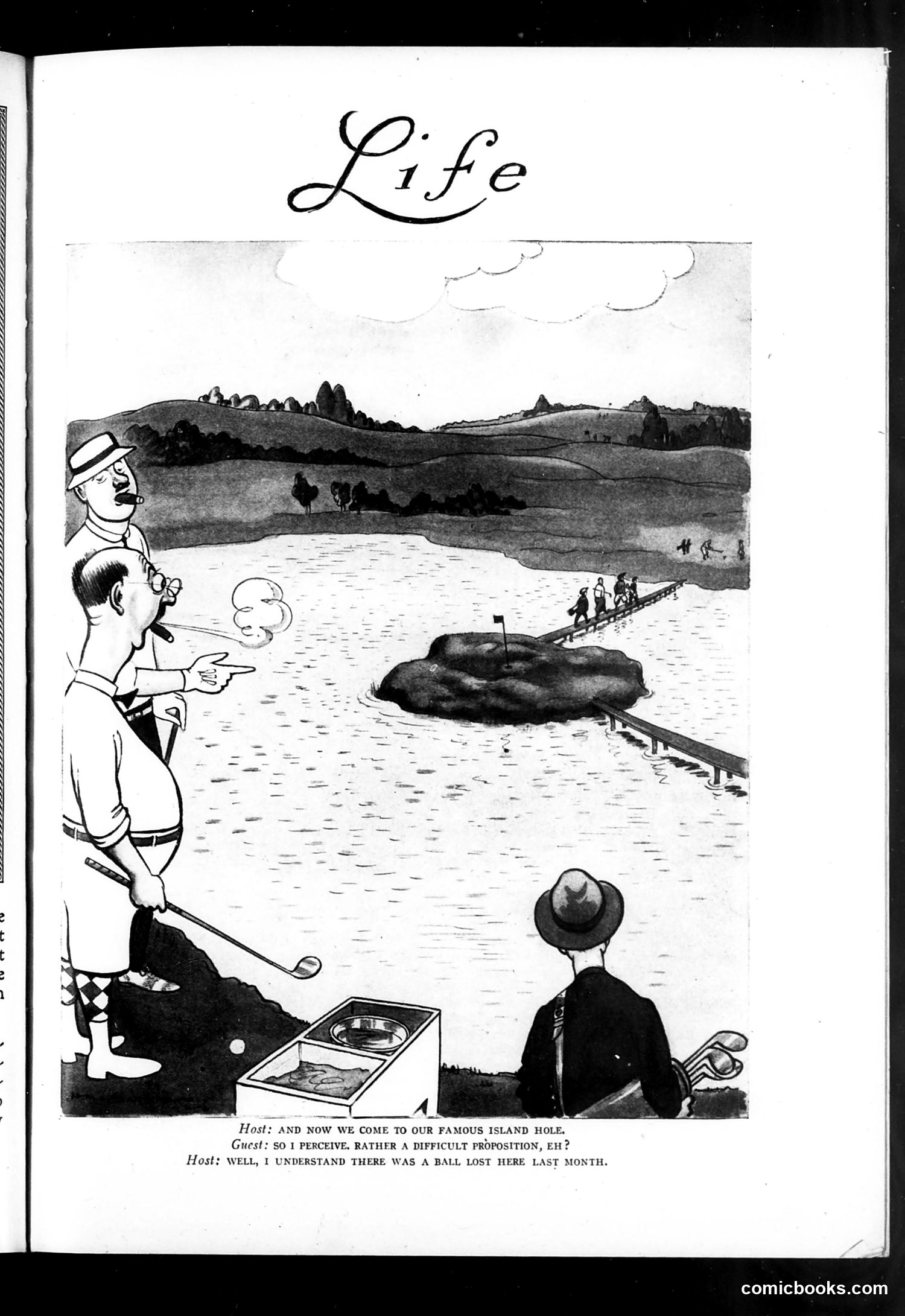
This page satirizes golf culture among wealthy Americans. The titled section "Life" shows a comedic golf scene where a host is giving a tour to a guest at what's labeled a "famous island hole." The host explains that a ball was lost there last month—the dark mass in the water appears to be the lost ball, now comically enlarged or transformed into something substantial enough to warrant a flag marker and viewing platform. The satire mocks both the obsessive nature of golfers and the pretentiousness of exclusive golf clubs. The exaggerated rendering of the "lost" ball as a major landmark suggests absurd dedication to the sport among the leisure class. The caricatured figures and refined setting emphasize the snobbish, upper-class associations of early 20th-century golf.
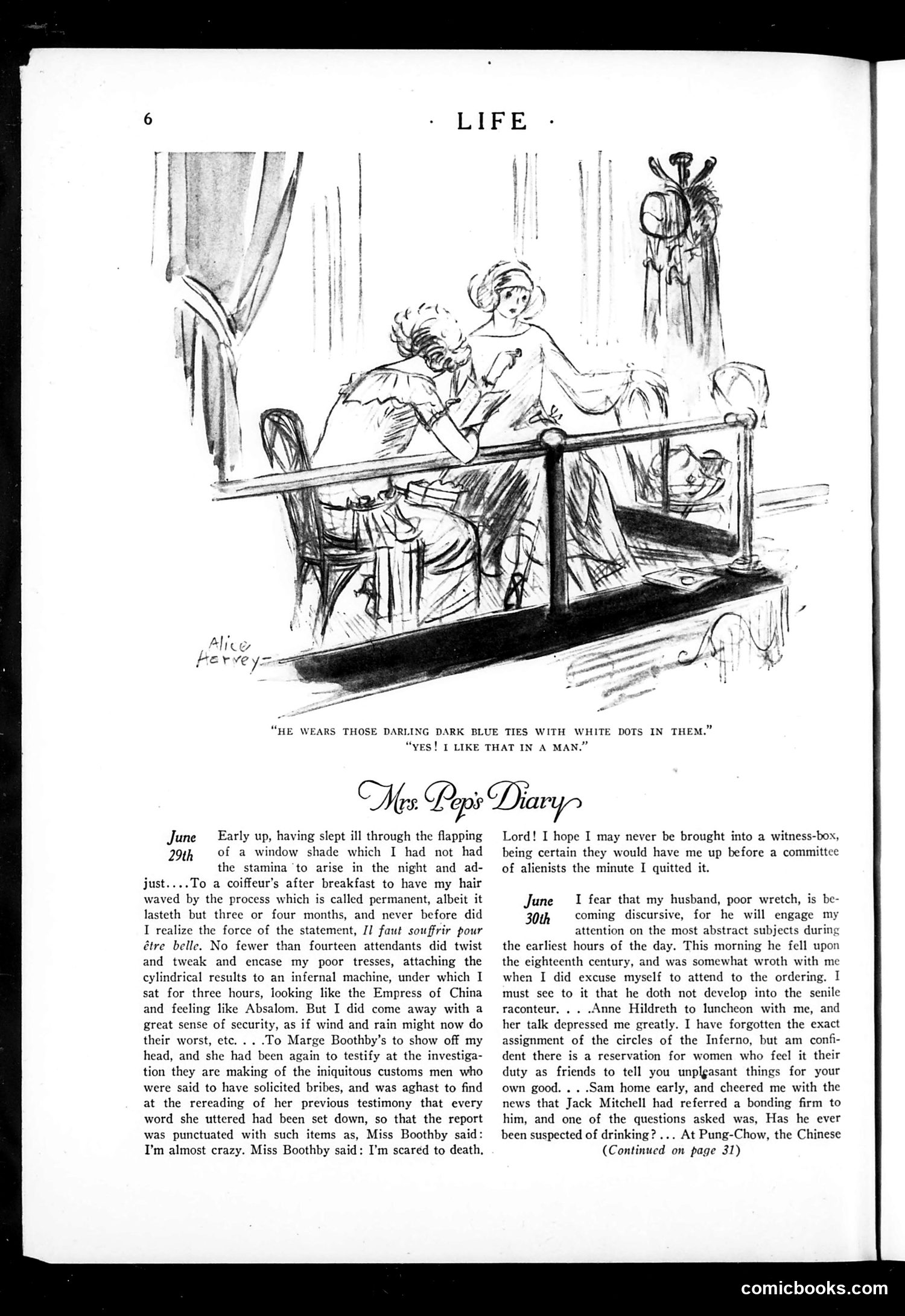
This page features a sketch and satirical diary entry. The illustration shows two women in what appears to be a bedroom or dressing room, with one seated and another attending to her hair. The caption quotes dialogue about a man's fashion choice: "dark blue ties with white dots." "Mrs. Pop's Diary" is a humor column dated June 20th-30th. The entry mocks the author's experiences with a permanent wave hairstyle treatment, describing it sarcastically as torture ("infernal machine"). It also satirizes her husband's inattention and her own efforts to engage him in intellectual conversation about eighteenth-century history, which he ignores. The piece humorously contrasts her intellectual pretensions with domestic frustrations, typical of 1920s satirical women's humor focusing on marriage dynamics and gender roles.
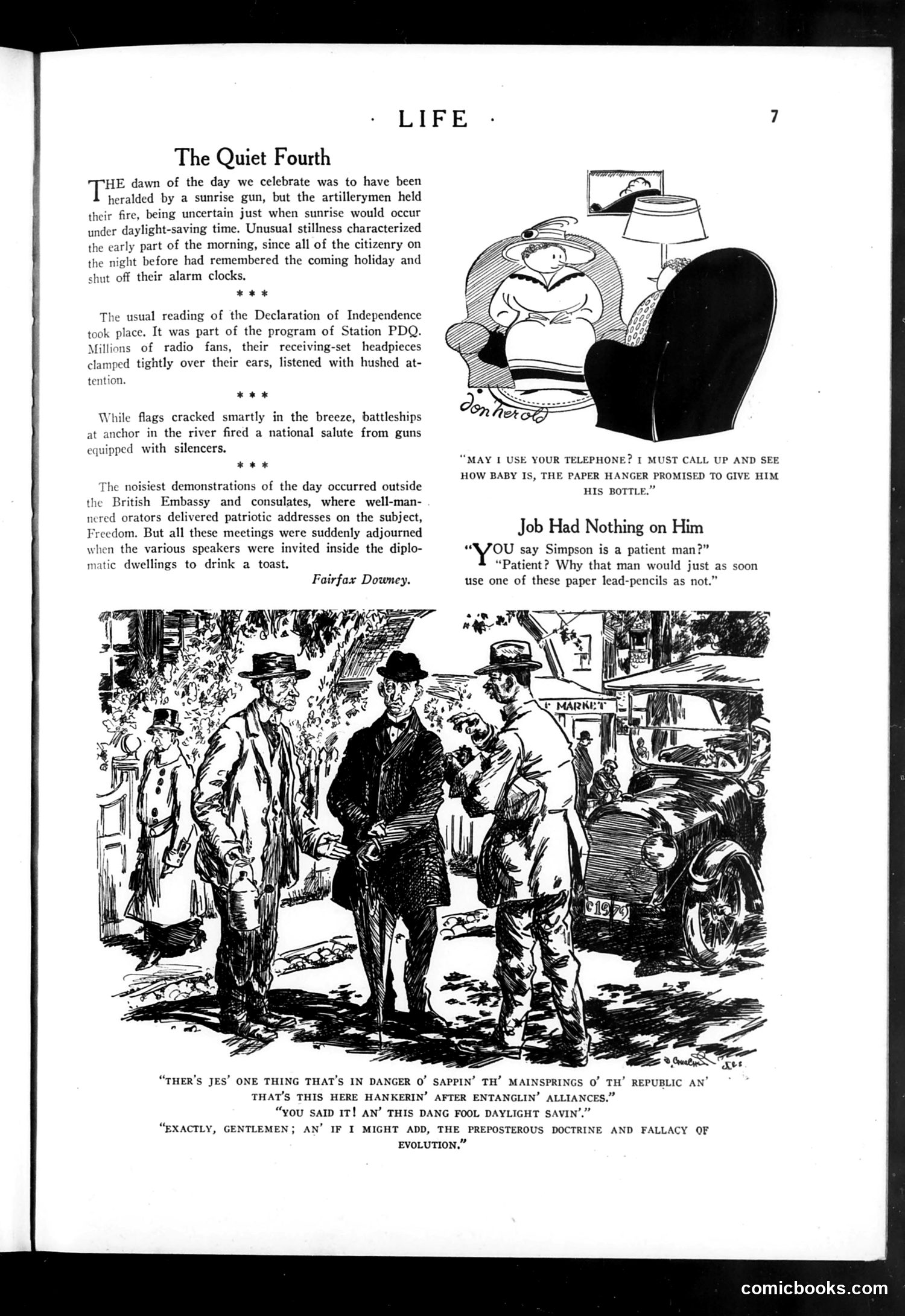
This page contains two separate pieces: **"The Quiet Fourth"** (top) describes Fourth of July 1918 celebrations during World War I—muted festivities because soldiers were deployed. References include radio broadcasts of the Declaration of Independence and military gun salutes. **"Job Had Nothing on Him"** (bottom) is a comic sketch satirizing a complaining man named Simpson. The dialogue ridicules his impatience and pessimism, with onlookers mocking his complaints about modern life using period slang ("dang fool daylight savin'"). The lower cartoon depicts street scenes with men in hats debating, likely commentary on post-war social or political discourse. The satire targets chronic complainers and their incessant grievances about contemporary conditions.
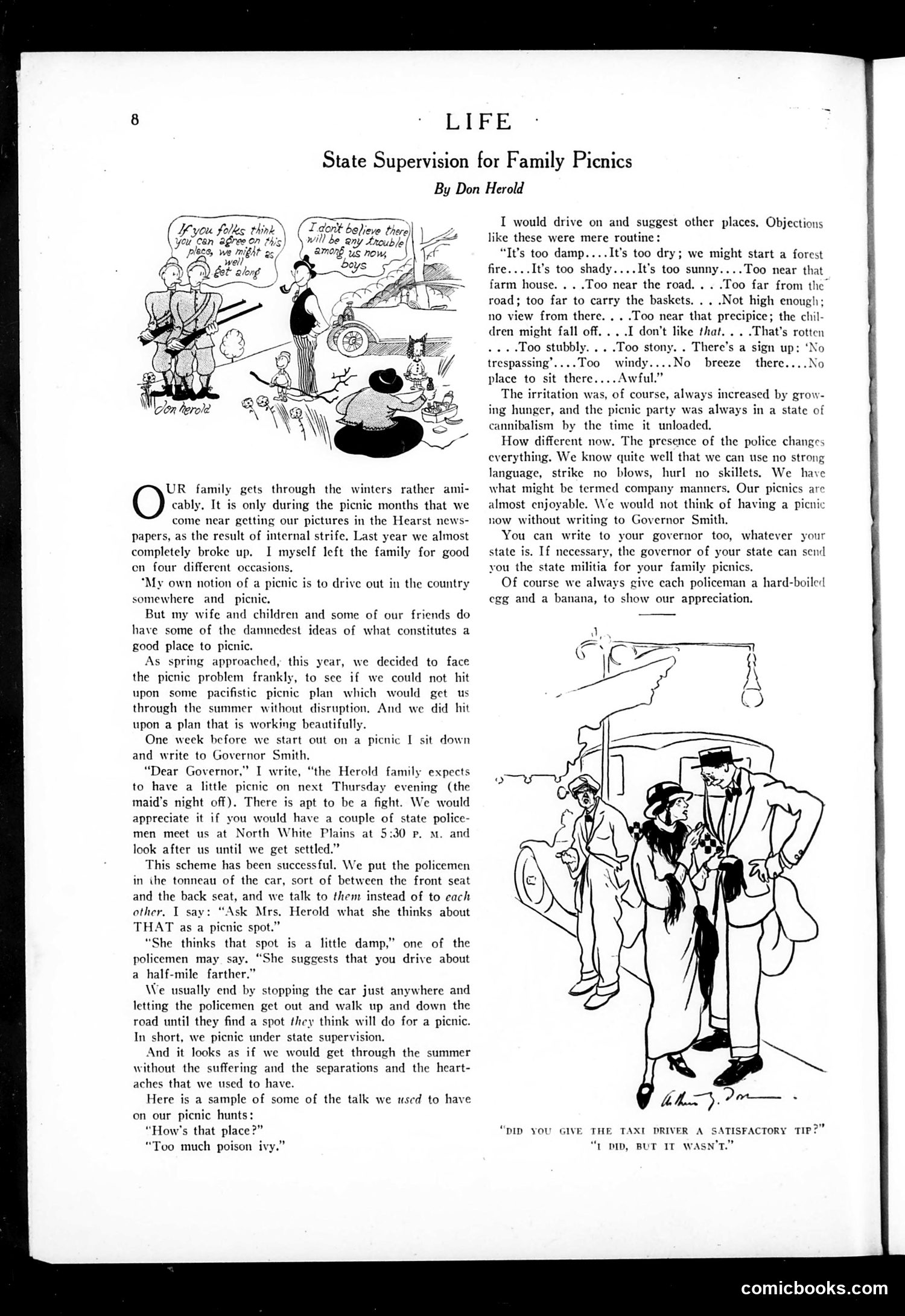
This satirical article by Don Herold describes the author's scheme to have state police supervise family picnics to prevent arguments and discord. The humor relies on the absurd idea of government oversight intruding into private leisure activities. The cartoon illustrations show the picnic scenario and, in the bottom image, police officers interacting with a family during their outing. The caption jokes about tipping the taxi driver: "DID YOU GIVE THE TAXI DRIVER A SATISFACTORY TIP?" / "I DID, BUT IT WASN'T." The satire targets mid-20th century concerns about bureaucratic expansion and social regulation, poking fun at how state intervention—intended to solve problems—becomes itself intrusive and ridiculous when applied to everyday family activities like picnicking.
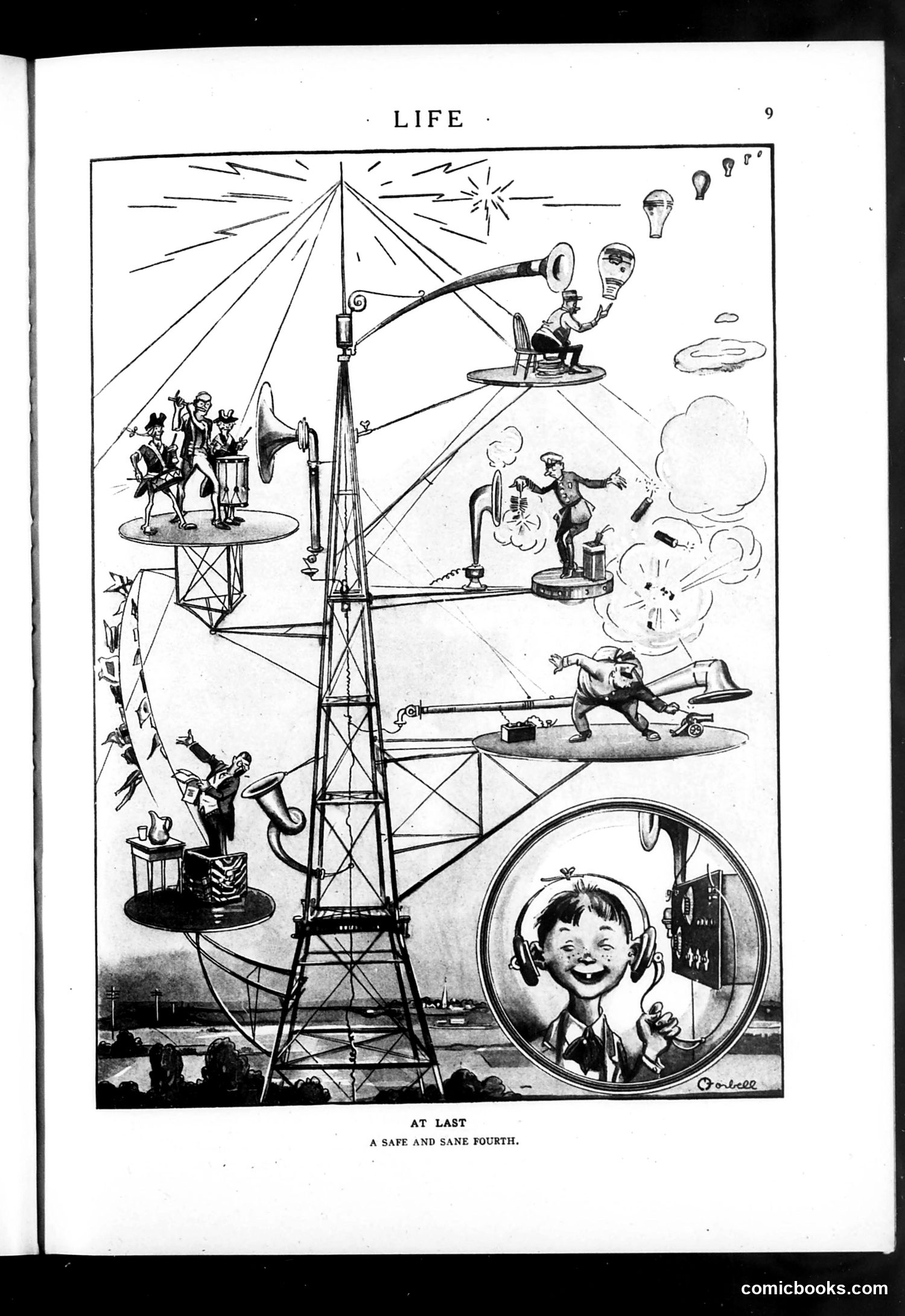
This cartoon satirizes **radio broadcasting**, specifically celebrating its arrival as a safe, reliable technology ("At Last—A Safe and Sane Fourth"). The central tower broadcasts to various platforms/activities below, each depicting different uses of radio: musicians performing, people listening via headphones, someone with an airplane, and explosions representing traditional Fourth of July fireworks dangers. The caption's wordplay—"safe and sane"—references the Progressive Era's "Safe and Sane Fourth" movement, which promoted alternatives to dangerous fireworks. The cartoon suggests radio entertainment replaces destructive holiday celebrations. The joyful child in the circular inset (likely listening to the broadcast) symbolizes how families could enjoy entertainment safely at home rather than risk injuries from fireworks. This reflects 1920s-30s optimism about radio's transformative, civilizing potential.
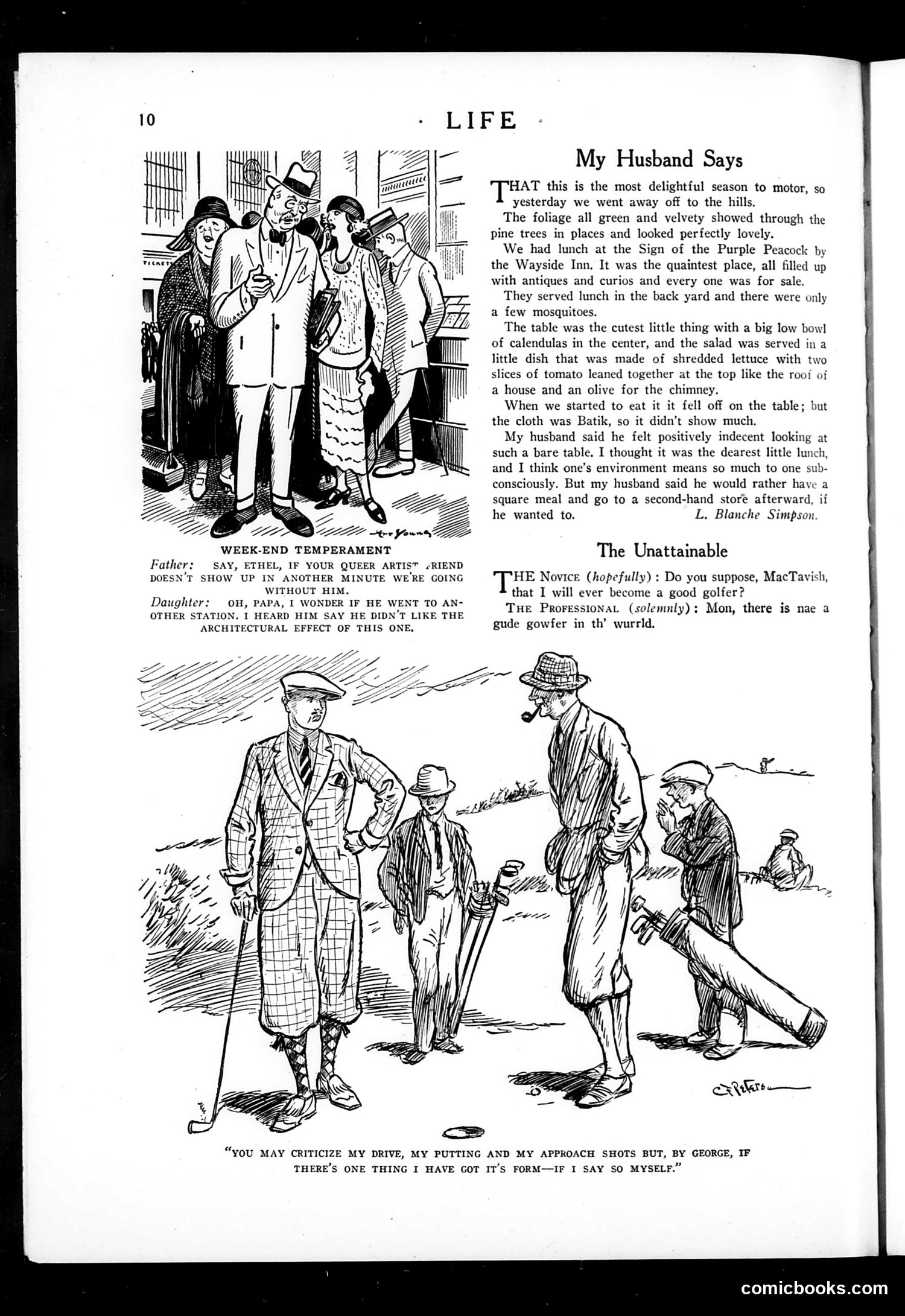
This page contains two distinct pieces from *Life* magazine: **Top section ("My Husband Says"):** A humorous domestic essay by L. Blanche Simpson about a motor outing to the hills. The piece gently satirizes her husband's preferences—he criticizes their elegant lunch setup at an inn as "indecent" and would prefer a "square meal" at a second-hand store afterward. It's satirizing masculine practicality versus feminine aesthetic sensibility, a common comedic theme of the era. **Bottom section ("The Unattainable"):** A golf cartoon featuring dialogue between a novice golfer and a professional. The novice asks if he'll ever become good; the professional responds there's "nae a gude gowfer in th' wurld"—using Scottish dialect for comic effect. The illustration shows golfers on a course. It's satirizing golf's impossibly high standards and the futility of amateur improvement. Both pieces use gentle domestic and sporting humor typical of early-20th-century *Life* magazine satire.
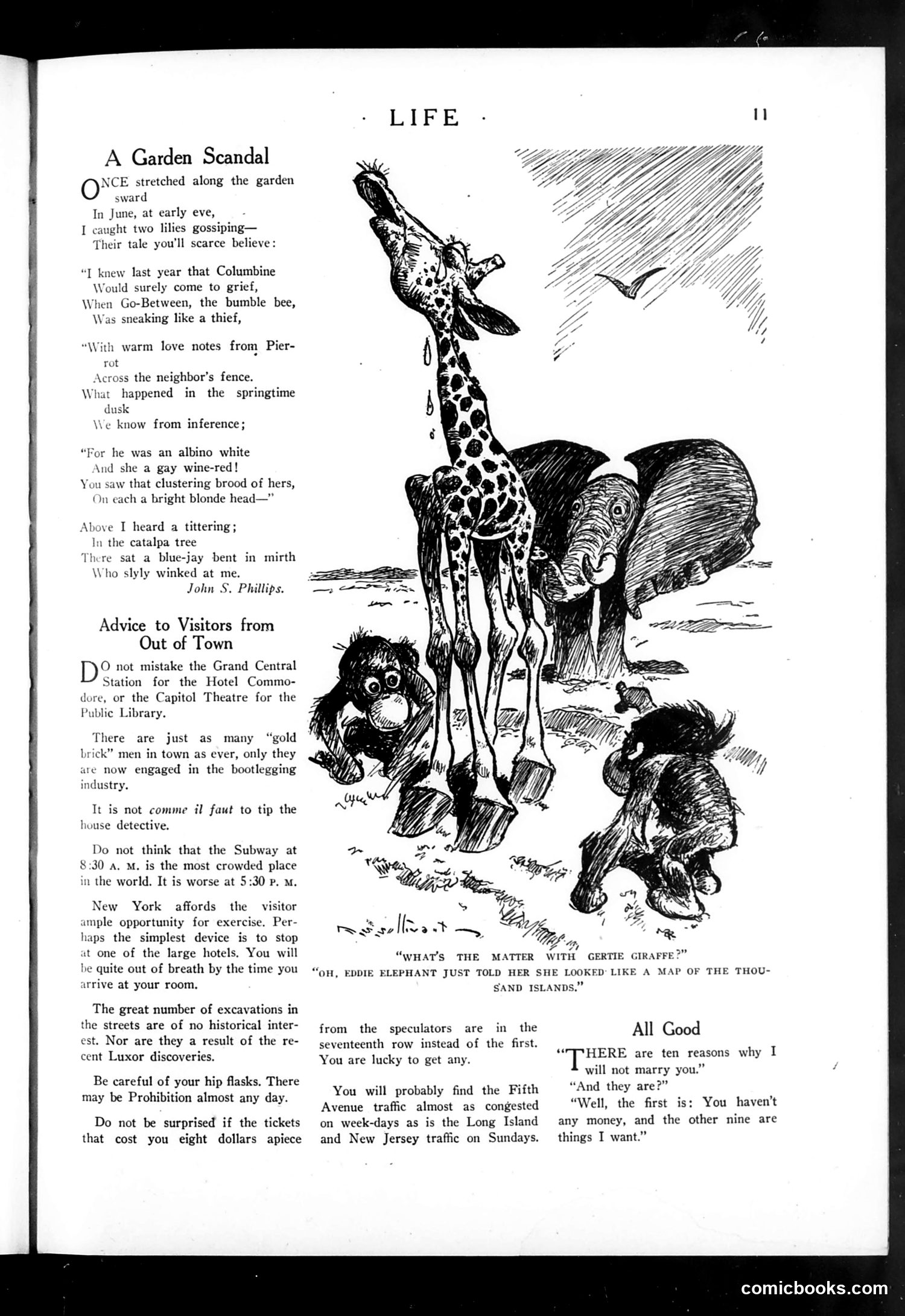
This satirical cartoon depicts a giraffe surrounded by smaller animals (an elephant and what appear to be monkeys or apes) in a zoo or similar setting. The caption reads: "Oh, Eddie elephant just told her she looked like a map of the thousand islands." The joke targets Gertie Giraffe's distinctive spotted pattern, comparing it to the geographical features of the Thousand Islands region. This appears to be gentle mockery of an animal's appearance rather than political satire. The cartoon likely references a popular animal character of the era, suggesting Gertie was recognizable to contemporary readers. The humor relies on visual comparison and the absurdity of animals gossiping about each other's looks.
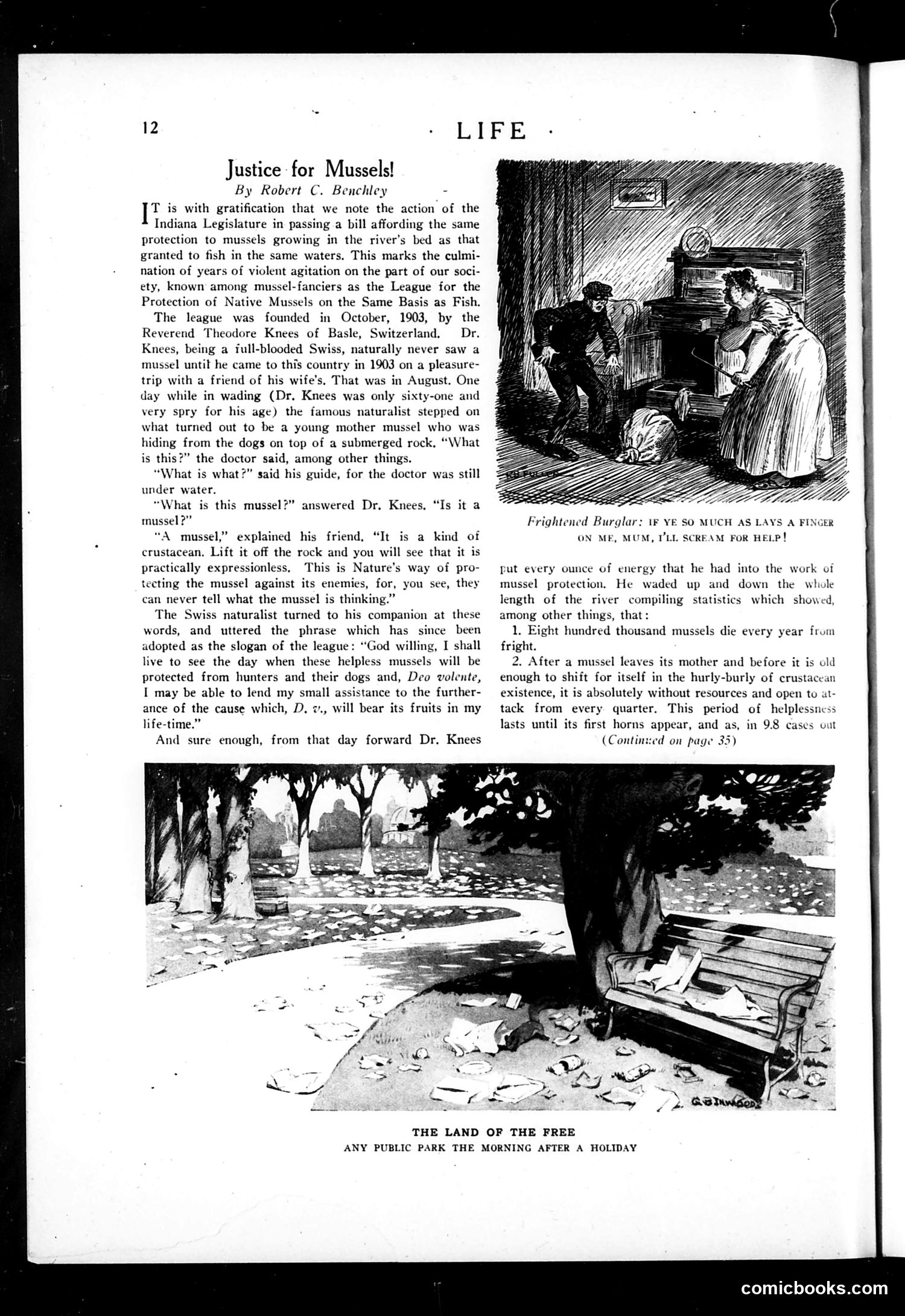
This page contains an article by Robert C. Benchley advocating for mussel protection legislation passed by Indiana. The article describes how Dr. Theodore Knees, a Swiss naturalist, founded the "League for the Protection of Native Mussels on the Same Basis as Fish" in 1903 after discovering a young mother mussel hiding from predators. The **upper cartoon** humorously depicts a burglar being startled by a woman threatening to scream for help—illustrating how the article uses absurdist humor. The **lower photograph** titled "The Land of the Free" shows a littered public park after a holiday, sardonically commenting on American carelessness and environmental disrespect—contrasting with the article's plea for protecting even lowly mussels from destruction.
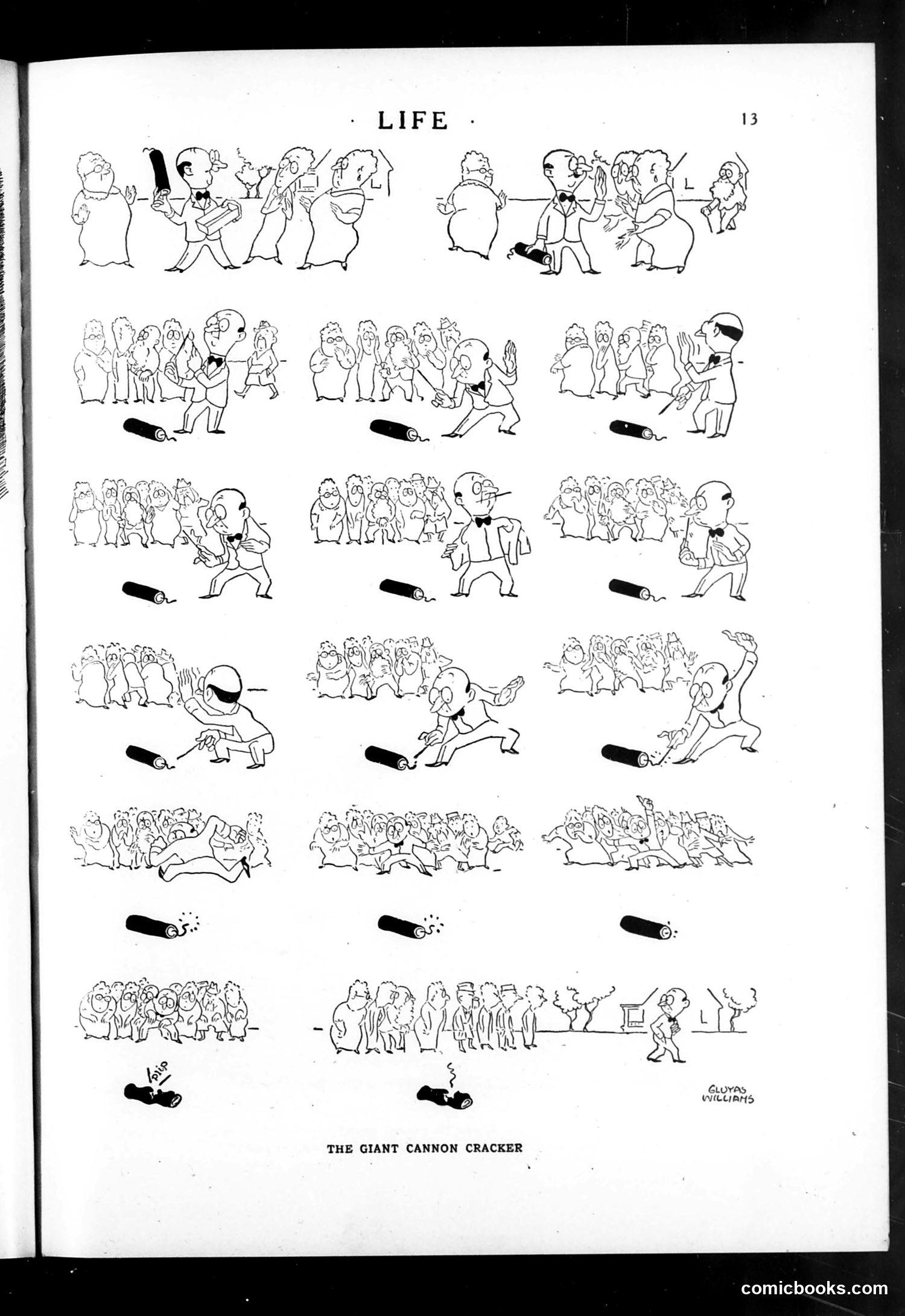
This satirical cartoon depicts a political figure (likely a prominent politician or public official, though not explicitly identified) as a giant firecracker being set off among a crowd of ordinary citizens. The sequential panels show the cracker's fuse being lit and the resulting chaos and explosion that scatters the crowd. The satire suggests that this person's actions or policies create destructive consequences for the public—they're portrayed as dangerously explosive and destabilizing to society. The "cannon cracker" metaphor implies reckless behavior with far-reaching, harmful effects on common people. Without identifying marks or a dated caption, the specific political figure and historical moment remain unclear, but the message critiques someone in power for causing public disruption and harm.
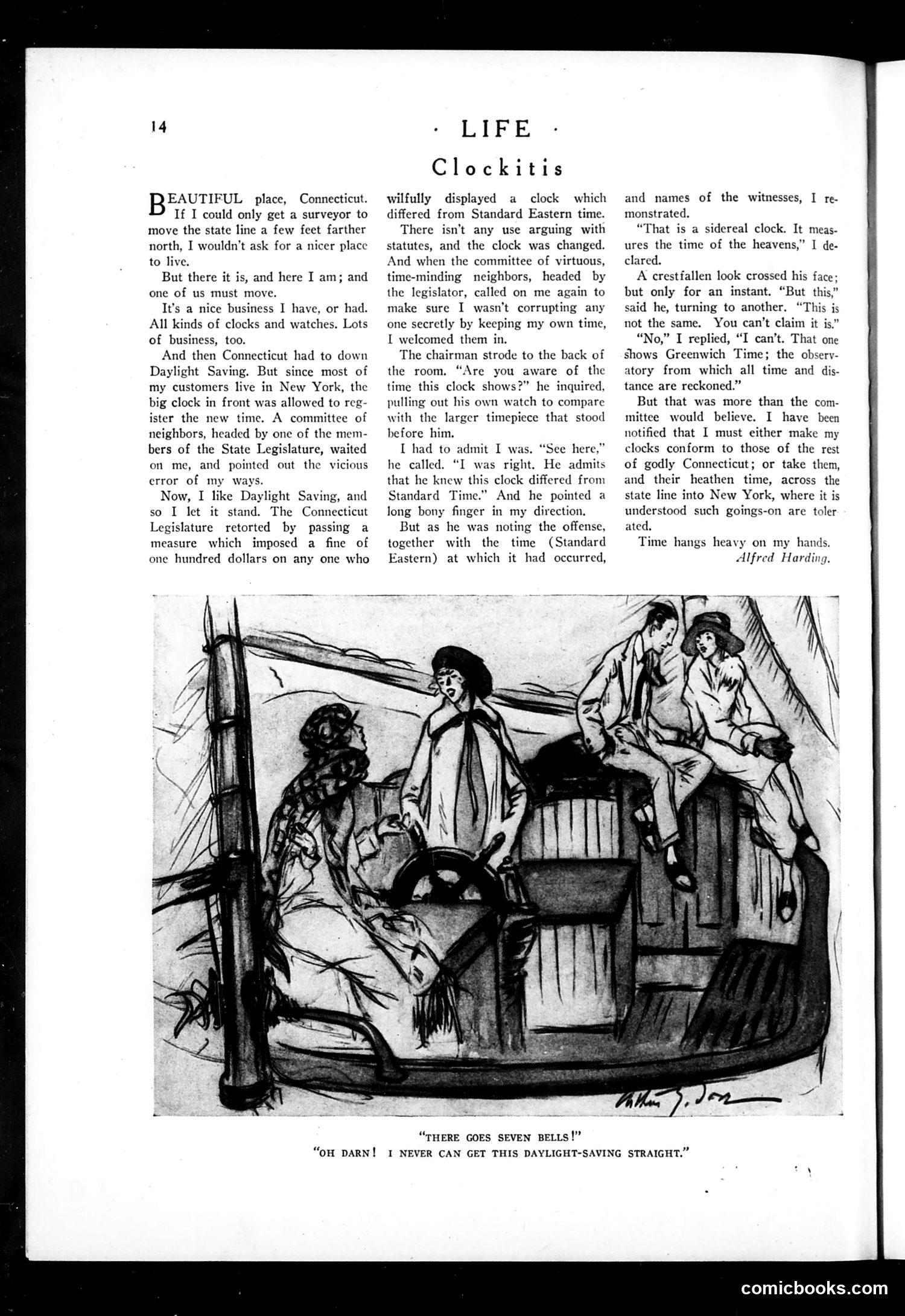
This page satirizes the implementation of Daylight Saving Time in Connecticut. The author (Alfred Harding) humorously recounts being forced to adjust his clock by legislative mandate, with a fine of $100 for non-compliance. The cartoon depicts a boat scene where someone appears confused about timekeeping, with dialogue referencing "seven bells" and frustration over "daylight-saving" adjustments. The satire targets the absurdity of government-mandated time changes—treating the bureaucratic intrusion into citizens' private lives as ridiculous overreach. The piece mocks how authorities policed compliance with the new system, suggesting the regulations were comically draconian and that adjusting to synchronized timekeeping created genuine practical confusion for ordinary people conducting daily business.
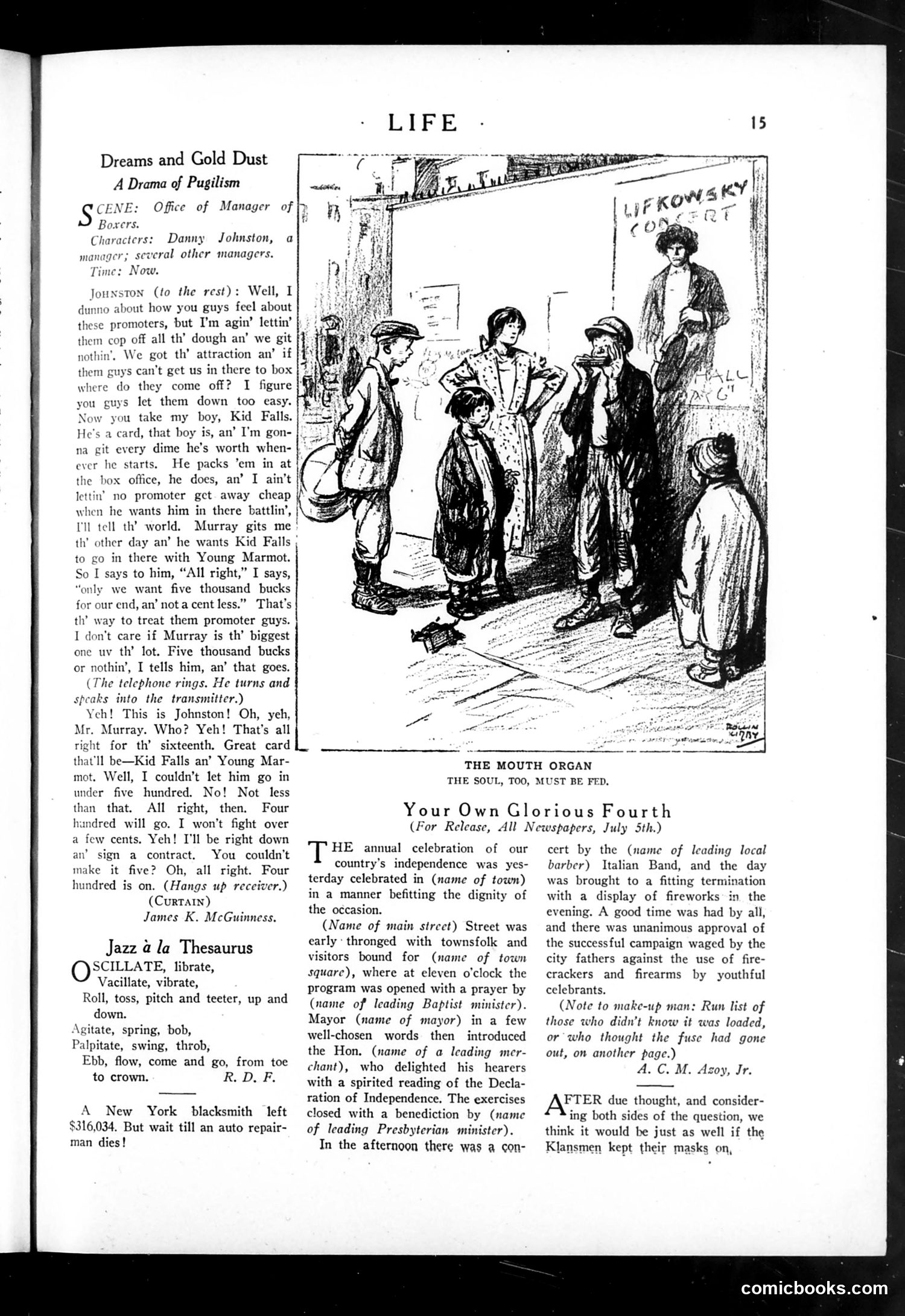
This sketch satirizes boxing managers' negotiating tactics and hypocrisy. Manager Danny Johnston boasts to colleagues about demanding top dollar for his fighter "Kid Falls," declaring he won't accept less than five thousand dollars and won't let promoters "get away cheap." However, when promoter Murray calls immediately after, Johnston capitulates repeatedly—first accepting four hundred dollars instead of five thousand, then agreeing to sign the contract despite claiming he "won't fight over a few cents." The humor lies in the stark contrast between his tough talk to peers and his immediate cave-in when actually negotiating. The satire targets the gap between boxing managers' public posturing about fighting for fighters' rights versus their actual, mercenary behavior—they quickly compromise for far less than demanded when a real deal appears.
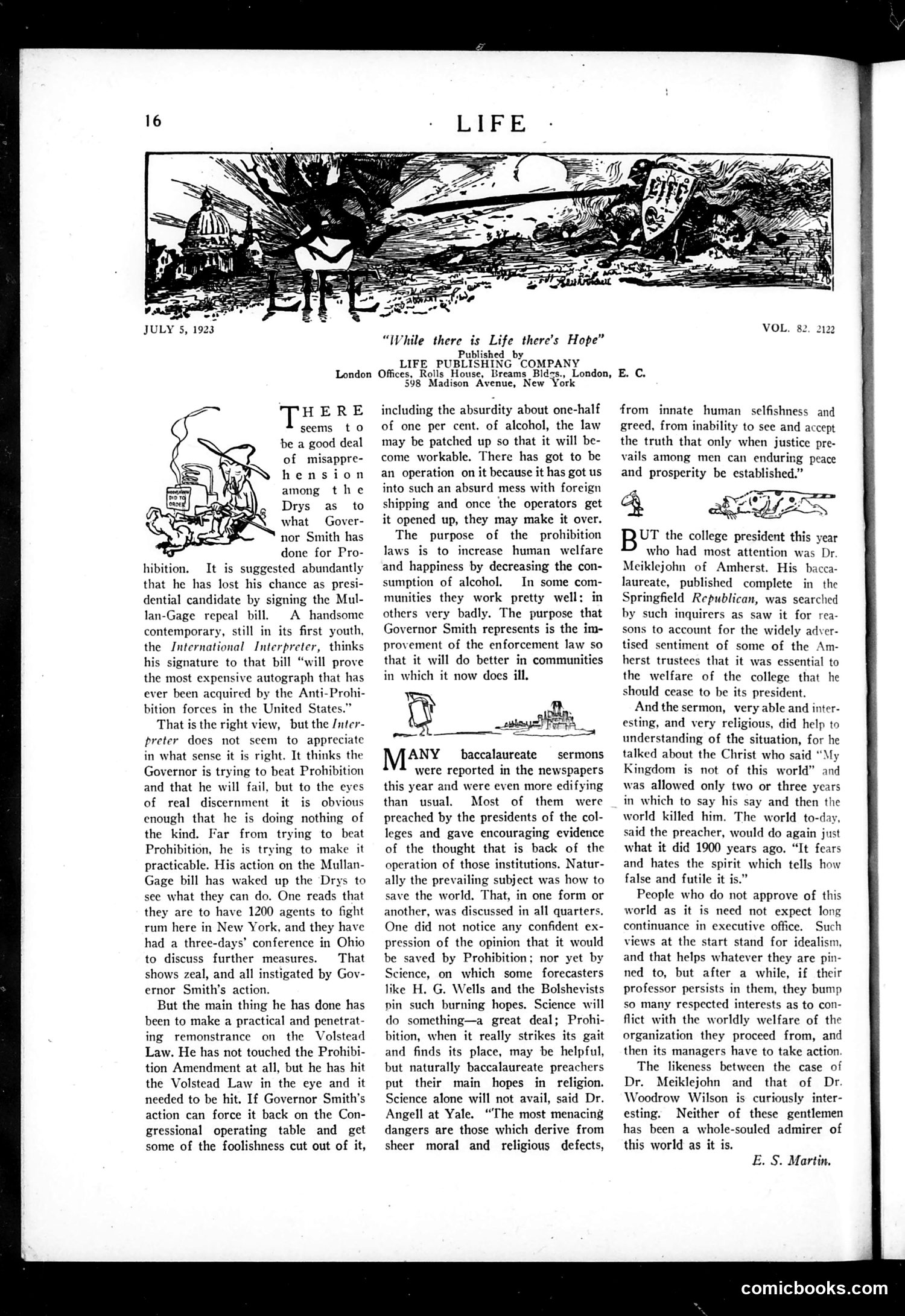
This editorial page defends New York Governor Al Smith's signing of the Mullan-Gage repeal bill against Prohibition supporters' criticism. The "Drys" (anti-alcohol advocates) believed Smith damaged his presidential prospects, but Life argues he actually strengthened enforcement by exposing the Volstead Law's absurdities—particularly its arbitrary one-half percent alcohol threshold. Smith's practical criticism, the magazine suggests, will force Congressional reconsideration and improvement of Prohibition's implementation rather than the amendment itself. The page also discusses college baccalaureate sermons emphasizing religion over Prohibition or Science as humanity's salvation. The cartoon (upper left) is difficult to parse precisely but appears to satirize Prohibition's chaotic effects on society.
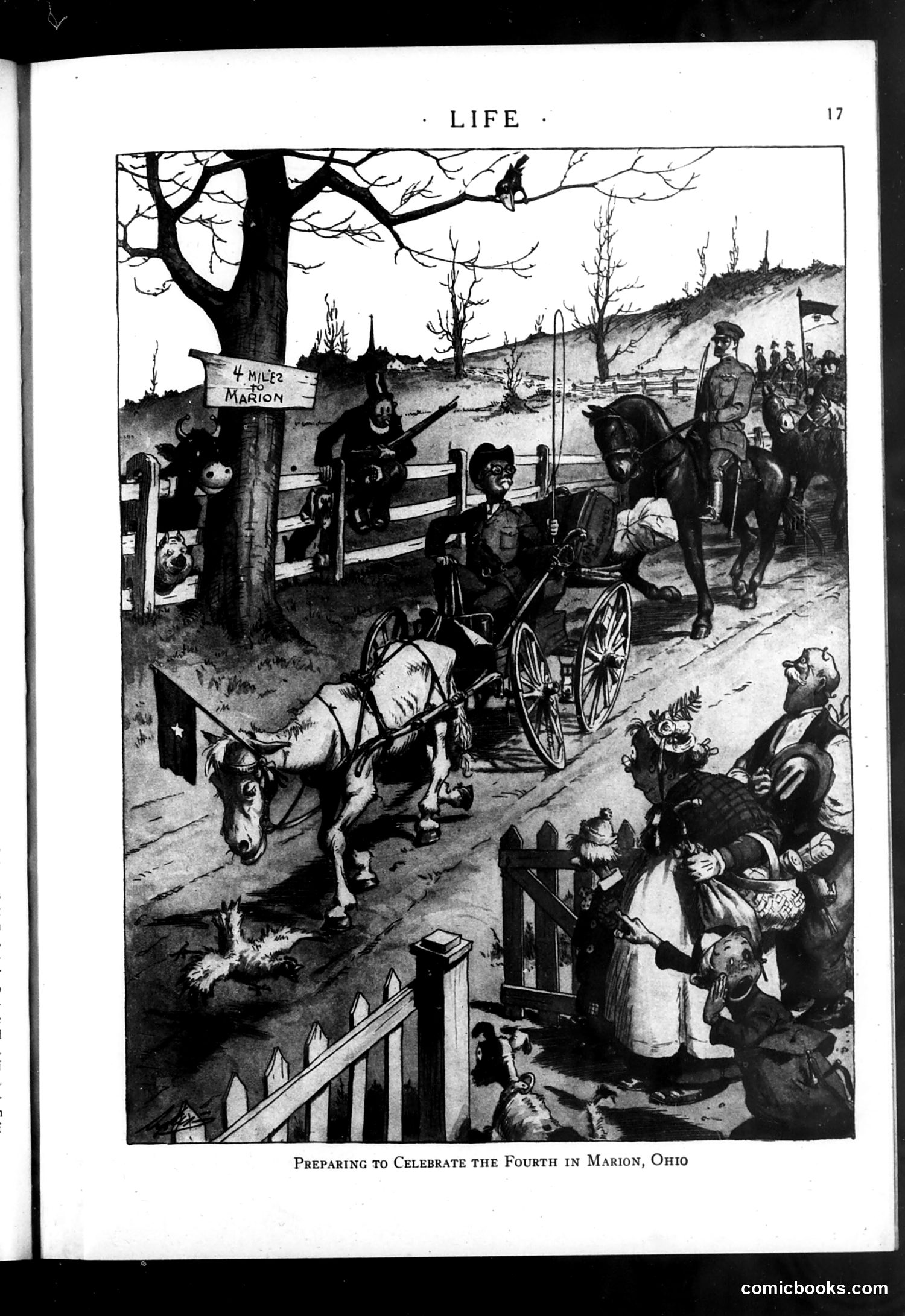
This is a satirical illustration depicting Fourth of July preparations in Marion, Ohio. The scene shows animals dressed as soldiers and townspeople gathered for Independence Day celebrations. A sign reading "4 Miles to Marion" anchors the composition. The satire appears to target small-town American patriotism and military preparation, using animal characters to mock the earnestness of provincial Independence Day festivities. The dressed-up animals—including what appear to be soldiers with rifles and civilians—suggest humorous commentary on how rural communities embraced nationalist sentiment, possibly around the time of American military involvement (the worn landscape and military presence suggest a WWI-era context). The animals' anthropomorphic participation in solemn military ritual creates the cartoon's comedic effect through incongruity.
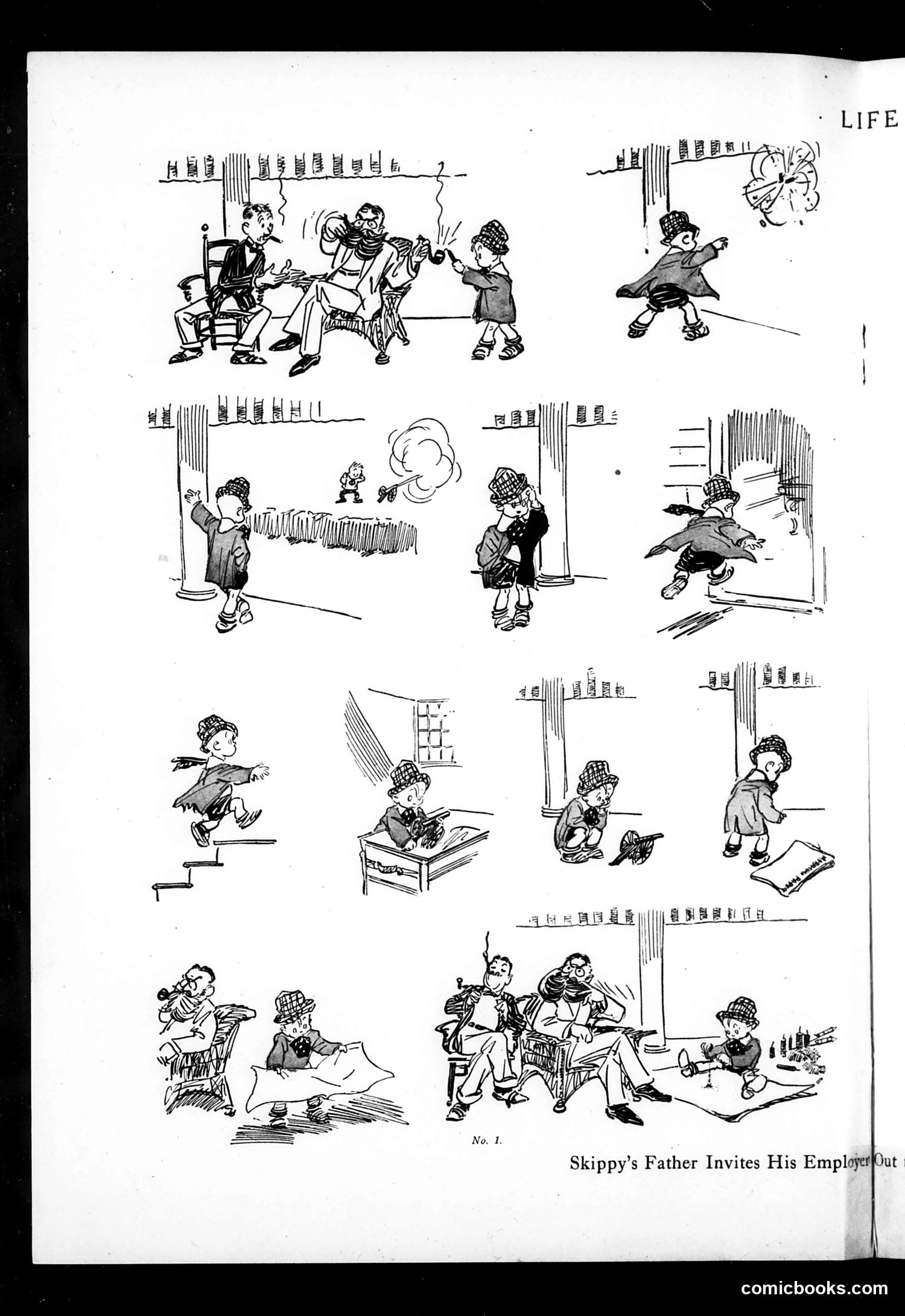
This is a comic strip sequence (labeled "No. 1") depicting a domestic scenario centered on class and social anxiety. The title indicates that Skippy's father is inviting his employer to visit—a situation that triggers comedic chaos in the household. The sequential panels show family members in various states of preparation and mishap: children playing, adults organizing, furniture being moved, and apparent disorder as the family attempts to present themselves respectfully to the visiting authority figure (the employer). The humor derives from the contrast between the family's aspirations to impress and their inability to control domestic life. This reflects early 20th-century anxieties about social propriety and workplace relationships, where an employee's home life and family reflected on professional standing.
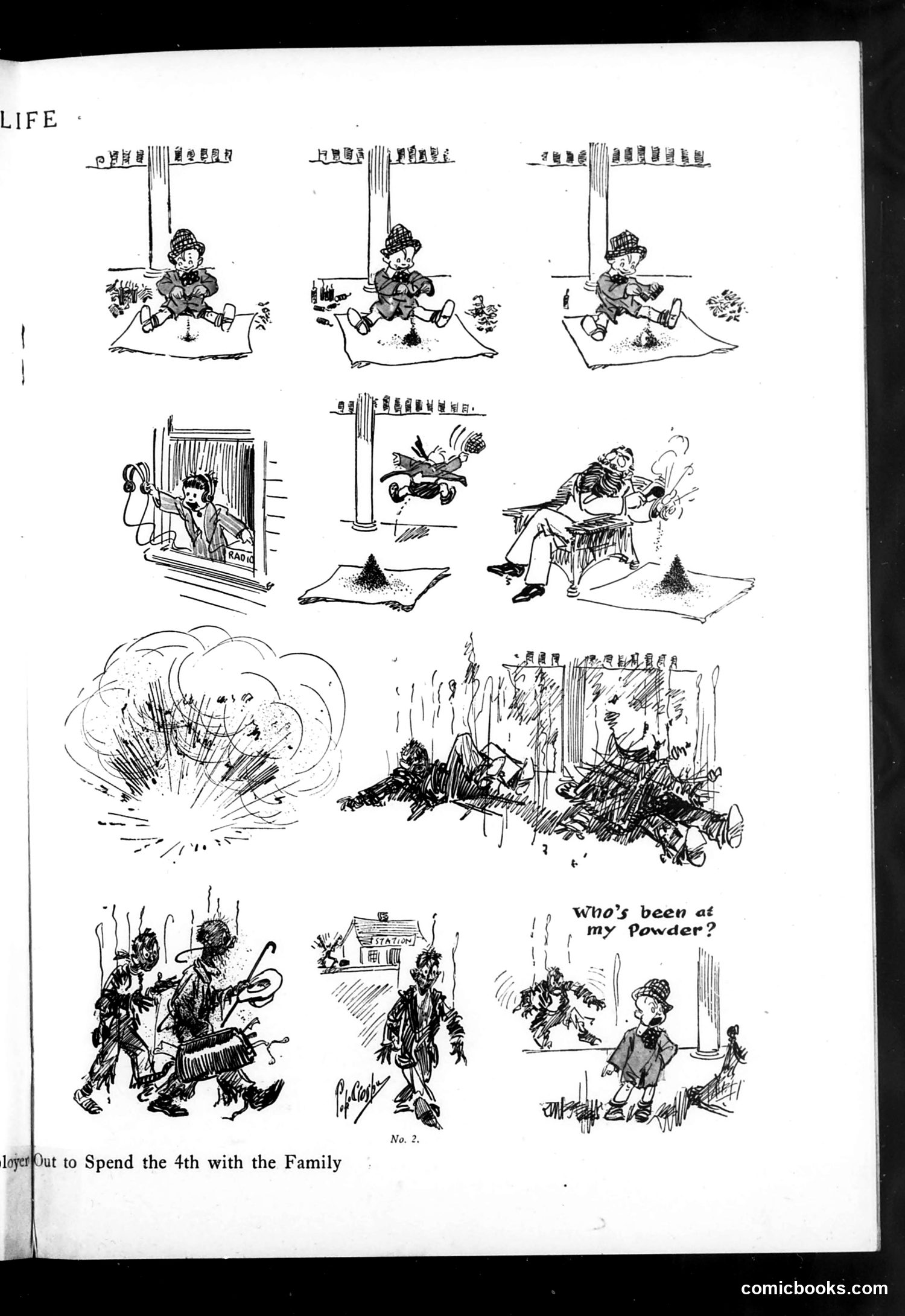
This satirical comic strip depicts a family's chaotic Fourth of July celebration. The sequential panels show escalating mayhem: children playing with fireworks indoors, explosions, a child peering from a window, adults being thrown about by blasts, and culminating in domestic disorder. The final panel shows an exasperated adult discovering their powder has been tampered with—likely face powder, suggesting children have raided a woman's toiletries. The humor targets turn-of-the-century American holiday traditions, portraying the Fourth of July as dangerously uncontrolled and anarchic rather than dignified or patriotic. The joke satirizes both children's mischief and adults' inability to maintain order during celebrations. The phrase "who's been at my powder" plays on the destruction wrought by actual gunpowder explosions throughout the sequence.
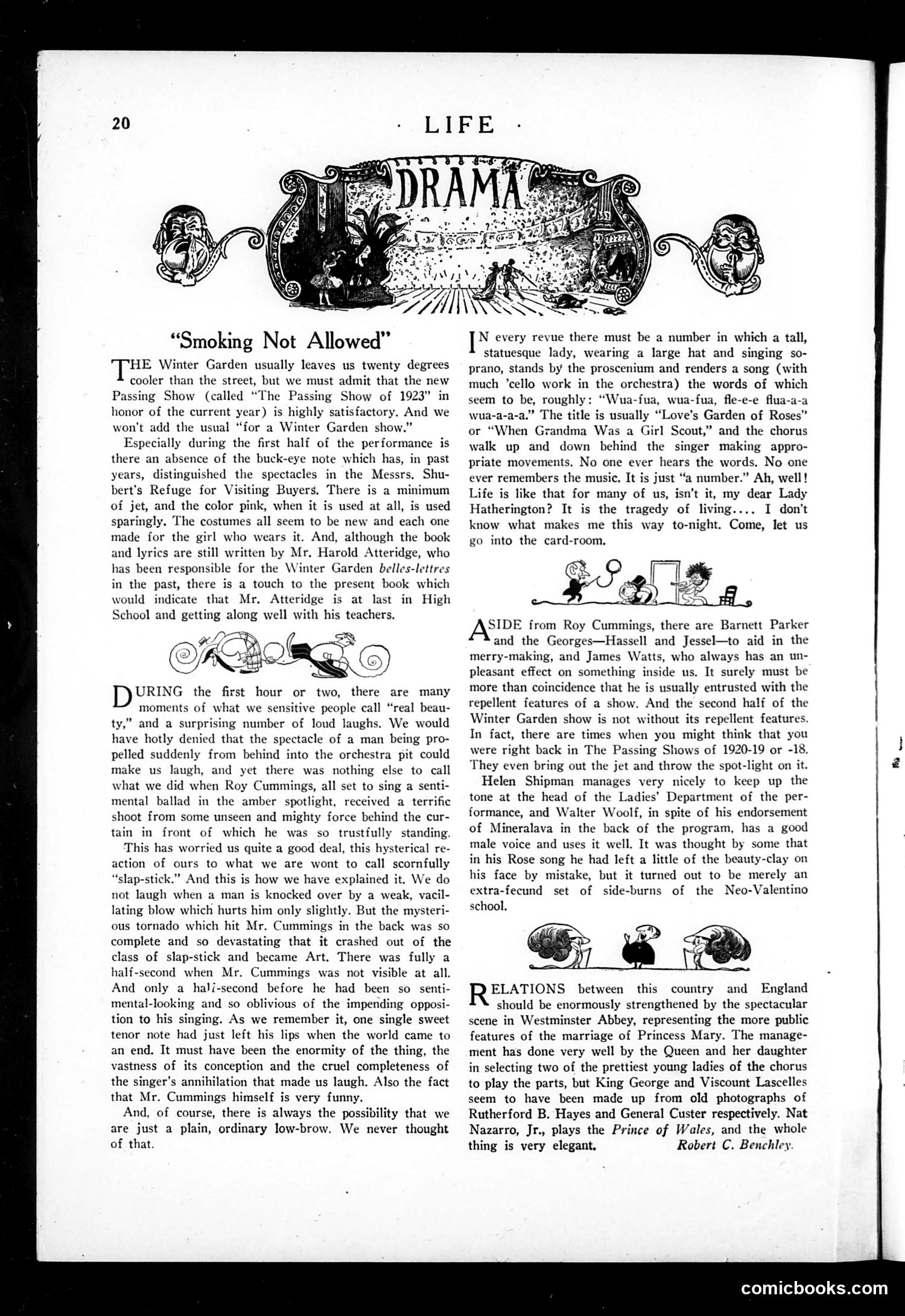
This is a theater review of a Broadway revue at the Winter Garden. The critic praises the production for departing from typical Shubert spectacle conventions—less reliance on the "buck-eye note" (likely referring to crude or lowbrow humor) and excessive use of jet beads and pink costumes. The satire targets: - **Harold Atteridge**, the librettist, whom the critic jokes has finally reached "High School" level of competence - **Roy Cummings**, a performer humorously knocked into the orchestra pit during a sentimental solo—the critic intellectualizes this "slap-stick" moment as "Art" rather than admitting they simply enjoyed lowbrow physical comedy - **Generic revue conventions**: the obligatory soprano number with nonsense lyrics ("Wua-fua") that audiences never remember The piece is self-aware satire about theater criticism itself and the critic's own taste, ending with the admission they might simply be "a plain, ordinary low-brow."
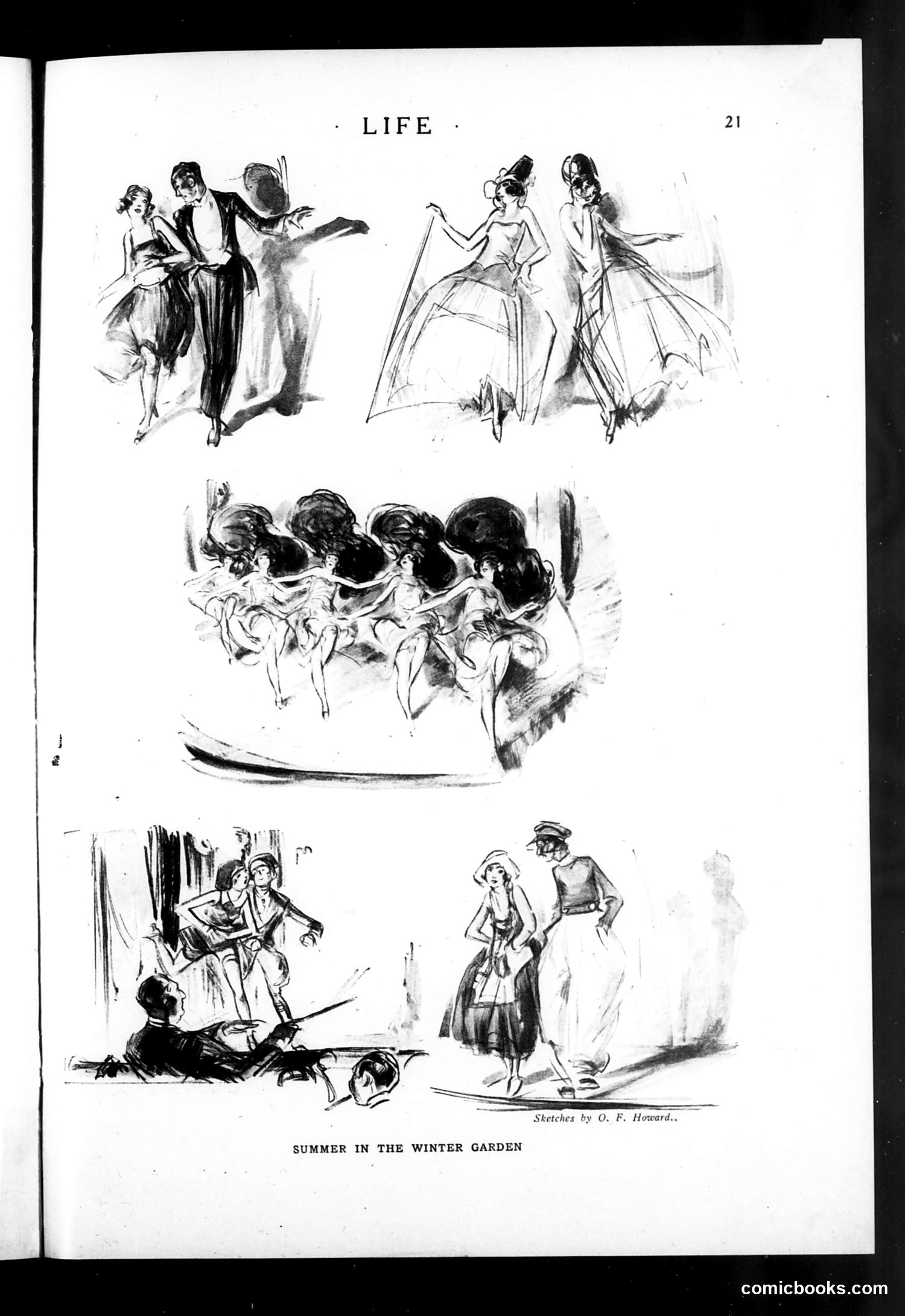
This page of sketches by O. F. Howard depicts social scenes at what appears to be an indoor entertainment venue called the Winter Garden. The six vignettes show various leisure activities: couples dancing and socializing, a group of women in elaborate hats gathered together, and interactions between men and women in fashionable dress. The satire likely mocks the artificiality of "summer" recreations happening indoors during winter—a commentary on upper-class urban entertainment and the pretensions of indoor social venues that attempted to recreate outdoor pleasures. The exaggerated attention to women's fashion (particularly the large, ornate hats) suggests humor about conspicuous consumption and the social rituals of the era's leisure class.
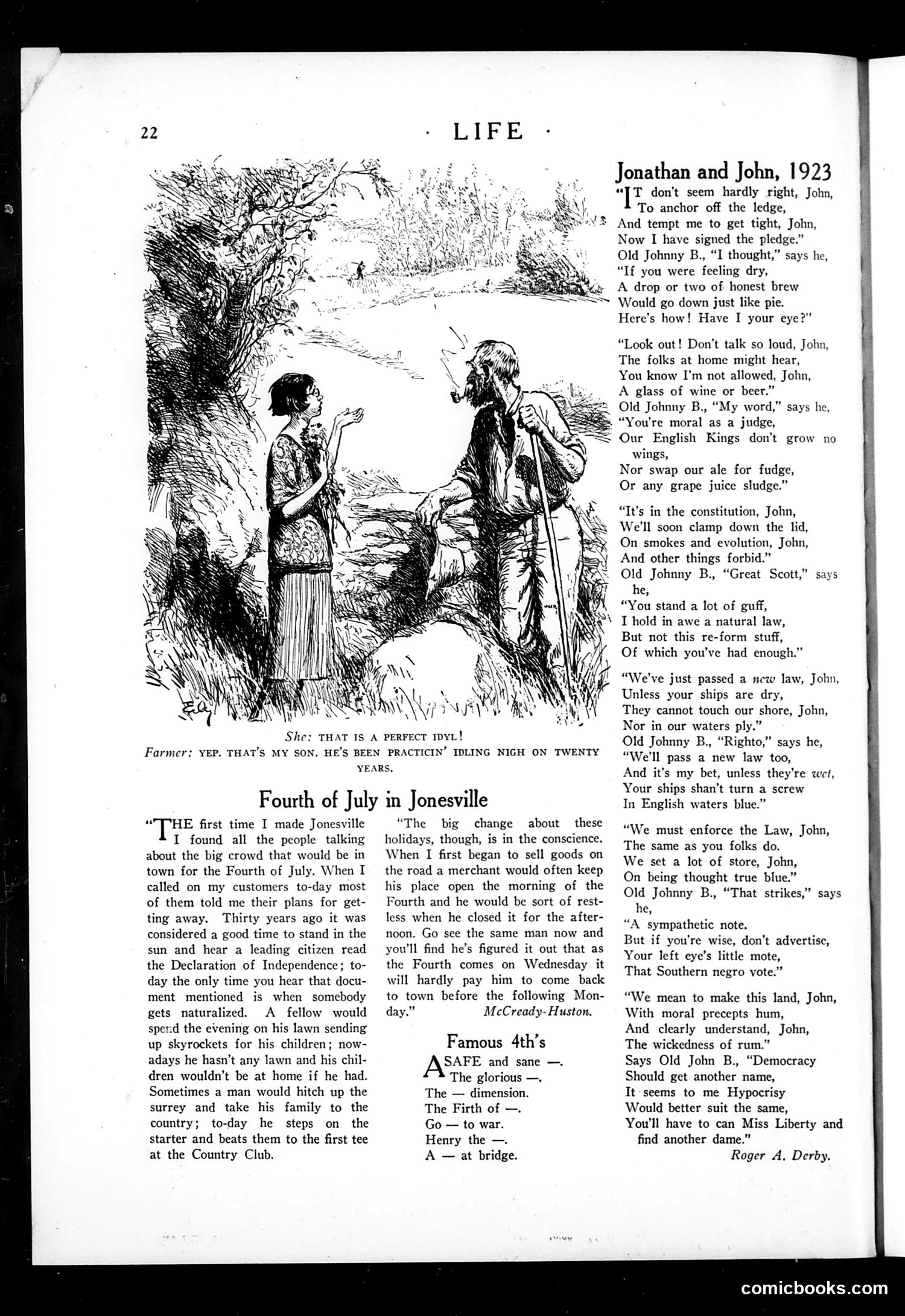
This page contains two satirical pieces mocking American social change. **"Jonathan and John, 1923"** depicts a conversation between an American (John) and a British character (Old Johnny B.). The satire attacks American Prohibition—the constitutional ban on alcohol that took effect in 1920. Old Johnny B. mocks John's moral righteousness about abstinence while pointing out American hypocrisy: America demands British ships remain "dry" (alcohol-free) in American waters, yet plans to enforce similar laws domestically. The final stanza sarcastically suggests "Democracy" should be renamed "Hypocrisy," and jabs at "the Southern negro vote," implying African American voters' political significance contradicts white Americans' claims to moral superiority. **"Fourth of July in Jonesville"** laments the decline of Independence Day observance. The author notes that thirty years prior, townspeople celebrated communally; now they've abandoned tradition for leisure activities (golf, motoring). The commentary suggests Americans have become indifferent to civic values and patriotic meaning—a broader critique of modern materialism replacing traditional community and national consciousness.
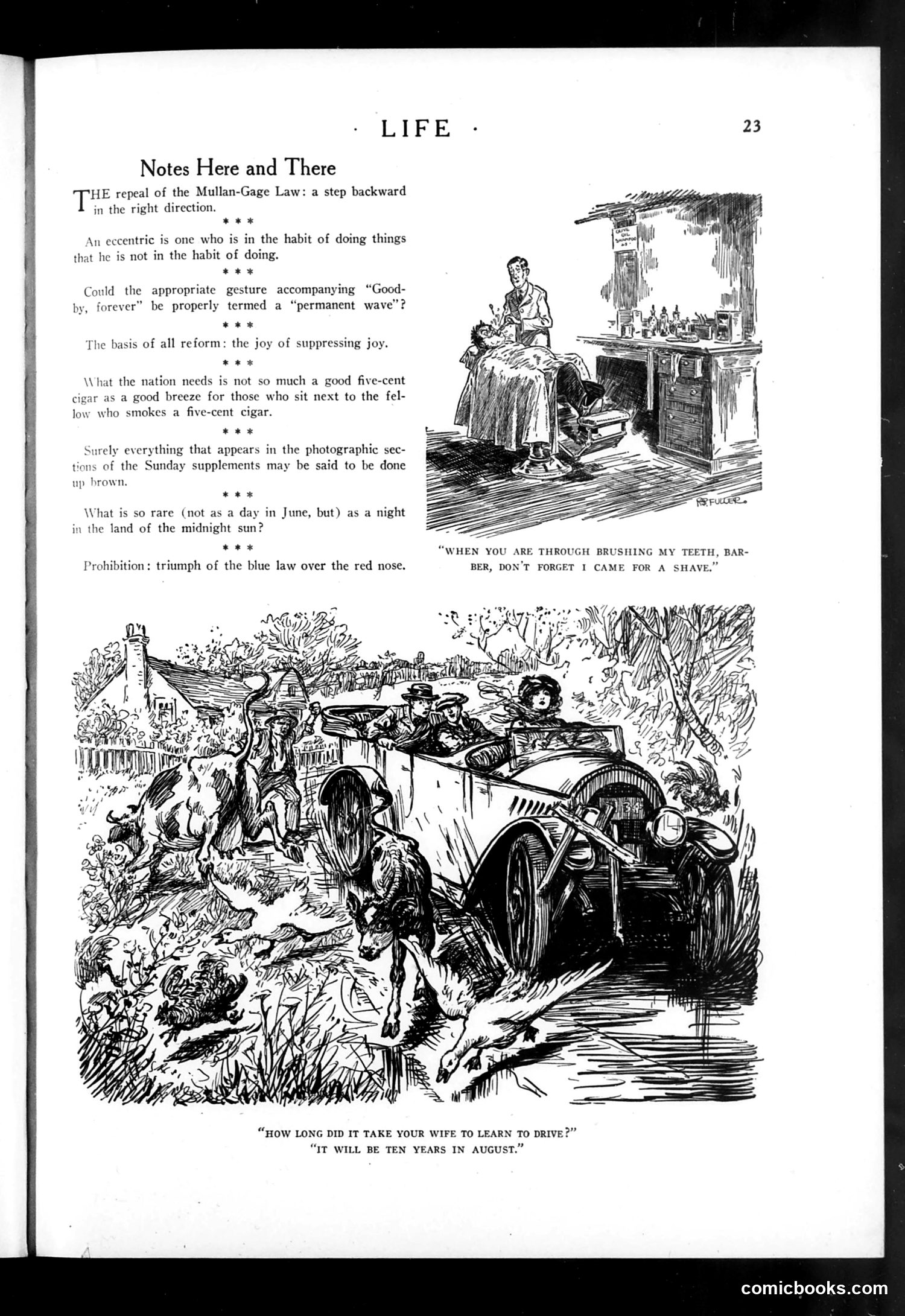
This page from *Life* magazine contains witty social commentary typical of early 20th-century American satire. **Top cartoon**: A barber shop scene where a customer, mid-tooth brushing, reminds the barber not to forget he came for a shave—a joke about absent-mindedness or distraction. **Bottom cartoon**: A man driving a car with passengers encounters another driver; when asked how long it took his wife to learn driving, he responds "ten years in August"—a joke implying his wife is a dangerously incompetent driver, with the humorous suggestion that she'll finally learn in ten years. **Text snippets**: Brief satirical aphorisms, including references to Prohibition ("triumph of the blue law over the red nose"), eccentric behavior, and social annoyances like secondhand cigar smoke. One note jokes about "permanent wave" hairstyles in relation to saying goodbye. The humor assumes readers' familiarity with Prohibition-era debates and early automotive culture when women drivers were still novelties worthy of ridicule.
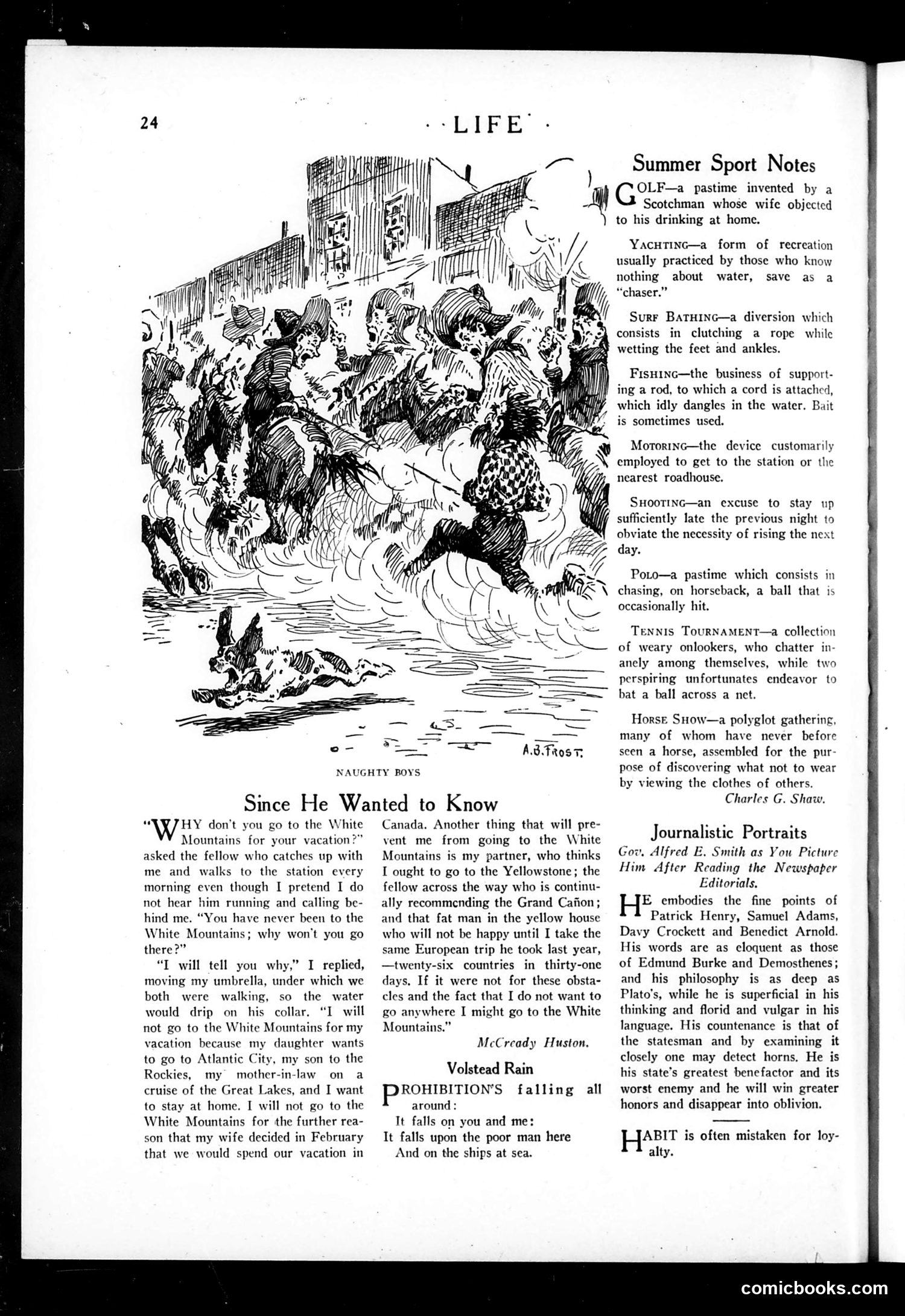
This Life magazine page contains three distinct satirical pieces: **"Naughty Boys"** (cartoon): Shows a chaotic seaside scene of children bathing. The humor derives from Victorian-era anxieties about unsupervised youth and improper beach behavior—depicting children as rowdy and undisciplined. **"Since He Wanted to Know"** (article): A humorous complaint about vacation planning. The narrator lists conflicting family demands (daughter wants Atlantic City, son wants Rockies, wife wants Canada, etc.), satirizing the impossibility of pleasing everyone. The punchline is his deliberately redirecting an acquaintance's umbrella drip onto the man's collar. **"Summer Sport Notes"** (definitions): Cynical definitions of leisure activities. Golf originated because a Scotsman's wife objected to his drinking; yachting appeals to those ignorant of water; tennis involves "weary onlookers" watching "perspiring unfortunates." This mocks upper-class summer pastimes as pointless or absurd. **"Volstead Rain"**: References Prohibition (the Volstead Act), using rain as metaphor for its universal imposition on society. The page reflects 1920s-era American satirical humor targeting class pretensions and social conventions.
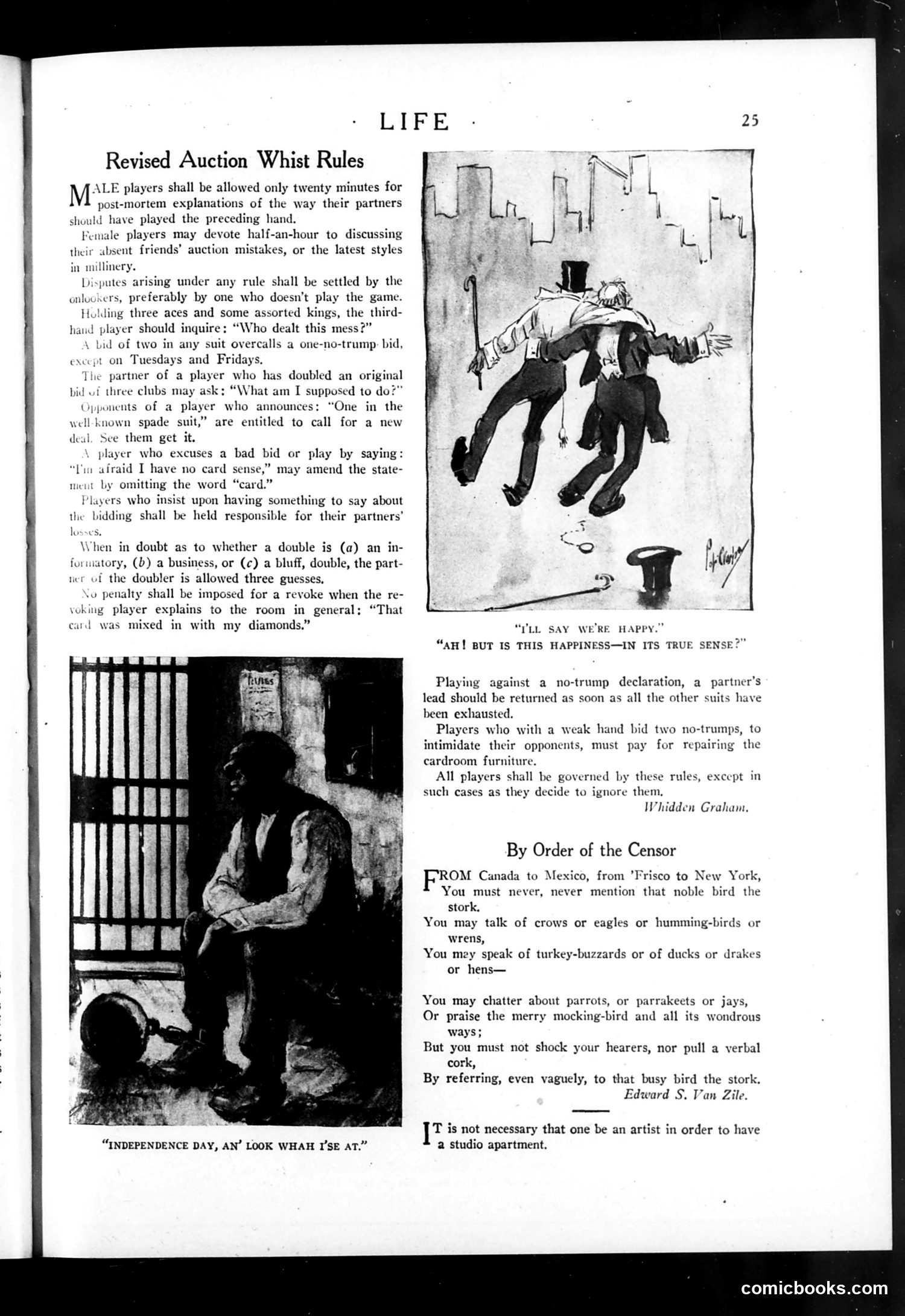
This page contains two distinct pieces of humor satirizing early 20th-century American social conventions. **"Revised Auction Whist Rules"** mocks card game etiquette through absurdist "rules" that expose common player behaviors: men get 20 minutes to explain bad plays; women get 30 minutes to gossip about friends' mistakes and fashion; disputes are settled by non-players; weak players make excuses. The satire targets how people rationalize poor performance and use social situations to air grievances. **"By Order of the Censor"** is a poem lampooning censorship regarding birth-related language. It notes Americans can discuss any bird freely—crows, eagles, parrots, mockingbirds—*except* the stork, the traditional euphemism for childbirth. The satire criticizes prudish social restrictions on discussing reproduction, highlighting the absurdity of censoring indirect references to natural processes. Both pieces use humor to critique rigid social conventions of the era.
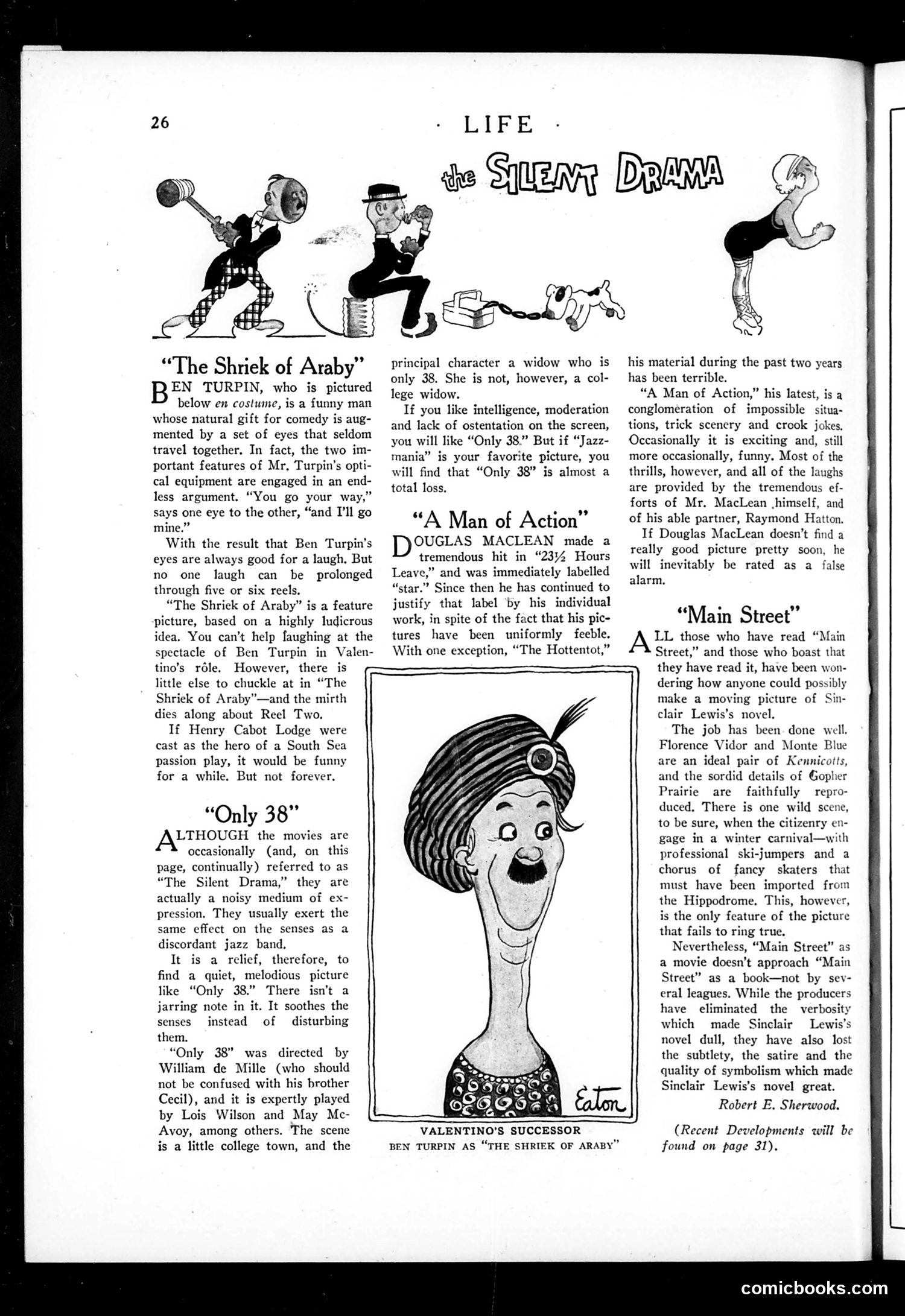
This page contains four film reviews from the silent film era. The central caricature depicts **Ben Turpin** in "The Shriek of Araby"—a parody where the cross-eyed comedian plays a Rudolph Valentino-style romantic lead. The satire mocks both Turpin's physical comedic quirk (his misaligned eyes) and the absurdity of casting him in roles meant for serious actors like Valentino. The reviews discuss silent films including "Only 38" (praised for restraint versus "Jazz-mania"), "A Man of Action" (Douglas MacLean vehicle), and "Main Street" (adapted from Sinclair Lewis's novel). Reviewers note these films struggle sustaining laughs beyond brief sequences, and that adapting Lewis's satirical novel loses its subtle critique through visual medium alone. The underlying critique: silent comedies rely on physical gags that tire quickly, while literary subtlety doesn't translate to screen.
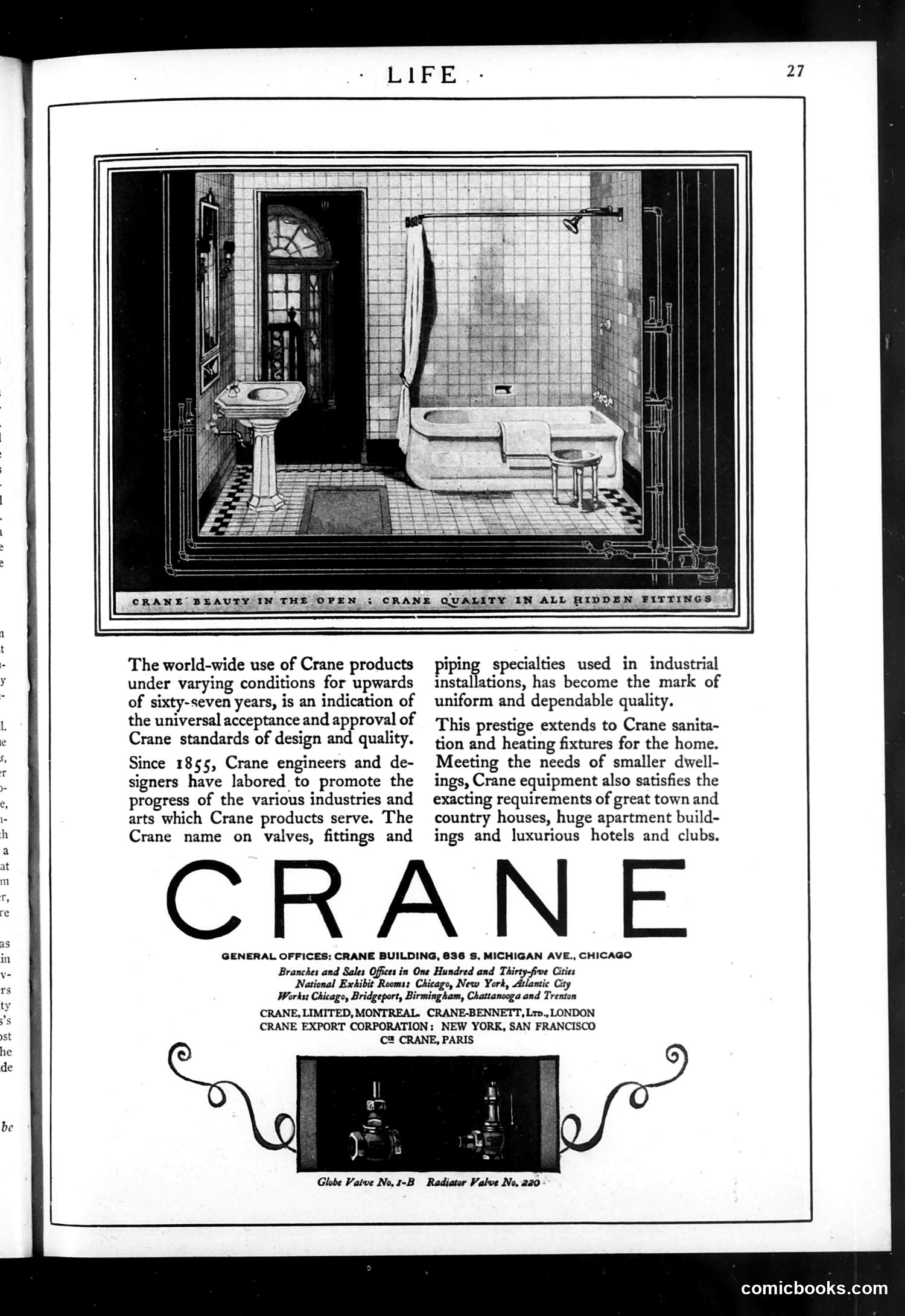
This is **not a cartoon or satire**—it's a straightforward advertisement for the Crane Company, a manufacturer of plumbing fixtures and industrial piping. The page features: 1. **Top illustration**: A stylized bathroom showroom displaying Crane sanitation fixtures (sink, bathtub, toilet), emphasizing quality and modern design 2. **Main text**: Corporate messaging emphasizing Crane's 67-year history (since 1855), reliability across industries, and expansion into residential markets 3. **Bottom illustration**: Technical product images of industrial valves The ad's pitch targets both industrial and domestic markets, suggesting Crane products serve "great town and country houses, huge apartment buildings and luxurious hotels." This positions plumbing quality as a status marker—associating Crane fixtures with prestige and luxury rather than mere utility. There is **no satire or political commentary** visible. This is standard early-20th-century corporate advertising using aspirational lifestyle imagery common in *Life* magazine's advertisement sections.
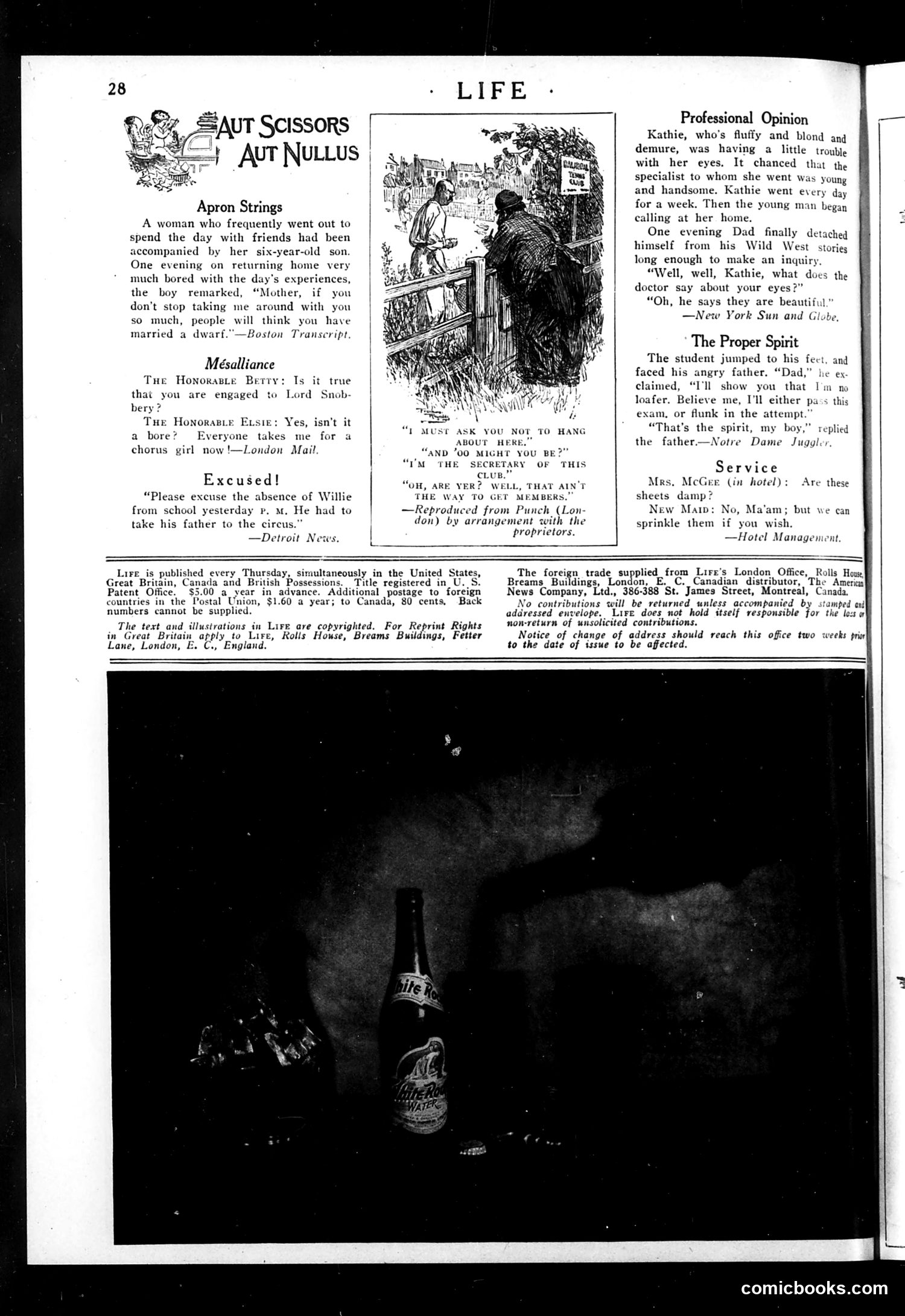
This page from *Life* magazine contains several short humorous anecdotes typical of early 20th-century American satire: **"Apron Strings"** mocks a mother who constantly drags her young son along on social visits; the exasperated boy threatens to stop accompanying her or people will think she's married a dwarf—implying her constant male companion is the child. **"Mésalliance"** jokes about class assumptions: a woman insists she's engaged to "Lord Snobbery," but everyone mistakes her for a chorus girl, suggesting social pretension doesn't match appearance. **"The Proper Spirit"** presents a father-son exchange where the boy vows to either pass his exam or fail trying. The father approves this determination, creating gentle humor through the boy's apparent obliviousness to what "flunking" actually means. The remaining items ("Excused," "Professional Opinion," "Service") are similarly brief comedic observations about everyday life—missed school days, eye doctors, and hotel service. These represent *Life*'s characteristic light, domestically-focused humor aimed at middle-class readers.
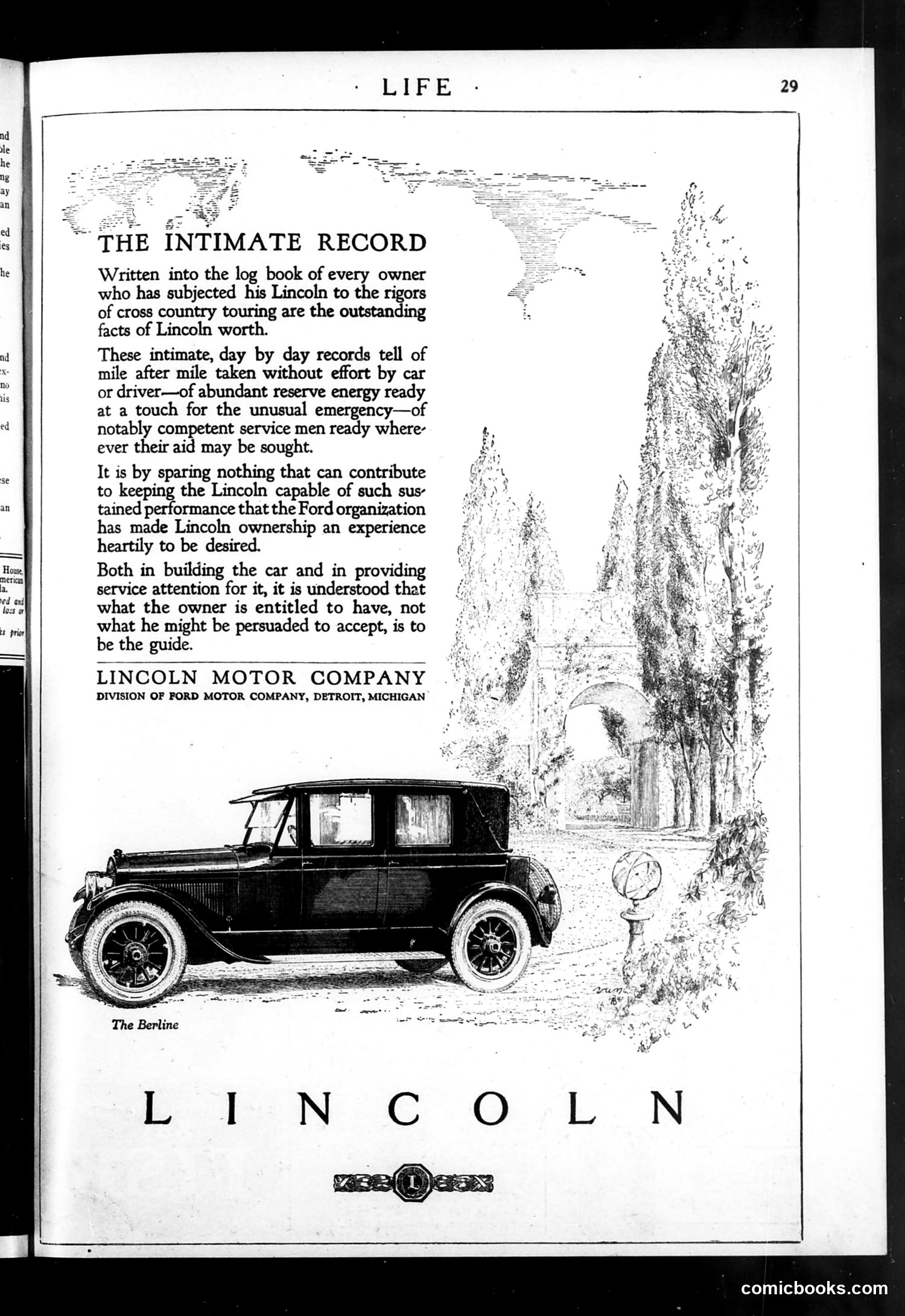
This is a **luxury automobile advertisement**, not a political cartoon. The page promotes Lincoln automobiles (a Ford Motor Company division) to wealthy readers of *Life* magazine. The ad emphasizes Lincoln's reliability and service quality through testimonial language—claiming owners' logbooks document the car's "outstanding facts of worth." The text highlights the vehicle's "abundant reserve energy" and "competent service men" available nationwide. The illustration shows "The Berline," a Lincoln model, parked beside a scenic natural vista with tall trees, suggesting leisure travel and American landscape exploration. The message targets affluent buyers: Lincoln ownership represents not just transportation but a curated experience where owners receive what they're "entitled to have"—quality and service befitting their status—rather than being merely "persuaded to accept" inferior alternatives. This represents Depression-era aspirational marketing to the wealthy.
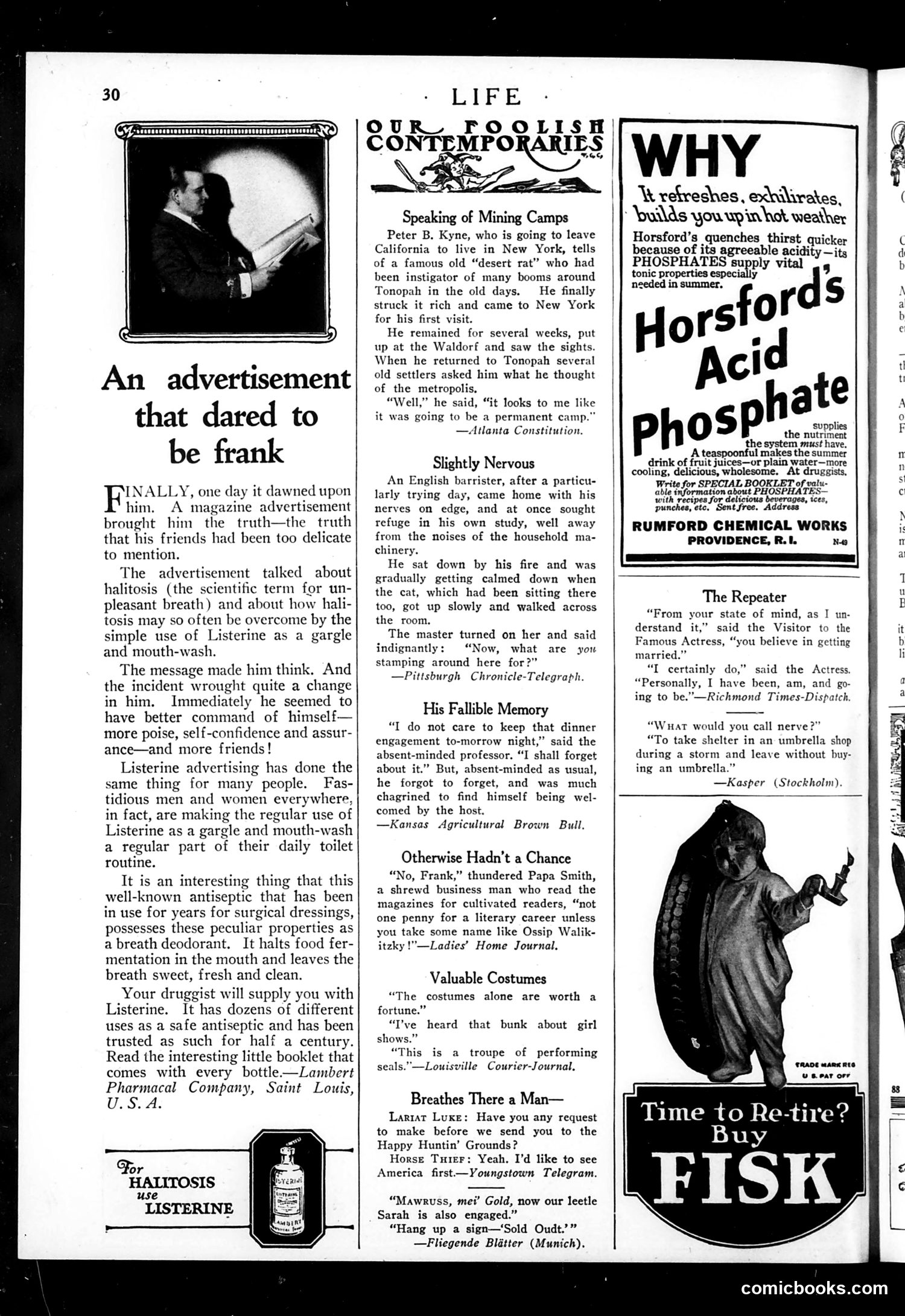
This page from *Life* magazine (undated, but stylistically early 20th century) is primarily **advertising and humor content**, not political cartoons. The dominant feature is a lengthy **Listerine advertisement** using a narrative approach—a man suffers social rejection due to bad breath ("halitosis"), discovers the product through advertising, and suddenly gains confidence and friends. This represents the era's emerging advertising strategy: creating social anxiety to sell solutions. The page also contains several **short humorous anecdotes** about everyday life: a Nevada miner's underwhelmed reaction to New York City; a nervous English lawyer's cat; an absent-minded professor; a father rejecting his son's literary ambitions unless he adopts an exotic name; and various other brief jokes. **For modern readers**: These jokes rely on now-dated assumptions about class (literary careers as pretentious), gender roles, and social propriety. The Listerine ad is notable as an early example of **shame-based marketing**—selling products by manufacturing social insecurity rather than emphasizing product benefits.
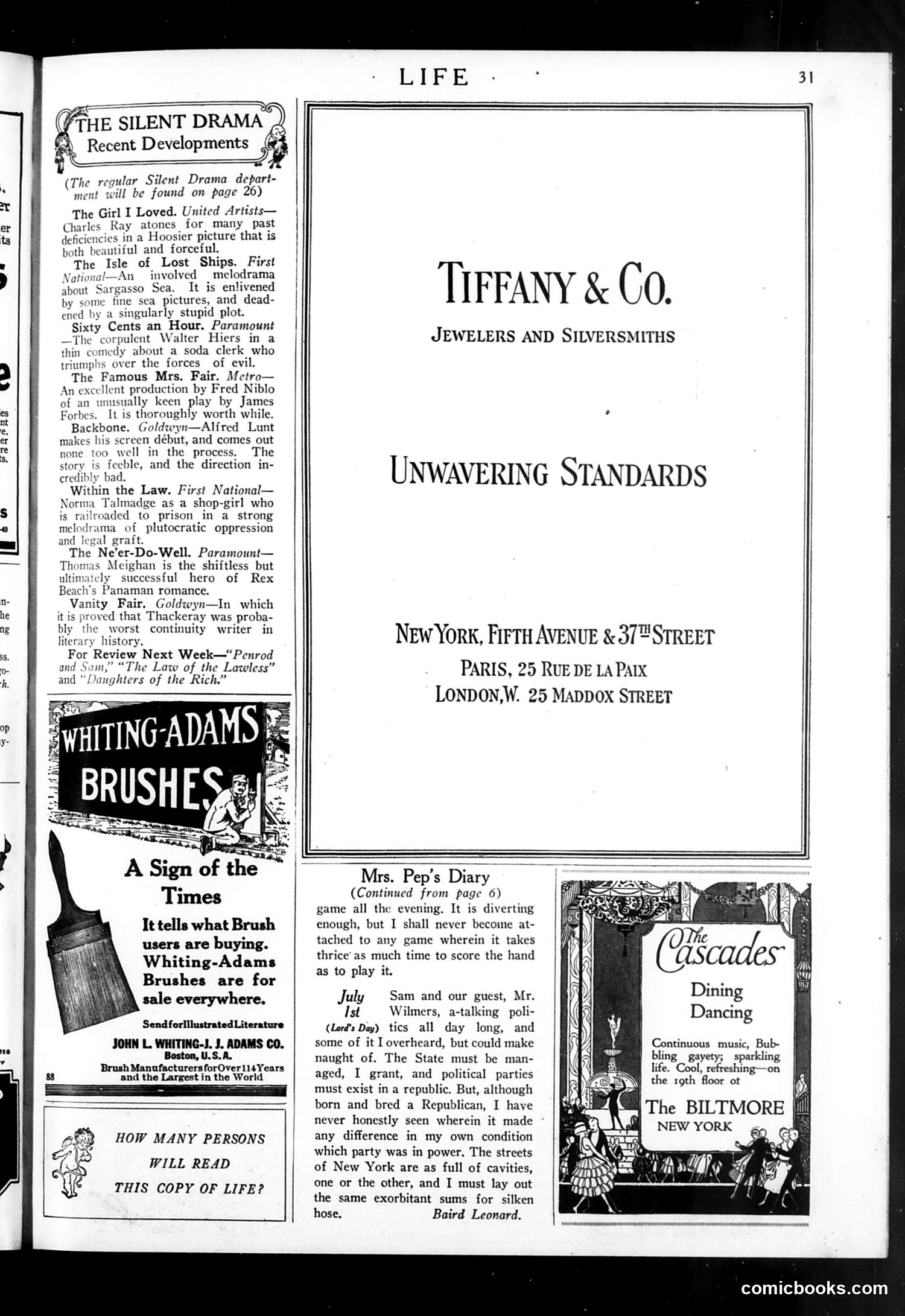
This page is primarily **advertising and society content**, not political satire. The main elements include: **Silent Film Reviews**: A column critiques recent movies (Charlie Ray, Norma Talmadge, etc.), offering brief judgments on their quality and plots—typical entertainment journalism of the era. **Tiffany & Co. Advertisement**: A full-page luxury jewelry ad emphasizing "unwavering standards" across New York, Paris, and London locations. **Mrs. Pep's Diary**: A serialized humor column where the narrator discusses a political conversation overheard at dinner. The joke appears to be gentle social commentary: despite Mr. Wilmers' lengthy political discourse about state management and party differences, the narrator (presumably female) observes that street conditions and household expenses remain unchanged regardless of which party holds power—a mild critique of political rhetoric's practical irrelevance to ordinary life. **Supporting Ads**: Whiting-Adams brushes and The Biltmore hotel round out the commercial content. The page reflects 1920s magazine structure: entertainment criticism mixed with luxury advertising and light domestic humor.
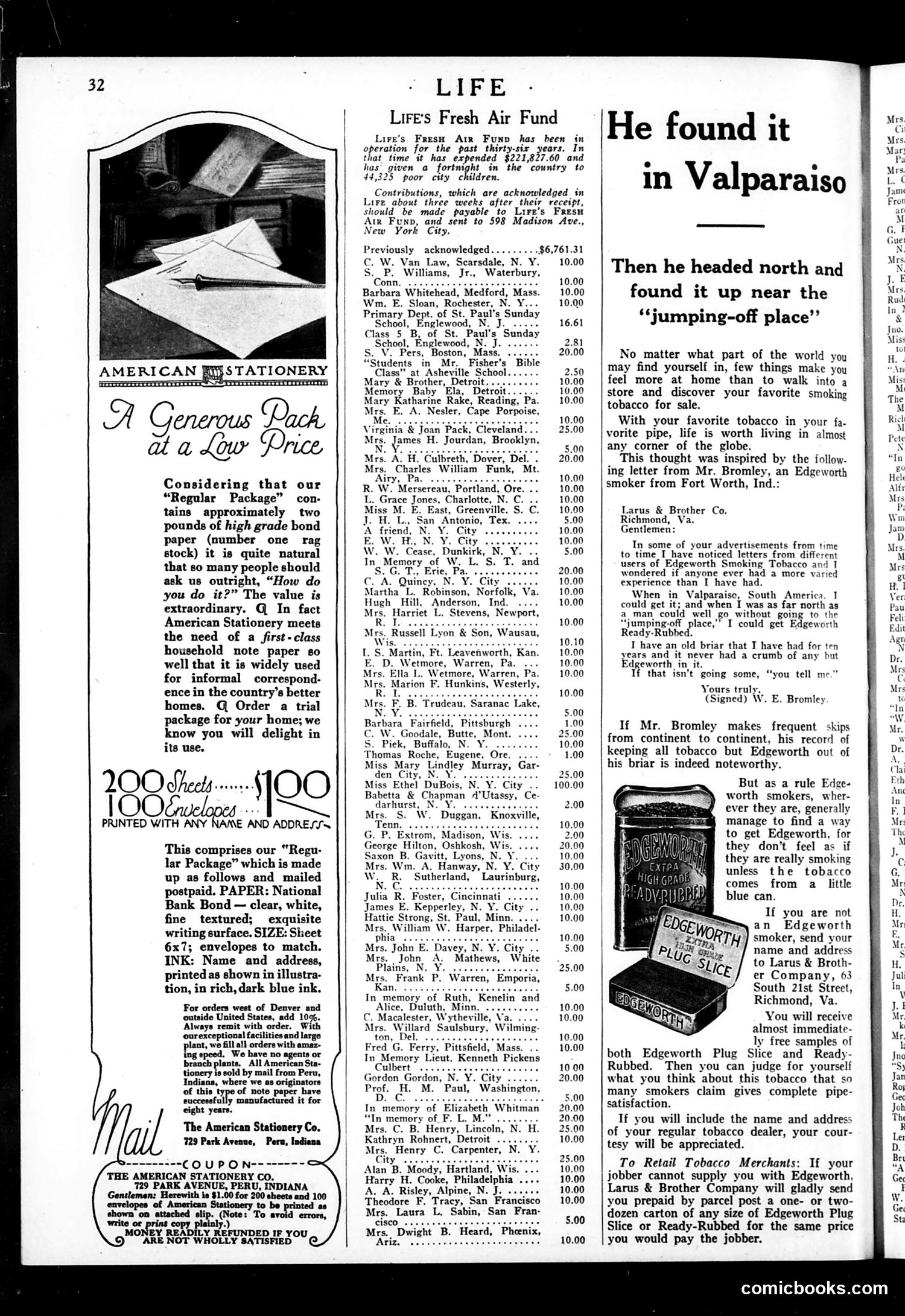
This page is primarily **advertising and fund-raising**, not political satire. The left side promotes **American Stationery** products—high-quality bond paper note sets at economical prices, with a mail-order coupon. The right side features **two distinct elements**: 1. **Life's Fresh Air Fund** listing—a charitable appeal documenting donations to send poor city children to the countryside for two weeks. This was Life's actual ongoing philanthropic initiative spanning thirty-six years. 2. **Edgeworth Tobacco Advertisement**—disguised as editorial content. A customer testimonial from "W. E. Bromley" (Fort Worth, Indiana) describes finding his preferred Edgeworth tobacco everywhere—from Valparaiso, South America to remote northern locations. The ad concludes with product images and ordering information for Larus & Brother Company. The tobacco ad's framing as a personal letter lends credibility while promoting brand loyalty and wide availability—a common early 20th-century advertising technique blending editorial voice with commercial messaging.
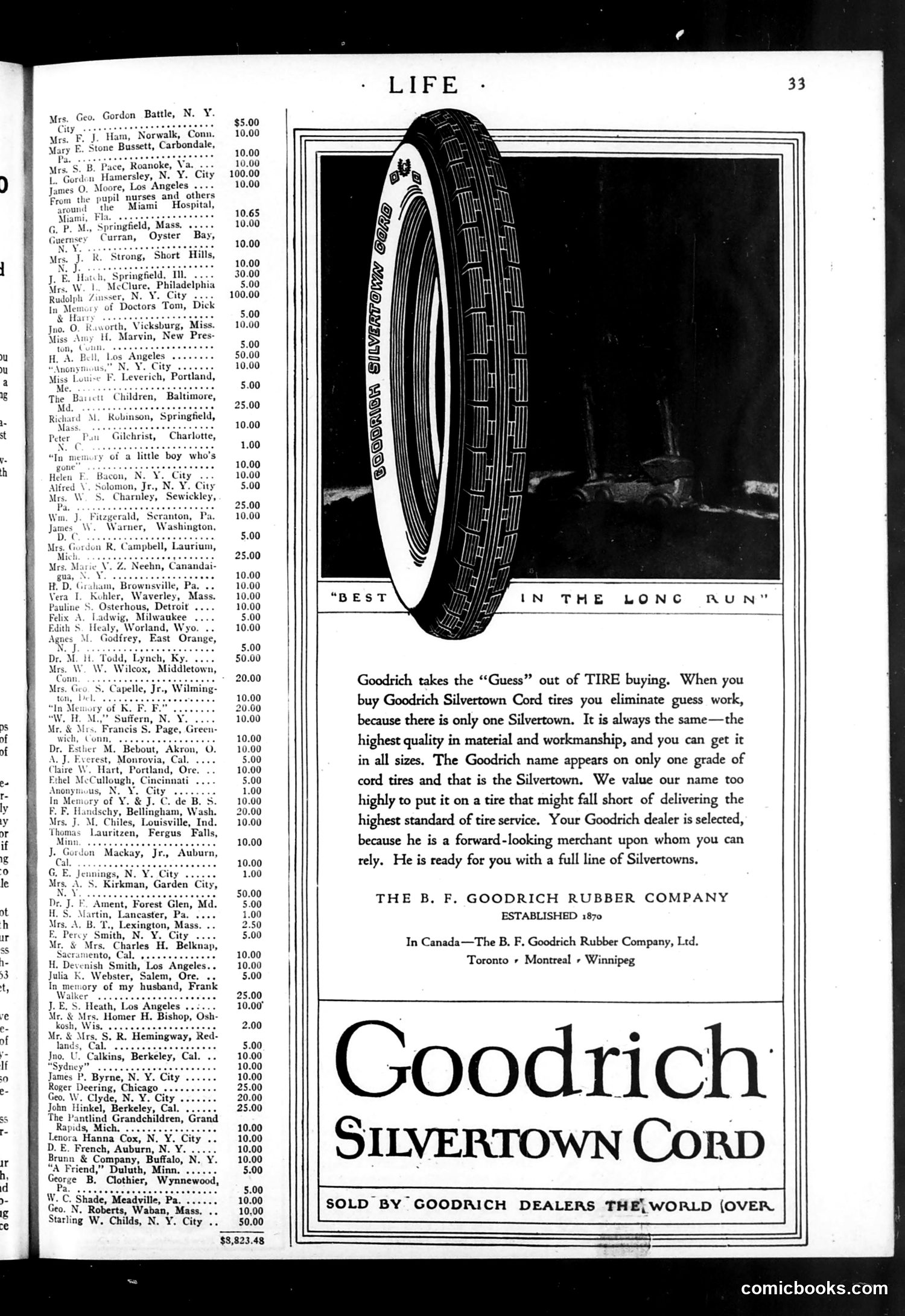
This page is primarily a **charitable donation listing** (left column) paired with a **tire company advertisement** (right side). The advertisement features a large photograph of a Goodrich Silvertown Cord tire with the tagline **"Best in the Long Run."** The copy emphasizes that Goodrich eliminates guesswork in tire purchasing because Silvertown maintains consistent quality across all sizes and grades—the company name appears on only one tire quality level, signaling premium standards. The ad positions Goodrich dealers as trustworthy, "forward-looking merchants" ready to serve customers. This was typical early-20th-century marketing: establishing brand reliability and dealer integrity to justify premium pricing during an era when automobile tire quality varied considerably. The donation list appears unrelated—listing contributors to Life magazine's charitable cause, with amounts ranging from $1 to $100.
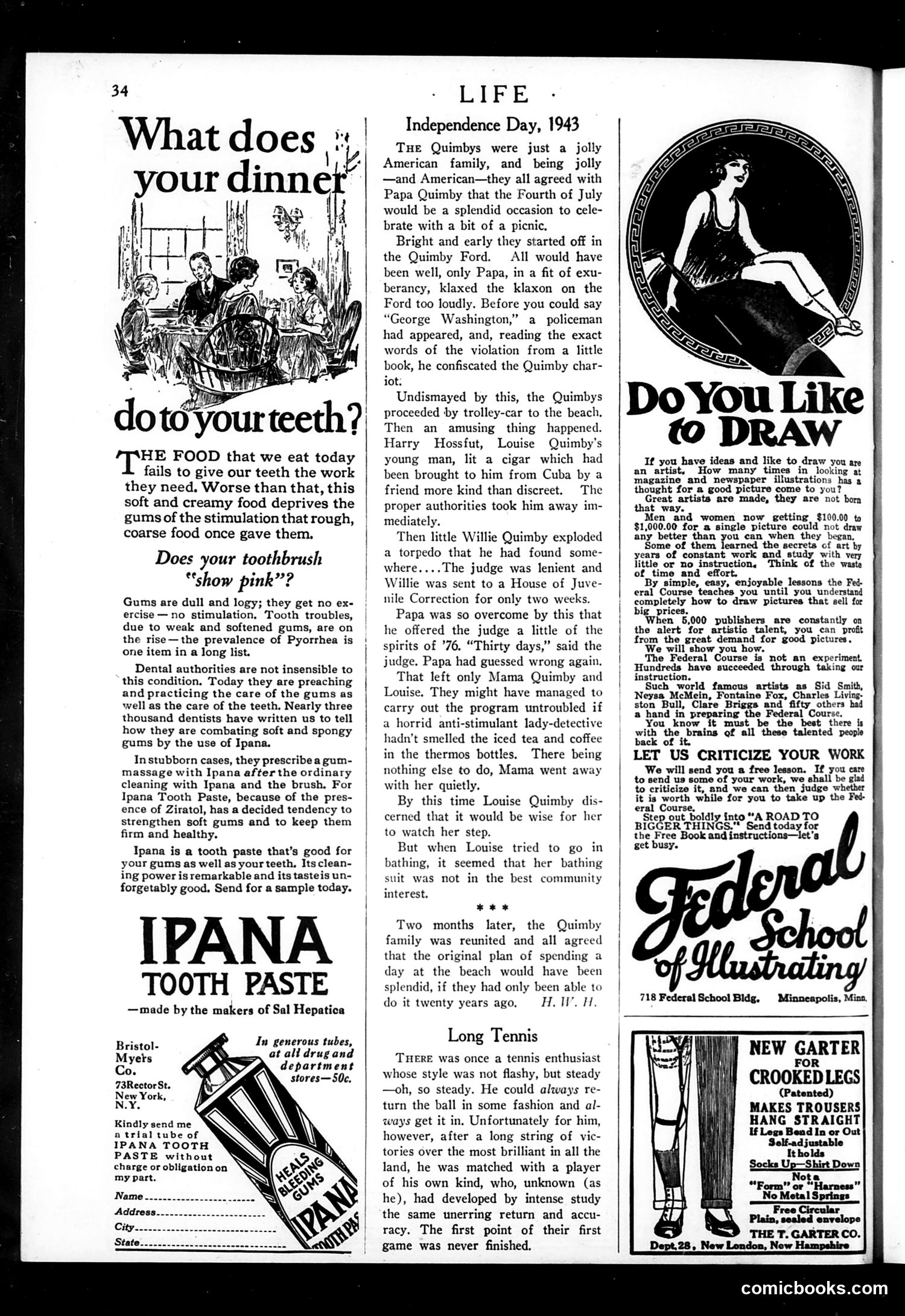
This satirical story mocks wartime restrictions on American freedoms. The Quimby family's Fourth of July picnic is repeatedly disrupted by authorities enforcing various regulations: Papa is fined for honking his car horn loudly; a young man is arrested for smoking a Cuban cigar (likely referencing import restrictions); the child Willie is imprisoned for setting off a firecracker; Mama is taken away for possessing iced beverages (suggesting prohibition-era or rationing concerns); and Louise is cited for her bathing suit's "community interest" violation (likely mocking morality policing). The punchline—that the family later agrees the beach trip would have been "splendid, if they had only been able to do it twenty years ago"—suggests these restrictions feel like returning to an earlier, less free era. The satire critiques how wartime regulations, while ostensibly necessary, constrain ordinary American activities and freedoms. It's a commentary on the tension between security measures and civil liberties during WWII.
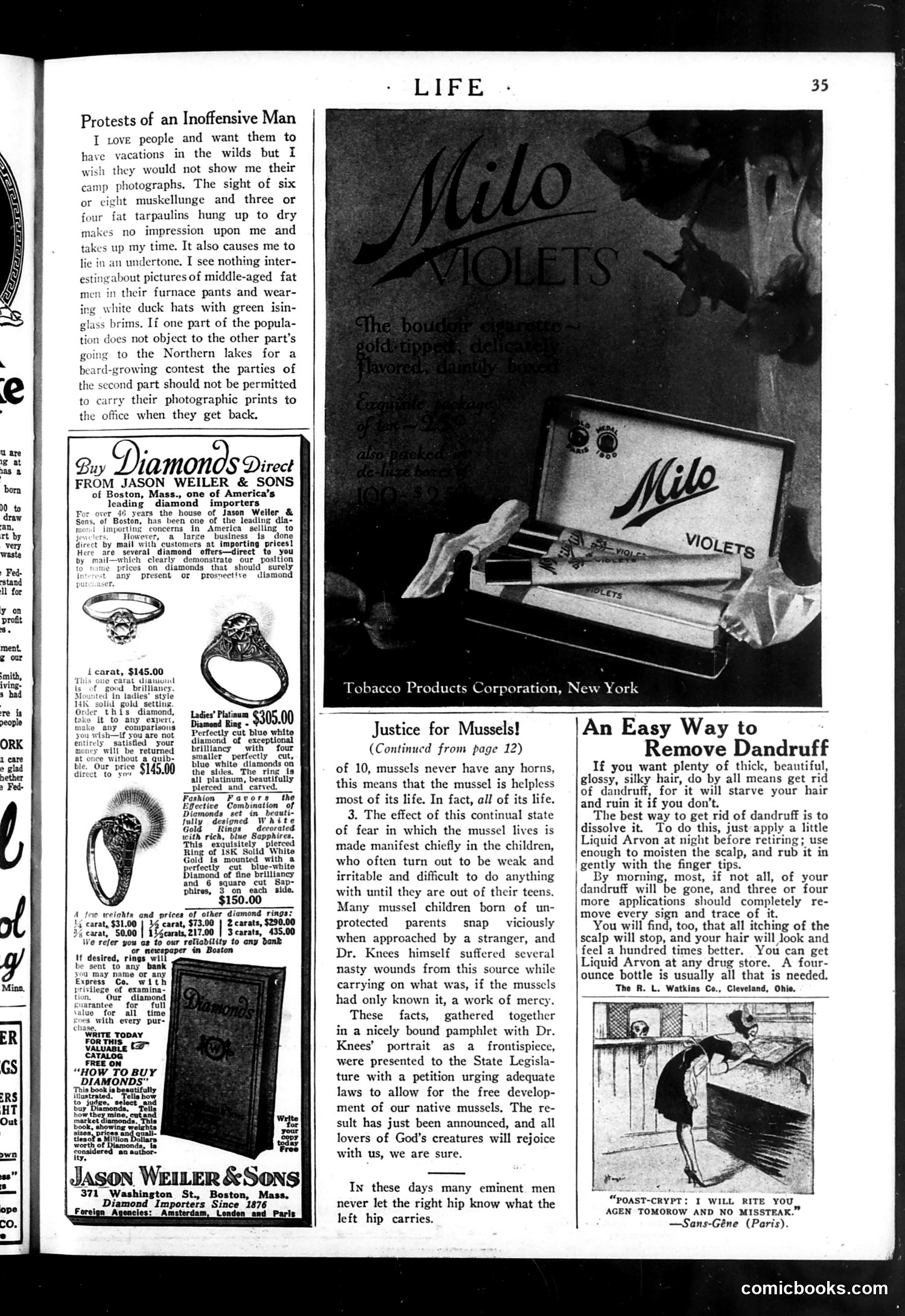
This page contains **satirical humor pieces and advertisements**, not political cartoons. The main content is "Protests of an Inoffensive Man"—a comedic rant about vacationers forcing colleagues to view tedious vacation photographs (fish catches, hunters in furnace pants and duck hats). The satire targets the social obligation to feign interest in others' vacation snapshots, a relatable frustration to the magazine's readers. Below that is "Justice for Mussels!"—absurdist satire about a Dr. Knees who advocates for protective laws for mussels, claiming they suffer psychological trauma from defenselessness and fear. This mocks both reformist zeal and sentimental animal advocacy. The remaining content is period **advertisements**: diamond rings from Jason Weiler & Sons (Boston jeweler), Milo Violets candies, and Liquid Arvon dandruff treatment. The page reflects 1920s-30s Life magazine's mix of gentle social satire and commercial messaging, targeting middle-class anxieties about etiquette and appearance.
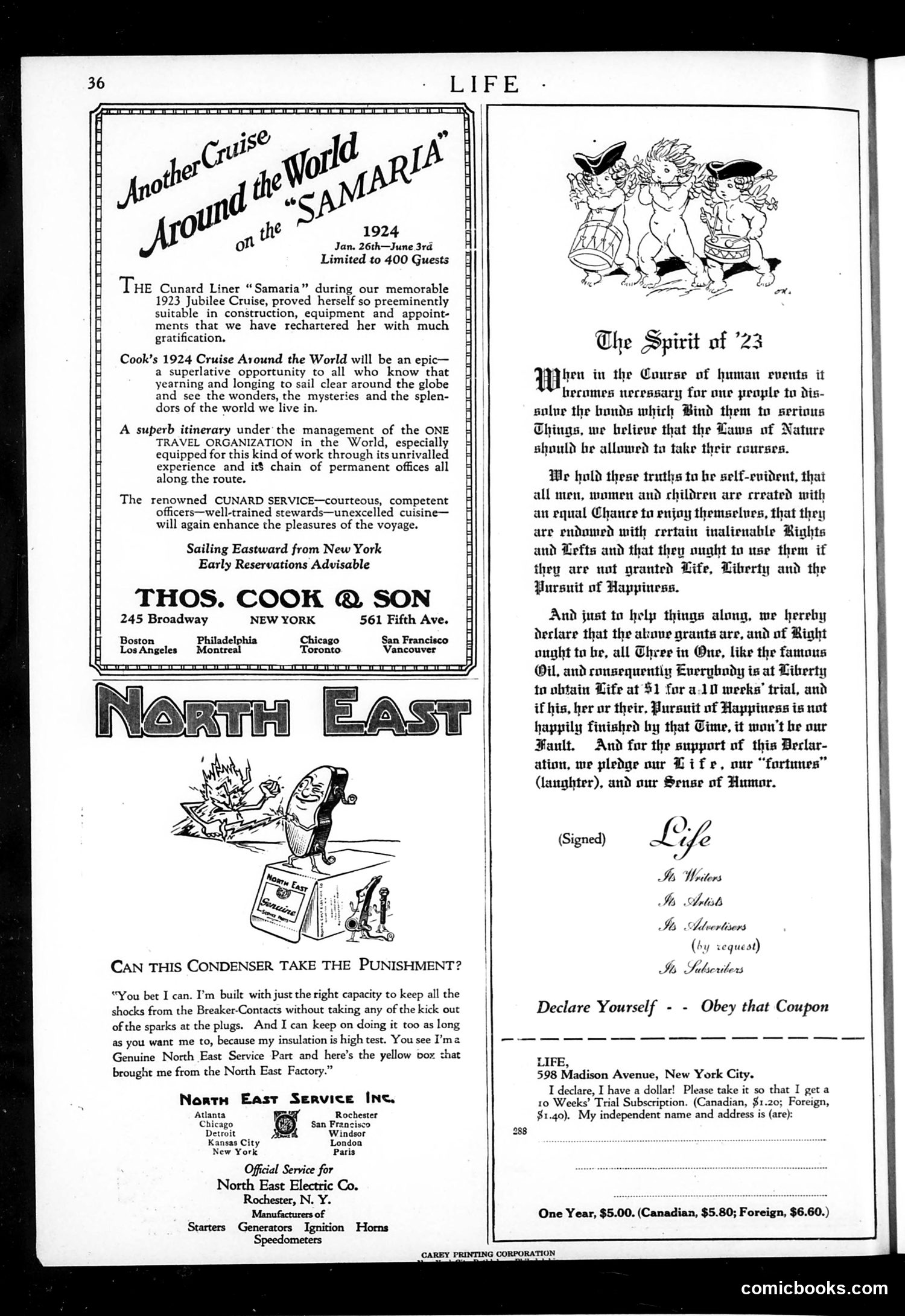
This page features Life magazine's 1924 New Year's editorial, a tongue-in-cheek parody of the Declaration of Independence rewritten for the Jazz Age. The satire mocks the frivolous hedonism of 1920s youth culture by mimicking America's founding document. Where the original asserts "Life, Liberty and the Pursuit of Happiness," Life magazine's version treats these as commodities: one can obtain "Life at $1 for a 10 weeks' trial." The joke targets both the commercialization of American ideals and the era's pleasure-seeking mentality. By applying revolutionary language to trivial concerns—subscriptions, leisure travel, automobile parts—the piece ridicules how the younger generation has trivialized founding principles into marketing slogans. The surrounding advertisements (cruise lines, auto parts) reinforce the irony: genuine revolutionary ideals have become mere selling points in a consumer economy.
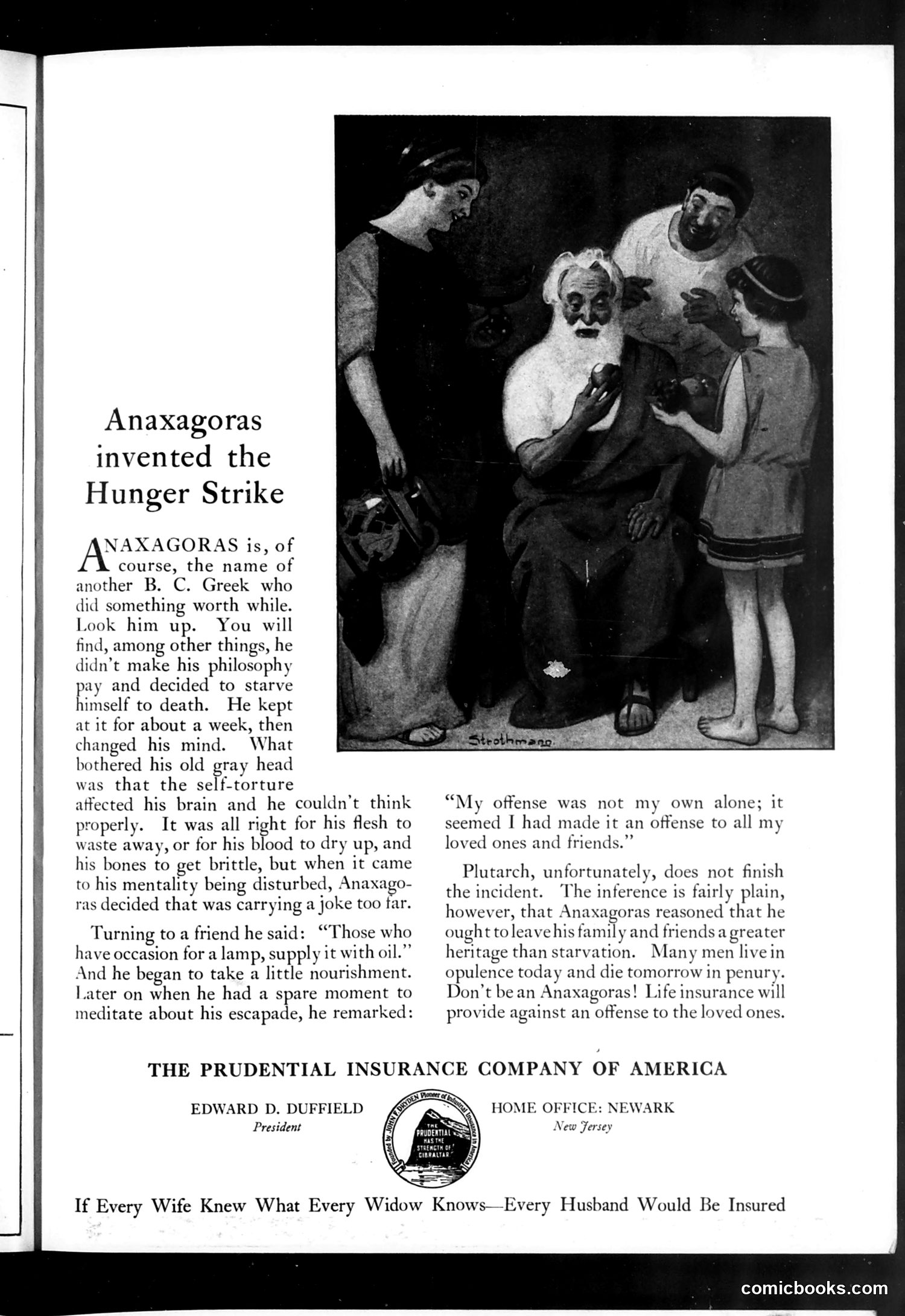
This is an insurance advertisement using classical history as moral persuasion. The piece references the ancient Greek philosopher Anaxagoras, who allegedly attempted suicide by starvation to protest his philosophy's lack of financial success, then abandoned it when the self-deprivation affected his thinking. The satire's point: the ad mocks ascetic self-denial while weaponizing guilt. It argues that starving oneself—or dying without life insurance—isn't noble sacrifice but selfish harm to loved ones. The closing image depicts a distressed woman and child, driving home the emotional manipulation: an uninsured man's death leaves his family in poverty. The tagline "If Every Wife Knew What Every Widow Knows—Every Husband Would Be Insured" uses fear of widowhood to shame men into purchasing Prudential policies. This represents early 20th-century insurance marketing that exploited family anxiety and gendered responsibility to sell protection products.
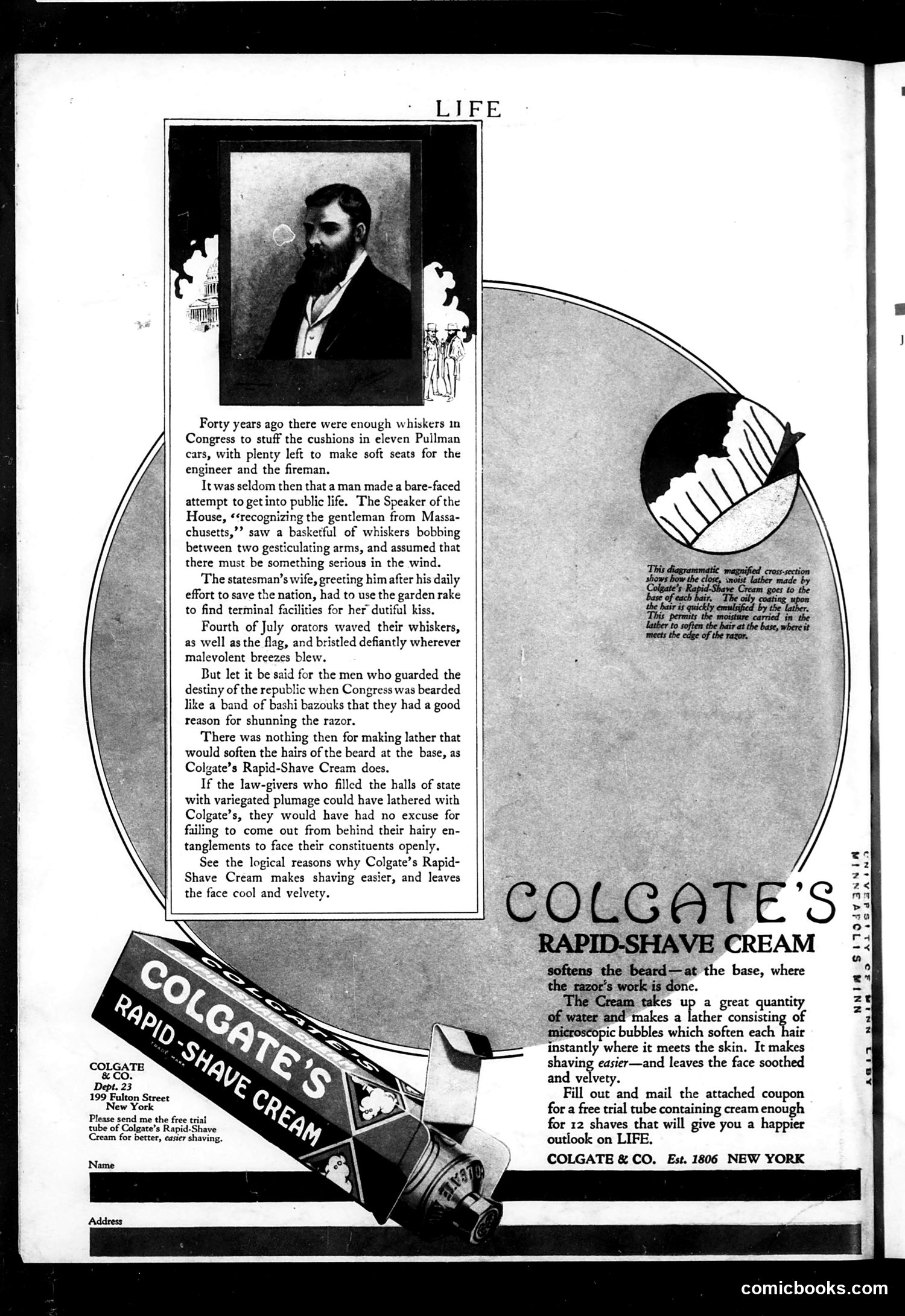
This page is primarily a **Colgate's Rapid-Shave Cream advertisement** disguised as editorial content in Life magazine. The accompanying text is satirical commentary on American politics. It nostalgically mocks congressmen from "forty years ago" (approximately the 1870s) who wore prominent beards, suggesting that facial hair made politicians seem serious and authoritative—even when they had nothing substantive to say. The satire implies that beards allowed incompetent men to hide behind imposing appearances and avoid genuine public accountability. The joke: modern (clean-shaven) politicians can no longer hide behind whiskers and must face constituents openly and honestly. The advertisement then pivots this into a pitch: Colgate's cream makes shaving easier, therefore enabling politicians to be more transparent and accountable. It's a humorous, tongue-in-cheek sales pitch leveraging political commentary to sell grooming products—typical of Life magazine's advertising-editorial hybrid approach.