
Life, 1923-07-05 · page 22 of 40
Life — July 5, 1923 — page 22: what you’re looking at
What you’re looking at
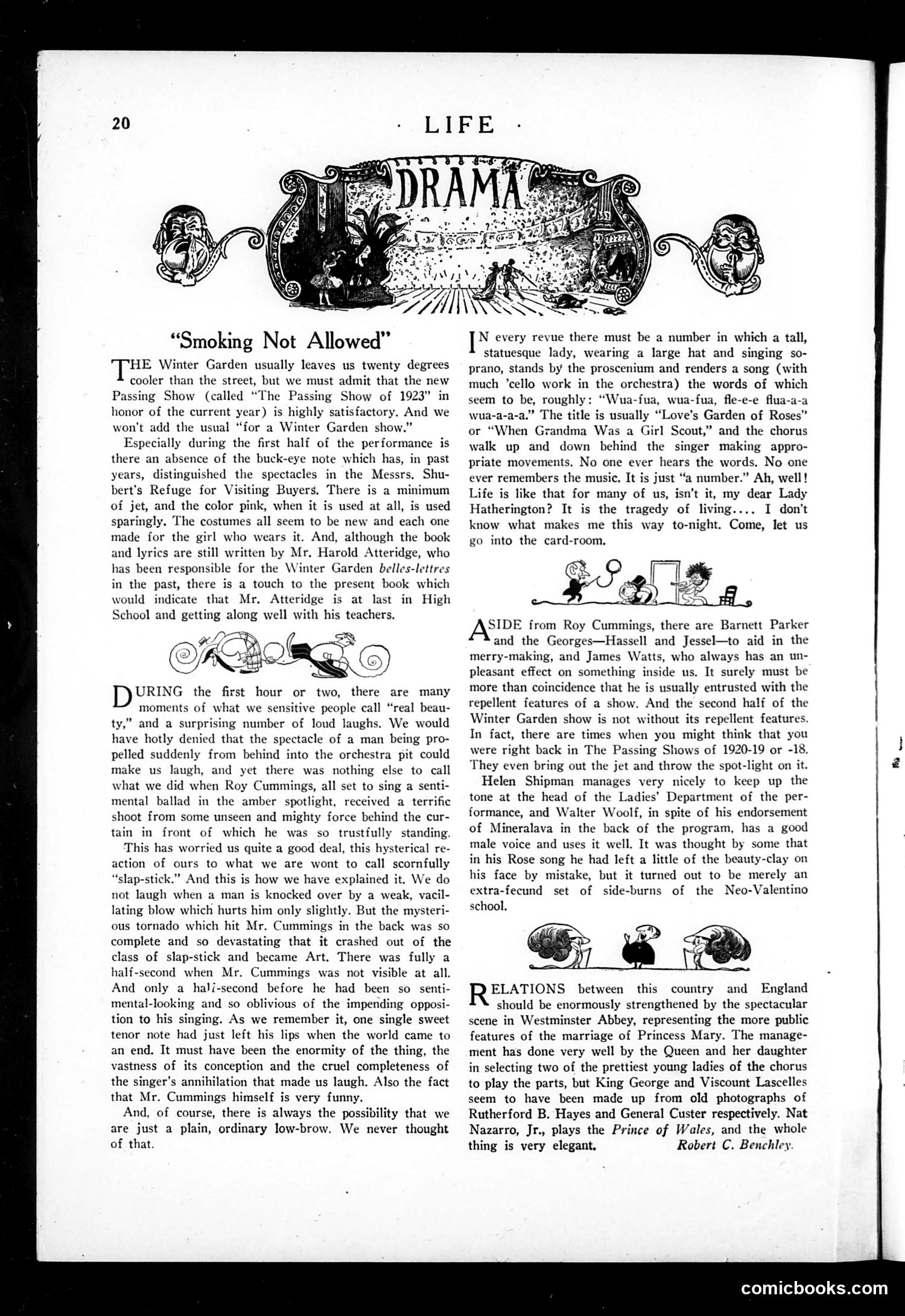
This is a theater review of a Broadway revue at the Winter Garden. The critic praises the production for departing from typical Shubert spectacle conventions—less reliance on the "buck-eye note" (likely referring to crude or lowbrow humor) and excessive use of jet beads and pink costumes. The satire targets: - **Harold Atteridge**, the librettist, whom the critic jokes has finally reached "High School" level of competence - **Roy Cummings**, a performer humorously knocked into the orchestra pit during a sentimental solo—the critic intellectualizes this "slap-stick" moment as "Art" rather than admitting they simply enjoyed lowbrow physical comedy - **Generic revue conventions**: the obligatory soprano number with nonsense lyrics ("Wua-fua") that audiences never remember The piece is self-aware satire about theater criticism itself and the critic's own taste, ending with the admission they might simply be "a plain, ordinary low-brow."
📄 Transcribed text from this page (OCR, searchable)
Machine-transcribed from the original scan — historical spelling and the odd misread are preserved.
“Smoking Not Allowed” ‘HE Winter Garden usually leaves us twenty degrees cooler than the street, but we must admit that the new Passing Show (called “The Passing Show of 1923” in honor of the current year) is highly satisfactory. And we won't add the usual “for a Winter Garden show.” Especially during the first half of the performance is there an absence of the buck-eye note which has, in past years, distinguished the spectacles in the Messrs, Shu- bert's Refuge for Visiting Buyers. There is a minimum of jet, and the color pink, when it is used at all, is used sparingly. The costumes all seem to be new and each one made for the girl who wears it. And, although the book and lyrics are still written by Mr, Harold Atteridge, who has been responsible for the Winter Garden belles-lettres in the past, there is a touch to the present book which would indicate that Mr. Atteridge is at last in High School and getting along well with his teachers, GLAS SB URING the first hour or two, there are many moments of what we sensitive people call “real beau- ty,” and a surprising number of loud laughs. We would have hotly denied that the spectacle of a man being pro- pelled suddenly from behind into the orchestra pit could make us laugh, and yet there was nothing else to call what we did when Roy Cummings, all set to sing a senti- mental ballad in the amber spotlight, received a terrific shoot from some unseen and mighty force behind the cur- tain in front of which he was so trustfully standing. This has worried us quite a good deal, this hysterical re- action of ours to what we are wont to call scornfully “slap-stick.” And this is how we have explained it. We do not laugh when a man is knocked over by a weak, vacil- lating blow which hurts him only slightly. But the mysteri- ous tornado which hit Mr. Cummings in the back was so complete and so devastating that it crashed out of the class of slap-stick and became Art. There was fully a half-second when Mr. Cummings was not visible at all. And only a hali-second before he had been so senti- mental-looking and so oblivious of the impending opposi- tion to his singing. As we remember it, one single sweet tenor note had just left his lips when the world came to an end. It must have been the enormity of the thing, the vastness of its conception and the cruel completeness of the singer’s annihilation that made us laugh. Also the fact that Mr. Cummings himself is very funny. And, of course, there is always the possibility that we are just a plain, ordinary low-brow. We never thought of that. N every revue there must be a number in which a tall, statuesque lady, wearing a large hat and singing so- prano, stands by the proscenium and renders a song (with much ‘cello work in the orchestra) the words of which seem to be, roughly: “Wua-fua, wua-fua, fle-e-e flua-a-a wua-a-a-a.” The title is usually ““Love’s Garden of Roses” or “When Grandma Was a Girl Scout,” and the chorus walk up and down behind the singer making appro- priate movements. No one ever hears the words. No one ever remembers the music, It is just “a number.” Ah, well! Life is like that for many of us, isn’t it, my dear Lady Hatherington? It is the tragedy of living.... I don’t know what makes me this way to-night. Come, let us go into the card-room, ASIDE from Roy Cummings, there are Barnett Parker and the Georges—Hassell and Jessel—to aid in the merry-making, and James Watts, who always has an un- pleasant effect on something inside us. It surely must be more than coincidence that he is usually entrusted with the repellent features of a show. And the second half of the Winter Garden show is not without its repellent features. In fact, there are times when you might think that you were right back in The Passing Shows of 1920-19 or -18. They even bring out the jet and throw the spot-light on it. Helen Shipman manages very nicely to keep up the tone at the head of the Ladies’ Department of the per- formance, and Walter Woolf, in spite of his endorsement of Mineralava in the back of the program, has a good male voice and uses it well. It was thought by some that in his Rose song he had left a little of the beauty-clay on his face by mistake, but it turned out to be merely an extra-fecund set of side-burns of the Neo-Valentino school, ELATIONS between this country and England should be enormously strengthened by the spectacular scene in Westminster Abbey, representing the more public features of the marriage of Princess Mary. The manage- ment has done very well by the Queen and her daughter in selecting two of the prettiest young ladies of the chorus to play the parts, but King George and Viscount Lascelles seem to have been made up from old photographs of Rutherford B. Hayes and General Custer respectively. Nat Nazarro, Jr., plays the Prince of Wales, and the whole thing is very elegant, Robert C. Benchley. comicbooks.com