
Life, 1923-07-05 · page 28 of 40
Life — July 5, 1923 — page 28: what you’re looking at
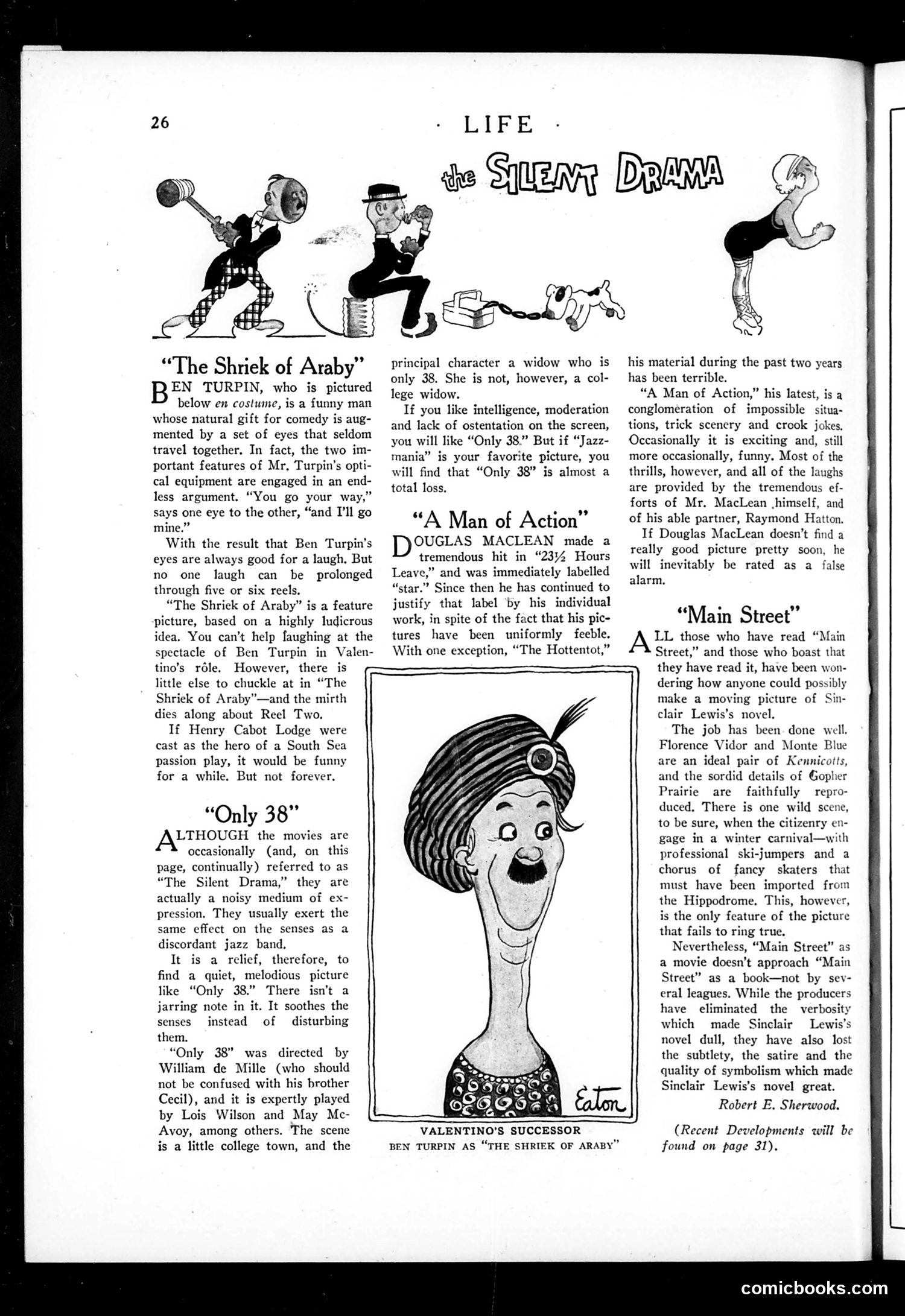
What you’re looking at
This page contains four film reviews from the silent film era. The central caricature depicts **Ben Turpin** in "The Shriek of Araby"—a parody where the cross-eyed comedian plays a Rudolph Valentino-style romantic lead. The satire mocks both Turpin's physical comedic quirk (his misaligned eyes) and the absurdity of casting him in roles meant for serious actors like Valentino. The reviews discuss silent films including "Only 38" (praised for restraint versus "Jazz-mania"), "A Man of Action" (Douglas MacLean vehicle), and "Main Street" (adapted from Sinclair Lewis's novel). Reviewers note these films struggle sustaining laughs beyond brief sequences, and that adapting Lewis's satirical novel loses its subtle critique through visual medium alone. The underlying critique: silent comedies rely on physical gags that tire quickly, while literary subtlety doesn't translate to screen.
📄 Transcribed text from this page (OCR, searchable)
Machine-transcribed from the original scan — historical spelling and the odd misread are preserved.
“The Shriek of Araby” BEX TURPIN, who is pictured below en costume, is a funny man whose natural gift for comedy is aug- mented by a set of eyes that seldom travel together. In fact, the two im- portant features of Mr. Turpin’s opti- cal equipment are engaged in an end- less argument. “You go your way,” says one eye to the other, “and I'll go mine.” With the result that Ben Turpin’s eyes are always good for a laugh. But no one laugh can be prolonged through five or six reels. “The Shriek of Araby” is a feature picture, based on a highly ludicrous idea. You can’t help faughing at the spectacle of Ben Turpin in Valen- tino’s réle. However, there is little else to chuckle at in “The Shriek of Araby”—and the mirth dies along about Reel Two. If Henry Cabot Lodge were cast as the hero of a South Sea passion play, it would be funny for a while. But not forever. ” “Only 38 LTHOUGH the movies are occasionally (and, on this page, continually) referred to as “The Silent Drama,” they are actually a noisy medium of ex- pression, They usually exert the same effect on the senses as a discordant jazz band. It is a relief, therefore, to find a quiet, melodious picture like “Only 38.” There isn’t a jarring note in it. It soothes the senses instead of disturbing them. “Only 38” was directed by William de Mille (who should not be confused with his brother Cecil), and it is expertly played by Lois Wilson and May Mc- principal character a widow who is only 38. She is not, however, a col- lege widow. If you like intelligence, moderation and lack of ostentation on the screen, you will like “Only 38.” But if “Jazz- mania” is your favorite picture, you will find that “Only 38” is almost a total loss, “A Man of Action” OUGLAS MACLEAN made a tremendous hit in “2314 Hours Leave,” and was immediately labelled “star.” Since then he has continued to justify that label ‘by his individual work, in spite of the fact that his pic- tures have been uniformly feeble. With one exception, “The Hottentot,” Avoy, among others. The scene is a little college town, and the VALENTINO’S SUCCESSOR BEN TURPIN AS “THE SHRIEK OF ARABY” Ss his material during the past two years has been terrible. “A Man of Action,” his latest, is a conglomeration of impossible situa- tions, trick scenery and crook jokes, Occasionally it is exciting and, still more occasionally, funny. Most of the thrills, however, and all of the laughs are provided by the tremendous ef- forts of Mr. MacLean himself, and of his able partner, Raymond Hatton, If Douglas MacLean doesn’t find a really good picture pretty soon, he will inevitably be rated as a false alarm. “Main Street” LL those who have read “Main Street,” and those who boast that they have read it, have been won- dering how anyone could possibly make a moving picture of Sin- clair Lewis’s novel. The job has been done well. Florence Vidor and Monte Blue are an ideal pair of Kennicotts, and the sordid details of Gopher Prairie are faithfully repro- duced, There is one wild sc to be sure, when the citizenry gage in a winter carnival—with professional ski-jumpers and a chorus of fancy skaters that must have been imported from the Hippodrome. This, however, is the only feature of the picture that fails to ring true. Nevertheless, “Main Street” as a movie doesn’t approach “Main Street” as a book—not by sev- eral leagues. While the producers have eliminated the verbosity which made Sinclair Lewis's novel dull, they have also lost the subtlety, the satire and the quality of symbolism which made Sinclair Lewis’s novel great. Robert E. Sherwood. (Recent Developments will be found on page 31). comicbooks.com