
Life, 1923-07-05 · page 18 of 40
Life — July 5, 1923 — page 18: what you’re looking at
What you’re looking at
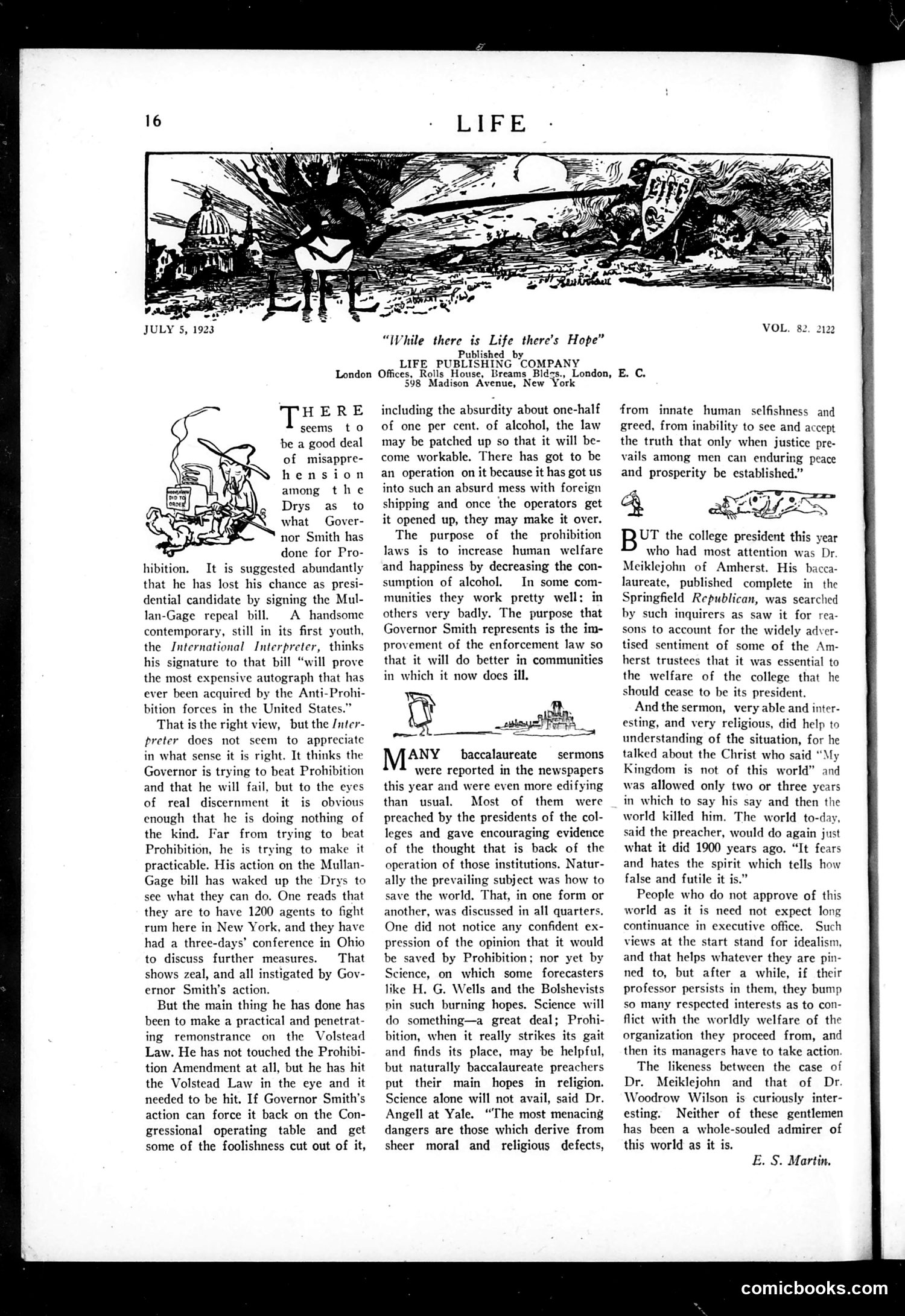
This editorial page defends New York Governor Al Smith's signing of the Mullan-Gage repeal bill against Prohibition supporters' criticism. The "Drys" (anti-alcohol advocates) believed Smith damaged his presidential prospects, but Life argues he actually strengthened enforcement by exposing the Volstead Law's absurdities—particularly its arbitrary one-half percent alcohol threshold. Smith's practical criticism, the magazine suggests, will force Congressional reconsideration and improvement of Prohibition's implementation rather than the amendment itself. The page also discusses college baccalaureate sermons emphasizing religion over Prohibition or Science as humanity's salvation. The cartoon (upper left) is difficult to parse precisely but appears to satirize Prohibition's chaotic effects on society.
📄 Transcribed text from this page (OCR, searchable)
Machine-transcribed from the original scan — historical spelling and the odd misread are preserved.
JULY 5, 1923 “While there is Life there’s Hope” Published by LIFE PUBLISHING COMPANY London Offices, Rolls House, Breams Bldzs., London, E. C. HERE seems t 0 be a good deal of misappre- hension among the Drys as to what Gover- nor Smith has done for Pro- hibition. It is suggested abundantly that he has lost his chance as presi- dential candidate by signing the Mul- lan-Gage repeal bill. A handsome contemporary, still in its first youth, the International Interpreter, thinks his signature to that bill “will prove the most expensive autograph that has ever been acquired by the Anti-Prohi- bition forces in the United States.” That is the right view, but the /nter- preter does not seem to appreciate in what sense it is right. It thinks the Governor is trying to beat Prohibition and that he will fail, but to the eyes of real discernment it is obvious enough that he is doing nothing of the kind. Far from trying to beat Prohibition, he is trying to make it practicable. His action on the Mullan- Gage bill has waked up the Drys to see what they can do. One reads that they are to have 1200 agents to fight rum here in New York, and they have had a three-days’ conference in Ohio to discuss further measures. That shows zeal, and all instigated by Gov- ernor Smith's action. But the main thing he has done has been to make a practical and penetrat- ing remonstrance on the Volstead Law. He has not touched the Prohibi- tion Amendment at all, but he has hit the Volstead Law in the eye and it needed to be hit. If Governor Smith's action can force it back on the Con- gressional operating table and get some of the foolishness cut out of it, 598 Madison Avenue, New York including the absurdity about one-half of one per cent. of alcohol, the law may be patched up so that it will be- come workable. There has got to be an operation on it because it has got us into such an absurd mess with foreign shipping and once the operators get it opened up, they may make it over. The purpose of the prohibition laws is to increase human welfare and happiness by decreasing the con- sumption of alcohol. In some com- munities they work pretty well: in others very badly. The purpose that Governor Smith represents is the im- provement of the enforcement law so that it will do better in communities in which it now does ill, =a at se) —: ANY baccalaureate sermons were reported in the newspapers this year and were even more edifying than usual. Most of them were preached by the presidents of the col- leges and gave encouraging evidence of the thought that is back of the operation of those institutions. Natur- ally the prevailing subject was how to save the world. That, in one form or another, was discussed in all quarters. One did not notice any confident ex- pression of the opinion that it would be saved by Prohibition; nor yet by Science, on which some forecasters like H. G. Wells and the Bolshevists pin such burning hopes. Science will do something—a great deal; Prohi- bition, when it really strikes its gait and finds its place, may be helpful, but naturally baccalaureate preachers put their main hopes in religion. Science alone will not avail, said Dr. Angell at Yale. “The most menacing dangers are those which derive from sheer moral and religious defects, from innate human selfishness and greed, from inability to see and accept the truth that only when justice pre- vails among men can enduring peace and prosperity be established.” & aT Bt the college president this year who had most attention was Dr. Meiklejohn of Amherst. His bacca- laureate, published complete in the Springfield Republican, was searched by such inquirers as saw it for rea- sons to account for the widely adver- tised sentiment of some of the Am- herst trustees that it was essential to the welfare of the college that he should cease to be its president. And the sermon, very able and inter- esting, and very religious, did help to understanding of the situation, for he talked about the Christ who said “My Kingdom is not of this world” and was allowed only two or three years in which to say his say and then the world killed him. The world to-day, said the preacher, would do again just what it did 1900 years ago. “It fears and hates the spirit which tells how false and futile it is.” People who do not approve of this world as it is need not expect long continuance in executive office. Such views at the start stand for idealism, and that helps whatever they are pin- ned to, but after a while, if their professor persists in them, they bump so many respected interests as to con- flict with the worldly welfare of the organization they proceed from, and then its managers have to take action. The likeness between the case of Dr. Meiklejohn and that of Dr. Woodrow Wilson is curiously inter- esting. Neither of these gentlemen has been a whole-souled admirer of this world as it is. E. S. Martin. comicbooks.com