
Life, 1923-07-05 · page 26 of 40
Life — July 5, 1923 — page 26: what you’re looking at
What you’re looking at
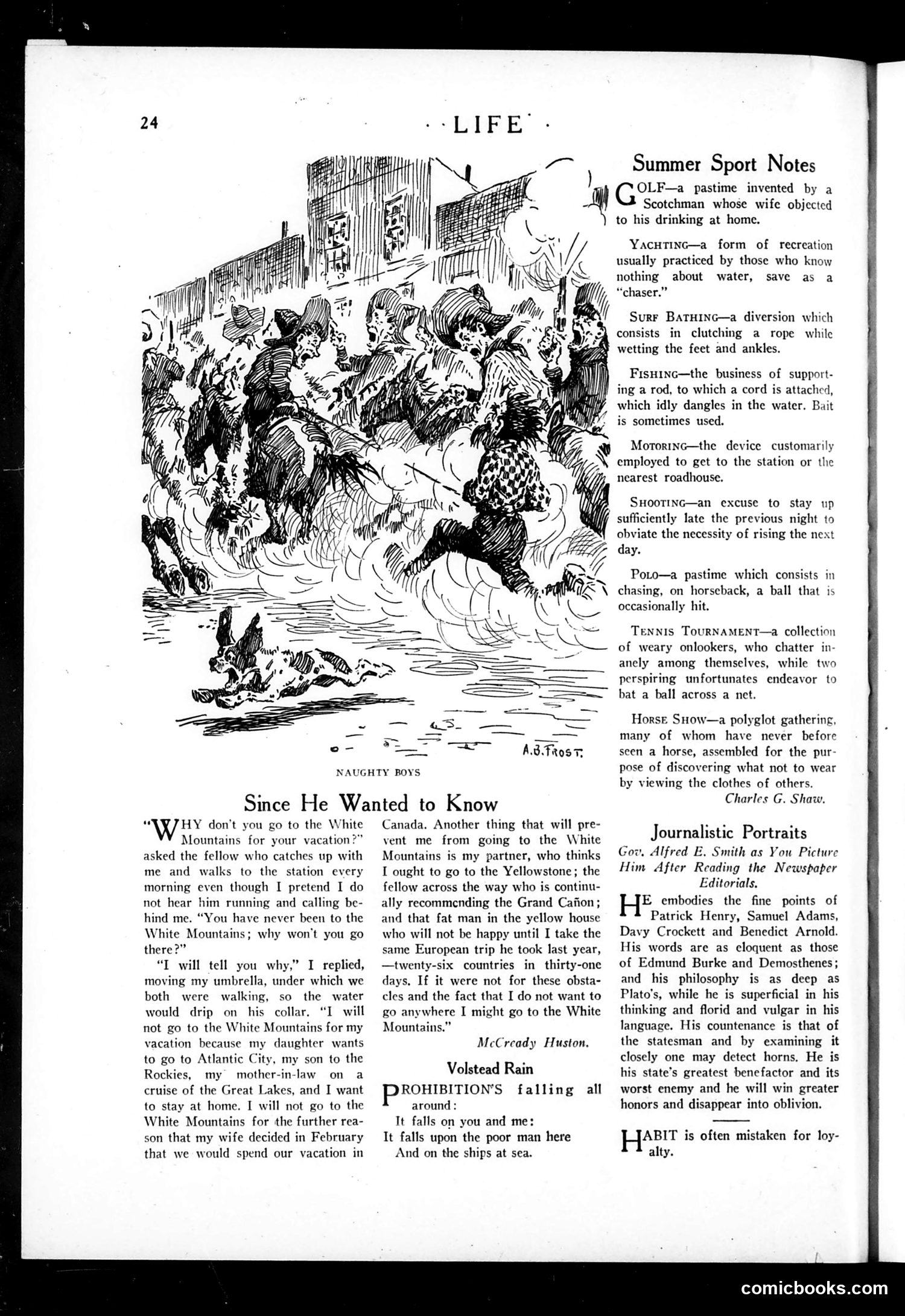
This Life magazine page contains three distinct satirical pieces: **"Naughty Boys"** (cartoon): Shows a chaotic seaside scene of children bathing. The humor derives from Victorian-era anxieties about unsupervised youth and improper beach behavior—depicting children as rowdy and undisciplined. **"Since He Wanted to Know"** (article): A humorous complaint about vacation planning. The narrator lists conflicting family demands (daughter wants Atlantic City, son wants Rockies, wife wants Canada, etc.), satirizing the impossibility of pleasing everyone. The punchline is his deliberately redirecting an acquaintance's umbrella drip onto the man's collar. **"Summer Sport Notes"** (definitions): Cynical definitions of leisure activities. Golf originated because a Scotsman's wife objected to his drinking; yachting appeals to those ignorant of water; tennis involves "weary onlookers" watching "perspiring unfortunates." This mocks upper-class summer pastimes as pointless or absurd. **"Volstead Rain"**: References Prohibition (the Volstead Act), using rain as metaphor for its universal imposition on society. The page reflects 1920s-era American satirical humor targeting class pretensions and social conventions.
📄 Transcribed text from this page (OCR, searchable)
Machine-transcribed from the original scan — historical spelling and the odd misread are preserved.
uy A f} NAUGHTY BOYS Since He Wanted to Know it) HY don’t you go to the White Mountains for your vacation?” asked the fellow who catches up with me and walks to the station every morning even though I pretend I do not hear him running and calling be- hind me. “You have never been to the White Mountains; why won't you go there?” “I will tell you why,” I replied, moving my umbrella, under which we both were walking, so the water would drip on his collar. “I will not go to the White Mountains for my vacation because my daughter wants to go to Atlantic City, my son to the Rockies, my mother-in-law on a cruise of the Great Lakes, and I want to stay at home. I will not go to the White Mountains for the further rea- son that my wife decided in February that we would spend our vacation in Canada. Another thing that will pre- vent me from going to the White Mountains is my partner, who thinks I ought to go to the Yellowstone; the fellow across the way who is continu- ally recommending the Grand Cajion; and that fat man in the yellow house who will not be happy until I take the same European trip he took last year, —twenty-six countries in thirty-one days, If it were not for these obsta- cles and the fact that I do not want to go anywhere I might go to the White Mountains.” McCready Huston. Volstead Rain [PROBISITION'S falling all around: It falls on you and me: It falls upon the poor man here And on the ships at sea. Summer Sport Notes OLF—a pastime invented by a Scotchman whose wife objected to his drinking at home. Yacutinc—a form of recreation usually practiced by those who know nothing about water, save as a “chaser.” Surr Batuinc—a diversion which consists in clutching a rope while wetting the feet and ankles. Fisuinc—the business of support- ing a rod, to which a cord is attached, which idly dangles in the water. Bait is sometimes used. Motortnc—the device customarily employed to get to the station or the nearest roadhouse. SHootinc—an excuse to stay up sufficiently late the previous night to obviate the necessity of rising the next day. Poto—a pastime which consists in chasing, on horseback, a ball that is occasionally hit. Tennis TouRNAMENT—a collection of weary onlookers, who chatter in- anely among themselves, while two perspiring unfortunates endeavor to bat a ball across a net. Horse SHow—a polyglot gathering, many of whom have never before seen a horse, assembled for the pur- pose of discovering what not to wear by viewing the clothes of others. Charles G. Shaw. Journalistic Portraits Gow, Alfred E, Smith as You Picture Him After Reading the Newspaper Editorials. E embodies the fine points of Patrick Henry, Samuel Adams, Davy Crockett and Benedict Arnold. His words are as eloquent as those of Edmund Burke and Demosthenes; and his philosophy is as deep as Plato's, while he is superficial in his thinking and florid and vulgar in his language. His countenance is that of the statesman and by examining it closely one may detect horns. He is his state’s greatest benefactor and its worst enemy and he will win greater honors and disappear into oblivion. ABIT is often mistaken for loy- alty. comicbooks.com