
Life, 1923-07-05 · page 27 of 40
Life — July 5, 1923 — page 27: what you’re looking at
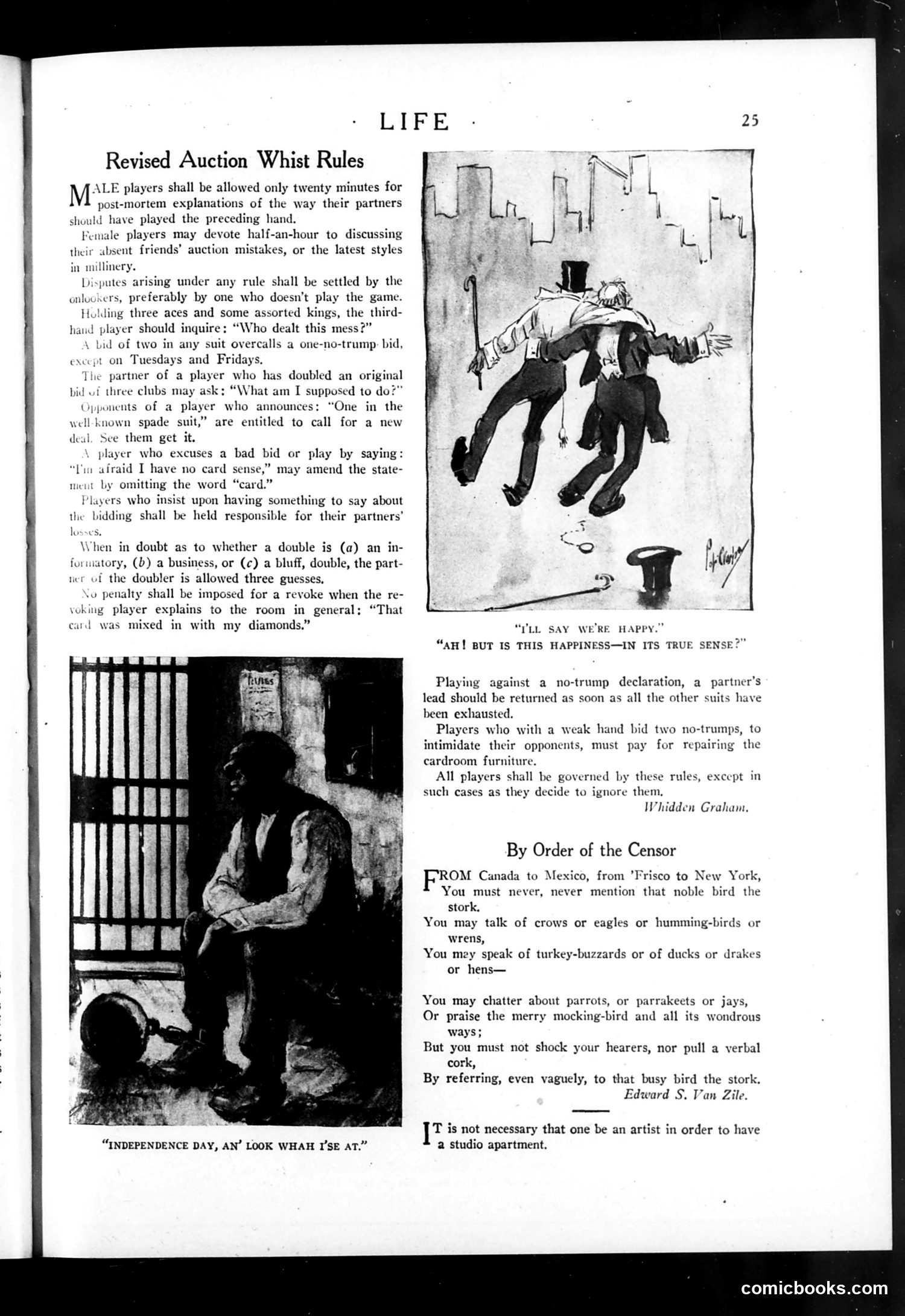
What you’re looking at
This page contains two distinct pieces of humor satirizing early 20th-century American social conventions. **"Revised Auction Whist Rules"** mocks card game etiquette through absurdist "rules" that expose common player behaviors: men get 20 minutes to explain bad plays; women get 30 minutes to gossip about friends' mistakes and fashion; disputes are settled by non-players; weak players make excuses. The satire targets how people rationalize poor performance and use social situations to air grievances. **"By Order of the Censor"** is a poem lampooning censorship regarding birth-related language. It notes Americans can discuss any bird freely—crows, eagles, parrots, mockingbirds—*except* the stork, the traditional euphemism for childbirth. The satire criticizes prudish social restrictions on discussing reproduction, highlighting the absurdity of censoring indirect references to natural processes. Both pieces use humor to critique rigid social conventions of the era.
📄 Transcribed text from this page (OCR, searchable)
Machine-transcribed from the original scan — historical spelling and the odd misread are preserved.
Revised Auction Whist Rules ALE players shall be allowed only twenty minutes for post-mortem explanations of the way their partners should have played the preceding hand. Female players may devote half-an-hour to discus: their absent friends’ auction mistakes, or the latest styles in millinery. Disputes arising under any rule shall be settled by the onlookers, preferably by one who doesn’t play the game. Holding three aces and some assorted kings, the third- haud player should inquire; “Who dealt this mess?” \ Lid of two in any suit overcalls a one-no-trump: bid, pt on Tuesdays and Fridays. The partner of a player who has doubled an original bid uf three clubs may ask: “What am I supposed to do?” Opponents of a player who announces: “One in the well-known spade suit,” are entitled to call for a new deal, See them get it. player who excuses a bad bid or play by saying: “liu afraid I have no card sense,” may amend the state- nicut by omitting the word ‘ Players who insist upon having the bidding shall be held responsible for their partners’ losses. \Vhen in doubt as to whether a double is (a) an in- formatory, (b) a business, or (c) a bluff, double, the part- ner of the doubler is allowed three guesses, ‘vu penalty shall be imposed for a revoke when the re- voking player explains to the room in general; “That card was mixed in with my diamonds,” “VLL SAY WE'RE HAPPY.” “aH! BUT IS THIS HAPPINESS—IN ITS TRUE SENS Playing against a no-trump declaration, a partner's lead should be returned as soon as all the other suits have been exhausted. Players who with a weak hand bid two no-trumps, to intimidate their opponents, must pay for repairing the cardroom furniture. All players shall be governed by these rules, except in such cases as they decide to ignore them, Whidden Graham. By Order of the Censor ROM Canada to Mexico, from ’Frisco to New York, You must never, never mention that noble bird the stork, You may talk of crows or eagles or humming-birds or wrens, You mey speak of turkey-buzzards or of ducks or drakes or hens— You may chatter about parrots, or parrakeets or jays, Or praise the merry mocking-bird and all its wondrous ways; But you must not shock your hearers, nor pull a verbal cork, By referring, even vaguely, to that busy bird the stork. Edward S. Van Zile. T is not necessary that one be an artist in order to have “NDEPENDENCE DAY, AN’ LOOK WHAH I’SE AT.” a studio apartment. comicbooks.com