
A complete issue · 44 pages · 1923
Life — June 14, 1923
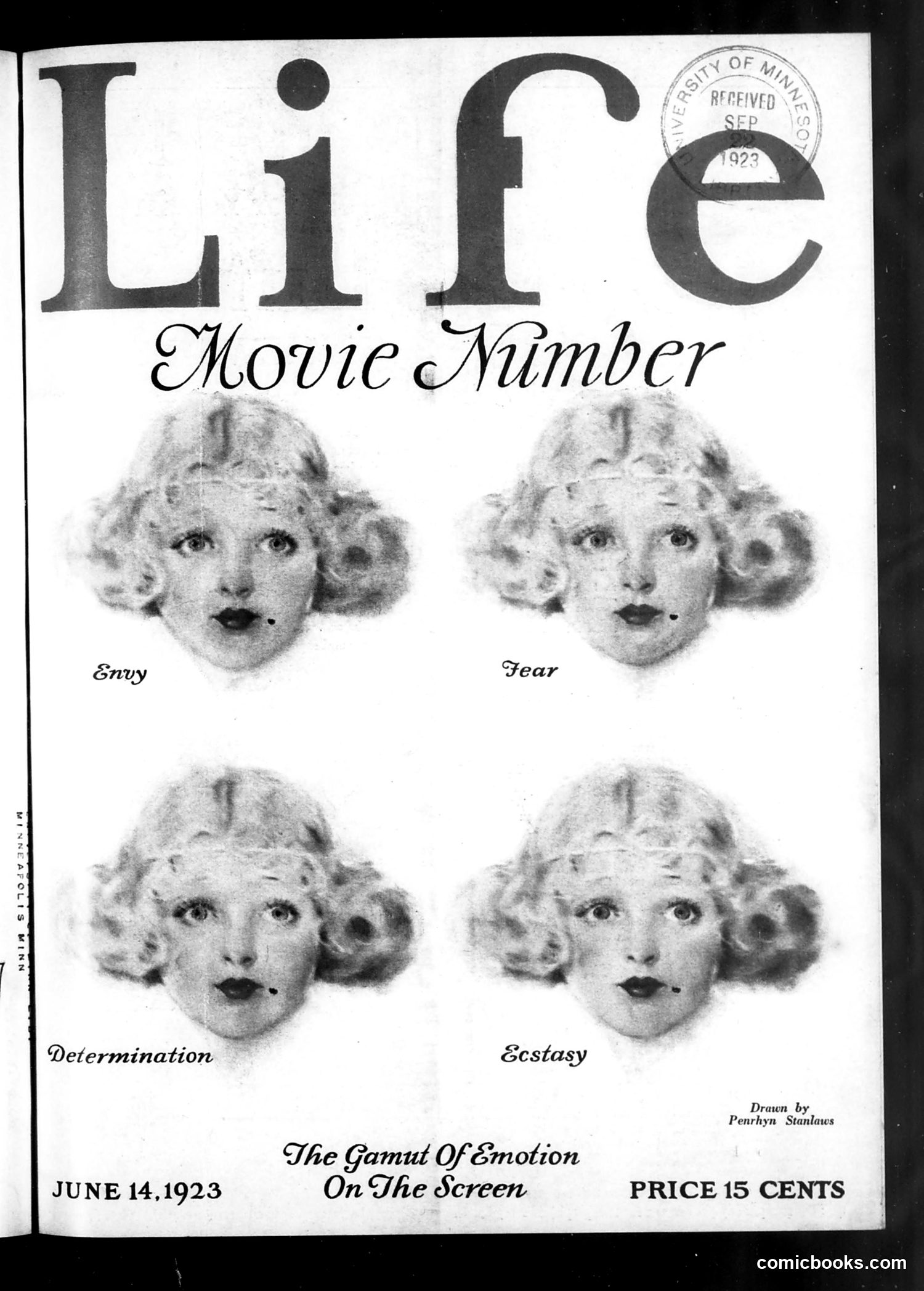
This June 14, 1923 Life cover satirizes silent film acting by showing four identical female faces labeled with emotions: "Envy," "Fear," "Determination," and "Ecstasy." The satire targets the exaggerated, often indistinguishable facial expressions silent film actors relied on, since they couldn't use dialogue. The joke suggests that actresses performed nearly identical expressions regardless of the emotion they were supposedly portraying—that viewers couldn't actually tell the emotions apart. This reflects early 1920s cinema criticism about over-the-top silent film acting. The cover mocks both the acting technique and the audience's supposed inability to distinguish genuine emotional nuance on screen. The illustration is credited to Penrhyn Stanlaws, a prominent illustrator of that era.
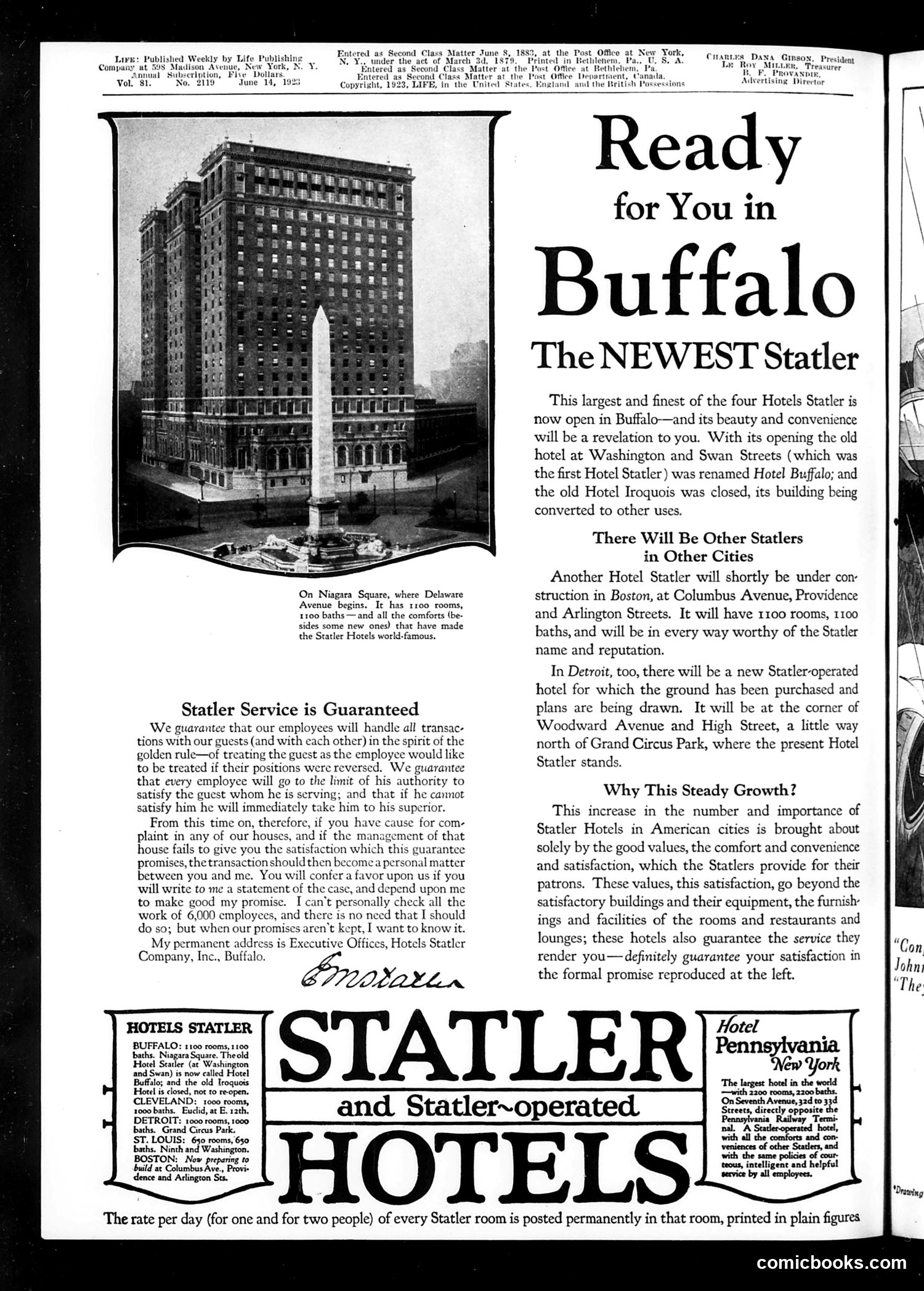
This page is **primarily a hotel advertisement**, not satirical content. It promotes the Statler Hotels chain, announcing the opening of their newest Buffalo location on Niagara Square. The advertisement emphasizes "Statler Service is Guaranteed," detailing management's promise that employees will treat guests with respect and ensure satisfaction. It announces expansion plans for hotels in Boston and Detroit. There is **no political cartoon or satire** on this page. The only illustration is a photograph of the Buffalo Statler hotel building itself. The text is straightforward promotional copy highlighting amenities (1,100 rooms, 1,100 baths) and the company's service philosophy. This reflects Life magazine's dual nature as both satirical commentary and commercial publication in the 1920s.
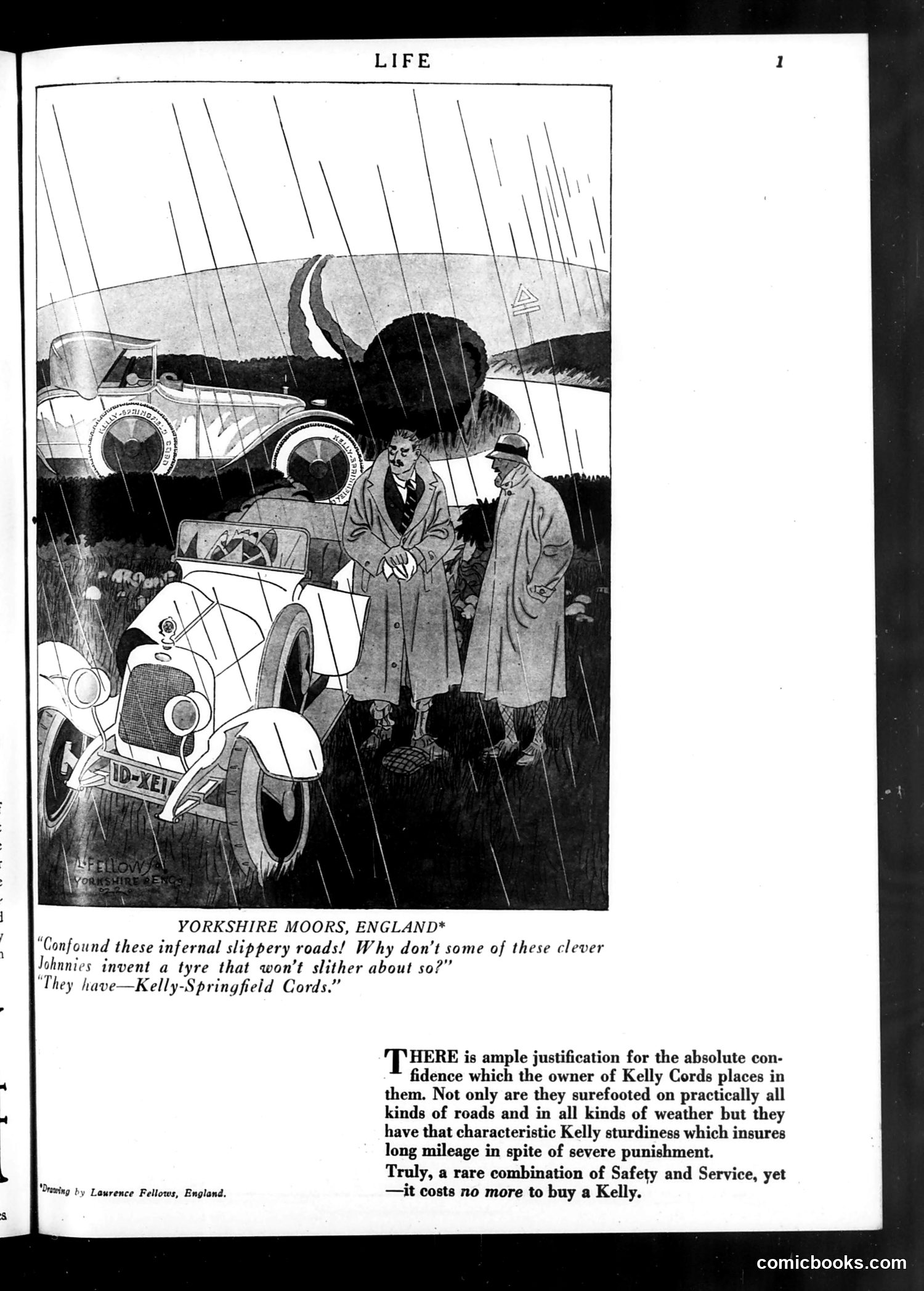
This is primarily a **Kelly Cords tire advertisement** disguised as editorial content in *Life* magazine. The cartoon depicts two men in coats examining cars stuck in mud on Yorkshire Moors during rain—a scenario designed to showcase tire performance in terrible conditions. One man complains about "infernal slippery roads" and suggests someone invent better tires. The other responds that the solution already exists: "Kelly-Springfield Cords." The advertisement then claims Kelly Cords are "surefooted on practically all kinds of roads and in all kinds of weather" and possess "Kelly sturdiness" for long mileage. The final line—"it costs no more to buy a Kelly"—uses comparative pricing as a sales pitch. This represents early 20th-century advertorial techniques where ads mimicked editorial cartoons to appear more legitimate and entertaining to readers.
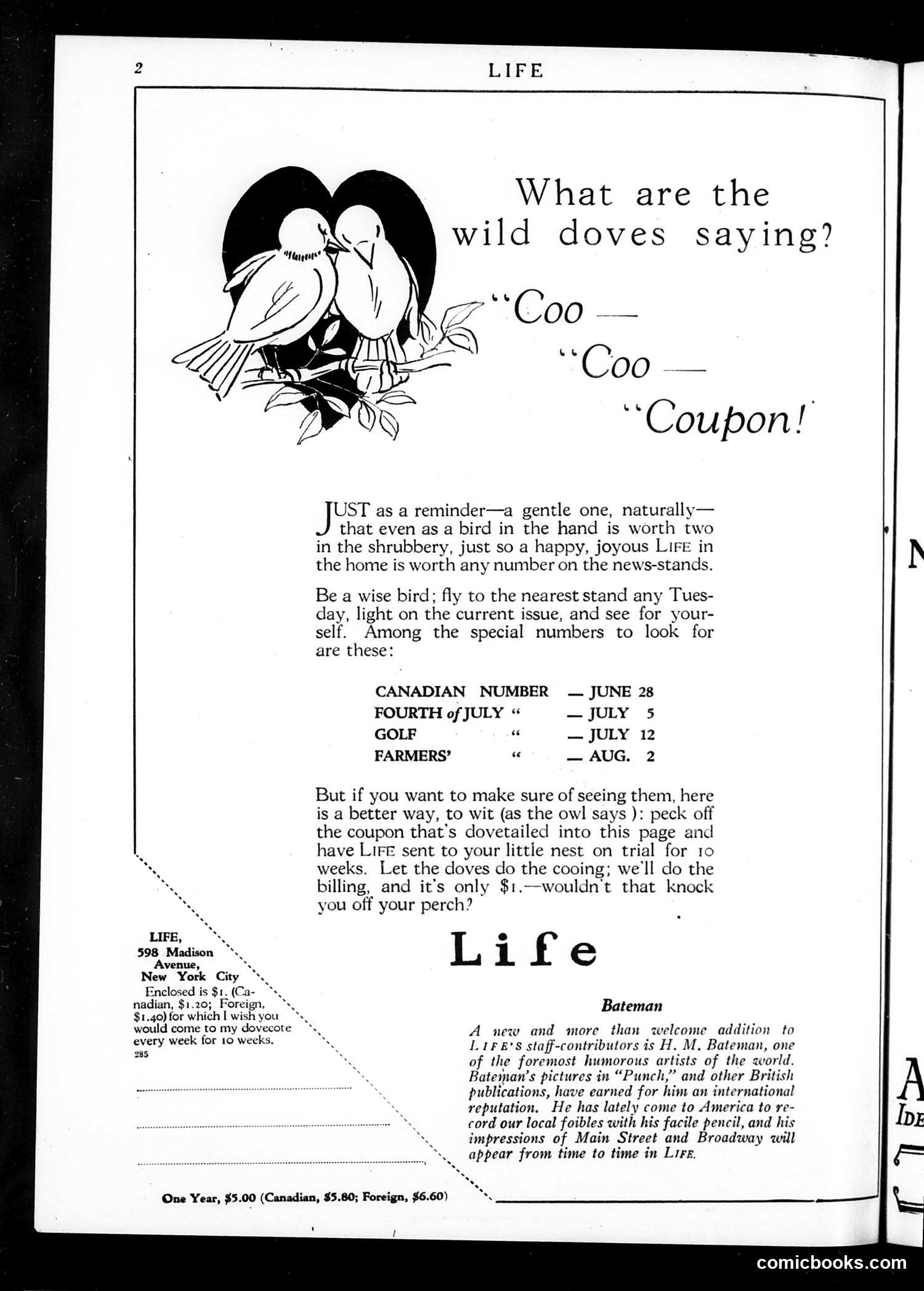
This page contains a **humorous advertisement for Life magazine itself**, not political satire. The illustration shows two wild doves cooing "Coo—Coo—Coupon!" The joke plays on a double meaning: the doves' natural call ("coo") sounds like "coupon," which Life is advertising. The text uses bird metaphors to pitch the magazine as a valuable home companion—"a bird in the hand is worth two in the shrubbery, just so a happy, joyous LIFE in the home is worth any number on the news-stands." The advertisement lists upcoming special issues (Canadian, Fourth of July, Golf, Farmers) and offers a trial subscription for $1. This is essentially a tongue-in-cheek sales pitch using nature wordplay to encourage subscriptions to Life's satirical content.
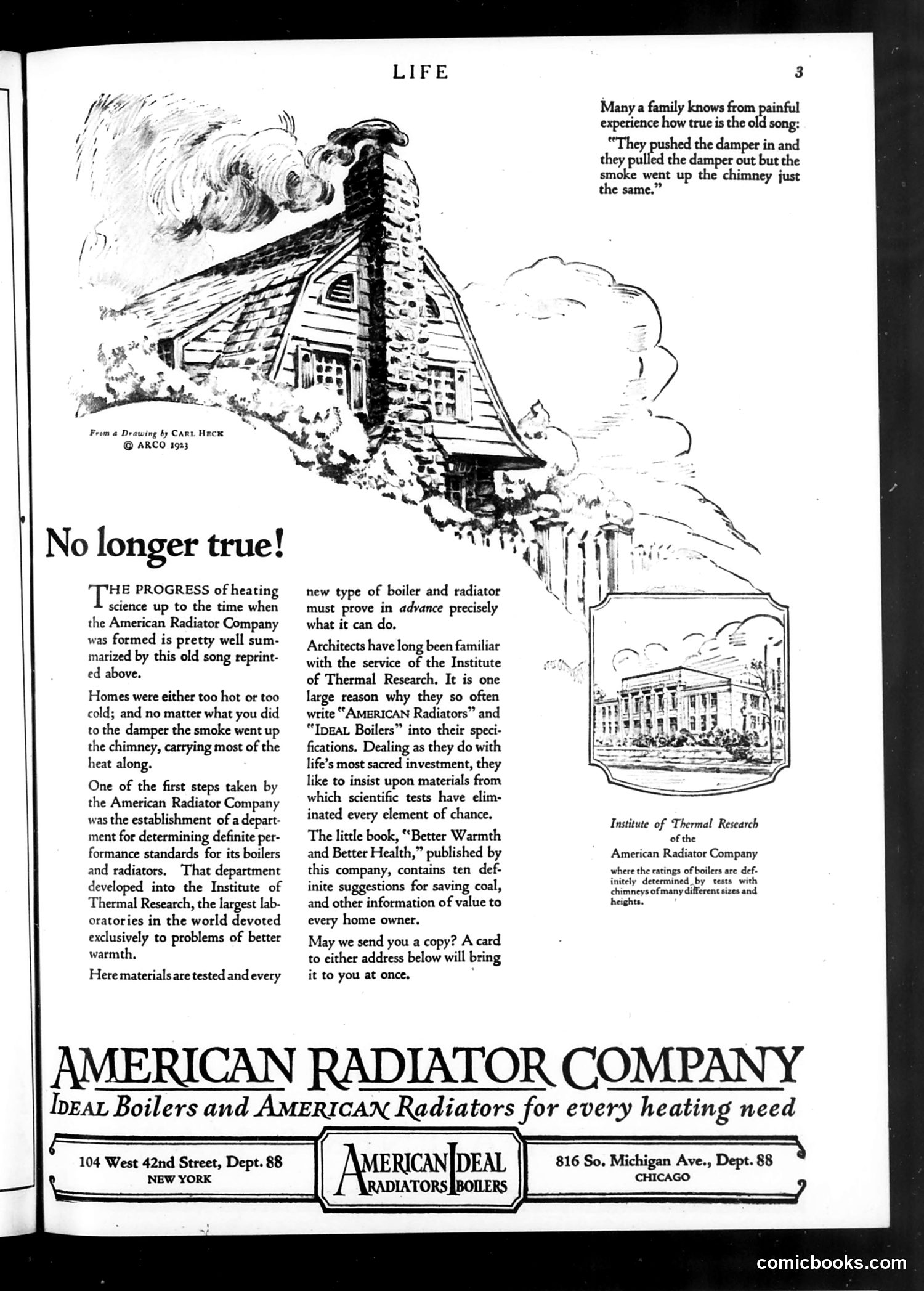
This page is primarily an **advertisement for American Radiator Company**, not political satire. The cartoon by Carl Heck illustrates an old folk saying about chimney dampers: "They pushed the damper in and they pulled the damper out but the smoke went up the chimney just the same." The ad's headline "No longer true!" uses this dated saying to argue that modern heating science has progressed beyond such ineffective methods. The company established the Institute of Thermal Research—described as "the largest laboratories in the world devoted exclusively to problems of better warmth"—to develop scientifically-tested boilers and radiators. The institute building is shown to emphasize technological credibility. This is essentially a corporate image-building advertisement claiming scientific superiority over outdated heating methods.
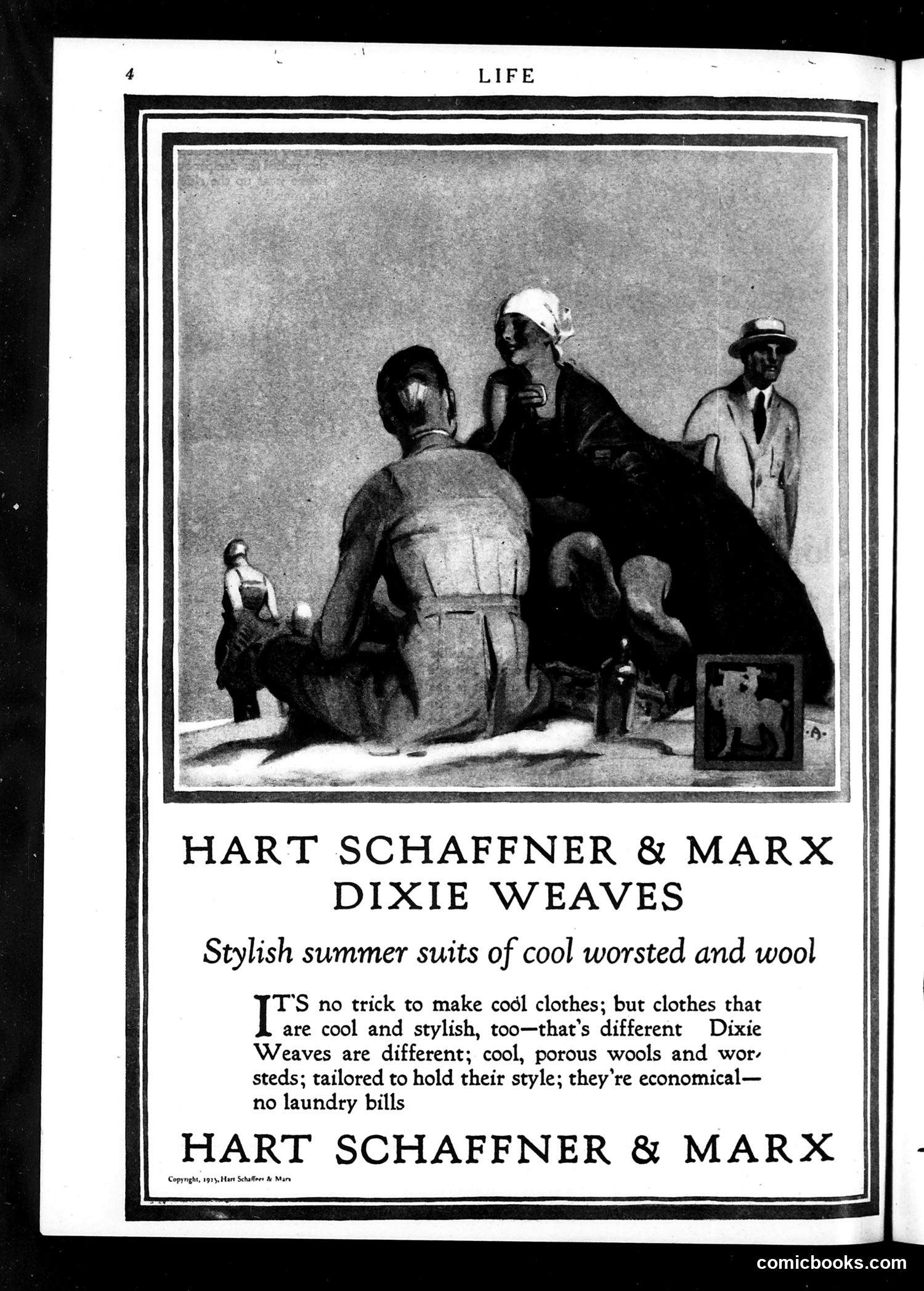
This page is **primarily a clothing advertisement**, not satire or political commentary. It advertises Hart Schaffner & Marx's "Dixie Weaves" summer suits. The illustration shows several men in 1920s business attire examining fabric or clothing samples. The advertisement emphasizes that Dixie Weaves suits are both stylish AND practical—made from "cool, porous wools and worsteds" that maintain their appearance and require minimal laundering. The sales pitch targets summer-conscious businessmen: these suits solve the problem of staying cool while remaining formally dressed during hot weather. The "no laundry bills" claim suggests durability and wrinkle-resistance, valuable selling points for practical consumers during the 1920s. This is straightforward commercial messaging, not political or social satire.
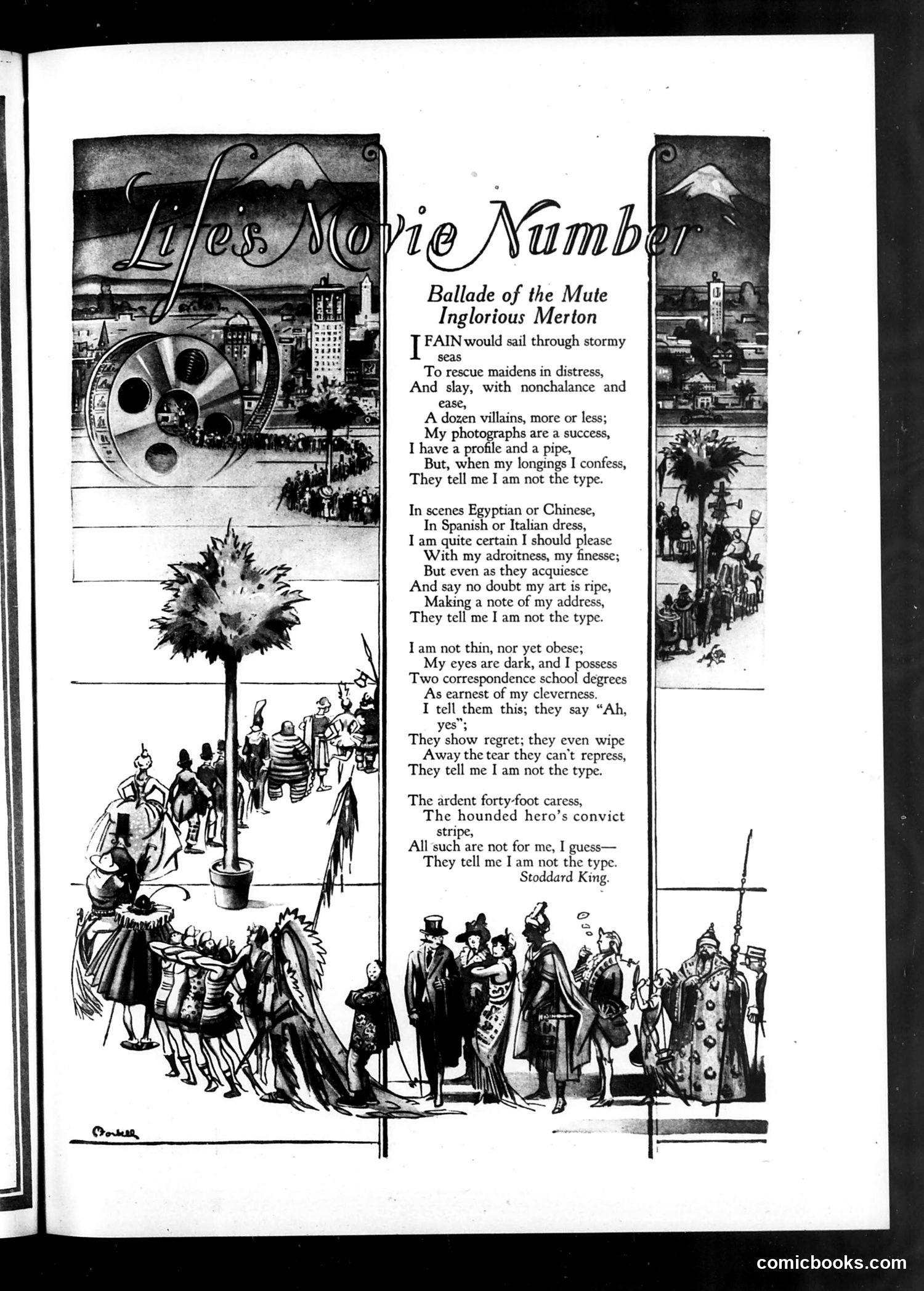
This page satirizes silent film culture and an actor (likely Inglorious Merton—a fictional character name mocking grandiose film personas). The poem mocks the disconnect between an actor's on-screen heroic image and his actual personality. The central joke: the character claims he'd sail through stormy seas rescuing maidens and defeat villains, yet confesses he's not "the type" for such heroics. Despite acquiring skills and appearing in exotic settings (Egyptian, Chinese, Spanish scenes), people recognize his ordinariness. The poem catalogs his mediocrity—he's "not thin, nor yet obese," possesses only correspondence school degrees, and lacks the ardent heroism his films suggest. The satirical point: silent film acting created false personas; audiences couldn't hear actors speak, enabling the illusion. The mute format allowed anyone to appear heroic on screen while remaining unremarkable in reality.
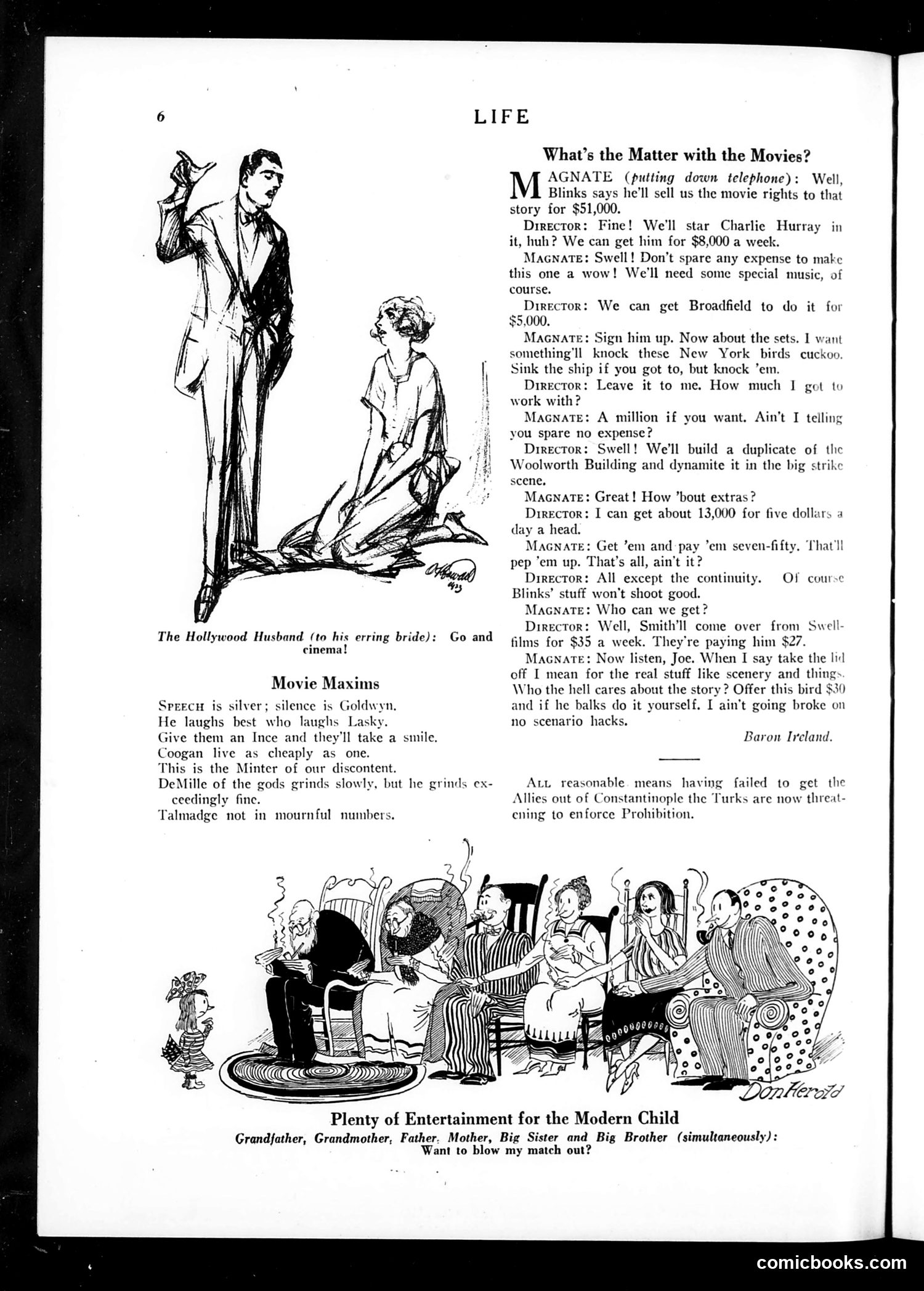
This page satirizes early Hollywood's filmmaking practices through a dialogue between a "Magnate" (studio executive) and a "Director." The satire mocks the industry's approach to adapting stories for cinema: executives demand expensive, spectacular productions while dismissing concerns about script quality or narrative coherence. Key targets include: - **Runaway production costs** (building sets, hiring extras at inflated wages) - **Star power over substance** (casting Charlie Murray for $8,000/week) - **Studio indifference to storytelling** ("Who the hell cares about the story?") - **Nepotism and cost-cutting** (hiring cheap outside talent like "Smith") The bottom cartoon mocks modern children's entertainment overstimulation, showing multiple family members simultaneously seeking amusement—a comment on entertainment culture's fragmentation and excess.
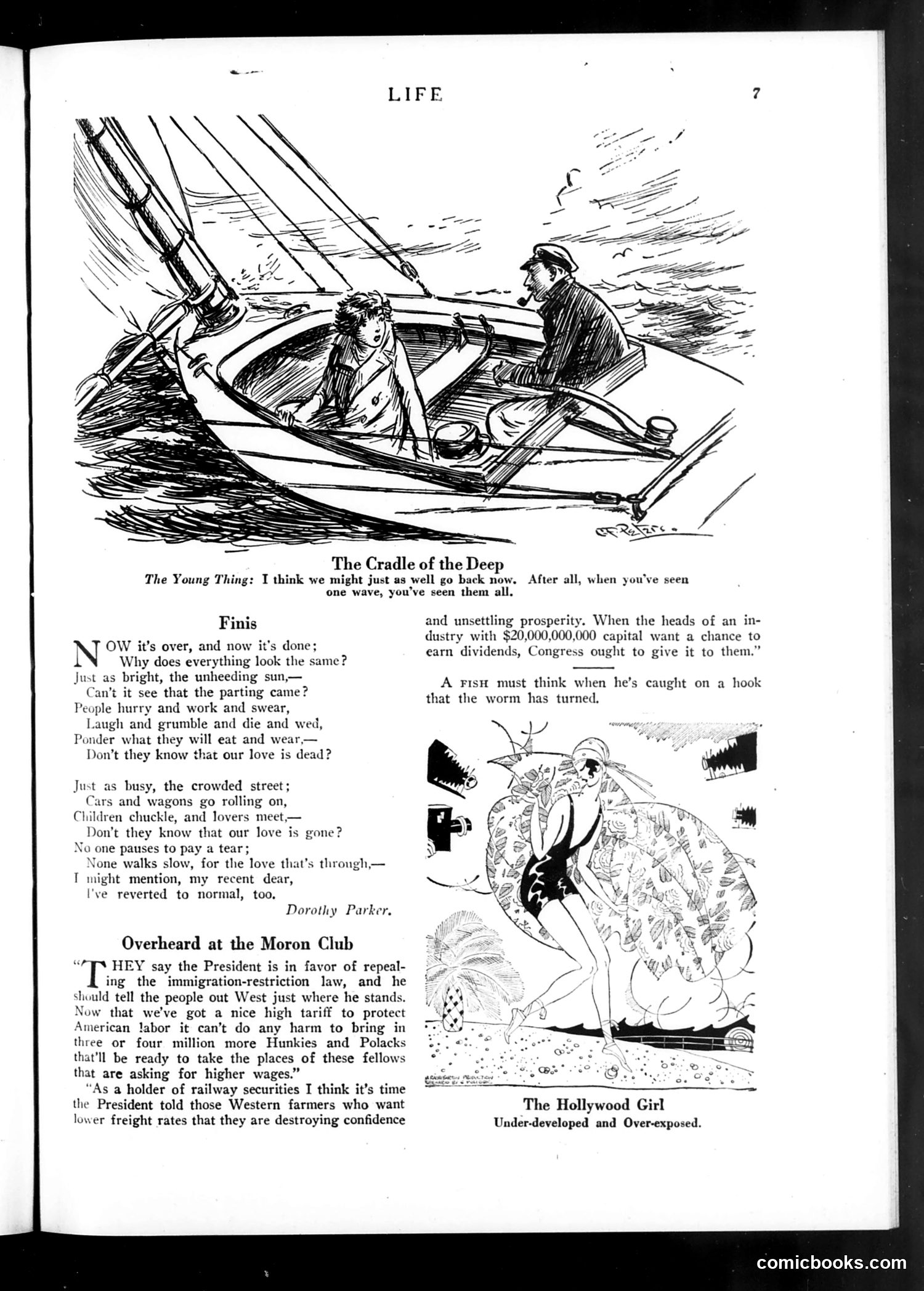
**"The Cradle of the Deep"** (top cartoon): Shows two figures in a small boat. The younger one suggests returning home, claiming "when you've seen one wave, you've seen them all"—satirizing shallow, jaded attitudes. **"Finis"** (poem by Dorothy Parker): A melancholic reflection on life's end, contrasting bright, unheeding nature with human mortality and grief. **"Overheard at the Moron Club"**: Political satire mocking anti-immigration rhetoric. A character advocates restricting immigration to protect American labor wages, while simultaneously supporting policies (low freight rates) that harm Western farmers—exposing the contradiction and selfishness in such positions. **"The Hollywood Girl"**: A cartoon captioned "Under-developed and Over-exposed," likely satirizing the entertainment industry's exploitation of young women. The page combines satirical commentary on politics, social hypocrisy, and cultural criticism.
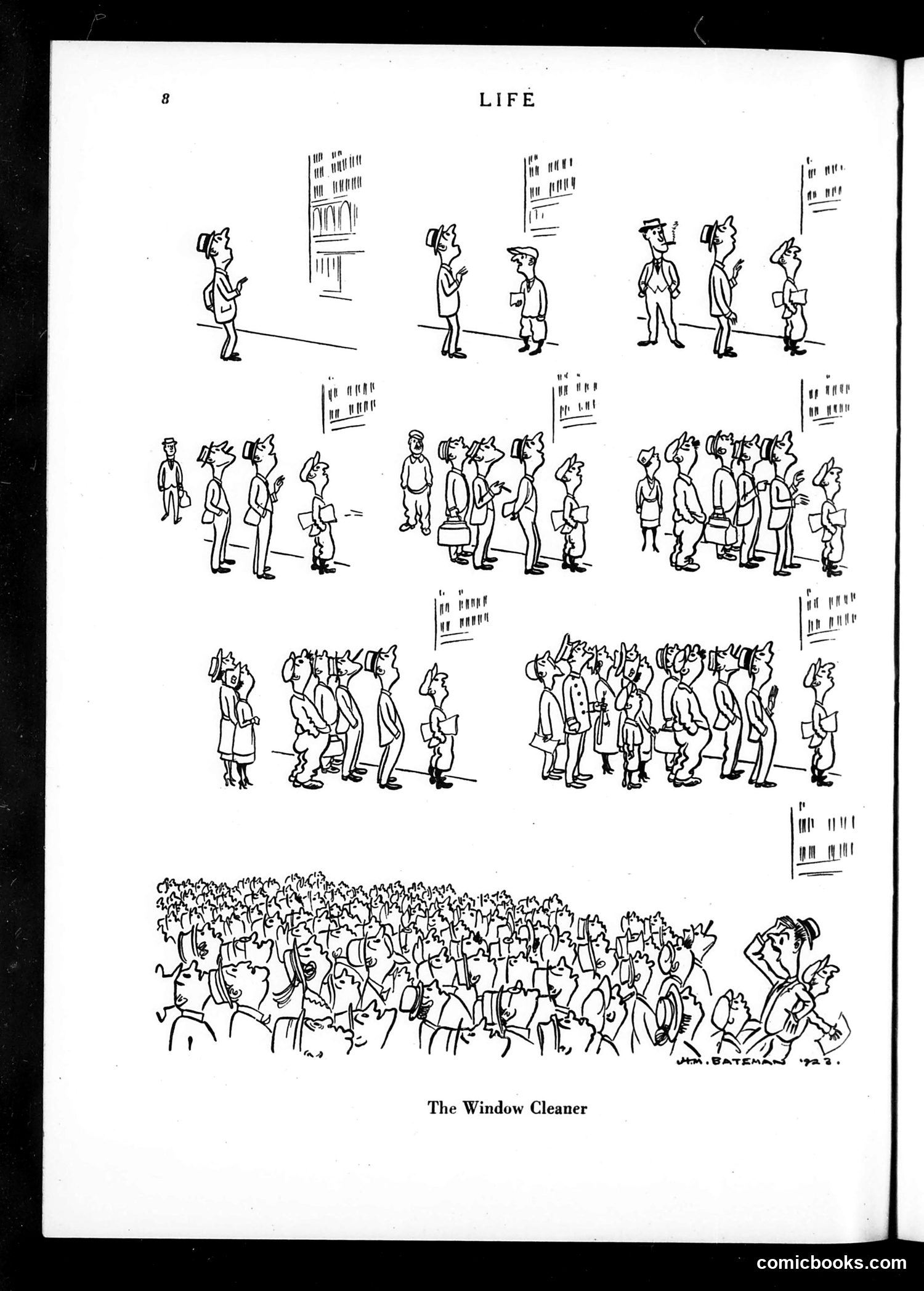
This satirical comic strip titled "The Window Cleaner" shows the progression of a single window cleaner's workday. It depicts how one person gradually attracts larger and larger crowds of onlookers—beginning with a solitary figure, expanding through panels showing growing groups of curious observers, and culminating in a massive throng of people watching him work. The joke likely satirizes public fascination with mundane street labor or urban spectacle. It suggests how ordinary activities can draw disproportionate attention in city life, or possibly mocks crowd mentality—how people gather simply because others are gathering. The exaggerated final panel, packed with dozens of observers for such a simple task, emphasizes the absurdity of this phenomenon.
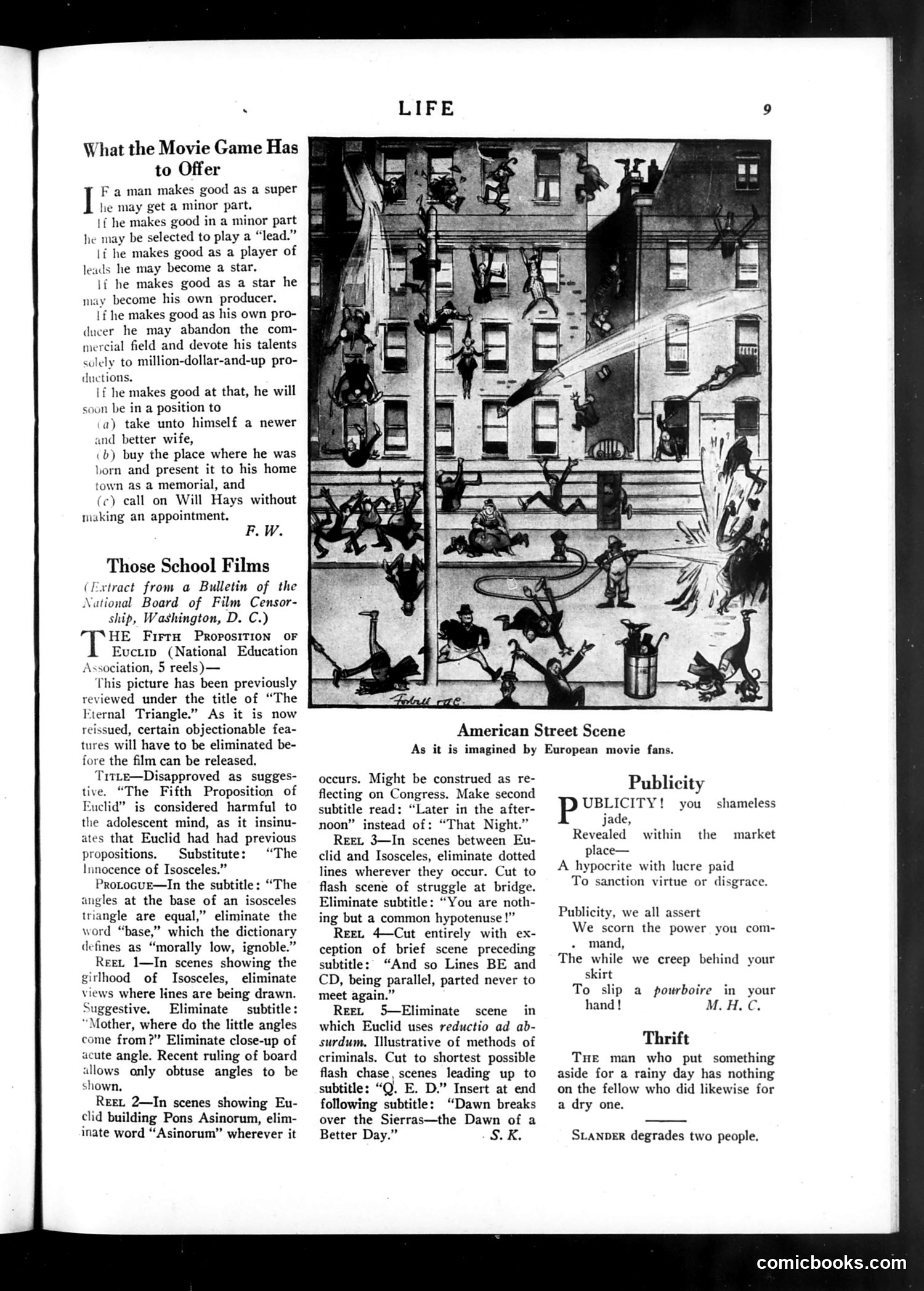
This page contains satirical commentary rather than a political cartoon. The main image, titled "American Street Scene As it is imagined by European movie fans," depicts a chaotic urban street where multiple figures are suspended or falling from a multi-story tenement building. The satire targets European perceptions of American city life, suggesting that European filmgoers imagine American streets as lawless and dangerous—with people literally falling from buildings. This mocks both exaggerated Hollywood depictions of American urban chaos and European stereotypes about American roughness. The accompanying text includes editorial pieces on film censorship, school films, and brief humor items, suggesting this reflects 1920s-era anxieties about cinema's influence on international perceptions of American culture.
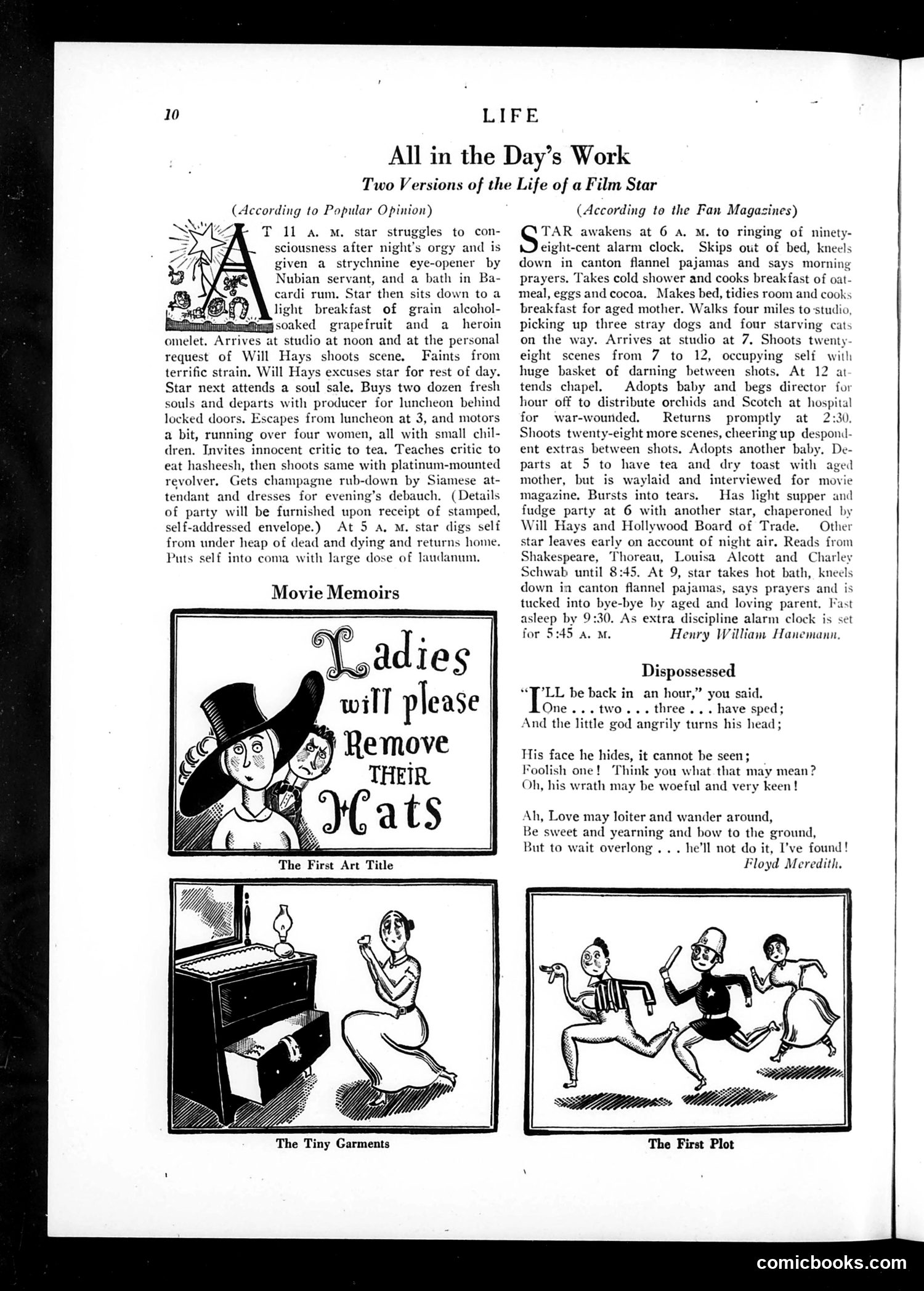
This page satirizes the glamorous reputation of film stars by presenting two contrasting daily schedules. The left column mocks popular fantasy: a star enjoys leisurely mornings, champagne, studio lunches with producers, and evening parties. The right column, attributed to "Fan Magazines," presents the actual reality: a star wakes at 6 a.m., works grueling twelve-hour shoots, distributes charity items between takes, and maintains strict discipline—essentially revealing the exhausting labor behind Hollywood's glamorous image. The accompanying cartoons and illustrations humorously underscore this contrast. The satire critiques both public misconceptions about stardom and fan magazines' complicity in promoting unrealistic portrayals of film actors' lives.
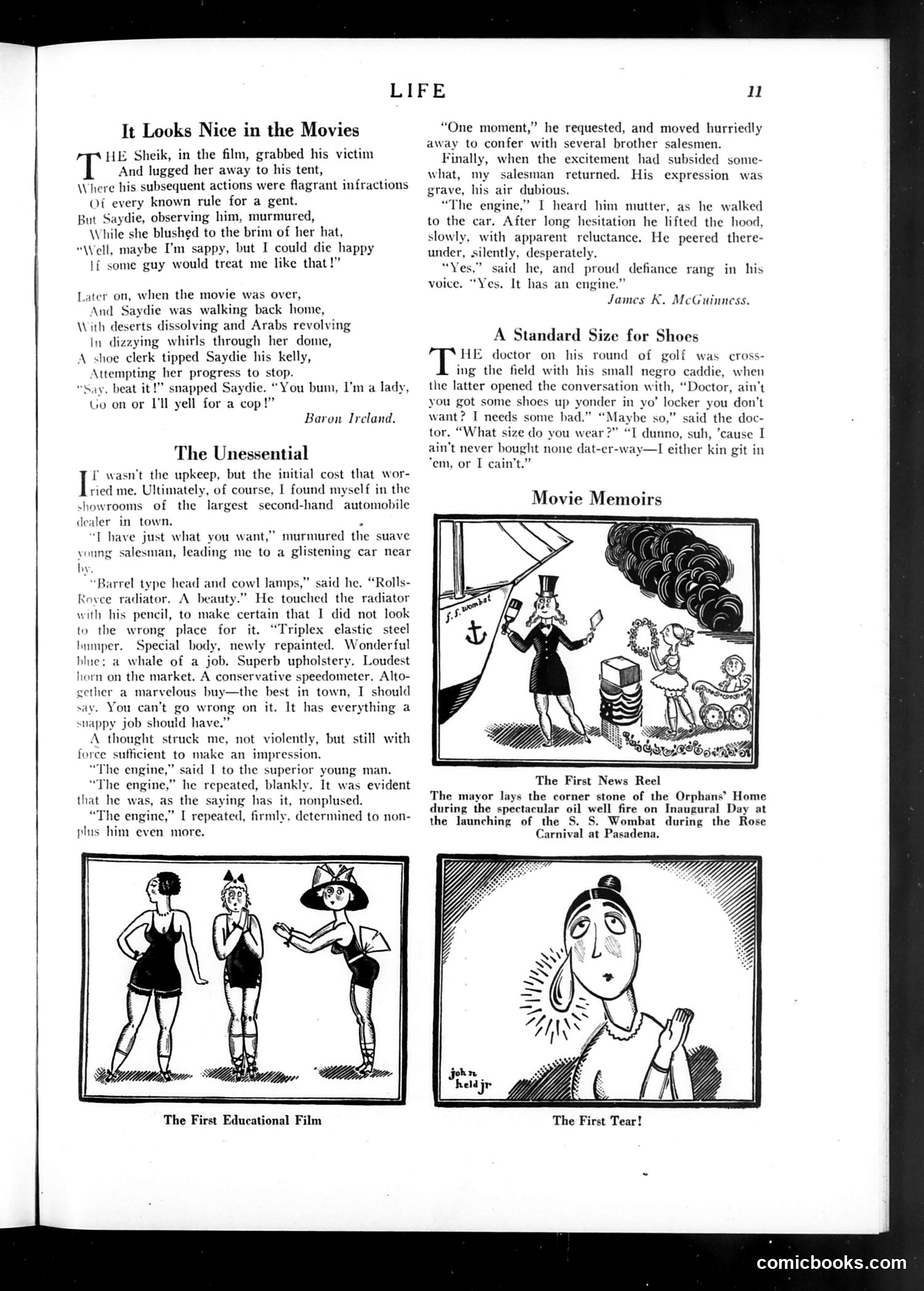
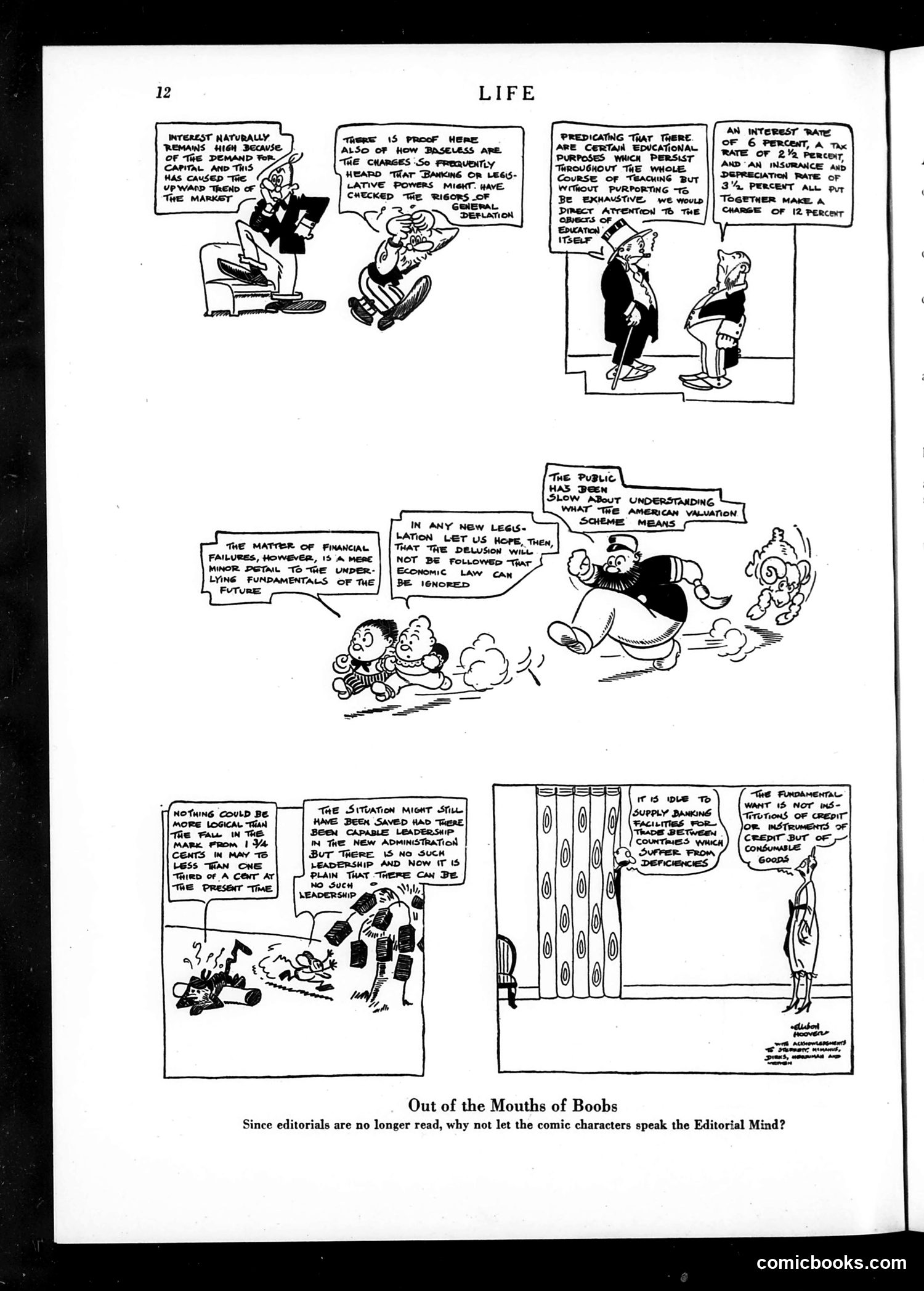
This satirical comic page mocks economic and political discussion by having cartoon characters debate serious policy matters (financial fundamentals, legislation, education, credit systems) while being portrayed as intellectually vacant "boobs." The subtitle explains the premise: since editorials are no longer read, why not have comic strip characters deliver editorial commentary instead? The satire cuts two ways—critiquing both the public (too foolish to understand serious issues) and the media (resorting to cartoons to communicate important matters). References include debates over economic law, new legislation, public valuation schemes, and credit instruments, suggesting this reflects early-to-mid 20th century financial/political discourse, likely during economic uncertainty or reform debates.
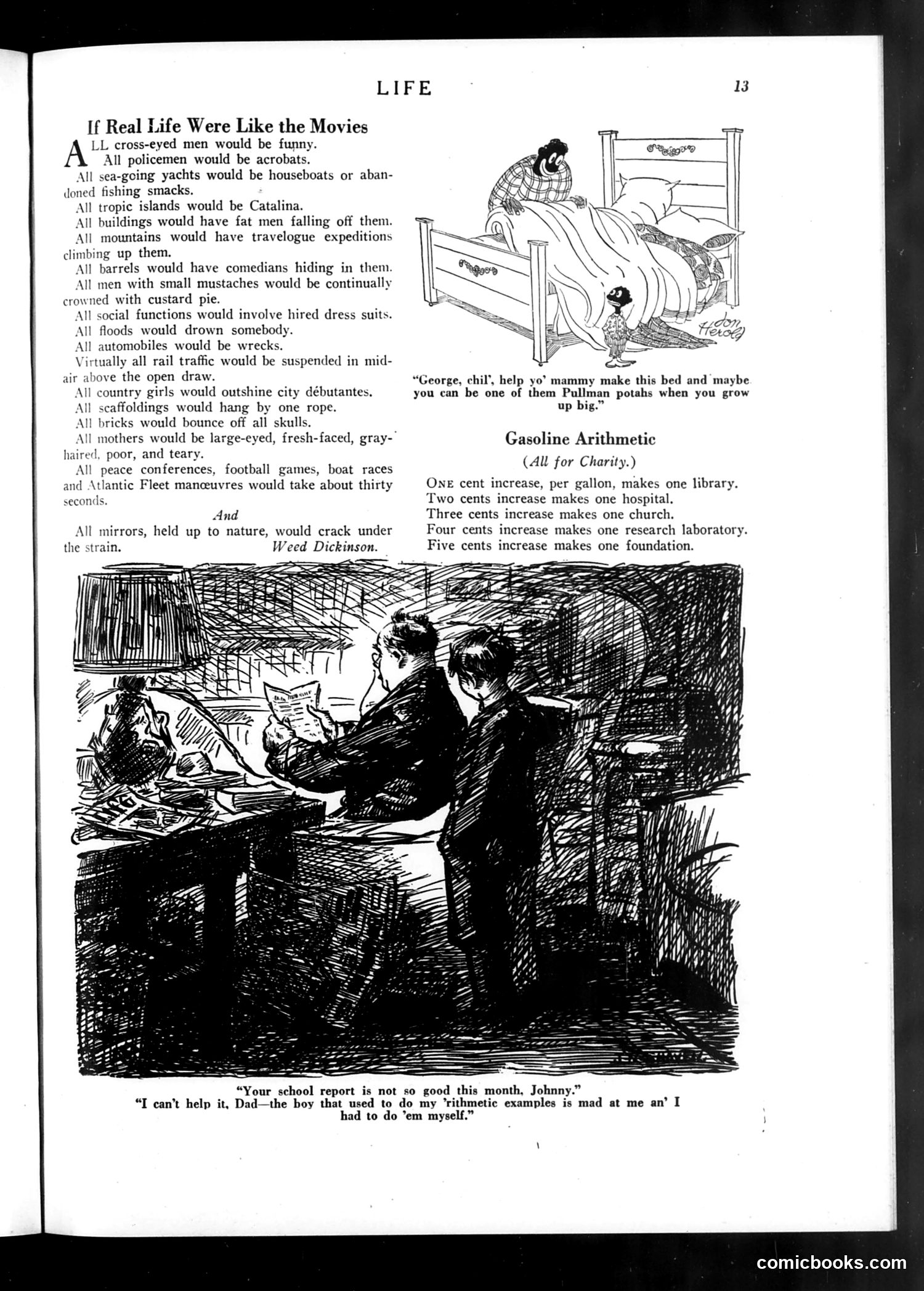
This page contains two separate pieces of satire: **"If Real Life Were Like the Movies"** presents a humorous list contrasting Hollywood's unrealistic conventions with actual reality—cross-eyed men being funny, all policemen being heroes, etc. It's credited to Weed Dickinson and satirizes cinema's distorted portrayal of life. **"Gasoline Arithmetic"** is a charity piece showing the social value of small fuel price increases, converting cents per gallon into libraries, hospitals, churches, and research labs. **The cartoon below** depicts a father frustrated with his son's school report, showing the boy "used to do my arithmetic examples" (homework) but the father had to do them himself—a relatable joke about parental struggle with children's academics and the temptation to do their work for them.
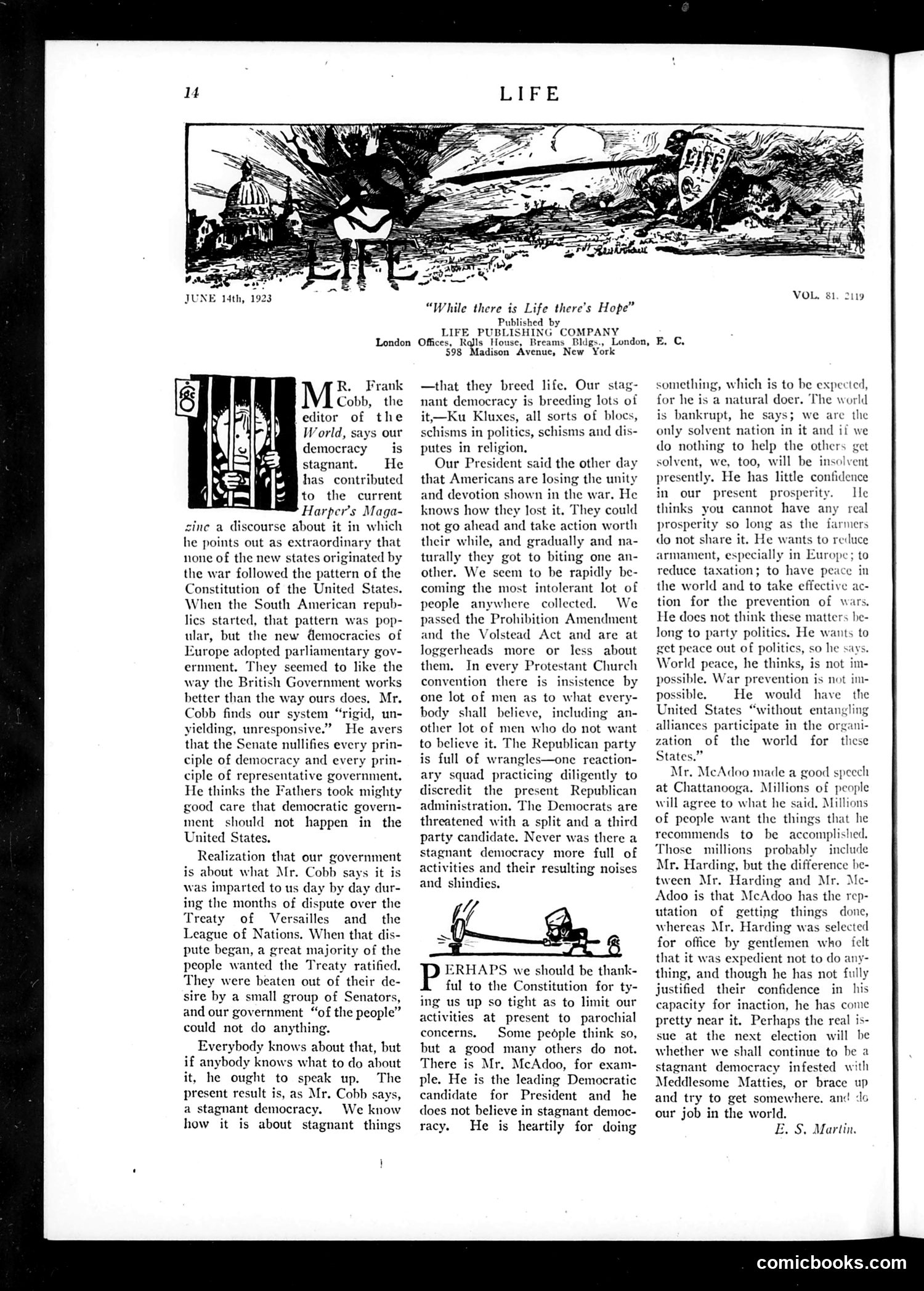
The article by editor Frank Cobb critiques what he calls "stagnant democracy"—the loss of American civic unity and vigor following World War I. Cobb argues that new democratic nations formed after the war initially mimicked America's Constitution, but are now outperforming the U.S. government. The piece discusses contemporary political divisions: the Republican party's internal conflicts, Democratic candidate James McAdoo's political viability, and President Harding's administrative shortcomings. Cobb suggests America's government has become paralyzed by partisan bickering, failing to address pressing national issues like taxation, international peace, and war prevention. The accompanying cartoon (top) appears allegorical, though its specific figures are unclear without additional context.
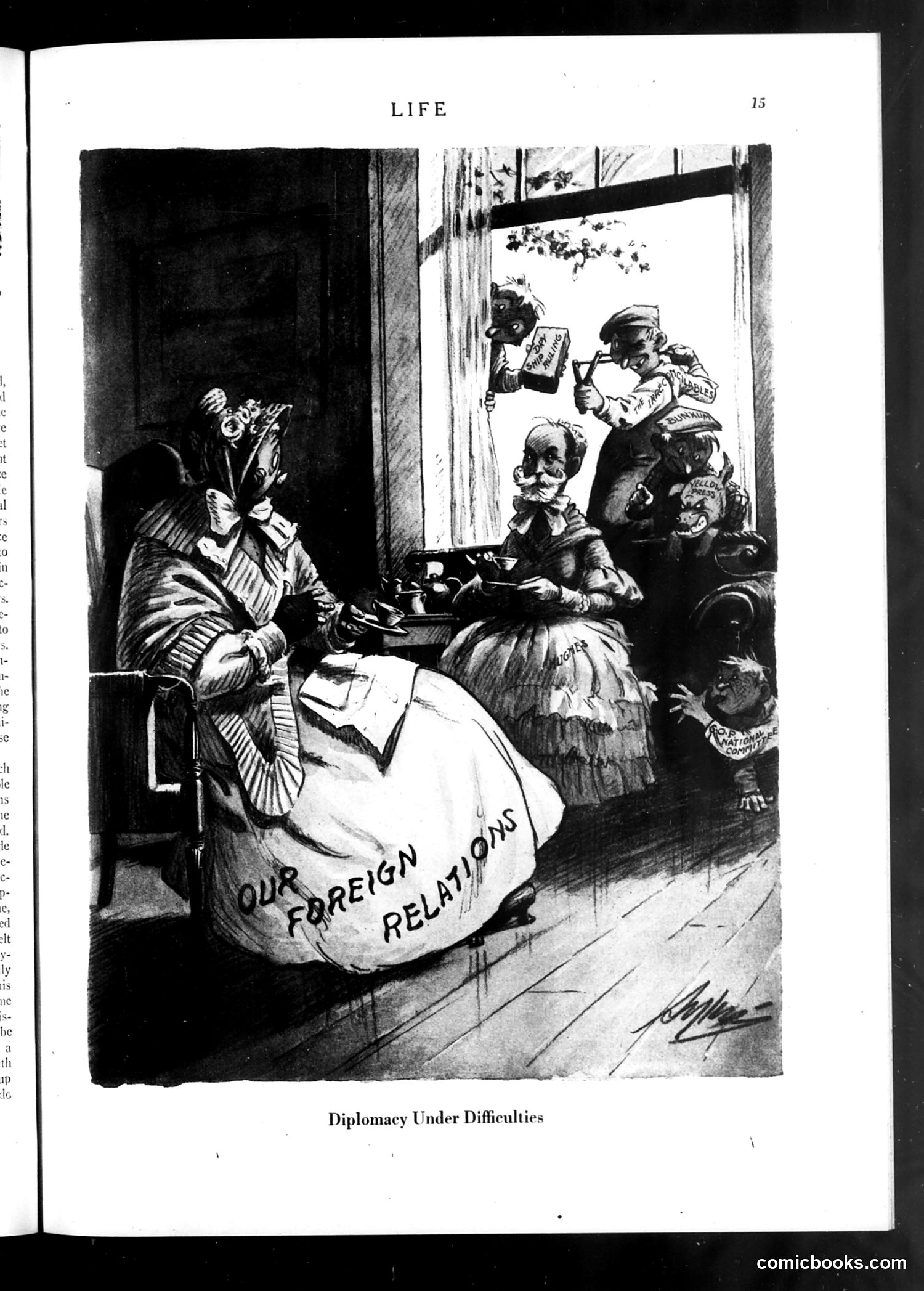
This political cartoon satirizes international diplomatic negotiations. A large figure labeled "OUR FOREIGN RELATIONS" sits at a table, attempting to conduct business while surrounded by chaotic visitors at a doorway and window. The intruders appear to be various foreign powers or representatives, some holding papers or gestures of complaint, creating pandemonium around the diplomat. The satire suggests that conducting foreign policy is nearly impossible amid constant interruptions and competing demands from other nations. The "difficulties" referenced in the title are literal—the diplomat cannot focus on diplomacy because of the disruptive crowd. This likely reflects early-20th-century American frustrations with complex international negotiations and the competing interests of various global powers seeking American attention and resources.
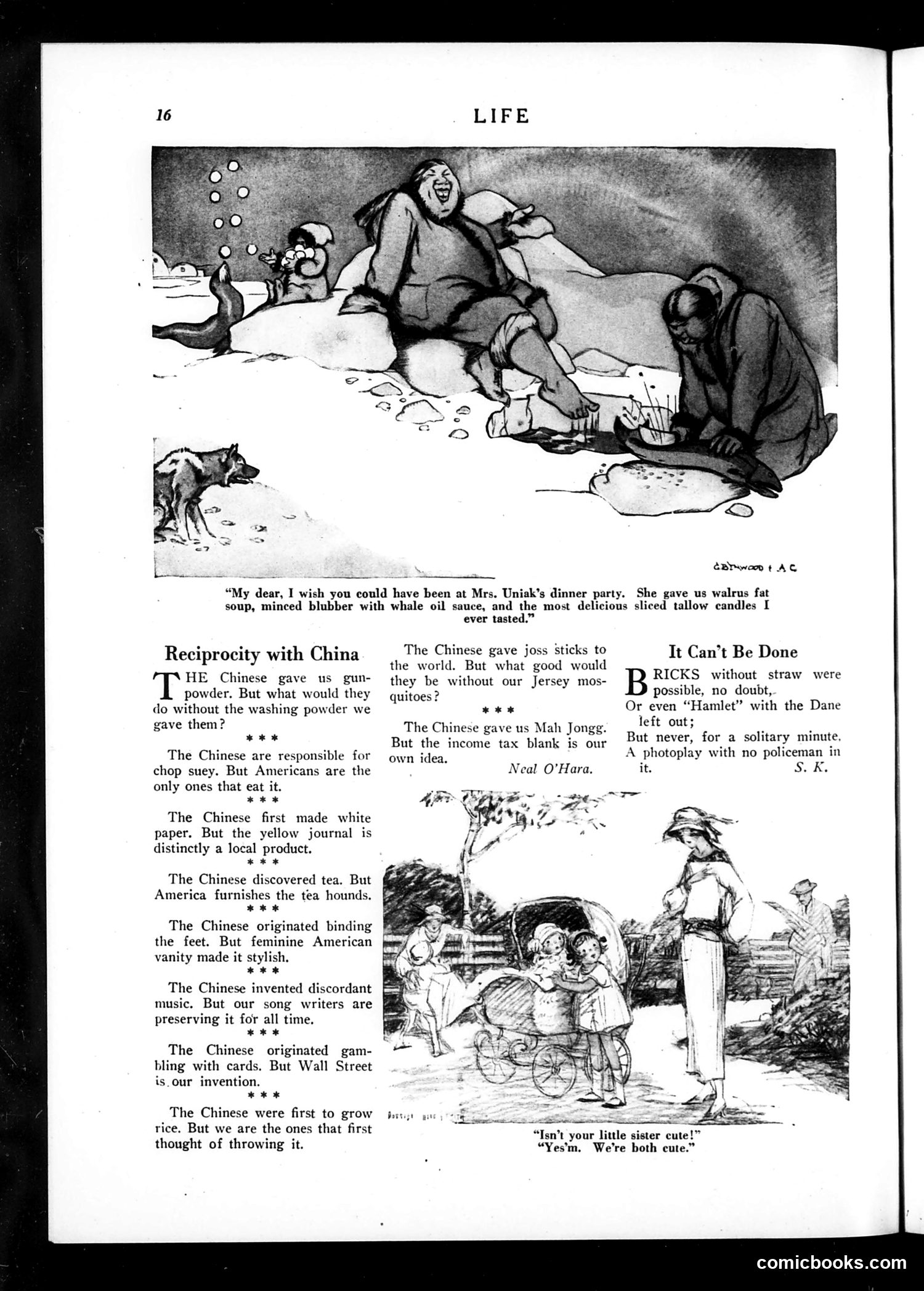
This page from *Life* magazine contains satirical commentary on U.S.-China relations through comparative cultural "achievements." **"Reciprocity with China"** (left column): The primary humor relies on a condescending, imperialist framework. The piece acknowledges Chinese inventions (gunpowder, paper, tea, etc.) but immediately "counters" with American "improvements" or uses. The underlying joke targets American smugness—suggesting America has perfected or commercialized Chinese innovations. Notably, items like foot-binding and "discordant music" mock Chinese culture itself. The final jab about rice-throwing at weddings is purely derisive. **"It Can't Be Done"** (right): A brief joke asserting that modern Hollywood films cannot exist without police presence—commentary on cinema's dependence on law-and-order narratives. **Top cartoon**: Shows people dining on Arctic fare (walrus, whale blubber), likely mocking exotic food trends among the wealthy or immigrant cuisine stereotypes. The page reflects early 20th-century American attitudes: condescension toward non-Western cultures masked as witty comparison, and casual cultural stereotyping considered acceptable humor.
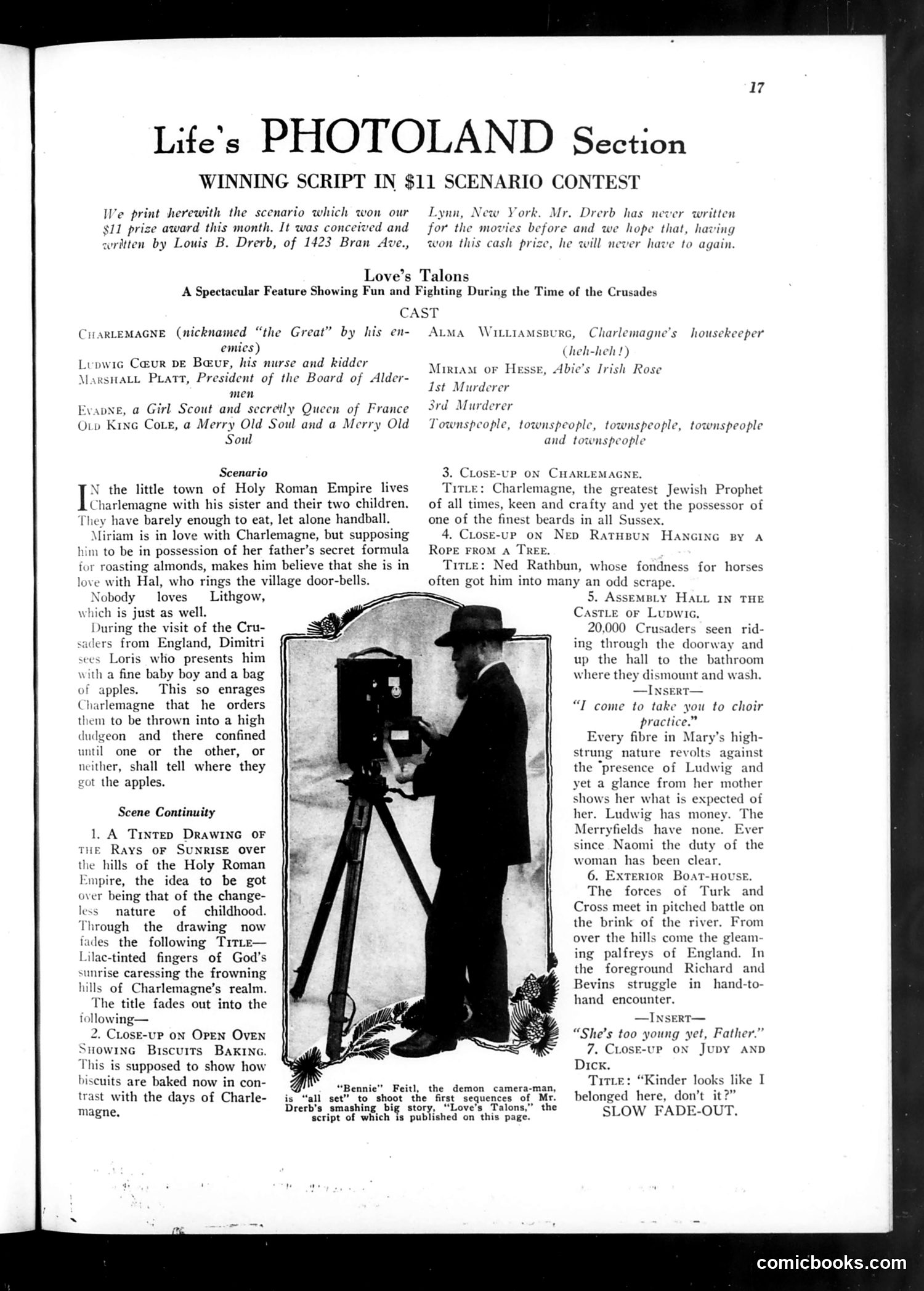
This page satirizes the absurdity of early 1920s silent film scenarios. Life magazine ran a contest offering an $11 prize for movie scripts, and published the winning entry—"Love's Talons"—as obvious mockery. The scenario is deliberately nonsensical: it conflates historical periods (Charlemagne with Crusaders), includes irrelevant characters (a Girl Scout as "secretly Queen of France"), and features an incoherent plot involving almonds, a secret formula, and unexplained violence. Scene descriptions are absurdly vague ("Lilac-tinted fingers of God's sunrise"). The accompanying photograph shows cameraman "Bennie" Feitl preparing to film this ridiculous script, suggesting it would actually be produced. Life's editorial note—"we hope that, having won this cash prize, he will never have to again"—confirms the satire: they're mocking both the low quality of submitted scripts and the film industry's willingness to produce incoherent material. The joke targets 1920s cinema's creative bankruptcy and the absurdly low standards for scenario writing.
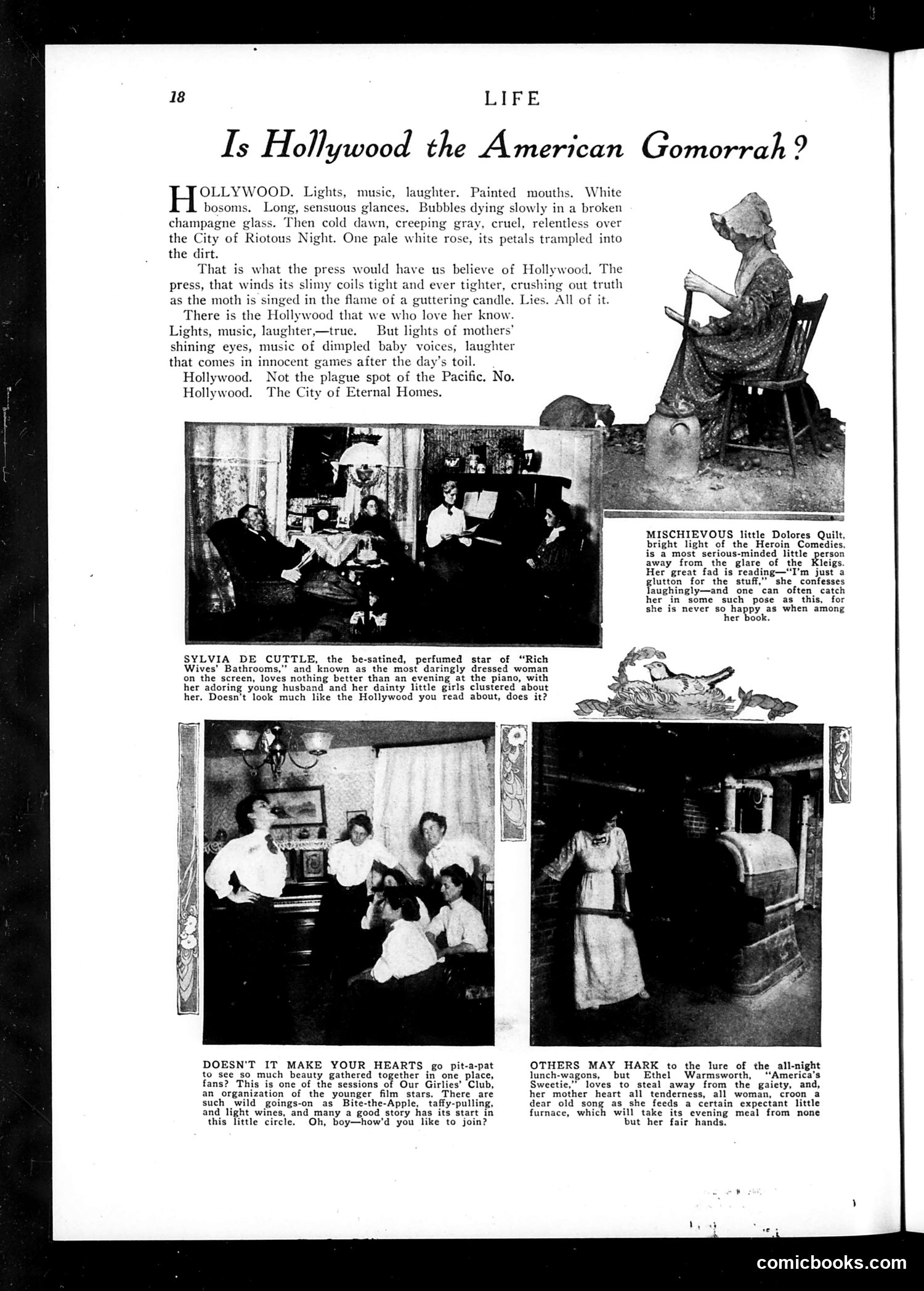
This piece satirizes the moral panic surrounding Hollywood in the early 20th century. The opening passage mockingly mimics sensationalist press accounts portraying the film industry as decadent and corrupt ("City of Riotous Night," "plague spot of the Pacific"), then pivots to defend Hollywood's actual character. The photographs and captions that follow ironically present starlets—with invented names like "Dolores Quilt" and "Sylvia de Cuttle"—engaged in wholesome domestic activities: reading books, playing piano with family, and attending a "Girlies' Club" doing innocent activities like taffy-pulling. The satire's point: the press manufactures scandalous myths about Hollywood actresses when reality shows them as ordinary, family-oriented women. The underlying joke targets both the moralistic media crusade against cinema and the public's appetite for celebrity scandal. Life defends the film industry against exaggerated criticism by contrasting fabricated vice with documented virtue.
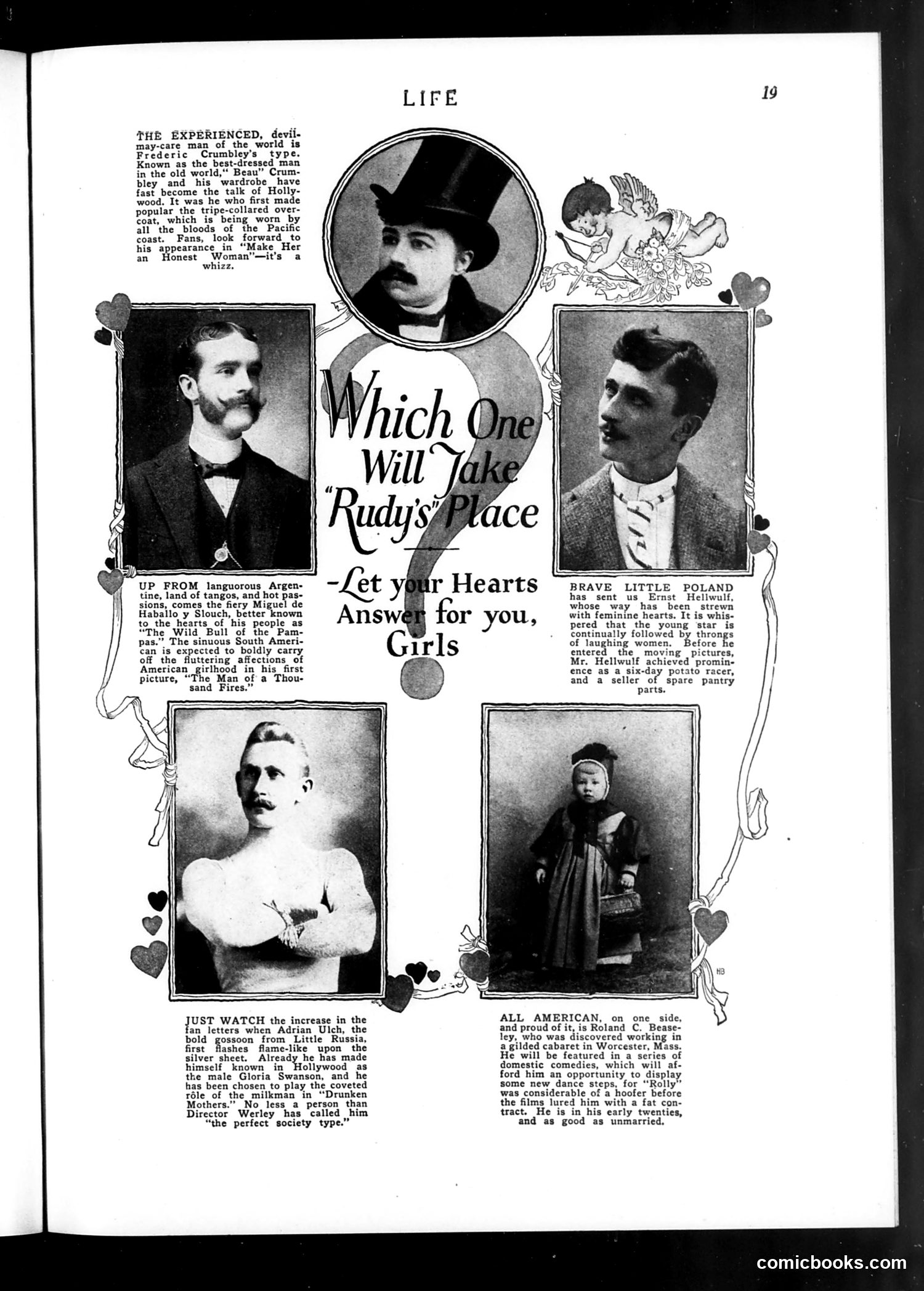
This page satirizes the early Hollywood studio system's marketing of male actors as romantic leads. The headline "Which One Will Take 'Rudy's' Place" references Rudolph Valentino, the era's most famous romantic actor, suggesting these five men are being promoted as his potential replacements. The satire works through absurd, fabricated backstories. The text describes actors with ridiculous credentials: one was a "potato racer," another a "spare pantry parts" seller, one a cabaret worker, one a milkman. Their supposed nationalities (Argentina, Russia, Poland, America) are exaggerated to suggest Hollywood's formula of importing "exotic" foreign types to appeal to female audiences. The joke targets both the studio system's cynical star-making machinery and audiences' gullibility—these men are being repackaged as romantic heroes based entirely on appearance and manufactured mystique, regardless of actual talent or background. It's media criticism through humor.
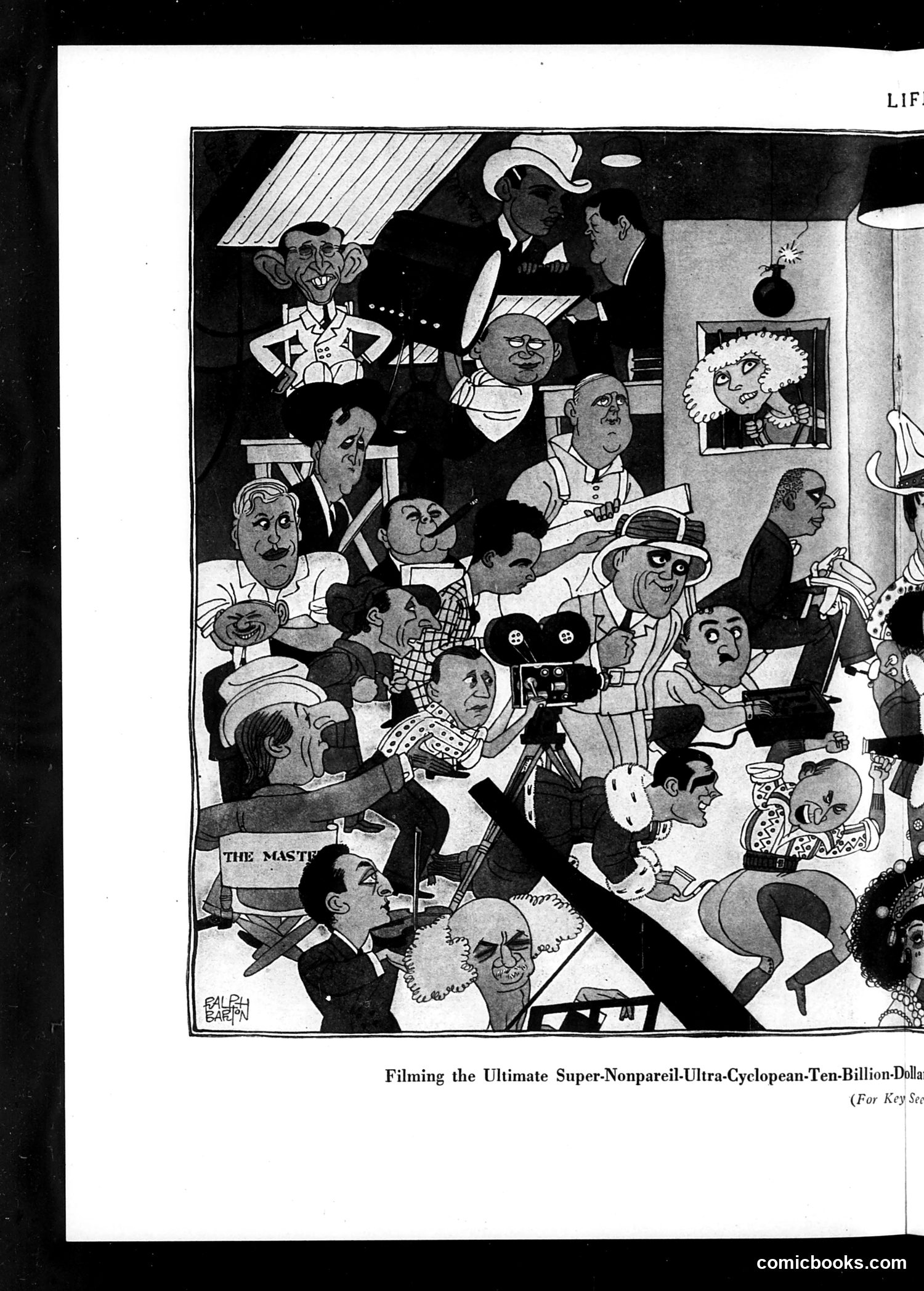
This is a satirical cartoon by Ralph Barton mocking the excesses of Hollywood filmmaking, likely from the 1920s based on the style and context. The caption's absurdly hyperbolic title—"Ultimate Super-Nonpareil-Ultra-Cyclopean-Ten-Billion-Dollar" production—is the joke itself. The crowded scene depicts a chaotic film set packed with numerous exaggerated characters: directors, actors, stagehands, and crew members in various costumes and states of confusion. A camera is visible center-stage. The satire targets Hollywood's tendency toward inflated budgets, overcomplicated productions, and ego-driven filmmaking that resulted in bloated, poorly managed sets. The cartoon satirizes how ambitious studio productions had become unwieldy and absurd—more concerned with scale and spectacle than coherent storytelling. The sheer visual chaos emphasizes the point that such massive productions were inherently ridiculous.
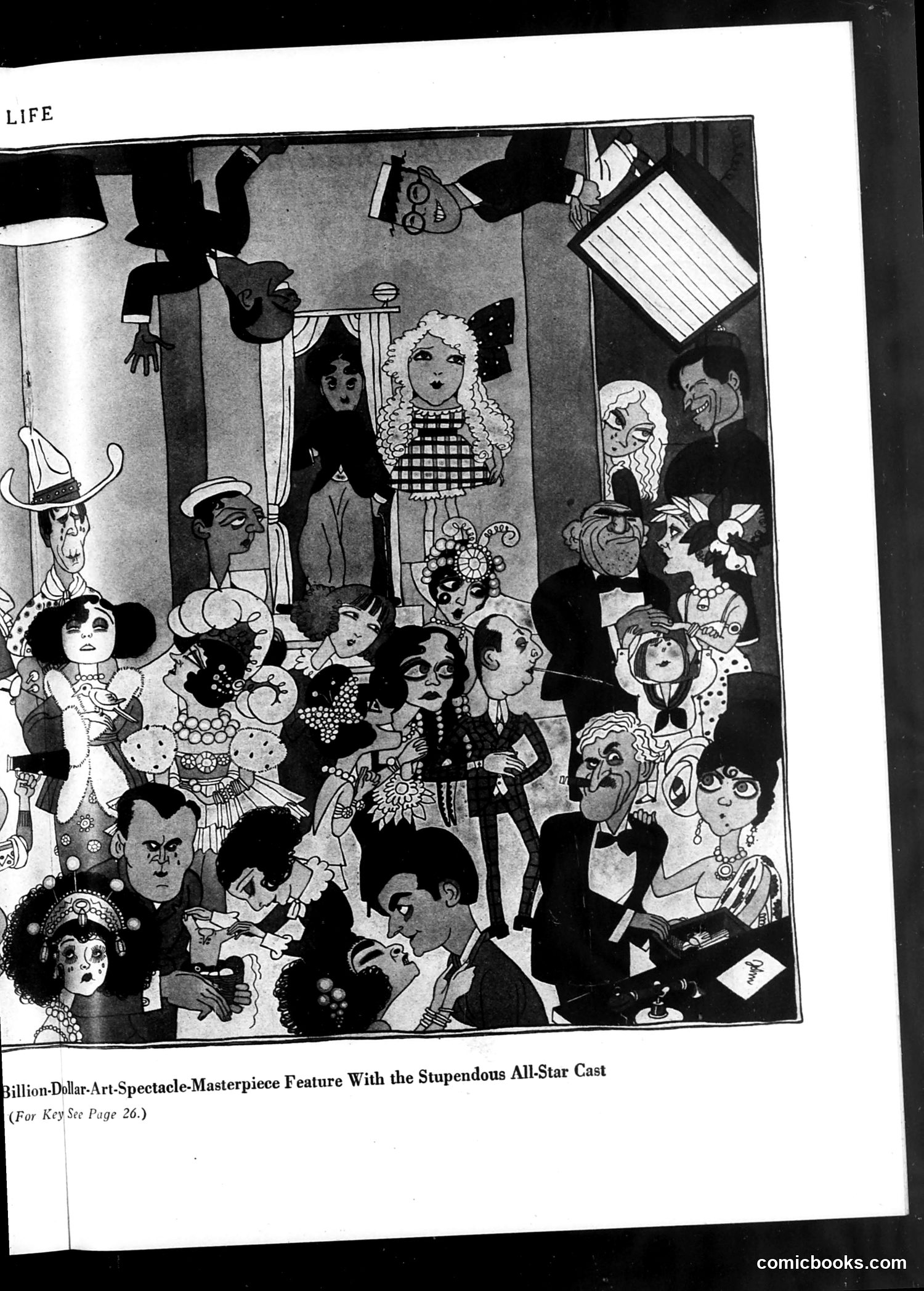
This appears to be a satirical illustration from Life magazine depicting a lavish theatrical or film production with an "all-star cast." The densely packed drawing shows numerous elaborately costumed figures—including people in exotic dress, theatrical makeup, and ornate jewelry—crowded together in an exaggerated scene of excess. The satire targets the film industry's trend toward expensive, star-studded "spectacle" productions. The caption's ironic language—"Billion-Dollar," "Masterpiece," "Stupendous"—mocks the grandiose marketing claims studios made. The crowded, chaotic composition suggests the absurdity of cramming too many celebrities into one production for publicity value rather than artistic merit. The reference to "Key See Page 26" indicates specific figures were identified elsewhere, likely prominent actors or directors of the era, though those names aren't visible here. The overall message criticizes Hollywood's bloated, cash-driven approach to filmmaking.
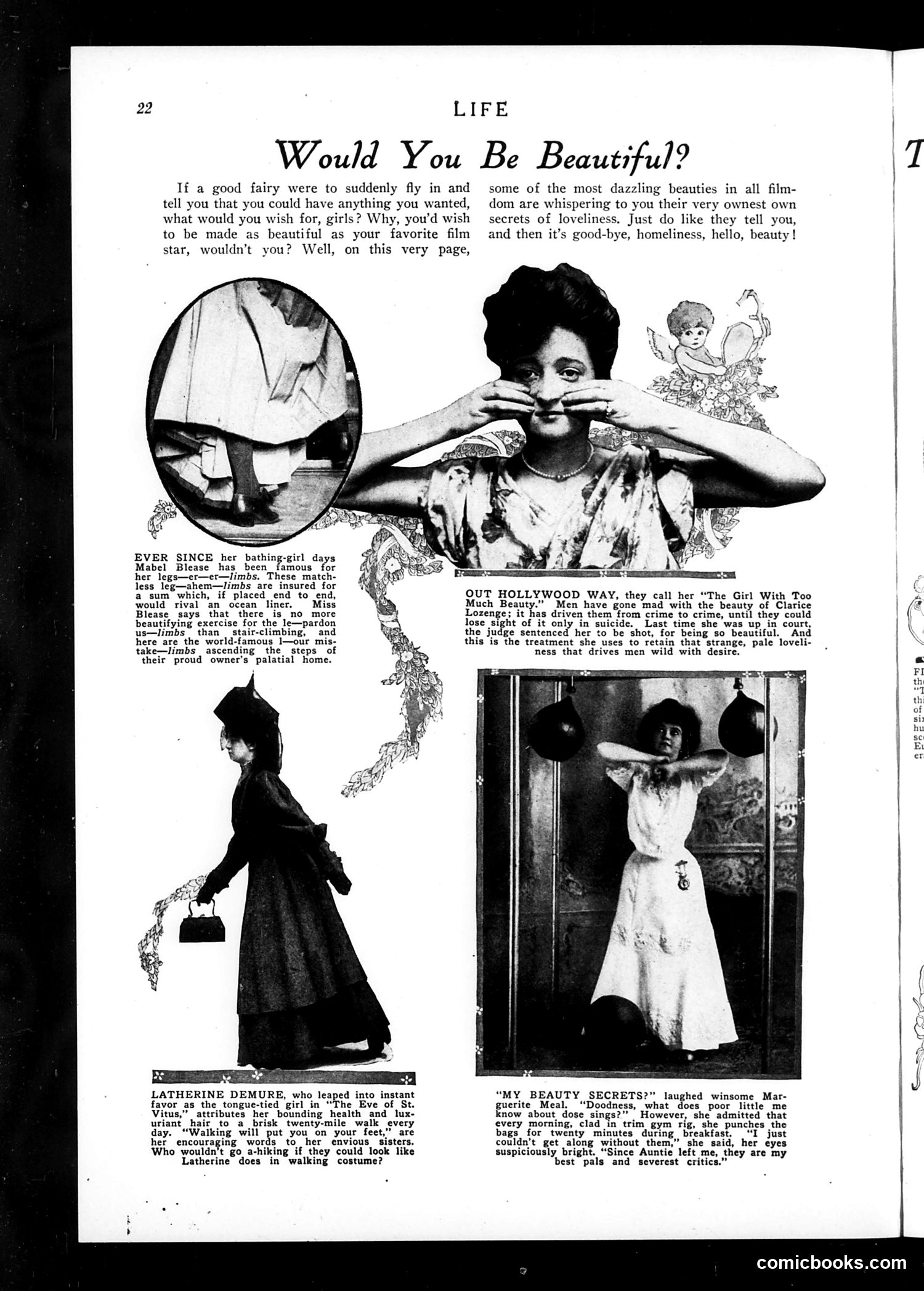
This page satirizes Hollywood starlets and their marketed "beauty secrets." The headline poses a fairy-tale premise, then exposes the absurdity of celebrity beauty advice through exaggerated caricatures and mock-serious descriptions. The satire targets: 1. **Mabel Blease** - mocked for obsessing over her legs/limbs, which are humorously "insured" for enormous sums. The joke: her beauty secret is merely stair-climbing. 2. **Clarice Lozenge** - described as so beautiful men commit crimes to be near her, with darkly comic consequences (she's sentenced to death). The satire: her secret is unnamed, suggesting there *is* none. 3. **Latherine Demure** - promotes twenty-mile daily walks as the beauty solution. 4. **Marguerite Meal** - performs vigorous boxing exercises during breakfast for beauty. The page mocks how Hollywood actresses peddle trivial or ridiculous routines as legitimate "beauty secrets," while magazines like *Life* amplify these claims through breathless coverage. The satire suggests celebrity beauty advice is mostly nonsense marketing.
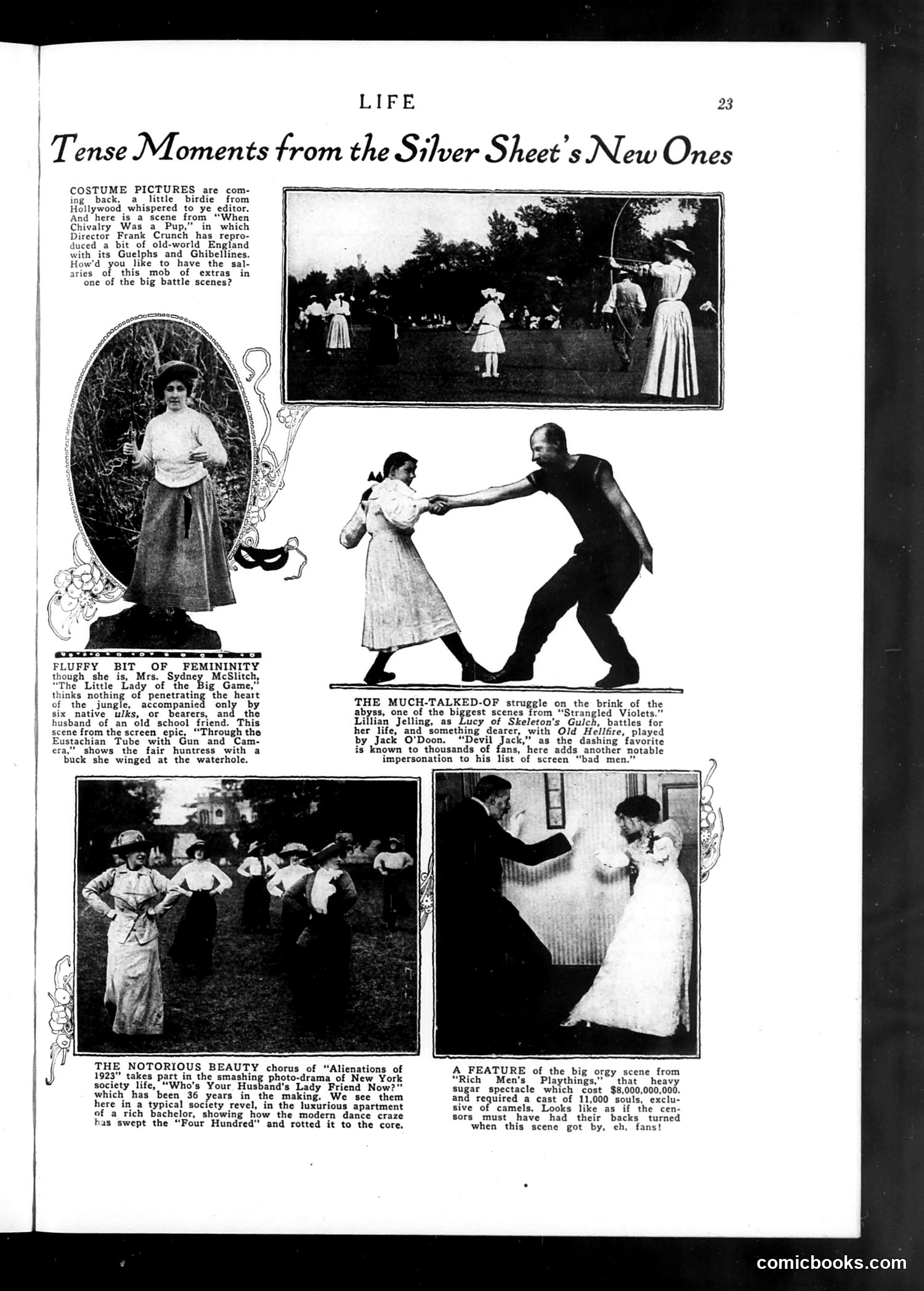
This page satirizes Hollywood's emerging costume picture and epic film trends of the 1920s. The magazine mocks: **Exaggerated Production Claims**: Films with absurdly pretentious titles ("When Chivalry Was a Pup," "Through the Eustachian Tube with Gun and Camera") and implausibly massive budgets ($8 billion for "Rich Men's Playthings") and casts (11,000 extras). **Overwrought Melodrama**: Captions describe overwrought plot elements—jungle adventures, "struggles on the brink of the abyss," morality tales about society corruption. **Star System Hype**: References to bit players getting inflated coverage and actors like "Devil Jack" O'Doon being marketed as dashing "bad men" despite mediocre performances. The humor targets Hollywood's growing tendency toward grandiose spectacle, inflated publicity, and absurdly expensive productions designed to impress rather than entertain—a critique of early cinema's commercial excess.
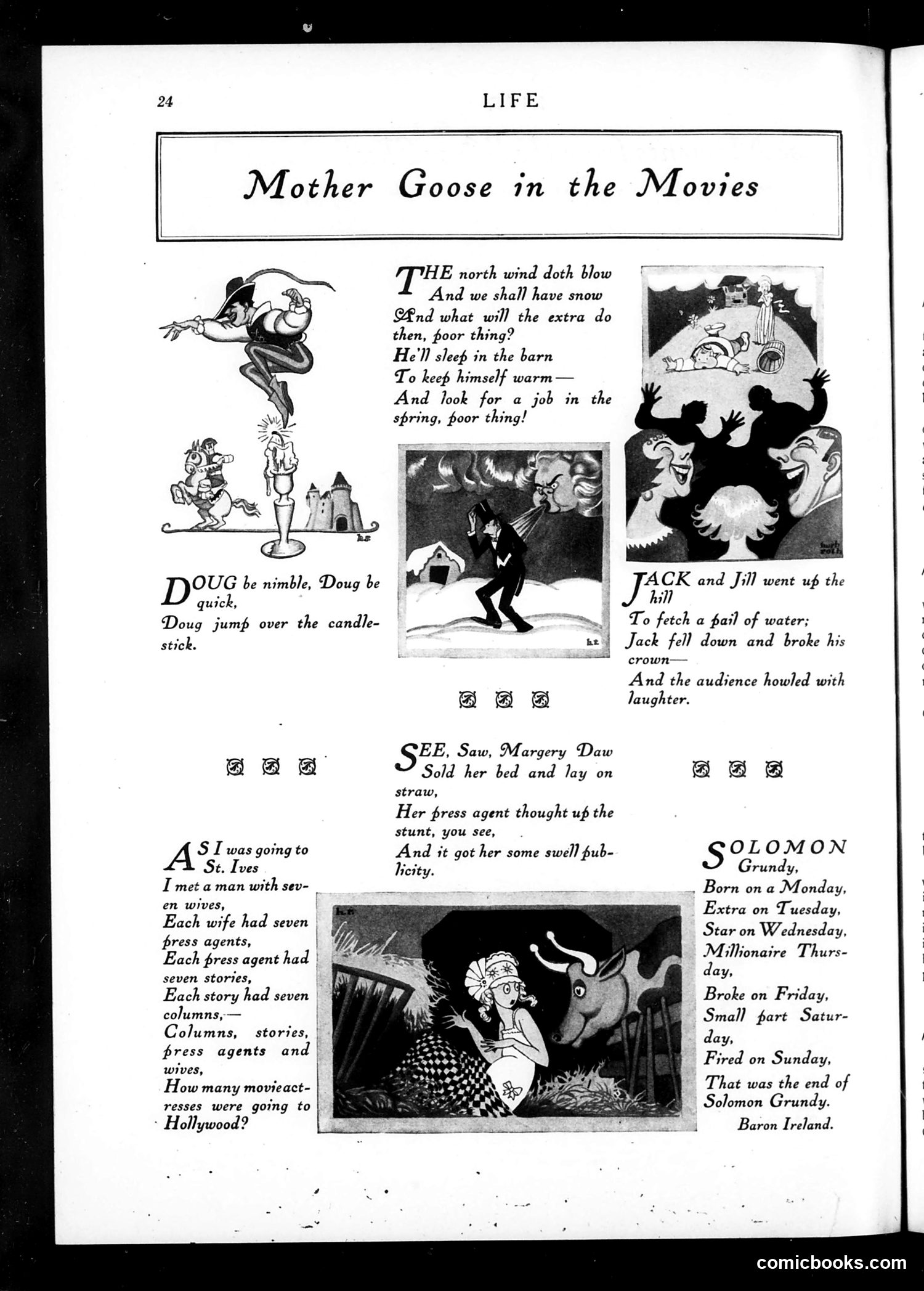
This page satirizes 1920s Hollywood's obsession with publicity and the rapid, unstable fortunes of movie actors. Traditional nursery rhymes are rewritten to mock the entertainment industry's practices. The humor targets: - **Press agents**: Multiple rhymes mention actresses hiring press agents to manufacture publicity stunts (Margery Daw "selling her bed" as a stunt) - **Extra actors**: References to impoverished "extras" sleeping in barns and desperately seeking work, contrasting with stars' luxury - **Rapid fame cycles**: "Solomon Grundy" depicts an actor's meteoric rise from extra (Monday) to millionaire (Thursday) to broke (Friday)—satirizing how quickly fortunes reversed in early cinema - **Manufactured stardom**: The joke about "seven press agents" implies actresses were constructed products rather than genuine talents The cartoons illustrate these themes with silhouettes of theatrical characters and performers. The satire suggests Hollywood's system was absurd, unsustainable, and driven by hype rather than merit—a critique that likely resonated during the silent film era's chaotic expansion.
This page is a self-satirizing essay by Life's drama critics, humorously confessing their critical failures. The piece mocks their own poor judgment by listing prestigious plays they dismissed or attacked that became major successes—including "Abie's Irish Rose," "Seventh Heaven," and "Chauve-Souris." The satire turns on itself: the critics admit they were confidently wrong. They then joke that "Abie's Irish Rose" management, undeterred by their scorn, keeps sending them gifts (pencils, joke books, even a birthday cake) as if rewarding enemies. The critics sarcastically propose other theatrical managements pay them to publicly denounce plays—essentially admitting their reviews are unreliable. The final section lists genuinely satisfying theatrical moments from the season's plays, suggesting their actual taste, despite their critical missteps. It's self-aware satire on critical pretension and the gap between expert judgment and popular success.
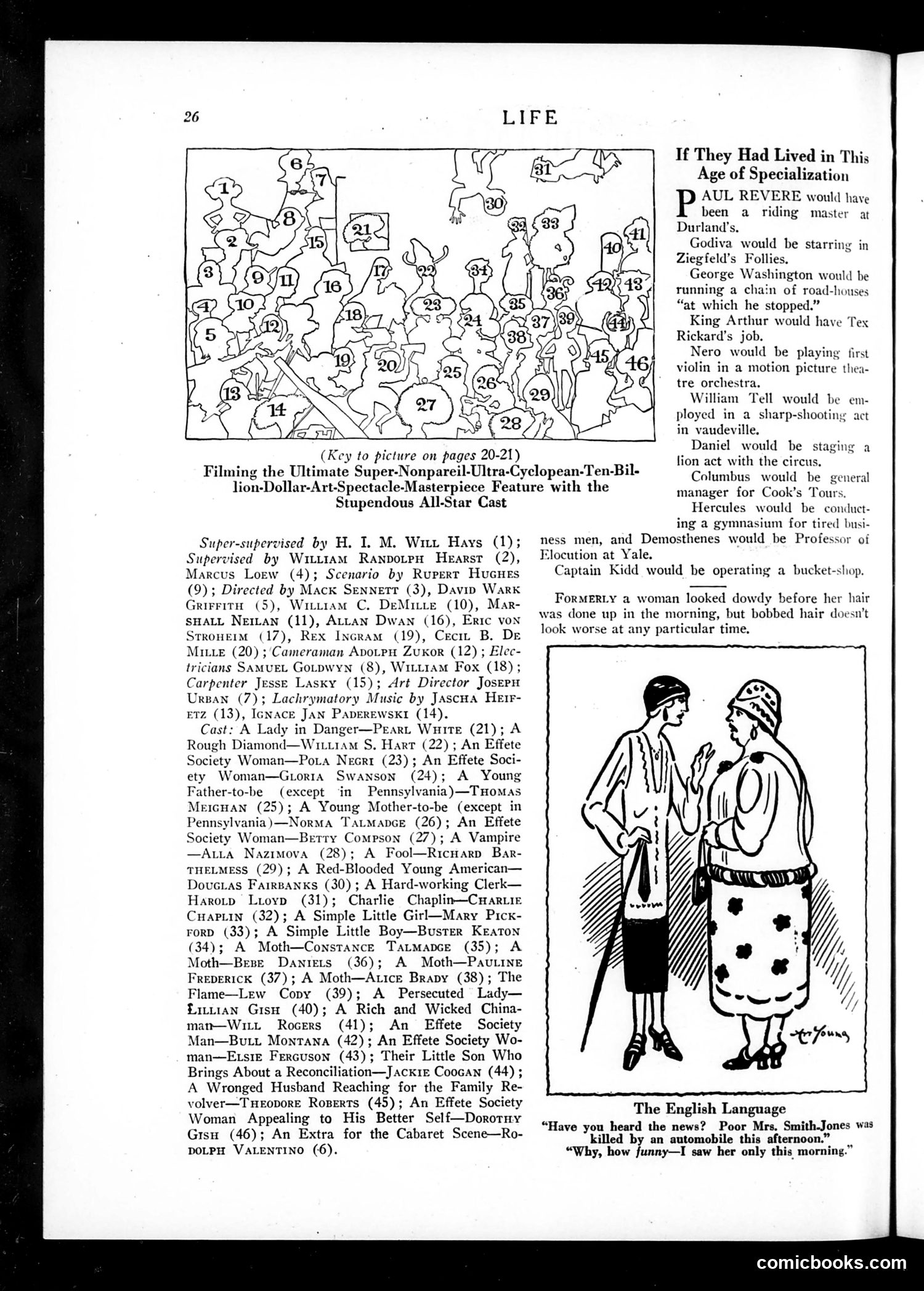
This page contains two distinct satirical pieces from Life magazine: ## "If They Had Lived in This Age of Specialization" A humorous essay mocking modern job specialization by imagining famous historical figures in contemporary (1920s) professions. Paul Revere becomes a riding instructor, Nero a movie orchestra violinist, William Tell a vaudeville sharpshooter. The satire suggests that the modern era has become so narrowly specialized that even legendary figures would be reduced to mundane, specialized roles rather than their grand historical achievements. ## "The English Language" Cartoon A brief joke about modern English usage, where someone responds to news of a woman's death with "how funny"—misinterpreting the speaker's use of "funny" (meaning "strange") as humorous. The cartoon illustrates how colloquial language creates miscommunication. The large center section catalogs the massive cast and crew for an elaborate film production, listing famous 1920s Hollywood names (Chaplin, Pickford, Keaton, Valentino, etc.)—likely satirizing Hollywood's obsession with star-studded "epic" productions.
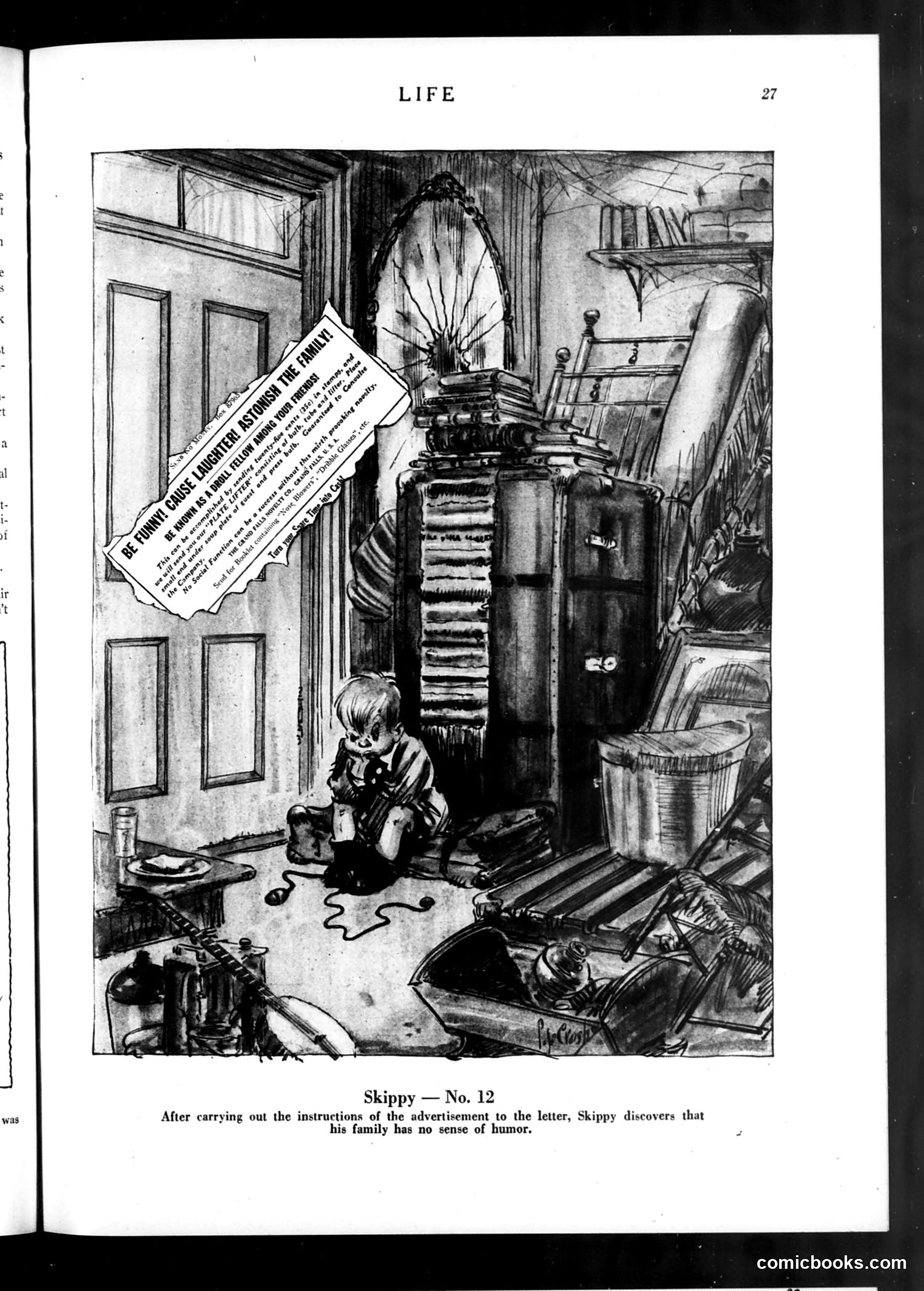
This is a comic strip installment featuring "Skippy," a character from a popular American comic strip. The caption indicates Skippy has followed instructions from an advertisement letter, only to discover his family lacks a sense of humor about the result. The humor relies on the contrast between Skippy's innocent obedience to commercial instructions and his family's humorless reaction. The chaotic room—cluttered with various objects—suggests whatever scheme Skippy attempted has created disorder. This reflects early 20th-century satire about advertising's power over children and the disconnect between commercial promises and reality. The joke assumes readers recognize "Skippy" as an established character and find humor in his misadventures with gullible consumerism.
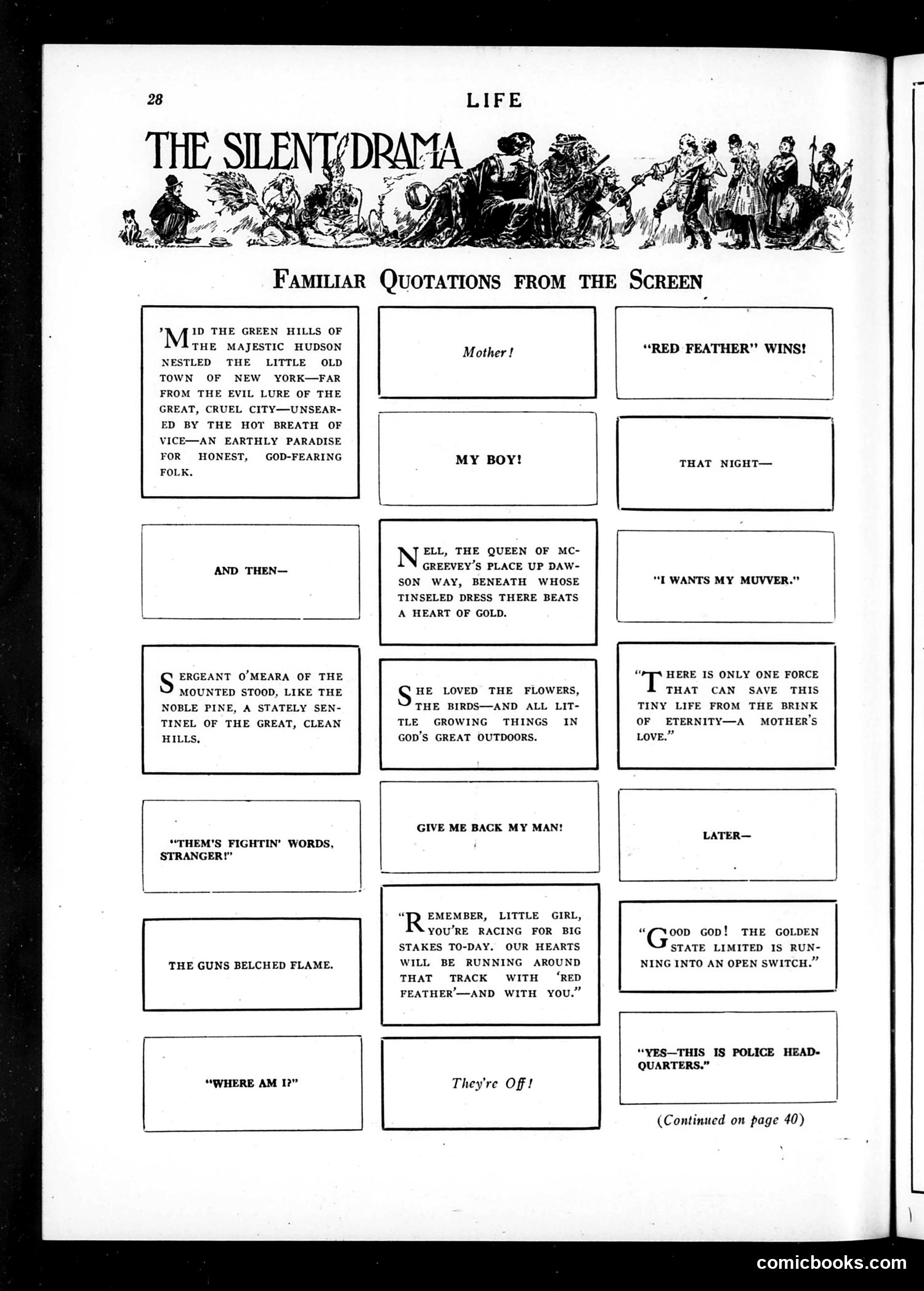
This page satirizes silent film melodrama by collecting overwrought, clichéd dialogue and plot elements typical of the era. The quotations parody the genre's stock situations: innocent country virtue ("green hills of the majestic Hudson"), virtuous women with hidden hearts of gold, mounted police heroes, emotional maternal pleas ("Mother!", "I wants my muvver"), violent confrontations, and absurdly contrived climaxes (a train running into an open switch, a horse race with high stakes). The humor targets how predictably sentimental and melodramatic these films were—the rigid moral binaries, the overwrought emotional appeals, the coincidental disasters. By presenting these lines without context as "familiar quotations," *Life* mocks how audiences had become so accustomed to these tired tropes that they'd recognize them instantly. The satire suggests silent cinema relied on formulaic sentimentality rather than genuine storytelling.
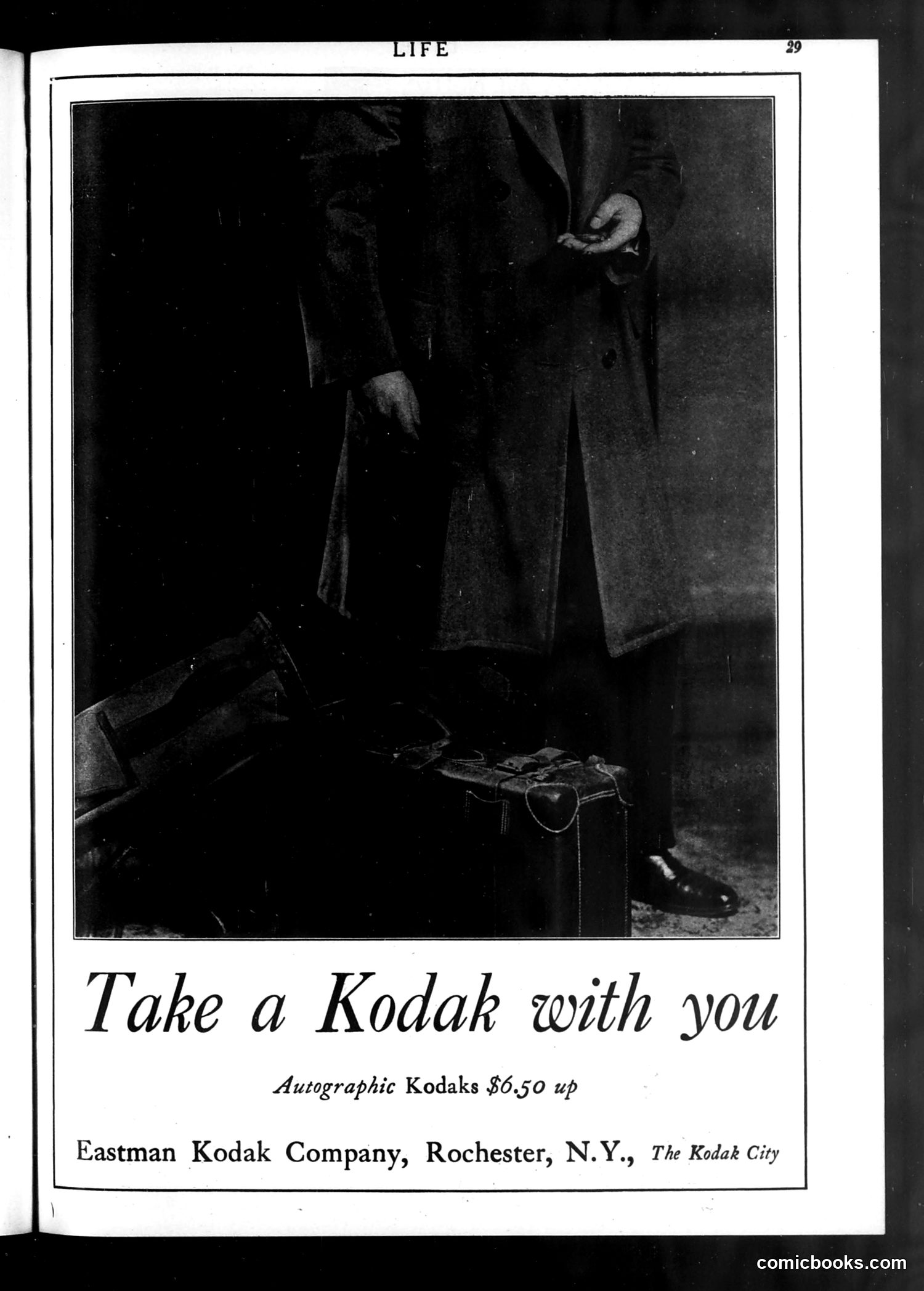
This is a Kodak camera advertisement rather than political satire or editorial cartooning. The image shows a stylishly dressed figure in dark clothing holding what appears to be a camera or photographic equipment, positioned against a dark background with dramatic lighting. The ad's message—"Take a Kodak with you"—encourages consumers to purchase Autographic Kodak cameras (priced at $6.50 and up) for personal use and travel photography. The composition emphasizes the camera as an elegant, portable accessory for the modern consumer. This represents early 20th-century advertising strategy, positioning photography equipment as an essential fashion and lifestyle item rather than purely functional technology. The Eastman Kodak Company location in Rochester, New York is prominently credited.
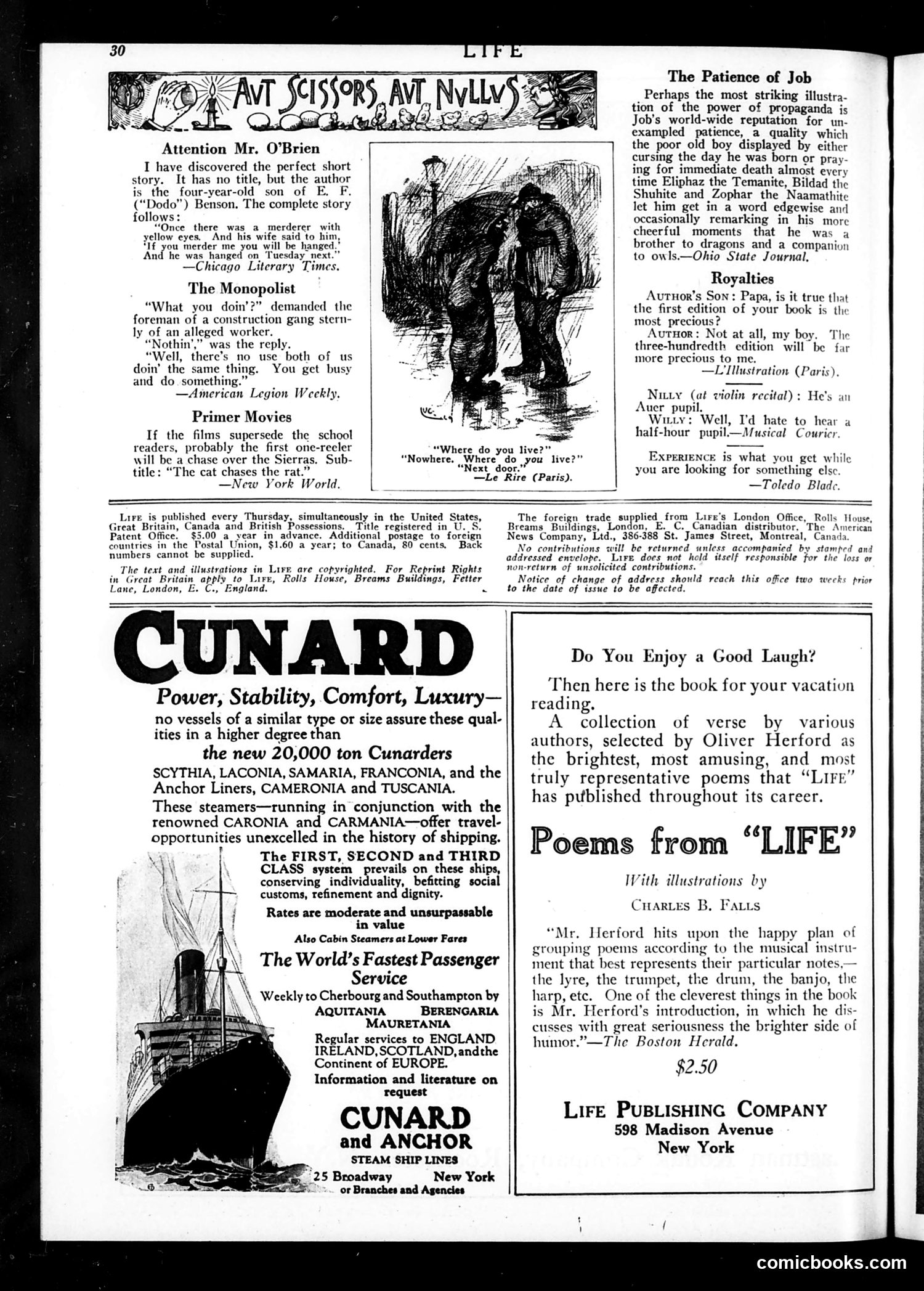
This page is primarily **advertising and miscellaneous content** rather than a cohesive political cartoon. The main elements include: **Short humor pieces** (reprinted from various publications): Brief jokes about construction workers, silent films, and authorship—typical early 20th-century newspaper filler material with no specific political target. **"The Patience of Job"** article discusses how propaganda has inflated the biblical Job's reputation for patience, suggesting the reality was he complained frequently. This is mild social commentary on how legends distort truth. **The illustration** (sketch of two figures) accompanies a French joke about neighboring addresses—straightforward visual humor unrelated to politics. **Advertising dominates**: Cunard steamship lines, Life Publishing Company's poetry book offer, and miscellaneous notices fill most space. This appears to be a **typical 1920s Life magazine back page**—a mix of reprinted jokes, short commentary, and advertising. No specific political figures or events are targeted; the humor is genteel and general-audience oriented.
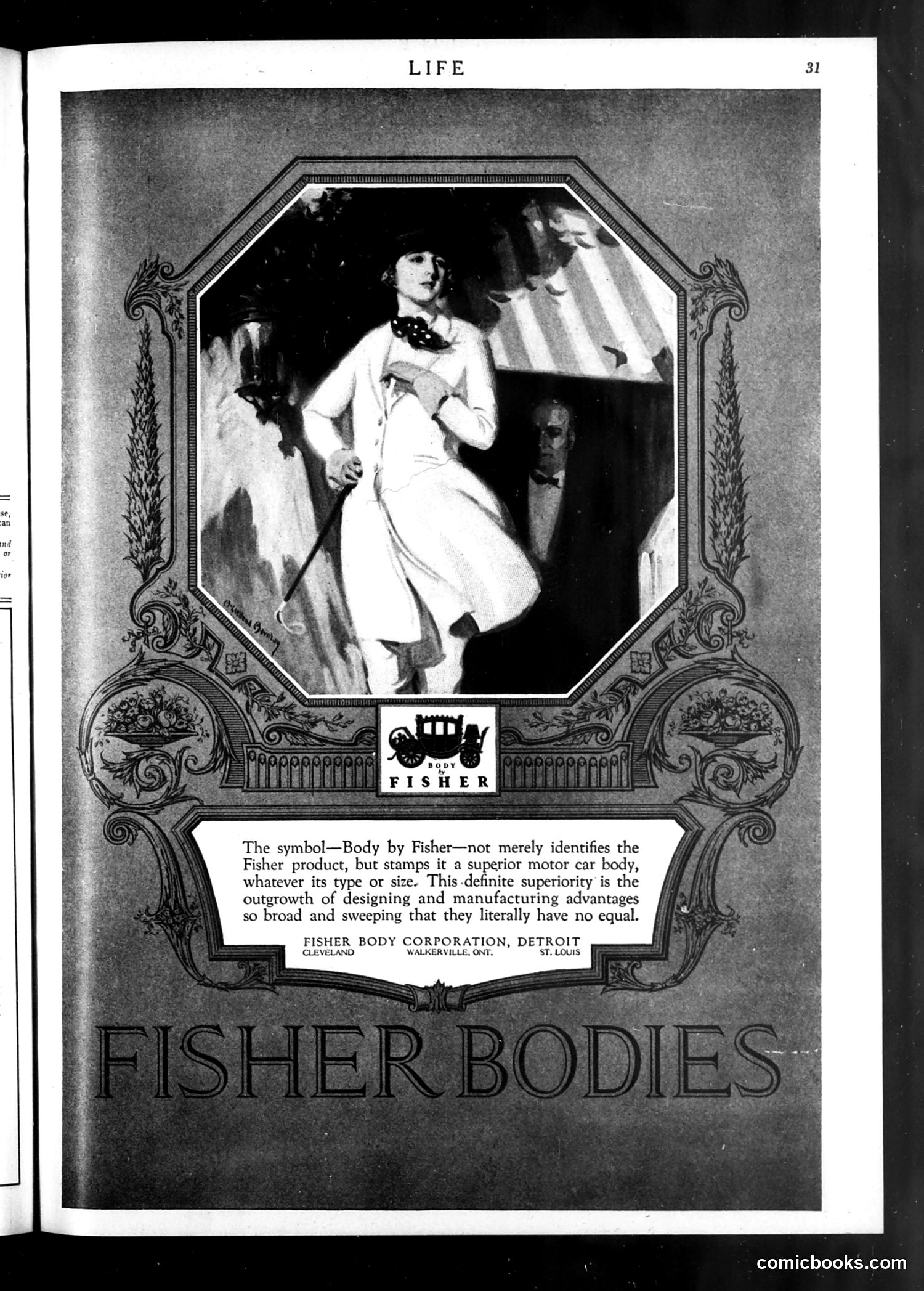
This is a **Fisher Body Corporation advertisement**, not political satire. It appears on page 31 of *Life* magazine and promotes automobile bodies manufactured by Fisher Body. The ad features an ornate Art Deco frame containing a photograph of a woman in a white dress, positioned to suggest elegance and luxury. The "Body by Fisher" logo appears beneath the image. The text claims that Fisher bodies represent superior automotive manufacturing, with design and production advantages that are unmatched in the industry. The company lists locations in Detroit, Cleveland, Walkerville (Ontario), and St. Louis. The advertisement uses the glamorous female figure as a visual metaphor—associating the quality "body" (both the woman and the car body) with sophistication and desirability. This was a common advertising strategy of the era, linking product quality to aesthetics and status.
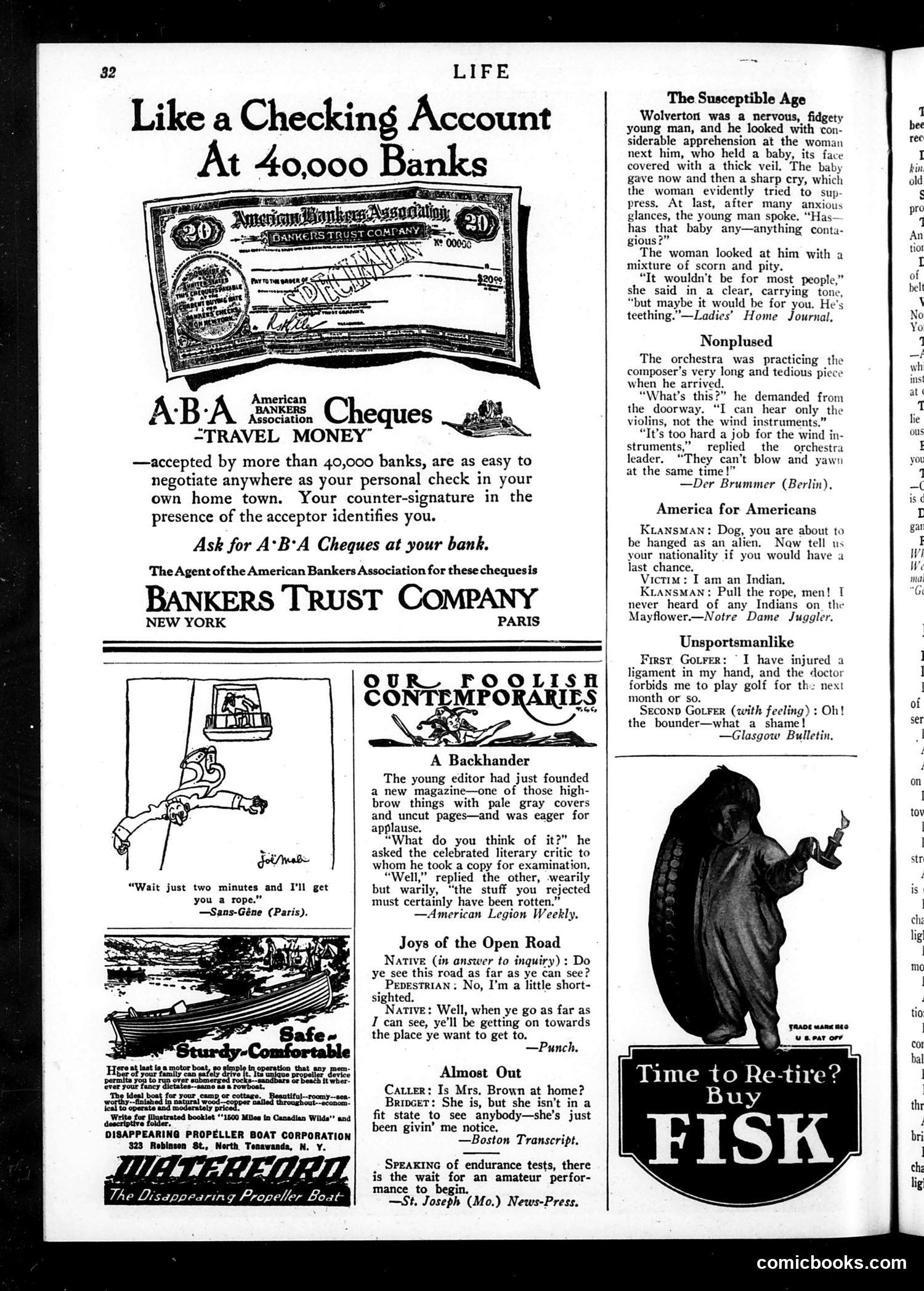
This page is primarily **advertisements and humor columns** rather than political cartoons. The content consists of: **Main Advertisement**: ABA Cheques (traveler's checks) promoted by Bankers Trust Company—positioned as convenient for international travel, accepted at 40,000 banks. **Humor Section** ("Our Foolish Contemporaries"): A collection of brief satirical jokes and anecdotes mocking various social situations: - A naive rope salesman's gaffe - A literary critic's backhanded insult to a new magazine editor - Irish dialect humor about road directions - A servant's notice to an employer - A nervous young man's anxiety about a veiled baby (the joke: it's teething, not contagious) - An orchestra conductor's complaint about wind instruments - **KKK satire**: A dark joke where Klansmen execute an Indian, claiming Indians weren't on the Mayflower - Golf humor about sportsmanship The page reflects 1920s-era American humor—much of it featuring ethnic/regional stereotypes and casual references to then-contemporary concerns. The KKK reference indicates the organization's prominence during this period.
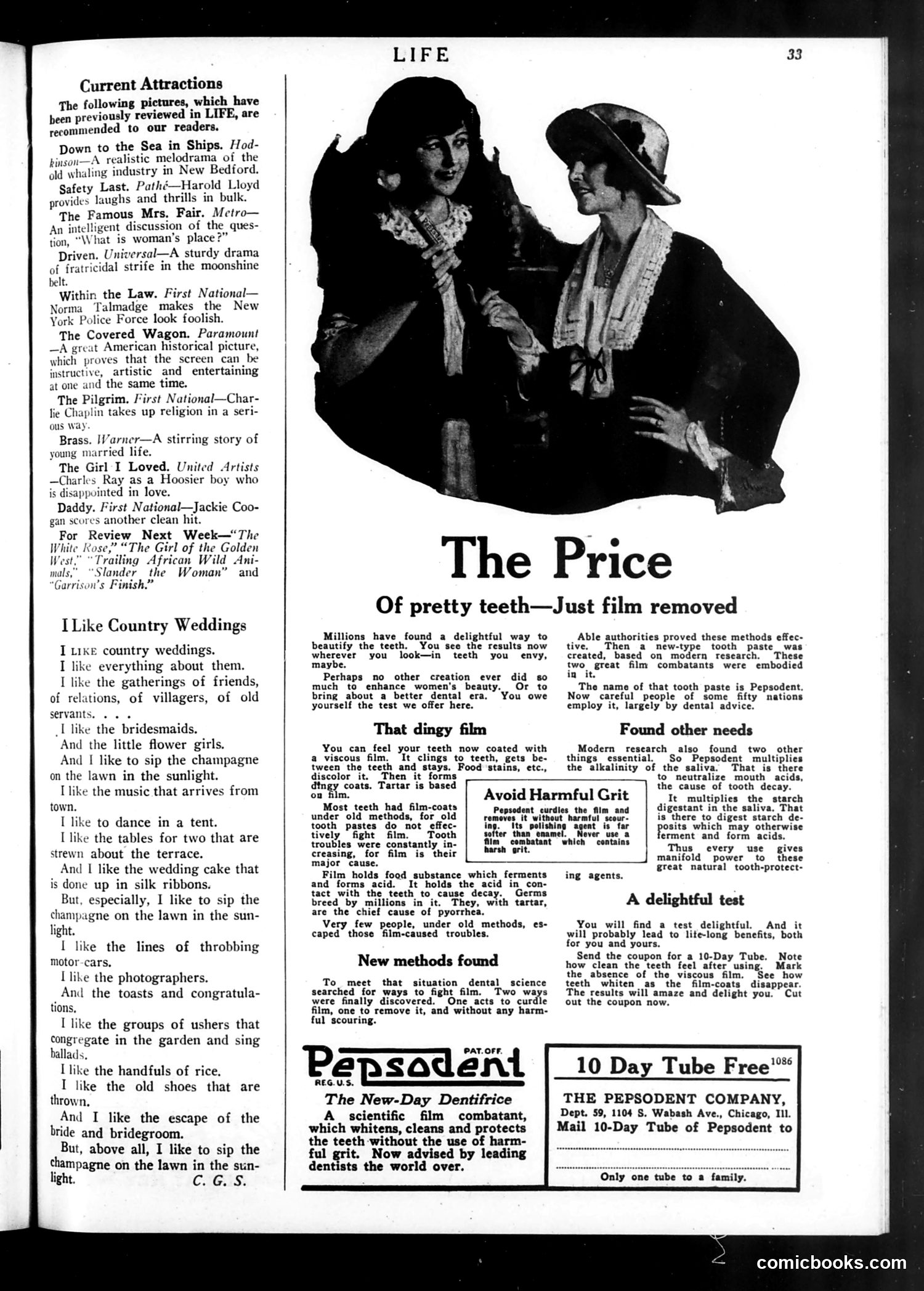
This page is primarily an advertisement for Pepsodent toothpaste, disguised as editorial content about dental science. The image shows two people examining teeth, illustrating the product's benefits. The ad's central claim is that teeth accumulate a "dingy film" that older toothpastes cannot effectively remove. Pepsodent allegedly uses new scientific methods to combat this film without harsh abrasives that damage enamel—a significant selling point, as many period toothpastes used gritty substances. The accompanying text presents pseudo-scientific explanations: film causes food stains, traps acid that causes decay, and harbors bacteria leading to pyorrhea (gum disease). Pepsodent positions itself as a modern solution discovered through dental research. The offer of a "10 Day Tube Free" was a common marketing tactic of the era, encouraging trial of the product. This represents early 20th-century advertising's evolution toward scientific-sounding health claims to market consumer goods.
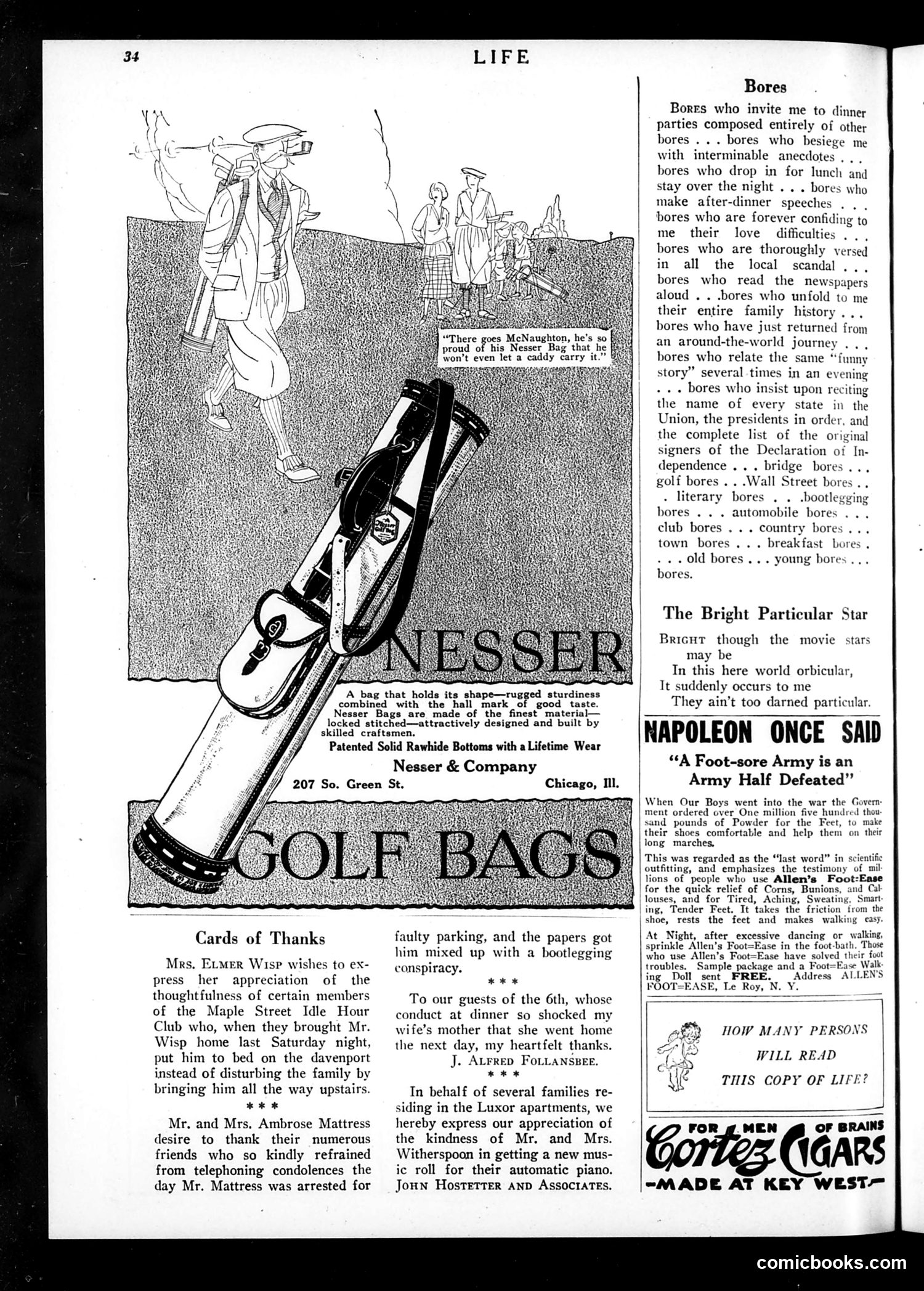
This page from *Life* magazine contains satirical humor typical of the 1920s, mixing advertisements with social commentary. The **Nesser Golf Bags advertisement** features a cartoon mocking golf enthusiasts, showing "McNaughton" so obsessed with his bag's status that he refuses to let a caddy carry it—satirizing vanity and conspicuous consumption among golfers. The **"Bores" column** is a lengthy comedic rant cataloging tedious social types: dinner party bores, family-history bores, gossips, and people who repeat stories. This reflects post-WWI anxiety about maintaining civilized social standards while enduring insufferable acquaintances. The **"Cards of Thanks"** section uses deadpan humor to describe genuinely embarrassing situations treated politely—a drunk guest, an arrest mixed up with bootleggers, rude dinner guests. This satirizes the social convention of thank-you notes by applying them to mortifying circumstances, poking fun at middle-class politeness rituals. The **Allen's Foot-Ease advertisement** invokes Napoleon and WWI soldiers' hardships to sell foot powder, a comedic juxtaposition of military gravitas with mundane consumer products—typical early-20th-century advertising absurdity.
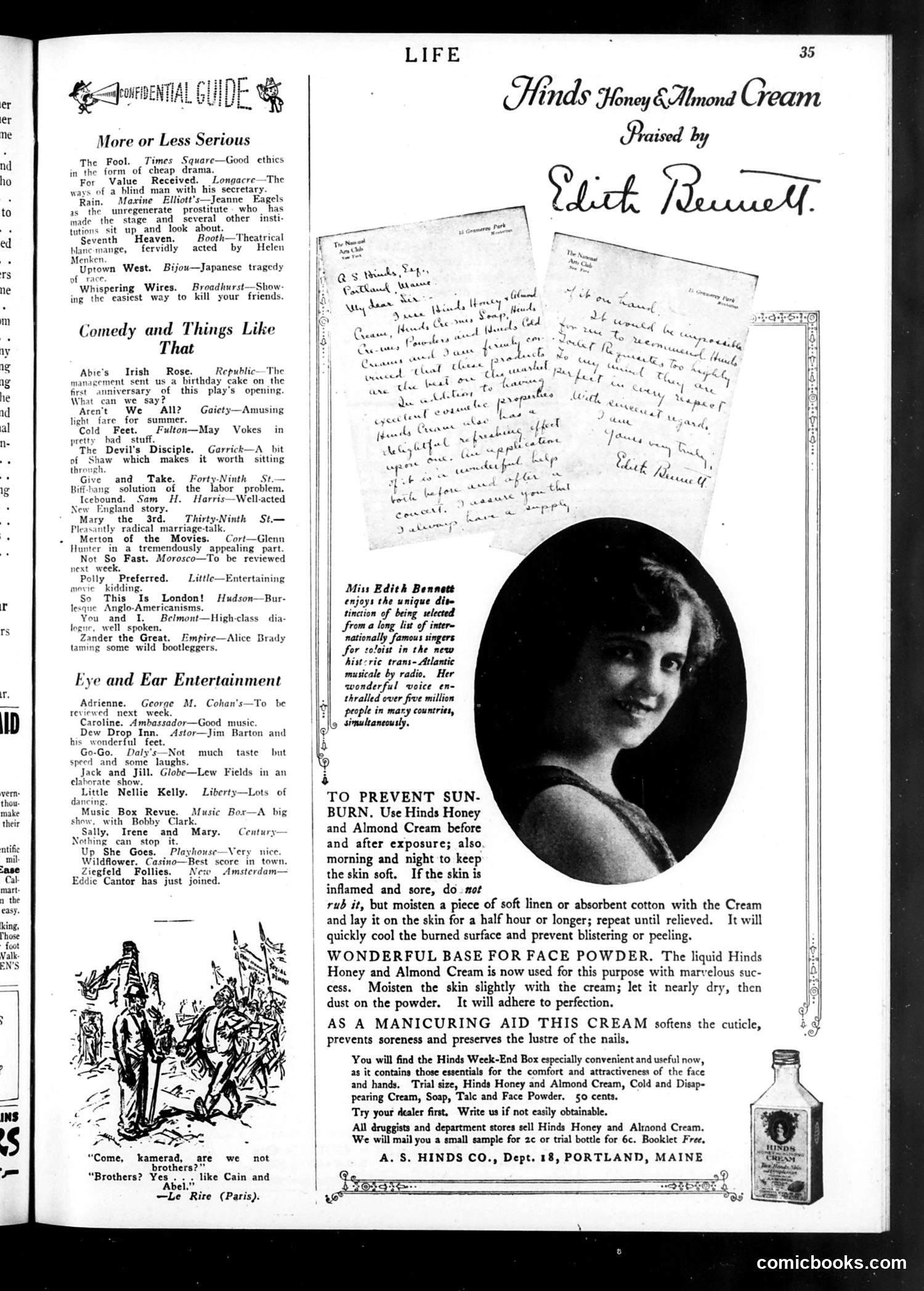
This page is primarily **advertising and entertainment listings**, not political satire. The main content includes: **Theater Reviews Section**: A "Confidential Guide" rating Broadway shows from serious drama (*Rain*, *Seventh Heaven*) to comedies (*Abie's Irish Rose*). The tone is gossipy and irreverent—e.g., mocking *Abie's Irish Rose* for its longevity, calling *Seventh Heaven* "theatrical blanc mange." **Small Cartoon**: At bottom left, a dialogue between two soldiers ("Come, kamerad, are we not brothers?") references post-WWI tensions and brotherhood rhetoric, comparing camaraderie to "Cain and Abel"—suggesting false brotherhood and underlying conflict. **Large Advertisement**: Hinds Honey and Almond Cream, featuring endorsement by singer Edith Bennett. The ad emphasizes preventing sunburn and cosmetic benefits—typical 1920s beauty marketing targeting women concerned with skin care and appearance. The page reflects 1920s popular culture: Broadway entertainment, consumer products, and lingering post-war cynicism about international relations.
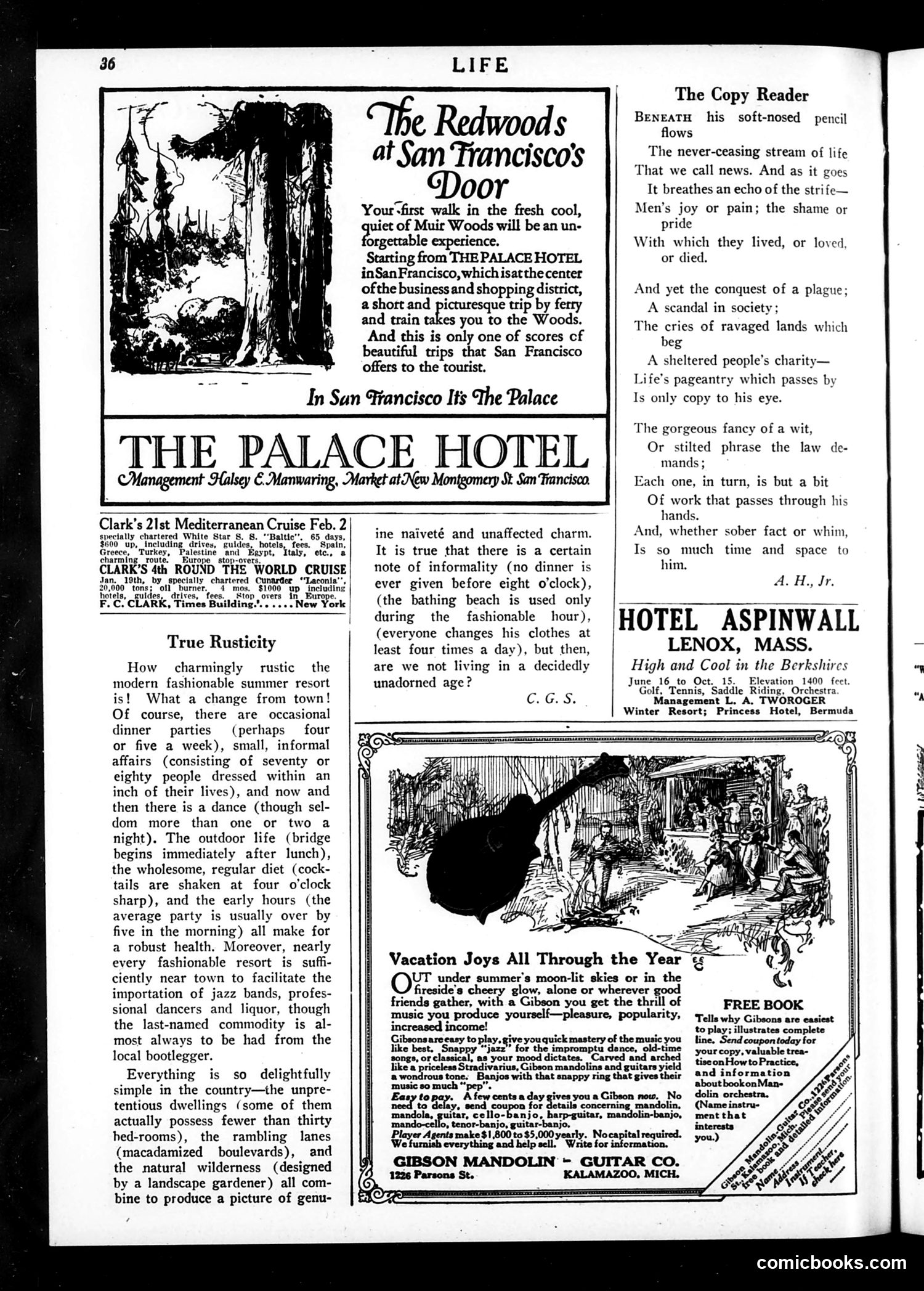
This page combines advertisements with satirical commentary on 1920s American leisure culture. **"True Rusticity"** is the main satire—a tongue-in-cheek article mocking wealthy Americans who claim to seek simple country living while actually recreating urban luxury and excess. The joke: their "rustic" summer resorts feature 70-80 person dinner parties, professional jazz bands, daily outfit changes, and cocktails at 4 p.m.—hardly rustic. The author sardonically notes that even the informality is formal (no dinner before 8 p.m., swimming only during "fashionable hours"). **"The Copy Reader"** is a sentimental poem about newspaper editors, celebrating how they chronicle life's dramas—tragedy, scandal, and human suffering—treating momentous events as mere "copy." The **advertisements** promote luxury travel (Mediterranean cruises, around-the-world voyages), upscale hotels, and Gibson mandolins—targeting the same wealthy leisure class being satirized. The Redwoods ad and Palace Hotel ad promote San Francisco tourism. These are straightforward advertisements, not satire.
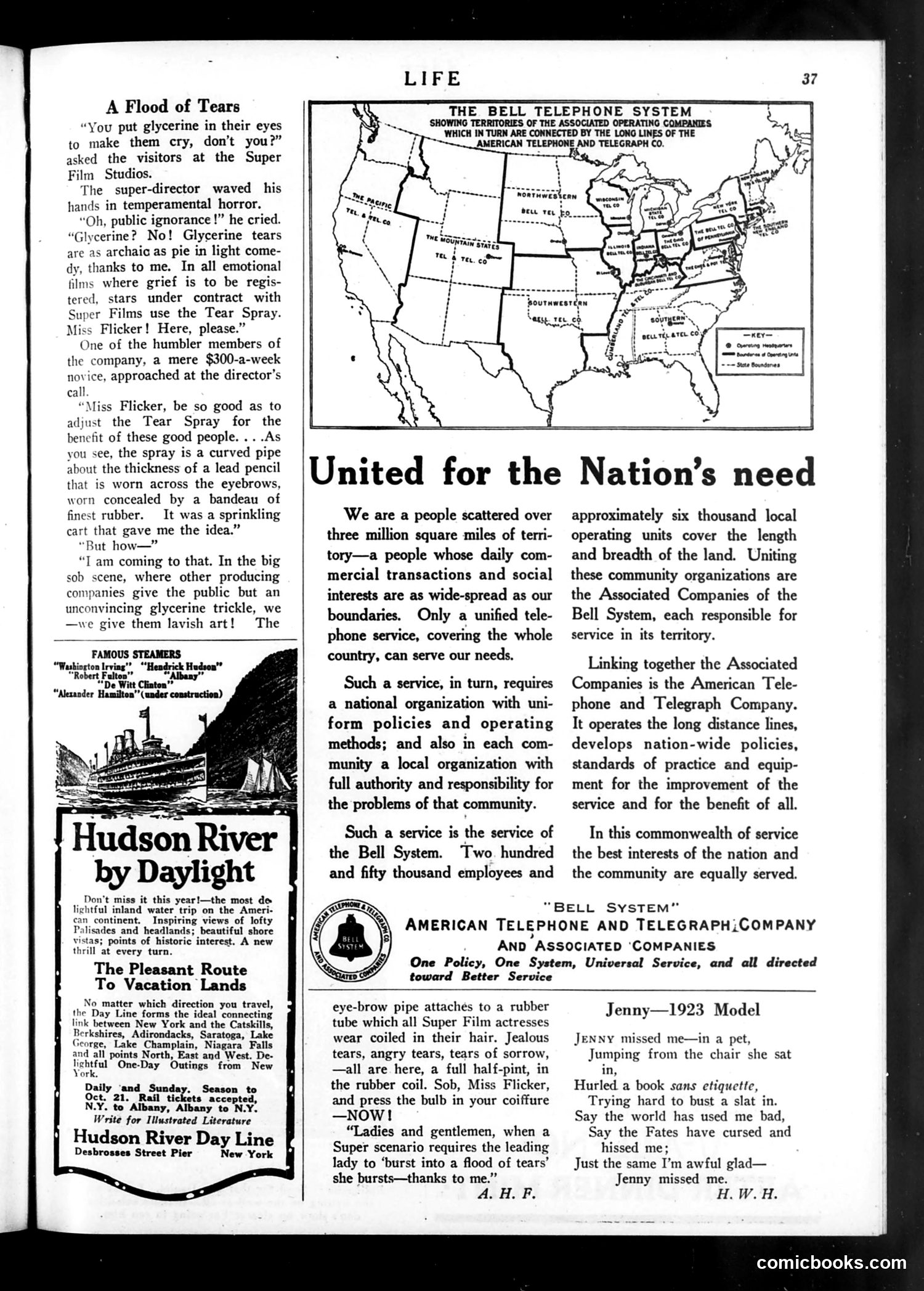
This satirical piece mocks the artificiality of silent cinema's emotional performances. A pretentious film director boasts to studio visitors about his innovation: the "Tear Spray," a mechanical device worn concealed under actresses' hair that sprinkles tears on command—replacing the outdated practice of using glycerine drops. The joke targets both filmmaking's mechanical fakery and the director's pompous self-importance. He describes the spray with absurd precision (comparing it to a lead pencil, claiming it was inspired by a sprinkling cart), treating cheap theatrical trickery as artistic genius. The accompanying vignette about actress "Miss Flicker" suggests the nameless, interchangeable actresses reduced to props executing the director's schemes. For 1923 readers, this satirized the known artificiality of silent film emotion—viewers understood tears were fabricated—yet the piece suggests this elaborate contraption epitomizes Hollywood's pretense and waste.
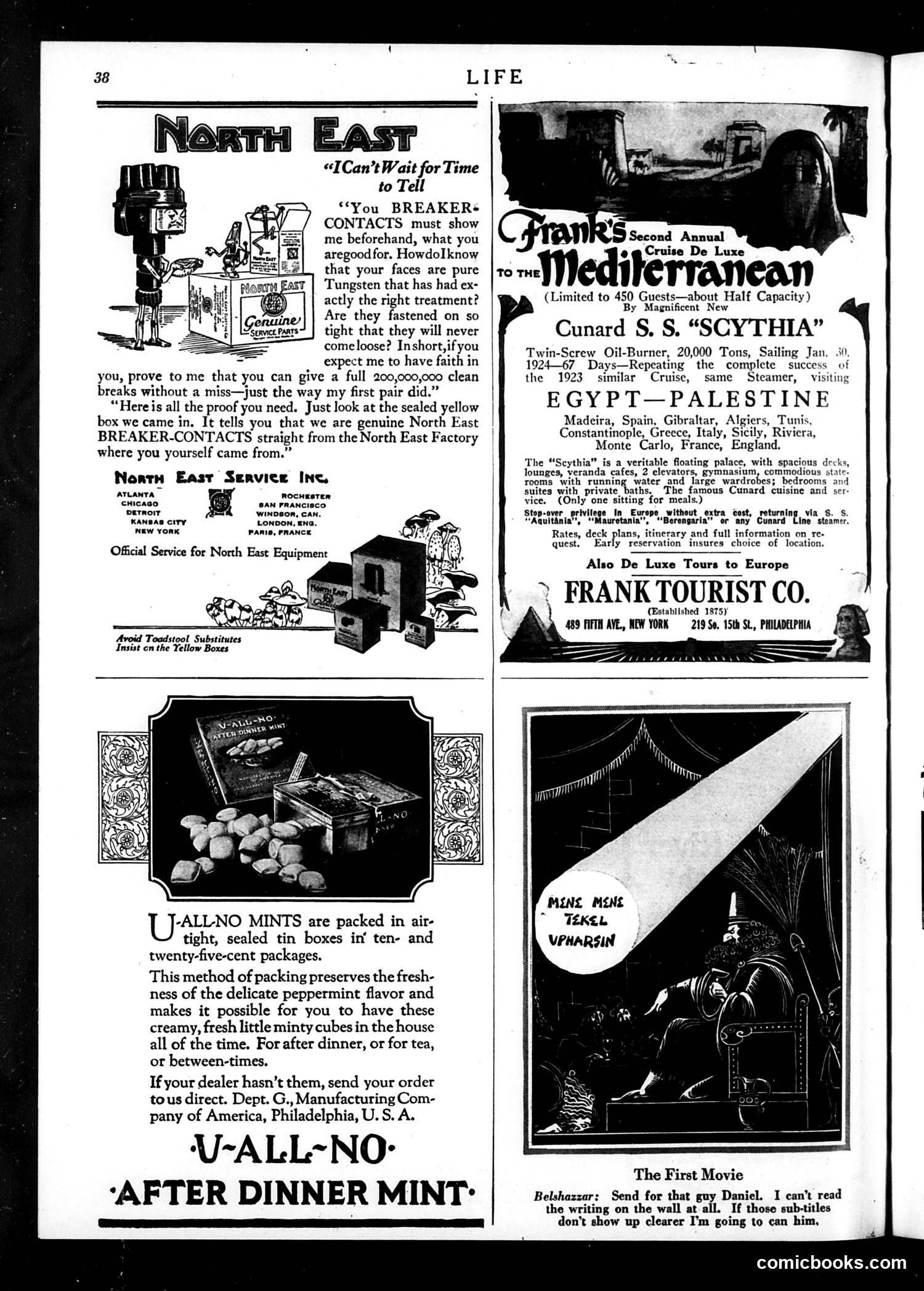
This page is primarily **advertising** rather than political satire. It contains four distinct ads: 1. **North East Breaker-Contacts** (top left): A sales pitch for electrical equipment, using humor about quality assurance—a customer demands proof the product won't fail. 2. **Frank's Tourist Co./Cunard cruise** (top right): Advertisement for a luxury Mediterranean cruise on the S.S. "Scythia," visiting Egypt, Palestine, and Europe. 3. **U-All-No After Dinner Mints** (bottom left): Product advertisement emphasizing fresh peppermint candies in sealed packaging. 4. **"The First Movie" cartoon** (bottom right): A brief joke referencing the Biblical story of Belshazzar's Feast, imagining it as a silent film where the mysterious "writing on the wall" appears as unclear subtitle text—poking gentle fun at early cinema's technical limitations. The page reflects 1920s consumer culture and emerging film industry humor.
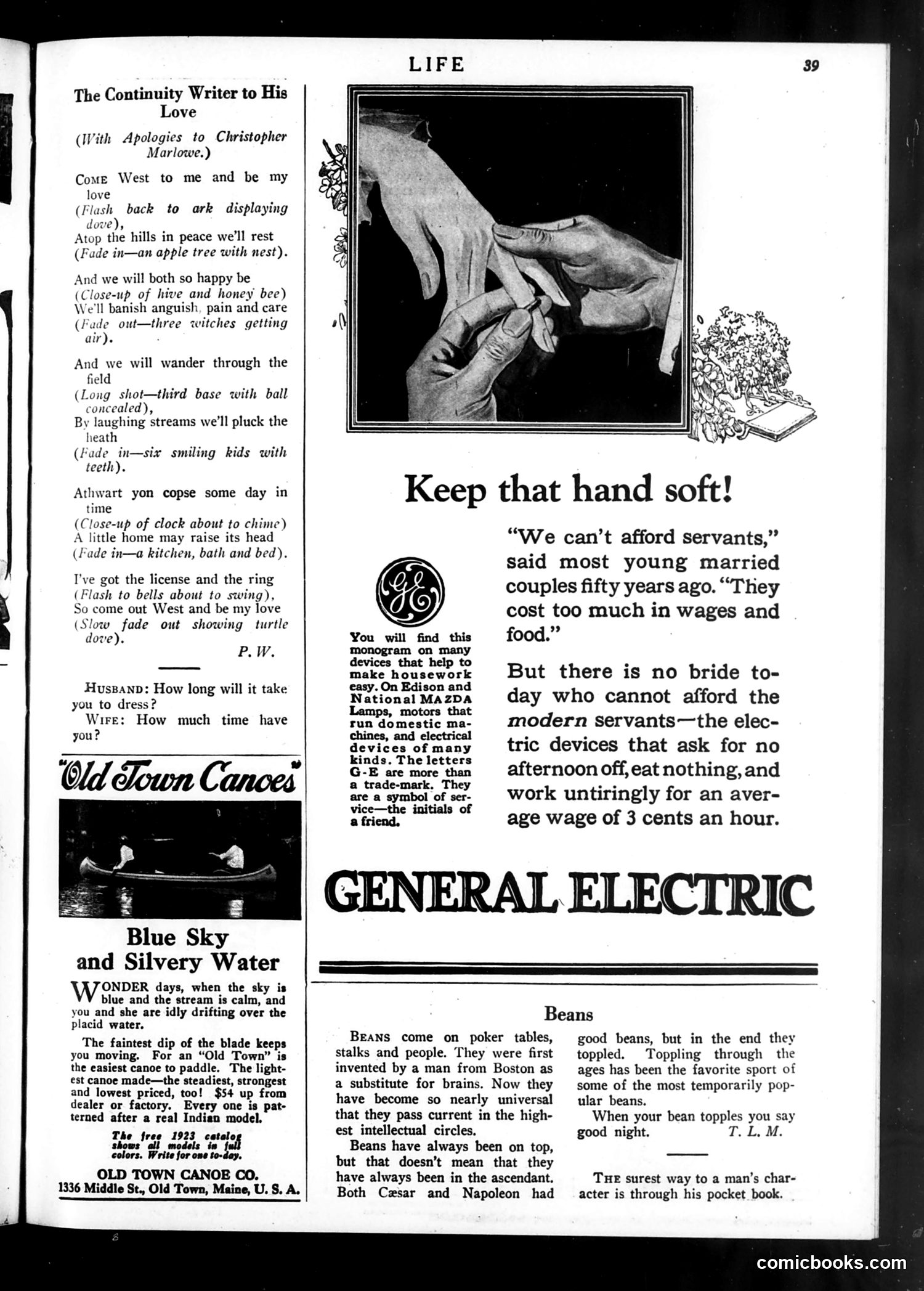
This page is primarily **advertising and light humor** rather than political commentary. The main content includes: 1. **"The Continuity Writer to His Love"** — a romantic poem with italicized stage directions (like "Flash back to ark displaying dove"), gently satirizing both love poetry and theatrical conventions of the era. 2. **General Electric advertisement** — "Keep that hand soft!" — promoting electric household devices as labor-saving replacements for servants. The ad argues that modern young couples can't afford servants, so they should buy GE appliances instead. This reflects early-20th-century anxieties about household labor and changing domestic economics. 3. **Old Town Canoes advertisement** and brief humor pieces about beans and character. The page reflects period concerns about domestic technology, marriage, and servant-keeping culture, presented through light satire and commercial appeals.
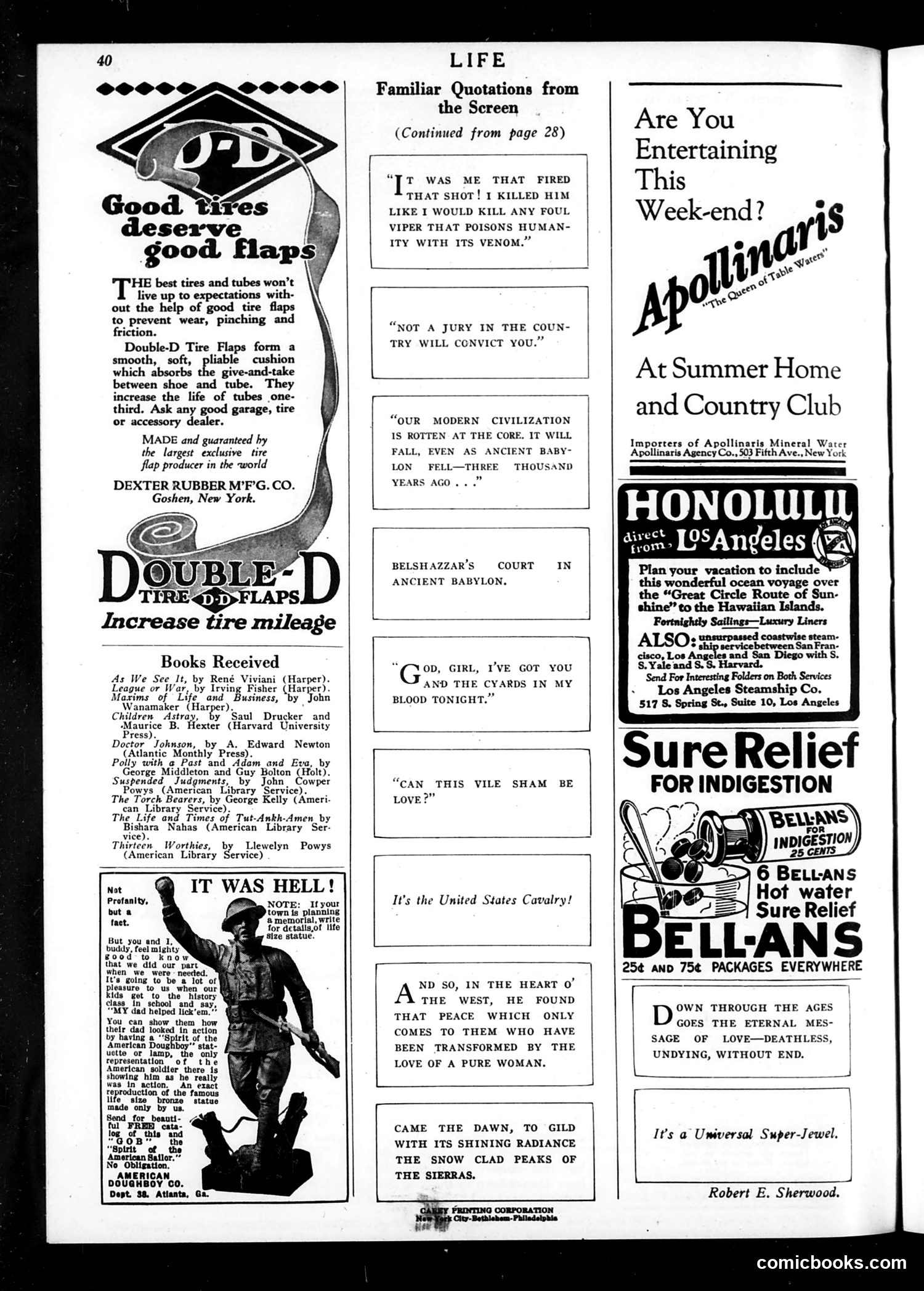
This page is primarily **advertising and book reviews**, not political satire. The dominant content includes: **Advertisements**: Tire flaps, a "Spirit of the American Doughboy" statue/lamp (appealing to post-WWI nostalgia), Apollinaris mineral water, Honolulu steamship travel, Bellans indigestion remedy, and a jewelry ad. **"Familiar Quotations from the Screen"** section: These are melodramatic lines from silent films—self-serious dialogue about justice ("Not a jury will convict you"), morality decay ("civilization is rotten"), and romantic redemption ("transformed by the love of a pure woman"). The satire is subtle: *Life* is mocking the overwrought, pretentious dialogue and purple prose typical of 1920s cinema. **Books Received**: Literary and philosophical works listed without commentary. The page reflects 1920s consumer culture and gently ridicules contemporary film conventions through juxtaposition rather than explicit cartoon commentary.
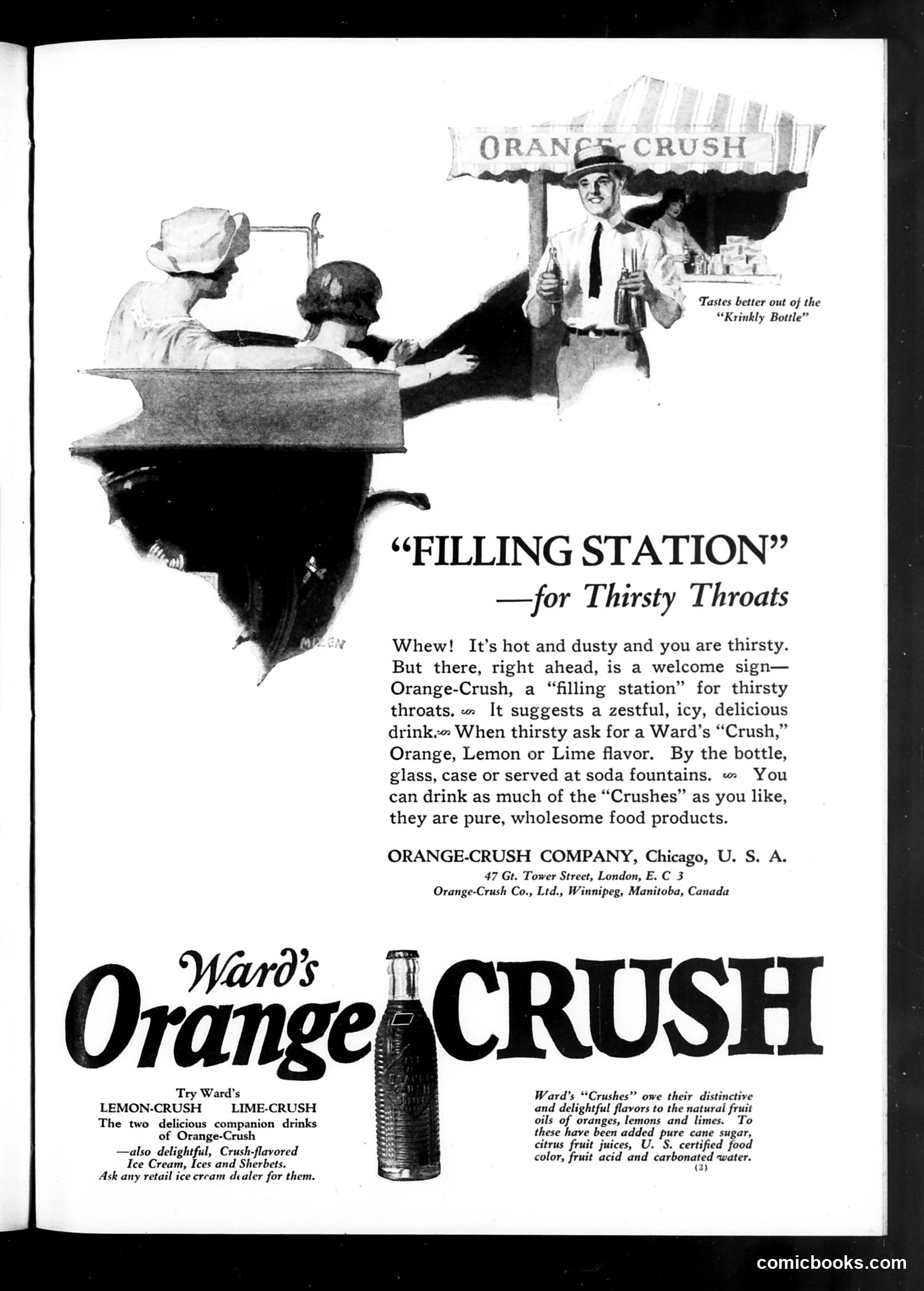
This is primarily a **soft drink advertisement**, not political satire. The page uses a visual pun to market Orange Crush soda: a cartoon "filling station" for people's thirst, mimicking the gas station concept that would have been familiar to 1920s-30s readers as automobiles became commonplace. The illustration shows a vendor at an umbrella stand labeled "Orange Crush" serving bottles to thirsty customers, playing on the idea that just as cars need fuel, people need refreshment. The tagline "Tastes better out of the 'Krinkly Bottle'" references the distinctive textured bottle design. The ad emphasizes the product is a "pure, wholesome food product" made from natural fruit oils, sugar, and citrus juices—marketing language typical of the era. Related products mentioned include Lemon-Crush and Lime-Crush variants, plus ice cream and sherbets.
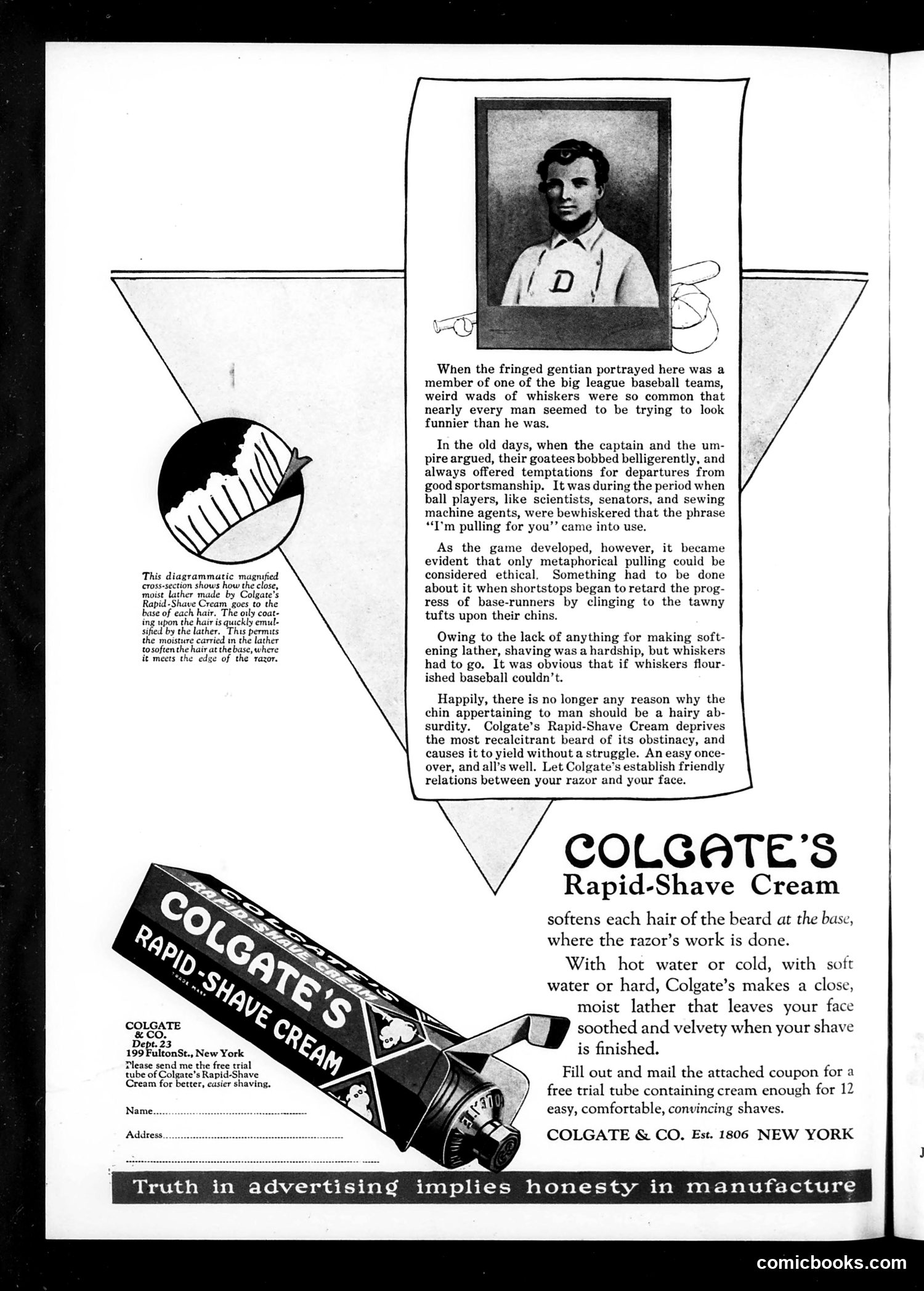
This is primarily a **Colgate's shaving cream advertisement**, not political satire. The humor is commercial rather than satirical. The ad uses a playful historical narrative: it claims that in early baseball, players wore elaborate facial hair (goatees, whiskers) so commonly that they became nuisances—literally interfering with gameplay when runners grabbed opponents' chins during plays. The phrase "I'm pulling for you" supposedly originated from this era of facial hair-grabbing. The joke is that **modern clean-shaving solves this problem**. By ridiculing the "hairy absurdity" of the past, Colgate positions its shaving cream as civilizing and progressive. The accompanying portrait shows a baseball player from that bewhiskered era. The technical diagram illustrates how the cream softens hair at the base for easier shaving. This reflects early 20th-century advertising's use of humor and pseudo-historical storytelling to sell grooming products—positioning shaving as modern, professional, and socially necessary.