
Life, 1923-06-14 · page 16 of 44
Life — June 14, 1923 — page 16: what you’re looking at
What you’re looking at
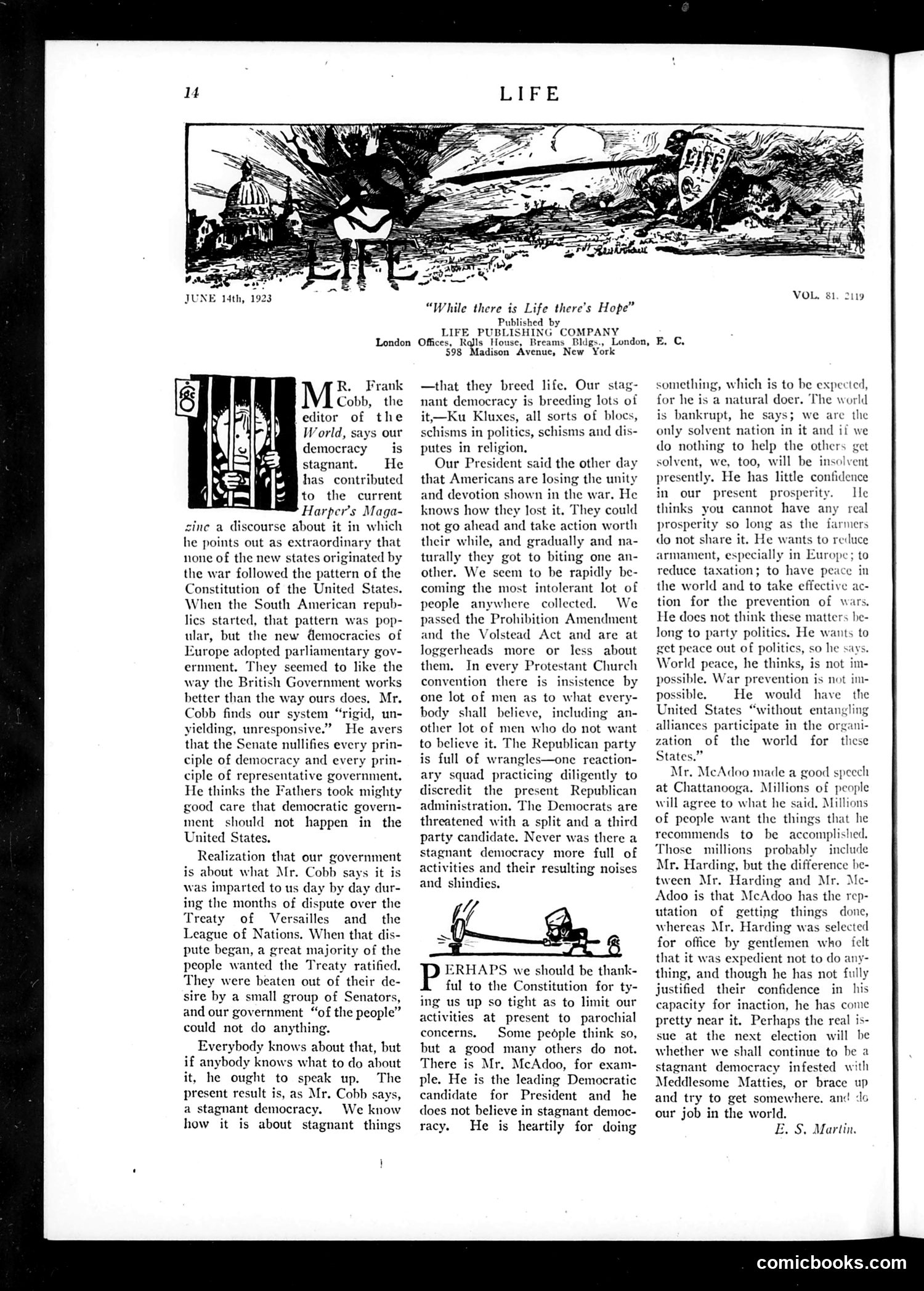
The article by editor Frank Cobb critiques what he calls "stagnant democracy"—the loss of American civic unity and vigor following World War I. Cobb argues that new democratic nations formed after the war initially mimicked America's Constitution, but are now outperforming the U.S. government. The piece discusses contemporary political divisions: the Republican party's internal conflicts, Democratic candidate James McAdoo's political viability, and President Harding's administrative shortcomings. Cobb suggests America's government has become paralyzed by partisan bickering, failing to address pressing national issues like taxation, international peace, and war prevention. The accompanying cartoon (top) appears allegorical, though its specific figures are unclear without additional context.
📄 Transcribed text from this page (OCR, searchable)
Machine-transcribed from the original scan — historical spelling and the odd misread are preserved.
“While there is Life there's Hope” Published by LIFE PUBLISHING COMPANY London Offices, Ri Touse, Breams Bldgs., London, E, C. R. Frank Cobb, the editor of the World, says our democracy is stagnant. He has contributed to the current Harper’s Maga- sine a discourse about it in which he points out as extraordinary that none of the new states originated by the war followed the pattern of the Constitution of the United States. When the South American repub- lics started, that pattern was pop- ular, but the new democracies of Europe adopted parliamentary gov- ernment. They seemed to like the way the British Government works better than the way ours does. Mr. Cobb finds our system “rigid, un- yielding, unresponsive.” He avers that the Senate nullifies every prin- ciple of democracy and every prin- ciple of representative government. He thinks the Fathers took mighty good care that democratic govern- ment should not happen in the United States. Realization that our government is about what Mr. Cobb says it is was imparted to us day by day dur- ing the months of dispute over the Treaty of Versailles and the League of Nations. When that dis- pute began, a great majority of the people wanted the Treaty ratified. They were beaten out of their de- sire by a small group of Senators, and our government “of the people” could not do anything. Everybody knows about that, but if anybody knows what to do about it, he ought to speak up. The present result is, as Mr. Cobb says, a stagnant democracy. We know how it is about stagnant things 598 Madison Avenue, New York —that they breed life. Our stag- nant democracy is breeding lots of it—Ku Kluxes, all sorts of blocs, schisms in politics, schisms and dis- putes in religion, Our President said the other day that Americans are losing the unity and devotion shown in the war, He knows how they lost it. They could not go ahead and take action worth their while, and gradually and na- turally they got to biting one an- other. We seem to be rapidly be- coming the most intolerant lot of people anywhere collected. We passed the Prohibition Amendment and the Volstead Act and are at loggerheads more or less about them. In every Protestant Church convention there is insistence by one lot of men as to what every- body shall believe, including an- other lot of men who do not want to believe it. The Republican party is full of wrangles—one reaction- ary squad practicing diligently to discredit the present Republican administration, The Democrats are threatened with a split and a third party candidate. Never was there a stagnant democracy more full of activities and their resulting noises and shindies. (4 > R ERHAPS we should be thank- ful to the Constitution for ty- ing us up so tight as to limit our activities at present to parochial concerns. Some pedple think so, but a good many others do not. There is Mr. McAdoo, for exam- ple. He is the leading Democratic candidate for President and he does not believe in stagnant democ- racy. He is heartily for doing something, which is to be expected, for he is a natural doer. The world is bankrupt, he says; we are the only solvent nation in it and if we do nothing to help the others get solvent, we, too, will be insolvent presently. He has little confidence in our present prosperity. Ie thinks you cannot have any real prosperity so long as the farmers do not share it. He wants to reduce armament, especially in Europe; to reduce taxation; to have peace in the world and to take effective ac- tion for the prevention of wars. He does not think these matters he- long to party politics. He wants to get peace out of politics, so he says. World peace, he thinks, is not im- possible. War prevention is not im- possible. He would have the United States “without entangling alliances participate in the organi- zation of the world for these States.” Mr. McAdoo made a good speech at Chattanooga. Millions of people will agree to what he said, Millions of people want the things that he recommends to be accomplished. Those millions probably include Mr. Harding, but the difference be- tween Mr. Harding and Mr. Me- Adoo is that McAdoo has the rep- utation of getting things done, whereas Mr, Harding was selected for office by gentlemen who felt that it was expedient not to do any- thing, and though he has not fully justified their confidence in his capacity for inaction, he has come pretty near it. Perhaps the real is- sue at the next election will be whether we shall continue to be a stagnant democracy infested with Meddlesome Matties, or brace up and try to get somewhere. and «lo our job in the world. E. S. Martin. comicbooks.com