
A complete issue · 40 pages · 1923
Life — May 3, 1923
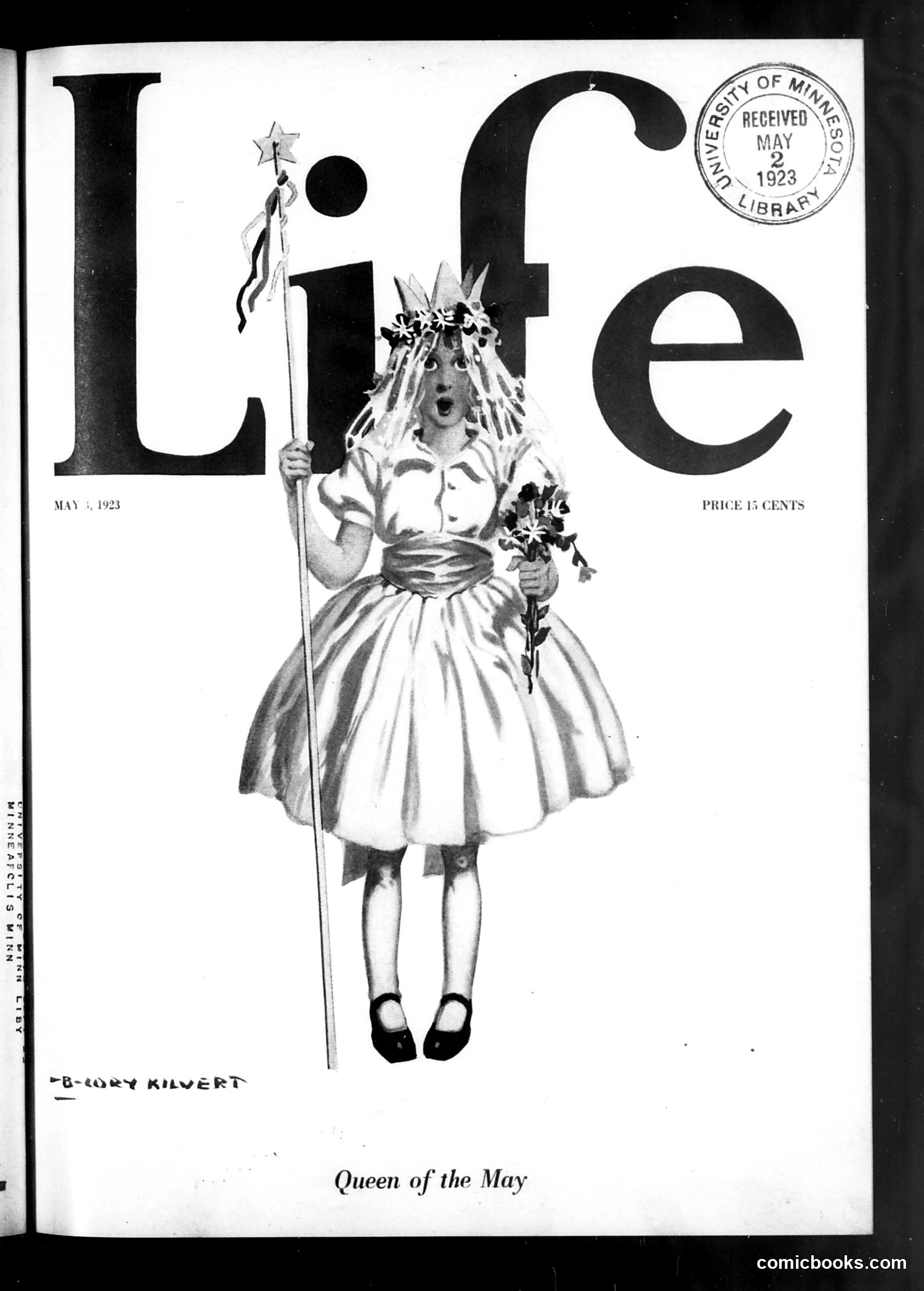
This is the cover of *Life* magazine from May 1, 1923, titled "Queen of the May." The illustration depicts a young woman in a white dress holding a tall staff topped with a star, wearing a crown and holding flowers. She embodies the "May Queen," a figure from traditional springtime celebrations. The satire likely comments on the commercialization or frivolity of May Day festivities in 1920s America, presenting an idealized, almost childlike representation of seasonal pageantry. The large letters spelling "Life" frame the figure, suggesting the magazine's commentary on contemporary American culture and values during this post-WWI period.
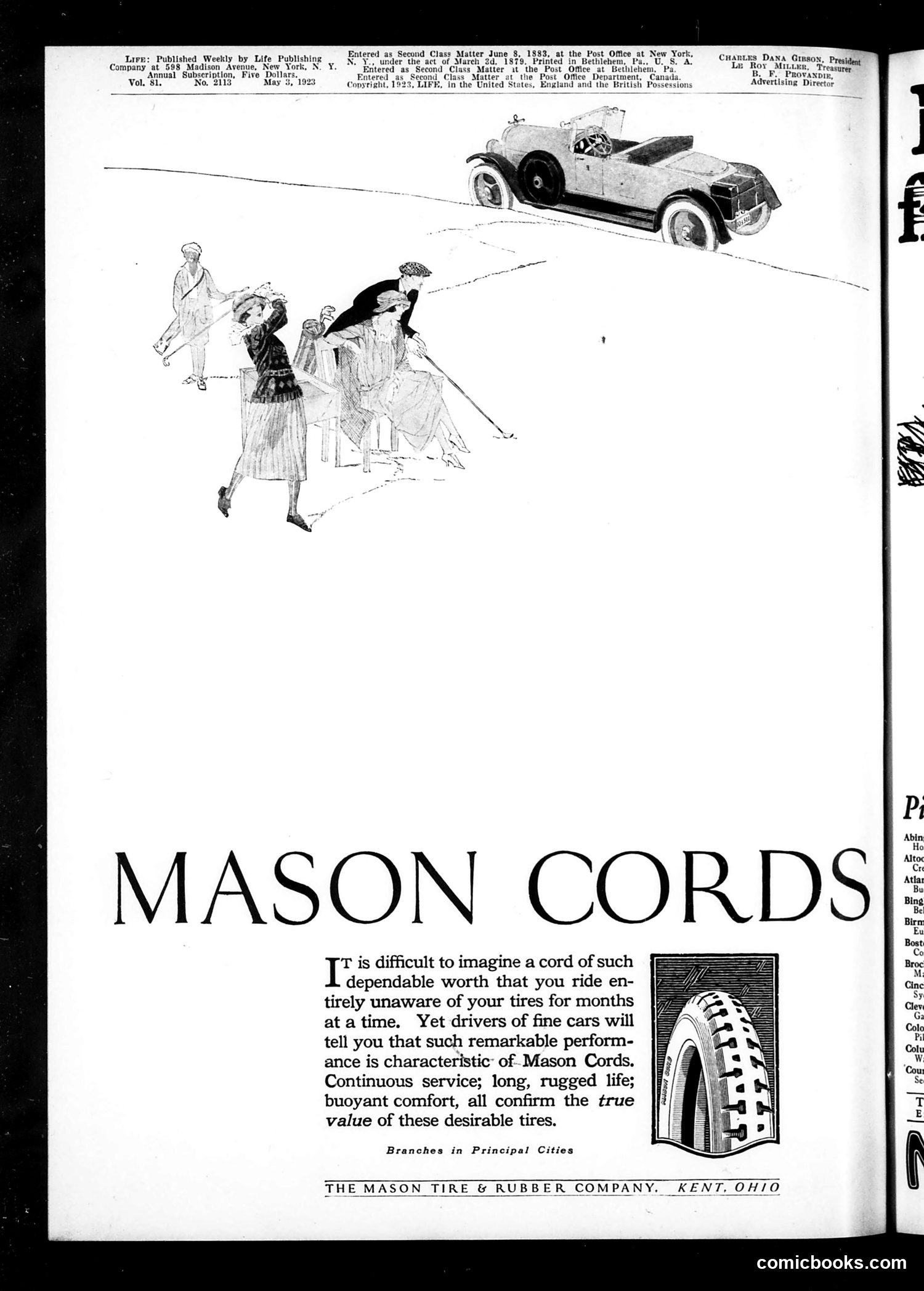
This is primarily a **tire advertisement** rather than political satire. The page shows an illustration of well-dressed 1920s figures (appears to be a woman and man) near a luxury automobile, with the tagline emphasizing Mason Cords' durability and "continuous service; long, rugged life; buoyant comfort." The ad's implicit message plays on **class anxiety**: it suggests that quality tires are so reliable you might "ride entirely unaware of your tires for months at a time"—a luxury concern for affluent car owners of the era. The illustration's refined figures and elegant styling reinforce the product's positioning as upscale. This is straightforward commercial messaging, not social commentary or political satire.
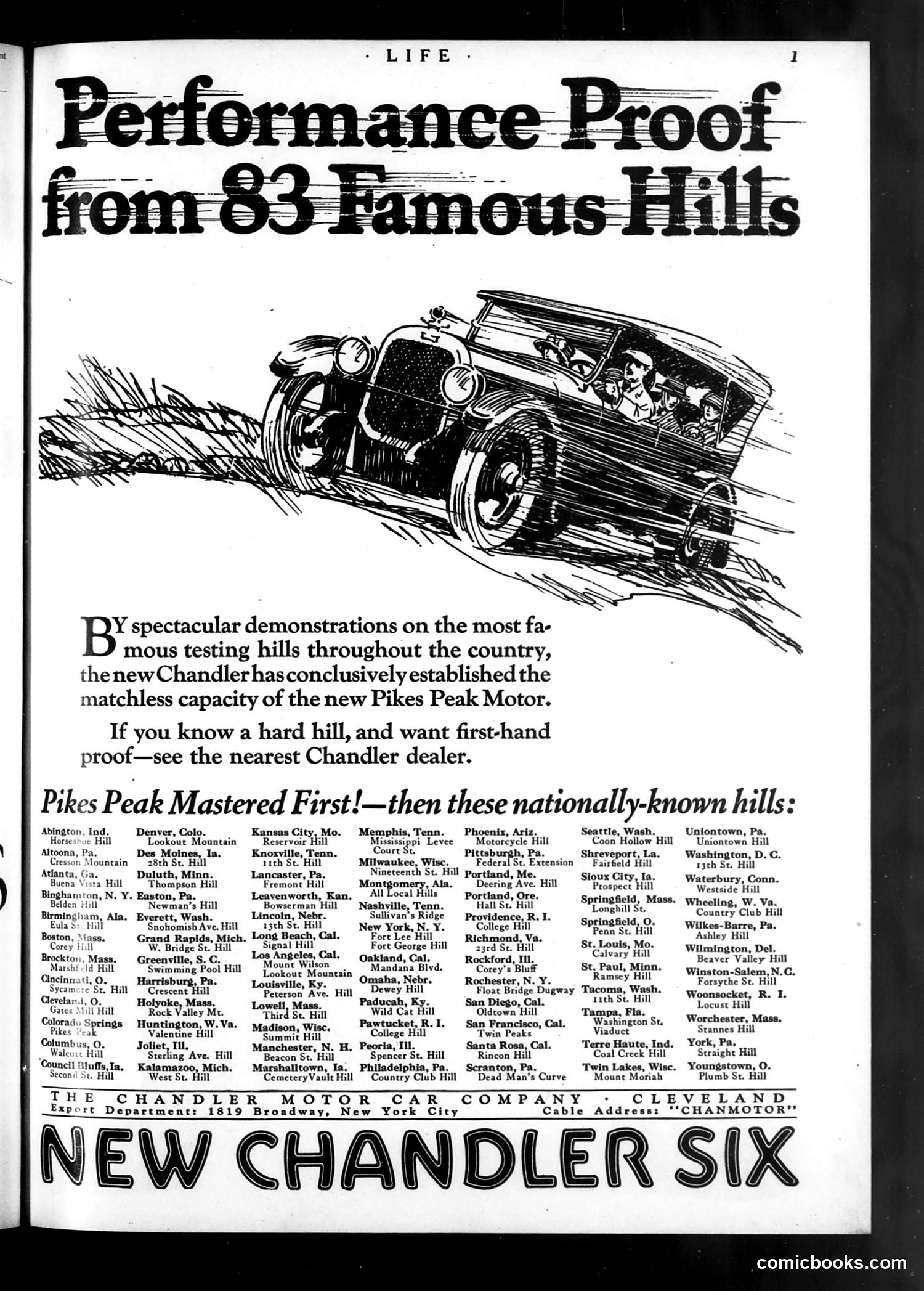
This page is **primarily an advertisement**, not satire or political commentary. It promotes the Chandler Motor Car Company's "New Chandler Six" automobile. The advertisement uses a dramatic illustration of a car ascending a steep hill to demonstrate the vehicle's performance capabilities. The headline promises "Performance Proof from 83 Famous Hills"—referencing actual hill-climbing demonstrations the company conducted across America to showcase the car's engine power and reliability. The extensive list below names specific hills throughout the country where Chandler vehicles successfully performed these tests, establishing credibility through geographic breadth. The phrase "Pikes Peak Mastered First!" references the famous Colorado mountain, implying superior climbing ability compared to competitors. This represents early automotive marketing strategy: using dramatic visual demonstrations and documented performance claims to convince consumers of mechanical superiority.
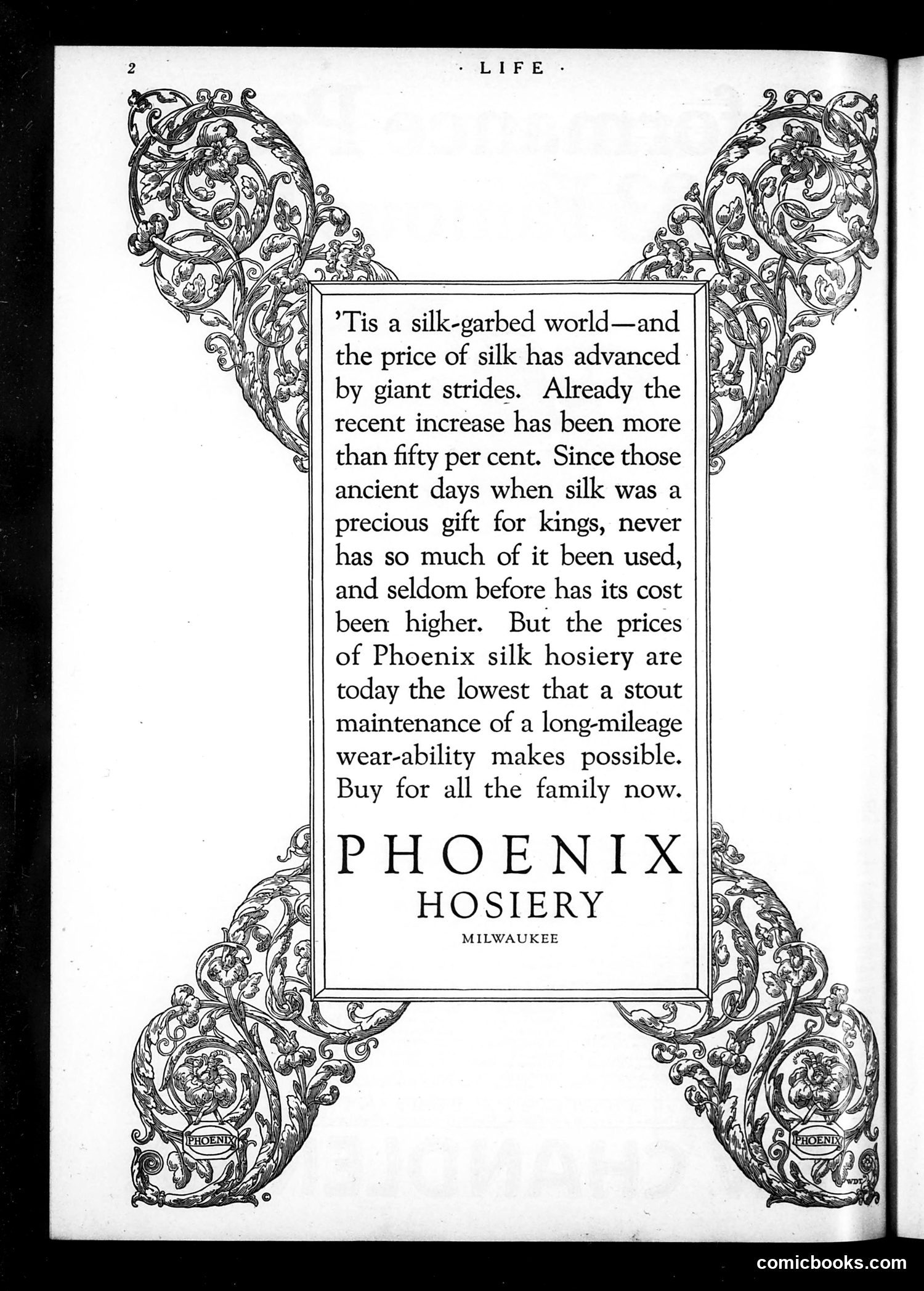
This page is **primarily an advertisement**, not political satire. It's a full-page ad for Phoenix Hosiery (Milwaukee) from an era when Life magazine was supported by advertising. The ad uses ornate decorative borders typical of early 20th-century design. The sales pitch argues that while silk prices have risen dramatically (over 50%), Phoenix silk hosiery remains competitively priced due to quality construction and durability. It appeals to budget-conscious families ("Buy for all the family now"), positioning the product as practical despite inflation. The historical context: this reflects a period when silk was a luxury commodity, and hosiery was essential daily wear for all family members. The copy invokes silk's ancient prestige while emphasizing modern value—a common advertising strategy blending heritage with affordability.
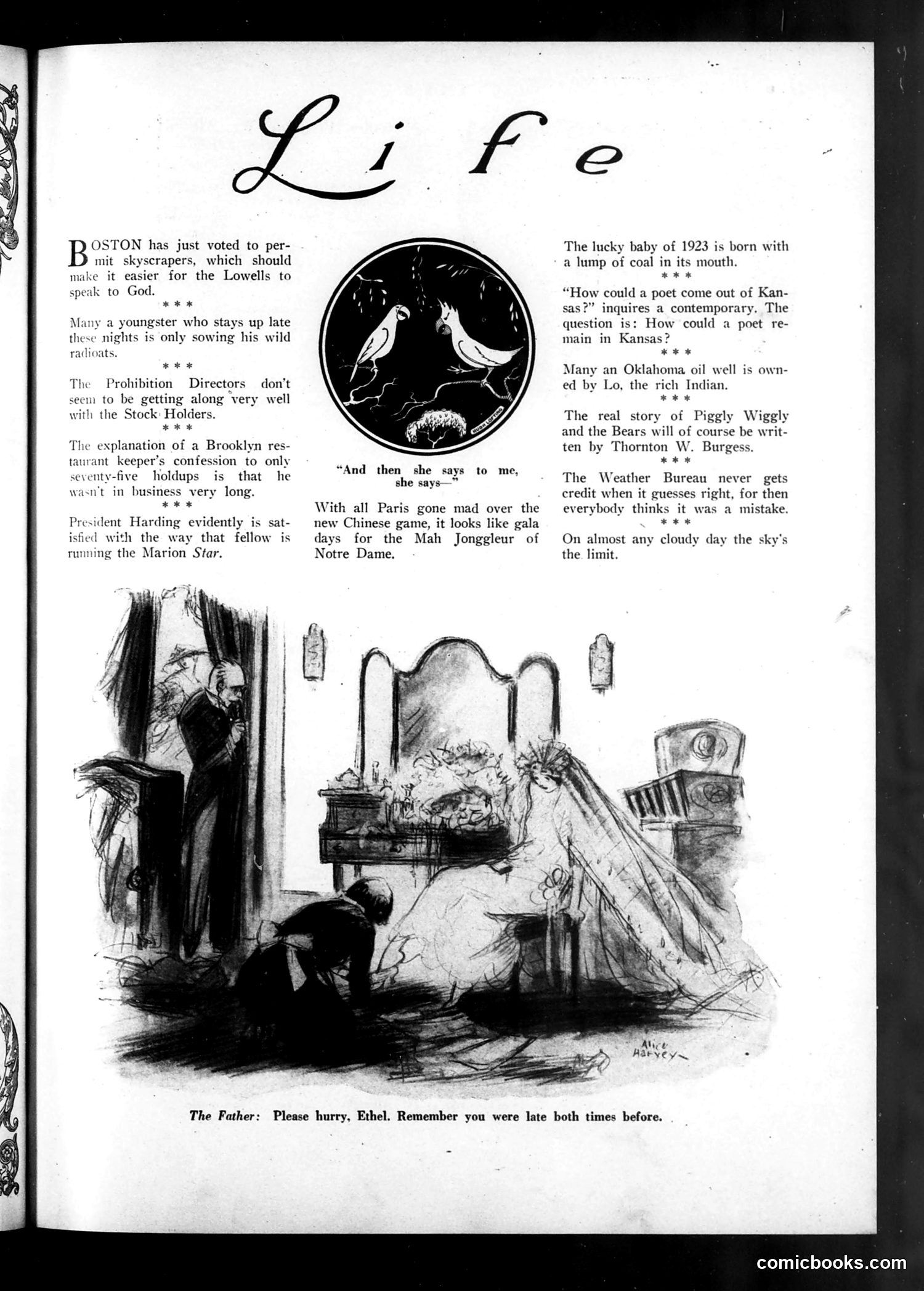
This "Life" section contains brief satirical observations about 1920s American society: **Political/Social References:** - Boston's vote to permit skyscrapers (modernization debate) - Prohibition and friction between Directors and Stock Holders - Brooklyn restaurant keeper's confession to only sixty-five holdups (crime under Prohibition) - President Harding and the *Marion Star* newspaper (his pre-presidential role) - Chinese Mah-jongg game craze in Paris - Thornton W. Burgess's animal stories - Weather Bureau's inaccuracy **The Main Cartoon** depicts a bedroom scene with a caption: "The Father: Please hurry, Ethel. Remember you were late both times before." The illustration suggests marital intimacy with a humorous domestic urgency—likely satirizing changing sexual attitudes or courtship norms of the Jazz Age. The scattered quips collectively mock contemporary follies: modernization, crime, leisure fads, and evolving social behavior.
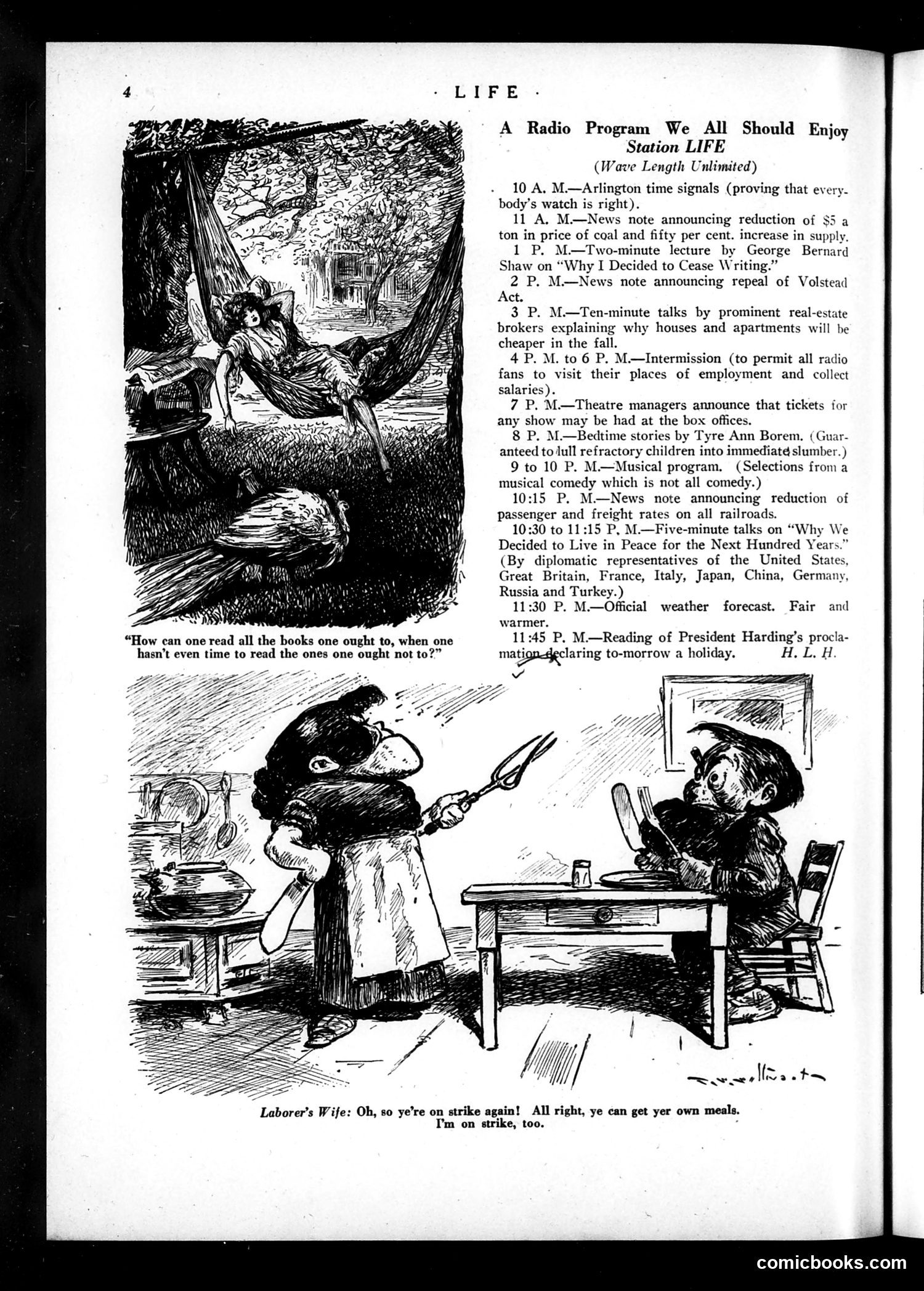
This page contains two distinct elements: **Upper section:** A radio program schedule for Station LIFE, listing daytime broadcasts including news, lectures, and entertainment. **Lower cartoon:** Depicts a labor strike scenario. A man (the laborer) holds a pitchfork while his wife sits at a table. She sarcastically announces she's also "on strike," refusing to cook. The caption reads: "Laborer's Wife: Oh, so ye're on strike again! All right, ye can get ye own meals. I'm on strike, too." **The satire:** This mocks strike action by suggesting that if workers withhold labor, household tasks will similarly halt—implying wives should support strikes through domestic non-cooperation. It reflects early 20th-century labor tensions while also revealing contemporary attitudes about gender roles and marriage, suggesting wives' domestic work paralleled industrial labor.
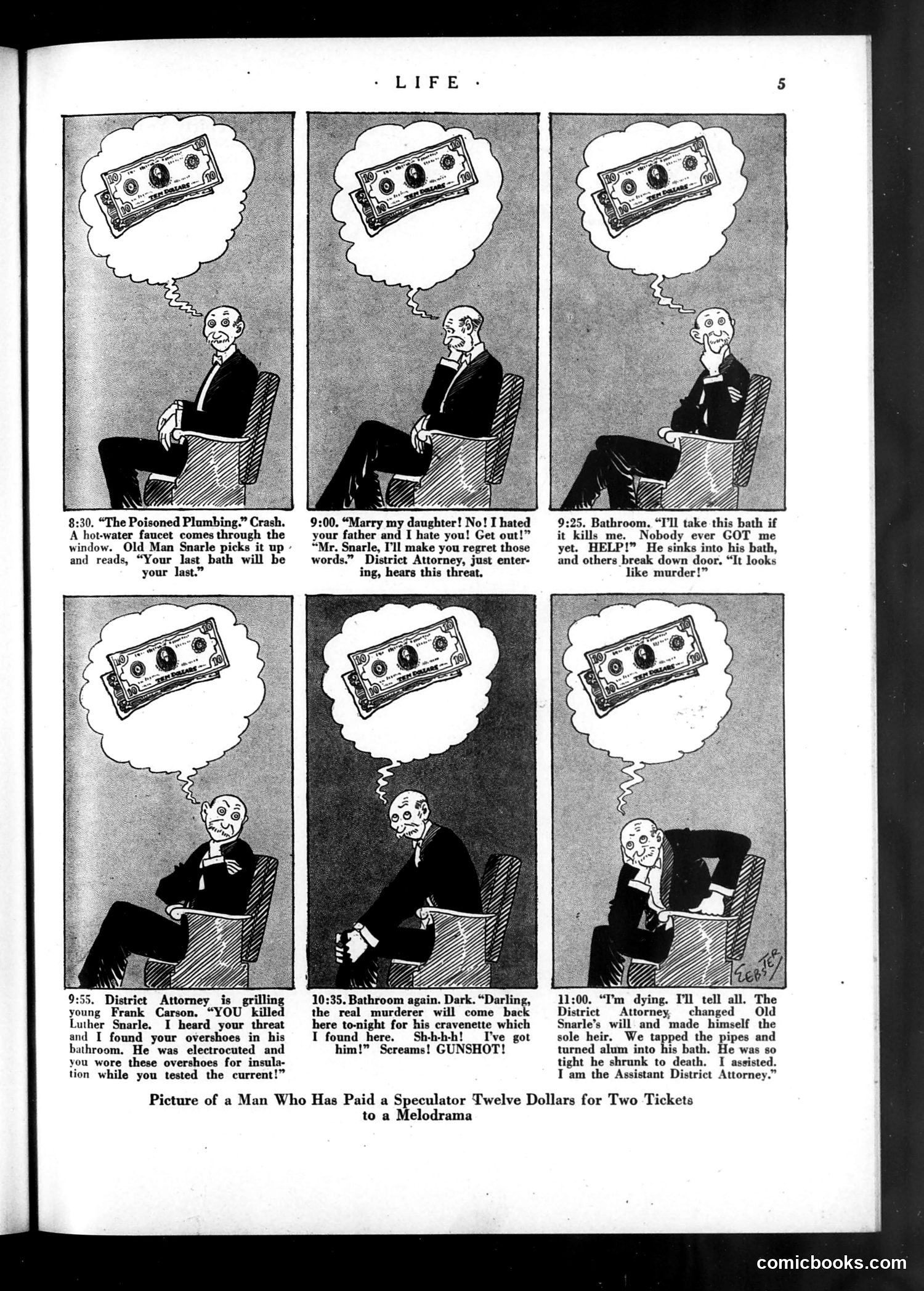
This is a satirical comic strip depicting a man's increasingly desperate daydreams about money as he experiences a series of domestic crises throughout the day. Each panel shows him thinking of a dollar bill while facing escalating troubles: a burst pipe, a family argument, bathroom problems, and interrogation by a District Attorney about murder accusations. The satire critiques how financial anxiety dominates the mind of an ordinary man dealing with everyday catastrophes. The title at bottom—about paying twelve dollars for two melodrama tickets—suggests this entire narrative is itself melodramatic exaggeration, mocking both working-class financial preoccupation and the absurd plot devices of contemporary melodramatic entertainment. The recurring dollar-bill imagery emphasizes how money concerns overshadow even serious legal jeopardy.
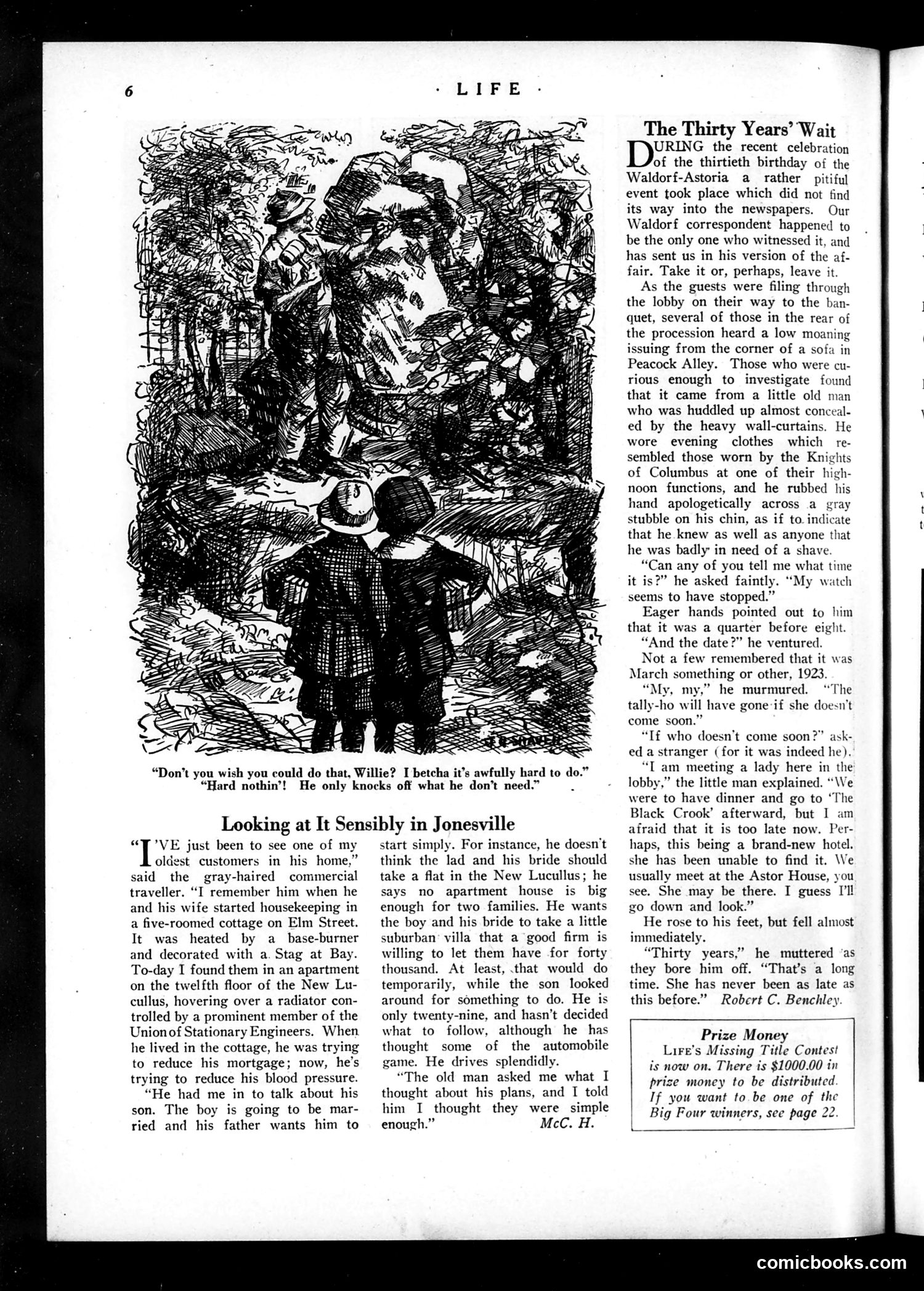
This page contains two distinct pieces: a satirical illustration titled "The Thirty Years' Wait" and an article "Looking at It Sensibly in Jonesville." **The Cartoon**: The detailed cross-hatched illustration appears to depict a chaotic domestic or social scene, though the specific satire isn't entirely clear from the image alone. The caption suggests commentary on marital patience or long-suffering relationships. **The Article**: Written by "McCH," it discusses a commercial traveler advising a young couple on practical financial planning for marriage—specifically, affordable housing and modest living rather than extravagant spending. The couple should "take a flat" and avoid expensive suburban villas, the narrator argues. This reflects 1920s middle-class anxieties about marriage costs and sensible resource management during an economically uncertain period.
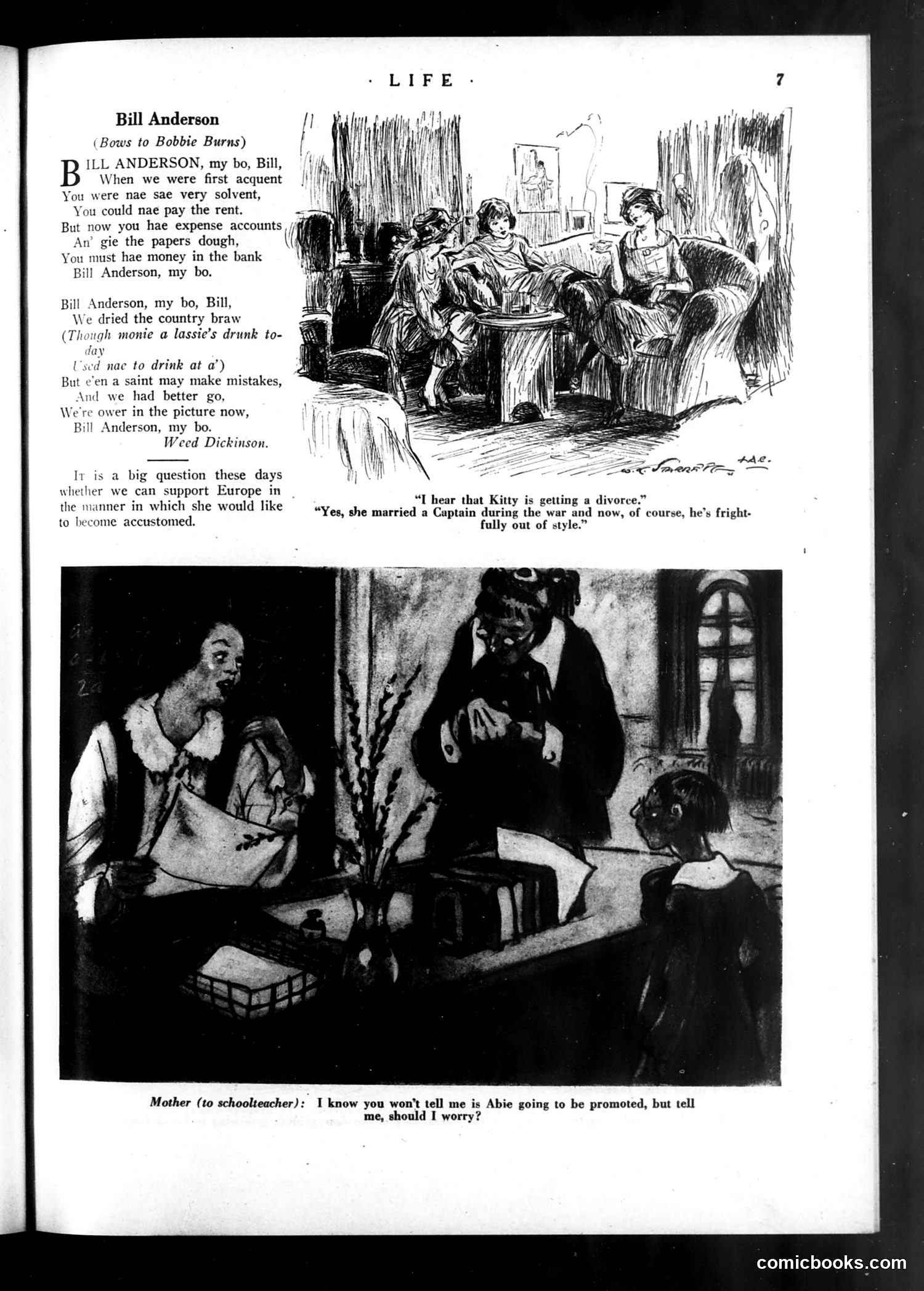
This page contains two satirical pieces about Scottish life and social commentary. **"Bill Anderson" (top):** A poem by Weed Dickinson addresses Bill Anderson about his financial troubles—he's moved from being "solvent" to having "expense accounts" and needing bank loans. The accompanying sketch shows men in a tavern, illustrating the poem's reference to drinking and financial mismanagement. **Bottom cartoon:** A photograph showing a mother confronting a schoolteacher, asking whether she should worry about her son Abie's lack of promotion. The humor derives from the mother's anxiety about academic advancement and the implication that promotion concerns were common parental worries in this era. Both pieces use Scottish dialect and working-class characters to satirize financial irresponsibility and middle-class anxieties about social mobility.
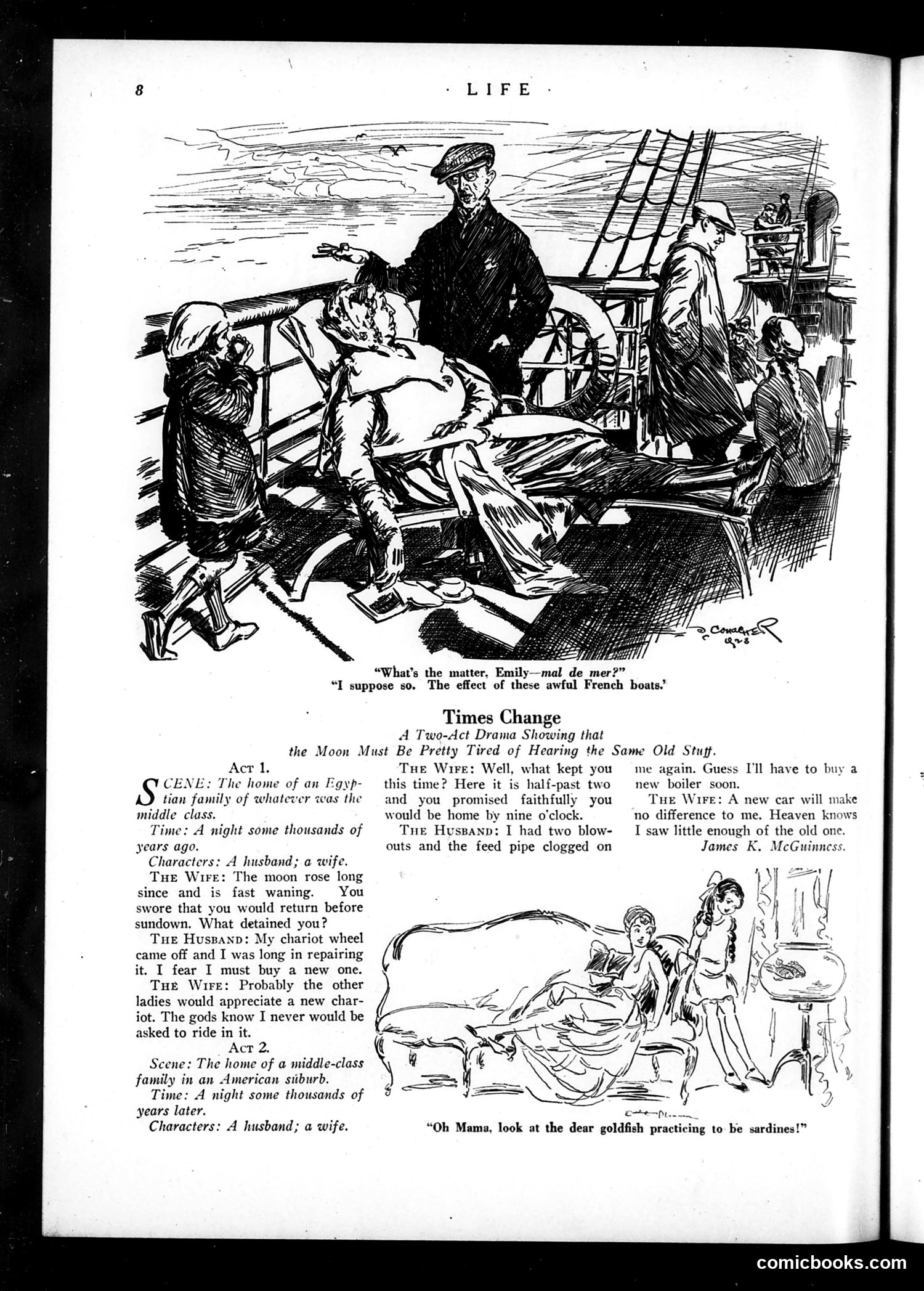
This two-act comic drama contrasts Egyptian and American domestic life across millennia. In **Act 1** (set in ancient Egypt), a husband complains about repair delays—the water wheel broke and the feed pipe clogged. His wife sarcastically suggests buying a new boiler. **Act 2** (modern American suburb) mirrors this: the wife now complains about similar household mechanical failures, and the husband suggests purchasing new equipment. The satire's point: despite thousands of years of civilization and technological progress, married couples still have identical domestic arguments about household maintenance and expenses. The "times change" but human nature—and marital friction—remain constant. This reflects Life's characteristic social humor about middle-class domesticity.
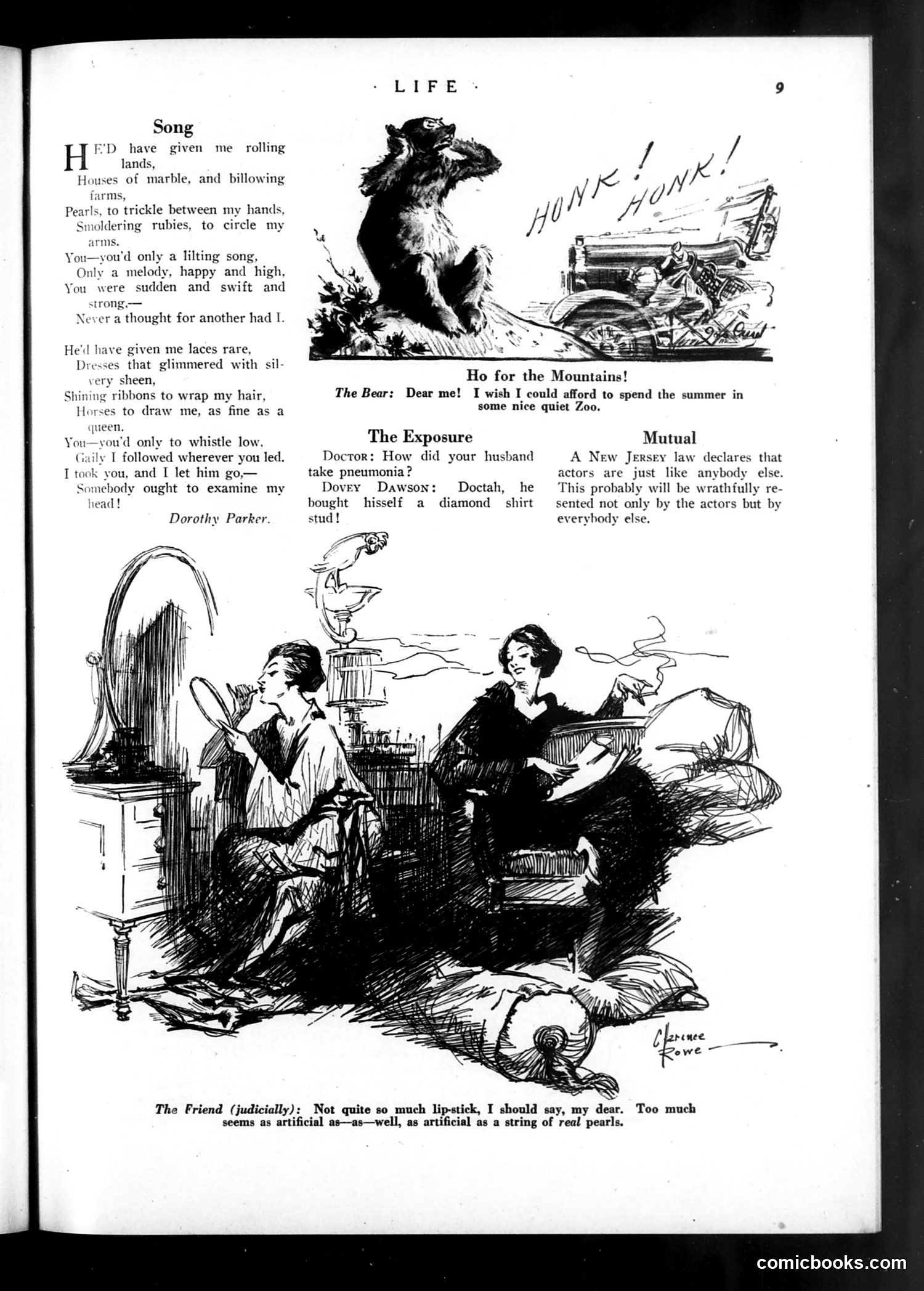
This page contains three separate satirical pieces: 1. **"Song"** by Dorothy Parker—a poem about romantic disappointment, where a lover gave material luxuries but no genuine affection. 2. **"Ho for the Mountains!"**—A cartoon showing a bear complaining it wishes it could afford "some nice quiet Zoo" instead of the mountains, satirizing the tourist invasion of natural spaces. 3. **"The Exposure" and "Mutual"**—Two brief joke items. The first mocks a husband buying himself a diamond shirt stud (suggesting emasculated consumerism). The second references a New Jersey law about actors resenting mutual sentiments. 4. **Bottom cartoon**—Shows two women at a mirror with a friend's critique about artificial pearls versus "real" ones, satirizing superficial materialism and vanity among society women. The page's recurring theme: critiquing 1920s consumer culture and shallow values.
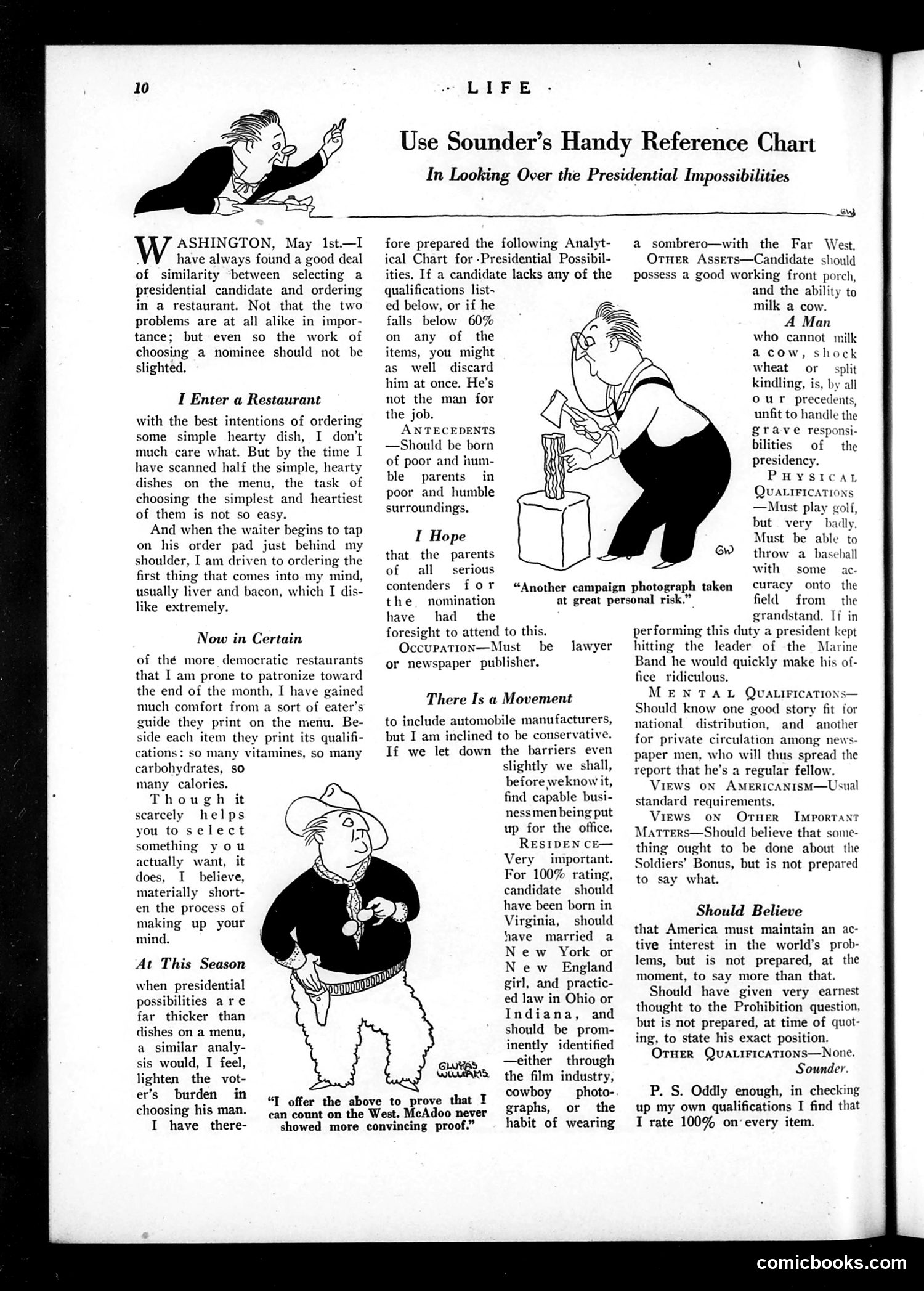
This page satirizes the challenge of selecting a U.S. presidential candidate by comparing it to ordering a simple restaurant meal—both tasks seem easy but prove surprisingly difficult. The author ("Sounder") presents a humorous "Handy Reference Chart" listing absurdly specific qualifications for candidates: must milk a cow, split kindling, throw a baseball accurately, know amusing anecdotes, have specific regional origins (born in Virginia, married in New York or New England, practiced law in Ohio or Indiana), and possess cowboy credentials or film-industry connections. The cartoon figures (appearing to be typical voter archetypes) illustrate the impossibly contradictory demands placed on candidates. The satire mocks how voters hold unrealistic expectations—wanting candidates to possess every conceivable qualification simultaneously—making sensible selection nearly impossible, much like choosing from an overwhelming restaurant menu.
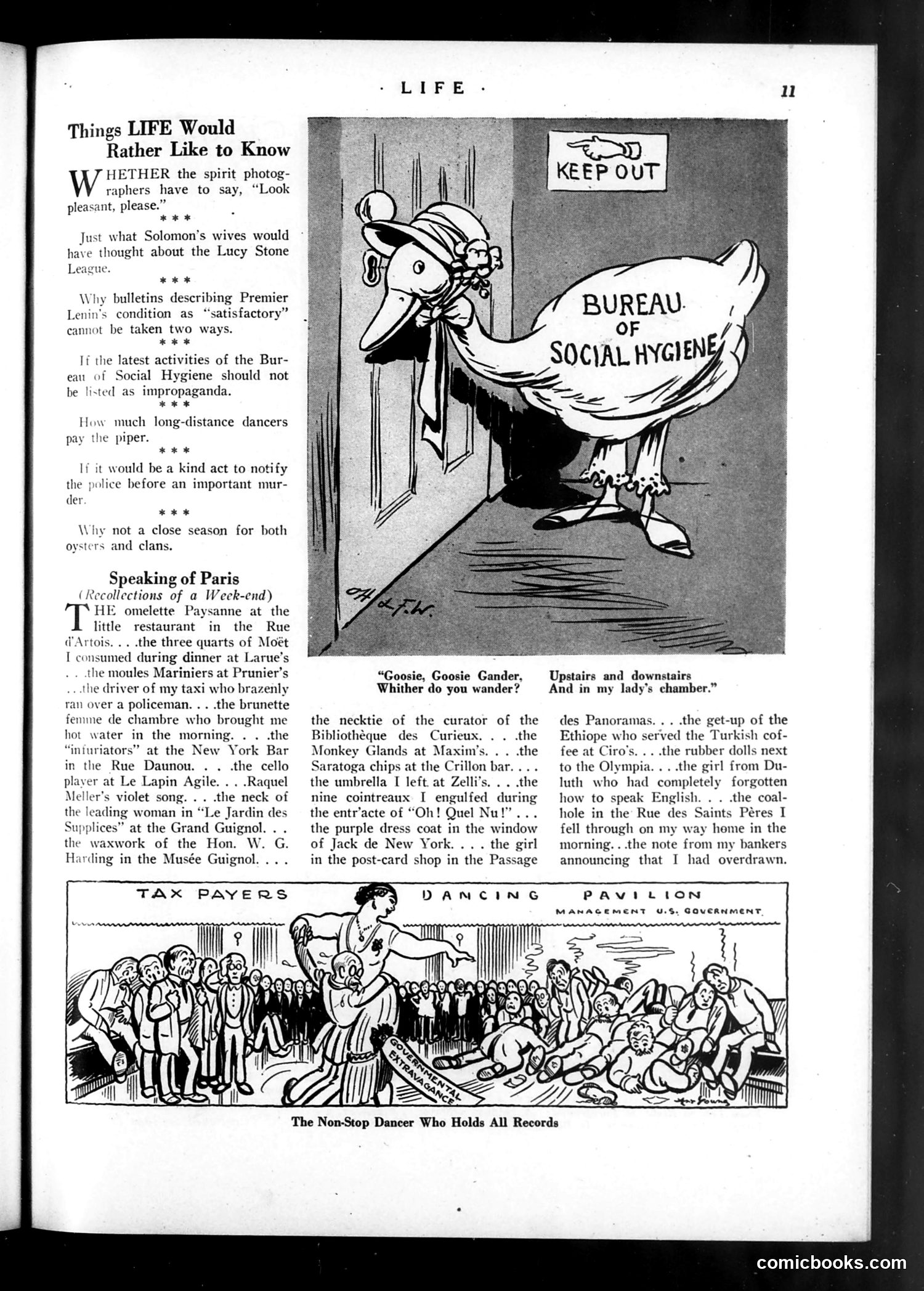
The main cartoon depicts a grotesque bird (likely representing bureaucratic government) labeled "Bureau of Social Hygiene" being kept out by a "Keep Out" sign. The bird wears official regalia and appears absurd and unwelcome. This satirizes the U.S. government's "Bureau of Social Hygiene," a real Progressive-era agency involved in public health and morality campaigns. The cartoon criticizes government overreach into private affairs—the exaggerated, intrusive bird character suggests the bureau's policies were seen as ridiculous interference. The bottom cartoon, titled "The Non-Stop Dancer Who Holds All Records," depicts exhausted taxpayers supporting a reckless dancer, satirizing wasteful government spending and the burden placed on ordinary citizens. These reflect 1920s skepticism toward expanding federal bureaucracy.
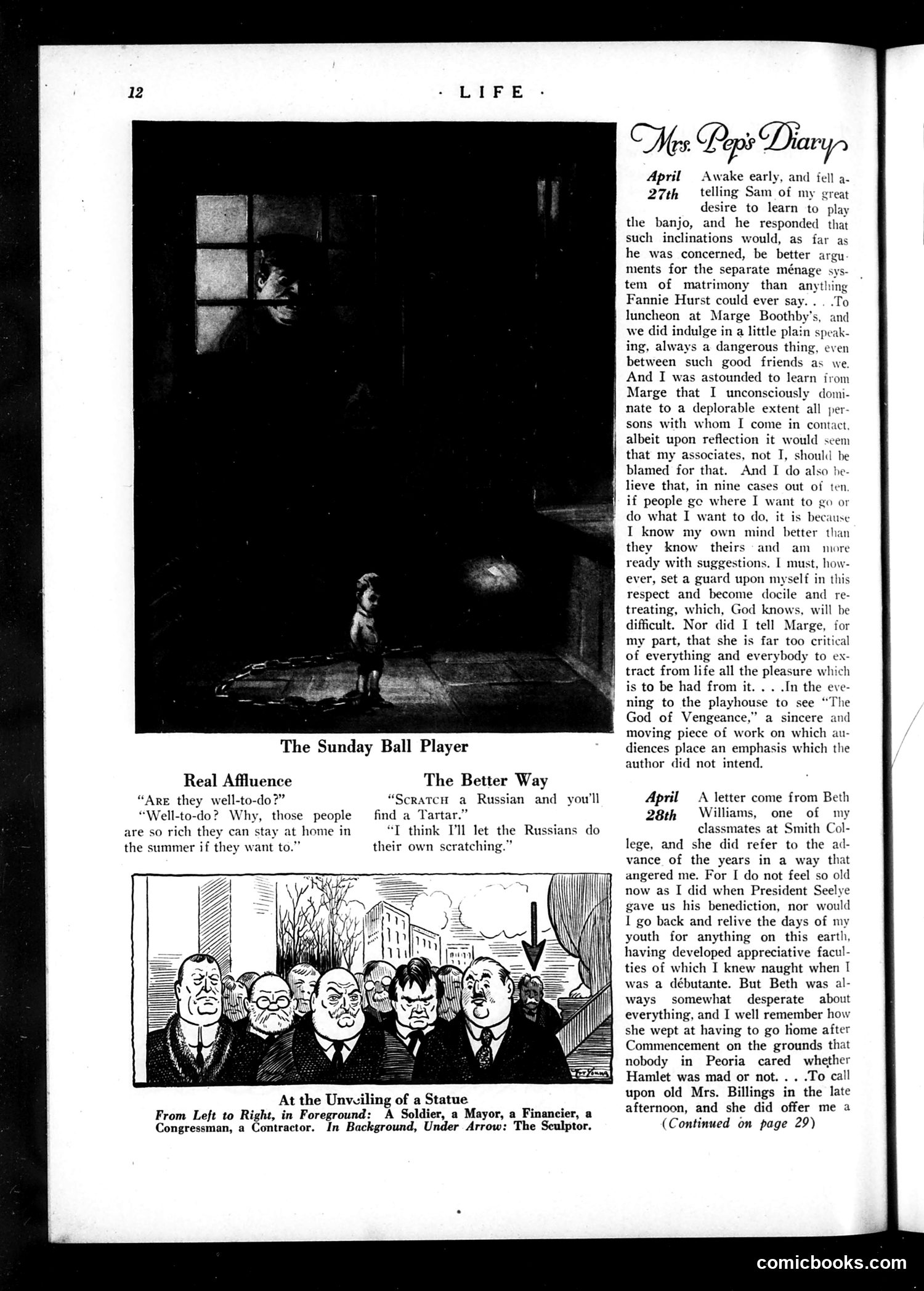
This satirical cartoon depicts five caricatured men at a statue unveiling ceremony. The caption identifies them left-to-right as "A Soldier, a Mayor, a Financier, a Politician, a Congressman" and notes "The Sculptor" in the background. The joke appears to mock public ceremony attendees and civic leaders as self-serving or corrupt types. The accompanying text snippets—"Real Affluence" (discussing wealthy people staying home summers) and "The Better Way" (a joke about Russians and Tartars)—suggest the cartoon critiques hypocrisy among the elite and powerful. The exaggerated facial expressions and body language typical of Life magazine's satirical style emphasize these figures as ridiculous or contemptible representatives of American institutions.
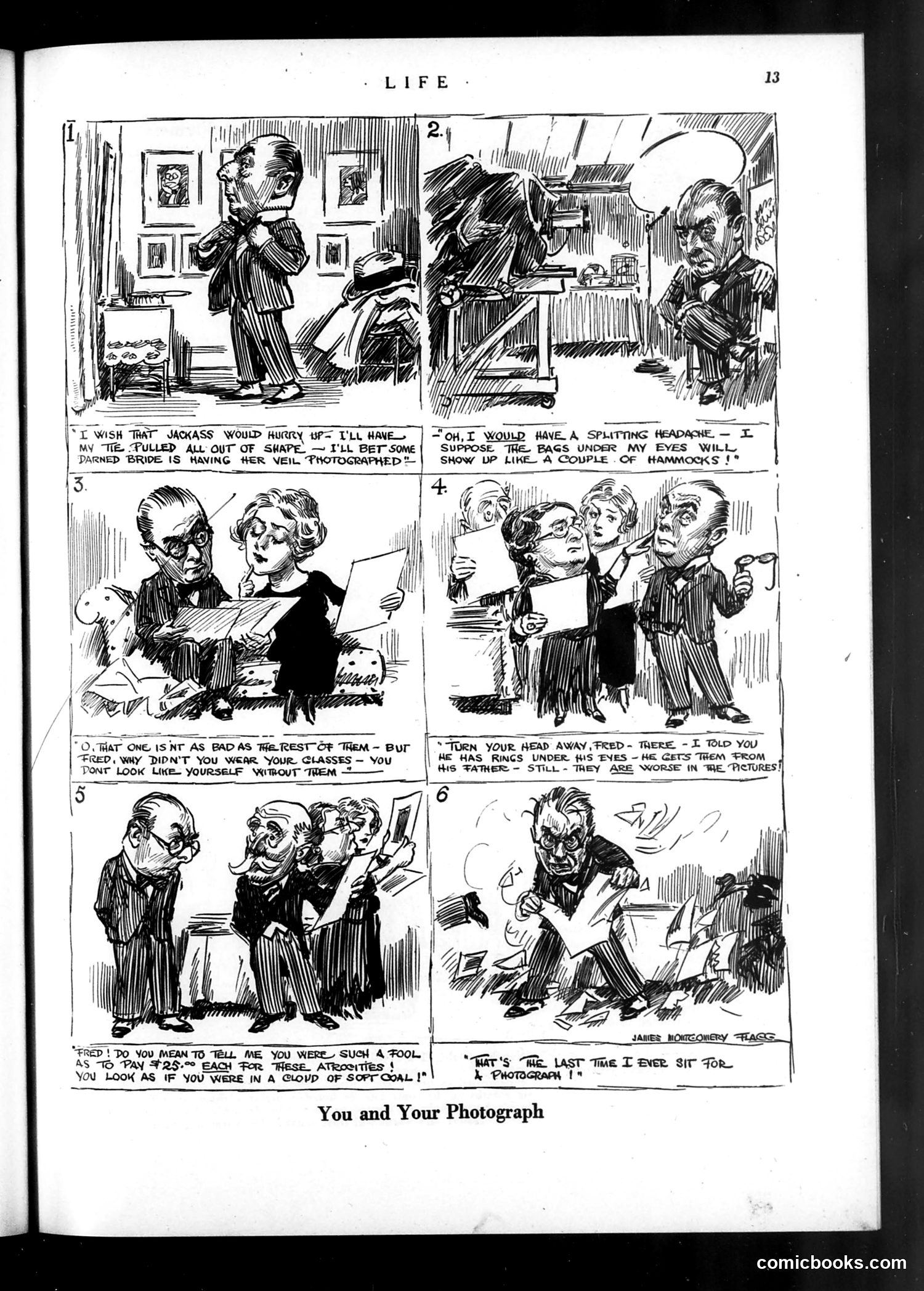
This six-panel satirical comic mocks the vanity and poor results of early portrait photography. The narrative follows a man preparing for a professional photograph: 1-2: He anticipates looking dignified, hoping the photographer will touch up his appearance. 3-4: The finished photograph reveals unflattering reality—bags under his eyes, poor presentation—disappointing compared to expectations. 5-6: When confronted about paying $25 per photograph, he realizes he's been fleeced, comparing himself unfavorably to coal miners in appearance. The humor targets both the pretensions of early 20th-century portrait photography and subjects' unrealistic expectations. The joke reflects contemporary frustration with photography's inability to enhance appearance as much as hoped, and photographers' seemingly exploitative pricing.
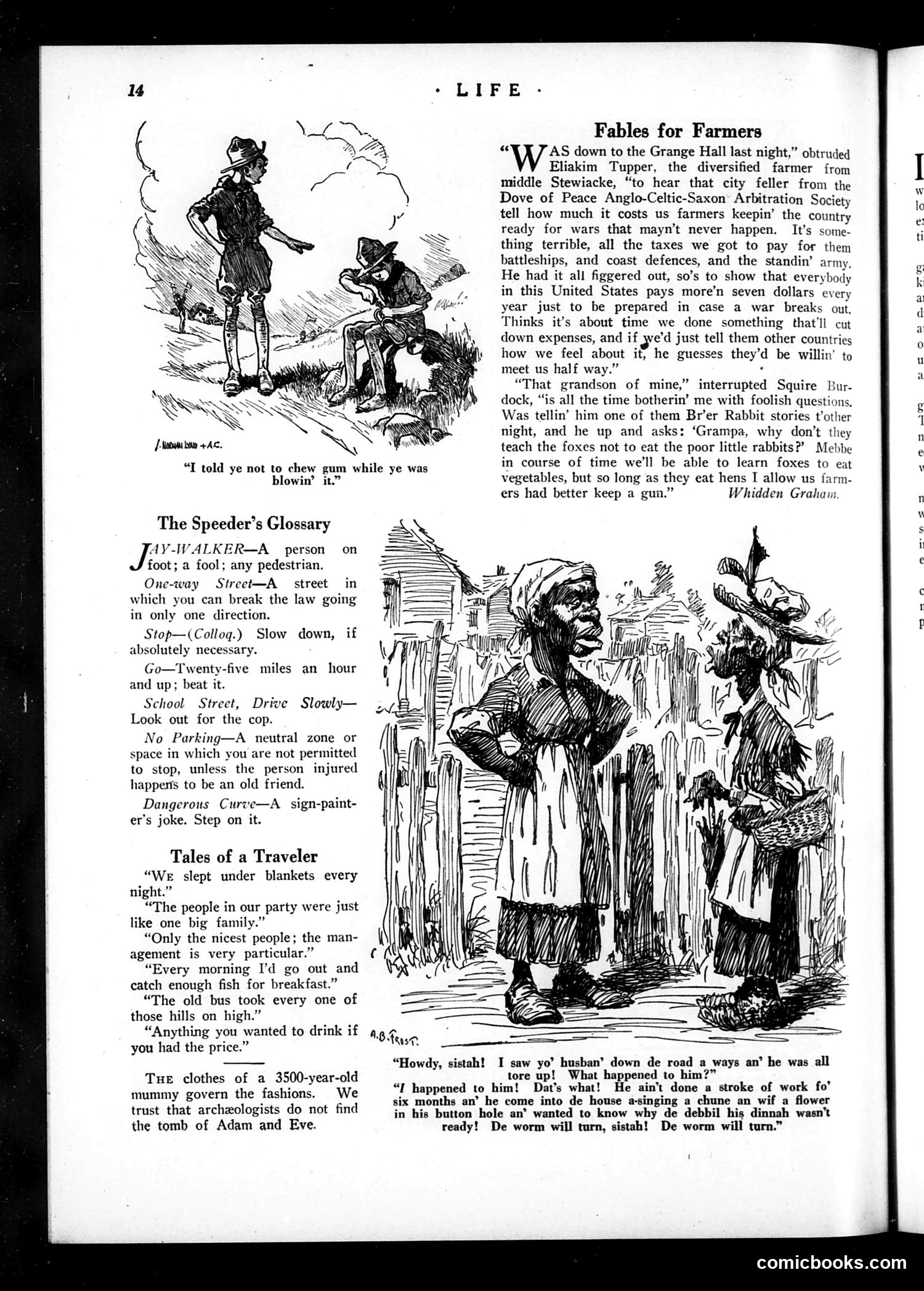
This page contains three satirical sections typical of Life's humor content: **"Fables for Farmers"** criticizes excessive military spending. Eliakum Tupper, a farmer, complains that Americans pay seven dollars yearly per capita for military preparedness against hypothetical wars, while other nations spend less. The satire targets wasteful defense budgeting during peacetime. **"The Speeder's Glossary"** mocks traffic enforcement jargon with absurdist definitions (e.g., "No Parking" means you can only break the law in one direction). **"Tales of a Traveler"** and the accompanying illustration appear to feature vernacular humor about rural or working-class life, though the specific reference is unclear from visible text. The cartoons use working-class characters to satirize government policies and social conventions of the era.
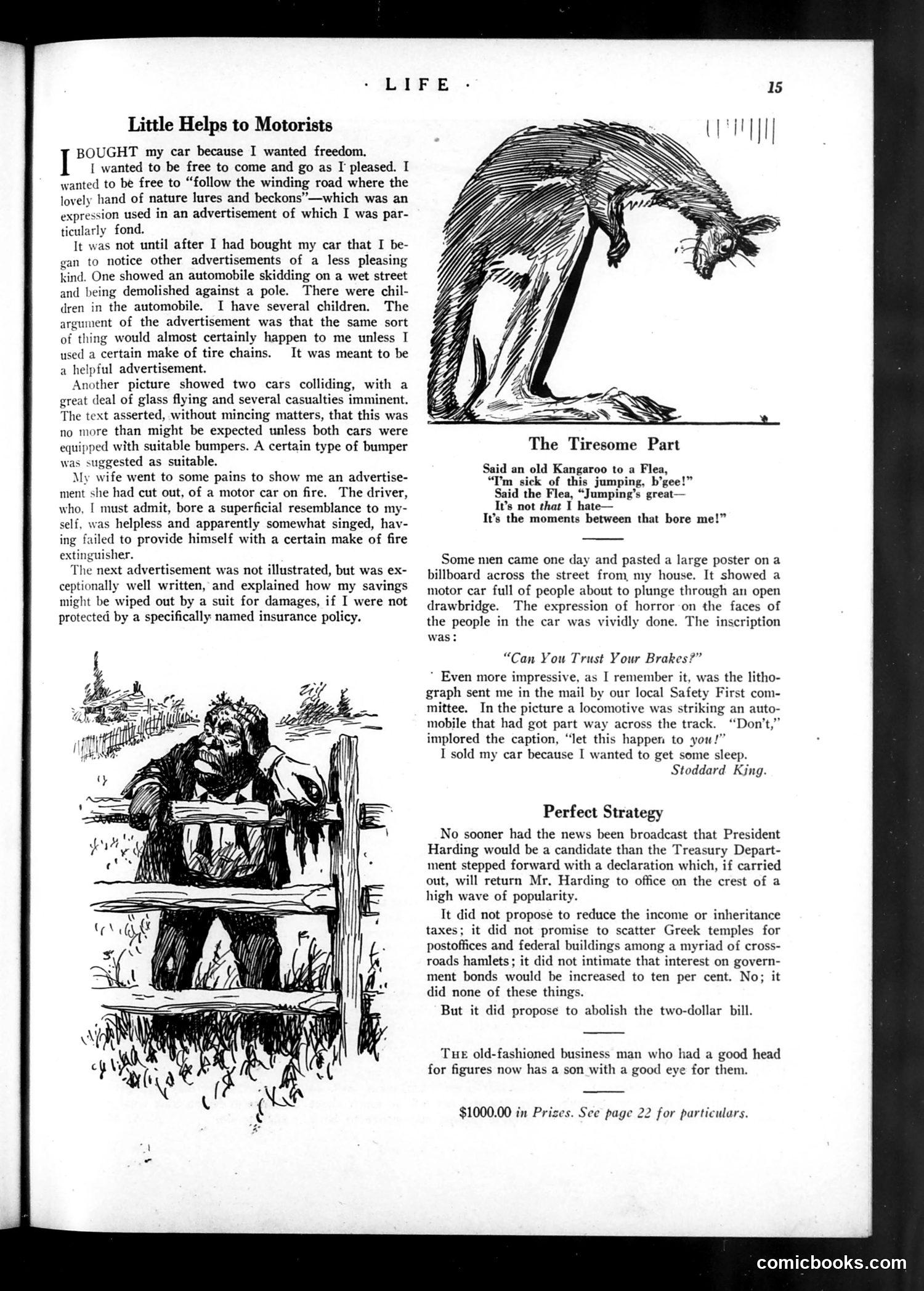
This satirical piece mocks aggressive automotive safety advertising of the 1920s. The author describes receiving increasingly alarming advertisements featuring car crashes, fires, and collisions—each designed to frighten him into buying specific products (tire chains, bumpers, fire extinguishers, insurance). The humor lies in the escalating absurdity: safety campaigns use gruesome imagery featuring children to manipulate consumer fear. The accompanying kangaroo cartoon reinforces the theme—the flea represents these constant safety warnings; the kangaroo is exhausted not by jumping itself but by the relentless "moments between" (the anxious intervals between scares). The author concludes he sold his car seeking peace from the psychological bombardment of fear-based marketing. The "Perfect Strategy" section separately satirizes President Harding's political popularity-building through abolishing the two-dollar bill—portrayed as trivial pandering.
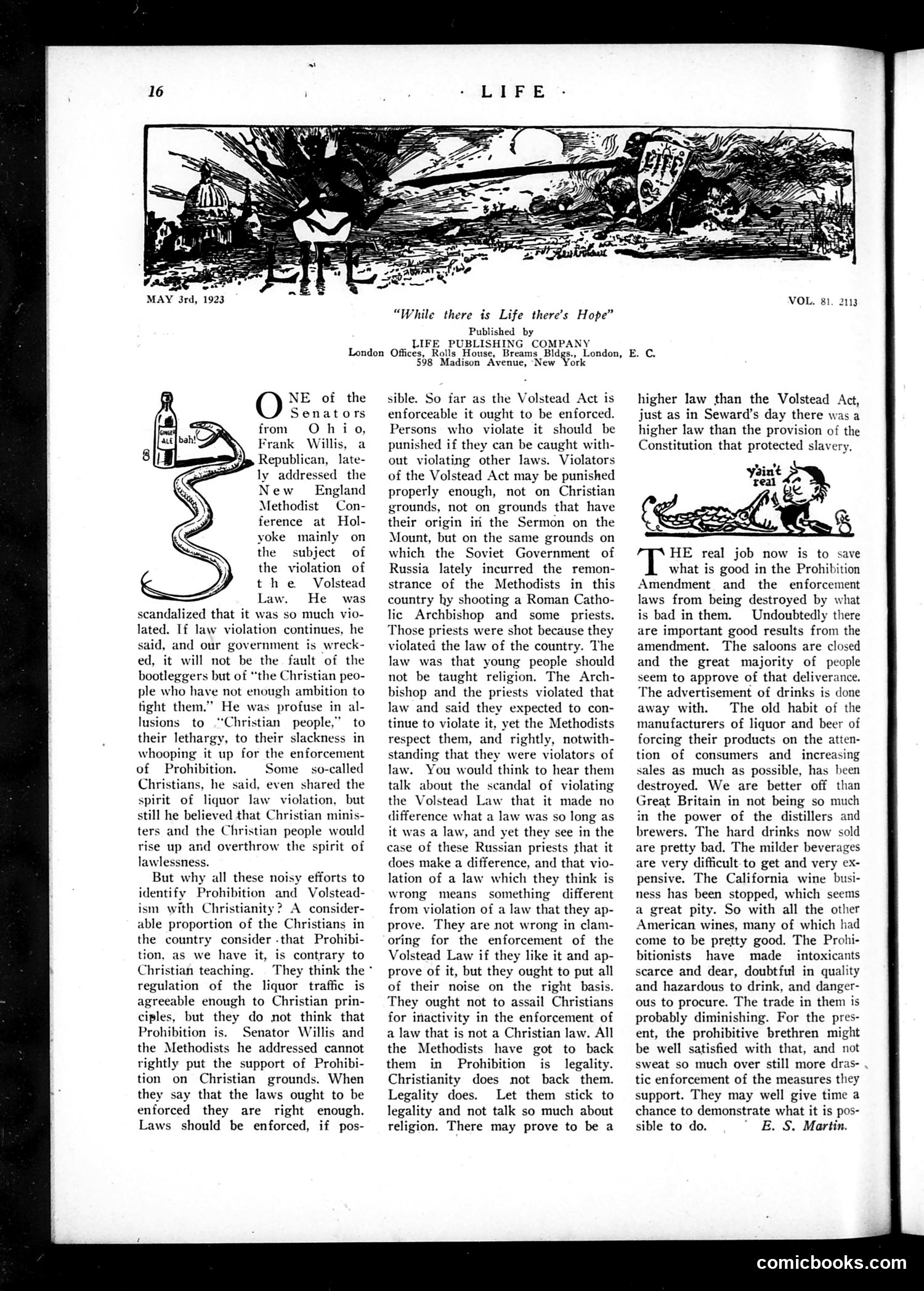
This 1923 *Life* magazine page critiques Senator Frank Willis (Ohio Republican) and Methodist leaders who framed Prohibition enforcement as a Christian moral duty. The satire's core argument: they're conflating legality with Christianity. The editorial points out hypocrisy: these same Methodists respected Russian priests who violated Soviet law against religious teaching—proving they recognize that *which* law matters morally. Yet they demand Christians enforce the Volstead Act (Prohibition law) on religious grounds, ignoring that many Christians consider Prohibition itself unchristian. The author argues legality and morality aren't identical. Just as abolitionists invoked "higher law" against slavery's constitutional protection, some may justify violating unjust laws. The Methodists should defend Prohibition on legal grounds alone, not claim Christianity demands its enforcement—a distinction they themselves acknowledge when defending the Russian priests.
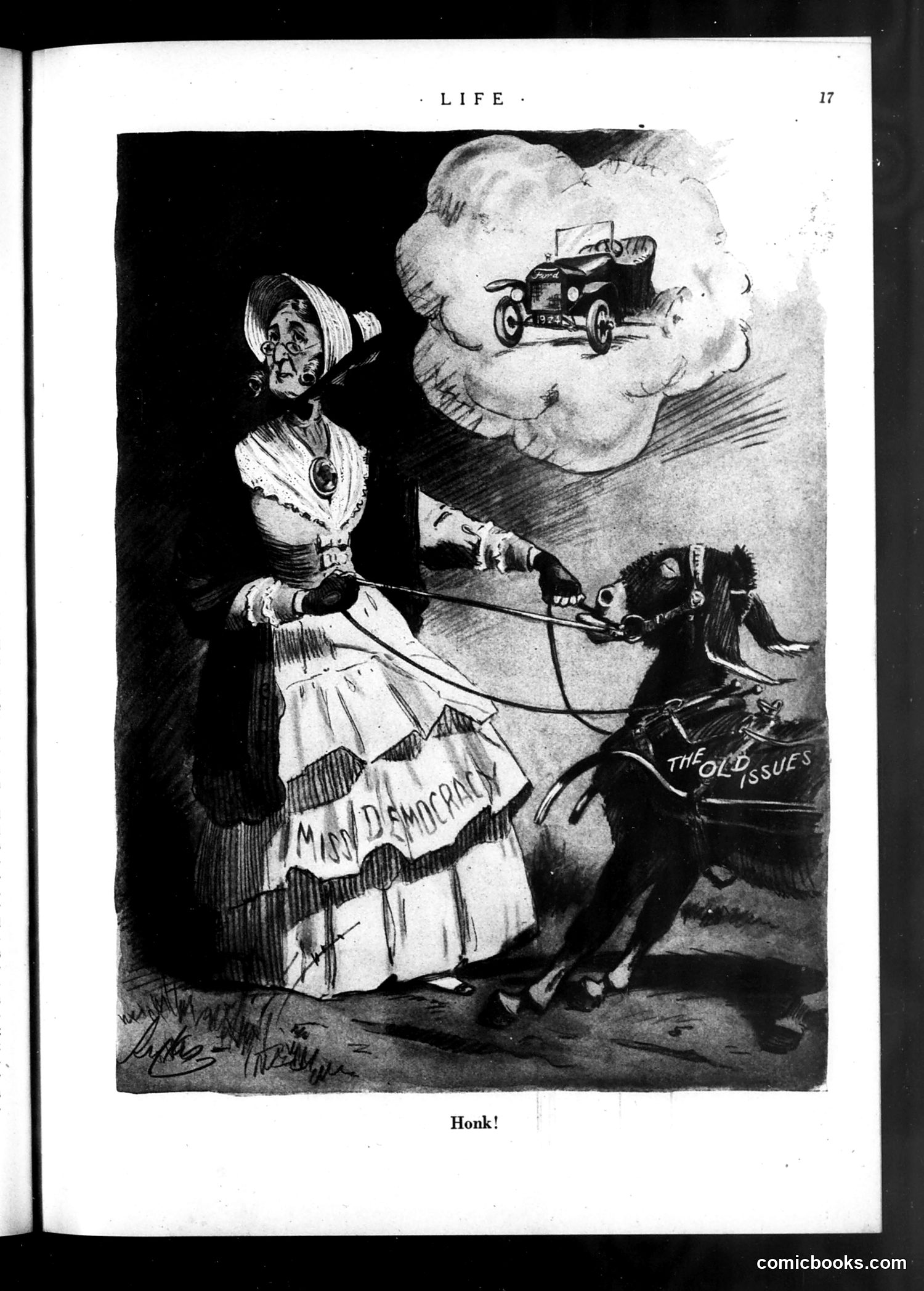
This satirical cartoon from *Life* magazine depicts a woman labeled "Miss Dishonest" being pulled by a large grotesque figure representing "The Old Issues" in a horse-drawn carriage. The figure is dreaming of—or dangling before her—a modern automobile, suggesting temptation or false promises. The satire critiques how outdated political problems or corrupt practices ("the old issues") continue to entrap society by offering superficial modernization or progress. The woman's formal Victorian dress contrasts with the modern auto, emphasizing the tension between clinging to old problems versus embracing genuine change. The caption "Honk!" reinforces the automobile imagery. The cartoon likely comments on political corruption or dishonesty persisting despite apparent modernization in American society.
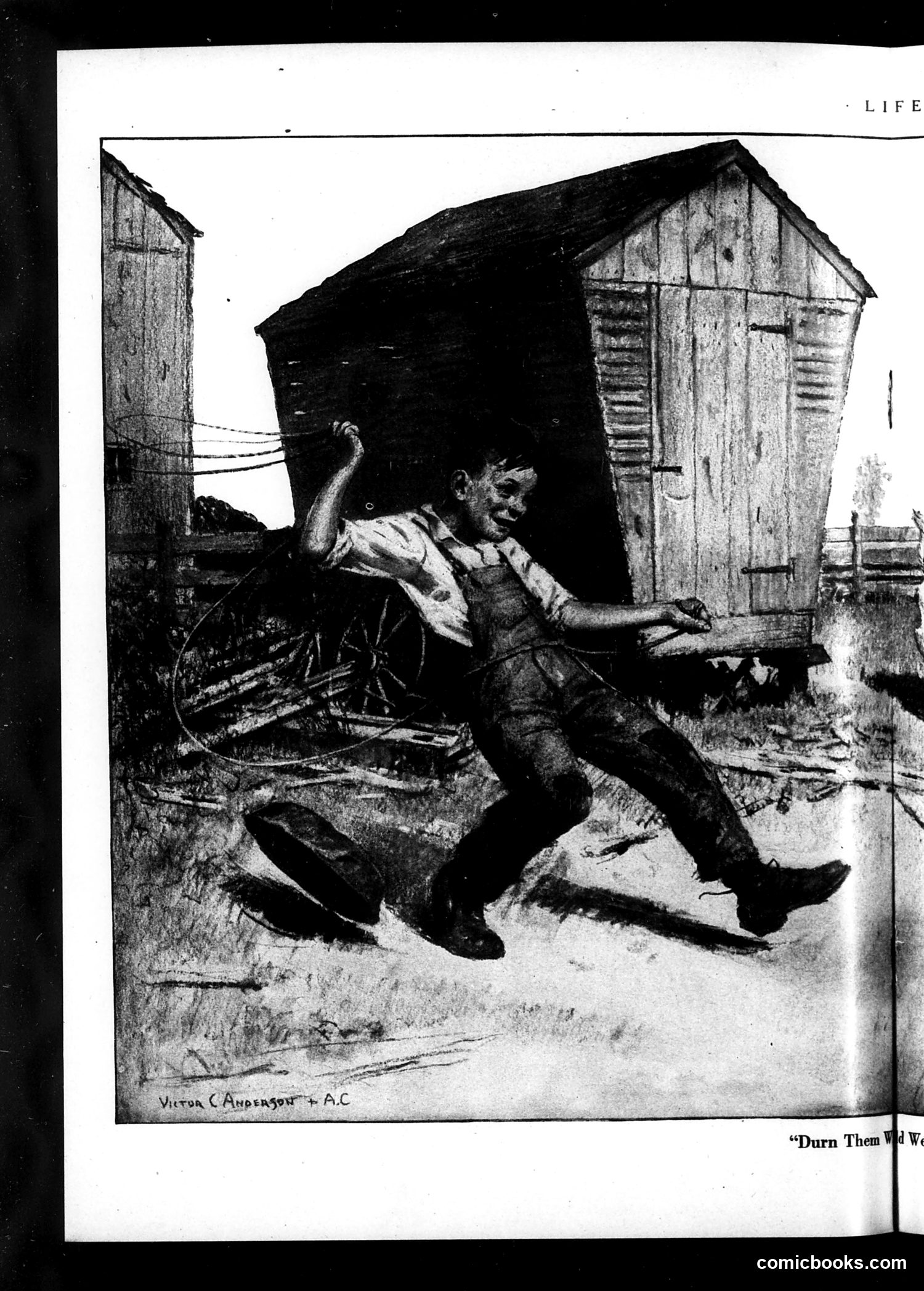
This appears to be a satirical illustration by Victor C. Anderson signed "A.C." The image shows a young boy in overalls emerging from a rural farm shed or outhouse structure, depicted in an exaggerated, comedic pose with his arms spread wide. The rural setting includes a water tower and fencing typical of early 20th-century American farms. The partially visible caption at bottom reads "Durn Them W[...]" (text cut off), suggesting rustic or rural dialect humor. Without the complete caption and full context, the specific satirical point is unclear. However, given *Life* magazine's tradition of lampooning rural American life and manners, this likely mocks country living, rural customs, or farm culture—a common target of the magazine's urban-focused humor during this era. The exact reference remains uncertain.
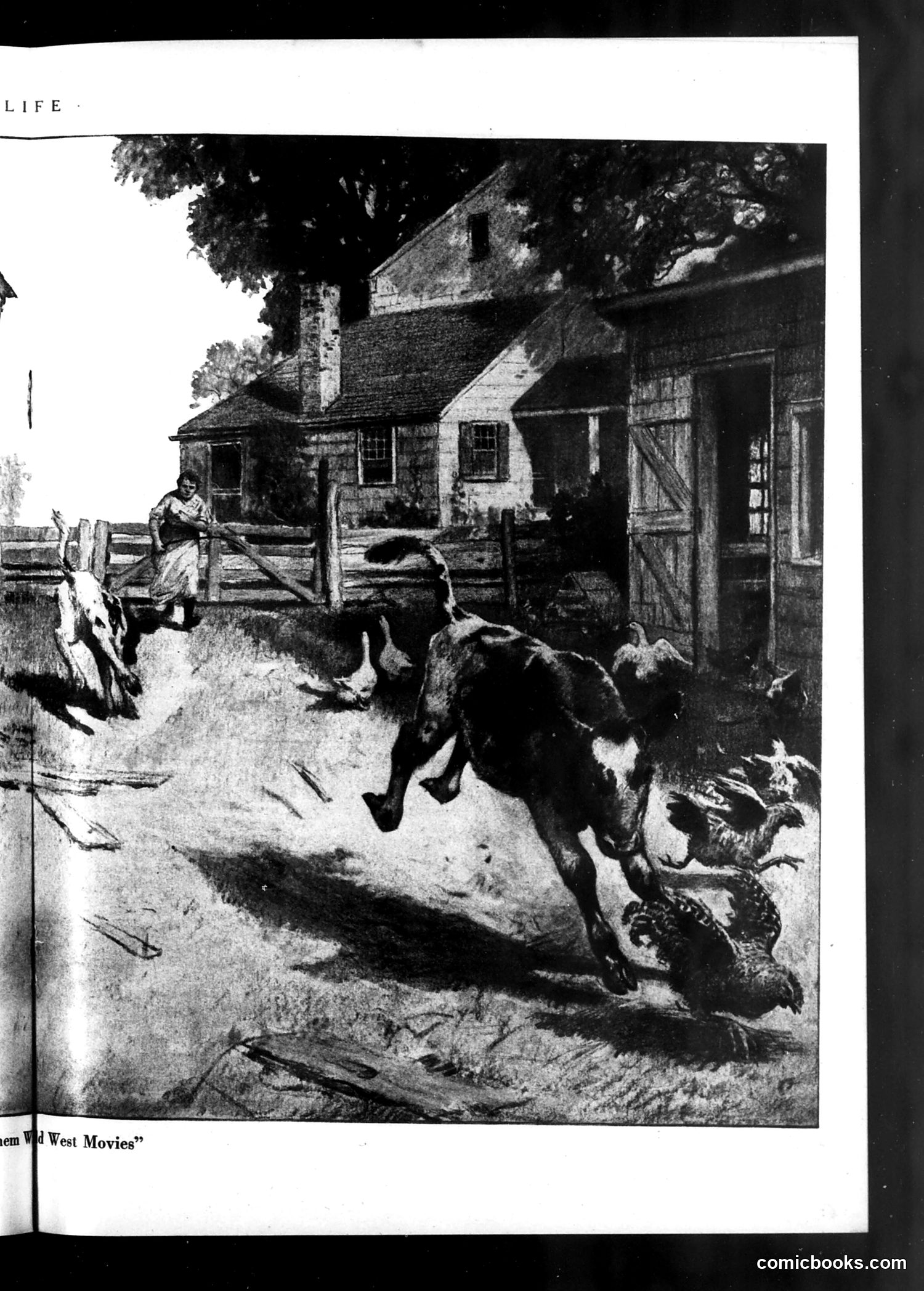
This appears to be a still photograph from an early Western film, not a political cartoon. The image shows a ranch scene with a cowboy on the left near a fence, several dogs chasing or attacking what appears to be a steer or bull in the center, and ranch buildings in the background. The caption references "Old West Movies," suggesting this is documentary coverage of early cinema rather than satire. The page itself is from *Life* magazine's "LIFE" section, but this particular content documents Hollywood's production methods rather than offering political or social commentary. Without clearer context or visible satirical elements, this reads as a straightforward behind-the-scenes photograph from early Western film production.
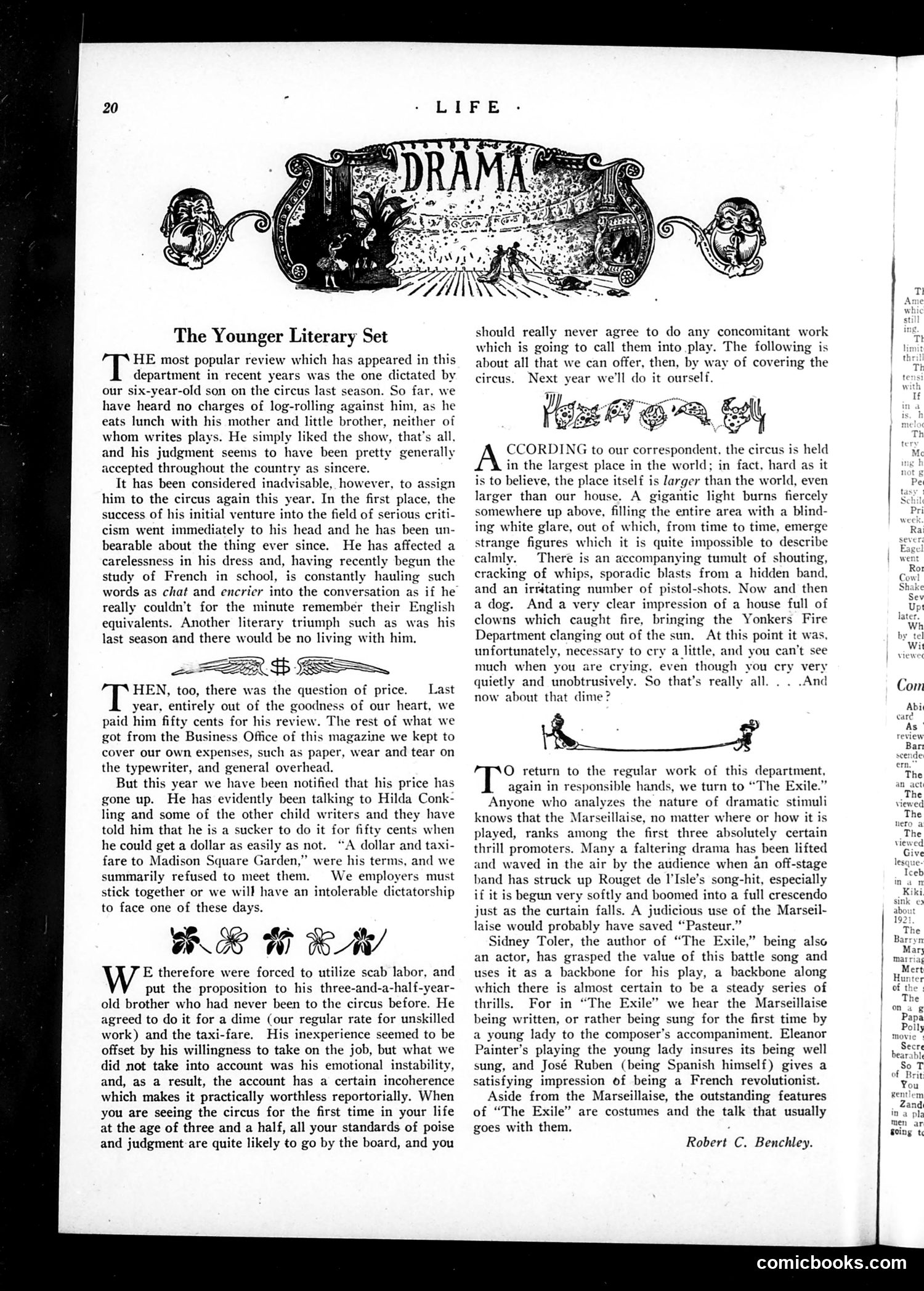
This is a humorous essay satirizing both child prodigies and labor disputes in the arts. The author paid his six-year-old son fifty cents to review the circus the previous season; the review was surprisingly popular and sincere. Now the child has become insufferable—affecting French affectations and demanding higher pay (a dollar plus taxi fare to Madison Square Garden) after being influenced by other "child writers" like Hilda Conkling. The father refuses, citing the need for "employers" to "stick together" against "intolerable dictatorship." Facing a strike, he hires his three-and-a-half-year-old as "scab labor" for a dime. The resulting circus review—included below—is intentionally incoherent, capturing a toddler's genuine overwhelming sensory experience rather than coherent criticism. The satire mocks both precocious child authors of the era and contemporary labor negotiations, treating childhood contract disputes as serious industrial conflict.
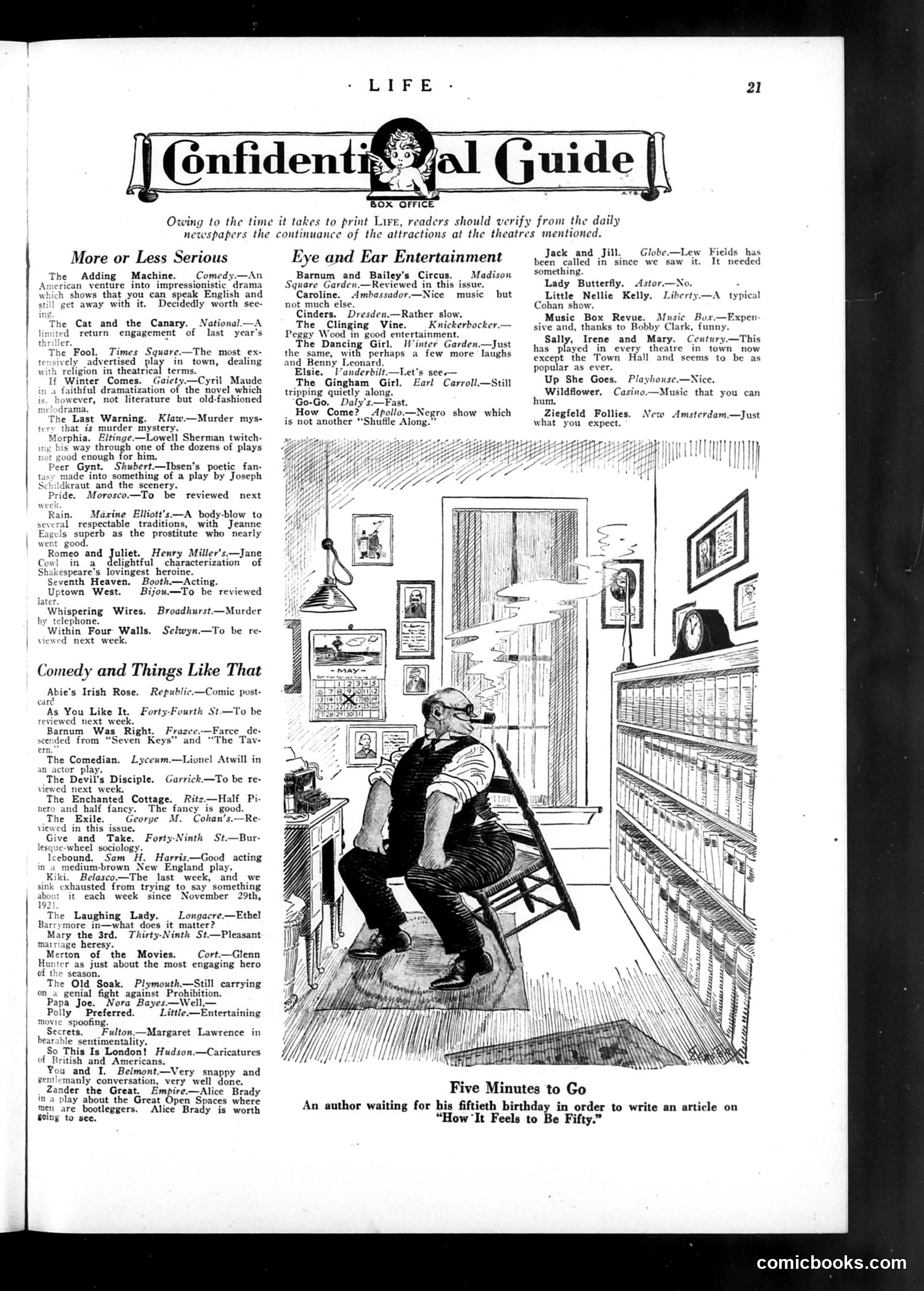
This page is a **theater review guide** from *Life* magazine—a staple feature listing Broadway productions with brief critical commentary. The main cartoon illustrates the caption below it: "Five Minutes to Go—An author waiting for his fiftieth birthday in order to write an article on 'How It Feels to Be Fifty.'" The joke satirizes the common practice of milestone-age articles. An anxious middle-aged man sits in his study, surrounded by books and writing materials, waiting to turn 50 so he can write the required reflective piece—suggesting that people mechanically produce such articles on schedule rather than from genuine inspiration. The reviews themselves mention now-obscure Broadway hits (like *Abie's Irish Rose* and *Kiki*) and note topical concerns: *The Old Soak* "carrying on a genial fight against Prohibition," and *So This Is London!* offering "caricatures of British and Americans"—reflecting 1920s cultural preoccupations with Prohibition enforcement and Anglo-American relations.
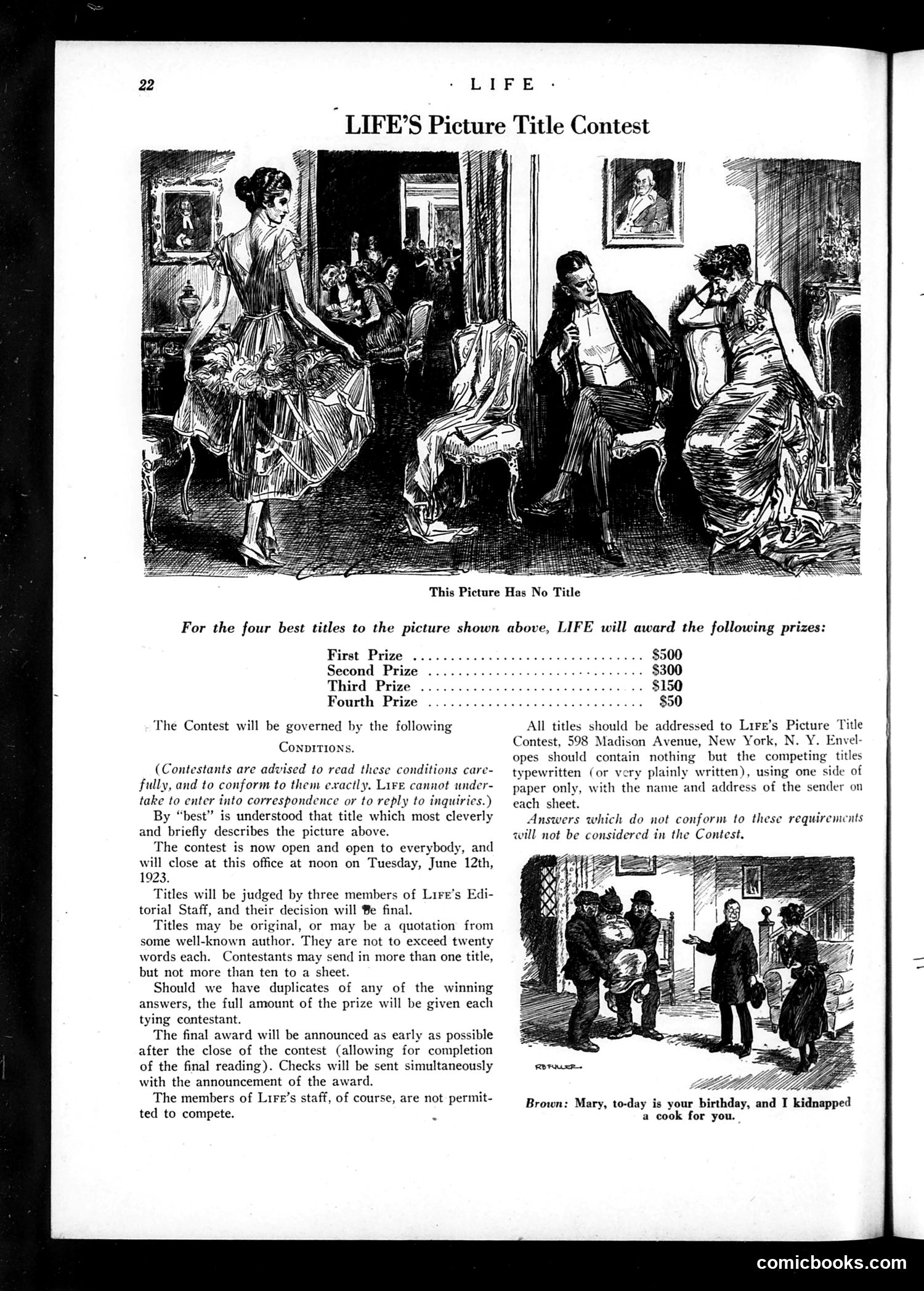
This page announces a reader-submission contest where Life magazine invites the public to suggest titles for an untitled illustration. The main image depicts an elegant social gathering—a woman dancing or performing while well-dressed guests observe in a parlor setting, suggesting upper-class entertainment. The contest offers prizes ($500 to $50) for the cleverest, most concise titles (maximum twenty words). Submissions must be typed, follow specific formatting rules, and arrive by June 12, 1923. Below is an unrelated cartoon captioned "Brown: Mary, to-day is your birthday, and I kidnapped a cook for you"—a joke about solving the domestic servant shortage (a post-WWI labor problem) through humorous "kidnapping." The page reflects early 1920s magazine culture where reader engagement through contests was common advertising strategy.
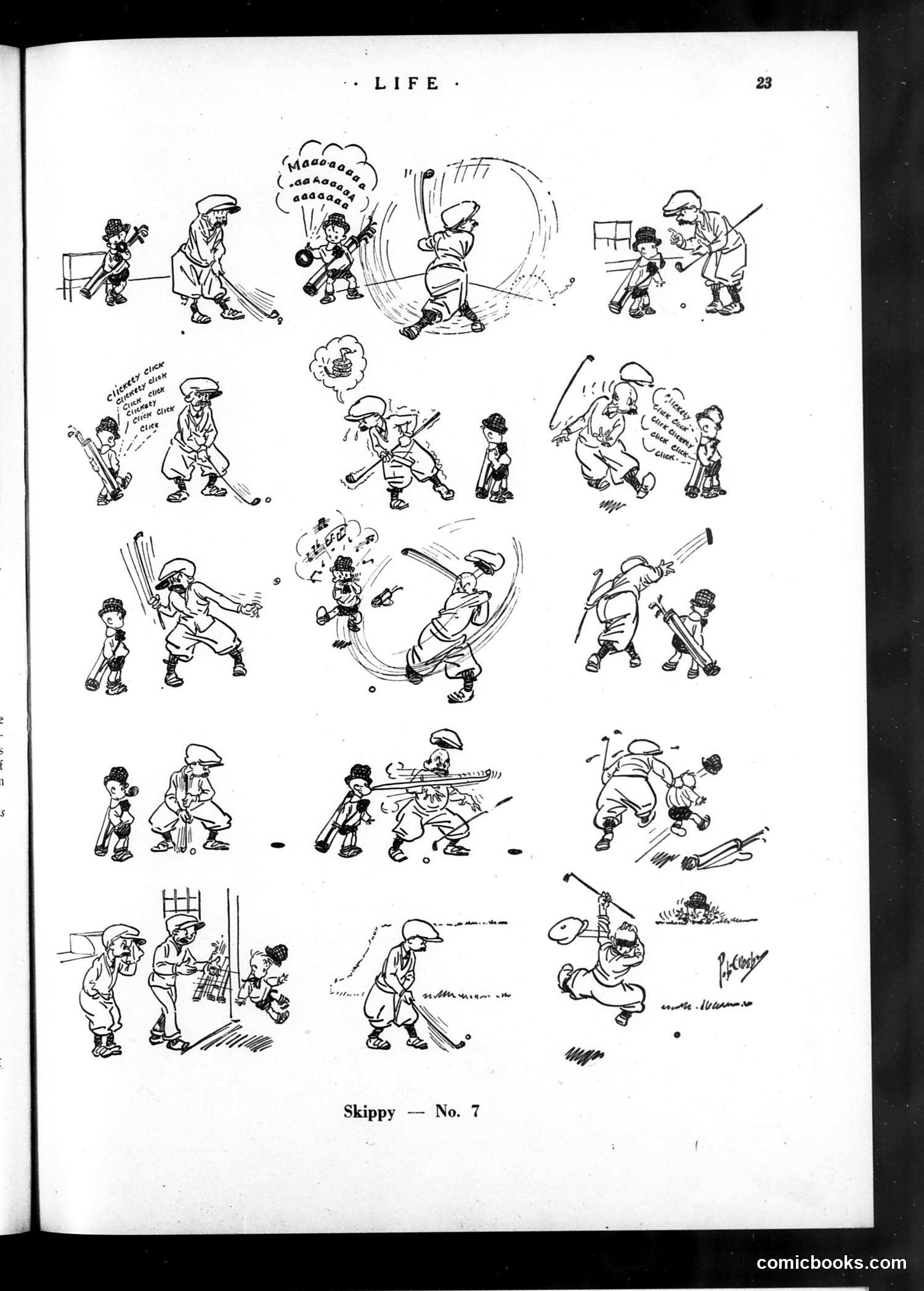
This page presents a comic strip sequence titled "Skippy," depicting a young boy character engaged in various baseball and street activities with other children and adults. The illustrations show typical early 20th-century childhood scenes: playing baseball, practicing with bats, interacting with what appears to be a coach or older male figure, and general neighborhood play. The strip appears to be a gentle, observational humor piece about childhood games and social dynamics rather than political satire. The humor derives from children's behavior, their earnestness in play, and interactions with authority figures. The OCR text is largely illegible, preventing specific caption identification, but the visual narrative emphasizes physical comedy and the everyday world of urban youth during this period.
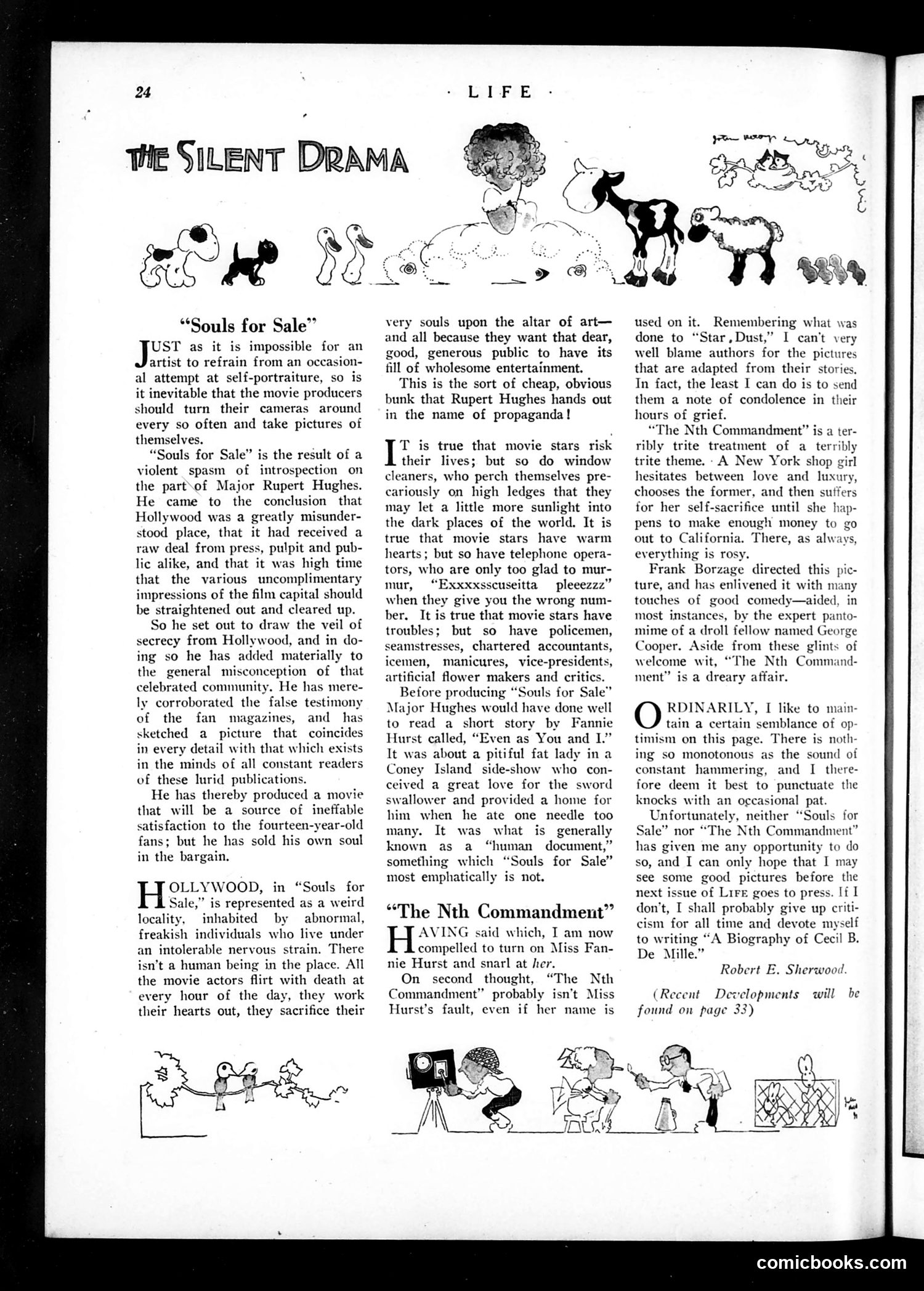
This page critiques two silent films through satirical reviews. "Souls for Sale," directed by Major Rupert Hughes, is mocked for presenting Hollywood as inhabited by self-sacrificing martyrs. The reviewer argues Hughes perpetuates fan-magazine mythology rather than revealing truth—comparing actors' supposed nobility to window cleaners' or telephone operators' equally valid sacrifices. The satire suggests Hughes's "propaganda" actually *reinforces* misconceptions he claimed to dispel. "The Nth Commandment," adapted from Fannie Hurst's story, receives similar dismissal as trite and formulaic—another New York shopgirl choosing love over luxury, conveniently resolved when she relocates to California. The reviewer sympathizes with authors whose work gets butchered in adaptation, particularly noting previous mishandlings like "Star, Dust." The decorative cartoon strips throughout illustrate film production absurdities, reinforcing the page's cynical view of Hollywood's self-mythologizing during the silent film era.
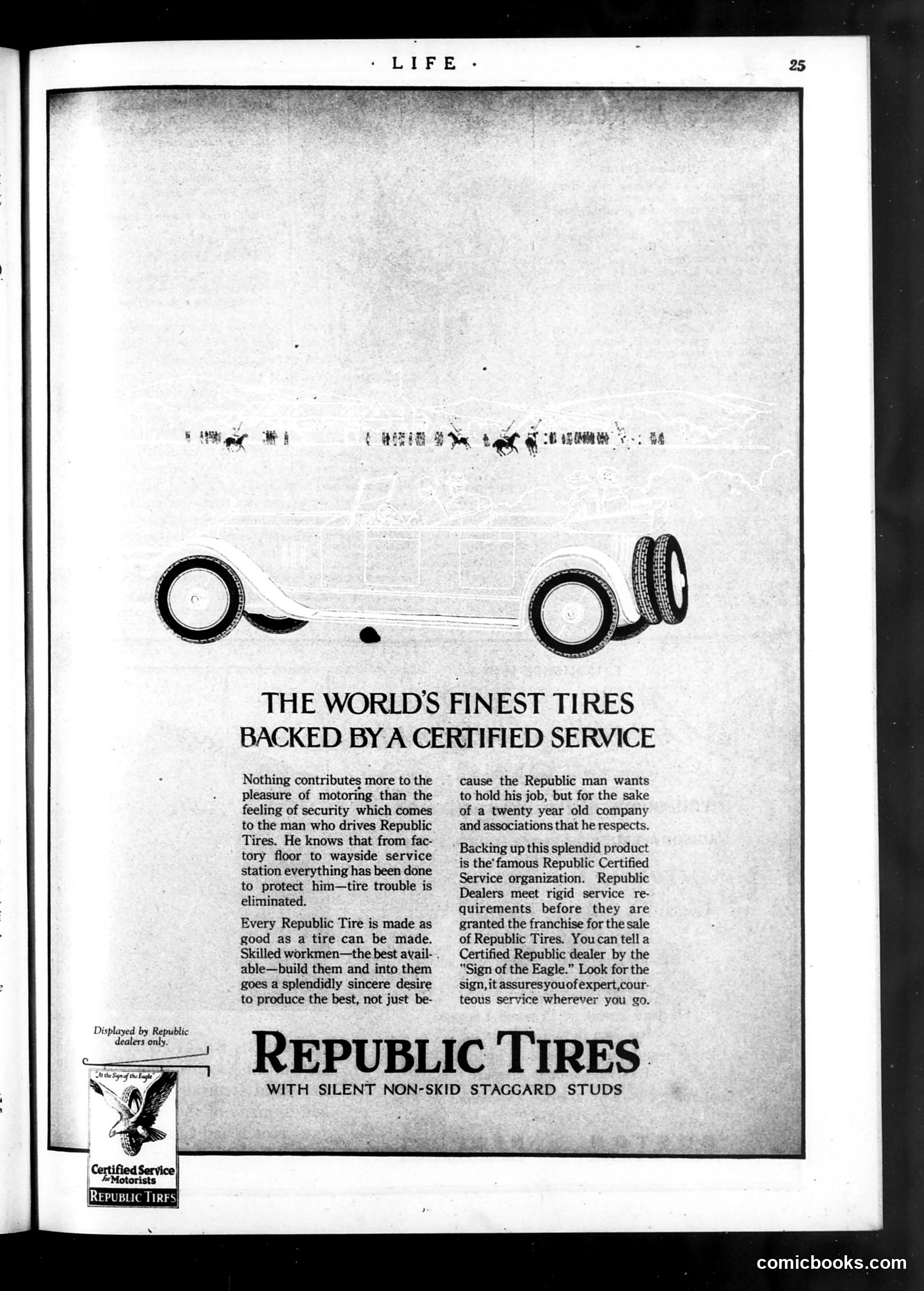
This is a **product advertisement**, not a political cartoon. It's a full-page ad for Republic Tires from *Life* magazine, promoting their tires and certified dealer network. The page features a simple line drawing of an automobile chassis with prominent tires on each end, emphasizing the product. The ad's messaging targets middle-class car owners, emphasizing security and reliability. Key selling points include: - Factory-to-service-station quality control - Skilled workmanship and company pride (referencing a "twenty year old company") - A "Certified Service" dealer network identified by an "Eagle" sign - "Silent non-skid staggard studs" (anti-skid technology) The appeal is to consumer confidence during the automobile era—a driver choosing Republic Tires gets not just a product but an entire service ecosystem guaranteeing expert, courteous support. The "Eagle" branding suggests patriotic, quality-assured American manufacturing.
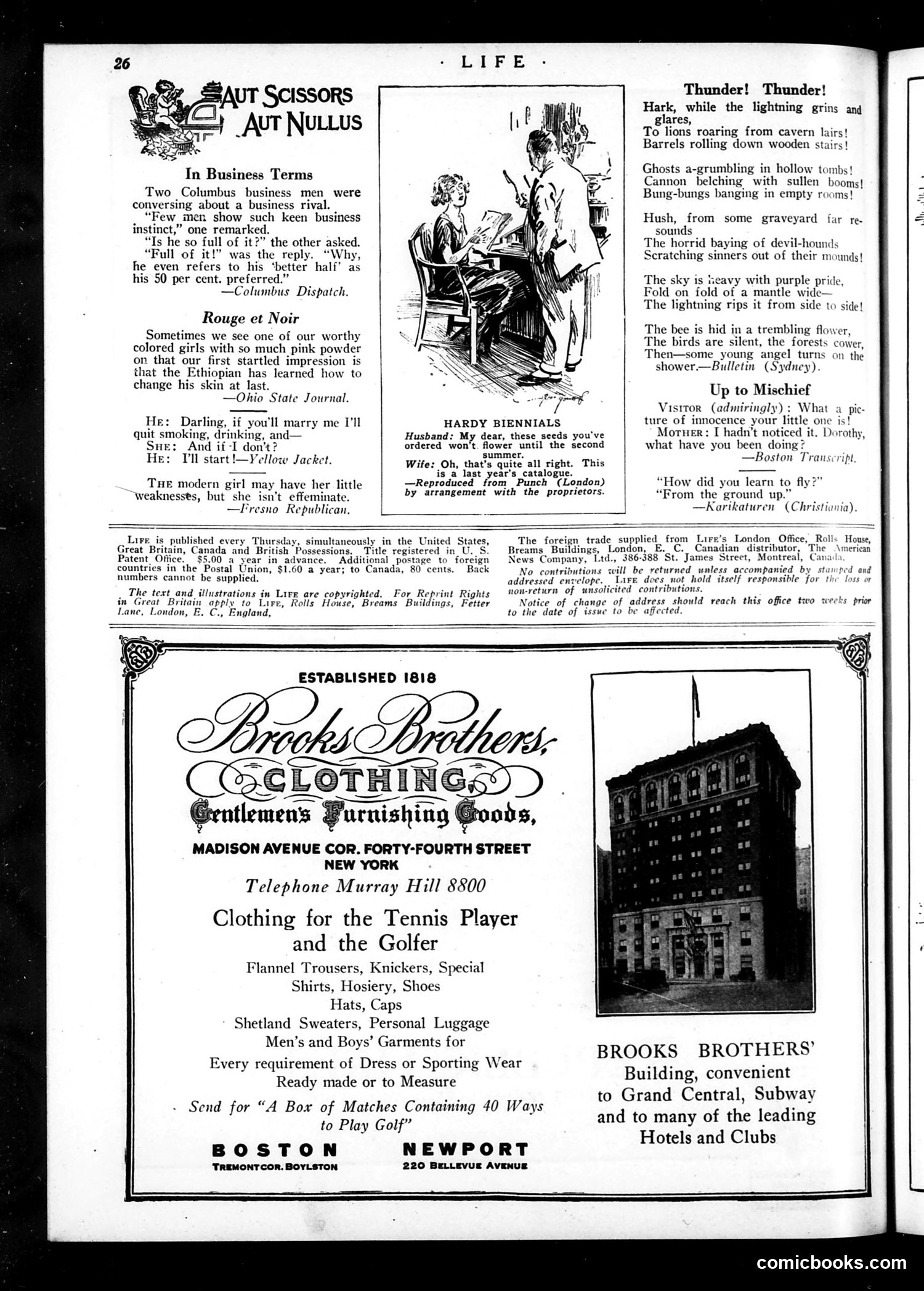
This page is primarily **advertising and humor shorts** rather than political content. The page contains: **Four brief jokes:** 1. A businessman refers to his wife as his "50 per cent. preferred" (stock market language applied to marriage) 2. Commentary on Black women wearing excessive face powder, treating it as a humorous observation about cosmetics 3. A man proposes to quit vices if his girlfriend marries him; she agrees—then he'll start (the vices, implying he was lying) 4. A wife orders seeds that won't flower until next year, using a outdated catalog **Poetry section** titled "Thunder! Thunder!" describing a dramatic storm with gothic imagery. **Two brief anecdotes** about visiting and children's misbehavior. **Dominant content:** A large **Brooks Brothers advertisement** occupying roughly half the page, promoting gentlemen's clothing for tennis and golf, with the company's building photograph and Manhattan address. The humor relies on wordplay, marital tension tropes, and period-typical observations. No significant political satire is present on this page.
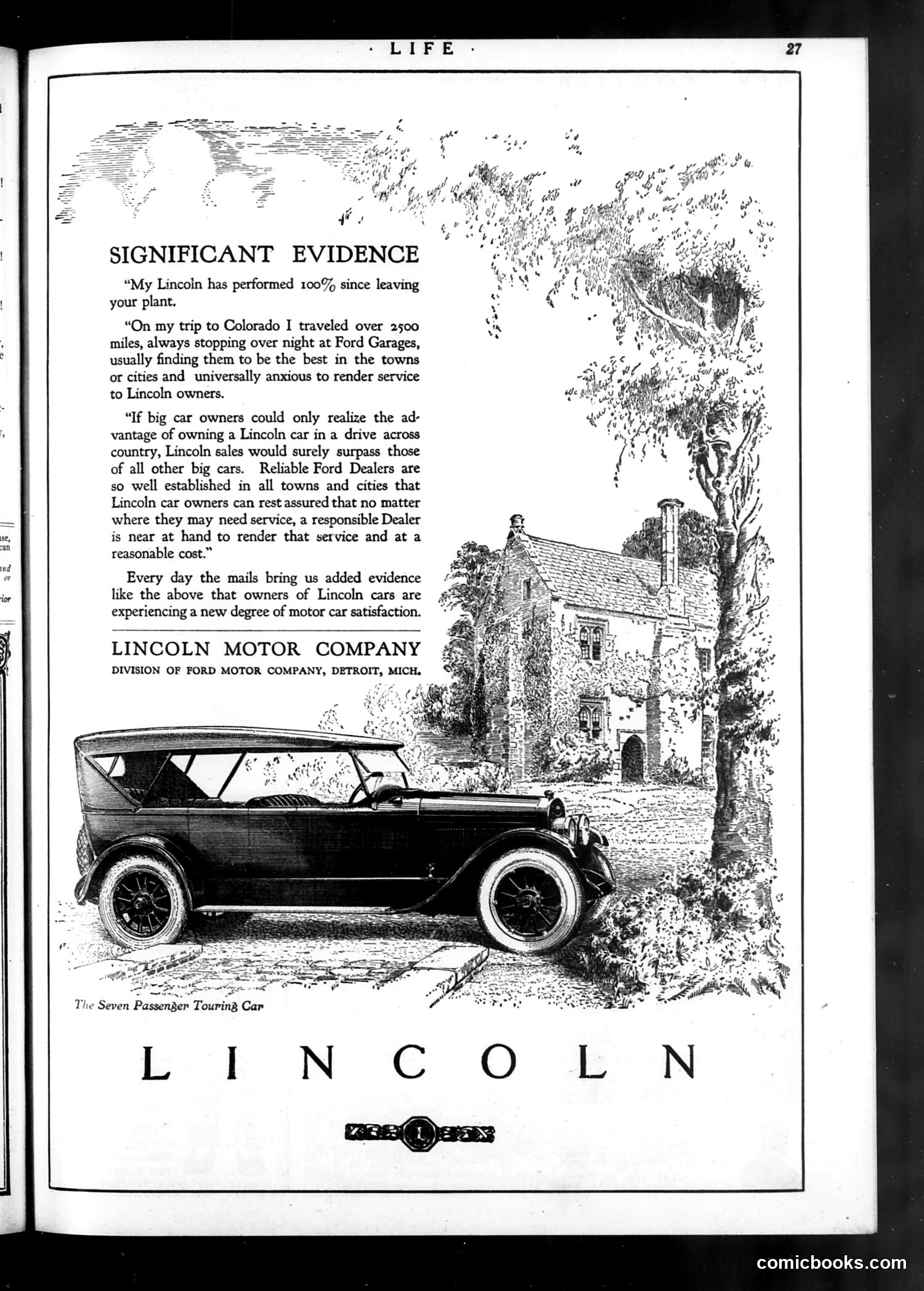
This is a full-page Lincoln Motor Company ad from Life magazine, featuring testimonial advertising. The "significant evidence" isn't satire—it's a genuine customer quote praising Lincoln's reliability and the availability of Ford dealers nationwide for service. The image shows a "Seven Passenger Touring Car" parked before a quaint cottage, establishing aspirational lifestyle messaging. The advertisement emphasizes Lincoln's competitive advantage: their parent company Ford's widespread dealer network ensures owners can find service anywhere, even on cross-country trips. This reflects early automotive-era concerns about reliability and service accessibility. The ad argues that Lincoln owners have superior support compared to competitors, making long-distance travel practical. The period detail—stopping overnight at garages, the touring car style—captures 1920s automobile culture.
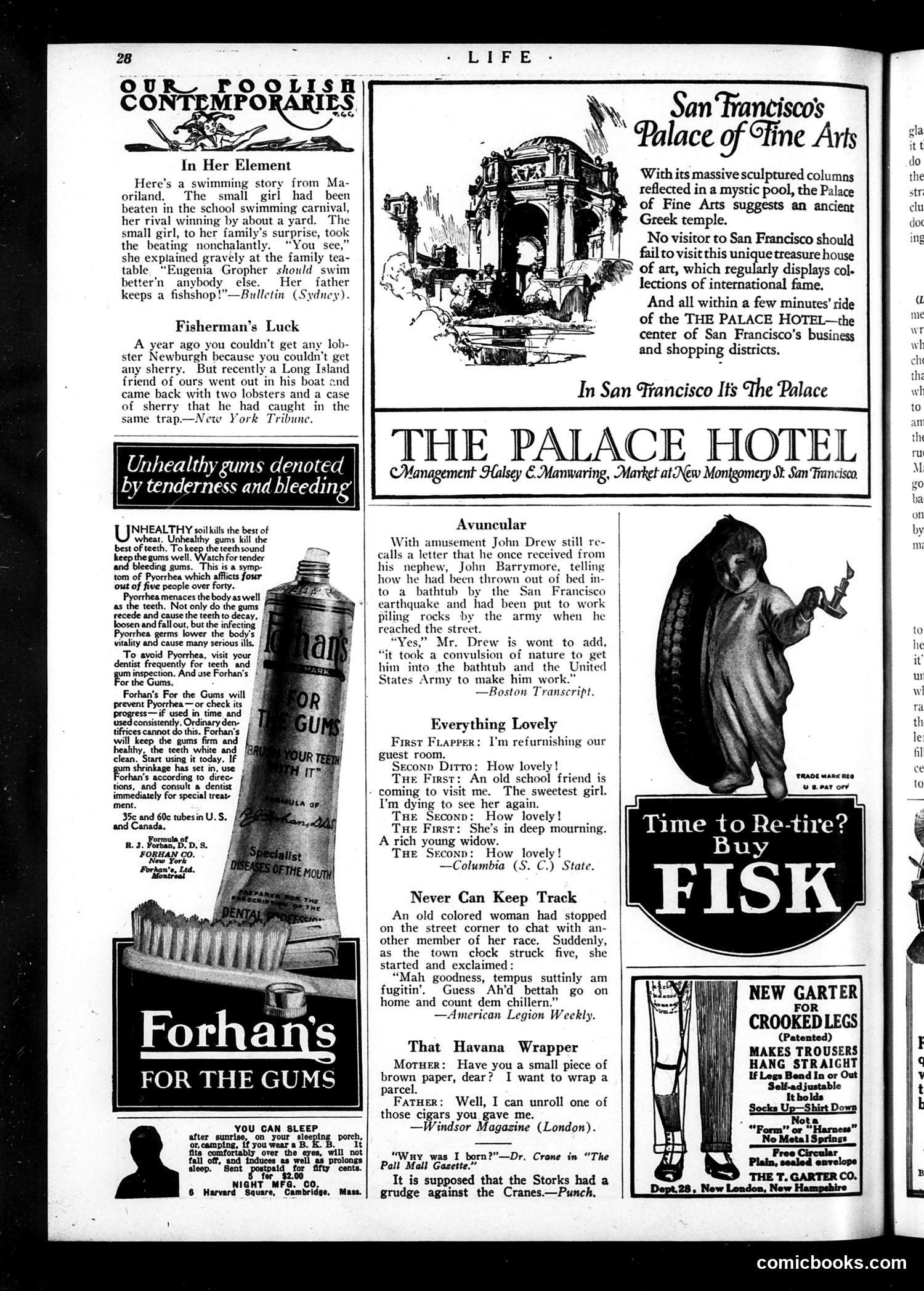
This page contains primarily **humor and advertisements** from Life magazine's "Our Foolish Contemporaries" section. The cartoons and jokes target everyday social observations rather than specific political figures: **The jokes mock:** - A child's logic about swimming ability based on her rival's father's occupation (fishmonger) - Wartime scarcity (sherry/lobster shortage during Prohibition era) - A conversation between two "flappers" (modern young women) expressing exaggerated politeness about a widow in mourning visiting - An elderly Black woman's malapropism, confusing "tempus fugit" (time flies) with "tempus am fugitin'" **The advertisements** promote dental care (Forhan's toothpaste for gum disease), The Palace Hotel in San Francisco, Fisk tires, and garter products. The humor is gentle, domestic satire typical of 1920s Life magazine—no sharp political commentary. The racial stereotype in the final joke reflects period attitudes but isn't the page's primary focus. Overall, this is a light entertainment/advertising page rather than politically engaged commentary.
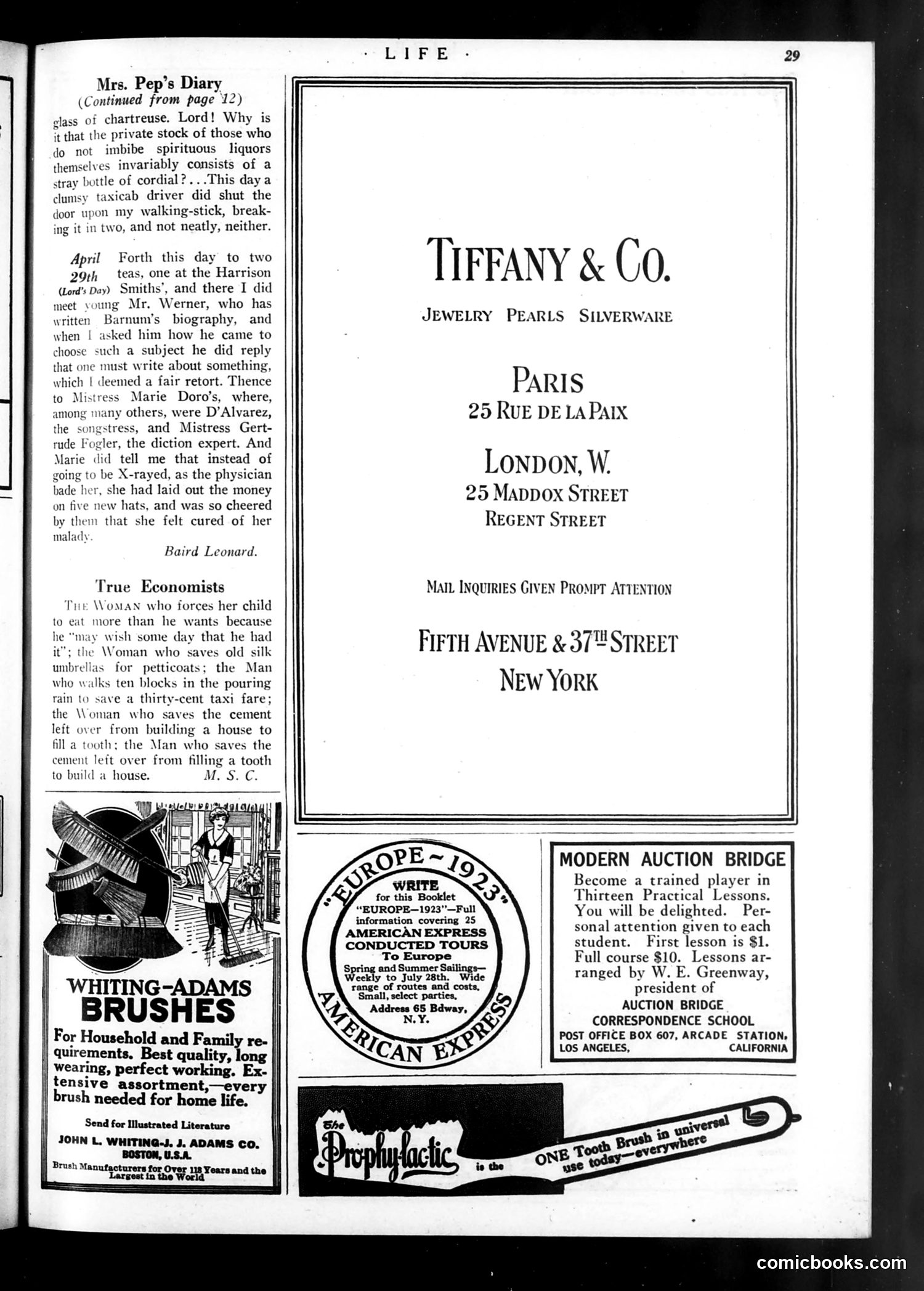
This page combines humor writing with period advertising, offering no political cartoons. **Content:** "Mrs. Pep's Diary" (continued) presents gossipy, satirical vignettes from high-society social calls and encounters with literati like a Barnum biographer. The humor depends on period-specific details: concerns about cordials in liquor cabinets, taxi incidents, and fashionable salon visits. **Satire:** "True Economists" mocks penny-pinching contradictions—people who save thirty cents on taxi fares while wasting money elsewhere, or who salvage building materials to patch teeth (or vice versa). The humor lies in exposing absurd false economy. **Advertising:** The remainder features luxury goods (Tiffany & Co.), travel services (American Express European tours), household brushes, and Auction Bridge lessons—all targeting affluent readers circa 1923. The page is primarily entertainment and commercial content rather than political commentary.
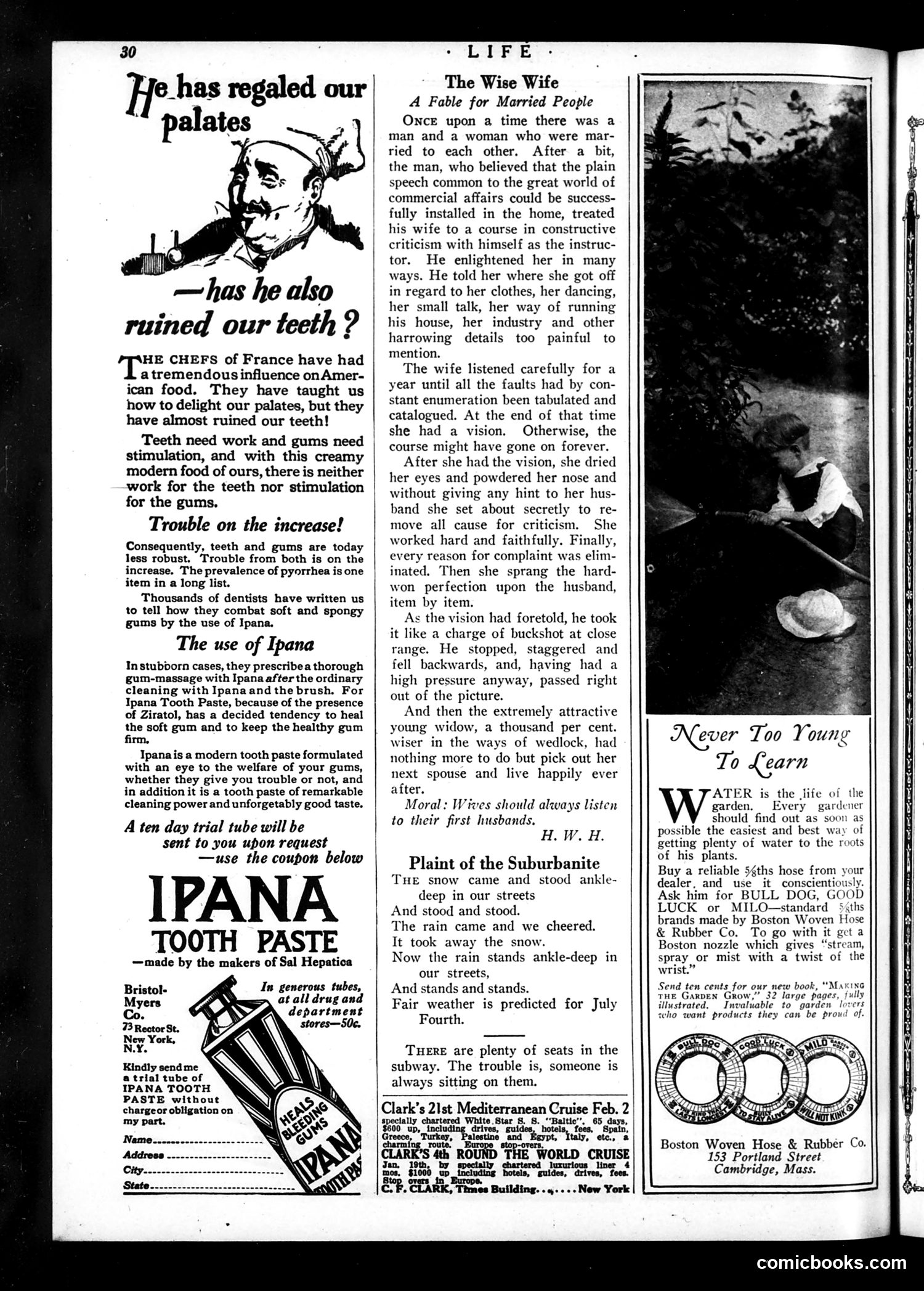
This page satirizes **French culinary influence on American dentistry**. The left column's advertisement warns that while French chefs have taught Americans to enjoy refined food, their soft, creamy cuisine provides insufficient jaw stimulation, causing tooth decay and gum disease. It promotes Ipana toothpaste (containing "Ziratol") as the solution—a period-accurate advertisement disguised as health advice. The center presents "The Wise Wife," a marital fable where a husband constantly criticizes his wife's domestic conduct. She secretly corrects every flaw, then reveals her perfection—which shocks him so severely he dies. The moral sardonically advises wives to ignore husbands' criticism. This appears to satirize both excessive marital nagging and the difficulty of pleasing overly critical partners. The brief poems below mock suburban weather complaints and subway crowding—light observational humor typical of Life's satirical voice during this era.
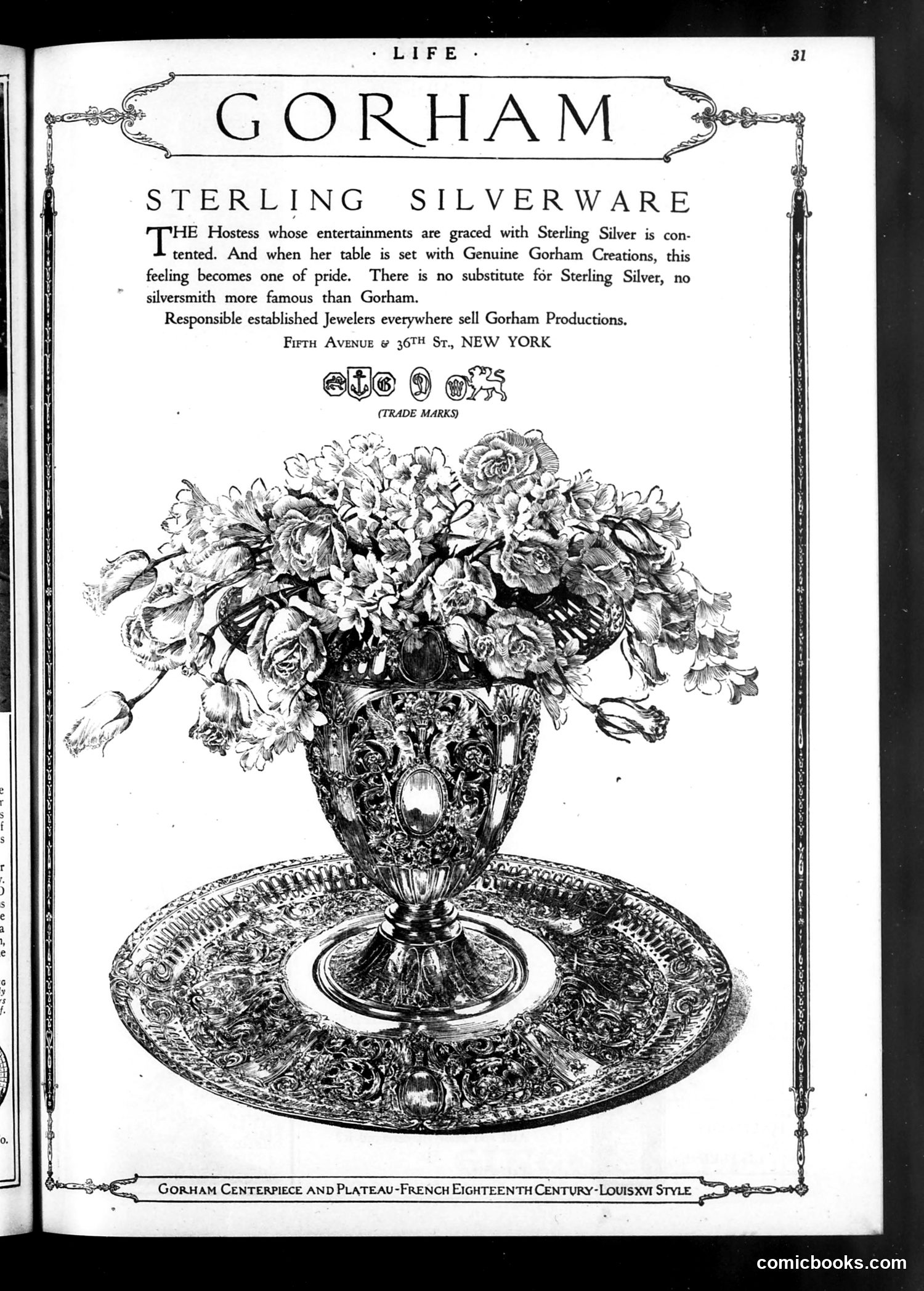
This is **not a cartoon or satire**—it's a straightforward advertisement for Gorham sterling silver products, appearing in *Life* magazine (page 31). The ad promotes Gorham Manufacturing Company's luxury silverware, targeting wealthy hostesses. It emphasizes that using Gorham sterling silver at dinner parties conveys status and pride. The ornate illustration shows an elaborate French-style silver centerpiece and plateau (serving tray), densely decorated with relief work and topped with an urn holding flowers. The copy reassures consumers that Gorham is "famous" and has "no substitute," positioning sterling silver—not plated ware—as essential for respectable entertaining. The company's Fifth Avenue and 36th Street New York address reinforces its prestige. This reflects early 20th-century upper-class consumer culture where luxury goods demonstrated social standing.
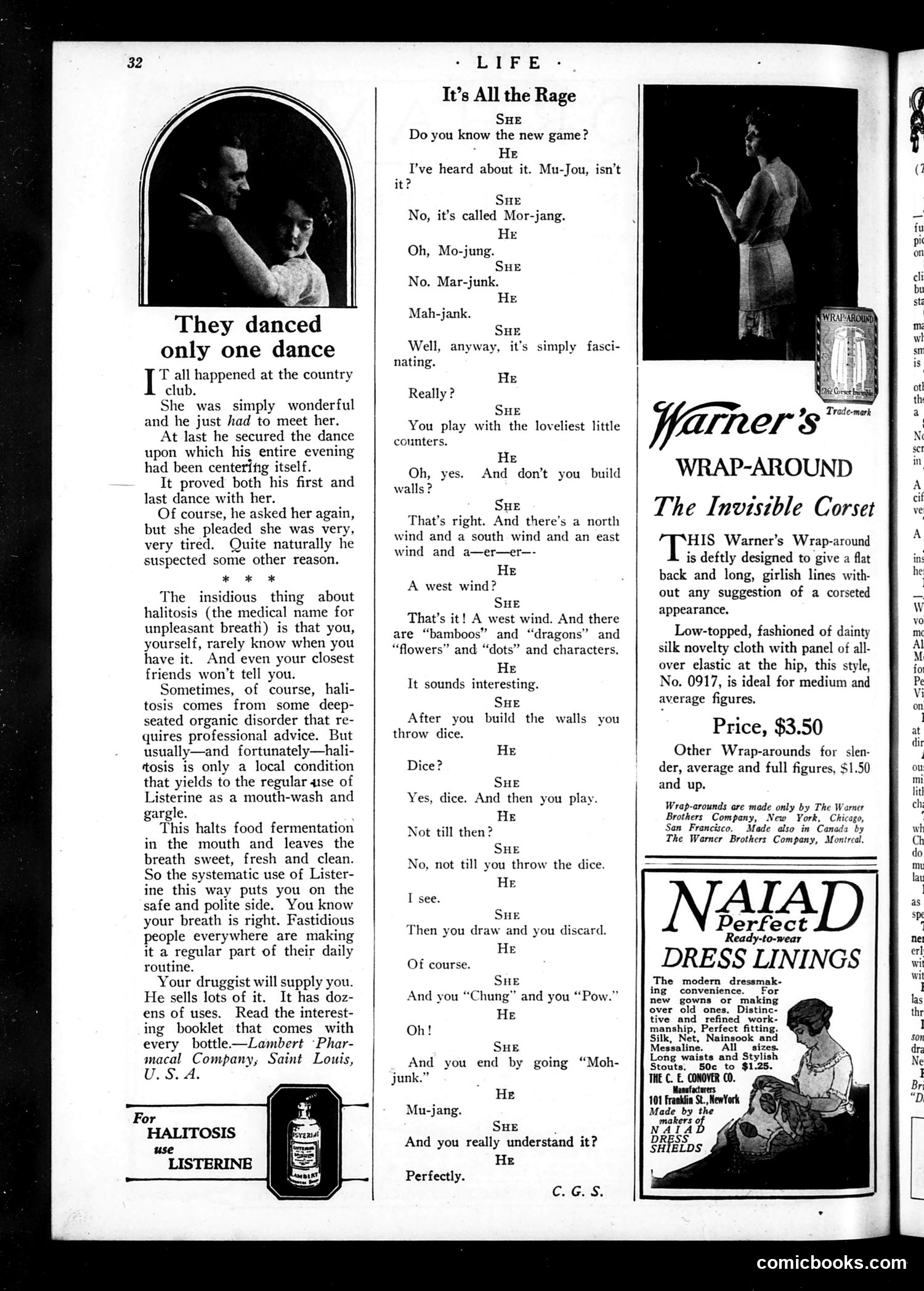
This page contains two satirical pieces about social embarrassment: **"They danced only one dance"** is a Listerine advertisement disguised as a short story. It depicts a common social anxiety: a man secures a dance with an attractive woman at a country club, but she refuses a second dance, claiming tiredness. The implication—made explicit in the accompanying text—is that she declined due to his bad breath (halitosis). The satire targets both the social humiliation of the situation and the marketing anxiety created by the advertisement itself, which warns that people won't tell you about your breath problem, making you vulnerable to rejection. **"It's All the Rage"** is a dialogue satirizing the craze for mahjong, the Chinese tile game that became wildly popular in America during the 1920s. The humor lies in the woman's vague, confused explanation of the game's rules—she can barely describe the gameplay or remember terminology correctly (repeatedly mispronouncing "mahjong")—yet she insists it's "simply fascinating." The satire mocks both the fad itself and people who enthusiastically adopt trends they don't fully understand. The page also includes period advertisements for women's undergarments and dress linings.
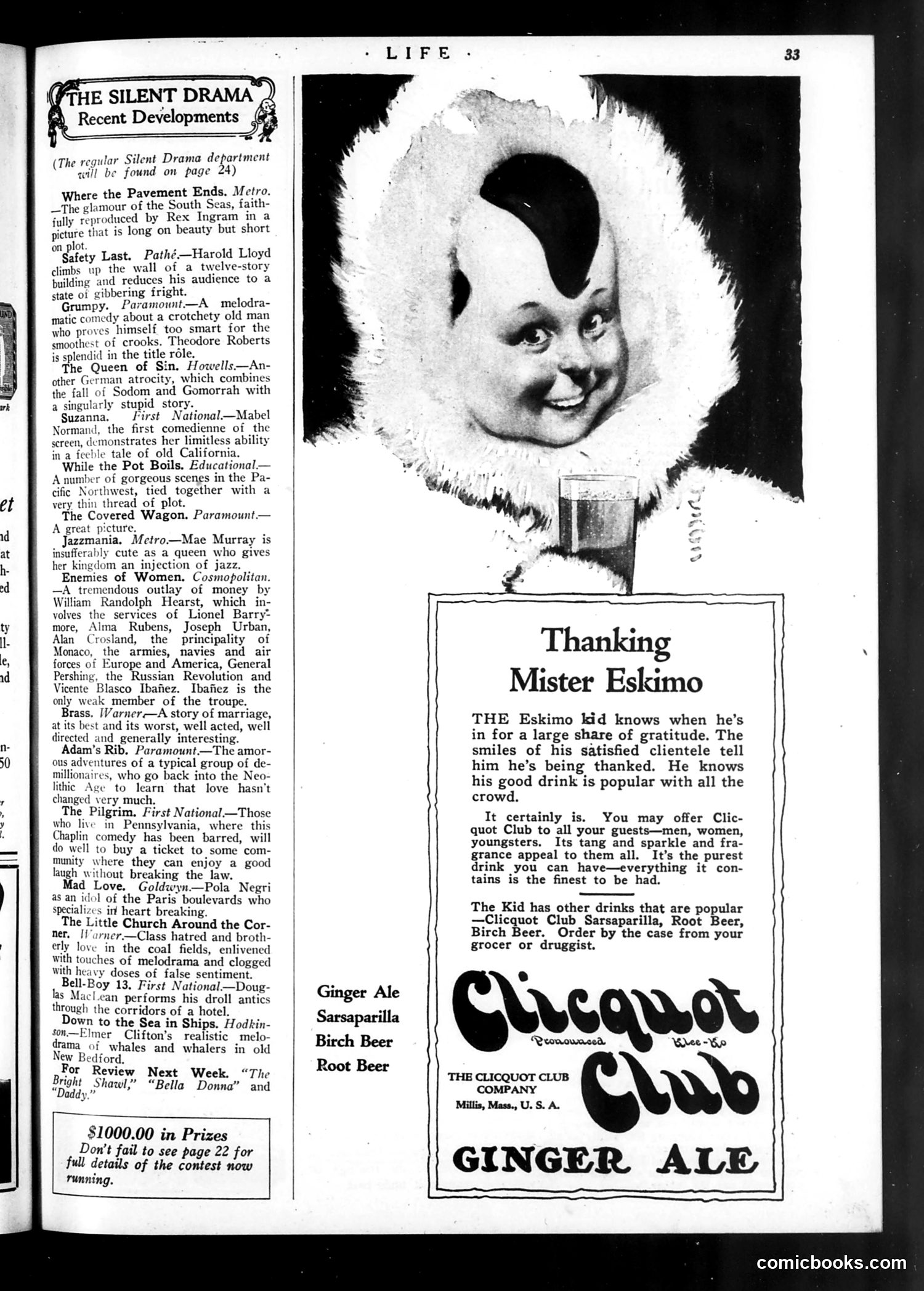
This page from Life magazine contains film reviews and advertisements typical of the early 1920s. The left column reviews silent films from various studios (Metro, Paramount, First National, etc.), featuring popular stars like Harold Lloyd, Mabel Normand, and Charlie Chaplin. These brief critiques reflect contemporary tastes in cinema. The dominant content is a full-page advertisement for Clicquot Club beverages featuring a photograph of a smiling Inuit (Eskimo) child. The ad uses the child's image and the phrase "Thanking Mister Eskimo" to market ginger ale, sarsaparilla, birch beer, and root beer as wholesome drinks suitable for "all your guests—men, women, youngsters." **Modern context:** This reflects the casual racism of early 20th-century advertising, where exotic or marginalized groups were used as marketing tools. The imagery objectifies Indigenous peoples while the copywriting emphasizes purity and family wholesomeness—a contradiction that modern viewers would immediately recognize as exploitative.
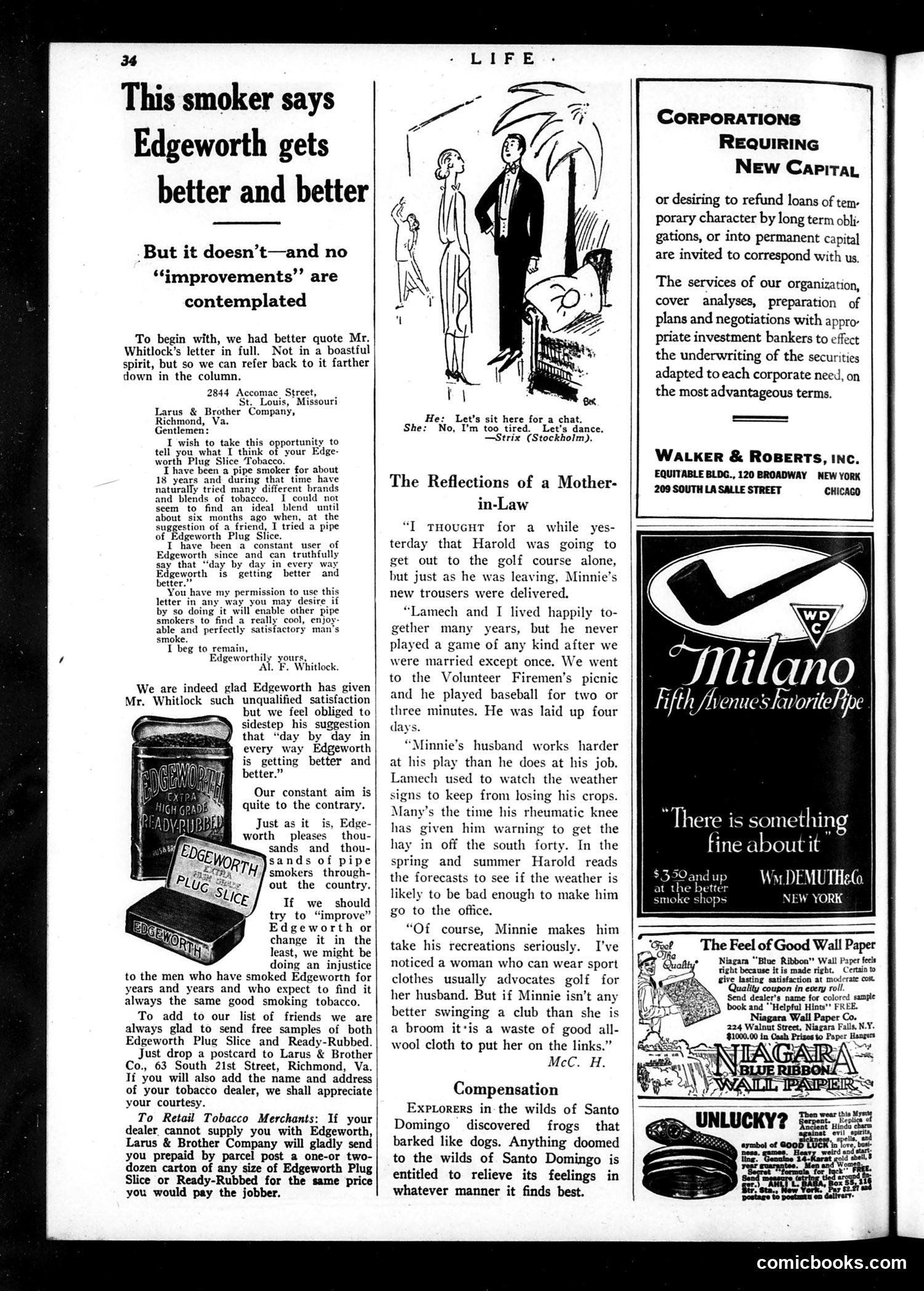
This page is primarily **advertising disguised as editorial content**. The main feature is a fake testimonial letter praising Edgeworth pipe tobacco, attributed to "Al. F. Whitlock" of St. Louis. The tobacco company Larus & Brother responds by *rejecting* the customer's suggestion that their product is "getting better and better"—claiming they deliberately make *no improvements* because existing customers depend on consistency. The satire is subtle but pointed: the company essentially admits that product innovation is irrelevant; customer loyalty matters more. By publishing this exchange, they're banking on appearing honest while actually promoting their product through the guise of candid correspondence. The page also contains lighter humor: a cartoon about a woman rejecting her suitor's offer to chat in favor of dancing, and a brief anecdote about a mother-in-law's observations on how modern husbands prioritize golf over work—social commentary on 1920s leisure culture.
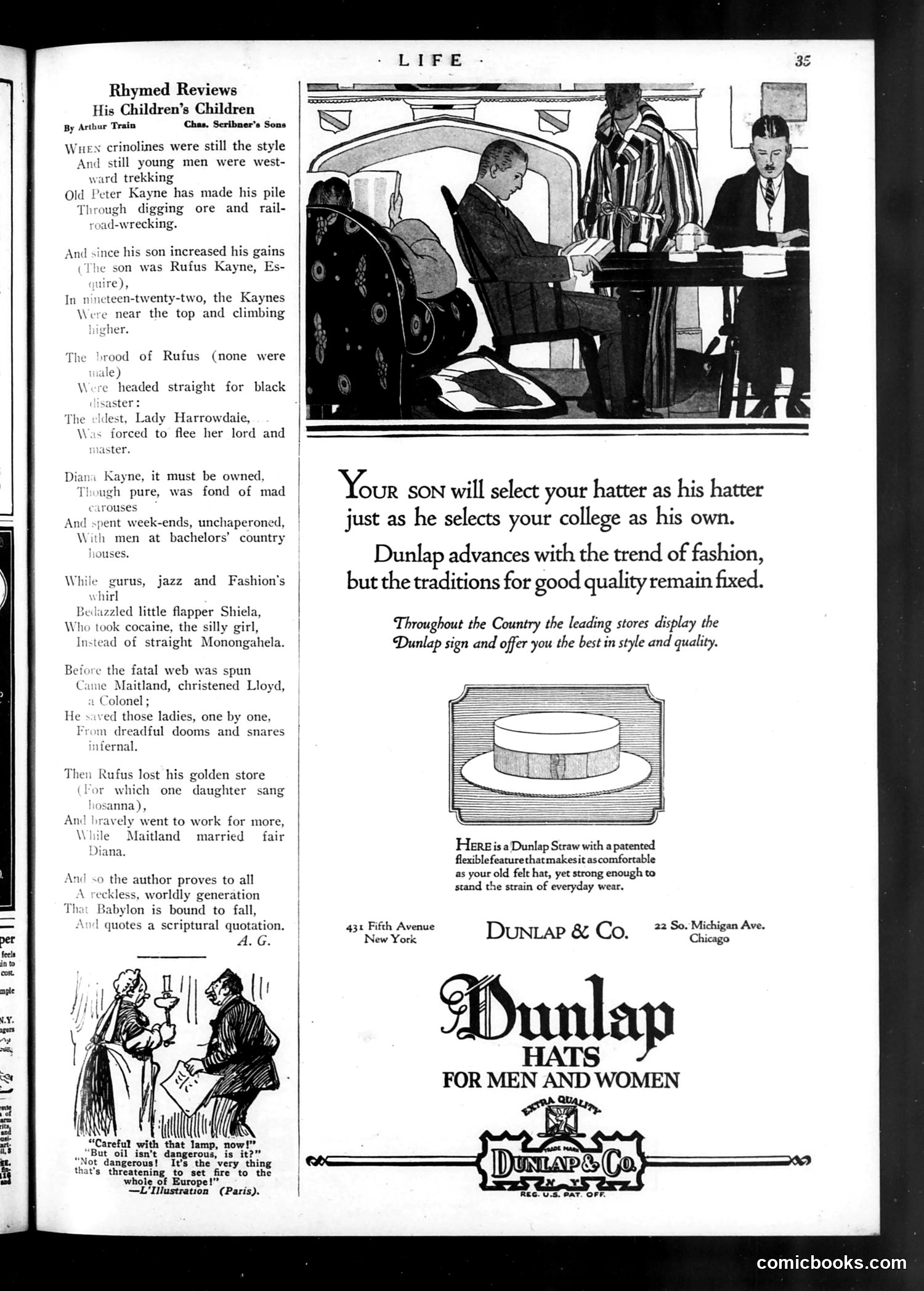
This page contains a **book review in verse** (left) and **advertising** (right). **The Verse Review:** Arthur Train's novel "His Children's Children" (Scribner's Sons) traces the decline of the wealthy Kayne family across generations. The satirical poem mocks the moral corruption of the 1920s younger generation—daughters involved in scandals, a "flapper" taking cocaine, unchaperoned weekends—warning that their reckless behavior will lead to family downfall. A character named Lloyd Maitland rescues the women from their follies. The moral: following biblical precedent (Babylon's fall), dissolute societies face destruction. **The Advertisement:** Dunlap hats dominate the right side, using a paternalistic pitch: sons choose their own hats as they choose colleges, yet quality traditions endure. The ad emphasizes Dunlap's straw hat as durable despite fashion trends. **Historical Context:** This reflects 1920s anxiety about Jazz Age morality, female independence (flappers, cocaine use), and generational conflict—themes Train's novel apparently addresses through cautionary melodrama.
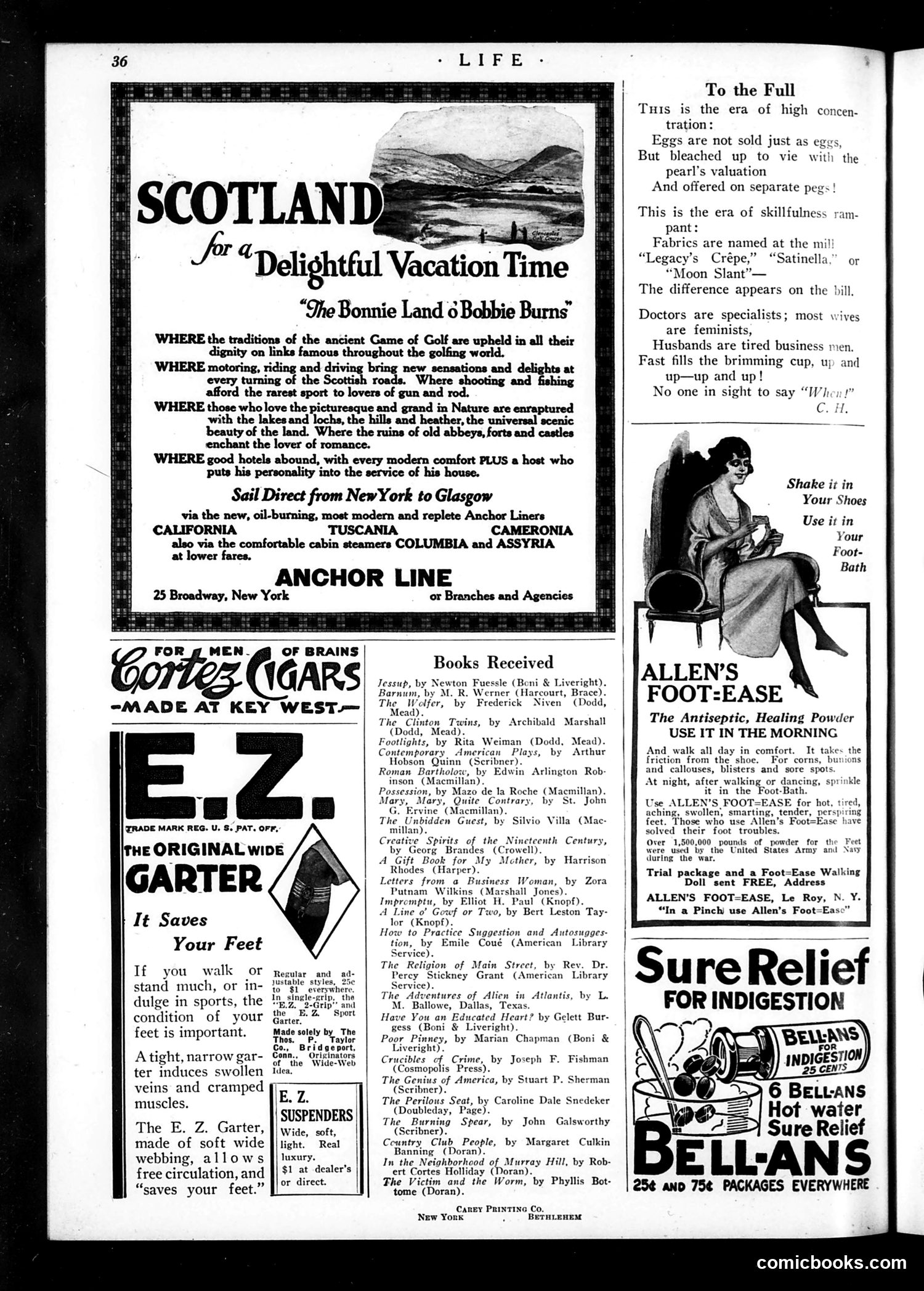
This page is primarily **advertising and book reviews**, not political satire. The main content consists of: **Large Advertisement (top half):** Anchor Line steamship company promoting Scottish tourism and direct sailings from New York to Glasgow. It emphasizes golf, hunting, fishing, scenic landscapes, and hotels—targeting affluent American leisure travelers. **Other Advertisements:** E.Z. Garter (supportive hosiery), Correz cigars, Allen's Foot-Ease powder, and Bellans indigestion remedy. **Satirical Poem (right side):** Titled "To the Full," this critiques modern commercial culture—eggs marketed with inflated pearl-like valuations, fabrics given fancy names despite minimal differences, doctors specializing excessively, and husbands as exhausted breadwinners. The satire targets commodification and overconsumption in 1920s America, though it's relatively gentle social commentary rather than pointed political critique. The page reflects Life magazine's typical format: mixing travel promotion, consumer goods, and light social satire for educated, affluent readers.
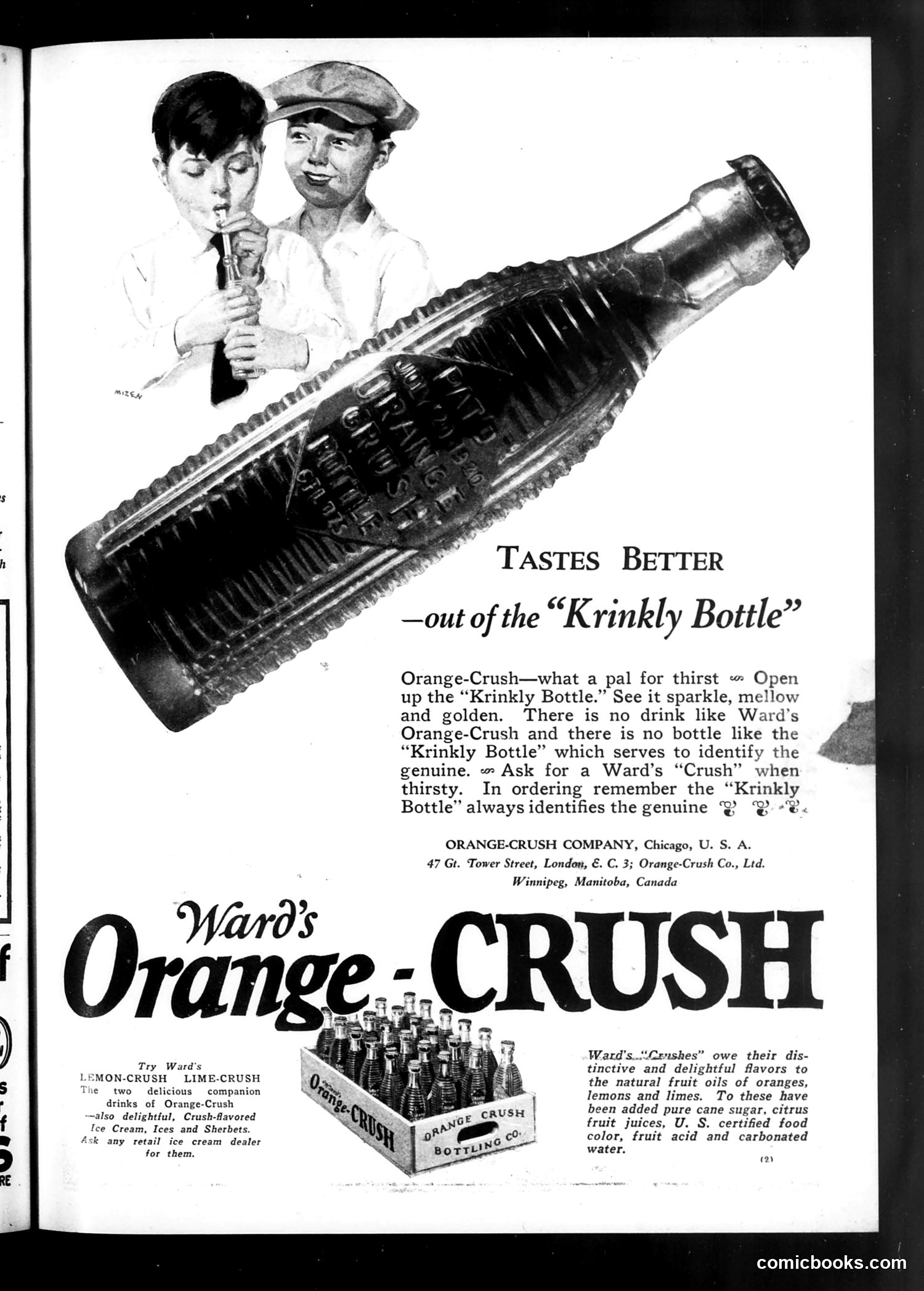
This is primarily a **product advertisement**, not political satire. The page promotes Ward's Orange-Crush, a citrus soft drink from the early 20th century. The illustration shows two young boys—one smoking a cigar, the other wearing a flat cap—examining a large "Krinkly Bottle," the distinctive ribbed bottle that served as Orange-Crush's trademark packaging. The "Krinkly Bottle" branding was emphasized as proof of authenticity against counterfeit competitors. The ad copy emphasizes the drink's natural fruit oils from oranges and limes, pure cane sugar, and carbonated water—marketing points meant to appeal to health-conscious consumers of the era. References to ice cream dealers suggest this was a popular soda fountain beverage. The illustration's casual depiction of a child smoking reflects early 20th-century advertising norms—today jarring, but unremarkable then. There is no discernible political commentary; this is straightforward commercial promotion.
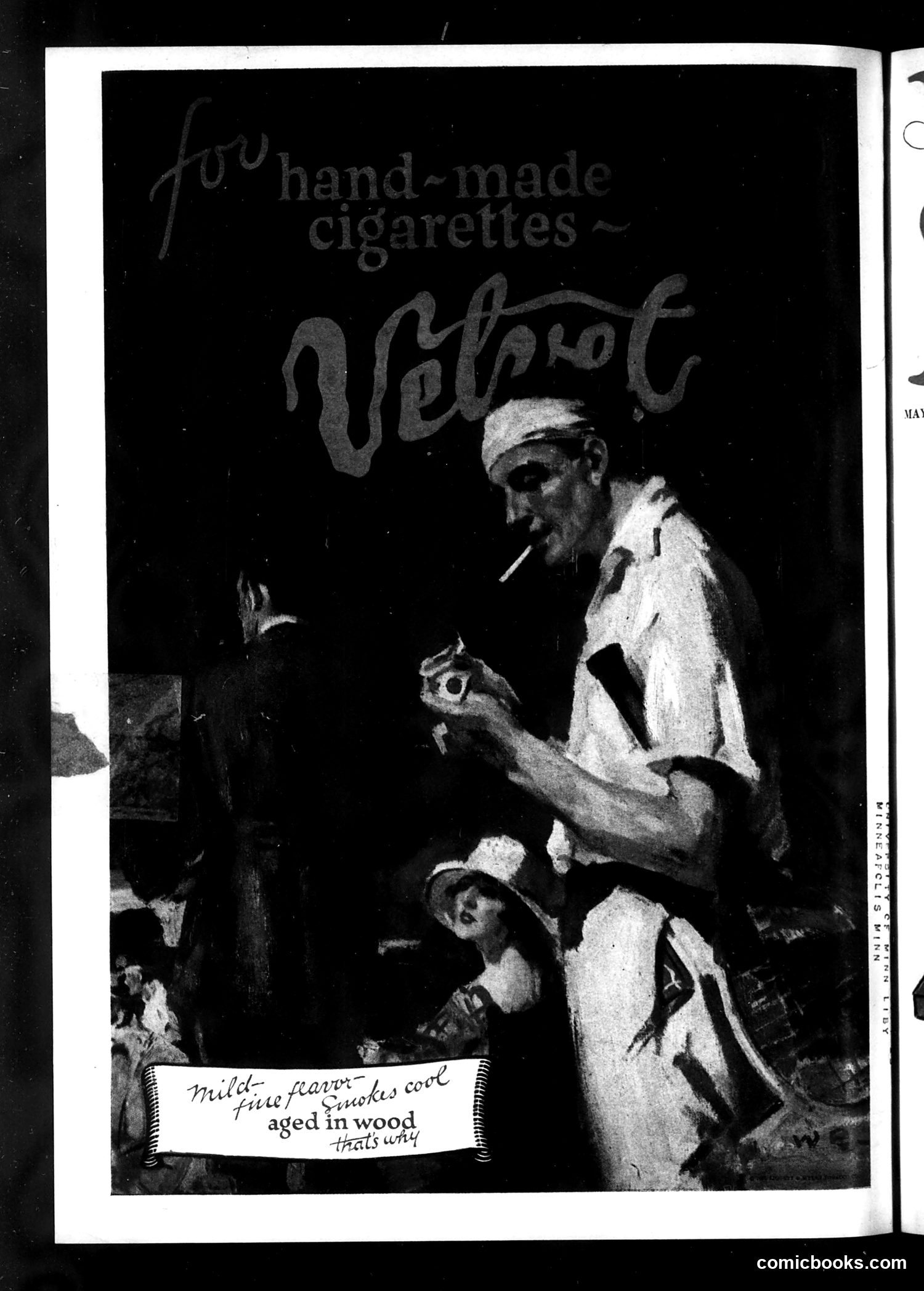
This is a vintage advertisement for **Velvet hand-made cigarettes**. The image shows a man in casual attire (headband, light shirt) smoking a cigarette while holding what appears to be a small animal or mascot. The tagline reads: "Mild fine flavor smokes cool aged in wood—that's why." This is straightforward product advertising rather than political satire. The ad emphasizes the cigarette's mild flavor and cooling properties, attributing these qualities to wood-aging. The casual, relaxed presentation of the smoker was typical marketing strategy for cigarettes in early-to-mid 20th century advertising, before health warnings became mandatory. The "aged in wood" claim attempts to add sophistication and quality perception to the product.