
Life, 1923-05-03 · page 26 of 40
Life — May 3, 1923 — page 26: what you’re looking at
What you’re looking at
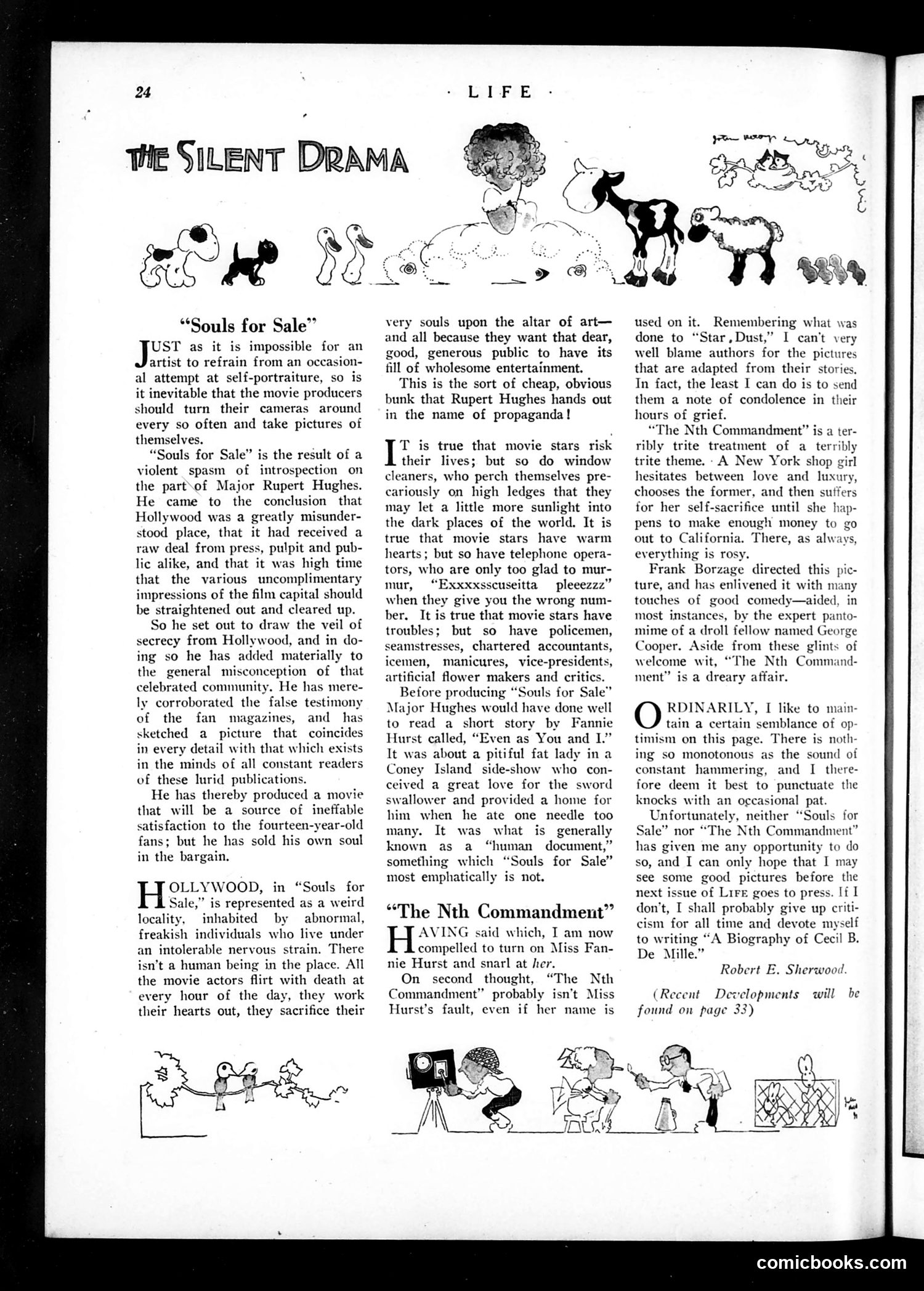
This page critiques two silent films through satirical reviews. "Souls for Sale," directed by Major Rupert Hughes, is mocked for presenting Hollywood as inhabited by self-sacrificing martyrs. The reviewer argues Hughes perpetuates fan-magazine mythology rather than revealing truth—comparing actors' supposed nobility to window cleaners' or telephone operators' equally valid sacrifices. The satire suggests Hughes's "propaganda" actually *reinforces* misconceptions he claimed to dispel. "The Nth Commandment," adapted from Fannie Hurst's story, receives similar dismissal as trite and formulaic—another New York shopgirl choosing love over luxury, conveniently resolved when she relocates to California. The reviewer sympathizes with authors whose work gets butchered in adaptation, particularly noting previous mishandlings like "Star, Dust." The decorative cartoon strips throughout illustrate film production absurdities, reinforcing the page's cynical view of Hollywood's self-mythologizing during the silent film era.
📄 Transcribed text from this page (OCR, searchable)
Machine-transcribed from the original scan — historical spelling and the odd misread are preserved.
24 Te SILENT DRAMA ye BS “Souls for Sale” UST as it is impossible for an artist to refrain from an occasion- al attempt at self-portraiture, so is it inevitable that the movie producers should turn their cameras around every so often and take pictures of themselves. “Souls for Sale” is the result of a violent spasm of introspection on the part\of Major Rupert Hughes. He came to the conclusion that Hollywood was a greatly misunder- stood place, that it had received a raw deal from press, pulpit and pub- lic alike, and that it was high time that the various uncomplimentary impressions of the film capital should be straightened out and cleared up. So he set out to draw the veil of secrecy from Hollywood, and in do- ing so he has added materially to the general misconception of that celebrated community. He has mere- ly corroborated the false testimony of the fan magazines, and has sketched a picture that coincides in every detail with that which exists in the minds of all constant readers of these lurid publications. He has thereby produced a movie that will be a source of ineffable satisfaction to the fourteen-year-old fans; but he has sold his own soul in the bargain. OLLYWOOD, in “Souls for Sale,” is represented as a weird inhabited by abnormal, freakish individuals who live under an intolerable nervous strain. There isn’t a human being in the place. All the movie actors flirt with death at every hour of the day, they work their hearts out, they sacrifice their very souls upon the altar of art— and all because they want that dear, good, generous public to have its fill of wholesome entertainment. This is the sort of cheap, obvious bunk that Rupert Hughes hands out in the name of propaganda! T is true that movie stars risk their lives; but so do window cleaners, who perch themselves pre- cariously on high ledges that they may let a little more sunlight into the dark places of the world. It is true that movie stars have warm hearts; but so have telephone opera- tors, who are only too glad to mur- mur, “Exxxxsscuseitta pleeezzz” when they give you the wrong num- ber. It is true that movie stars have troubles; but so have policemen, seamstresses, chartered accountants, icemen, manicures, vice-presidents, artificial flower makers and criti Before producing “Souls for Sale” Major Hughes would have done well to read a short story by Fannie Hurst called, “Even as You and 1.” It was about a pitiful fat lady in a Coney Island side-show who con- ceived a great love for the sword swallower and provided a home for him when he ate one needle too many. It was what is generally known as a “human document,” something which “Souls for Sale” most emphatically is not. “The Nth Commandment” AVING said which, I am now compelled to turn on Miss Fan- nie Hurst and snarl at her. On second thought, “The Nth Commandment” probably isn’t Miss Hurst’s fault, even if her name is SD Or Beep used on it. Remembering what was done to “Star,Dust,” I can’t very well blame authors for the pictures that are adapted from their stories, In fact, the least I can do is to send them a note of condolence in their hours of grief. “The Nth Commandment” is a ter- ribly trite treatment of a terribly trite theme. - A New York shop girl hesitates between love and luxury, chooses the former, and then sutfers for her self-sacrifice until she hap- pens to make enough money to go out to California. There, as alwa everything is rosy. Frank Borzage directed this pic- ture, and has enlivened it with many touches of good comedy—aided, in most instances, by the expert panto- mime of a droll fellow named George Cooper. Aside from these glints of welcome wit, “The Nth Command- ment” is a dreary affair. RDINARILY, I like to main- tain a certain semblance of op- timism on this page. There is noth- ing so monotonous as the sound of constant hammering, and I there- fore deem it best to punctuate the knocks with an occasional pat. Unfortunately, neither “Souls for Sale” nor “The Nth Commandment” has given me any opportunity to do so, and I can only hope that I may see some good pictures before the next issue of Lire goes to press. Ii 1 don’t, I shall probably give up criti- cism for all time and devote myself to writing “A Biography of Cecil B. De Mille.” Robert E. Sherwood. (Recent Developments will be found on page 33) oc 7}. fe rates bh ‘i comicbooks.com