
Life, 1923-05-03 · page 17 of 40
Life — May 3, 1923 — page 17: what you’re looking at
What you’re looking at
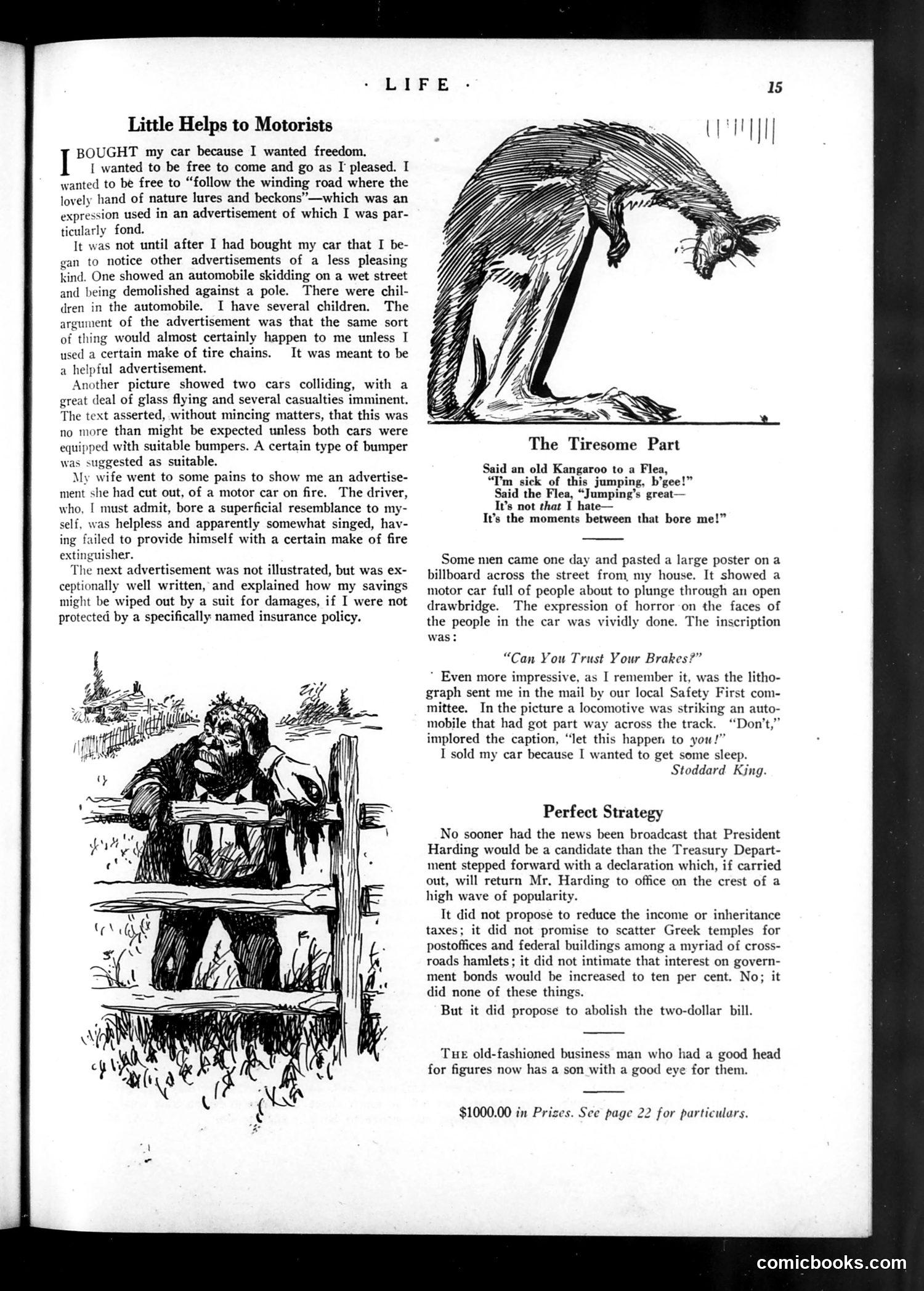
This satirical piece mocks aggressive automotive safety advertising of the 1920s. The author describes receiving increasingly alarming advertisements featuring car crashes, fires, and collisions—each designed to frighten him into buying specific products (tire chains, bumpers, fire extinguishers, insurance). The humor lies in the escalating absurdity: safety campaigns use gruesome imagery featuring children to manipulate consumer fear. The accompanying kangaroo cartoon reinforces the theme—the flea represents these constant safety warnings; the kangaroo is exhausted not by jumping itself but by the relentless "moments between" (the anxious intervals between scares). The author concludes he sold his car seeking peace from the psychological bombardment of fear-based marketing. The "Perfect Strategy" section separately satirizes President Harding's political popularity-building through abolishing the two-dollar bill—portrayed as trivial pandering.
📄 Transcribed text from this page (OCR, searchable)
Machine-transcribed from the original scan — historical spelling and the odd misread are preserved.
Little Helps to Motorists BOUGHT my car because I wanted freedom. I wanted to be free to come and go as I pleased. I wanted to be free to “follow the winding road where the lovely hand of nature lures and beckons”—which was an expression used in an advertisement of which I was par- ticularly fond. It was not until after I had bought my car that I be- gan to notice other advertisements of a less pleasing kind. One showed an automobile skidding on a wet street and being demolished against a pole. There were chil- dren in the automobile. I have several children. The argument of the advertisement was that the same sort of thing would almost certainly happen to me unless IT used a certain make of tire chains. It was meant to be a helpful advertisement. Another picture showed two cars colliding, with a great deal of glass flying and several casualties imminent. The text asserted, without mincing matters, that this was no more than might be expected unless both cars were equipped with suitable bumpers. A certain type of bumper was suggested as suitable. My wife went to some pains to show me an advertise- ment she had cut out, of a motor car on fire. The driver, who, | must admit, bore a superficial resemblance to my- self, was helpless and apparently somewhat singed, hav- i ed to provide himself with a certain make of fire xtinguisher. The next advertisement was not illustrated, but was ex- ceptionally well written, and explained how my savings might be wiped out by a suit for damages, if I were not protected by a specifically named insurance policy. Is The Tiresome Part Said an old Kangaroo to a Flea, “Tm sick of this jumping, b’gee!” Said the Flea, “Jumping’s great— It’s not that I hate— It’s the moments between that bore me!” Some men came one day and pasted a large poster on a billboard across the street from, my house. It showed a motor car full of people about to plunge through an open drawbridge. The expression of horror on the faces of the people in the car was vividly done. The inscription was: “Can You Trust Your Brakes?” * Even more impressive, as I remember it, was the litho- graph sent me in the mail by our local Safety First com- mittee. In the picture a locomotive was striking an auto- mobile that had got part way across the track. ‘‘Don't,” implored the caption, “let this happen to you!” I sold my car because I wanted to get some sleep. Stoddard King. Perfect Strategy No sooner had the news been broadcast that President Harding would be a candidate than the Treasury Depart- ment stepped forward with a declaration which, if carried out, will return Mr, Harding to office on the crest of a high wave of popularity. It did not propose to reduce the income or inheritance taxes; it did not promise to scatter Greek temples for postoffices and federal buildings among a myriad of cross- roads hamlets; it did not intimate that interest on govern- ment bonds would be increased to ten per cent. No; it did none of these things. But it did propose to abolish the two-dollar bill. Tue old-fashioned business man who had a good head for figures now has a son with a good eye for them. $1000.00 in Prizes. See page 22 for particulars. comicbooks.com