
Life, 1923-05-03 · page 18 of 40
Life — May 3, 1923 — page 18: what you’re looking at
What you’re looking at
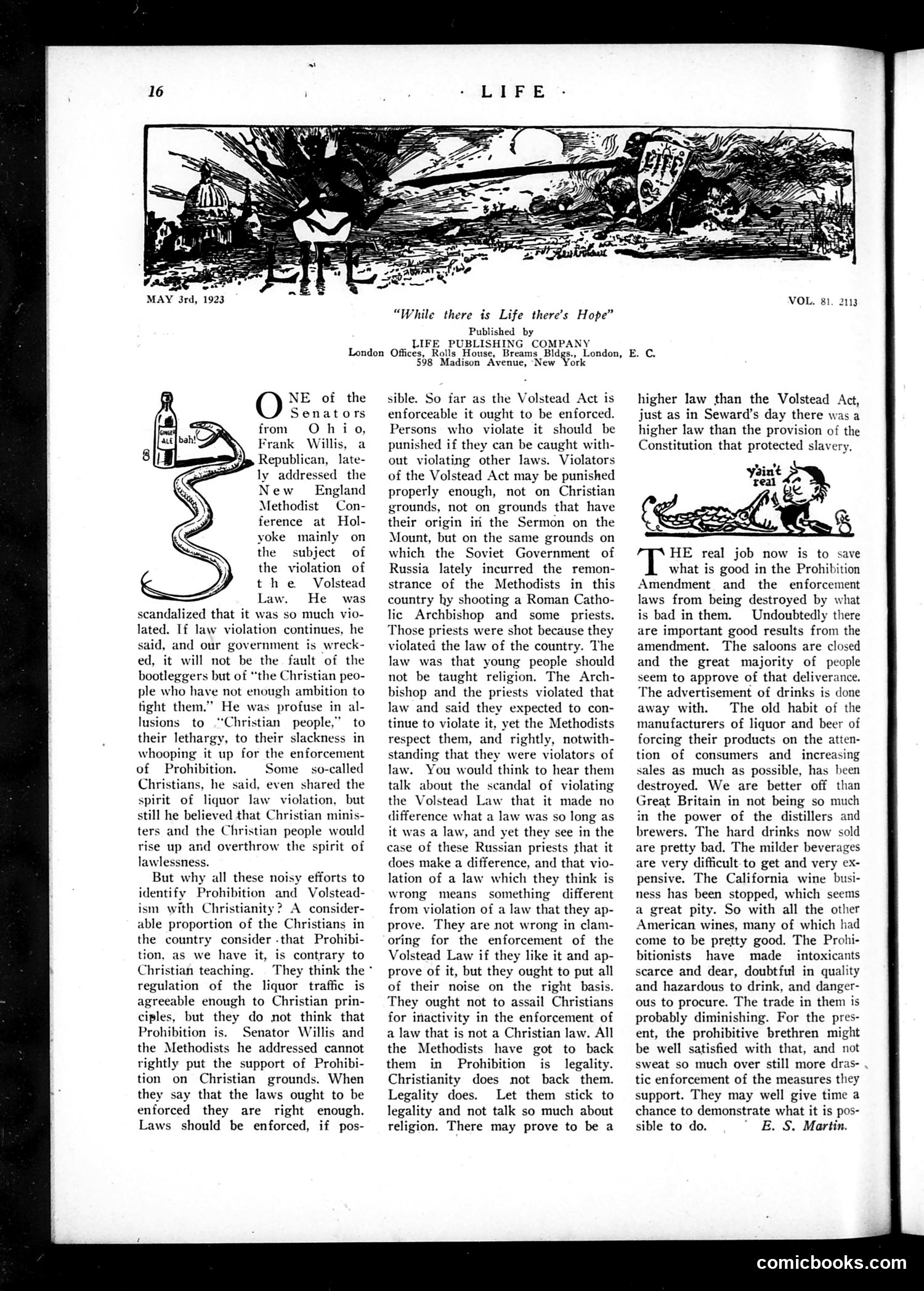
This 1923 *Life* magazine page critiques Senator Frank Willis (Ohio Republican) and Methodist leaders who framed Prohibition enforcement as a Christian moral duty. The satire's core argument: they're conflating legality with Christianity. The editorial points out hypocrisy: these same Methodists respected Russian priests who violated Soviet law against religious teaching—proving they recognize that *which* law matters morally. Yet they demand Christians enforce the Volstead Act (Prohibition law) on religious grounds, ignoring that many Christians consider Prohibition itself unchristian. The author argues legality and morality aren't identical. Just as abolitionists invoked "higher law" against slavery's constitutional protection, some may justify violating unjust laws. The Methodists should defend Prohibition on legal grounds alone, not claim Christianity demands its enforcement—a distinction they themselves acknowledge when defending the Russian priests.
📄 Transcribed text from this page (OCR, searchable)
Machine-transcribed from the original scan — historical spelling and the odd misread are preserved.
MAY 3rd, 1923 “While there is Life there’s Hope” Published by IFE PUBLISHING COMPANY VOL. 81. 2113 Li London Offices, Rolls House, Breams Bldgs., jpondon, EC. NE of the Senators from Ohio, Frank Willis, a Republican, late- ly addressed the New England Methodist | Con- ference at Hol- yoke mainly on the subject of the violation of t he Volstead Law. He was scandalized that it was so much vio- lated. If law violation continues, he said, and our government is wreck- ed, it will not be the fault of the bootleggers but of “the Christian peo- ple who have not enough ambition to fight them.” He was profuse in al- lusions to “Christian people,” to their lethargy, to their slackness in whooping it up for the enforcement of Prohibition. Some so-called Christians, he said, even shared the spirit of liquor law violation, but still he believed that Christian minis- ters and the Christian people would rise up and overthrow the spirit of lawlessness. But why all these noisy efforts to identify Prohibition and Volstead- ism with Christianity? A consider- able proportion of the Christians in the country consider -that Prohibi- tion, as we have it, is contrary to Christian teaching. regulation of the liquor traffic is agreeable enough to Christian prin- ciples, but they do not think that Prohibition is. Senator Willis and the Methodists he addressed cannot rightly put the support of Prohibi- tion on Christian grounds. When they say that the laws ought to be enforced they are right enough. Laws should be enforced, if pos- They think the * 598 Madison Avenue, New York sible. So far as the Volstead Act is enforceable it ought to be enforced. Persons who violate it should be punished if they can be caught with- out violating other laws. Violators of the Volstead Act may be punished properly enough, not on Christian grounds, not on grounds that have their origin iri the Sermon on the Mount, but on the same grounds on which the Soviet Government of Russia lately incurred the remon- strance of the Methodists in this country hy shooting a Roman Catho- lic Archbishop and some priests. Those priests were shot because they violated the law of the country. The law was that young people should not be taught religion. The Arch- bishop and the priests violated that law and said they expected to con- tinue to violate it, yet the Methodists respect them, and rightly, notwith- standing that they were violators of law. You would think to hear them talk about the scandal of violating the Volstead Law that it made no difference what a law was so long as it was a law, and yet they see in the case of these Russian priests that it does make a difference, and that vio- lation of a law which they think is wrong means something different from violation of a law that they ap- prove. They are not wrong in clam- oring for the enforcement of the Volstead Law if they like it and ap- prove of it, but they ought to put all of their noise on the right basis. They ought not to assail Christians for inactivity in the enforcement of a law that is not a Christian law. All the Methodists have got to back them in Prohibition is legality. Christianity does not back them. Legality does. Let them stick to legality and not talk so much about religion. There may prove to be a higher law than the Volstead Act, just as in Seward’s day there was a higher law than the provision of the Constitution that protected slavery, HE real job now is to save what is good in the Prohibition Amendment and the enforcement laws from being destroyed by what is bad in them. Undoubtedly there are important good results from the amendment. The saloons are closed and the great majority of people seem to approve of that deliverance. The advertisement of drinks is done away with. The old habit of the manufacturers of liquor and beer of forcing their products on the atten- tion of consumers and_ increasing sales as much as possible, has been destroyed. We are better off than Great Britain in not being so much in the power of the distillers and brewers. The hard drinks now sold are pretty bad. The milder beverages are very difficult to get and very ex- pensive. The California wine busi- ness has been stopped, which seems a great pity. So with all the other American wines, many of which had come to be pretty good. The Prohi- bitionists have made intoxicants scarce and dear, doubtful in quality and hazardous to drink, and danger- ous to procure. The trade in them is probably diminishing. For the pres- ent, the prohibitive brethren might be well satisfied with that, and not sweat so much over still more dras- tic enforcement of the measures they support. They may well give time a chance to demonstrate what it is pos- sible to do. E. S. Martin. comicbooks.com