
Life, 1923-05-03 · page 22 of 40
Life — May 3, 1923 — page 22: what you’re looking at
What you’re looking at
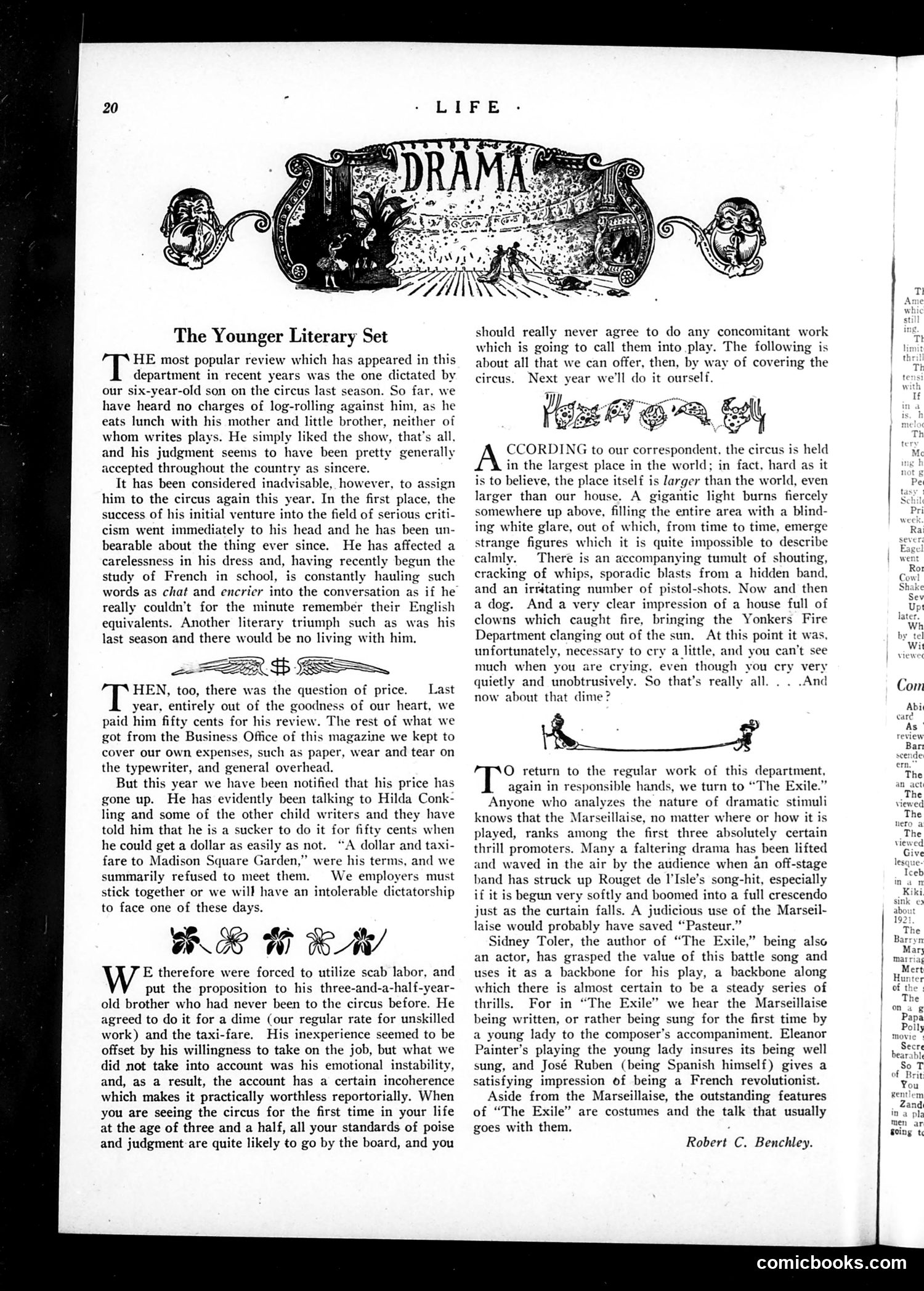
This is a humorous essay satirizing both child prodigies and labor disputes in the arts. The author paid his six-year-old son fifty cents to review the circus the previous season; the review was surprisingly popular and sincere. Now the child has become insufferable—affecting French affectations and demanding higher pay (a dollar plus taxi fare to Madison Square Garden) after being influenced by other "child writers" like Hilda Conkling. The father refuses, citing the need for "employers" to "stick together" against "intolerable dictatorship." Facing a strike, he hires his three-and-a-half-year-old as "scab labor" for a dime. The resulting circus review—included below—is intentionally incoherent, capturing a toddler's genuine overwhelming sensory experience rather than coherent criticism. The satire mocks both precocious child authors of the era and contemporary labor negotiations, treating childhood contract disputes as serious industrial conflict.
📄 Transcribed text from this page (OCR, searchable)
Machine-transcribed from the original scan — historical spelling and the odd misread are preserved.
The Younger Literary Set HE most popular review which has appeared in this department in recent years was the one dictated by our six-year-old son on the circus last season. So far, we have heard no charges of log-rolling against him, as he eats lunch with his mother and little brother, neither of whom writes plays. He simply liked the show, that’s all, and his judgment seems to have been pretty generally accepted throughout the country as sincere. It has been considered inadvisable, however, to assign him to the circus again this year. In the first place, the success of his initial venture into the field of serious criti- cism went immediately to his head and he has been un- bearable about the thing ever since. He has affected a carelessness in his dress and, having recently begun the study of French in school, is constantly hauling such words as chat and encrier into the conversation as if he really couldn't for the minute remember their English equivalents. Another literary triumph such as was his last season and there would be no living with him. T HEN, too, there was the question of price. Last ar, entirely out of the goodness of our heart, we paid him fifty cents for his review. The rest of what we got from the Business Office of this magazine we kept to cover our own expenses, such as paper, wear and tear on the typewriter, and general overhead. But this year we have been notified that his price has gone up. He has evidently been talking to Hilda Conk- ling and some of the other child writers and they have told him that he is a sucker to do it for fifty cents when he could get a dollar as easily as not. “A dollar and taxi- fare to Madison Square Garden,” were his terms, and we summarily refused to meet them. We employers must stick together or we will have an intolerable dictatorship to face one of these days. NS E therefore were forced to utilize scab labor, and put the proposition to his three-and-a-half-year- old brother who had never been to the circus before. He agreed to do it for a dime (our regular rate for unskilled work) and the taxi-fare. His inexperience seemed to be offset by his willingness to take on the job, but what we did not take into account was his emotional instability, and, as a result, the account has a certain incoherence which makes it practically worthless reportorially. When you are seeing the circus for the first time in your life at the age of three and a half, all your standards of poise and judgment are quite likely to go by the board, and you should really never agree to do any concomitant work which is going to call them into play. The following is about all that we can offer, then, by way of covering the circus. Next year we'll do it ourself. 7 : 7 e* CCORDING to our correspondent, the circus is held in the largest place in the world; in fact. hard as it is to believe, the place itself is larger than the world, even larger than our house. A gigantic light burns fiercely somewhere up above, filling the entire area with a blind- ing white glare, out of which, from time to time, emerge strange figures which it is quite impossible to describe calmly. There is an accompanying tumult of shouting, cracking of whips, sporadic blasts from a hidden band, and an irritating number of pistol-shots. Now and then a dog. And a very clear impression of a house full of clowns which caught fire, bringing the Yonkers Fire Department clanging out of the sun. At this point it was, unfortunately, necessary to cry a little, and you can’t see much when you are crying, even though you cry very quietly and unobtrusively. So that’s really all... .And now about that dime? a: O return to the regular work of this department, again in responsible hands, we turn to “The Exile.” Anyone who analyzes the nature of dramatic stimuli knows that the Marseillaise, no matter where or how it is played, ranks among the first three absolutely certain thrill promoters. Many a faltering drama has been lifted and waved in the air by the audience when an off-stage band has struck up Rouget de I’Isle’s song-hit, especially if it is begun very softly and boomed into a full crescendo just as the curtain falls. A judicious use of the Marseil- laise would probably have saved “Pasteur.” Sidney Toler, the author of “The le,” being also an actor, has grasped the value of this battle song and uses it as a backbone for his play, a backbone along which there is almost certain to be a steady series of thrills. For in “The Exile’ we hear the Marseillaise being written, or rather being sung for the first time by a young lady to the composer’s accompaniment. Eleanor Painter’s playing the young lady insures its being well sung, and José Ruben (being Spanish himself) gives a satisfying impression of being a French revolutionist. Aside from the Marseillaise, the outstanding features of “The Exile” are costumes and the talk that usually goes with them. Robert C. Benchley. men ar Boing te comicbooks.com