
A complete issue · 37 pages · 1923
Life — March 8, 1923
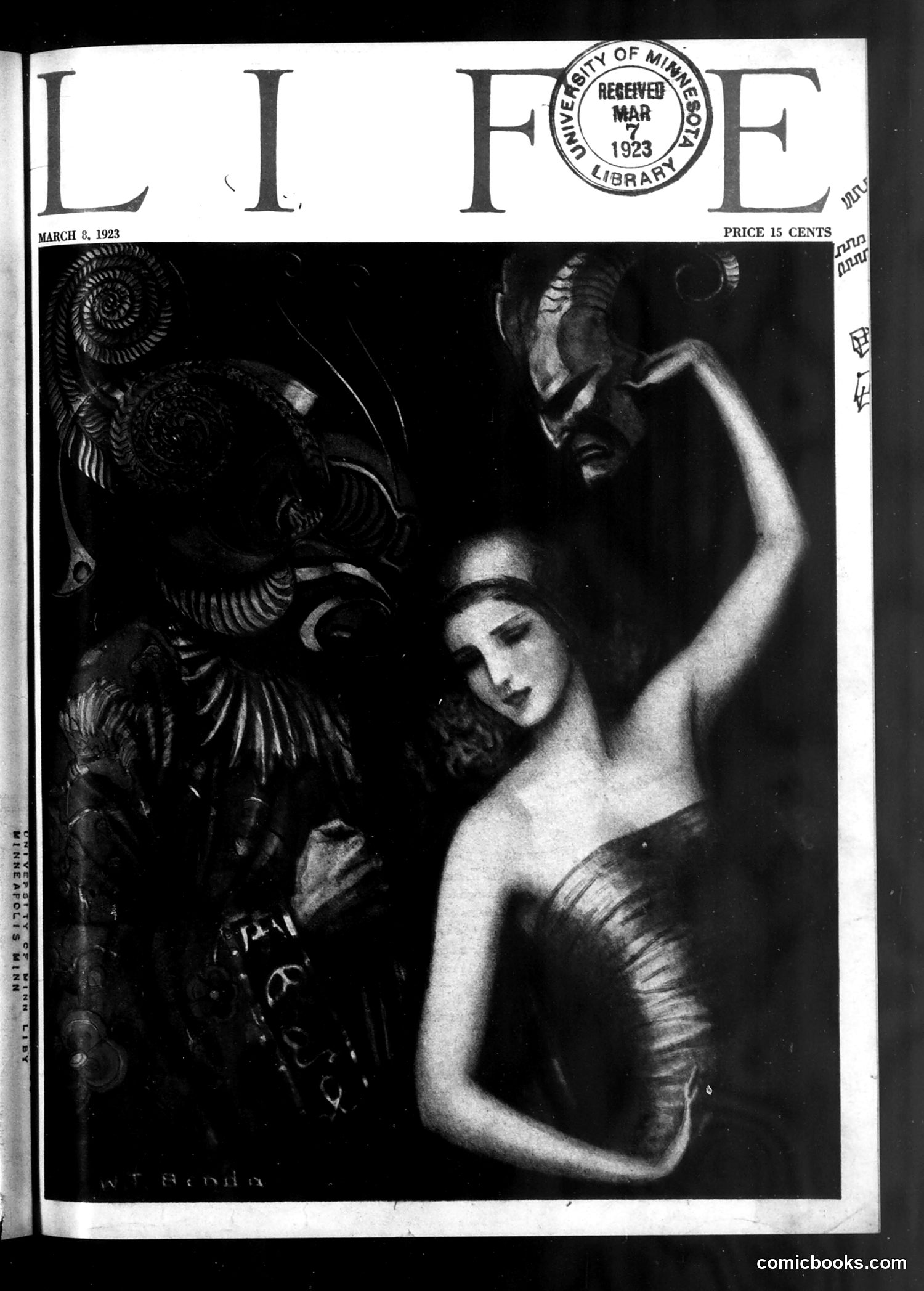
I can see this is the cover of *Life* magazine from March 3, 1923, priced at 15 cents. The image shows an Art Deco-style illustration of a woman in evening wear alongside an ornately dressed figure (possibly representing a mythological or fantastical character) against a dark background. However, without clearer text identifying the specific subject, figures, or accompanying article titles on this cover, I cannot definitively explain what political or social commentary this illustration makes or what contemporary events or personalities it references. The artistic style suggests 1920s glamour and possibly theatrical or entertainment themes, but the precise satirical point remains unclear from the image alone.
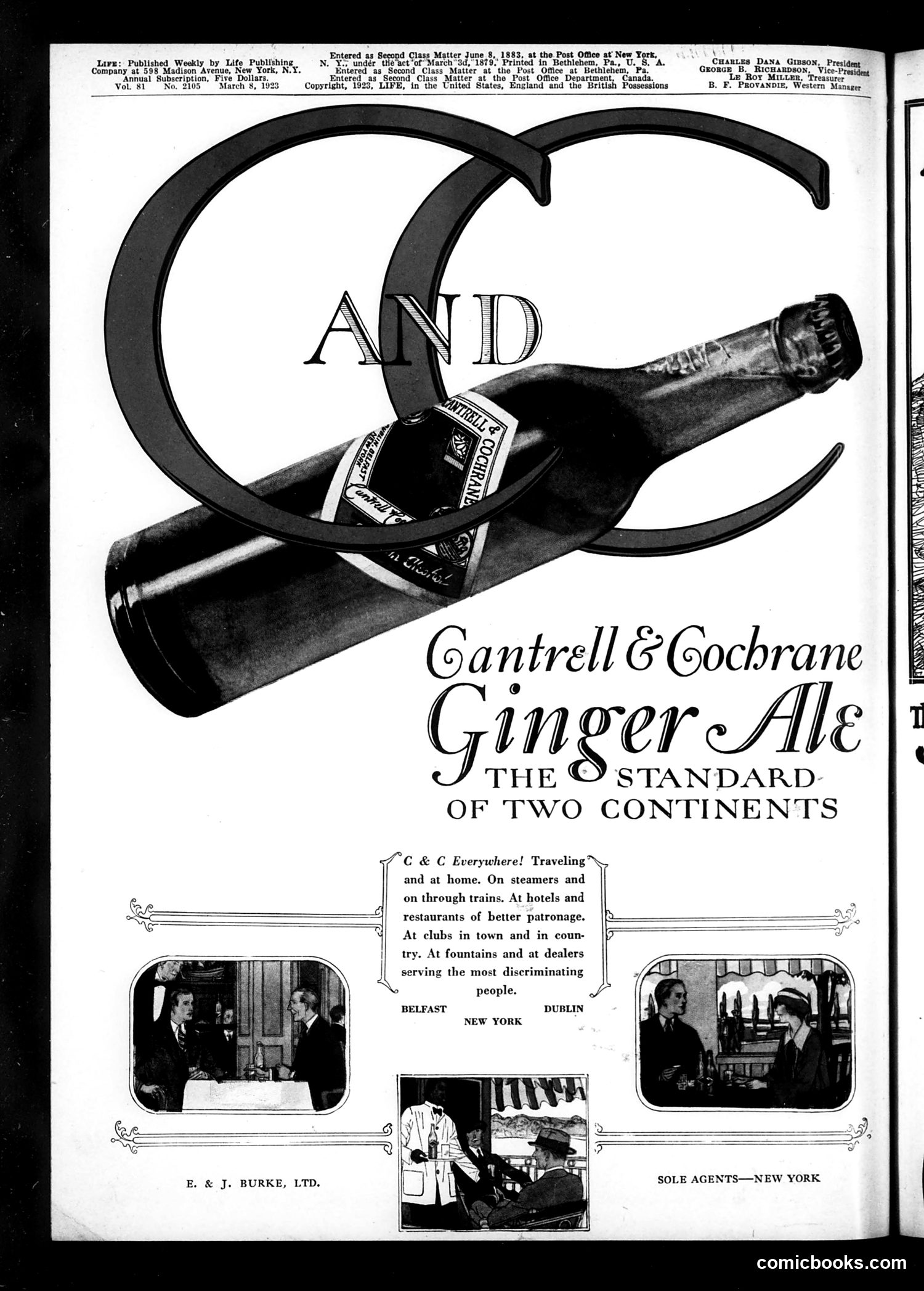
This page is primarily **advertising, not political satire**. It's a full-page advertisement for Cantrell & Cochrane Ginger Ale from the March 8, 1925 issue of *Life* magazine. The design features a large decorative "C&C" monogram with a ginger ale bottle nestled within it. The ad emphasizes the product's international prestige as "the standard of two continents," claiming availability across premium venues: steamships, trains, hotels, clubs, and upscale restaurants. Three black-and-white photographs show affluent patrons in different settings (labeled Belfast, Dublin, New York), depicting the drink's use among "discriminating people." E. & J. Burke Ltd. are listed as distributors, with New York sole agents noted. The advertisement reflects 1920s marketing strategies targeting wealthy consumers through association with luxury establishments.
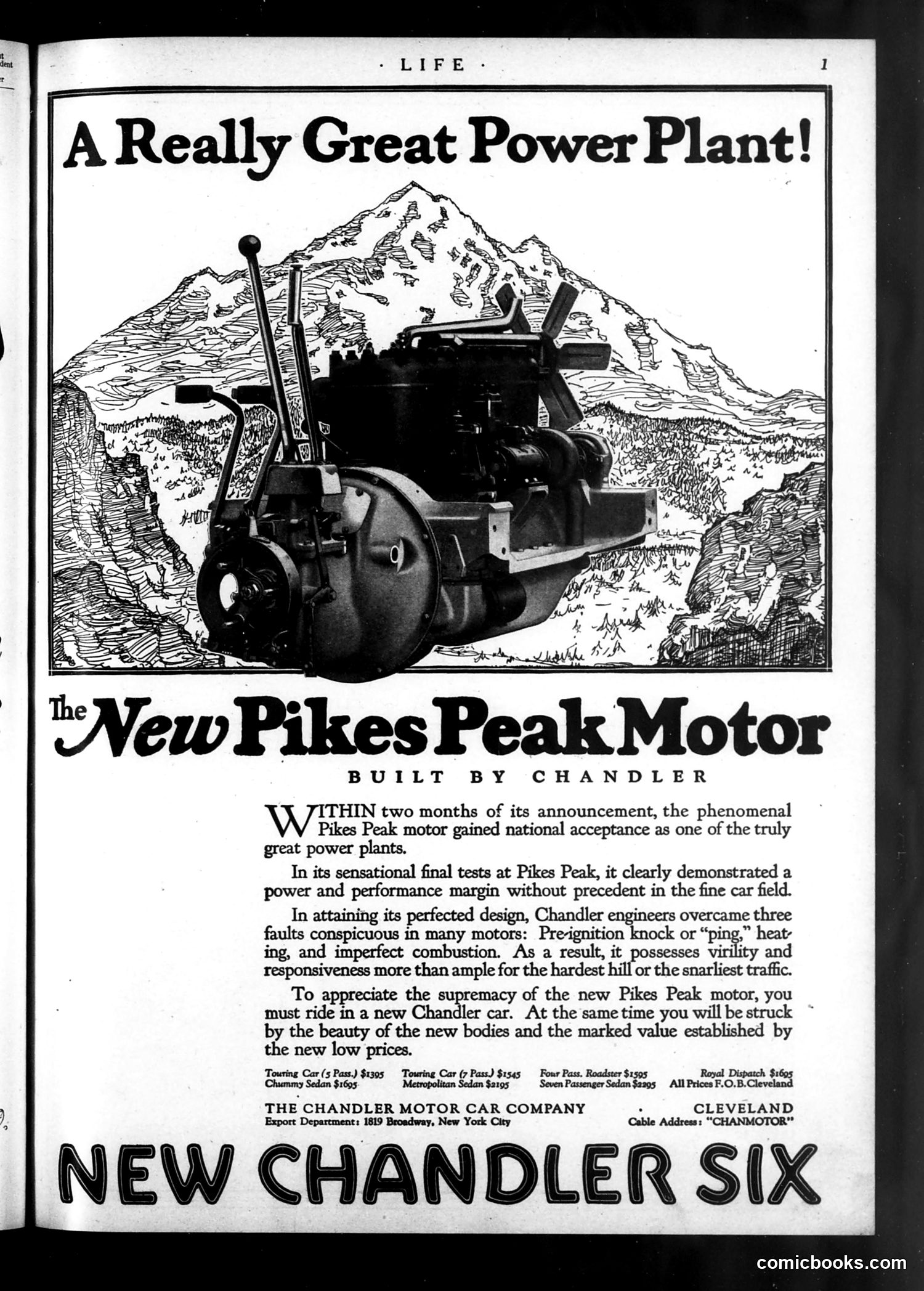
This is **not a political cartoon or satire**—it's a straightforward automobile advertisement from Life magazine's early 20th century period. The page advertises the **Chandler Motor Car Company's new "Pikes Peak Motor,"** built for the Chandler Six automobile. The central image shows a motorcar positioned dramatically against a mountain backdrop (Pikes Peak), emphasizing the vehicle's power and capability. The advertisement claims the motor gained "national acceptance as one of the truly great power plants" within two months of announcement. It highlights engineering achievements: overcoming "pre-ignition knock," heating problems, and combustion issues that plagued competitors. The appeal is straightforward: superior engineering equals reliability for "the hardest hill or the smartest traffic." This reflects early automotive marketing's focus on mechanical performance rather than style.
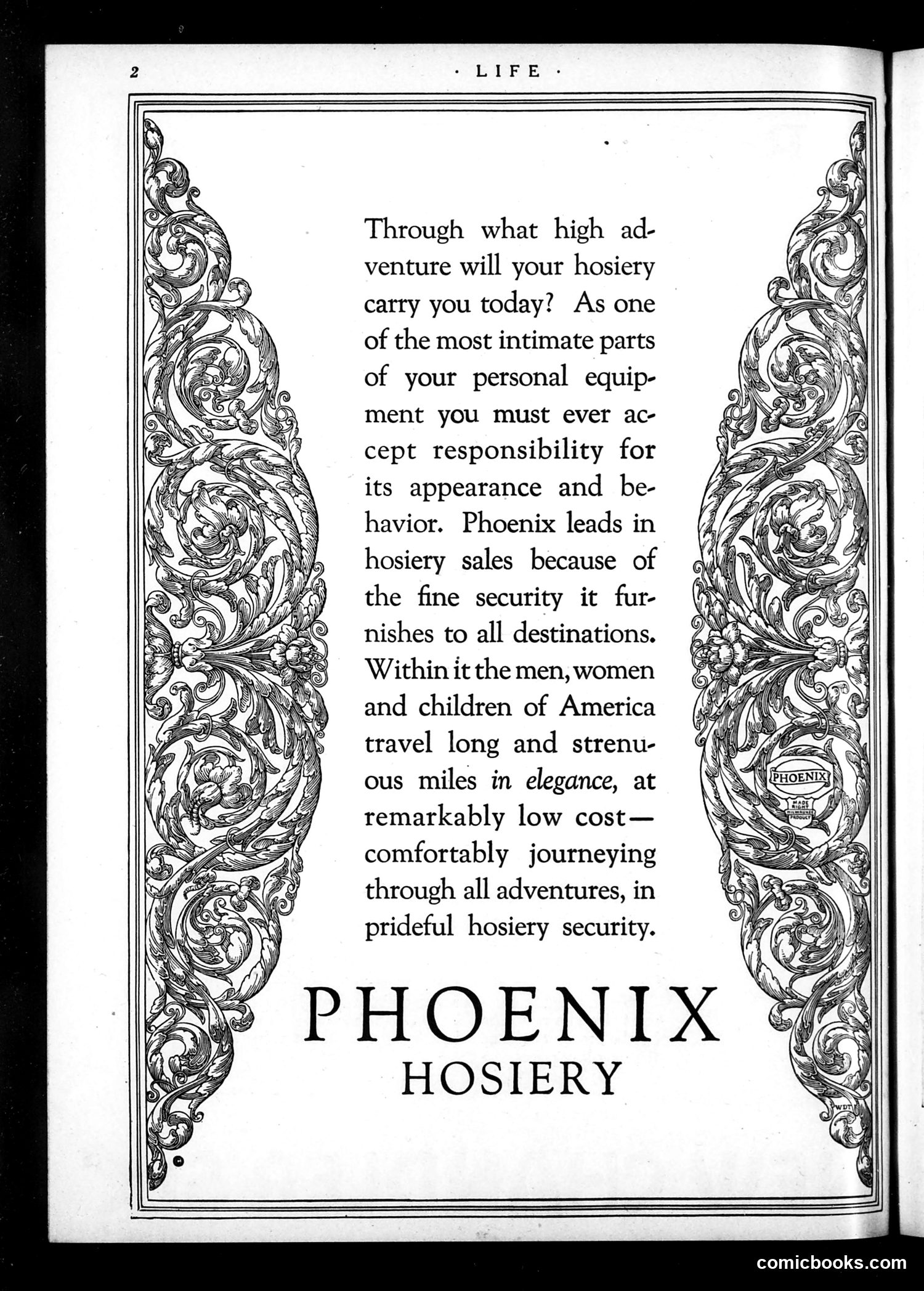
This is **not a cartoon or satire**—it's a straightforward **advertisement for Phoenix Hosiery** from *Life* magazine. The page features ornamental decorative borders framing marketing copy. The ad uses aspirational language appealing to early 20th-century consumers, emphasizing that Phoenix hosiery enables Americans to travel in "elegance" and "security" at "remarkably low cost." The rhetoric treats hosiery as essential personal equipment worthy of serious consideration. The only visual element besides the decorative borders is a small Phoenix brand logo/seal. There is no political commentary, caricature, or satire present—this is a period advertisement leveraging *Life*'s readership to promote quality hosiery as both practical and prestigious.
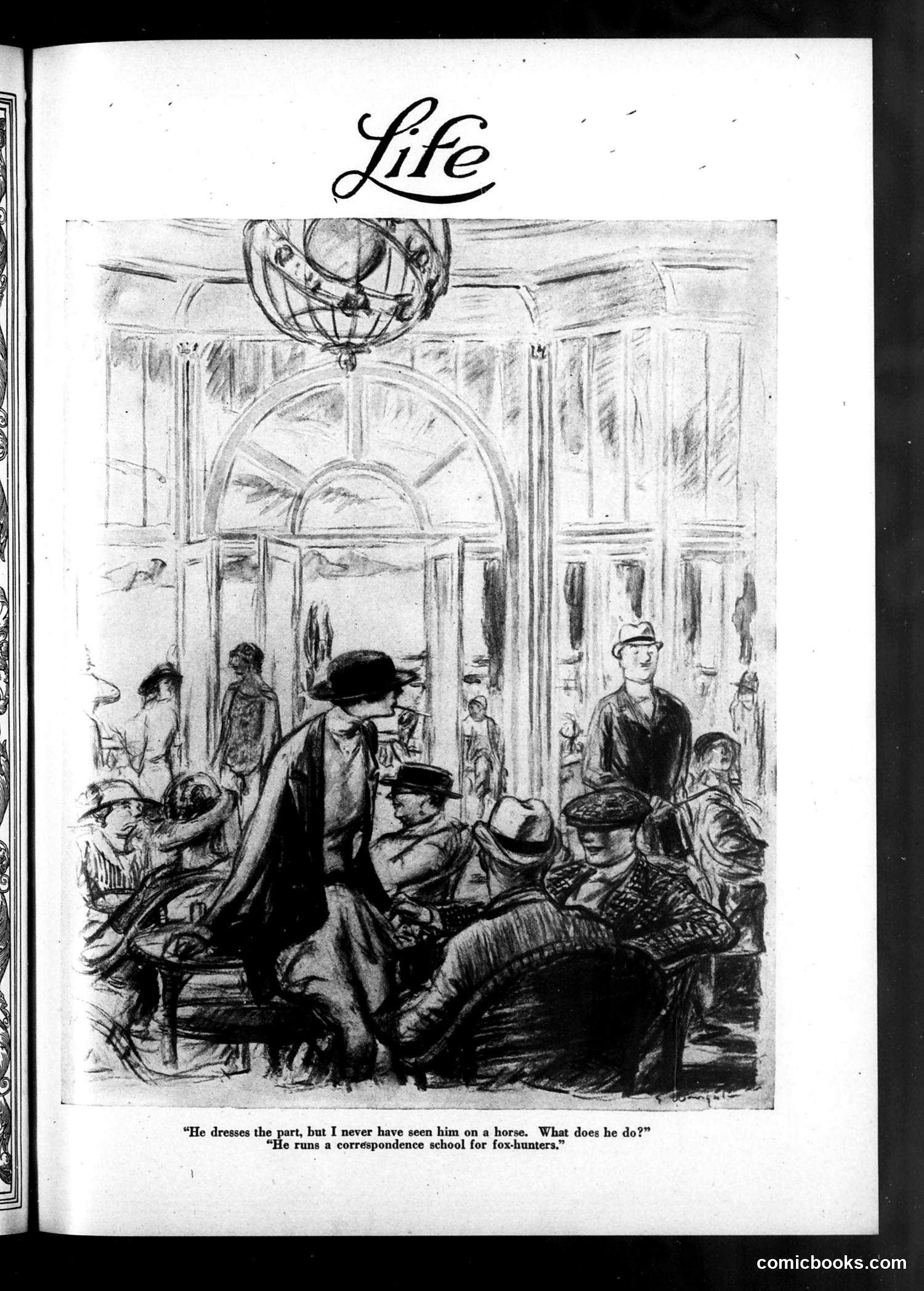
This satirical cartoon depicts an indoor social gathering, likely from the early 20th century. The caption contains a humorous exchange: someone notes a man "dresses the part, but I never have seen him on a horse. What does he do?" The response reveals: "He runs a correspondence school for fox-hunters." The joke satirizes pretension and fraudulent self-presentation. The well-dressed man apparently poses as an accomplished fox-hunter (suggesting aristocratic leisure and sporting expertise) despite having no actual equestrian or hunting experience. He profits by teaching others through mail-based instruction—a then-common educational method. The satire targets both the charlatan selling fake expertise and the gullible students believing they can learn hunting from correspondence alone. The cartoon mocks class affectation and mail-order fraud culture.
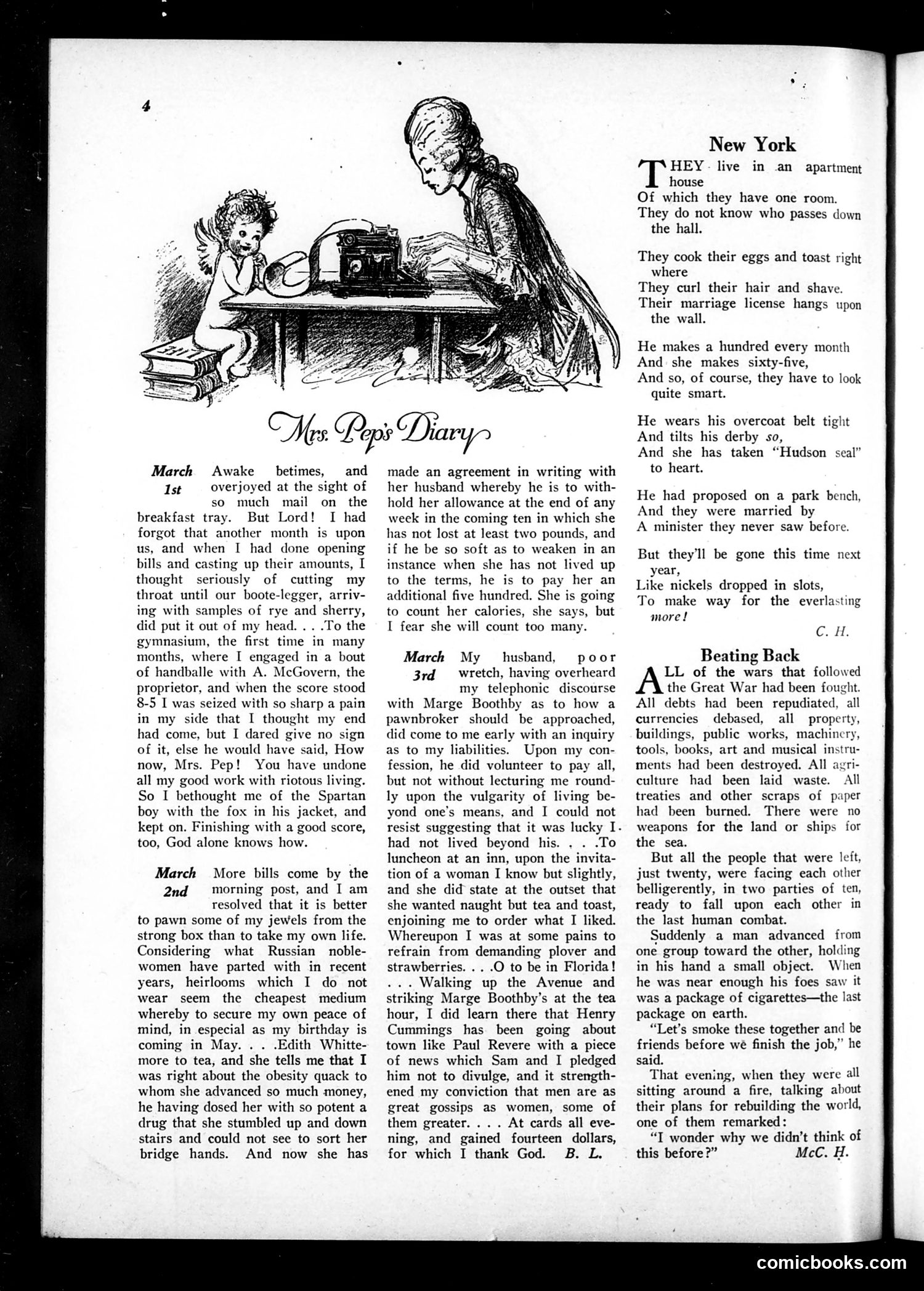
This page presents **"Mrs. Pep's Diary,"** a satirical domestic humor column tracking a New York couple's financial struggles in 1920s urban life. The cartoon shows a woman at a typewriter with a cherub, illustrating the diary format. The accompanying text mocks middle-class married life: the couple lives in a cramped apartment, survives on modest income ($100 monthly for him, $65 for her), and must maintain appearances despite poverty. Satirical details include cooking in their room, their frugal grooming habits, and the wife monitoring her husband's spending. The adjacent "Beating Back" column discusses post-World War I reconstruction efforts and economic recovery. The satire targets **post-war American economic anxiety**—depicting how even employed couples struggled financially in tight urban housing while pretending respectability.
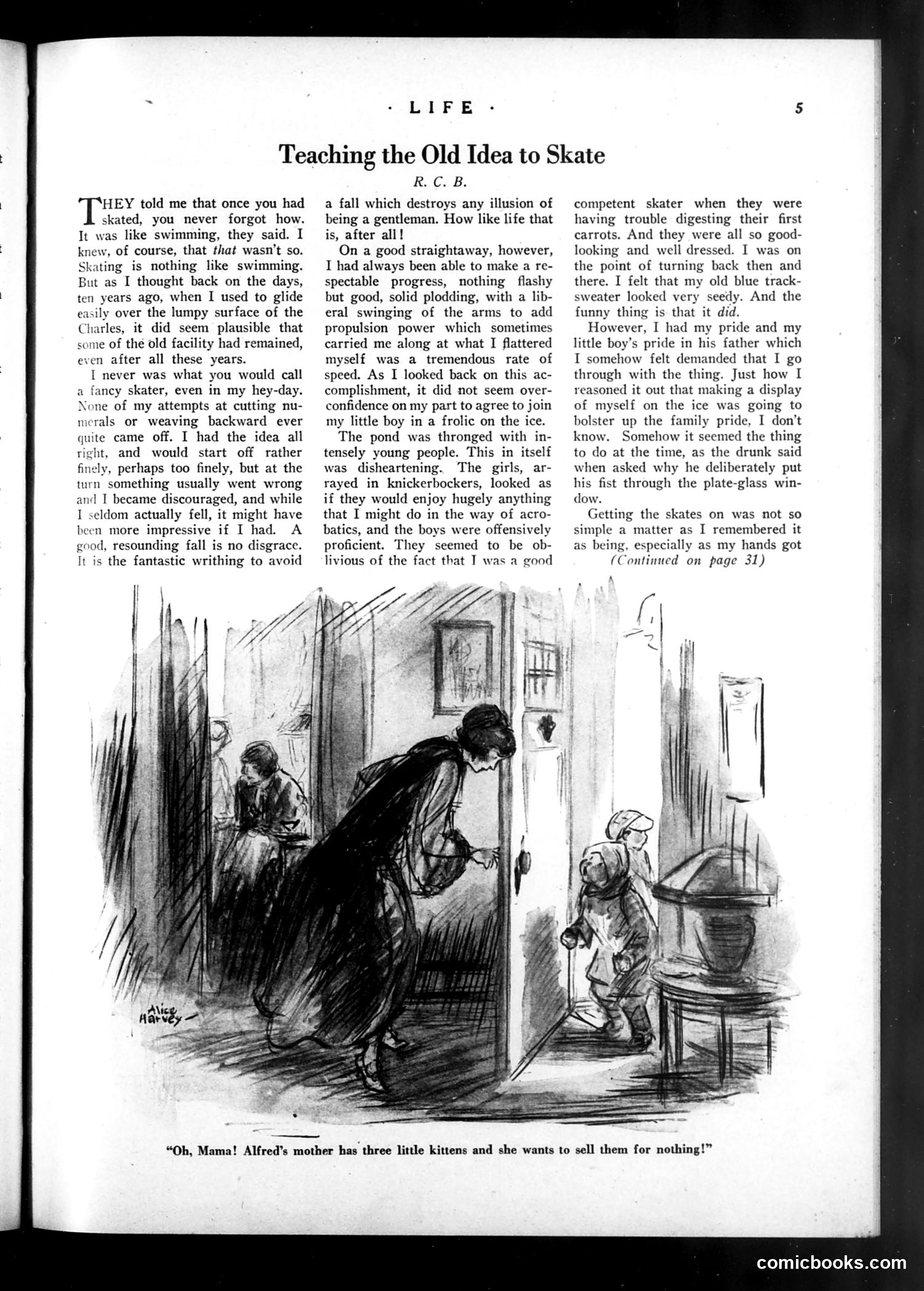
This is a humorous personal essay by R.C.B. about learning to ice skate in adulthood. The author reflects on being told that "once you had skated, you never forgot," only to discover this wasn't true. The piece describes the awkwardness of returning to skating after years away, including physical clumsiness on the ice and embarrassment watching younger, more graceful skaters. The accompanying illustration depicts a domestic scene: an adult (likely the author) bending over while helping a young child with skates, watched by another adult in a doorway. The caption reads: "Oh, Mama! Alfred's mother has three little kittens and she wants to sell them for nothing!"—a humorous non-sequitur suggesting the child's distraction from the skating lesson.
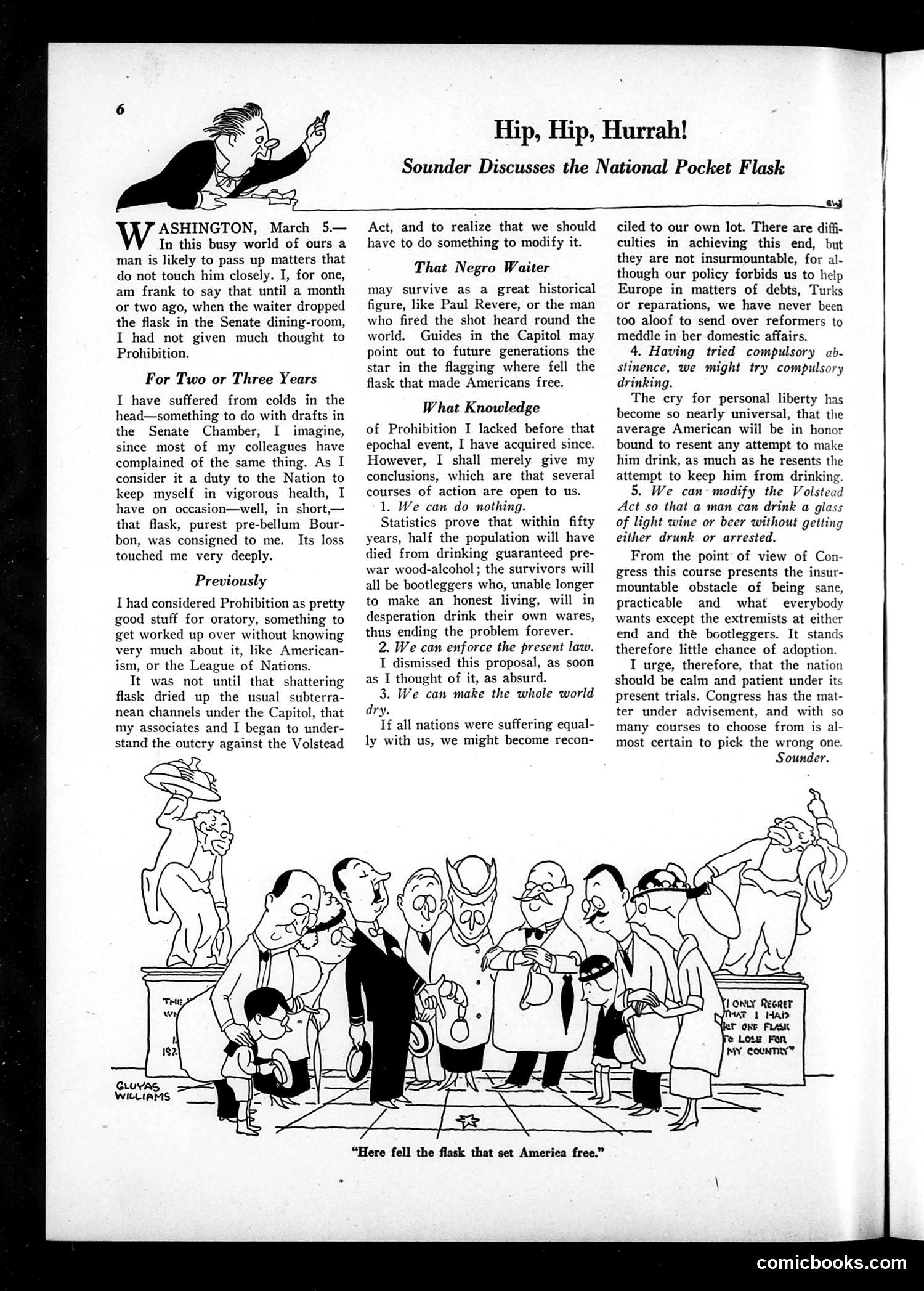
This page satirizes Prohibition and its enforcement challenges. Senator Sounder, writing from Washington in March, describes his changing views on alcohol prohibition after suffering colds in the Capitol's "subterranean channels." The cartoon by Gluyas Williams depicts various political figures gathered around a fallen flask, captioned "Here fell the flask that set America free." The satire mocks Prohibition's failure: despite legal bans, underground drinking persists widely. The scattered figures represent Washington elites unable to enforce or uphold the policy themselves. Sounder's column lists absurd counter-arguments to Prohibition (making the world dry, enforcing present laws), ultimately concluding that compulsory drinking offers "little chance of adoption"—suggesting the policy is doomed by public resistance and widespread hypocrisy among its advocates.
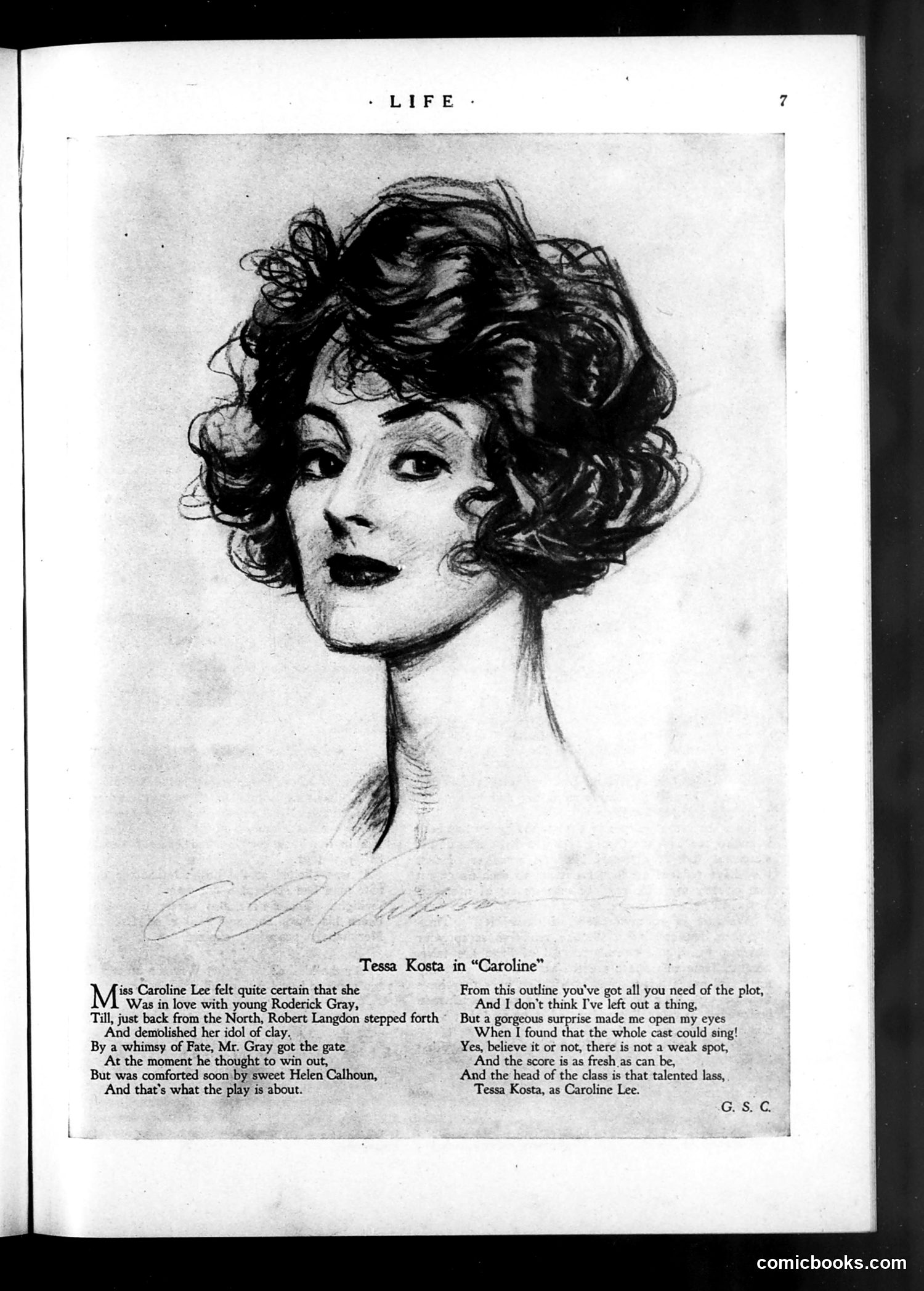
This is a theatrical review page featuring a portrait and commentary on actress **Tessa Kosta** performing in a play called **"Caroline."** The sketch shows a stylish 1920s woman with short, curled hair—the fashionable "bob" of the era. The accompanying text (signed "G.S.C.") reviews the production, noting that Kosta plays Caroline Lee opposite actor Robert Langdon. The critic praises her performance, describing her as "talented" with "not a weak spot," and notes she performs opposite Helen Calhoun's character. The review focuses on the plot mechanics and Kosta's acting ability rather than satire—this appears to be straightforward theater criticism rather than political commentary. The page documents early 20th-century stage entertainment and performance evaluation.
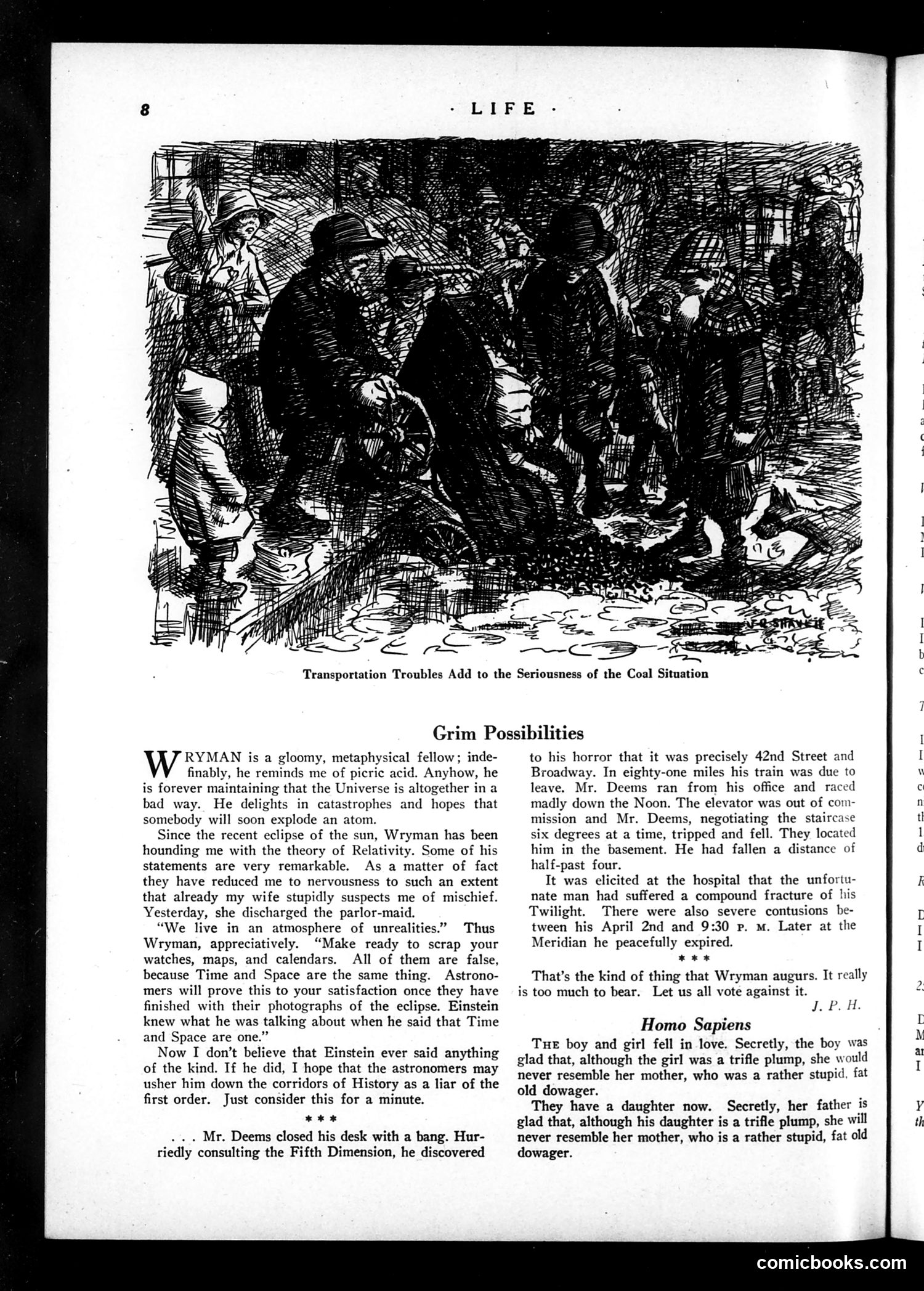
This cartoon depicts a crowded scene of men in dark coats and hats gathered together, apparently discussing or reacting to a crisis. The caption references "coal situation" and "transportation troubles," suggesting this relates to a coal strike or shortage affecting fuel distribution. The accompanying article titled "Grim Possibilities" mentions a character named Wryman, described as gloomy and obsessed with catastrophic theories about atomic explosions and relativity. The text satirizes his pessimistic worldview and tendency toward doomsaying. Without a specific date visible, the exact historical coal crisis referenced is unclear, but this appears to comment on early-20th-century labor unrest and transportation infrastructure problems affecting fuel supplies—serious economic concerns treated here with satirical humor.
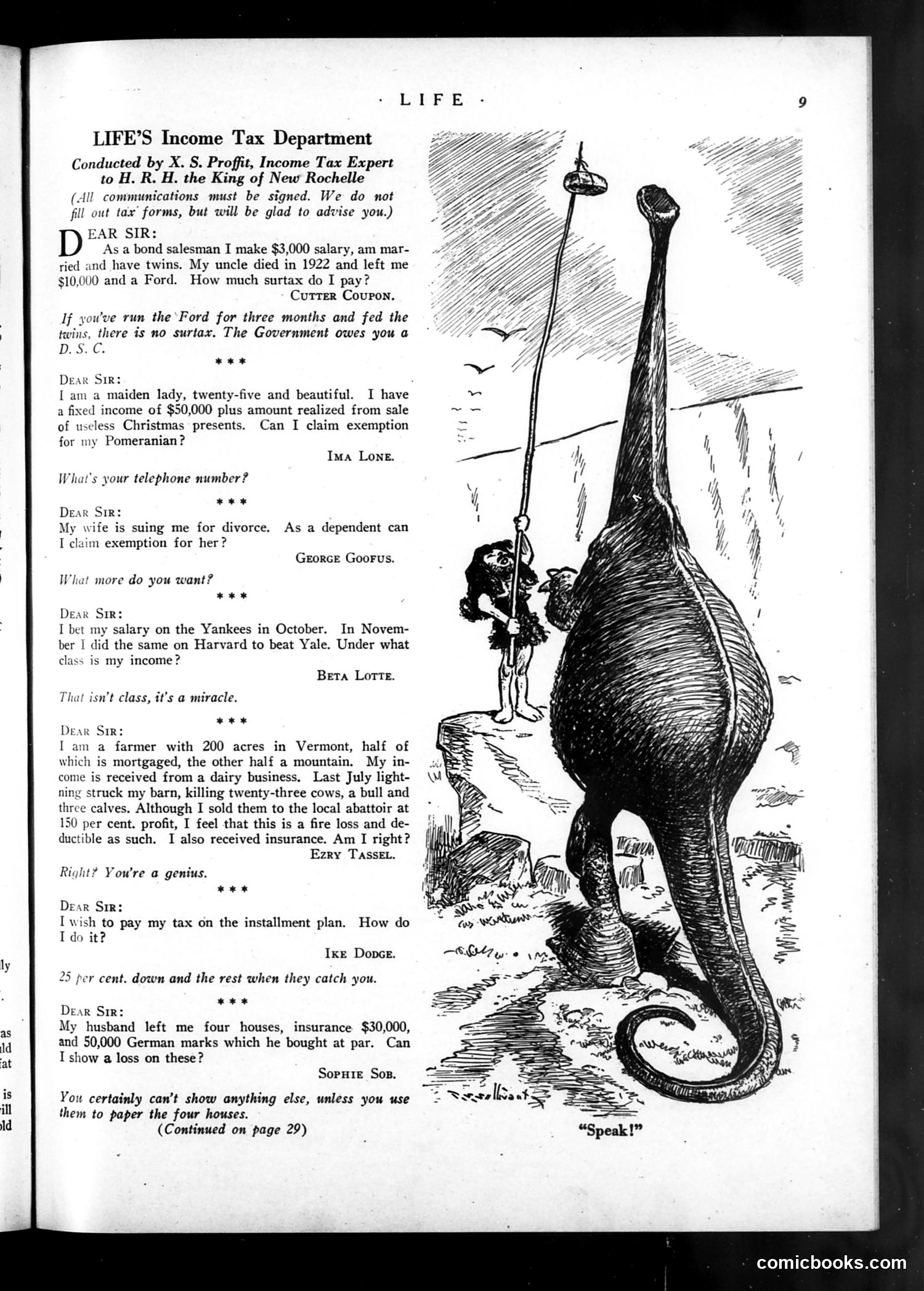
This page features **"LIFE's Income Tax Department,"** a humor column answering readers' tax questions. The large cartoon depicts an **elephant being forced to speak or confess** by a small figure pulling its trunk upward—likely representing the government forcing taxpayers to reveal their financial information. The comic letters below satirize **the complexity and absurdity of early income tax law**. Writers describe contradictory situations: inheriting cars with no tax burden, betting on sports, farming losses from lightning strikes, and currency speculation. The expert's responses are dismissively brief ("That isn't class, it's a miracle"), mocking both the byzantine regulations and taxpayers' creative attempts at deductions. The overall message: **income tax enforcement requires extracting reluctant "confessions" from the public.**
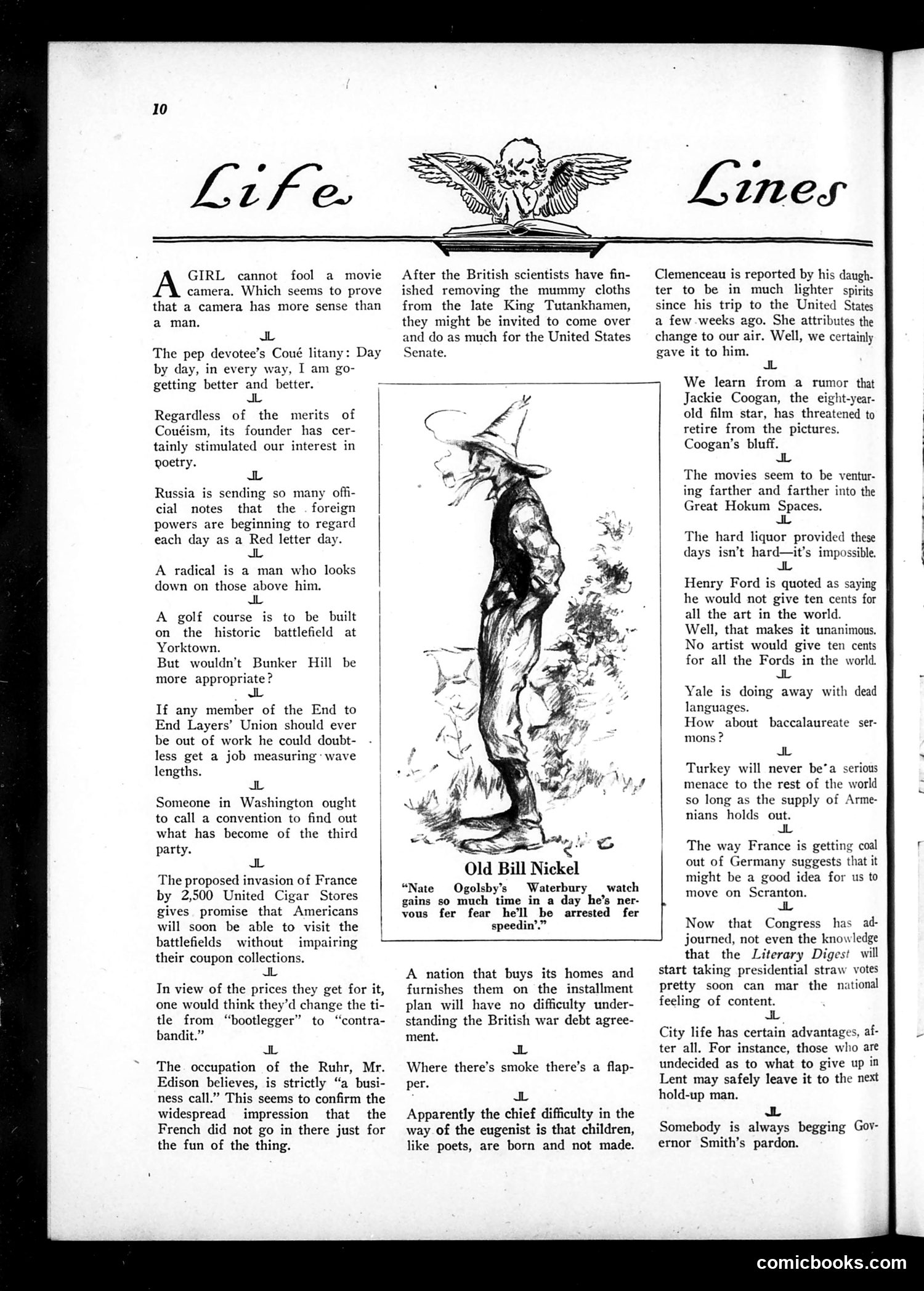
This page contains miscellaneous short satirical commentary and one central cartoon titled "Old Bill Nickel." The cartoon depicts a tall, thin, disheveled figure labeled as such, with the caption suggesting he nervously watches time pass due to fear of arrest for speeding. The surrounding "Life Lines" are brief jokes and observations on contemporary topics: movie cameras, poetry, Bolshevism, golf courses, labor unions, France's occupation of the Ruhr, eugenics, and Henry Ford's dismissal of art. The cartoon likely references a specific contemporary figure or incident involving speeding arrests, though the exact reference is unclear without additional context. The overall page reflects Life magazine's typical format: mixing visual satire with pithy commentary on 1920s American politics, culture, and social issues.
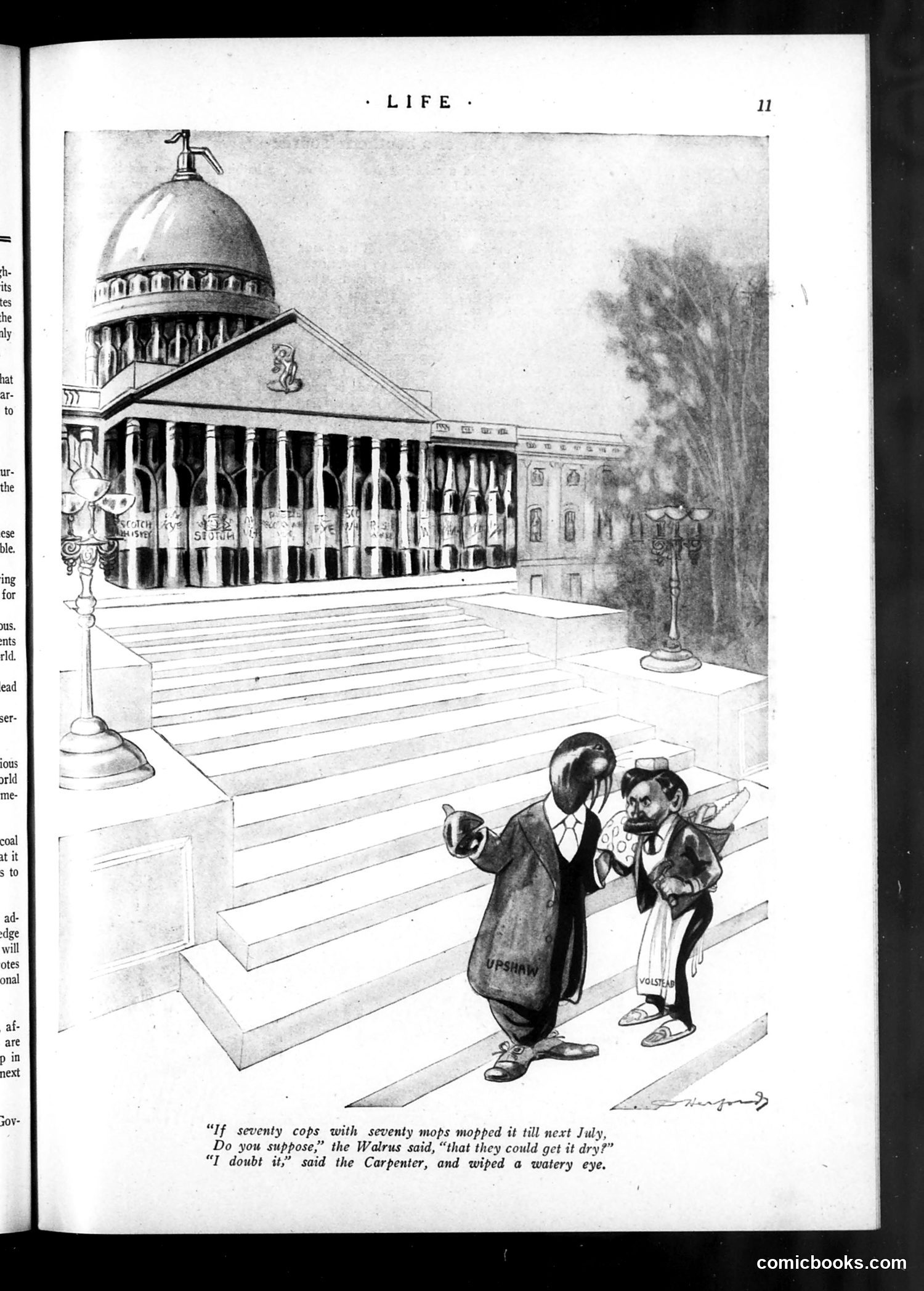
This Life magazine cartoon depicts three figures at the U.S. Capitol building. Two characters labeled "Walrus" and "Carpenter" (likely referencing the Lewis Carroll poem) discuss cleaning the Capitol steps. The Walrus says they could get it done by next July if they had "seventy cops with seventy mops," to which the Carpenter responds skeptically, "I doubt it," while wiping a watery eye. The satire targets Congressional inefficiency and corruption—suggesting that even massive cleaning efforts couldn't purify the institution. The "seventy cops with seventy mops" humorously exaggerates what would be needed to metaphorically clean up Congress's problems. The reference to the literary characters adds intellectual wit to the critique of government dysfunction.
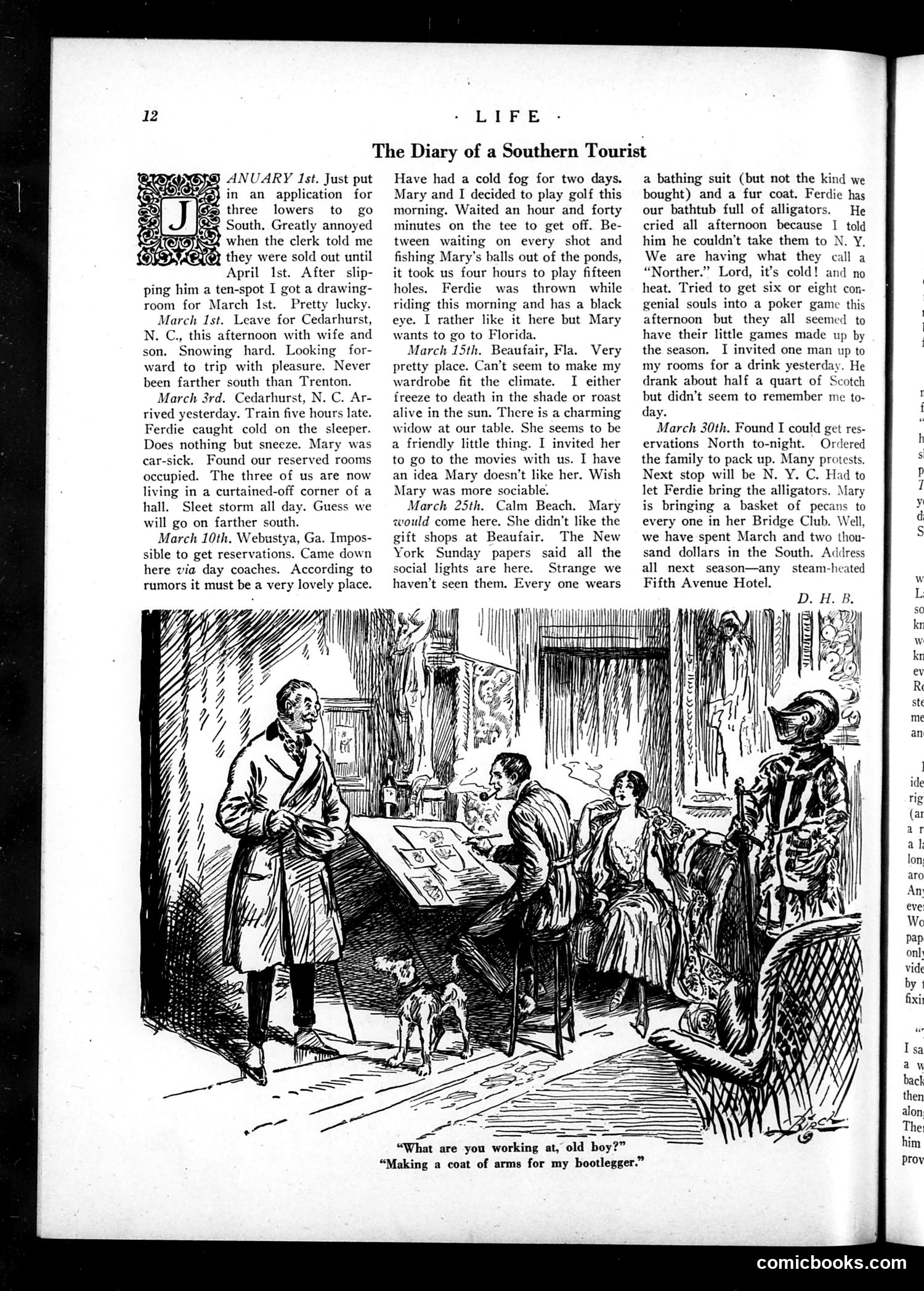
This page presents a travel diary spanning January through March, documenting a tourist's journey through the American South. The accompanying illustration depicts a scene at what appears to be a tailor's shop, where a well-dressed man oversees work on a garment while a small dog observes. The caption reads: "What are you working at, old boy?" "Making a coat of arms for my bootlegger." This joke references **Prohibition** (1920-1933), when alcohol sales were illegal. The humor lies in the ironic absurdity: a "coat of arms" (heraldic nobility symbol) is being created for a "bootlegger" (illegal alcohol smuggler)—suggesting criminals were acquiring trappings of respectability despite their lawbreaking. The cartoon mocks how Prohibition-era bootleggers operated openly despite legal prohibition.
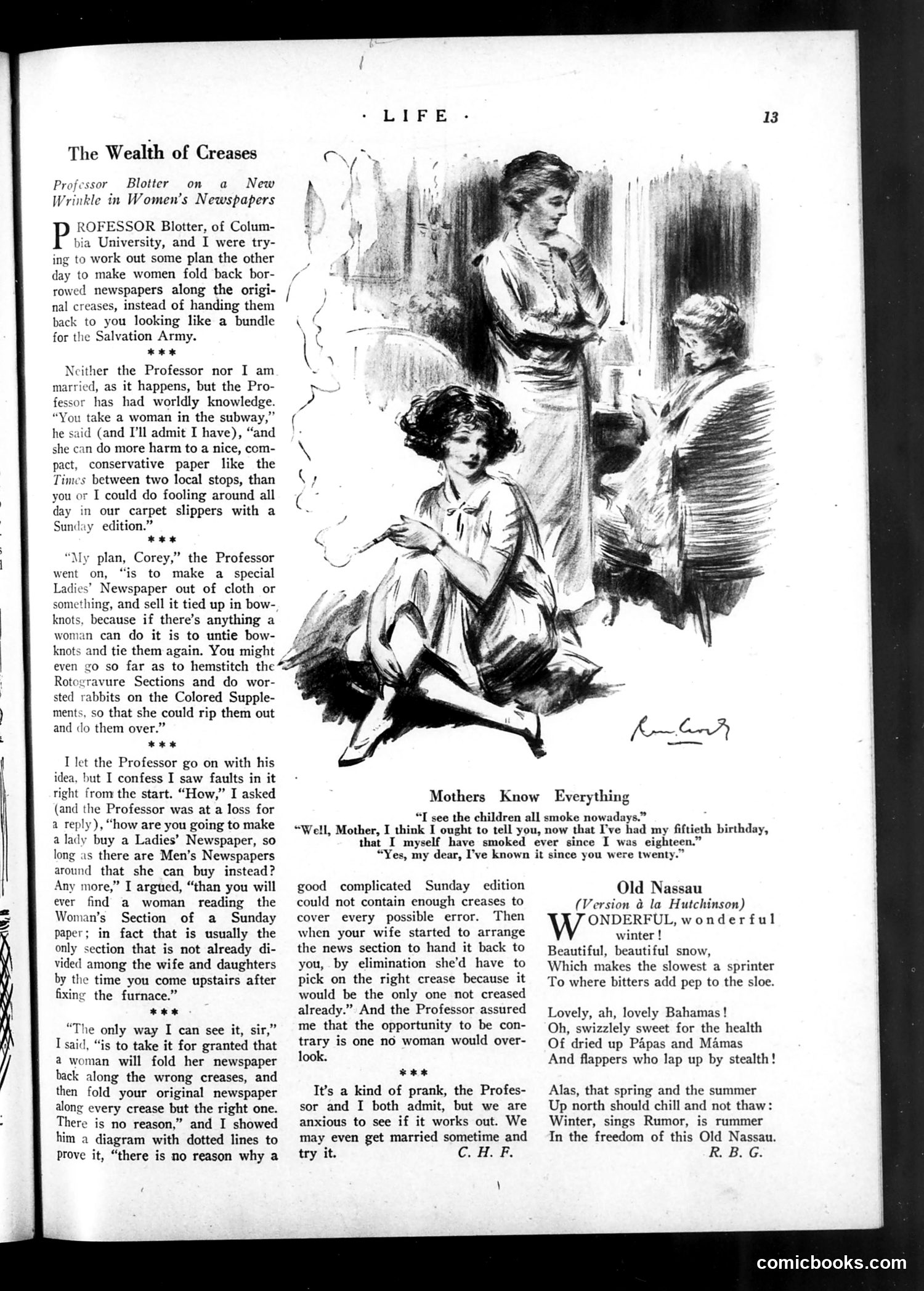
This piece satirizes Professor Blotter's proposal for a new women's newspaper focused on practical household advice. The sketch depicts women reading and managing newspapers, illustrating the article's central joke: the professor suggests women's newspapers should feature instructions on folding and ironing clothes rather than news content. The satire mocks both the professor's patronizing assumption that women need domestic instruction manuals disguised as newspapers, and implicitly critiques the actual limited content in women's newspaper sections of the era. The author points out the absurdity—that such a publication would be utterly impractical—while also noting that women's newspaper sections were already marginalized compared to men's sections. The cartoon appears to illustrate women engaged with print media, reinforcing the discussion's focus on gendered journalism.
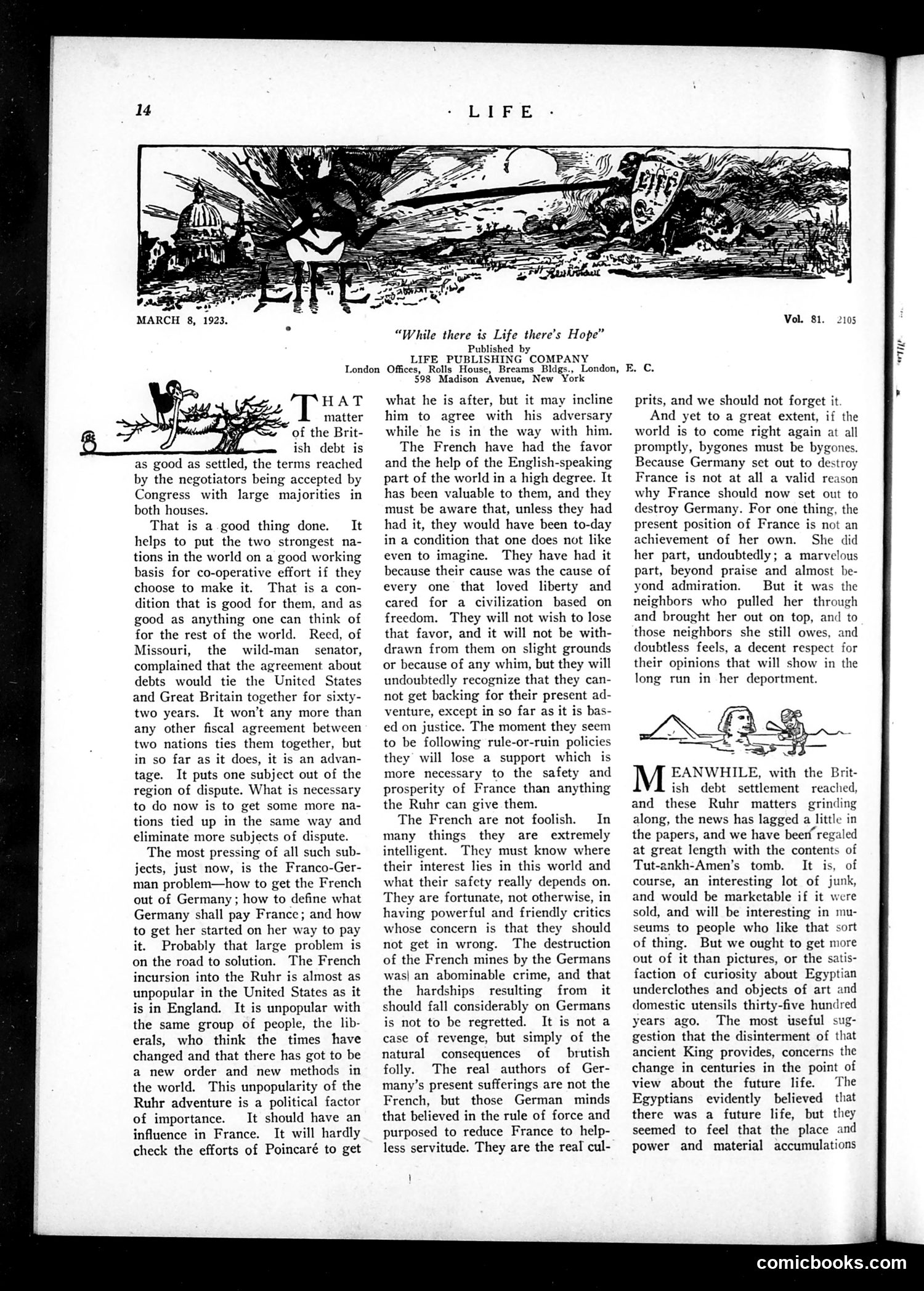
The masthead illustration depicts a chaotic landscape with industrial/military imagery—smokestacks, aircraft, and destruction—suggesting post-WWI geopolitical chaos. The article "While there is Life there's Hope" discusses Franco-German debt negotiations and the Ruhr occupation. The text argues that Britain and France should unite on fiscal matters rather than pursue separate interests, warning that France's current approach toward Germany risks destabilizing Europe. The cartoon's visual chaos appears to symbolize the dangerous consequences of unresolved post-war tensions and conflicting national policies. The reference to a "wild-man senator" likely alludes to American isolationist opposition to international entanglements. The overall message urges pragmatic cooperation between Allied powers to prevent future conflict.
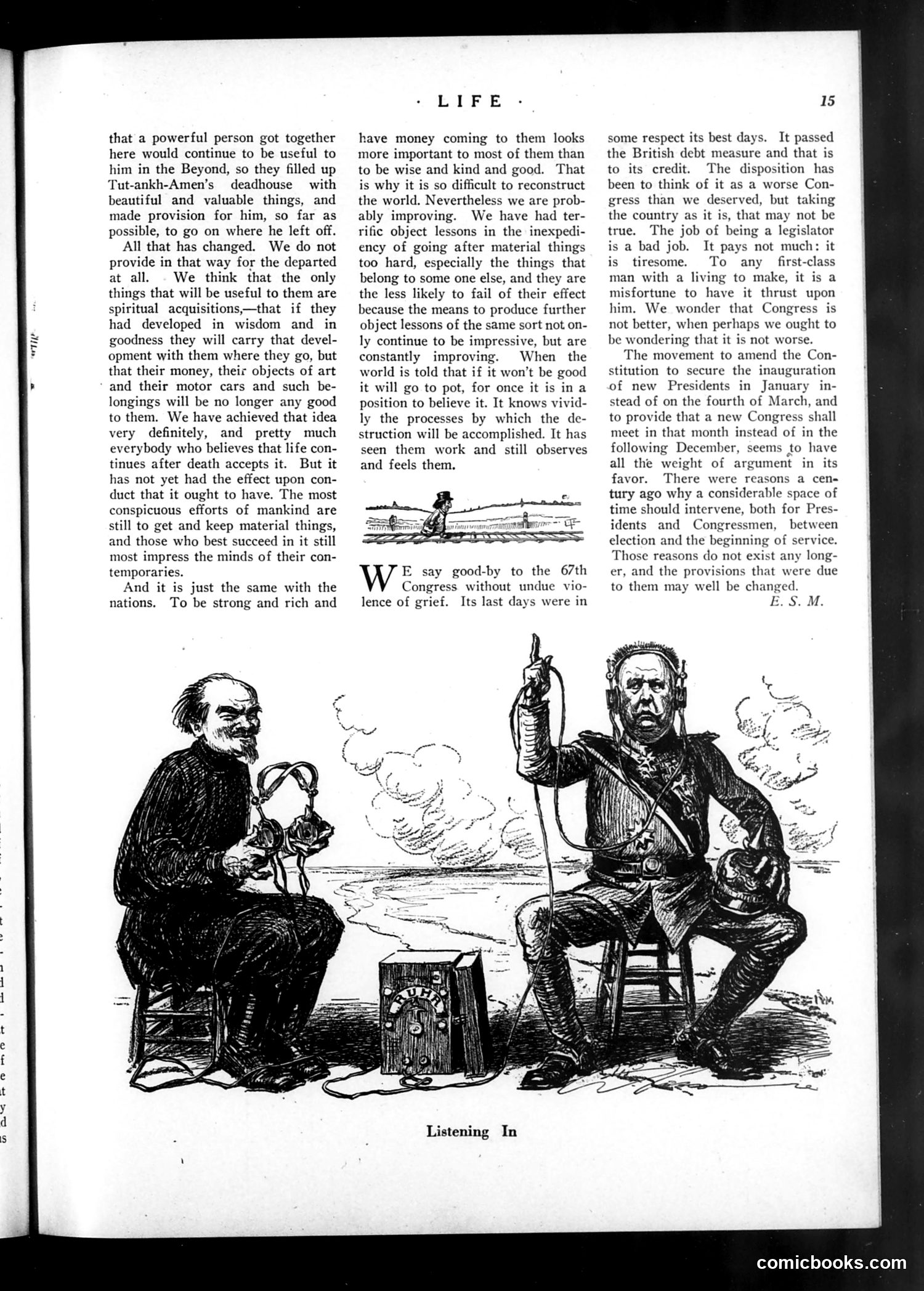
This editorial cartoon satirizes political inattention and poor governance. The image shows two figures seated before a radio: on the left, an older man in civilian dress appearing to listen earnestly; on the right, a military or political official in uniform, seemingly distracted or dismissive, holding what appears to be a listening device away from his ear. The accompanying text discusses the departing 67th Congress, characterizing it as undistinguished but perhaps not worse than deserved given that legislators are underpaid and overworked. The "Listening In" title suggests the cartoon critiques leaders who *claim* to listen to constituents or advisors but fail to genuinely engage—a commentary on political performativity versus actual accountability during the post-WWI era congressional transition referenced in the text (mentioning proposed changes to presidential/congressional inauguration timing).
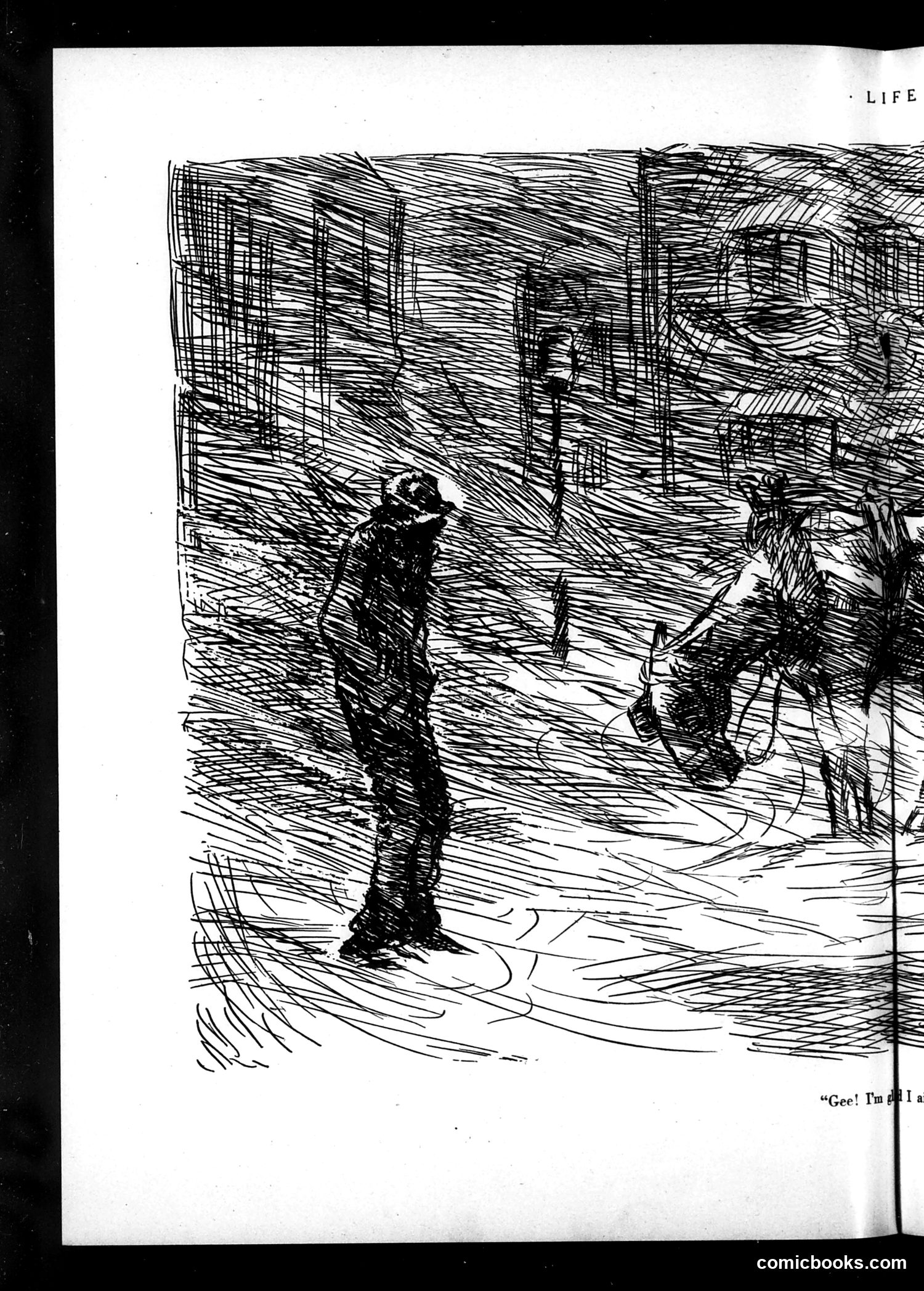
This is a sketch-style illustration showing a figure standing in what appears to be an industrial or construction site, with buildings or structures visible in the background. The figure stands in a characteristic pose suggesting exhaustion or resignation. The partial caption reads "Gee! I'm all a..." (text cut off), which appears to be the beginning of an exclamation, likely "Gee! I'm all in" or similar—a common period expression meaning worn out or tired. Without the complete caption or additional context, the specific satirical target is unclear. The scene could reference labor conditions, unemployment, or urban hardship during an economic period (Life magazine published satirical social commentary). However, I cannot definitively identify the intended subject or joke without seeing the complete text or having certain knowledge of the publication date.
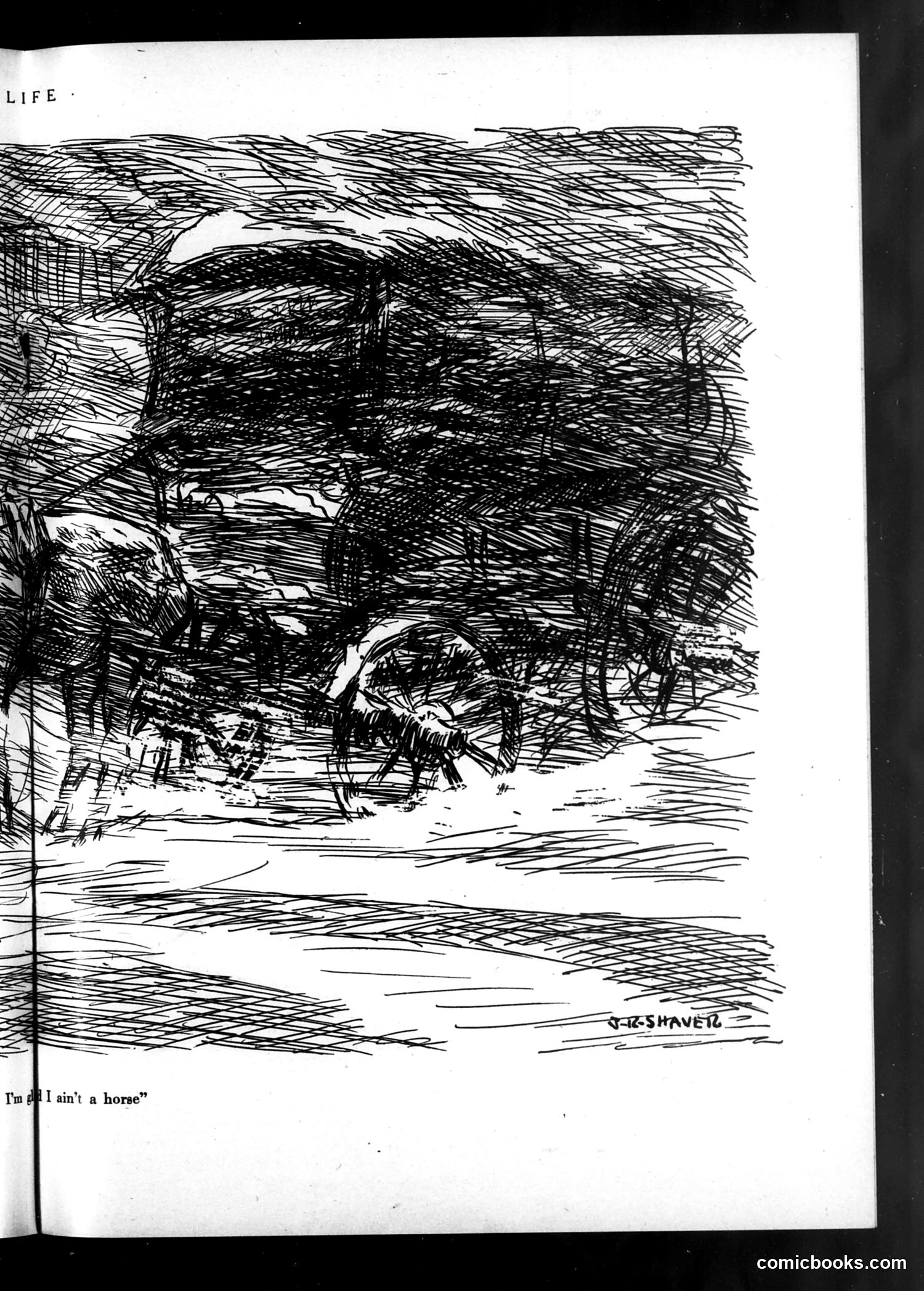
This single-panel cartoon depicts a figure (drawn in heavy cross-hatching) standing before what appears to be a covered or obscured object, declaring "I ain't a horse." The sketch style and composition suggest a humorous commentary, likely playing on a common phrase or misidentification. The cartoon's satire appears to target someone or something being mistaken for something else—possibly a political figure or public personality forced to deny an unflattering comparison. Without additional context about the specific publication date or contemporary events, the precise target remains unclear. The heavy, crude drawing style emphasizes the subject's indignation at the comparison, suggesting public embarrassment or ridicule as the humor's basis. The artist's signature appears to read "Shaver" or similar.
This page satirizes New York entertainment through animal show commentary. The writer uses the 47th Westminster Kennel Club Dog Show as a humorous lens to critique contemporary theater. **The satire:** Wire-haired fox-terriers are praised for enthusiastic, purposeless barking—"barking for barking's sake"—while Great Danes appear indifferent and sleep. Scotties, dressed in "blue-and-gold wrappers," recline "up-stage" in affected manner, considering themselves superior. **Social commentary:** The dogs' behavior mirrors human theatrical pretension. The energetic but pointless terriers represent cheap entertainment; the aloof Danes and self-important Scotties embody artistic pretension and snobbery. **Additional critique:** The second section dismisses "The God of Vengeance" (a Scholom Asch play about a prostitute) as initially sincere but corrupted by commercial success and Broadway audiences—suggesting that popularity degrades art. The humor relies on anthropomorphizing dogs to mock both lowbrow entertainment and highbrow theatrical affectation.
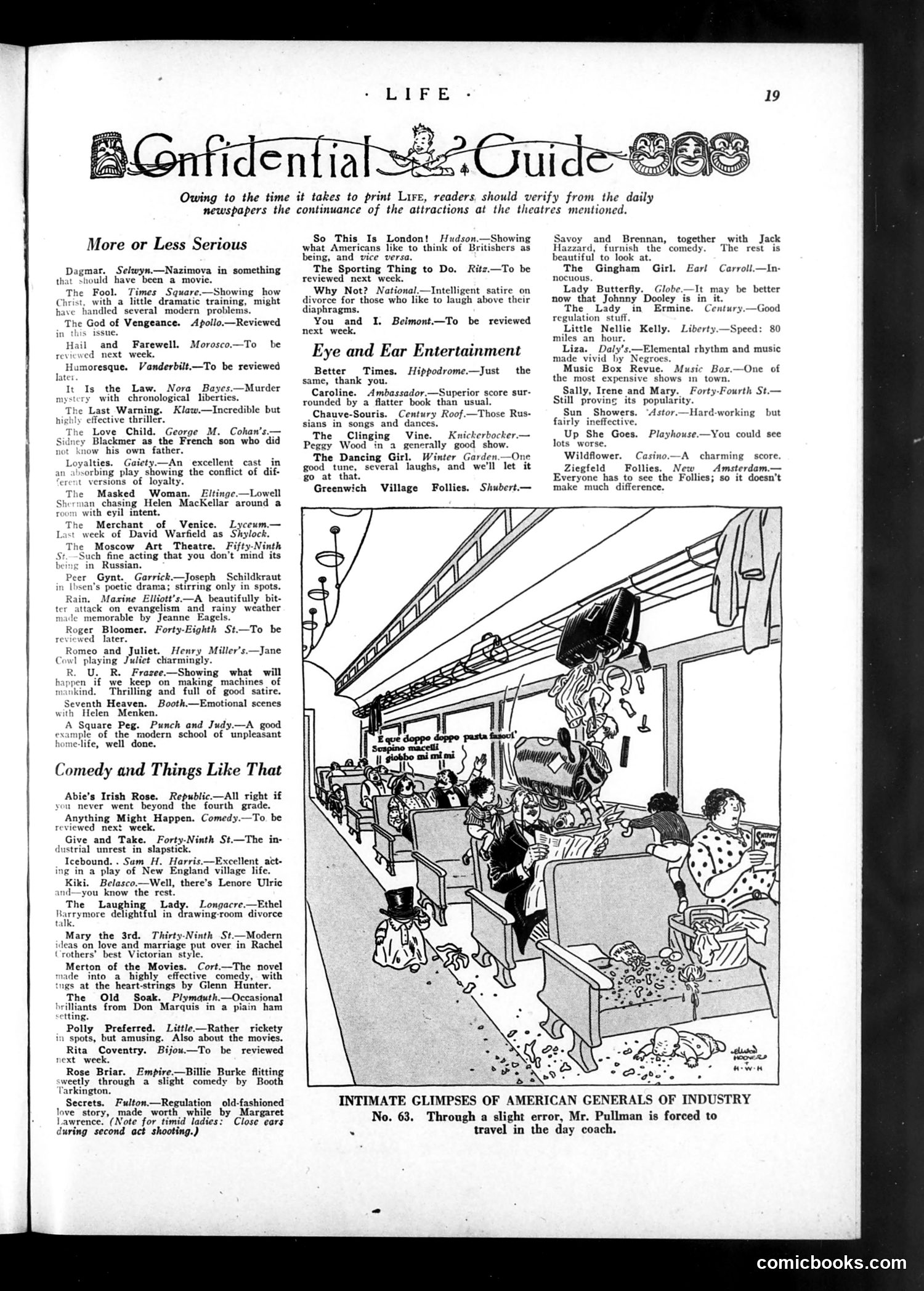
This page is a theater guide from *Life* magazine's "Confidential Guide" section, listing Broadway shows with brief, often satirical reviews. The illustration at bottom—captioned "Intimate Glimpses of American Generals of Industry, No. 63"—depicts a crowded day coach on a train where a wealthy businessman ("Mr. Pullman") is forced to travel among ordinary passengers. The satire mocks wealthy industrialists: Pullman, famous for his luxury railroad cars, is ironically confined to standard seating with common folk. The joke targets industrial magnates who profit enormously while average Americans endure cramped conditions—highlighting class disparity and the hypocrisy of the wealthy. The illustration's crude, chaotic style emphasizes the indignity of the situation for someone accustomed to opulence. This reflects early 20th-century American anxiety about industrial wealth concentration.
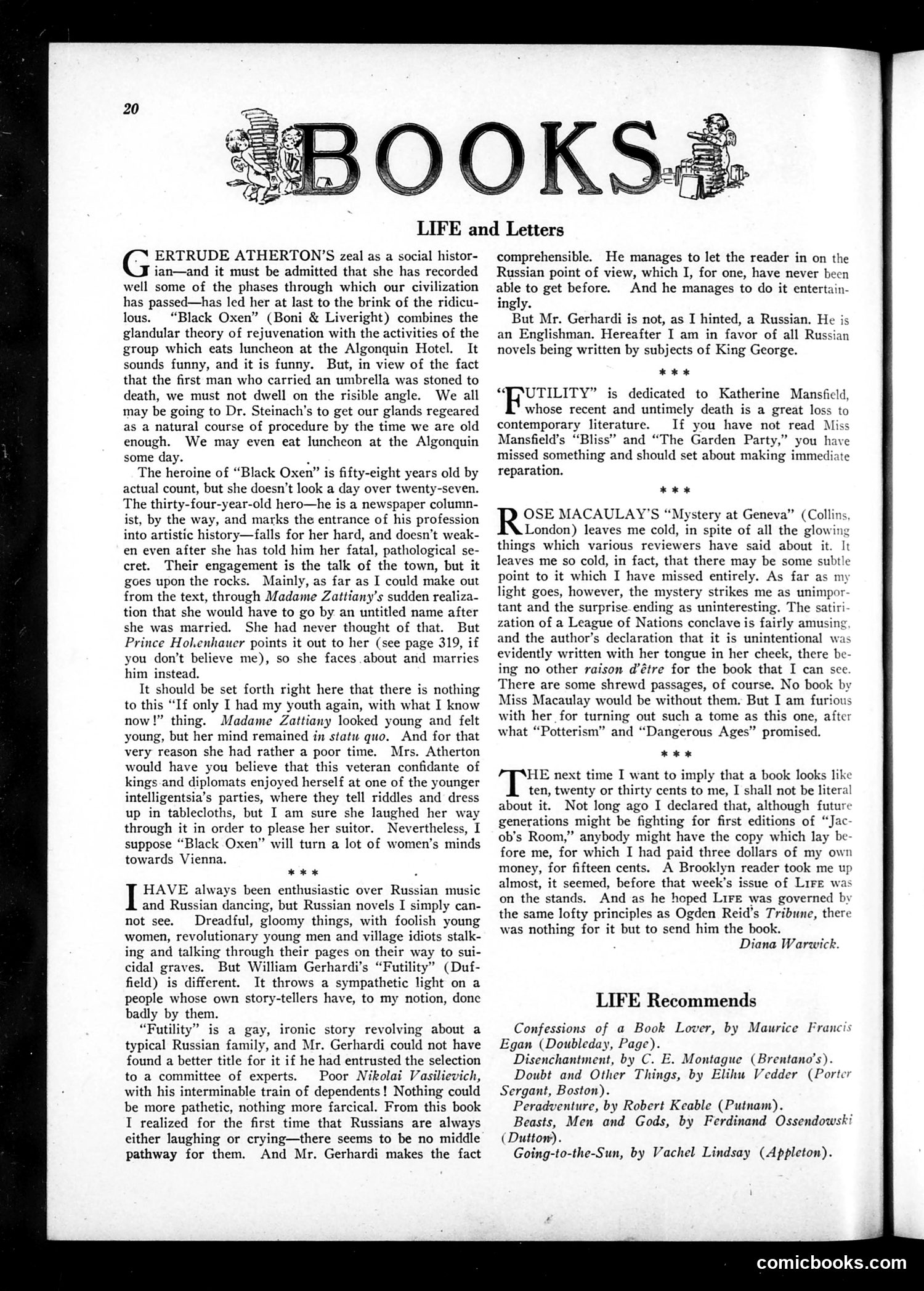
This page is a book review section from *Life* magazine, not a political cartoon. It contains literary criticism of contemporary novels, primarily focusing on Gertrude Atherton's "Black Oxen" and William Gerhardi's "Futility." The reviewer satirizes Atherton's plot about a 58-year-old woman made to look 27 through glandular rejuvenation treatment, mocking both the pseudoscientific premise and the heroine's concern about losing her title upon marriage. The humor targets fashionable Vienna medical trends and women's vanity. The second review praises Gerhardi's novel about a typical Russian family, noting it's refreshingly different from typical Russian literature—which the reviewer characterizes as uniformly gloomy and nihilistic. The satire concludes with tongue-in-cheek approval that Russians should write their own novels through English authors rather than native writers.
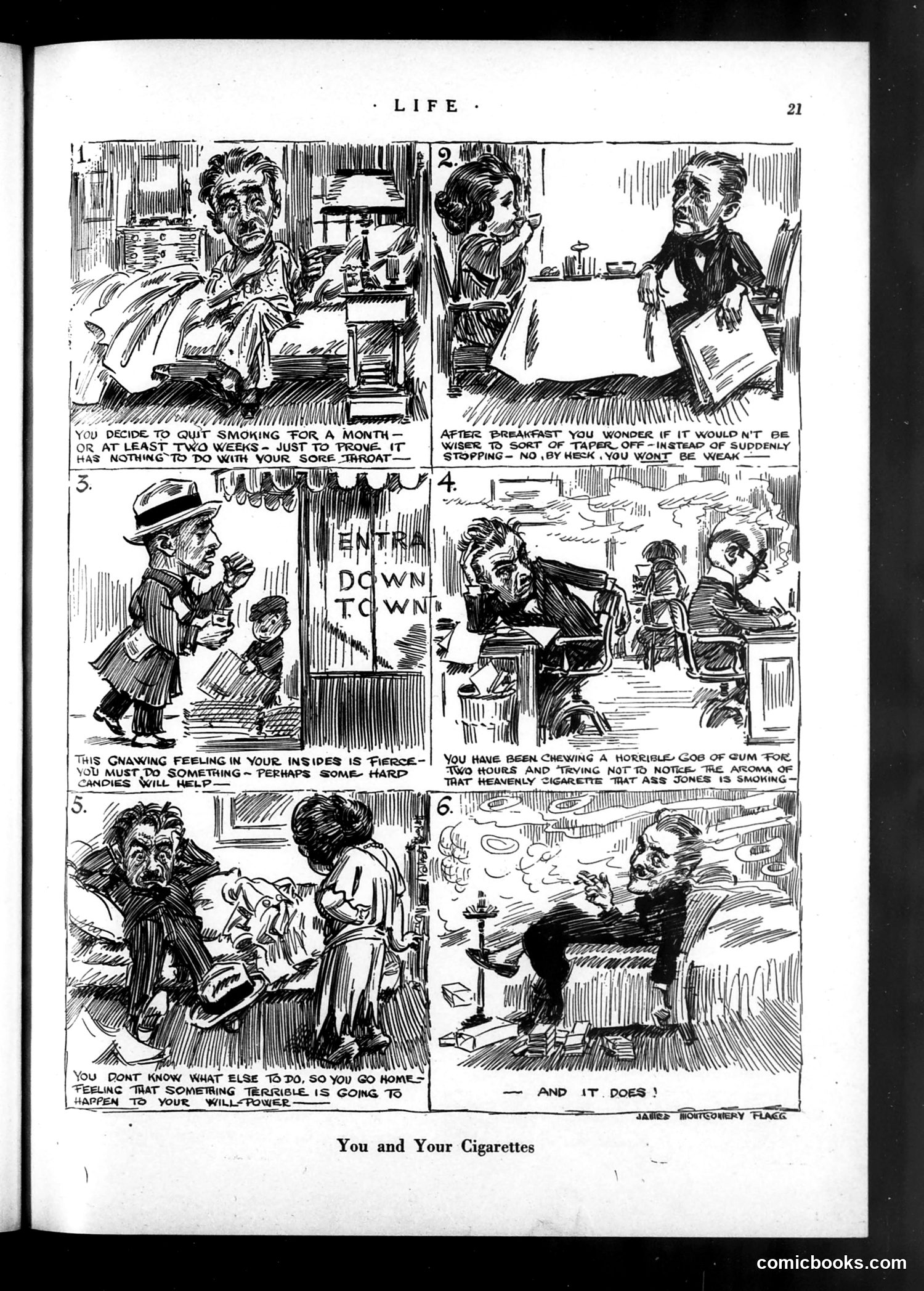
This six-panel comic satirizes the difficulty of quitting smoking. It depicts an everyman character attempting to quit cigarettes for a month "to prove" smoking doesn't affect his health, particularly his sore throat. The satire progresses through his failed willpower: he decides to quit abruptly, then compromises by tapering instead. Downtown, a "gnawing feeling" drives him to distraction. He chews gum for two hours without relief. Desperate and unable to identify what he's missing, he returns home—where smoking immediately "does" satisfy him. The joke's point: smokers convince themselves cigarettes aren't addictive or harmful, yet their bodies immediately betray this denial upon quitting. The comic mocks the rationalization and self-deception smokers employ, particularly the claim that throat irritation has "nothing to do" with smoking. It's anti-smoking satire targeting contemporary denial about cigarette addiction.
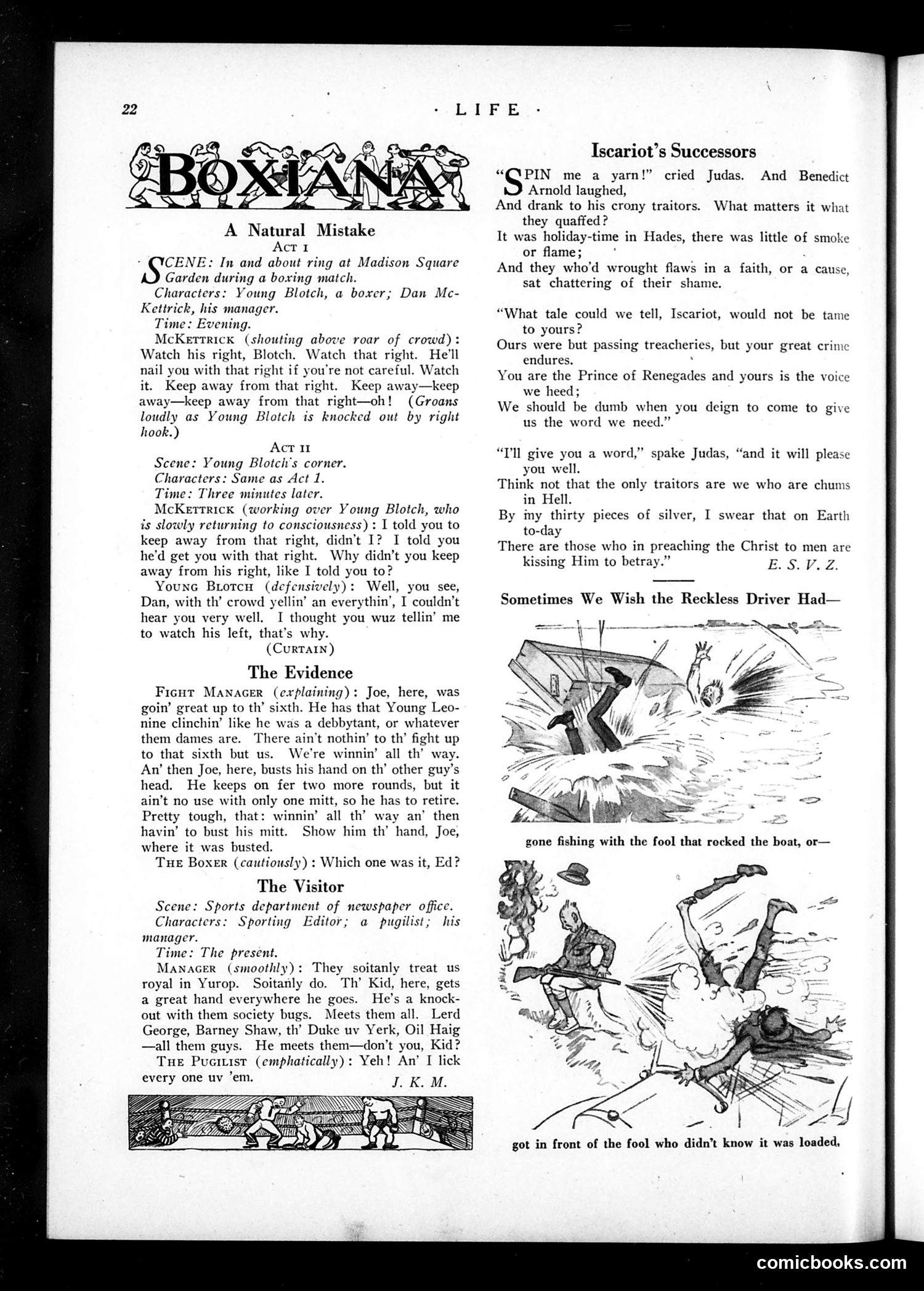
This page contains three separate satirical boxing sketches and a poem about betrayal. **The Boxing Sketches:** These mock the incompetence of boxing managers and fighters through comedic misunderstandings. In "A Natural Mistake," a manager shouts warnings about his opponent's right hand, but the boxer mishears due to crowd noise and gets knocked out. "The Evidence" features a manager's elaborate excuse-making about a fighter's injury. "The Visitor" shows a boxer's manager bragging about European celebrity encounters, while the fighter boasts he "lick[ed] every one uv 'em"—suggesting either violence toward dignitaries or comic exaggeration. The dialect and characters satirize working-class boxing culture. **"Iscariot's Successors":** This poem compares biblical/historical traitors (Judas, Benedict Arnold) to contemporary religious figures who "preach the Christ to men" while "kissing Him to betray"—likely criticizing clergy or religious leaders perceived as hypocritical or unfaithful to their principles. **"Reckless Driver":** A brief satirical caption accompanying a car accident illustration, critiquing dangerous driving.
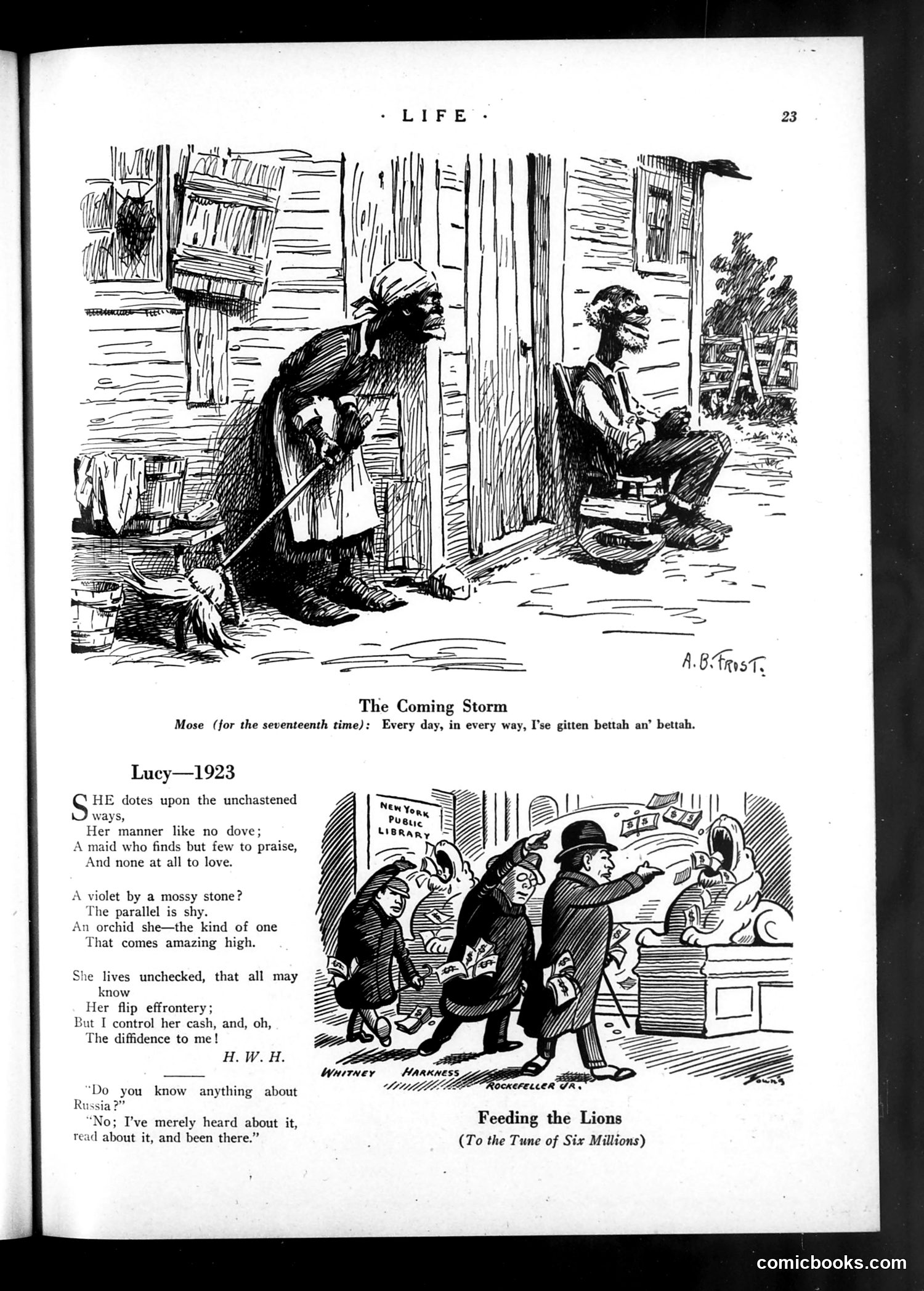
**"The Coming Storm"** depicts a Black man (labeled "Mose") repeating Émile Coué's famous positive-affirmation mantra ("Every day, in every way, I've gotten better and better")—a 1920s self-help fad. The humor relies on racist caricature: the figure's exaggerated features suggest the satire mocks both the affirmation trend and, problematically, the speaker himself. **"Lucy—1923"** is a poem satirizing modern, independent women of the Jazz Age. It mocks the "flapper"—sexually liberated, financially carefree, and socially unconventional ("flip effrontery"). The ironic twist: her father controls her money despite her apparent freedom. **"Feeding the Lions"** cartoon shows figures labeled "Whitney," "Harkness," and "Rockefeller" at a New York Public Library, satirizing wealthy philanthropists as merely "feeding" (financially supporting) institutional lions—suggesting their donations are self-serving rather than genuinely altruistic.
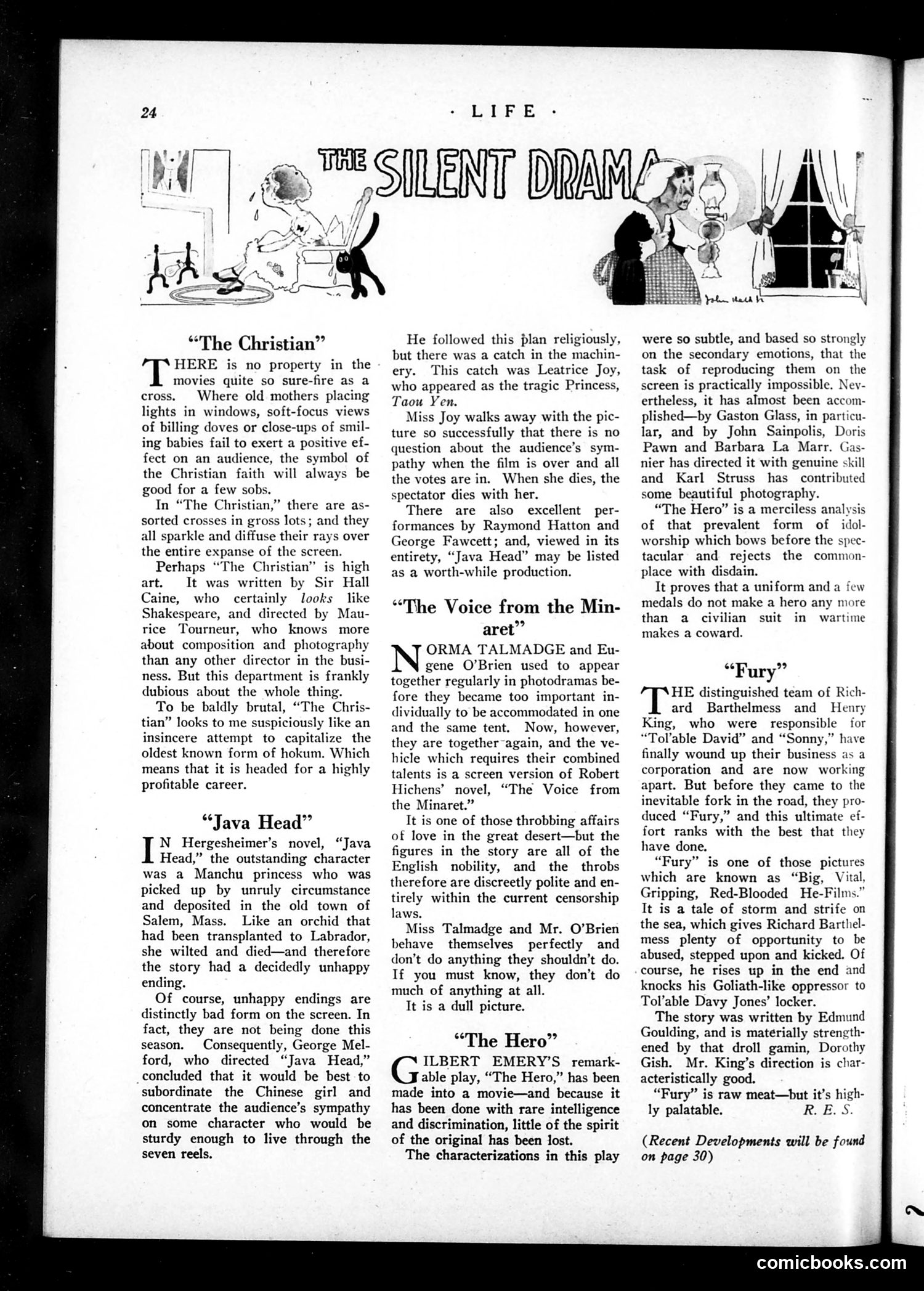
This page contains satirical reviews of five silent films. The critic's tone is biting and cynical throughout: **"The Christian"** — The reviewer accuses the film of cynical hokum, arguing it exploits religious imagery (crosses) to manipulate audiences emotionally rather than tell an authentic story. He predicts it will be commercially successful *because* of this insincerity. **"Java Head"** — The reviewer notes the film altered its source novel's tragic ending (standard practice in 1920s cinema) to provide a happy conclusion, yet the lead actress (Leatrice Joy) steals the picture anyway, making her character's death emotionally powerful despite the director's intent. **"The Voice from the Minaret"** — Dismissed as dull. The reviewer mocks that the leads (Talmadge and O'Brien) behave so perfectly and do "much of anything at all." **"The Hero"** — Praised for successfully translating subtle stage performances to screen, particularly Gaston Glass's acting. The satire criticizes filmmakers' manipulation of emotion and audience taste while acknowledging cinema's commercial realities.
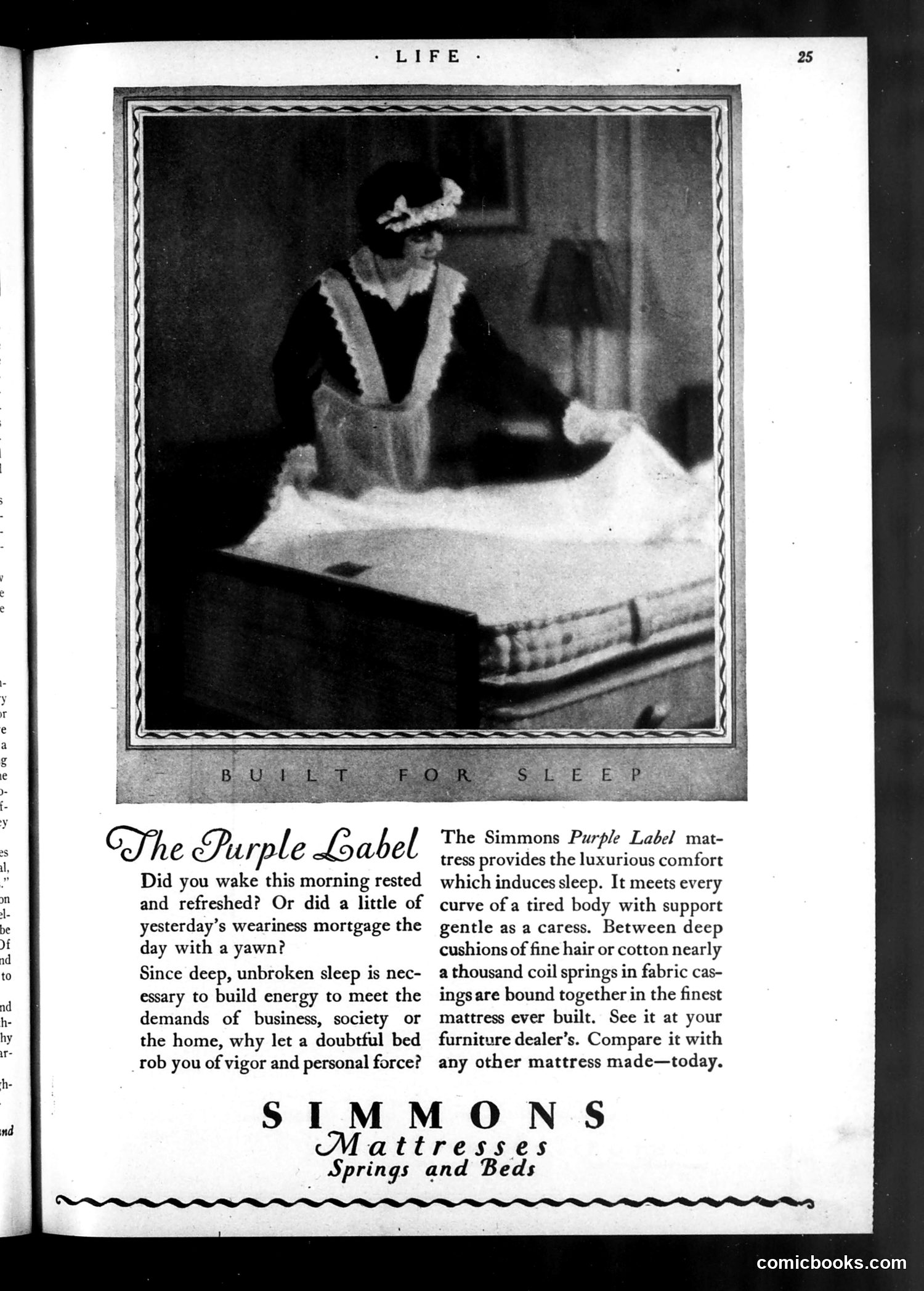
This page is primarily a **product advertisement**, not political satire or comics content. It advertises the Simmons "Purple Label" mattress, a luxury bedding product. The image shows a well-dressed woman in 1920s attire examining a mattress, with the caption "Built for Sleep." The advertisement uses psychological appeals typical of early 20th-century marketing: it frames quality sleep as essential to business success and personal vigor, suggesting that a poor mattress undermines one's competitive edge and energy. The tagline "Did you wake this morning rested and refreshed?" directly addresses consumer anxieties about productivity and vitality. The detailed product description emphasizes engineering ("nearly a thousand coil springs") and material quality to justify premium pricing. This reflects broader social messaging of the era linking consumer goods to modern success and well-being.
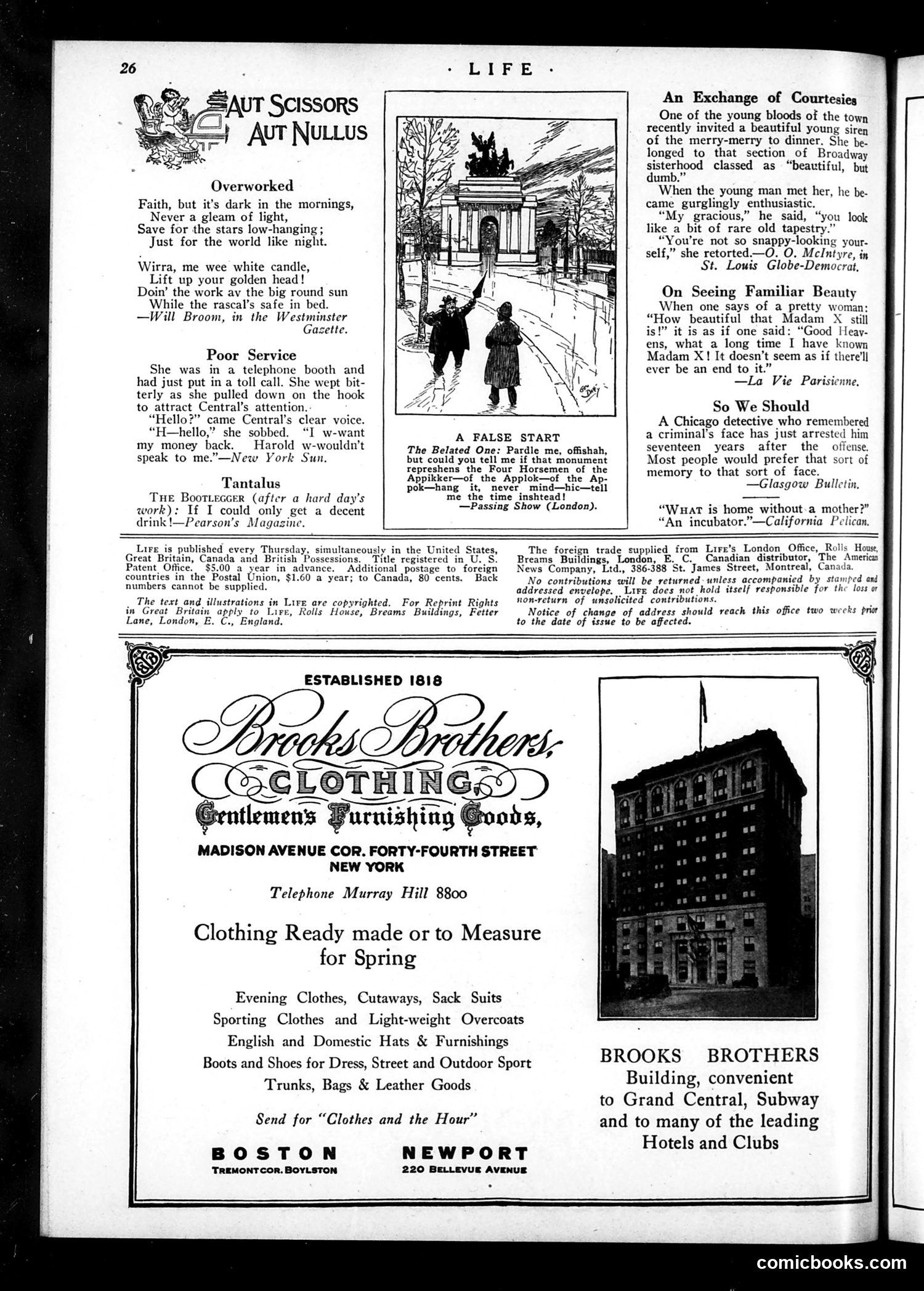
This page from *Life* magazine contains several short humorous pieces and advertisements. The top section features "Aut Scissors Aut Nullus," a collection of brief satirical items: - **"Overworked"** mockingly addresses a candle doing the sun's work while the sun sleeps - **"Poor Service"** jokes about a woman calling her husband Harold through a telephone operator, upset he won't return her money - **"An Exchange of Courtesies"** depicts a young man complimenting a Broadway entertainer as "rare old tapestry," only for her to insult his appearance in return - **"A False Start"** shows a drunk man confusedly asking about a monument, mistaking the "Four Horsemen" - **"So We Should"** presents a detective solving a 17-year-old crime based on memory The humor targets everyday frustrations (poor service, drunkenness, superficial interactions) and contemporary urban life. The page is largely dominated by a Brooks Brothers clothing advertisement.
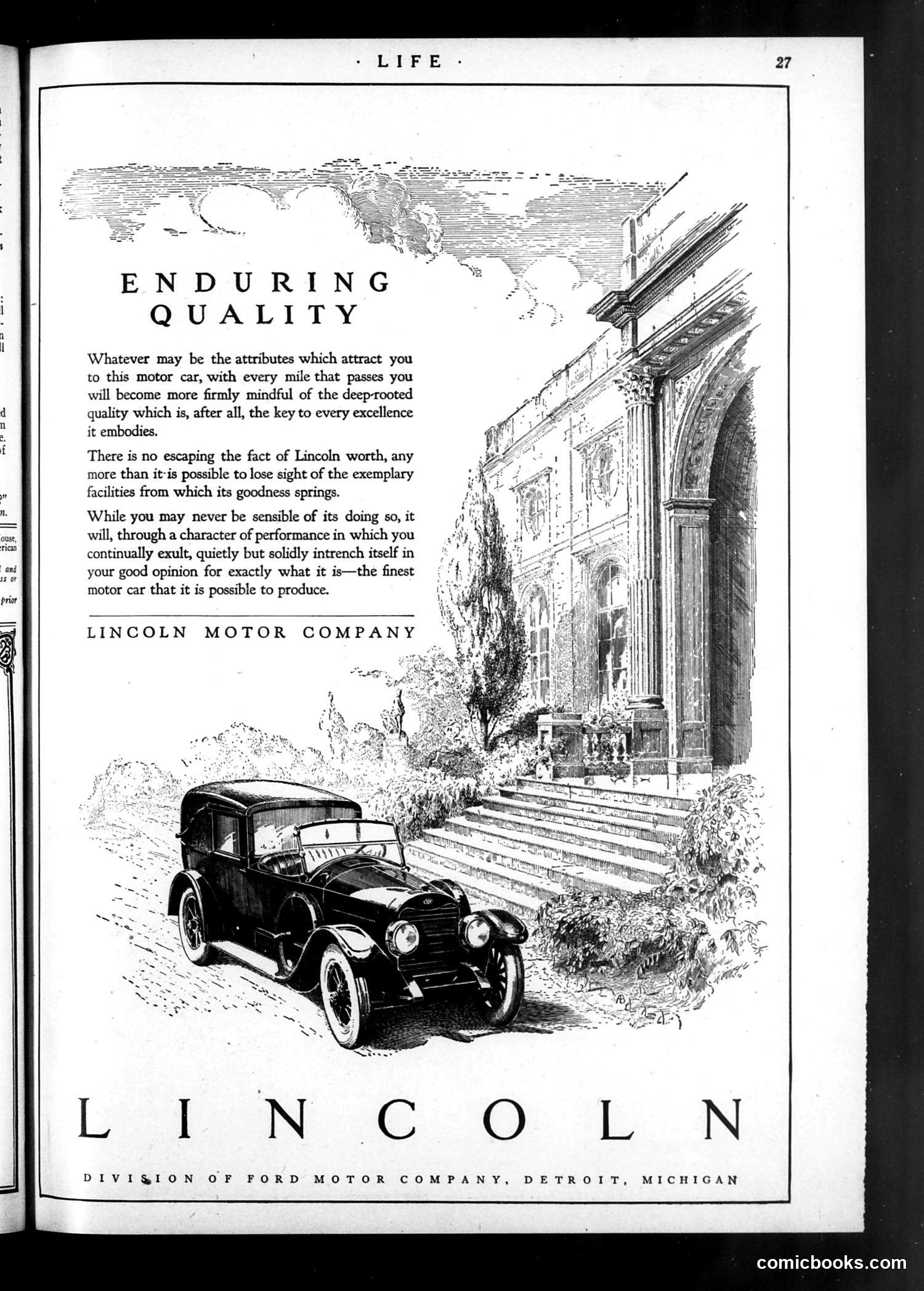
This is **not a cartoon or satire**—it's a straightforward luxury automobile advertisement from Life magazine's early automotive era. The page promotes Lincoln automobiles (a Ford Motor Company division) to wealthy readers. The ad uses aspirational imagery: a Lincoln car positioned before an ornate classical building with grand columns and steps, suggesting prestige and permanence. The text emphasizes "enduring quality" and "deep-rooted" excellence, positioning Lincoln as the "finest motor car" available. The rhetorical strategy targets affluent readers by appealing to their desire for understated superiority—the car's quality supposedly speaks for itself through performance rather than flashy design. This represents typical early-20th-century luxury marketing: associating a product with classical architecture and refined taste to justify premium pricing to an elite audience.
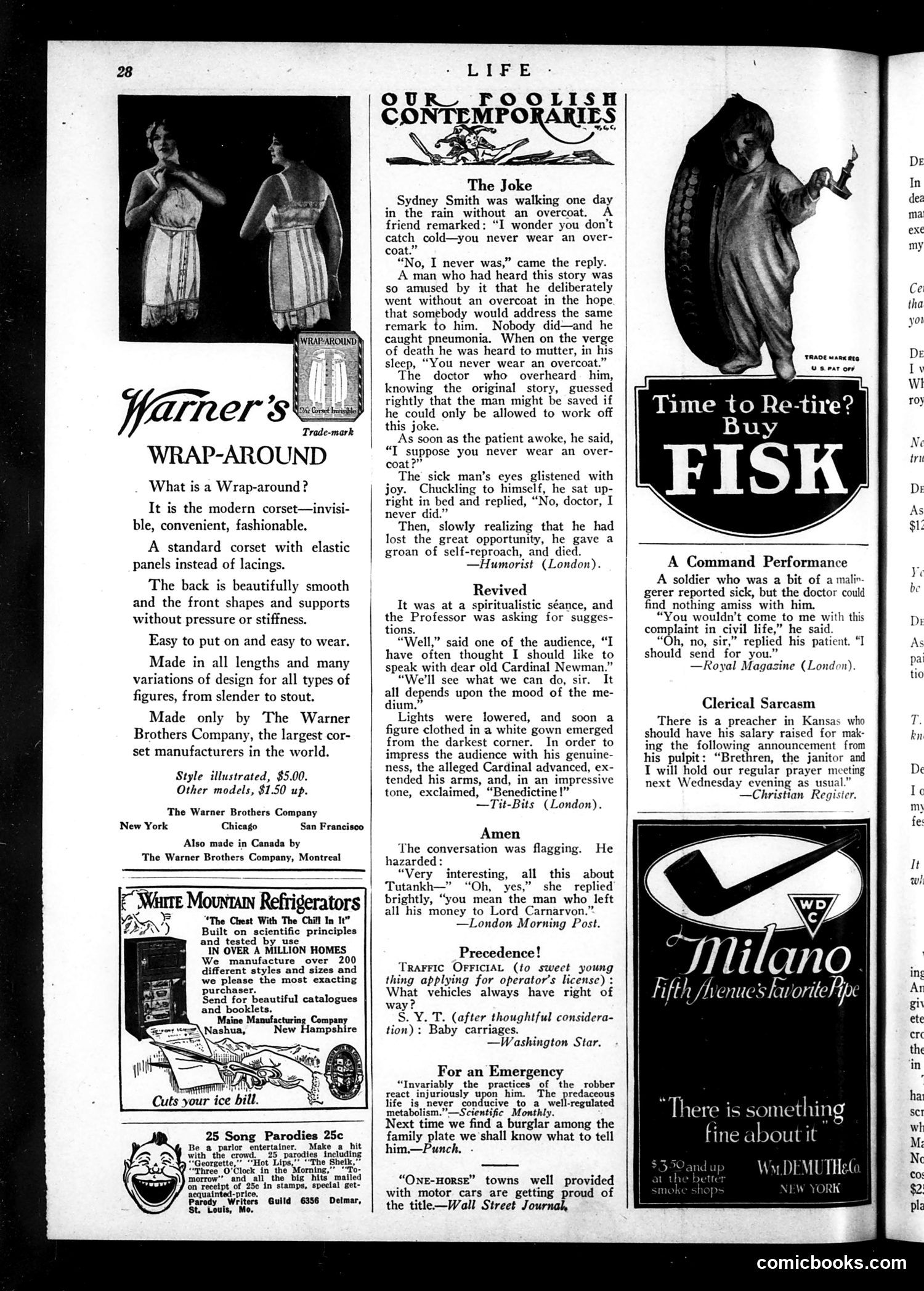
This page from *Life* magazine presents a collection of brief humorous anecdotes satirizing human nature and contemporary absurdities. **The main content** consists of six short jokes mocking various types of foolishness: - **"The Joke"**: A man dies from pneumonia after deliberately copying someone's behavior to hear a witty remark—satirizing people who pursue jokes at the cost of common sense. - **"Revived"**: A spiritualist séance where a "Cardinal Newman" figure exclaims "Benedictine!" (a liqueur brand)—mocking spiritualism fraud and pretension. - **"Amen"**: A woman confuses Tutankhamun with a man who gave money to Lord Carnarvon—satirizing superficial knowledge. - **"Precedence"** and **"For an Emergency"**: Brief quips on absurd logic and misapplied advice. The surrounding advertisements (Warner corsets, refrigerators, Milano pipes) are typical period commercial content. The cartoons mock human folly, pretension, and illogical thinking—staples of *Life's* satirical mission during this era.
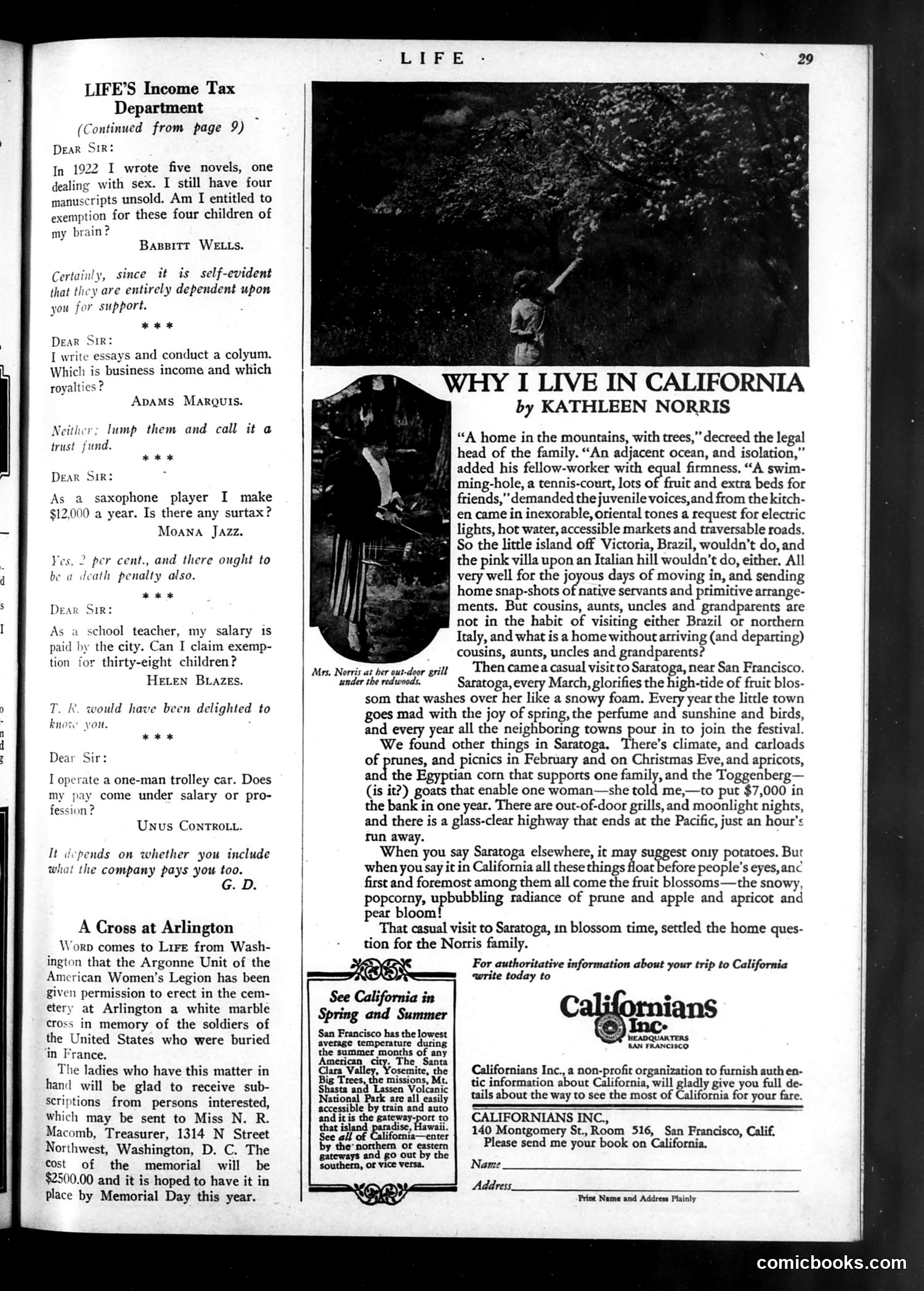
This page contains **LIFE magazine's satirical "Income Tax Department"** — a humor column mocking Depression-era tax confusion through fake reader letters. The jokes target: 1. **Failed artists seeking tax breaks** (Barrett Wells): A novelist with unsold manuscripts tries to claim unpublished works as dependents — absurd, since they generate no income. 2. **Ambiguous income categories** (Adams Marquis, Moana Jazz, Helen Blazes, Unus Control): Readers ask whether essays, saxophone playing, teaching stipends, and trolley-car work count as "business" or "salary" — reflecting genuine confusion about newly complex tax codes. 3. **The responses mock** both the questions and the IRS's vague guidelines, using deadpan logic ("lump them and call it a trust fund"). The right side features a travel advertisement for California (by Kathleen Norris), unrelated to the satire. The tax column's humor relies on readers' shared frustration with incomprehensible income classifications — a timely topic during America's early income-tax era.
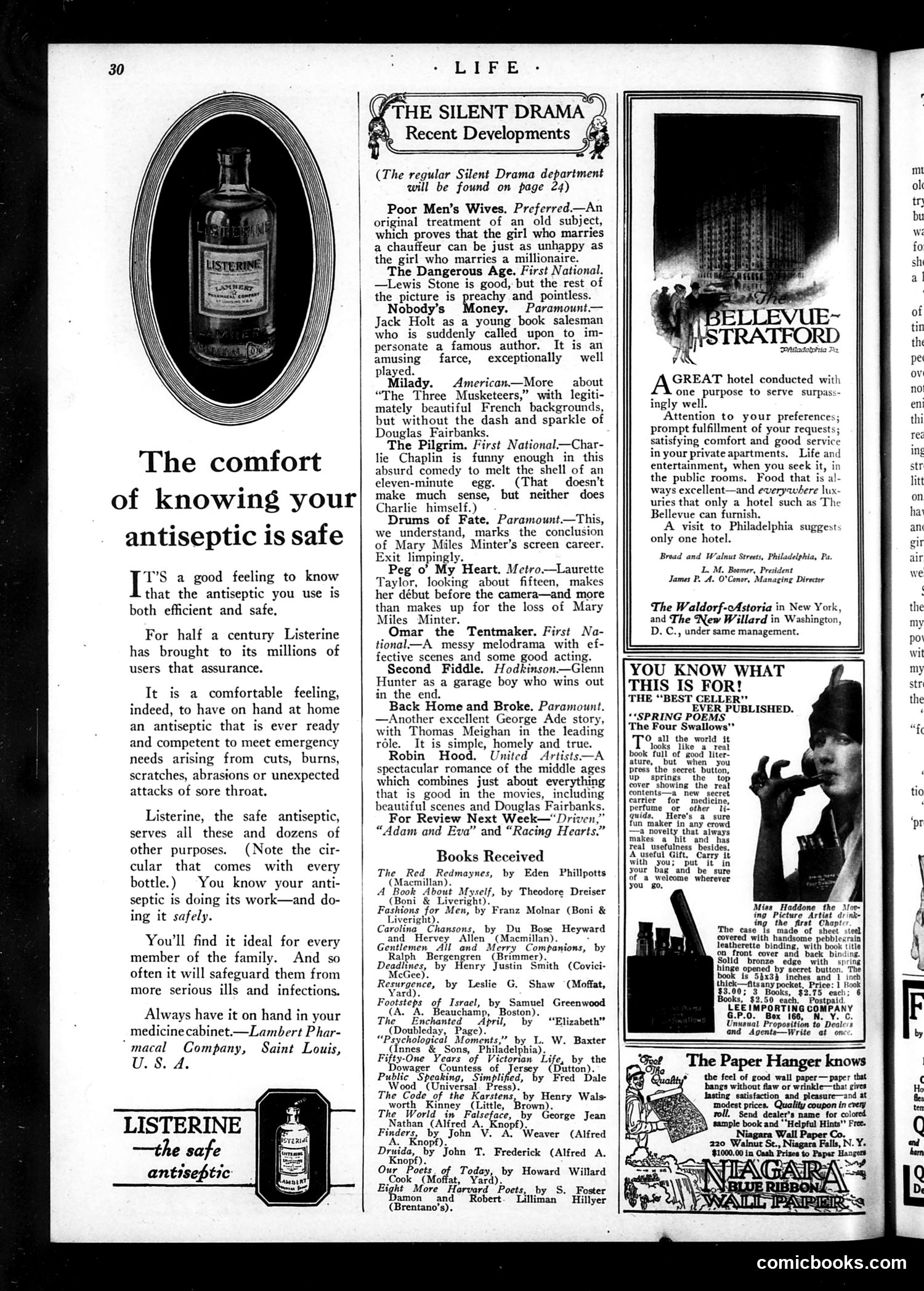
This page is primarily **advertising and book reviews**, not political satire. The dominant content is a **Listerine antiseptic advertisement** occupying the left column—a straightforward commercial pitch emphasizing the product's safety and reliability for household first aid. The right side contains **"The Silent Drama" section**, reviewing recent films. These are conventional movie critiques with light humor (notably Charlie Chaplin "funny enough...to melt the shell of an eleven-minute egg"). The reviews mention contemporary stars like Douglas Fairbanks, Mary Miles Minter, and Thomas Meighan. Below are **book reviews** and a **hotel advertisement** for the Bellevue-Stratford in Philadelphia. **There is no political cartoon or satire on this page.** The content reflects typical 1920s magazine fare: product advertising, entertainment reviews, and literary notices. Any "satire" is incidental and gentle, not pointed social commentary.
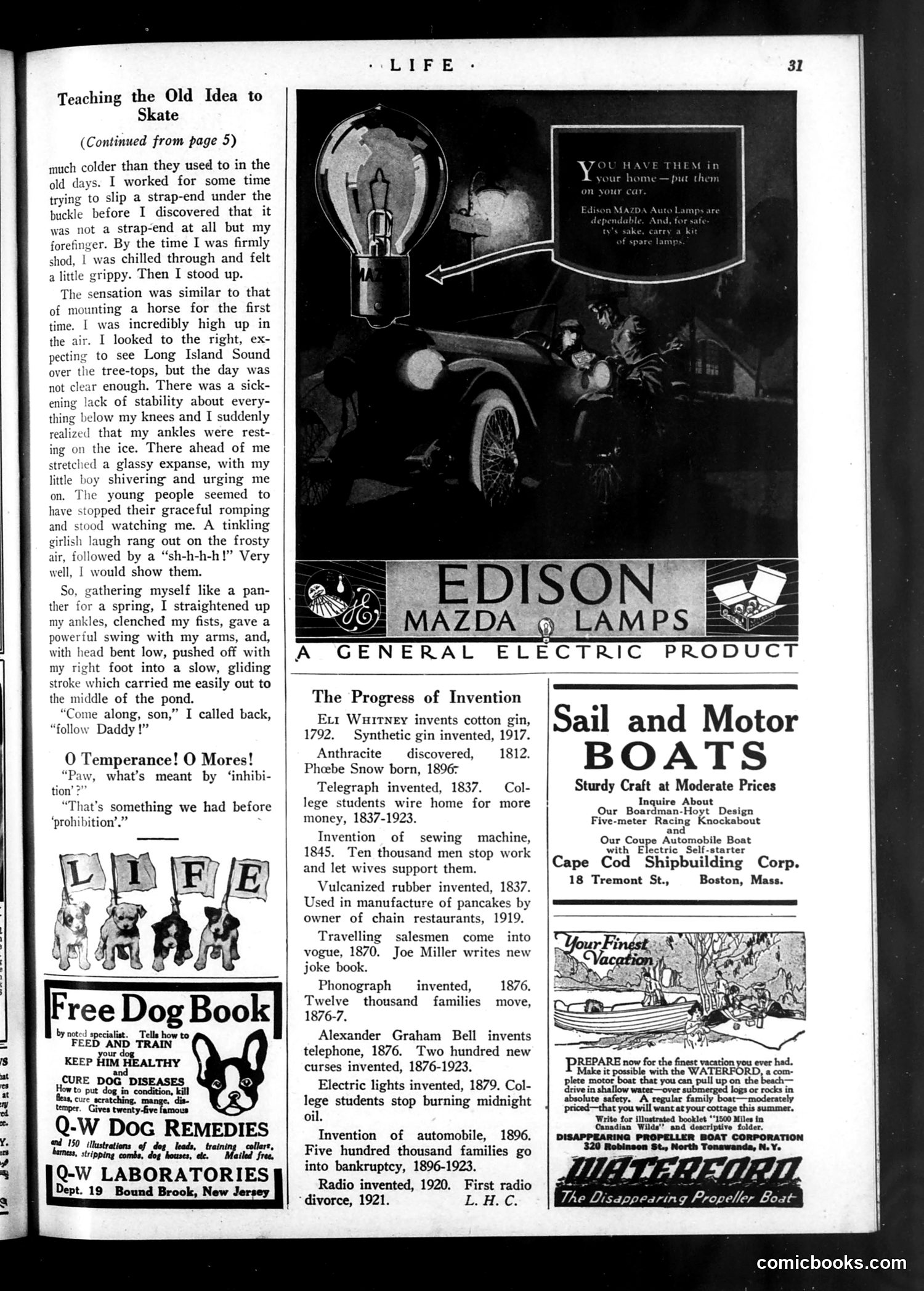
This page is primarily **advertising and filler content** rather than editorial satire. The main article, "Teaching the Old Idea to Skate," is a humorous first-person account of an adult learning to ice skate, depicting physical anxiety and loss of dignity on ice. The satirical content appears in "The Progress of Invention," a brief humor column listing technological advances paired with their social consequences—all cynical observations about human nature. Notable examples: cotton gin paired with "synthetic gin invented, 1917" (Prohibition-era joke); the telephone with "two hundred new curses invented"; the automobile with "five hundred thousand families go into bankruptcy." The page otherwise contains legitimate product advertisements (Edison Mazda Lamps, Q-W Dog Remedies, boat manufacturers) typical of 1920s Life magazine. The satire's point: technology doesn't improve society—it simply creates new ways for people to be foolish, wasteful, and immoral.
This page is primarily **advertising and light humor**, not political satire. The main content includes: **Advertising dominates**: A Life magazine subscription pitch featuring a cherub mascot promising readers will "greet every issue with a smile." Additional ads promote shoe-lacing hooks, The Manor resort in Asheville, Cortez cigars, Bell-Ans indigestion relief, and Mediterranean cruises. **Humor pieces** include: - "The Reflections of a Mother-in-Law"—nostalgic commentary comparing modern husbands (who help with housework, eat lunch downtown, handle dishes) favorably to her late husband's generation - "The End of the Lend"—a brief poem about a borrowed book passing through multiple hands and never returning - "Executive" definition—a short joke defining an executive as someone hired to entertain visitors so employees can work **No significant political content** is visible. The page reflects early-20th-century domestic social changes, particularly evolving gender roles and male participation in household tasks, presented in a lighthearted tone rather than as satire.
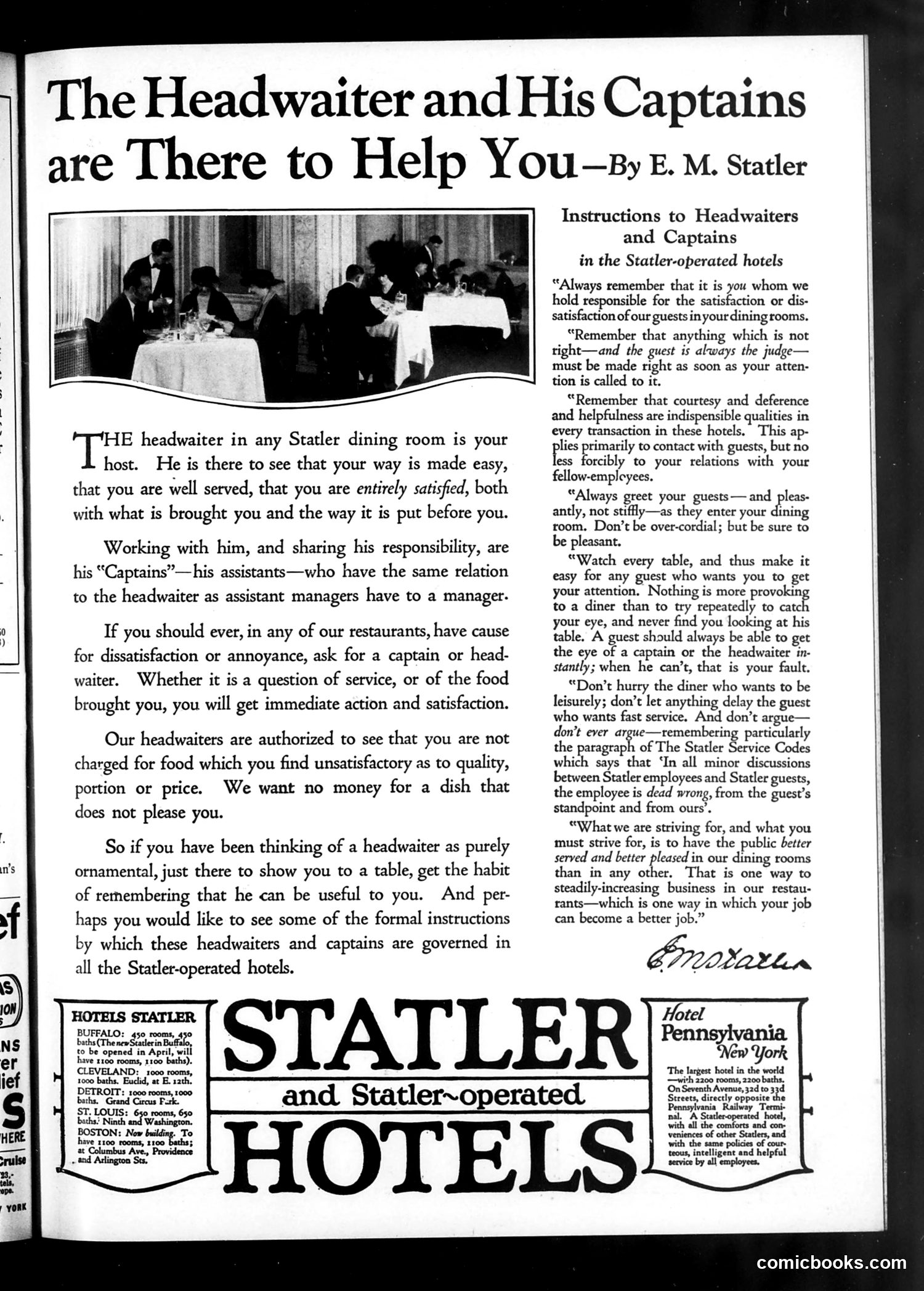
This is an advertisement for Statler Hotels, not political satire. E. M. Statler uses the page to redefine the role of headwaiters and their assistants ("captains") from merely decorative to actively responsible for guest satisfaction. The article argues that headwaiters are "hosts," not ornaments—they must solve problems, authorize refunds for unsatisfactory food, and maintain constant vigilant attention to diners' needs. Formal instructions emphasize absolute customer deference: employees must always agree the guest is right, "remember particularly" that "the employee is dead wrong, from the guest's standpoint." This reflects early 20th-century hospitality industry efforts to professionalize service work and establish customer-centered management philosophy. The hierarchical structure (headwaiter → captains) mirrors corporate management chains. Notably, the instructions also demand courtesy toward fellow-employees, suggesting emerging concerns about workplace dignity alongside customer service.
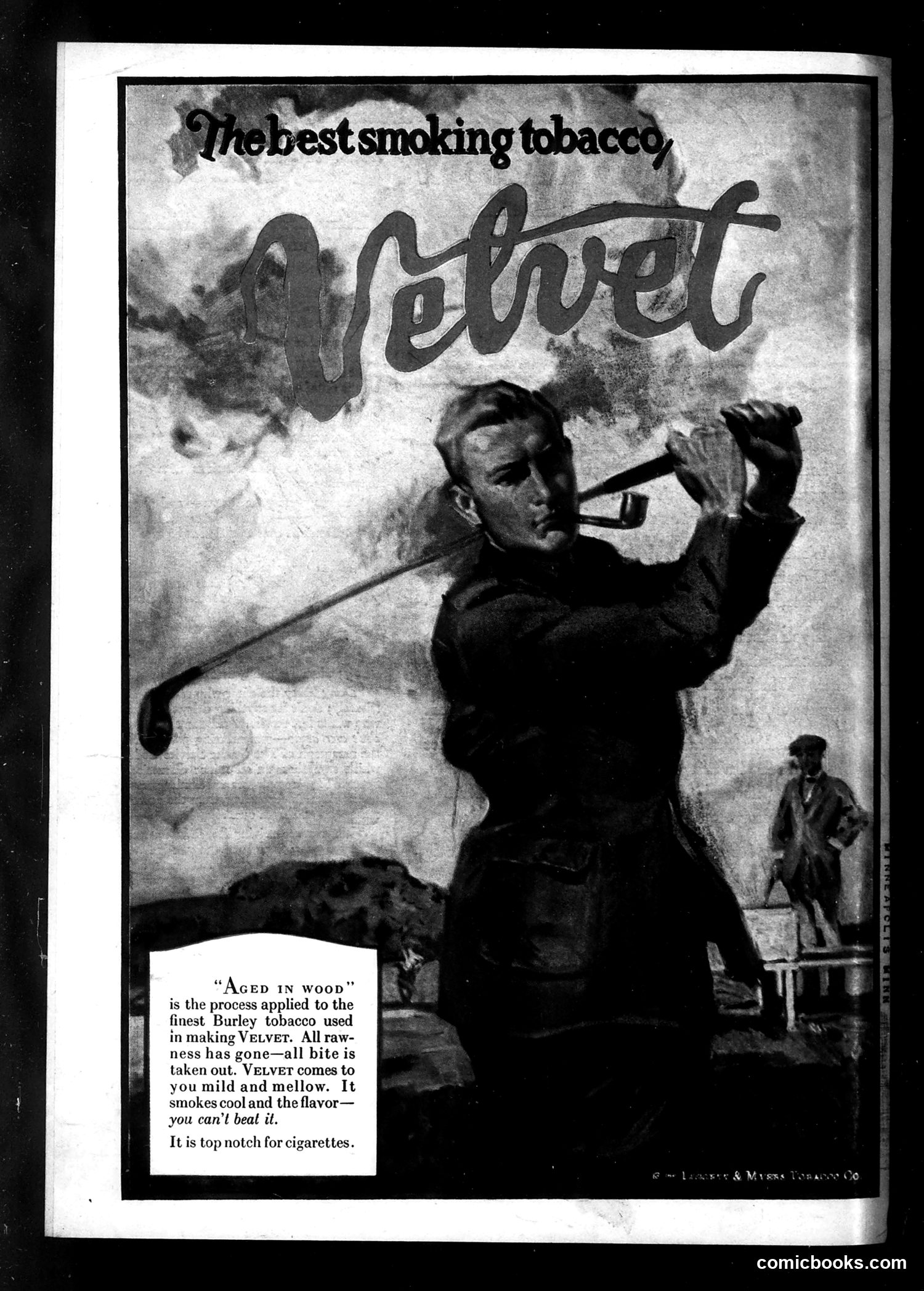
This is a tobacco advertisement, not political satire. The page promotes "Velvet" brand cigarettes, featuring a golfer mid-swing as the central image. The ad emphasizes that Velvet uses "aged in wood" Burley tobacco, claiming this process removes rawness and bite, resulting in a mild, mellow smoke that's "cool" and flavorful. The golfer represents leisure and sophistication—a common advertising trope linking cigarettes to desirable lifestyles. The smaller figure in the background appears to be an observer or caddy. This reflects early 20th-century tobacco marketing before health warnings were required. The ad's language ("you can't beat it") and imagery are typical of the era's approach to selling cigarettes as a refined, enjoyable product.

I can see this is a black and white page from Life magazine, but the image quality is too poor for me to reliably read the OCR text or identify specific cartoon content with confidence. The page appears quite dark with some faint illustrations visible—I can make out what might be a circular design or spiral pattern in the upper right area—but I cannot discern enough detail to accurately identify figures, captions, or the satirical point being made. To properly explain the cartoon's meaning, historical references, and satirical intent to a modern reader, I would need a higher-quality image where the text and illustrations are legible. I'd rather acknowledge this limitation than speculate inaccurately about the content.