
Life, 1923-03-08 · page 21 of 37
Life — March 8, 1923 — page 21: what you’re looking at
What you’re looking at
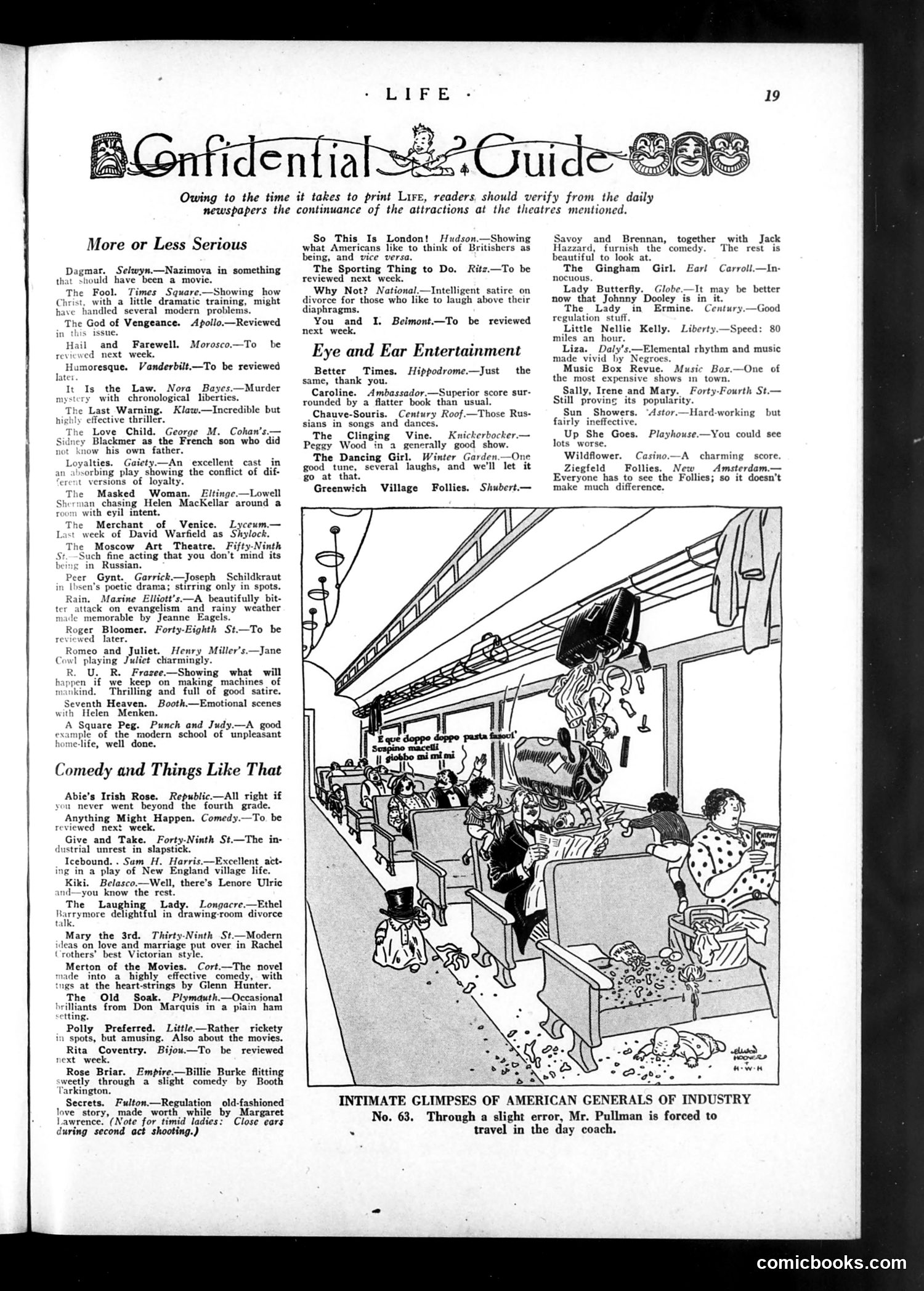
This page is a theater guide from *Life* magazine's "Confidential Guide" section, listing Broadway shows with brief, often satirical reviews. The illustration at bottom—captioned "Intimate Glimpses of American Generals of Industry, No. 63"—depicts a crowded day coach on a train where a wealthy businessman ("Mr. Pullman") is forced to travel among ordinary passengers. The satire mocks wealthy industrialists: Pullman, famous for his luxury railroad cars, is ironically confined to standard seating with common folk. The joke targets industrial magnates who profit enormously while average Americans endure cramped conditions—highlighting class disparity and the hypocrisy of the wealthy. The illustration's crude, chaotic style emphasizes the indignity of the situation for someone accustomed to opulence. This reflects early 20th-century American anxiety about industrial wealth concentration.
📄 Transcribed text from this page (OCR, searchable)
Machine-transcribed from the original scan — historical spelling and the odd misread are preserved.
More or Less Serious Dagmar. Selwyn.—Nazimova in something that should have been a movi The Fool. Times Square.—Showing how Christ, with 'a little dramatic training, might have handled several modern problems. God of Vengeance. Apollo.—Reviewed in this issue. Hail and Farewell. reviewed next week, Humoresque. Vanderbilt.—To be reviewed late: It Is the Law. Nora Bayes.—Murder y with chronological liberties. Last Warning. Klaw.—Incredible but effective thriller. Love Child. George M. Cohan’s.— » Blackmer as the French son who did not know his own father. Loyalties. Gai —An excellent cast in an absorbing play showing the conflict of dif- erent versions of loyalty. The Masked Woman. Eltinge.—Lowell Sherman chasing Helen MacKellar around a room with eyil intent. The Merchant of Venice. Lyceum. Last week of David Warfield as Shylock. ne Moscow Art Theatre. Fifty-Ninth Such fine acting that you don’t mind its Morosco.—To be bei in Russian. Peer Gynt. Garrick.—Joseph Schildkraut in Ibsen's poetic drama; stirring only Rain. Maxine Elliott’s—A. beautifully bit- ter attack on evangelism and rainy weather made memorable by Jeanne Eagels. Roger Bloomer. Forty-Eighth St—To be reviewed later. Romeo and Juliet. Henry Miller’s.—Jane Cowl playing Juliet charming! R. U. R. Frazee—Showing what will happen if we keep on making machines of kind. Thrilling and full of good satire. Seventh Heaven. Booth.—Emotional scenes with Helen Menken. A Square Peg. Punch and Judy.—A good example of the modern school of unpleasant ne-life, well done. Comedy and Things Like That Abie’s Irish Rose. Republic.—All right if you never went beyond the fourth grade. Anything Might Happen. Comedy.—To be reviewed next week. Give and Take. Forty-Ninth St.—The in- dustrial unrest in slapstick. Icebound. . Sum H. Harris.—Excellent, act- ing in a play of New England village life. Kiki. Belasco.—Well, there’s Lenore Ulric you know the rest. The Laughing Lady. Longacre.—Ethel Rarrymore delightful in drawing-room divorce talk. Mary the 3rd. Thirty-Ninth St—Modern teas on, love and marriage put over in Rachel Crothers’ best Victorian style. Merton of the Movies. Cort.—The novel made into a highly effective comedy, with tugs at the heart-strings by Glenn Hunter. The Old Soak. Plymauth.—Occasional brilliants from Don Marquis in a piain ham setting. Polly Preferred. Little—Rather rickety in spots, but amusing. Also about the movies. Rita Coventry. Bijou.—To be reviewed next week. Rose Briar. Empire.—Billie Burke flitting weetly through a slight comedy by Booth Tarkington. Secrets. Fulton.—Regulation old-fashioned love story, made worth while by Margaret Lawrence. (Note for timid ladies: Close ears during second act shooting.) Owing to the time it takes to print Lire, readers. should verify from the daily newspapers the continuance of the attractions at the theatres mentioned. So This Is London! Hudson.—Showing what Americans like to think of Britishers as being, and vice versa. The Sporting Thing to Do. Ritz. —To be reviewed next week. Why Not? National.—Intelligent satire on divorce for those who like to laugh above their diaphragms. You and I. next week, Eye and Ear Entertainment Beimont.—To be reviewed Better Times. Hippodrome.—Just the same, thank you. Caroline. Ambassador.—Superior score sur- rounded by a flatter book than usual. Chauve-Souris. Century Roof.—Those Rus- sians in songs and dances. The Clinging Vine. Knickerbocker.— Peggy Wood in a generally good show. The Dancing Girl. Winter Garden—One good tune, several laughs, and we'll let it go at that Greenwich Village Follies. Shubert.— with Jack Savoy and Brennan, together The rest is Hazzard, furnish the comedy. beautiful to look at. The Gingham Girl. nocuous. Lady Butterfly. Globe.—It may be better now that Johnny Dooley is in_it. The Lady in Ermine. Century.—Good regulation. stuff. Little Nellie Kelly. miles an hour. Liza. Daly’s.—Elemental rhythm and music made vivid by Negroes. Music Box Revue. Music Box.—One of the most expensive shows mm town. Sally, Irene and Mary. Forty-Fourth St— Still proving its popularit Sun Showers. “Astor.— fairly ineffective. Up She Goes. lots worse. Wildflower. Casino.—A charming score. Ziegfeld Follies. New Amsterdam.— Everyone has to see the Follies; so it doesn’t make much difference. Earl Carroll.—In- Liberty.—Speed: 80 fard-working but Playhouse.—You could see INTIMATE GLIMPSES OF AMERICAN GENERALS OF INDUSTRY No. 63. Through a slight error, Mr. Pullman is forced to travel in the day coach. comicbooks.com