
Life, 1923-03-08 · page 16 of 37
Life — March 8, 1923 — page 16: what you’re looking at
What you’re looking at
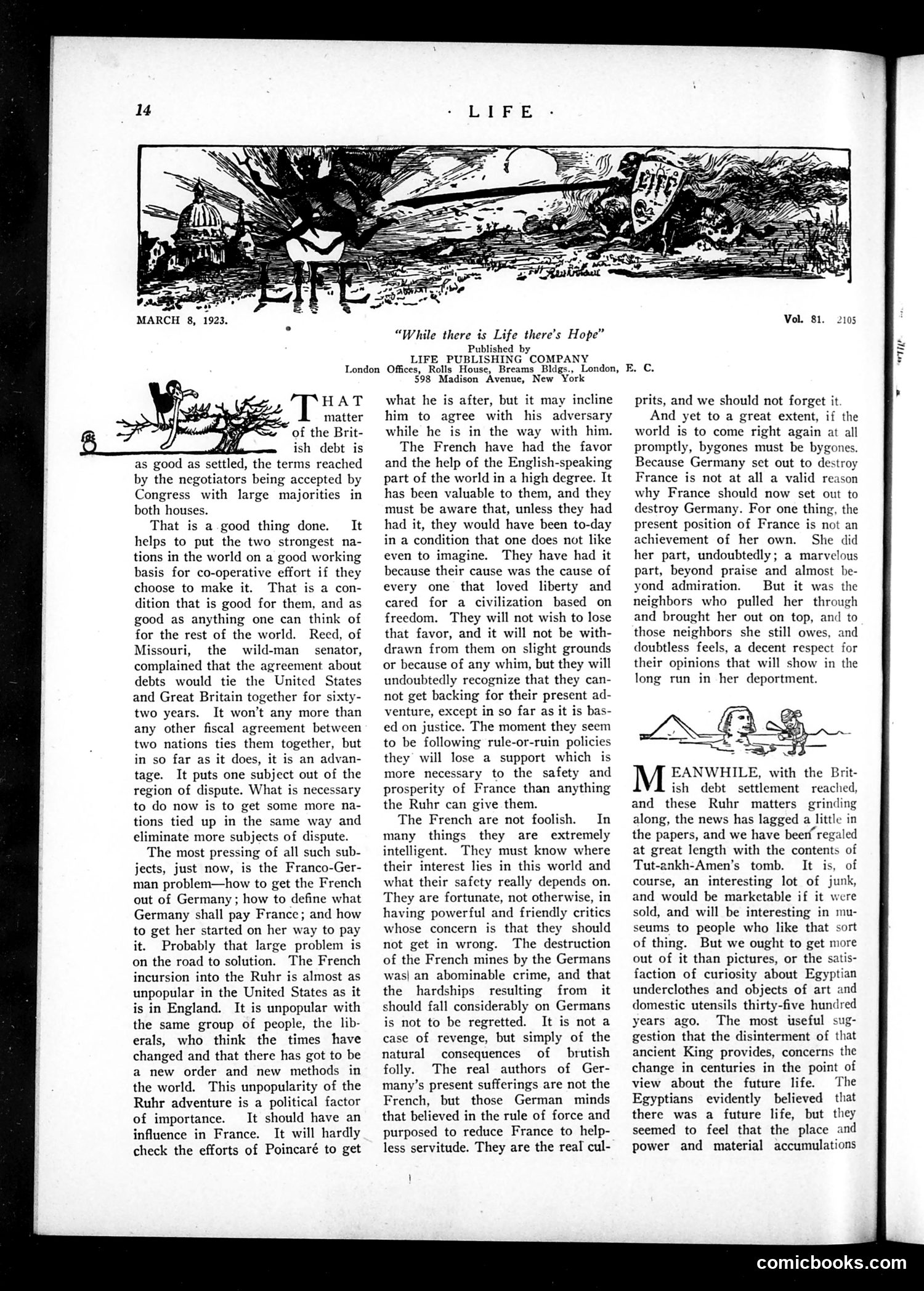
The masthead illustration depicts a chaotic landscape with industrial/military imagery—smokestacks, aircraft, and destruction—suggesting post-WWI geopolitical chaos. The article "While there is Life there's Hope" discusses Franco-German debt negotiations and the Ruhr occupation. The text argues that Britain and France should unite on fiscal matters rather than pursue separate interests, warning that France's current approach toward Germany risks destabilizing Europe. The cartoon's visual chaos appears to symbolize the dangerous consequences of unresolved post-war tensions and conflicting national policies. The reference to a "wild-man senator" likely alludes to American isolationist opposition to international entanglements. The overall message urges pragmatic cooperation between Allied powers to prevent future conflict.
📄 Transcribed text from this page (OCR, searchable)
Machine-transcribed from the original scan — historical spelling and the odd misread are preserved.
“While there is Life there’s Hope” Published by LIFE PUBLISHING COMPANY Vol. 81. 2105 London Offices, Rolls House, Breams Bldgs., London, E. C. HAT matter of the Brit- ish debt is ‘ms reached by the negotiators being accepted by Congress with large majorities in both houses. That is a good thing done. It helps to put the two strongest na- tions in the world on a good working basis for co-operative effort if they choose to make it. That is a con- dition that is good for them, and as good as anything one can think of for the rest of the world. Reed, of Missouri, the wild-man__ senator, complained that the agreement about debts would tie the United States and Great Britain together for sixty- two years. It won’t any more than any other fiscal agreement between two nations ties them together, but in so far as it does, it is an advan- tage. It puts one subject out of the region of dispute. What is necessary to do now is to get some more na- tions tied up in the same way and eliminate more subjects of dispute. The most pressing of all such sub- jects, just now, is the Franco-Ger- man problem—how to get the French out of Germany ; how to define what Germany shall pay France; and how to get her started on her way to pay it. Probably that large problem is on the road to solution. The French incursion into the Ruhr is almost as unpopular in the United States as it is in England. It is unpopular with the same group of people, the lib- erals, who think the times have changed and that there has got to be a new order and new methods in the world. This unpopularity of the Ruhr adventure is a political factor of importance. It should have an influence in France. It will hardly check the efforts of Poincaré to get 598 Madison Avenue, New York what he is after, but it may incline him to agree with his adversary while he is in the way with him. The French have had the favor and the help of the English-speaking part of the world in a high degree. It has been valuable to them, and they must be aware that, unless they had had it, they would have been to-day in a condition that one does not like even to imagine. They have had it because their cause was the cause of every one that loved liberty and cared for a civilization based on freedom. They will not wish to lose that favor, and it will not be with- drawn from them on slight grounds or because of any whim, but they will undoubtedly recognize that they can- not get backing for their present ad- venture, except in so far as it is bas- ed on justice. The moment they seem to be following rule-or-ruin policies they will lose a support which is more necessary to the safety and prosperity of France than anything the Ruhr can give them. The French are not foolish. In many things they are extremely intelligent. They must know where their interest lies in this world and what their safety really depends on. They are fortunate, not otherwise, in having powerful and friendly critics whose concern is that they should not get in wrong. The destruction of the French mines by the Germans was| an abominable crime, and that the hardships resulting from it should fall considerably on Germans is not to be regretted. It is not a case of revenge, but simply of the natural consequences of brutish folly. The real authors of Ger- many’s present sufferings are not the French, but those German minds that believed in the rule of force and purposed to reduce France to help- less servitude. They are the real cul- i prits, and we should not forget it And yet to a great extent, if the world is to come right again at all promptly, bygones must be bygones. Because Germany set out to destroy France is not at all a valid reason why France should now set out to destroy Germany. For one thing, the present position of France is not an achievement of her own. She did her part, undoubtedly; a marvelous part, beyond praise and almost be- yond admiration. But it was the neighbors who pulled her through and brought her out on top, and to those neighbors she still owes, and doubtless feels, a decent respect for their opinions that will show in the long run in her deportment. EANWHILE, with the Brit- ish debt settlement reached, and these Ruhr matters grinding along, the news has lagged a little in the papers, and we have beert regaled at great length with the contents of Tut-ankh-Amen’s tomb. It is, of course, an interesting lot of junk, and would be marketable if it were sold, and will be interesting in mu- seums to people who like that sort of thing. But we ought to get more out of it than pictures, or the satis- faction of curiosity about Egyptian underclothes and objects of art and domestic utensils thirty-five hundred years ago. The most useful sug- gestion that the disinterment of that ancient King provides, concerns the change in centuries in the point of view about the future life. The Egyptians evidently believed that there was a future life, but they seemed to feel that the place and power and material accumulations rie comicbooks.com