
Life, 1923-03-08 · page 7 of 37
Life — March 8, 1923 — page 7: what you’re looking at
What you’re looking at
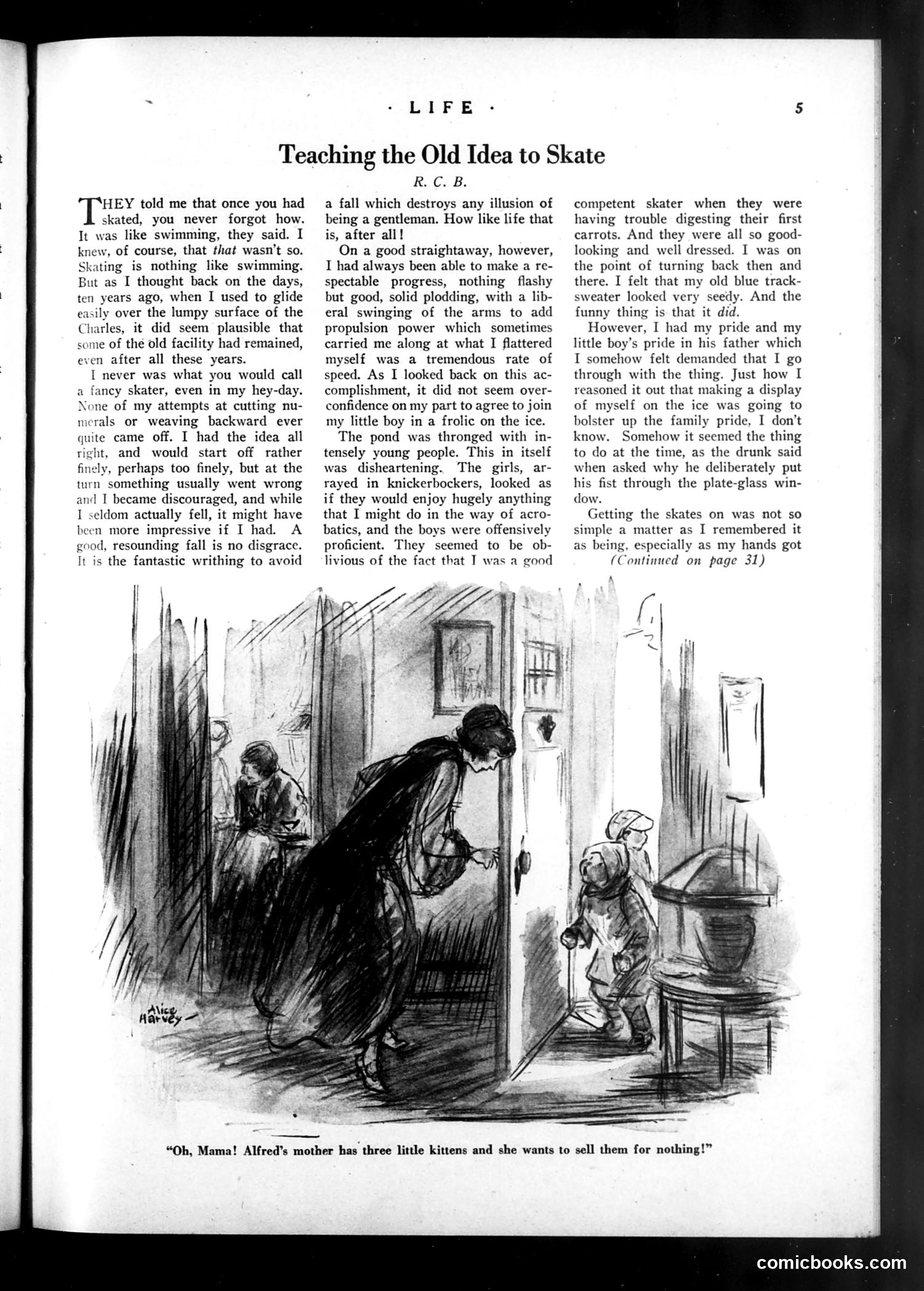
This is a humorous personal essay by R.C.B. about learning to ice skate in adulthood. The author reflects on being told that "once you had skated, you never forgot," only to discover this wasn't true. The piece describes the awkwardness of returning to skating after years away, including physical clumsiness on the ice and embarrassment watching younger, more graceful skaters. The accompanying illustration depicts a domestic scene: an adult (likely the author) bending over while helping a young child with skates, watched by another adult in a doorway. The caption reads: "Oh, Mama! Alfred's mother has three little kittens and she wants to sell them for nothing!"—a humorous non-sequitur suggesting the child's distraction from the skating lesson.
📄 Transcribed text from this page (OCR, searchable)
Machine-transcribed from the original scan — historical spelling and the odd misread are preserved.
LIFE - Teaching the Old Idea to Skate HEY told me that once you had skated, you never forgot how. It was like swimming, they said. I y, of course, that that wasn’t so. skating is nothing like swimming. But as I thought back on the days, ten years ago, when I used to glide easily over the lumpy surface of the Charles, it did seem plausible that some of the old facility had remained, even after all these years. I never was what you would call a fancy skater, even in my hey-day. None of my attempts at cutting nu- merals or weaving backward ever quite came off. I had the idea all right, and would start off rather finely, perhaps too finely, but at the turn something usually went wrong and I became discouraged, and while I seldom actually fell, it might have been more impressive if I had. A good, resounding fall is no disgrace. It is the fantastic writhing to avoid | R. C. B. a fall which destroys any illusion of being a gentleman. How like life that is, after all! On a good straightaway, however, I had always been able to make a re- spectable progress, nothing flashy but good, solid plodding, with a lib- eral swinging of the arms to add propulsion power which sometimes carried me along at what I flattered myself was a tremendous rate of speed. As I looked back on this ac- complishment, it did not seem over- confidence on my part to agree to join my little boy in a frolic on the ice. The pond was thronged with in- tensely young people. This in itself was disheartening. The girls, ar- rayed in knickerbockers, looked as if they would enjoy hugely anything that I might do in the way of acro- batics, and the boys were offensively proficient. They seemed to be ob- livious of the fact that I was a good competent skater when they were having trouble digesting their first carrots. And they were all so good- looking and well dressed. I was on the point of turning back then and there. I felt that my old blue track- sweater looked very seedy. And the funny thing is that it did. However, I had my pride and my little boy’s pride in his father which I somehow felt demanded that I go through with the thing. Just how I reasoned it out that making a display of myself on the ice was going to bolster up the family pride, I don’t know. Somehow it seemed the thing to do at the time, as the drunk said when asked why he deliberately put his fist through the plate-glass win- dow. Getting the skates on was not so simple a matter as I remembered it as being, especially as my hands got (Continued on page 31) “Oh, Mama! Alfred’s mother has three little kittens and she wants to sell them for nothing!” comicbooks.com