
Life, 1923-03-08 · page 26 of 37
Life — March 8, 1923 — page 26: what you’re looking at
What you’re looking at
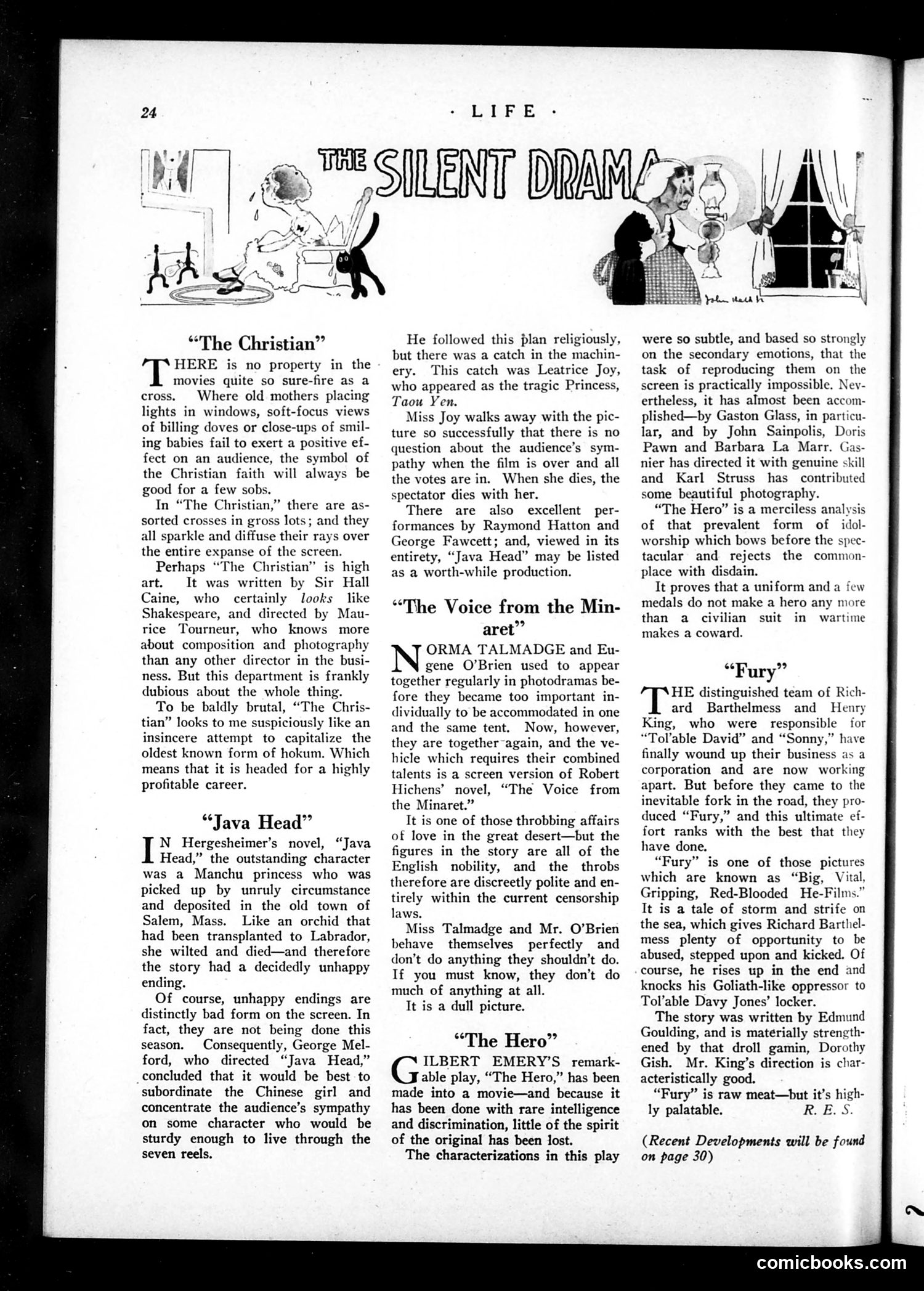
This page contains satirical reviews of five silent films. The critic's tone is biting and cynical throughout: **"The Christian"** — The reviewer accuses the film of cynical hokum, arguing it exploits religious imagery (crosses) to manipulate audiences emotionally rather than tell an authentic story. He predicts it will be commercially successful *because* of this insincerity. **"Java Head"** — The reviewer notes the film altered its source novel's tragic ending (standard practice in 1920s cinema) to provide a happy conclusion, yet the lead actress (Leatrice Joy) steals the picture anyway, making her character's death emotionally powerful despite the director's intent. **"The Voice from the Minaret"** — Dismissed as dull. The reviewer mocks that the leads (Talmadge and O'Brien) behave so perfectly and do "much of anything at all." **"The Hero"** — Praised for successfully translating subtle stage performances to screen, particularly Gaston Glass's acting. The satire criticizes filmmakers' manipulation of emotion and audience taste while acknowledging cinema's commercial realities.
📄 Transcribed text from this page (OCR, searchable)
Machine-transcribed from the original scan — historical spelling and the odd misread are preserved.
“The Christian” HERE is no property in the movies quite so sure-fire as a cross. Where old mothers placing lights in windows, soft-focus views of billing doves or close-ups of smil- ing babies fail to exert a positive ef- fect on an audience, the symbol of the Christian faith will always be good for a few sobs. In “The Christian,” there are as- sorted crosses in gross lots; and they all sparkle and diffuse their rays over the entire expanse of the screen. Perhaps “The Christian” is high art. It was written by Sir Hall Caine, who certainly looks like Shakespeare, and directed by Mau- rice Tourneur, who knows more about composition and photography than any other director in the busi- ness. But this department is frankly dubious about the whole thing. To be baldly brutal, “The Chris- tian” looks to me suspiciously like an insincere attempt to capitalize the oldest known form of hokum. Which means that it is headed for a highly profitable career. “Java Head” N Hergesheimer’s novel, “Java Head,” the outstanding character was a Manchu princess who was picked up by unruly circumstance and deposited in the old town of Salem, Mass. Like an orchid that had been transplanted to Labrador, she wilted and died—and therefore the story had a decidedly unhappy ending. Of course, unhappy endings are distinctly bad form on the screen. In fact, they are not being done this season. Consequently, George Mel- ford, who directed “Java Head,” concluded that it would be best to subordinate the Chinese girl and concentrate the audience’s sympathy on some character who would be sturdy enough to live through the seven reels, He followed this plan religiously, but there was a catch in the machin- ery. This catch was Leatrice Joy, who appeared as the tragic Princess, Taou Yen. Miss Joy walks away with the pic- ture so successfully that there is no question about the audience’s sym- pathy when the film is over and all the votes are in. When she dies, the spectator dies with her. There are also excellent per- formances by Raymond Hatton and George Fawcett; and, viewed in its entirety, “Java Head” may be listed as a worth-while production. “The Voice from the Min- aret” ORMA TALMADGE and Eu- Naw O’Brien used to appear together regularly in photodramas be- fore they became too important in- dividually to be accommodated in one and the same tent. Now, however, they are together again, and the ve- hicle which requires their combined talents is a screen version of Robert Hichens’ novel, “The Voice from the Minaret.” It is one of those throbbing affairs of love in the great desert—but the figures in the story are all of the English nobility, and the throbs therefore are discreetly polite and en- tirely within the current censorship laws. Miss Talmadge and Mr. O’Brien behave themselves perfectly and don’t do anything they shouldn’t do. If you must know, they don’t do much of anything at all. It is a dull picture. “The Hero” ILBERT EMERY’S remark- able play, “The Hero,” has been made into a movie—and because it has been done with rare intelligence and discrimination, little of the spirit of the original has been lost. The characterizations in this play were so subtle, and based so strongly on the secondary emotions, that the task of reproducing them on the screen is practically impossible. Nev- ertheless, it has almost been accom- plished—by Gaston Glass, in particu- lar, and by John Sainpolis, Doris Pawn and Barbara La Marr. ( nier has directed it with genuine skill and Karl Struss has contributed some beautiful photography. “The Hero” is a merciless analysis of that prevalent form of idol- worship which bows before the spec- tacular and rejects the common- place with disdain. It proves that a uniform anda few medals do not make a hero any more than a civilian suit in wartime makes a coward. “Fury” HE distinguished team of Rich- ard Barthelmess and Henry King, who were responsible for “Tol’'able David” and “Sonny,” have finally wound up their business as a corporation and are now working apart. But before they came to the inevitable fork in the road, they pro- duced “Fury,” and this ultimate ef- fort ranks with the best that they have done. “Fury” is one of those pictures which are known as “Big, Vital, Gripping, Red-Blooded He-Films.” It is a tale of storm and strife on the sea, which gives Richard Barthel- mess plenty of opportunity to be abused, stepped upon and kicked. Of course, he rises up in the end and knocks his Goliath-like oppressor to Tol’able Davy Jones’ locker. The story was written by Edmund Goulding, and is materially strength- ened by that droll gamin, Dorothy Gish. Mr. King’s direction is char- acteristically good. “Fury” is raw meat—but it’s high- ly palatable. R.E.S. (Recent Developments will be found on page 30) comicbooks.com