
Life, 1923-03-08 · page 6 of 37
Life — March 8, 1923 — page 6: what you’re looking at
What you’re looking at
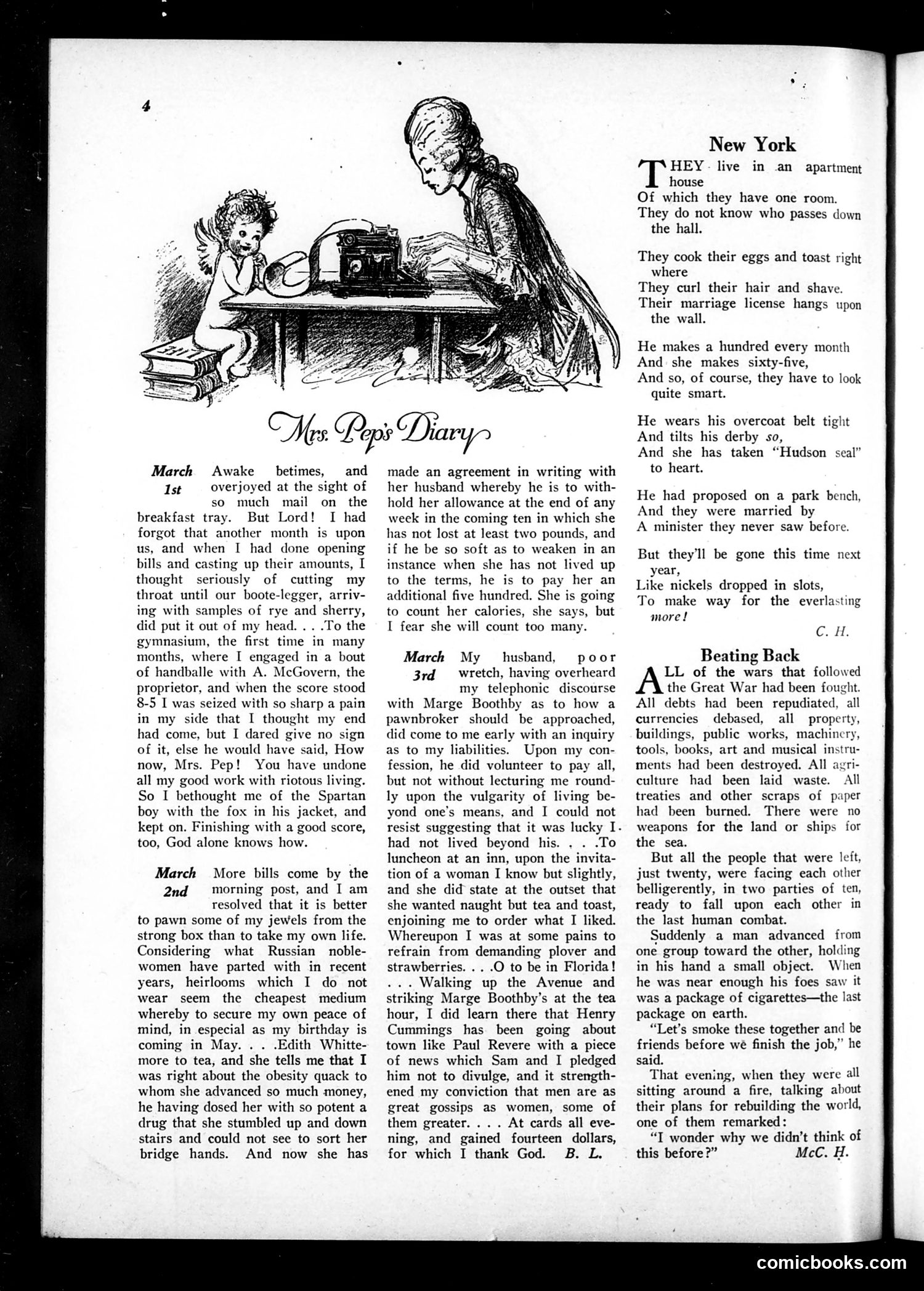
This page presents **"Mrs. Pep's Diary,"** a satirical domestic humor column tracking a New York couple's financial struggles in 1920s urban life. The cartoon shows a woman at a typewriter with a cherub, illustrating the diary format. The accompanying text mocks middle-class married life: the couple lives in a cramped apartment, survives on modest income ($100 monthly for him, $65 for her), and must maintain appearances despite poverty. Satirical details include cooking in their room, their frugal grooming habits, and the wife monitoring her husband's spending. The adjacent "Beating Back" column discusses post-World War I reconstruction efforts and economic recovery. The satire targets **post-war American economic anxiety**—depicting how even employed couples struggled financially in tight urban housing while pretending respectability.
📄 Transcribed text from this page (OCR, searchable)
Machine-transcribed from the original scan — historical spelling and the odd misread are preserved.
March Awake betimes, and Ist overjoyed at the sight of so much mail on the breakfast tray. But Lord! I had forgot that another month is upon us, and when I had done opening bills and casting up their amounts, I thought seriously of cutting my throat until our boote-legger, arriv- ing with samples of rye and sherry, did put it out of my head. . . .To the gymnasium, the first time in many months, where I engaged in a bout of handballe with A. McGovern, the proprietor, and when the score stood 8-5 I was seized with so sharp a pain in my side that I thought my end had come, but I dared give no sign of it, else he would have said, How now, Mrs. Pep! You have undone all my good work with riotous living. So I bethought me of the Spartan boy with the fox in his jacket, and kept on. Finishing with a good score, too, God alone knows how. March 2nd More bills come by the morning post, and I am resolved that it is better to pawn some of my jewels from the strong box than to take my own life. Considering what Russian noble- women have parted with in recent years, heirlooms which I do not wear seem the cheapest medium whereby to secure my own peace of mind, in especial as my birthday is coming in May. . . .Edith Whitte- more to tea, and she tells me that I was right about the obesity quack to whom she advanced so much money, he having dosed her with so potent a drug that she stumbled up and down stairs and could not see to sort her bridge hands. And now she has made an agreement in writing with her husband whereby he is to with- hold her allowance at the end of any week in the coming ten in which she has not lost at least two pounds, and if he be so soft as to weaken in an instance when she has not lived up to the terms, he is to pay her an additional five hundred. She is going to count her calories, she says, but I fear she will count too many. March 3rd My husband, poor wretch, having overheard my telephonic discourse with Marge Boothby as to how a pawnbroker should be approached, did come to me early with an inquiry as to my liabilities. Upon my con- fession, he did volunteer to pay all, but not without lecturing me round- ly upon the vulgarity of living be- yond one’s means, and I could not resist suggesting that it was lucky I. had not lived beyond his. . . .To luncheon at an inn, upon the invita- tion of a woman I know but slightly, and she did state at the outset that she wanted naught but tea and toast, enjoining me to order what I liked. Whereupon I was at some pains to refrain from demanding plover and strawberries. . . .O to be in Florida! ... Walking up the Avenue and striking Marge Boothby’s at the tea hour, I did learn there that Henry Cummings has been going about town like Paul Revere with a piece of news which Sam and I pledged him not to divulge, and it strength- ened my conviction that men are as great gossips as women, some of them greater. . . . At cards all eve- ning, and gained fourteen dollars, for which I thank God. B. L. New York HEY. live in .an apartment house Of which they have one room. They do not know who passes down the hall. They cook their eggs and toast right where They curl their hair and shave. Their marriage license hangs upon the wall. He makes a hundred every month And she makes sixty-five, And so, of course, they have to look quite smart. He wears his overcoat belt tight And tilts his derby so, And she has taken “Hudson seal” to heart. He had proposed on a park bench, And they were married by A minister they never saw before. But they'll be gone this time next year, Like nickels dropped in slots, To make way for the everlasting more! C. H. Beating Back LL of the wars that followed the Great War had been fought. All debts had been repudiated, all currencies debased, all property, buildings, public works, machinery, tools, books, art and musical instr ments had been destroyed. All ag culture had been laid waste. All treaties and other scraps of paper had been burned. There were no weapons for the land or ships for the sea. But all the people that were leit, just twenty, were facing each other belligerently, in two parties of ten, ready to fall upon each other in the last human combat. Suddenly a man advanced from one group toward the other, holding in his hand a small object. When he was near enough his foes saw it was a package of cigarettes—the last package on earth. “Let’s smoke these together and be friends before wé finish the job,” he said. That evening, when they were all sitting around a fire, talking about their plans for rebuilding the world, one of them remarked: “I wonder why we didn’t think of this before?” McC. H. comicbooks.com