
Life, 1923-03-08 · page 22 of 37
Life — March 8, 1923 — page 22: what you’re looking at
What you’re looking at
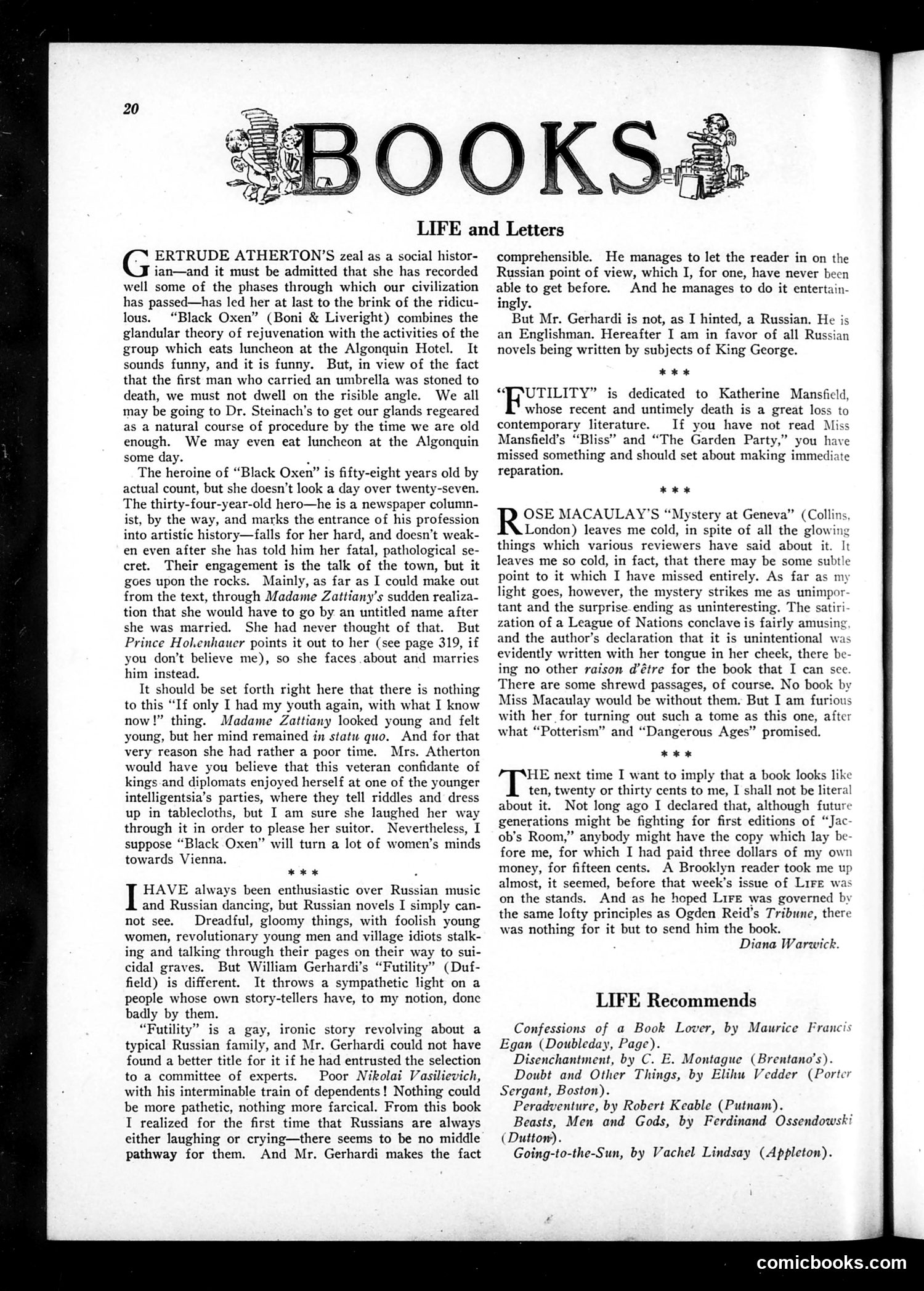
This page is a book review section from *Life* magazine, not a political cartoon. It contains literary criticism of contemporary novels, primarily focusing on Gertrude Atherton's "Black Oxen" and William Gerhardi's "Futility." The reviewer satirizes Atherton's plot about a 58-year-old woman made to look 27 through glandular rejuvenation treatment, mocking both the pseudoscientific premise and the heroine's concern about losing her title upon marriage. The humor targets fashionable Vienna medical trends and women's vanity. The second review praises Gerhardi's novel about a typical Russian family, noting it's refreshingly different from typical Russian literature—which the reviewer characterizes as uniformly gloomy and nihilistic. The satire concludes with tongue-in-cheek approval that Russians should write their own novels through English authors rather than native writers.
📄 Transcribed text from this page (OCR, searchable)
Machine-transcribed from the original scan — historical spelling and the odd misread are preserved.
LIFE and Letters "’ ERTRUDE ATHERTON’S zeal as a social histor- ian—and it must be admitted that she has recorded well some of the phases through which our civilization has passed—has led her at last to the brink of the ridicu- lous. “Black Oxen” (Boni & Liveright) combines the glandular theory of rejuvenation with the activities of the group which eats luncheon at the Algonquin Hotel. It sounds funny, and it is funny. But, in view of the fact that the first man who carried an umbrella was stoned to death, we must not dwell on the risible angle. We all may be going to Dr. Steinach’s to get our glands regeared as a natural course of procedure by the time we are old enough. We may even eat luncheon at the Algonquin some day. : The heroine of “Black Oxen” is fifty-eight years old by actual count, but she doesn’t look a day over twenty-seven. The thirty-four-year-old hero—he is a newspaper column- ist, by the way, and marks the entrance of his profession into artistic history—falls for her hard, and doesn’t weak- en even after she has told him her fatal, pathological se- cret. Their engagement is the talk of the town, but it goes upon the rocks. Mainly, as far as I could make out from the text, through Madame Zattiany’s sudden realiza- tion that she would have to go by an untitled name after she was married. She had never thought of that. But Prince Holenhauer points it out to her (see page 319, if you don’t believe me), so she faces about and marries him instead. It should be set forth right here that there is nothing to this “If only I had my youth again, with what I know now!” thing. Madame Zattiany looked young and felt young, but her mind remained in statu quo. And for that very reason she had rather a poor time. Mrs. Atherton would have you believe that this veteran confidante of kings and diplomats enjoyed herself at one of the younger intelligentsia’s parties, where they tell riddles and dress up in tablecloths, but I am sure she laughed her way through it in order to please her suitor. Nevertheless, I suppose “Black Oxen” will turn a lot of women’s minds towards Vienna. xe *K . HAVE always been enthusiastic over Russian music and Russian dancing, but Russian novels I simply can- not see. Dreadful, gloomy things, with foolish young women, revolutionary young men and village idiots stalk- ing and talking through their pages on their way to sui- cidal graves. But William Gerhardi’s “Futility” (Duf- field) is different. It throws a sympathetic light on a people whose own story-tellers have, to my notion, done badly by them. “Futility” is a gay, ironic story revolving about a typical Russian family, and Mr. Gerhardi could not have found a better title for it if he had entrusted the selection to a committee of experts. Poor Nikolai Vasilievich, with his interminable train of dependents! Nothing could be more pathetic, nothing more farcical. From this book I realized for the first time that Russians are always either laughing or crying—there seems to be no middle pathway for them. And Mr. Gerhardi makes the fact comprehensible. He manages to let the reader in on the Russian point of view, which I, for one, have never been able to get before. ingly. But Mr. Gerhardi is not, as I hinted, a Russian. He is an Englishman. Hereafter I am in favor of all Russian novels being written by subjects of King George. And he manages to do it entertain- kK “TUTILITY” is dedicated to Katherine Mansfield, whose recent and untimely death is a great loss to contemporary literature. If you have not read Miss Mansfield’s “Bliss” and “The Garden Party,” you have missed something and should set about making immediate reparation. *eK OSE MACAULAY’S “Mystery at Geneva” (Collins, London) leaves me cold, in spite of all the glowing things which various reviewers have said about it. It leaves me so cold, in fact, that there may be some subtle point to it which I have missed entirely. As far as my light goes, however, the mystery strikes me as unimpor- tant and the surprise ending as uninteresting. The satiri- zation of a League of Nations conclave is fairly amusing and the author’s declaration that it is unintentional was evidently written with her tongue in her cheek, there be- ing no other raison d’étre for the book that I can see. There are some shrewd passages, of course. No book by Miss Macaulay would be without them. But I am furious with her for turning out such a tome as this one, after what “Potterism” and “Dangerous Ages” promised. xk HE next time I want to imply that a book looks like ten, twenty or thirty cents to me, I shall not be literal about it. Not long ago I declared that, although future generations might be fighting for first editions of “Jac- ob’s Room,” anybody might have the copy which lay be- fore me, for which I had paid three dollars of my own money, for fifteen cents. A Brooklyn reader took me up almost, it seemed, before that week’s issue of LiFe was on the stands. And as he hoped Lire was governed by the same lofty principles as Ogden Reid’s Tribune, there was nothing for it but to send him the book. : Diana Warwick. LIFE Recommends Confessions of a Book Lover, by Maurice Francis Egan (Doubleday, Page). Disenchantment, by C. E. Montague (Brentano's). Doubt and Other Things, by Elihu Vedder (Porter Sergant, Boston). Peradventure, by Robert Keable (Putnam). Beasts, Men and Gods, by Ferdinand Ossendowski (Dutton). Going-to-the-Sun, by Vachel Lindsay (Appleton). comicbooks.com