
Life, 1923-03-08 · page 20 of 37
Life — March 8, 1923 — page 20: what you’re looking at
What you’re looking at
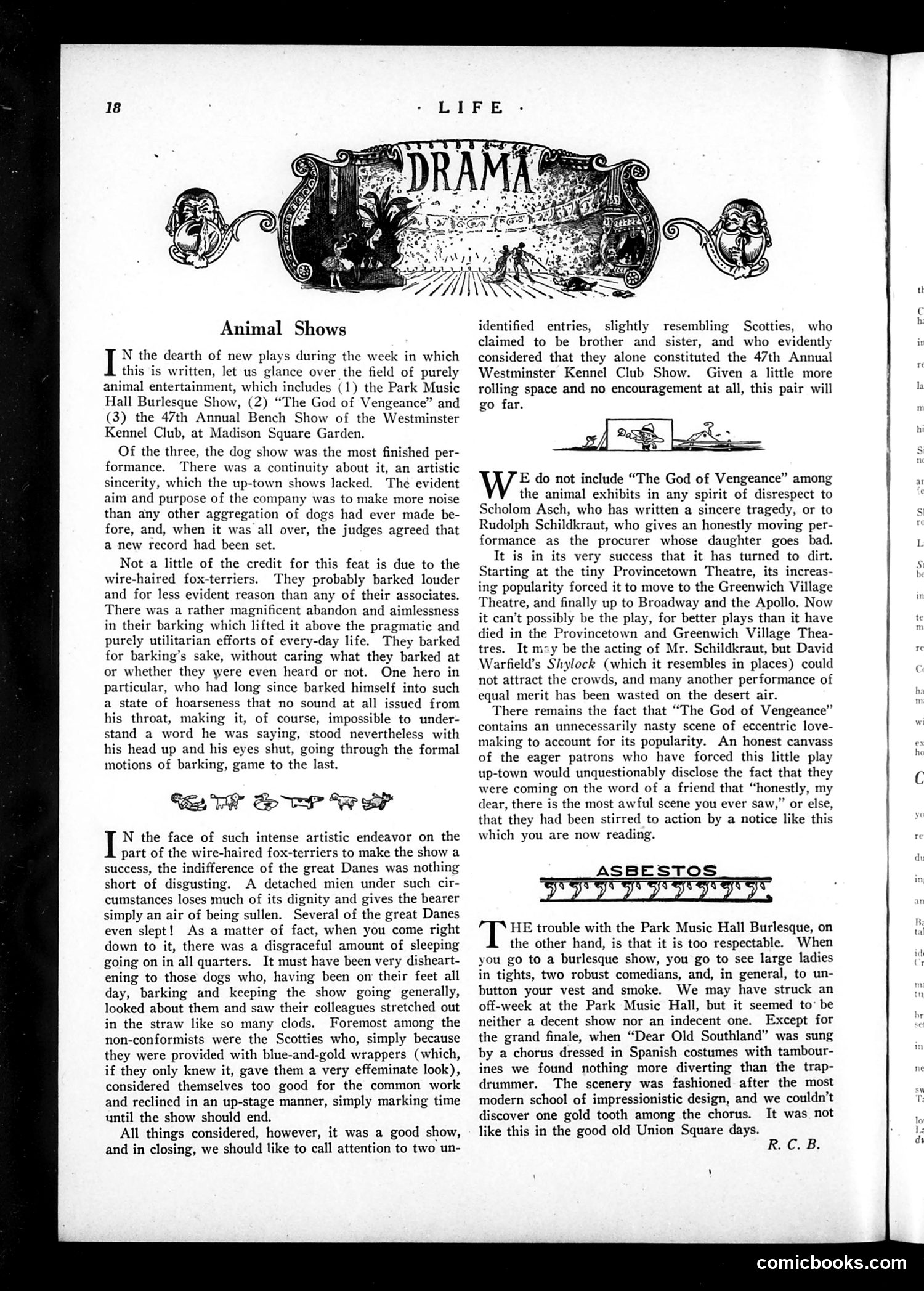
This page satirizes New York entertainment through animal show commentary. The writer uses the 47th Westminster Kennel Club Dog Show as a humorous lens to critique contemporary theater. **The satire:** Wire-haired fox-terriers are praised for enthusiastic, purposeless barking—"barking for barking's sake"—while Great Danes appear indifferent and sleep. Scotties, dressed in "blue-and-gold wrappers," recline "up-stage" in affected manner, considering themselves superior. **Social commentary:** The dogs' behavior mirrors human theatrical pretension. The energetic but pointless terriers represent cheap entertainment; the aloof Danes and self-important Scotties embody artistic pretension and snobbery. **Additional critique:** The second section dismisses "The God of Vengeance" (a Scholom Asch play about a prostitute) as initially sincere but corrupted by commercial success and Broadway audiences—suggesting that popularity degrades art. The humor relies on anthropomorphizing dogs to mock both lowbrow entertainment and highbrow theatrical affectation.
📄 Transcribed text from this page (OCR, searchable)
Machine-transcribed from the original scan — historical spelling and the odd misread are preserved.
Animal Shows N the dearth of new plays during the week in which this is written, let us glance over the field of purely animal entertainment, which includes (1) the Park Music Hall Burlesque Show, (2) “The God of Vengeance” and (3) the 47th Annual Bench Show of the Westminster Kennel Club, at Madison Square Garden. Of the three, the dog show was the most finished per- formance. There was a continuity about it, an artistic sincerity, which the up-town shows lacked. The evident aim and purpose of the company was to make more noise than any other aggregation of dogs had ever made be- fore, and, when it was all over, the judges agreed that a new record had been set. Not a little of the credit for this feat is due to the wire-haired fox-terriers. They probably barked louder and for less evident reason than any of their associates. There was a rather magnificent abandon and aimlessness in their barking which lifted it above the pragmatic and purely utilitarian efforts of every-day life. They barked for barking’s sake, without caring what they barked at or whether they were even heard or not. One hero in particular, who had long since barked himself into such a state of hoarseness that no sound at all issued from his throat, making it, of course, impossible to under- stand a word he was saying, stood nevertheless with his head up and his eyes shut, going through the formal motions of barking, game to the last. a TH Eee Ww SP N the face of such intense artistic endeavor on the part of the wire-haired fox-terriers to make the show a success, the indifference of the great Danes was nothing short of disgusting. A detached mien under such cir- cumstances loses much of its dignity and gives the bearer simply an air of being sullen. Several of the great Danes even slept! As a matter of fact, when you come right down to it, there was a disgraceful amount of sleeping going on in all quarters. It must have been very disheart- ening to those dogs who, having been om their feet all day, barking and keeping the show going generally, looked about them and saw their colleagues stretched out in the straw like so many clods. Foremost among the non-conformists were the Scotties who, simply because they were provided with blue-and-gold wrappers (which, if they only knew it, gave them a very effeminate look), considered themselves too good for the common work and reclined in an up-stage manner, simply marking time until the show should end. All things considered, however, it was a good show, and in closing, we should like to call attention to two un- identified entries, slightly resembling Scotties, who claimed to be brother and sister, and who evidently considered that they alone constituted the 47th Annual Westminster Kennel Club Show. Given a little more rolling space and no encouragement at all, this pair will E do not include “The God of Vengeance” among the animal exhibits in any spirit of disrespect to Scholom Asch, who has written a sincere tragedy, or to Rudolph Schildkraut, who gives an honestly moving per- formance as the procurer whose daughter goes bad. It is in its very success that it has turned to dirt. Starting at the tiny Provincetown Theatre, its increas- ing popularity forced it to move to the Greenwich Village Theatre, and finally up to Broadway and the Apollo. Now it can’t possibly be the play, for better plays than it have died in the Provincetown and Greenwich Village Thea- tres. It msy be the acting of Mr. Schildkraut, but David Warfield’s Shylock (which it resembles in places) could not attract the crowds, and many another performance of equal merit has been wasted on the desert air. There remains the fact that “The God of Vengeance” contains an unnecessarily nasty scene of eccentric love- making to account for its popularity. An honest canvass of the eager patrons who have forced this little play up-town would unquestionably disclose the fact that they were coming on the word of a friend that “honestly, my dear, there is the most awful scene you ever saw,” or else, that they had been stirred to action by a notice like this which you are now reading. ASBESTOS HE trouble with the Park Music Hall Burlesque, on the other hand, is that it is too respectable. When you go to a burlesque show, you go to see large ladies in tights, two robust comedians, and, in general, to un- button your vest and smoke. We may have struck an off-week at the Park Music Hall, but it seemed to’ be neither a decent show nor an indecent one. Except for the grand finale, when “Dear Old Southland” was sung by a chorus dressed in Spanish costumes with tambour- ines we found nothing more diverting than the trap- drummer. The scenery was fashioned after the most modern school of impressionistic design, and we couldn’t discover one gold tooth among the chorus. It was not like this in the good old Union Square days. RC. B: comicbooks.com