
A complete issue · 36 pages · 1922
Life — November 23, 1922
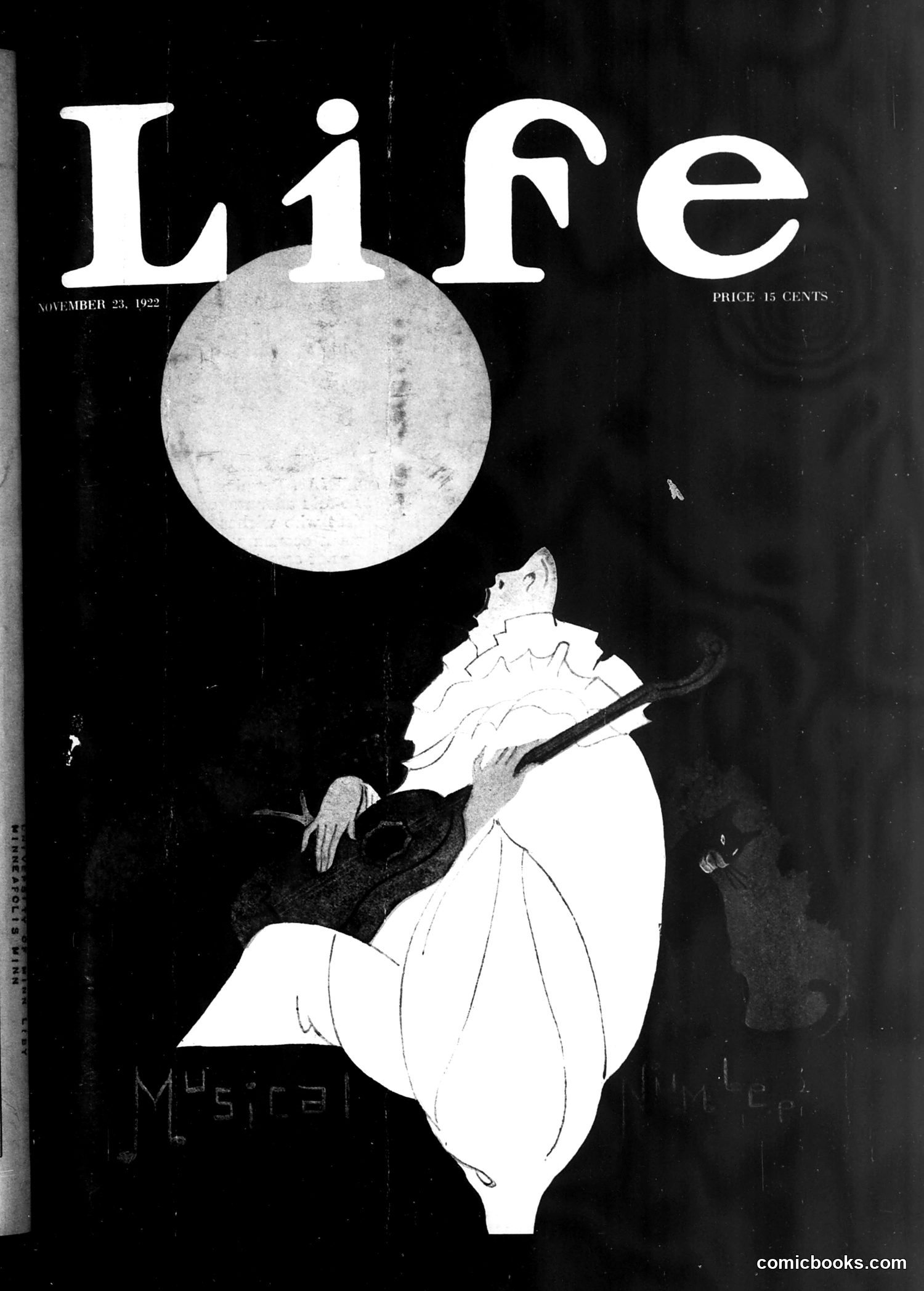
This cover depicts a fashionably dressed woman gazing up at a large moon while holding what appears to be a small black cat or similar creature. The Art Deco styling and elegant line work are characteristic of 1920s illustration. The satire likely references the romantic or whimsical associations of moonlight and femininity popular in 1920s culture. The woman's fashionable attire and posed elegance suggest commentary on modern women or contemporary beauty standards of the Jazz Age era. Without additional text identifying specific figures or events, the precise satirical target remains unclear, though the image captures the era's aesthetic sensibility and likely comments on romantic idealization or popular entertainment of the period.
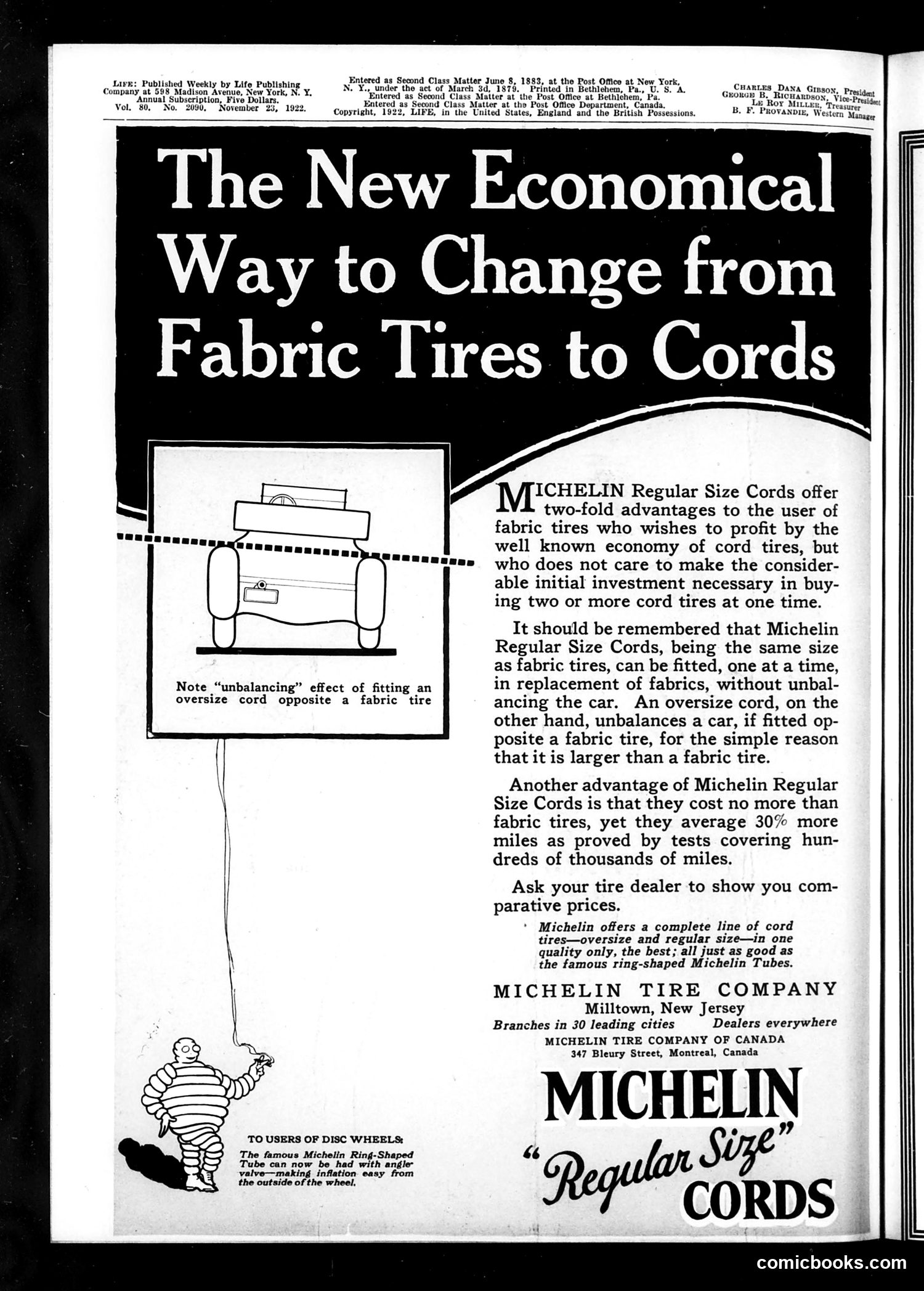
This page is **primarily a Michelin Tire Company advertisement**, not satirical content. The advertisement promotes "Regular Size Cords"—a transitional tire technology—as an economical alternative to fabric tires. The visual diagram shows a car with an unbalanced tire setup (oversized cord opposite a fabric tire), illustrating a practical concern: these mixed-tire combinations could cause vehicle imbalance. However, the ad argues Michelin cords solve this by matching fabric tire dimensions while offering 30% better mileage at equal cost. The Michelin Man (Bibendum) mascot appears at bottom left, noting that the famous "ring-shaped" tube design now fits cord tires. **There is no political satire here**—this is straightforward consumer marketing addressing a genuine automotive transition of the 1920s era.
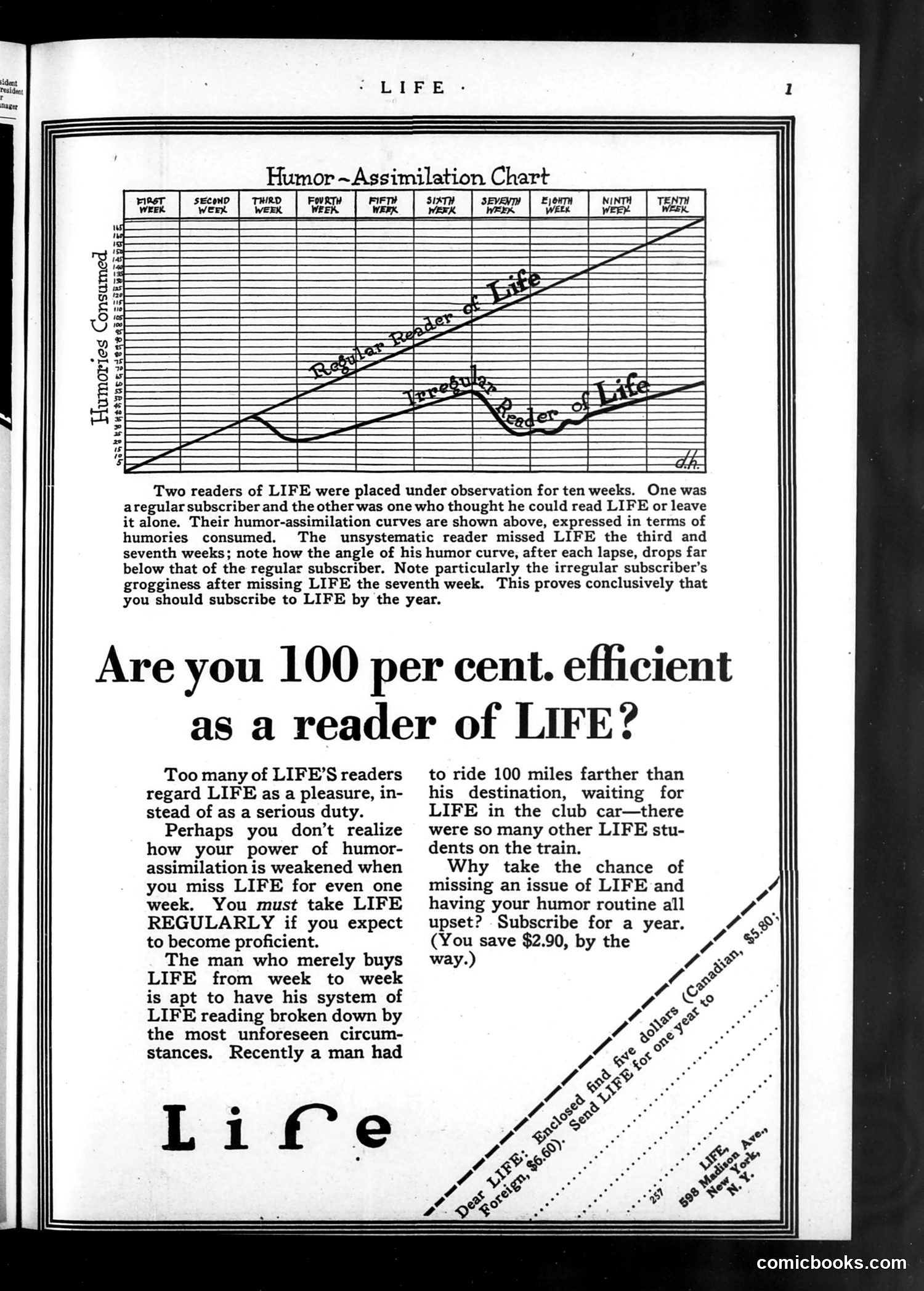
This is a **subscription advertisement disguised as editorial content**. The "Humor-Assimilation Chart" compares two readers' engagement with *Life* magazine over ten weeks: a regular subscriber versus an irregular one. The satirical point: missing even one issue of *Life* causes your "humor assimilation" to drop significantly—the irregular reader's curve plummets after week seven when they missed an issue. The ad argues that *Life* reading must be **habitual and complete** to maintain comedic benefit. The pitch is tongue-in-cheek but serious: readers shouldn't risk missing *Life* for fear of social incompetence or incomplete enjoyment. It's early advertising psychology, using mock-scientific charts to encourage annual subscriptions (saving $2.90).
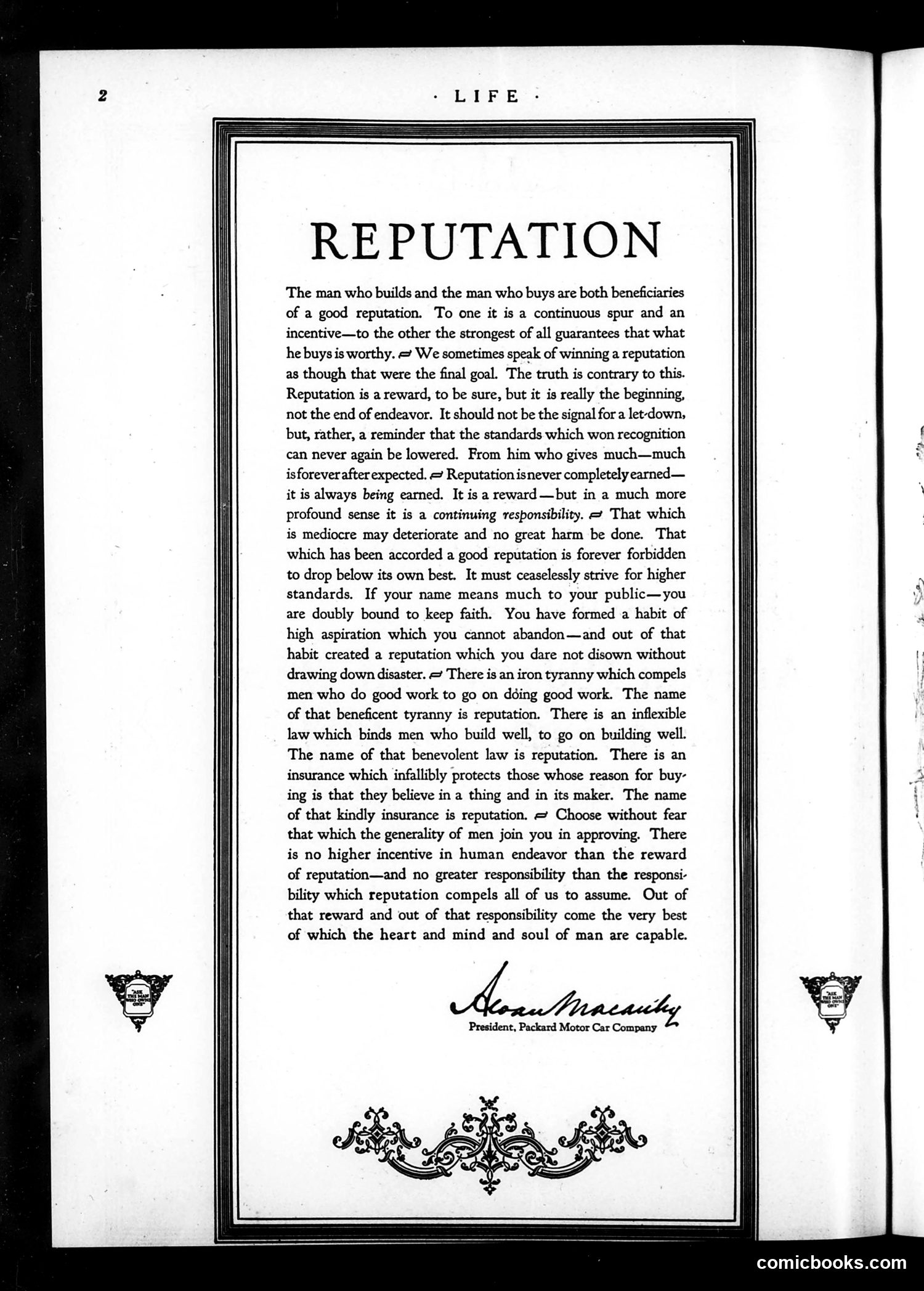
This page is **not a cartoon or satire**, but rather a serious corporate advertisement/editorial piece. It's a formal essay on reputation signed by what appears to be the President of Packard Motor Car Company. The text argues that reputation is not an achievement's end point, but rather its beginning—a continuous responsibility. It uses metaphors of "iron tyranny" and "benevolent law" to suggest that a good reputation creates ongoing obligation to maintain high standards. The decorative ornamental borders and formal typography indicate this is presented as dignified corporate messaging, likely aimed at business readers of Life magazine during the early-to-mid 20th century. The piece emphasizes that quality products and ethical business practices build reputation, which then demands sustained excellence.
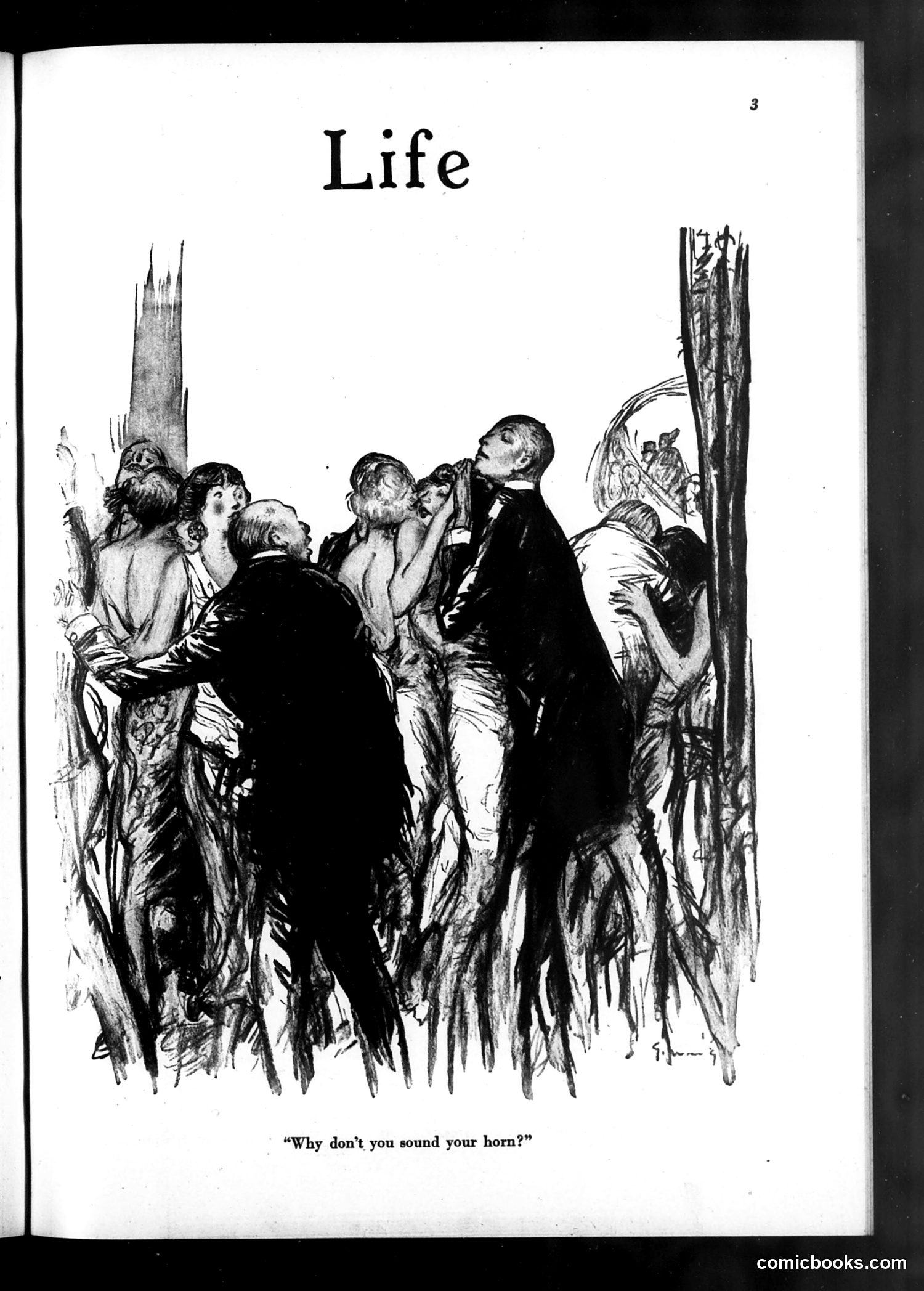
This page from *Life* magazine features a satirical cartoon titled "Life" with the caption "Why don't you sound your horn?" The sketch depicts a group of well-dressed men in formal attire (suits and coats) crowded together on a narrow urban street, flanked by tall buildings. They appear to be pedestrians in a congested city environment, seemingly unable to move freely. The caption's ironic question—"Why don't you sound your horn?"—appears to mock urban congestion and the frustration of city life, where individuals are so tightly packed that conventional means of getting attention (like a horn) become absurdly ineffective. The cartoon satirizes the impersonal, claustrophobic nature of modern metropolitan living, where people are reduced to anonymous figures trapped in crowded spaces.
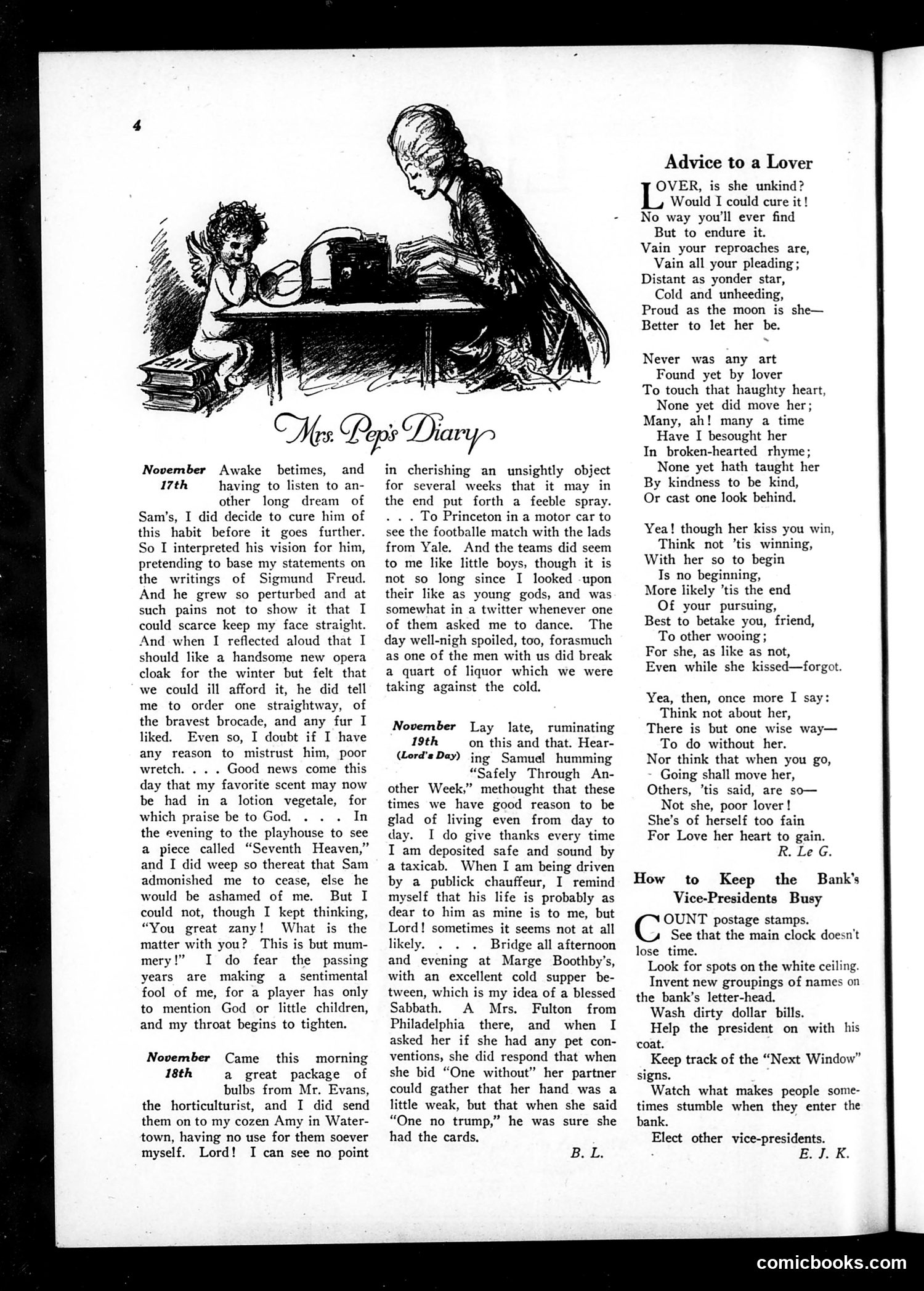
This page contains **Mrs. Pep's Diary**, a humorous personal column featuring diary entries from November 17th-19th describing mundane domestic life—attending football matches, worrying about a husband named Sam, and managing household tasks like ordering a winter coat and planting bulbs. The accompanying illustration shows a woman at a desk with a cherub/cupid figure, typical of Life magazine's decorative style. Separately, the page includes **"Advice to a Lover,"** a poem suggesting that winning an unkind woman's affection is futile, and **"How to Keep the Bank's Vice-Presidents Busy,"** which offers satirical office management tips like watching ceiling spots and inventing new filing systems. The content represents typical early 20th-century Life magazine humor—domestic satire and gentle office comedy aimed at middle-class readers.
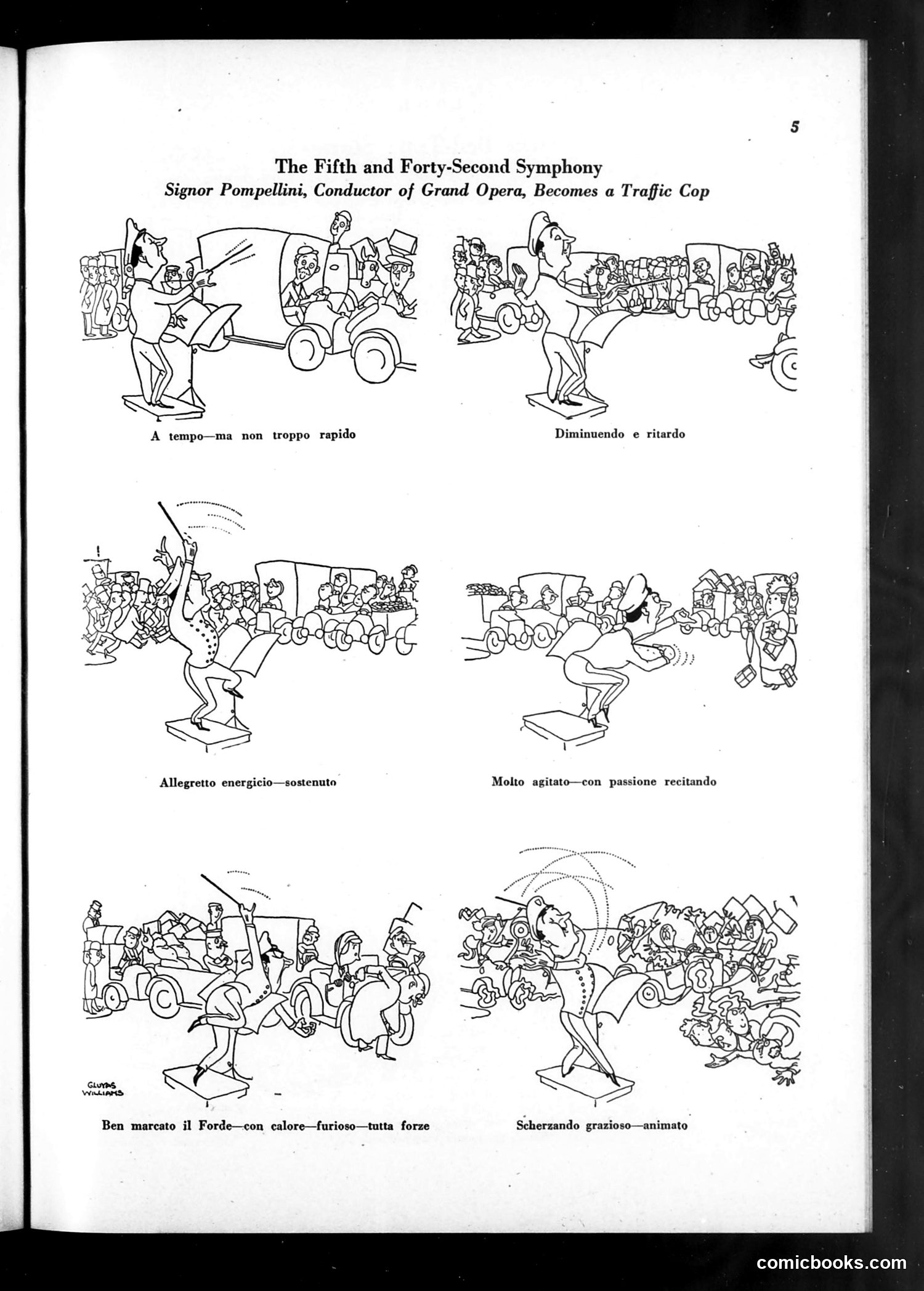
This page satirizes conductor Arturo Toscanini (identified as "Signor Pompellini" in the subtitle) through a series of humorous illustrations. The cartoon depicts him as the newly appointed "Traffic Cop" of Grand Opera, showing him conducting increasingly chaotic musical scenes. Each panel uses Italian musical directions as captions while showing absurd scenarios: orchestras in automobiles, frantic conducting gestures, and general mayhem. The satire appears to mock either Toscanini's reputation for intense, dramatic conducting style or perhaps a recent appointment or controversy involving him and opera management. The cartoonist suggests that conducting opera requires managing chaos as much as interpreting music—a playful jab at both the conductor's personality and the operatic world itself.
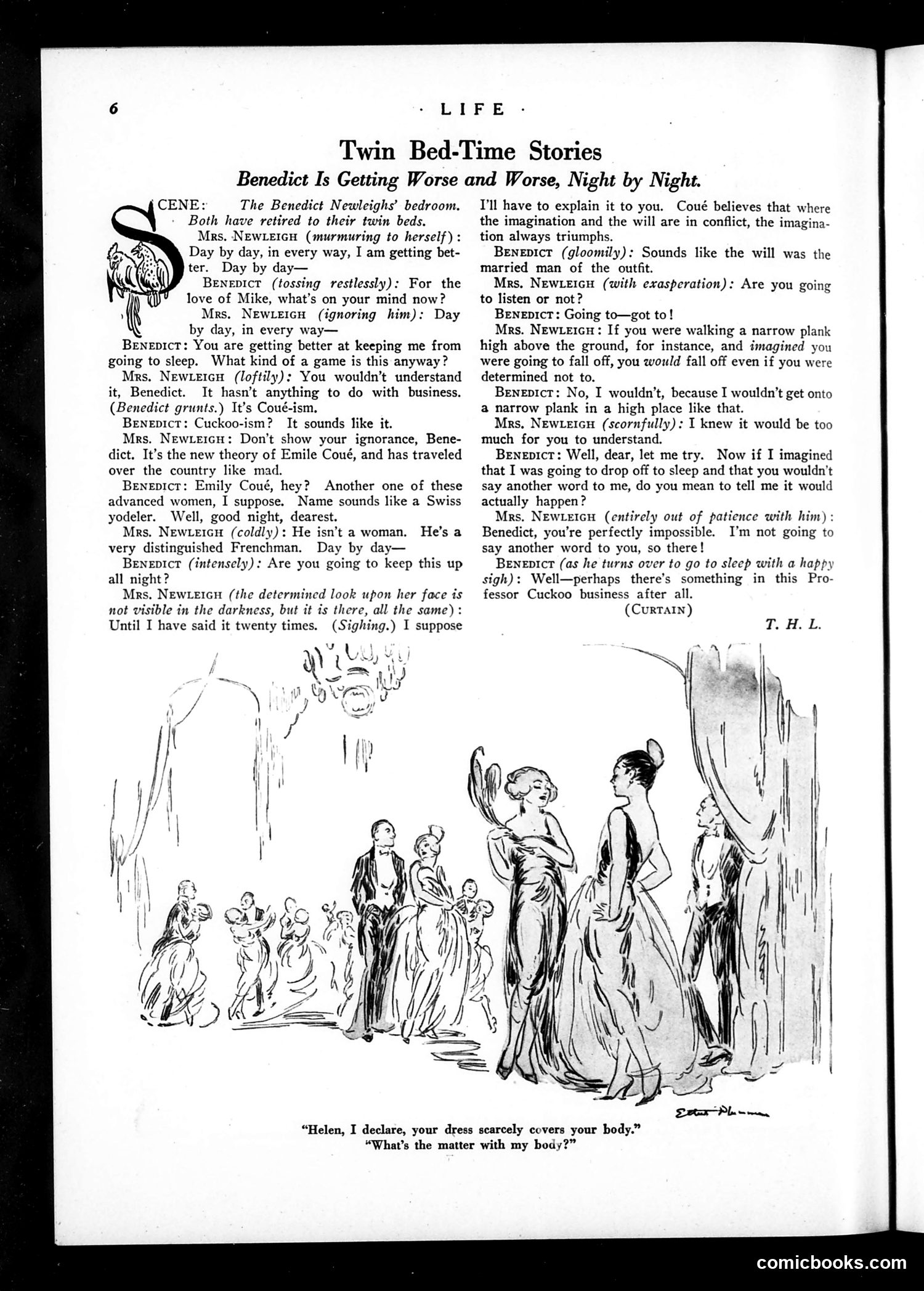
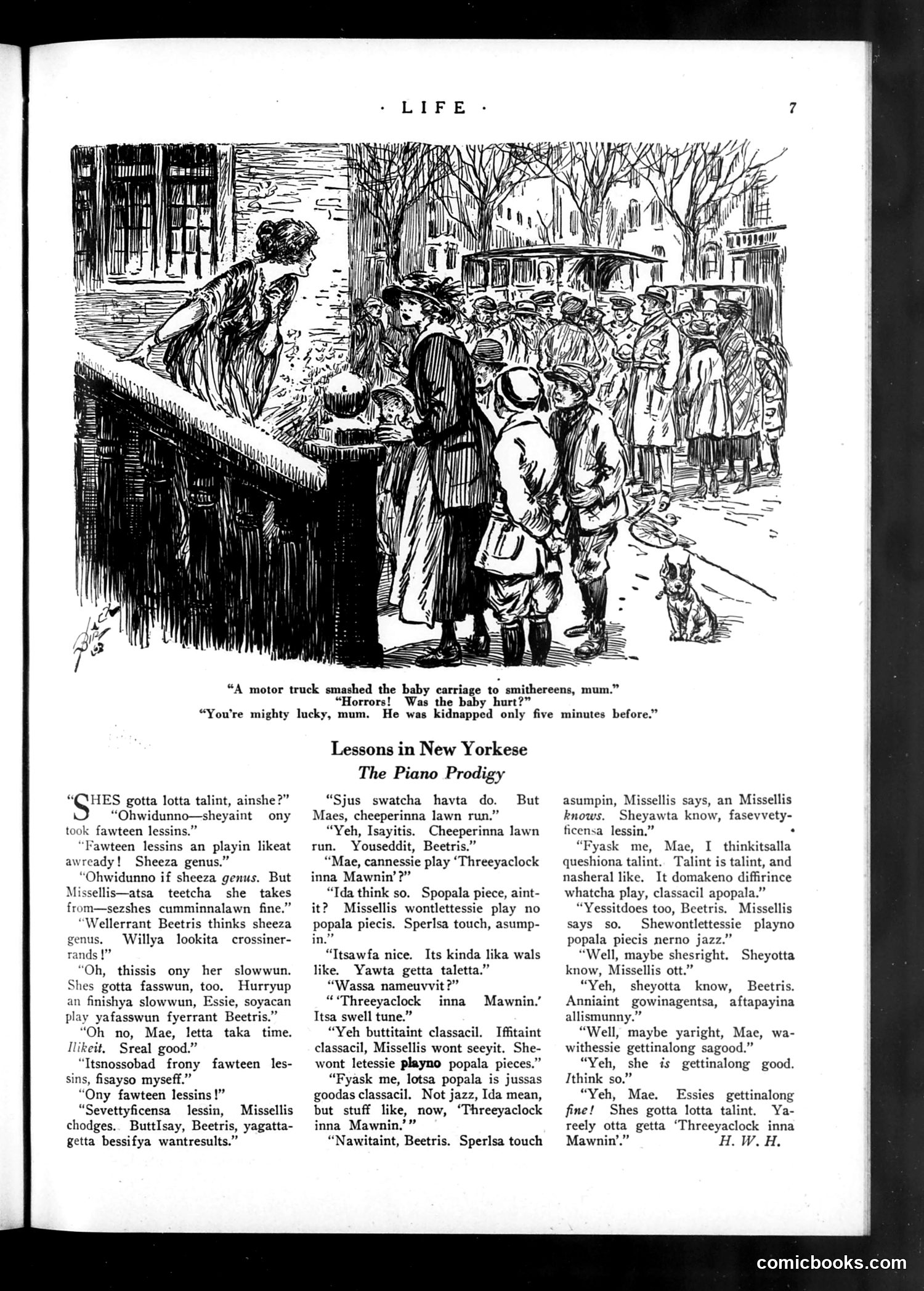
The cartoon depicts a street scene where a mother is being told her baby carriage was hit by a motor truck and the child was kidnapped five minutes before the accident. This is early 20th-century satire about **urban traffic dangers and child abduction**—two emerging anxieties of the automobile age. The joke's dark humor lies in the mother's "luck": her child survived the truck only to be taken by a kidnapper. The crowd's reaction and the woman's shock underscore how these modern dangers (vehicular accidents and stranger abduction) were becoming normalized urban hazards. The accompanying text below, "Lessons in New Yorkese: The Piano Prodigy," appears unrelated—it's a humorous phonetic transcription of how New Yorkers speak, likely satirizing accent and dialect.
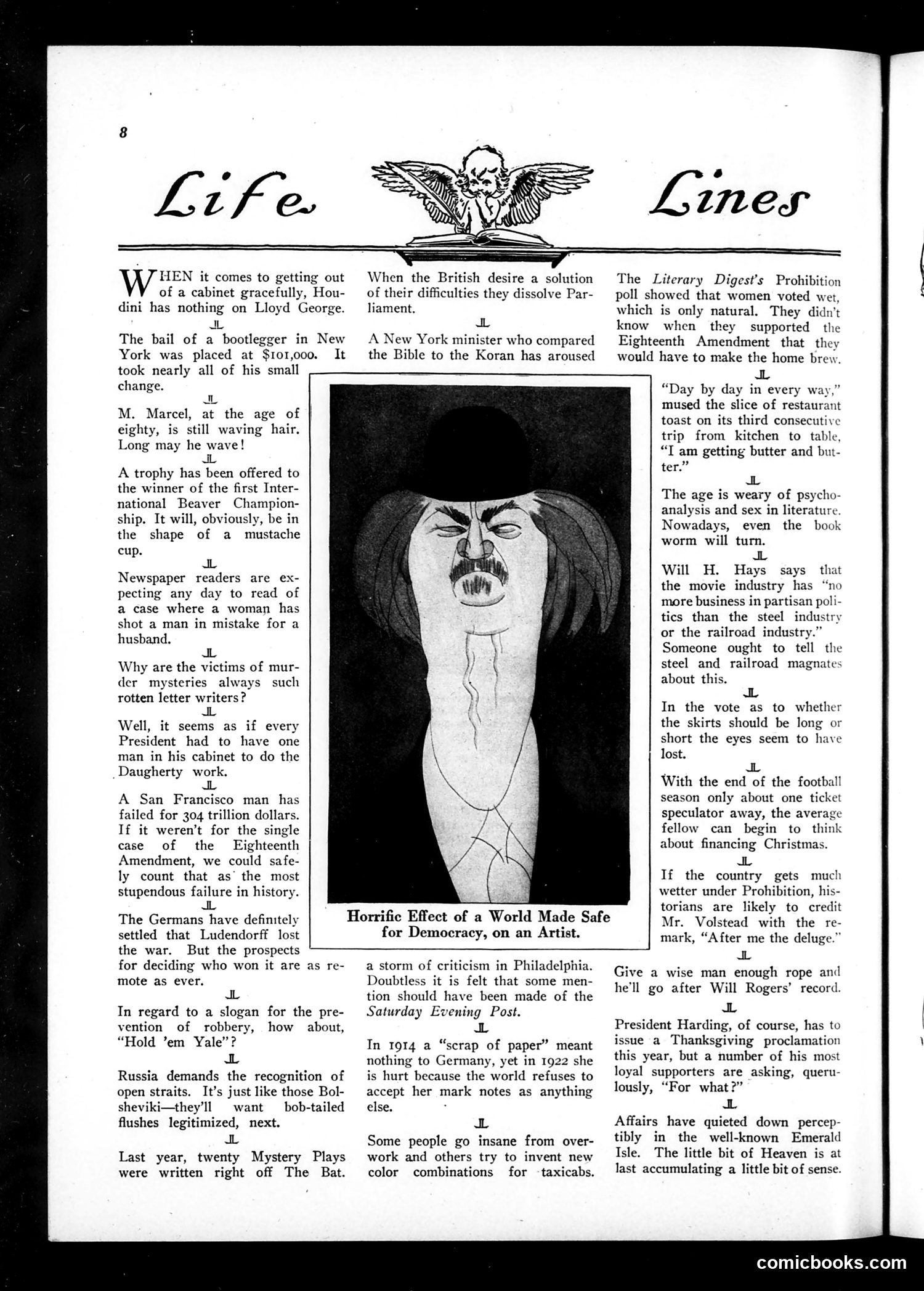
The central cartoon depicts a grotesquely distorted face with an exaggerated mustache and elongated chin, titled "Horrific Effect of a World Made Safe for Democracy, on an Artist." This appears to be anti-Prohibition satire. The grotesque transformation suggests that Prohibition (the 18th Amendment, referenced in the text) has psychologically damaged an artist—likely through censorship or the loss of creative freedom that alcohol-fueled artistic expression represented in the 1920s. The surrounding "Life Lines" commentary mocks various contemporary targets: British Parliament dissolution, the Eighteenth Amendment's unpopularity, literary censorship, and Prohibition's effects on society. The overall message: Prohibition and moral reform legislation have made American life absurd and creatively stifling—literally disfiguring the nation's artistic soul.
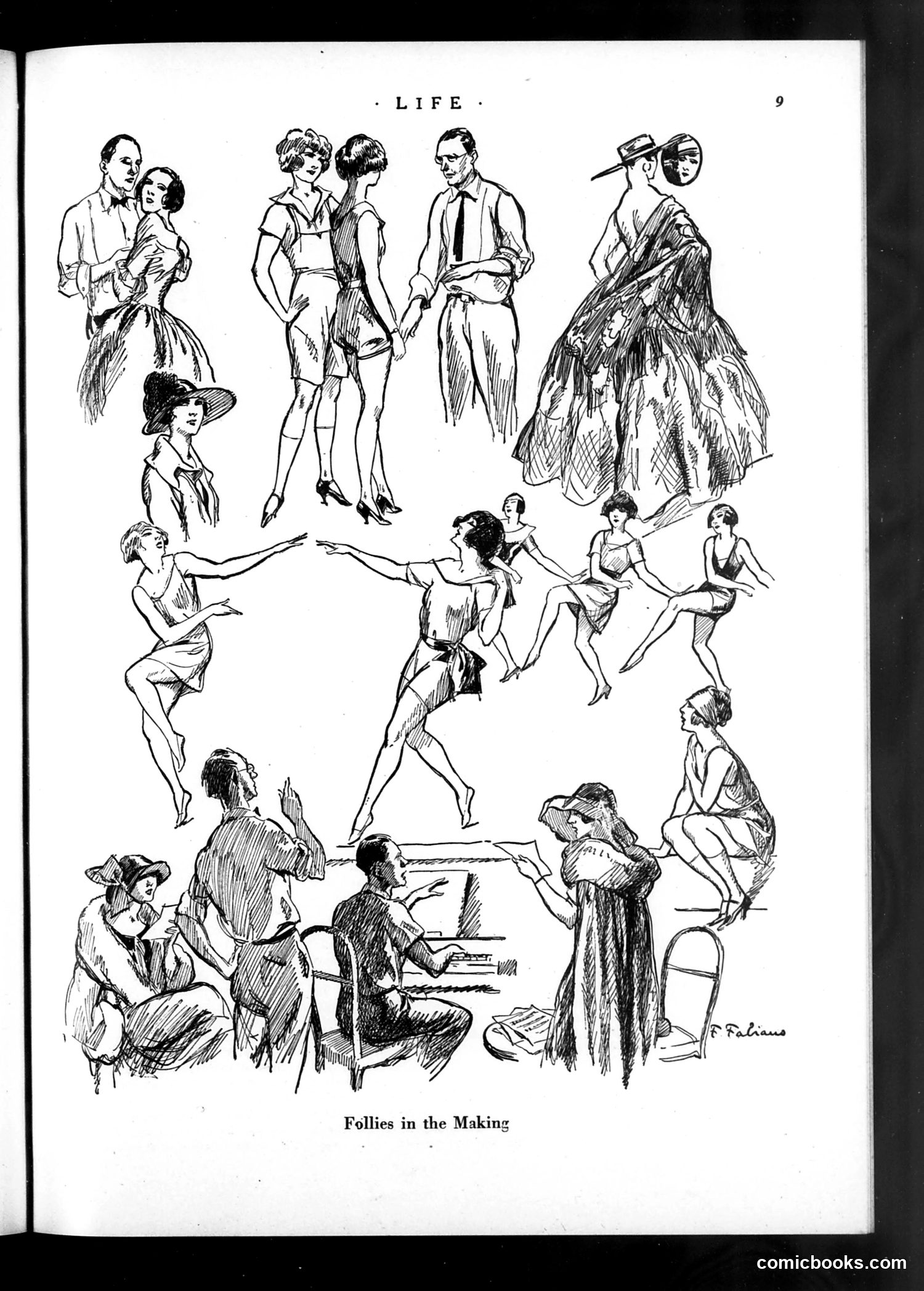
This page depicts theatrical production, likely from a Broadway revue or musical comedy of the early 20th century. The illustrations show various stages of show business: performers in formal wear socializing at top, dancers in increasingly revealing costumes in the middle, and at bottom, what appears to be backstage or rehearsal scenes with musicians, directors, and performers. The satire targets the spectacle and artifice of theatrical "follies"—elaborate musical productions known for scantily-clad dancers. The progression from fully-clothed social scenes to minimally-dressed performers comments on the gap between public respectability and the actual content of these shows. The title suggests these entertainments were considered somewhat frivolous or morally questionable by contemporary satirists.
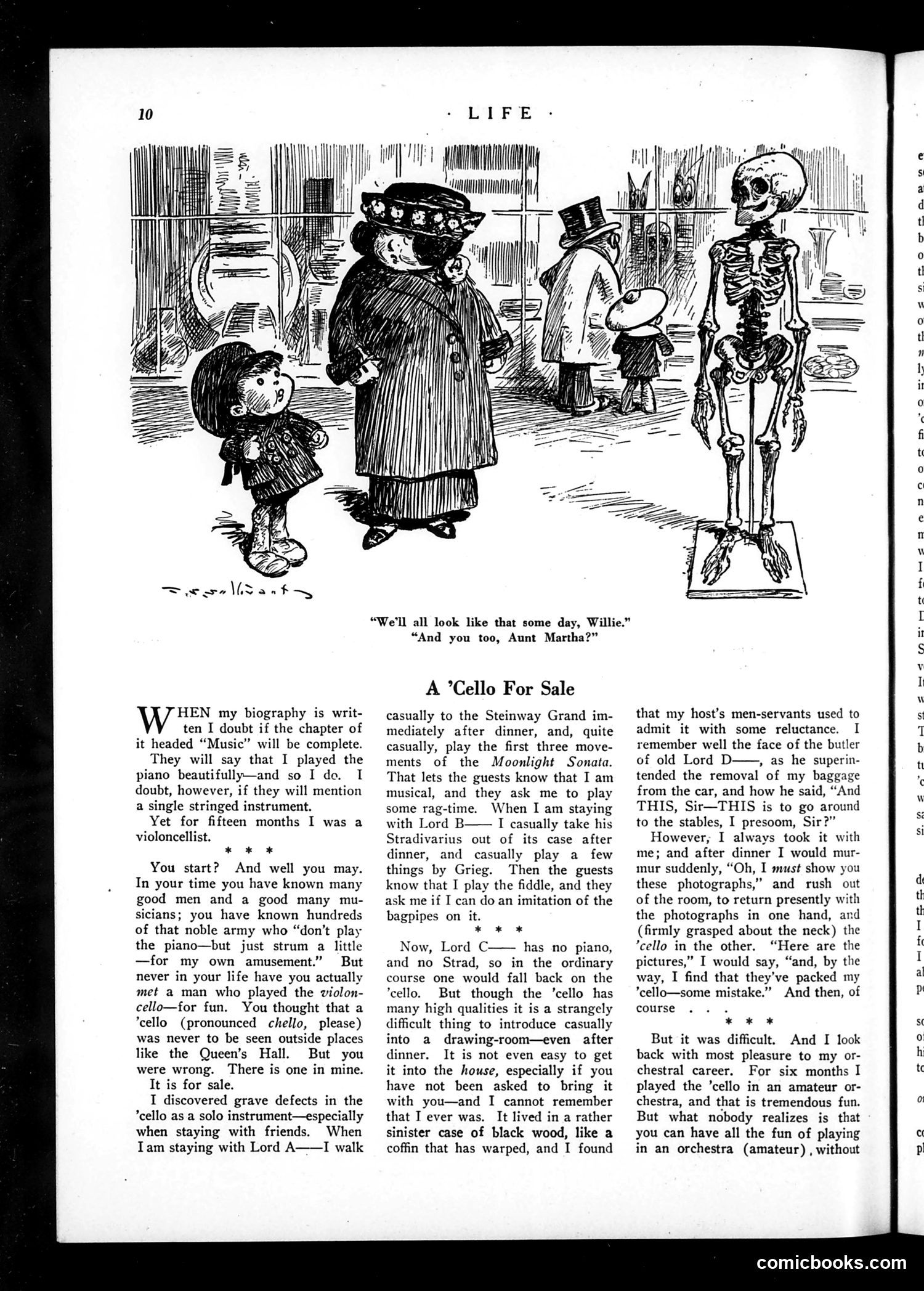
The cartoon depicts an adult showing a skeleton to a small child, with the caption: "We'll all look like that some day, Willie" / "And you too, Aunt Martha?" This is dark Victorian-era humor playing on morbid sentimentality. The joke relies on the child's innocent, literal-minded response to an adult's philosophical comment about mortality—by pointing out that "Aunt Martha" will also eventually become a skeleton, the child awkwardly highlights the uncomfortable truth the adult was making. The accompanying article discusses someone's experience as a cellist, mentioning they played a "cello for sale" and discovering defects in the instrument. The skeleton likely serves as a visual metaphor for a worn-out or damaged cello—hollow, stripped of its musical qualities, essentially "dead" as an instrument.
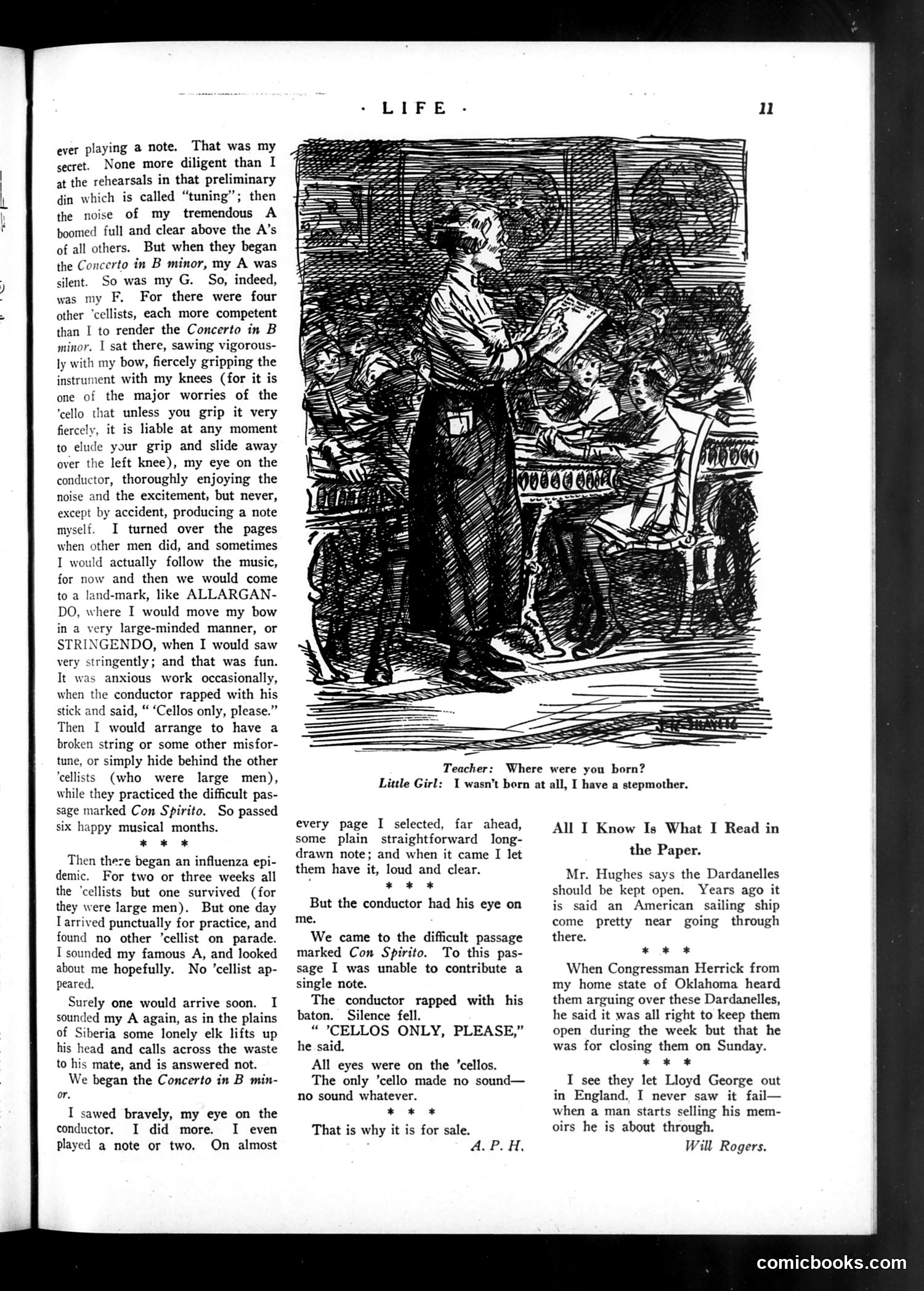
This page from *Life* magazine contains a humorous illustration and anecdote about a music rehearsal, not a political cartoon. The image shows a conductor instructing cellists during orchestra practice of a Concerto in B minor. The joke centers on the conductor's frustration: when the passage marked "Con Spirito" (with spirit/vigor) arrives, he must silence all instruments except cellos to hear them properly. The cellos produce no sound at all—revealing they're unable to play their part. The accompanying caption presents a teacher-student exchange where a girl claims she "wasn't born at all" but "have a stepmother," which is wordplay suggesting illegitimacy or absent parentage. The satire gently mocks both orchestral incompetence and social pretension of the era, using humor rather than political commentary.
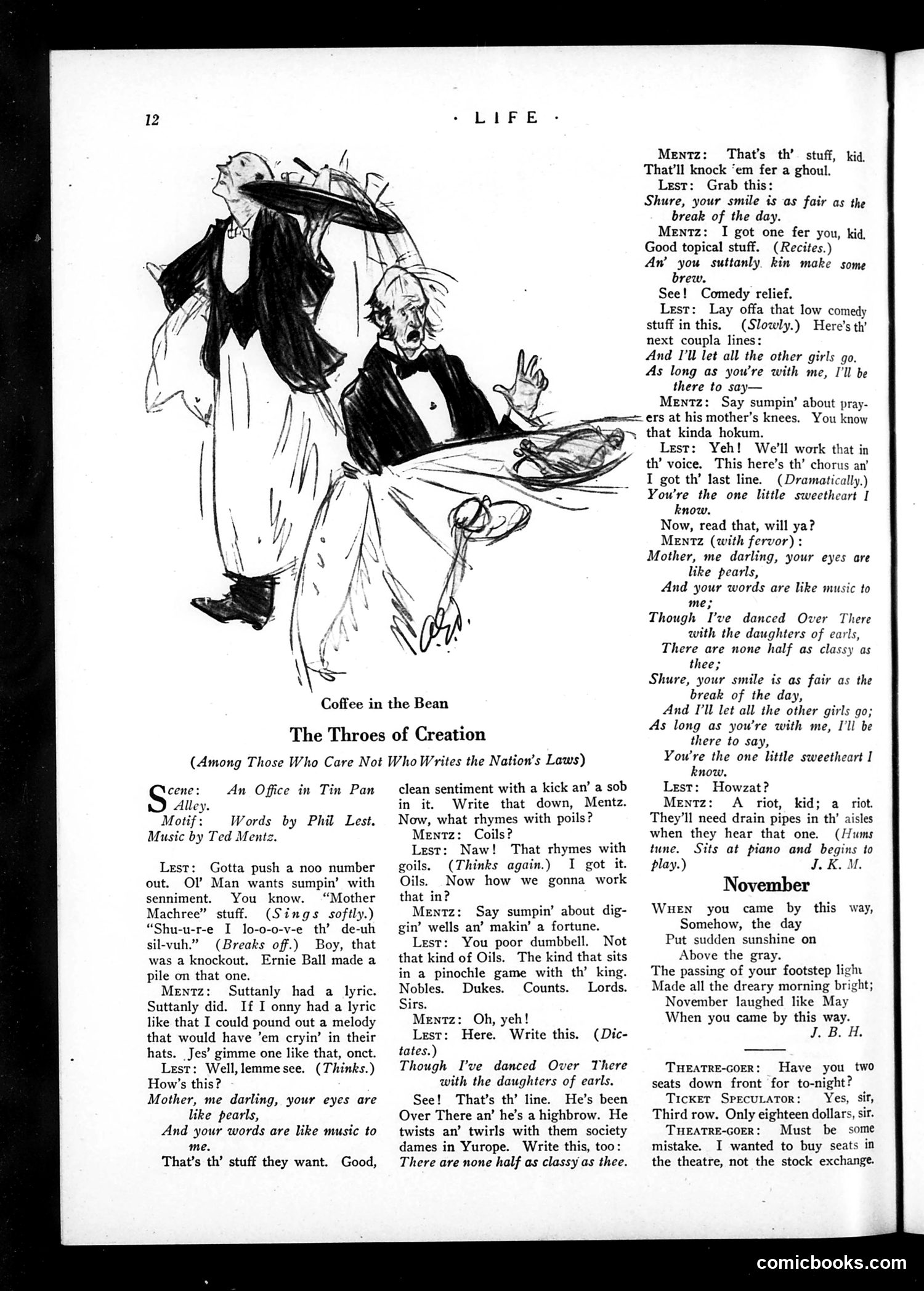
This sketch satirizes the collaborative struggle of creating popular entertainment. Two figures work at an office desk—one standing dramatically gesturing (labeled "Mentz"), one seated (labeled "Lest")—apparently composing song lyrics and music together. The cartoon mocks the messy, contentious process of artistic creation: they debate rhyme schemes, argue over sentimental versus clever wordplay, and struggle to balance commercial appeal ("Good topical stuff") with artistic merit. The scattered papers and exaggerated poses emphasize creative chaos. The caption "(Among Those Who Care Not Who Writes the Nation's Laws)" suggests these entertainers, while ignored by serious society, nonetheless shape public taste and culture through popular songs and theater—a satirical commentary on entertainment's underestimated cultural influence.
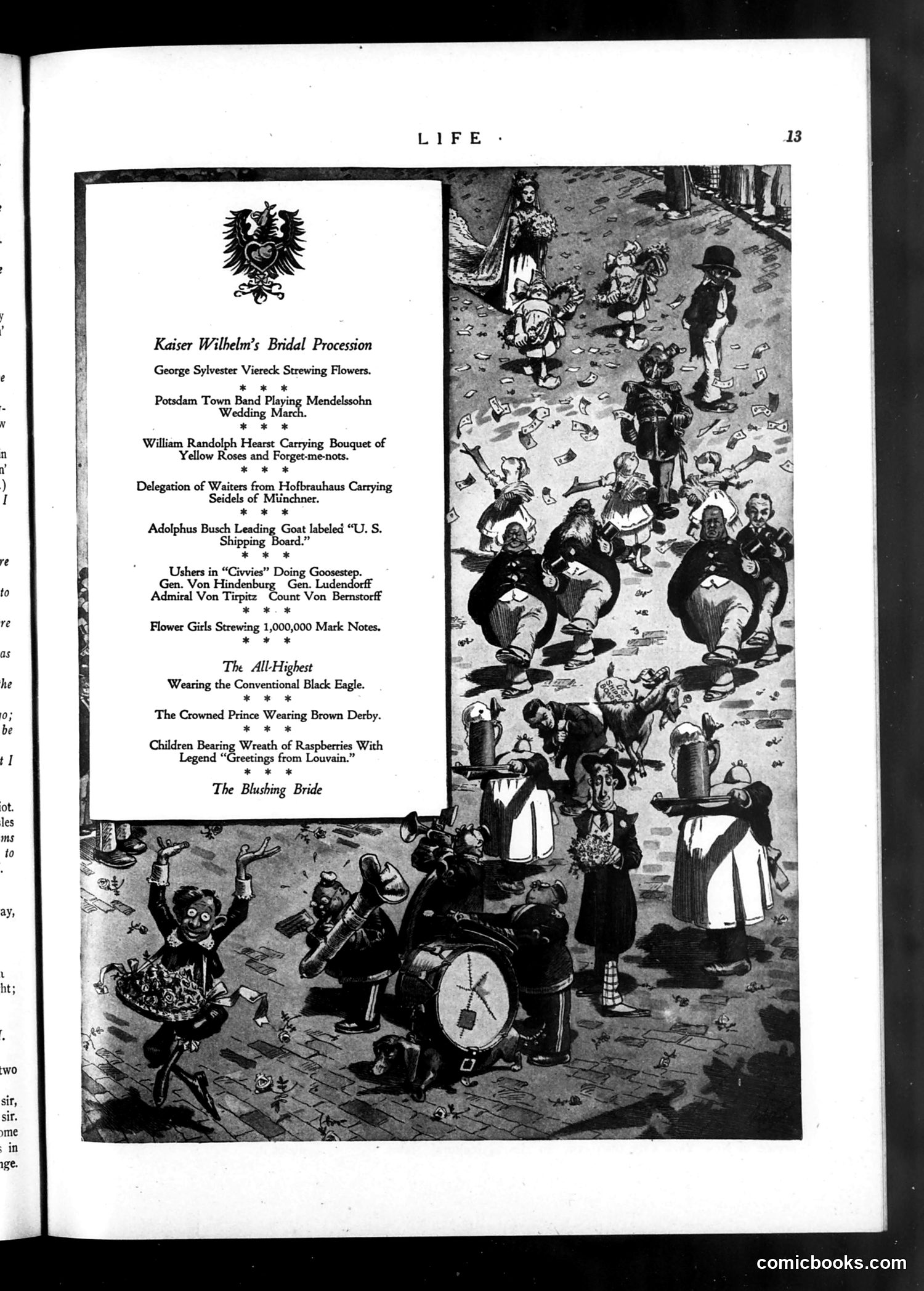
This page satirizes **Kaiser Wilhelm II's bridal procession** through a grotesque, crowded cartoon. The left panel lists absurdist wedding details—including George Sylvester Viereck strewing flowers, a Potsdam band playing Mendelssohn, and flower girls handling enormous quantities of "Mark Notes" (German currency). The right illustration depicts caricatured German aristocrats and officials in a chaotic street scene, likely mocking German militarism and imperial pretension. References to "U.S. Shipping Board," various German counts, and "The Blushing Bride" suggest this ridicules Germany's imperial ambitions, possibly its economic situation or war-related activities. The cartoon's crude, crowded style emphasizes chaos and excess, typical of American satirical responses to German imperial authority during the early 20th century.
This *Life* magazine page contains editorial commentary on recent U.S. elections, likely referencing the 1922 midterms. The text criticizes voters' intelligence and political judgment, arguing that electoral outcomes reflect voter discomfort rather than rational choice. The article specifically discusses New York politics, mentioning candidates "Miller and Smith" (likely referring to a gubernatorial race). It critiques voters for making discriminatory choices based on impulse rather than knowledge of candidates' qualifications. The second section discusses Massachusetts politics and mentions Lodge (likely Henry Cabot Lodge), suggesting voter dissatisfaction with Republican leadership despite their congressional control. The illustrated header and decorative elements are typical of *Life's* satirical style, though specific figures are unclear from this reproduction.
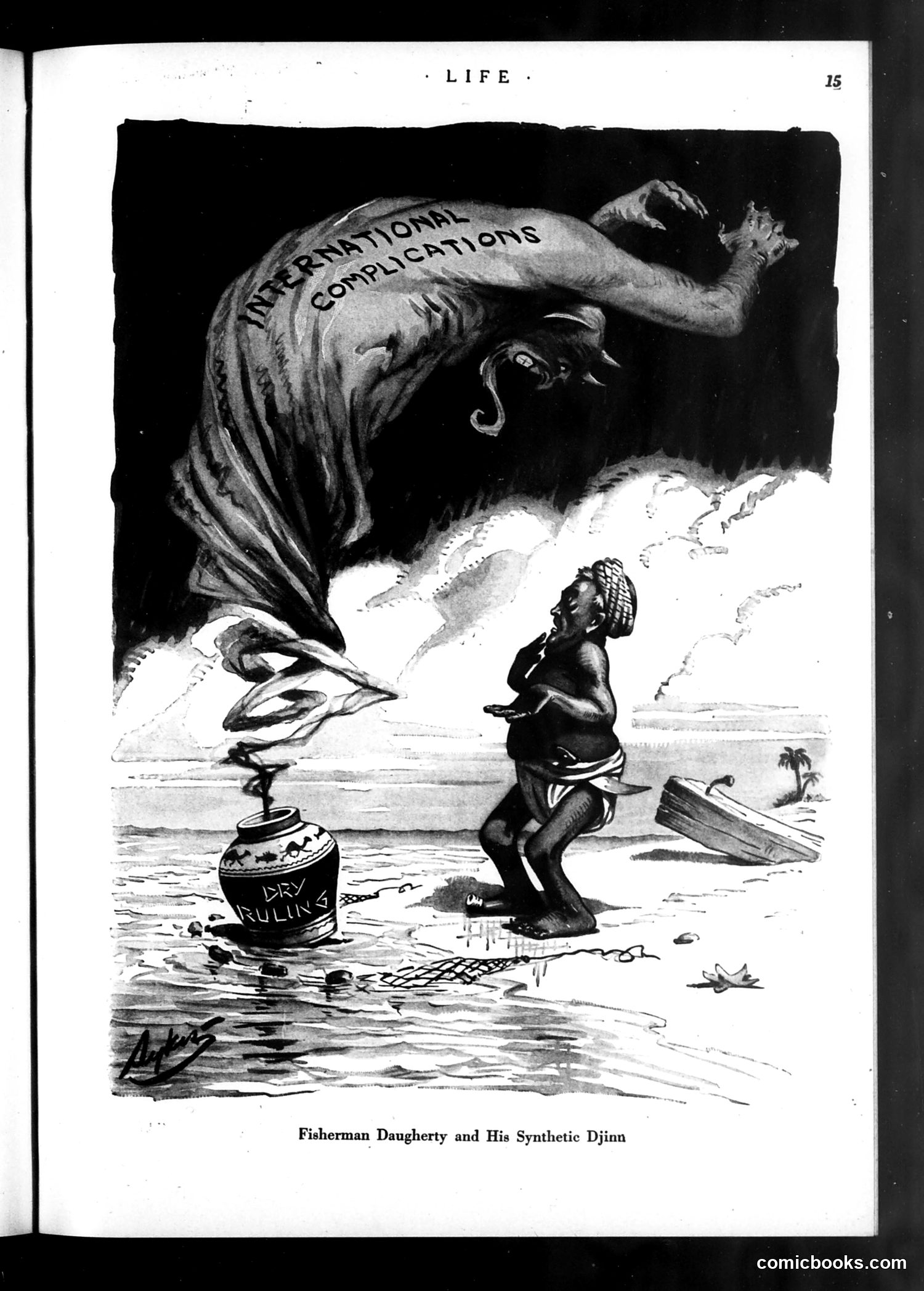
This political cartoon satirizes **Harry Daugherty**, who appears to be a fisherman casting a line. The genie-like figure emerging from a bottle labeled "DRY RULING" represents an uncontrolled consequence of his actions. The title "Fisherman Daugherty and His Synthetic Djinn" plays on the classic tale of summoning a genie—suggesting Daugherty has unleashed something dangerous he cannot control. The "Dry Ruling" reference likely pertains to Prohibition-era legal decisions, implying that Daugherty's involvement with alcohol-related policy has created unexpected complications. The satire critiques how political figures' decisions backfire, creating problems beyond their original intent. Without additional context about the specific ruling date, the precise historical incident remains unclear, though it concerns early 20th-century American legal/political controversy.
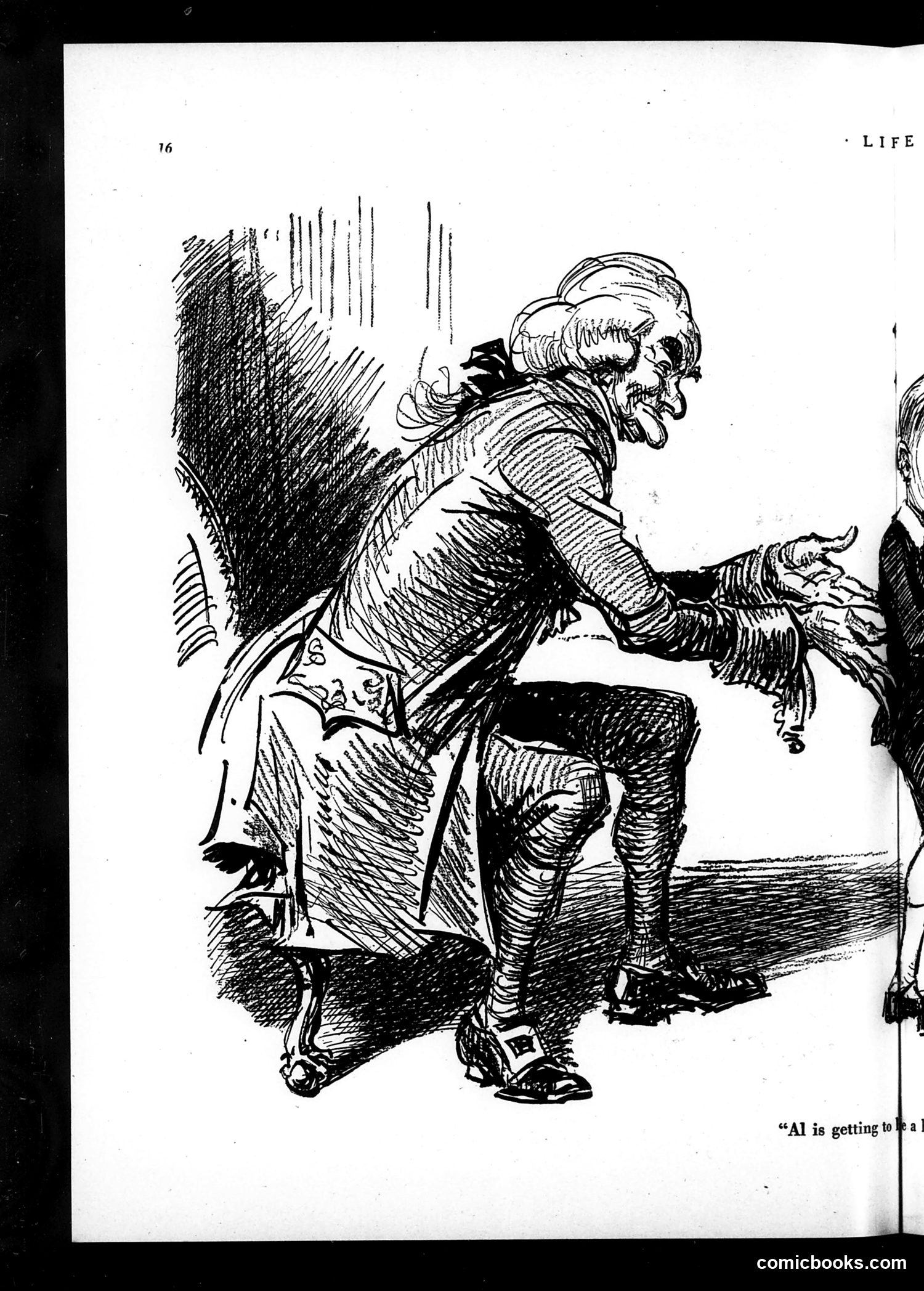
This is a political cartoon from Life magazine showing a caricatured figure in period clothing (appearing to be late 18th or early 19th century dress based on the coat style and hair). The figure is depicted in an exaggerated, satirical manner typical of Life's style. The partially visible caption reads "Al is getting to fea[r]..." but is cut off, making the complete meaning unclear. Without the full caption or additional context, I cannot definitively identify who "Al" refers to or what specific political or social situation is being satirized. The artistic style and clothing suggest this comments on a historical figure or event, but I cannot assert specifics without risking inaccuracy.
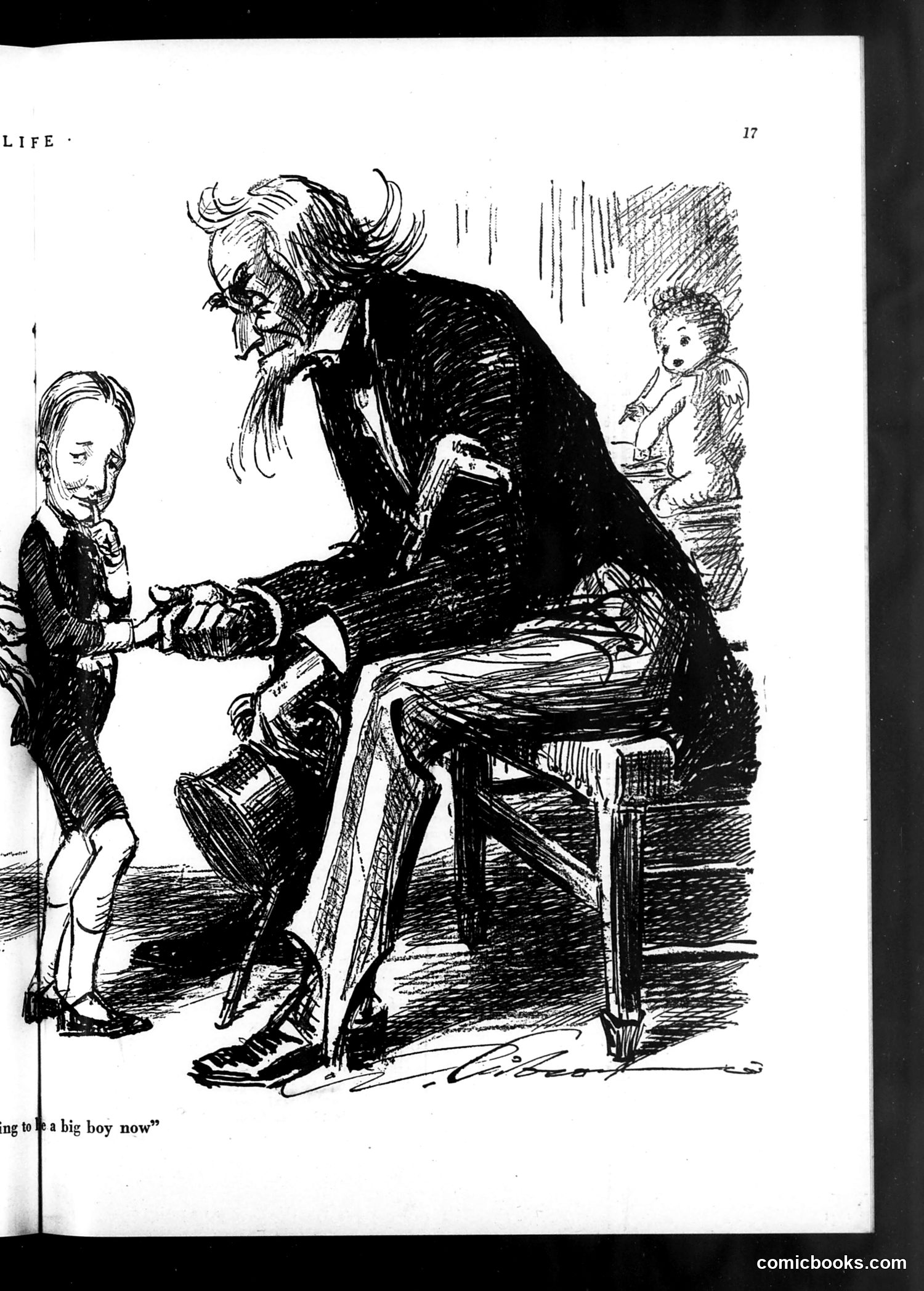
This is a satirical illustration from *Life* magazine (page 17) depicting an interaction between an adult man and a young boy. The visible caption fragment reads "ing to be a big boy now" (likely "going to be a big boy now"). The cartoon appears to satirize adult-child dynamics, possibly commenting on parenting, education, or social expectations. The exaggerated facial features of the adult—particularly the prominent nose and stern expression—suggest caricature for comic effect. A second child appears in the background. Without the complete caption or publication date, the specific political or social reference remains unclear. The sketch style is characteristic of early-to-mid 20th century American satirical cartooning, but the exact target of satire—whether parental discipline, schooling, or broader social commentary—cannot be definitively determined from the visible text alone.
This *Life* magazine drama review discusses three innovative theatrical productions: 1. **"Six Characters in Search of an Author"** (Pirandello): A metatheatrical Italian play where fictional characters interrupt a rehearsal, demanding the actors give them life. The reviewer notes this is philosophically complex but engaging. 2. **"The World We Live In"** (Brothers Capek's *Insect Comedy*): A satirical play using insects to mirror human society—love, money, and warfare. The ant-hill scene particularly resonates with post-WWI audiences, who recognize the "pointed helmets on the ant warriors" as a jab at recently-defeated Germans. The reviewer notes audiences applaud this contemporary political dig. 3. **"The 4gers"**: A sketch-comedy revue at the Punch and Judy Theatre featuring contemporary parodies and entertainment. The broader point: theater is finally offering something genuinely original rather than recycled plots. The reviewer celebrates these avant-garde works while gently noting they're intellectually demanding—not lightweight entertainment.
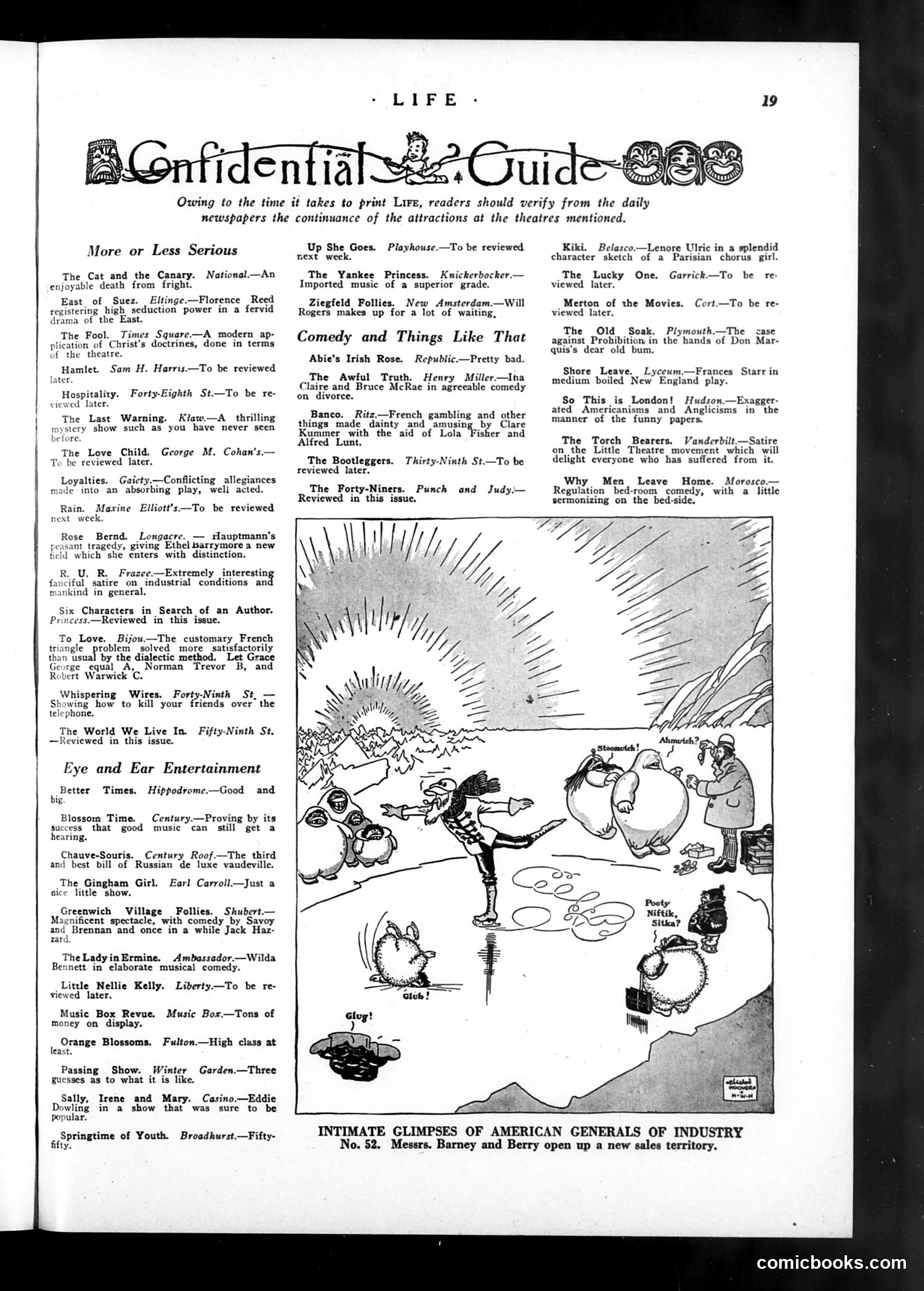
This is a **theater review page** from Life magazine, listing Broadway productions with brief critical commentary. The cartoons and illustrations are secondary to the main content. The large cartoon depicts **labor conflict or industrial chaos**: workers and machinery in apparent disarray, with explosions and confusion. This likely relates to reviews of plays about social themes—specifically "R.U.R." (a Czech play about robots and industrial conditions) and "The World We Live In," both noted as satirizing modern industry and labor. The smaller cartoon at bottom shows characters labeled "Glory!" appearing to celebrate or marvel at something, possibly referencing theatrical spectacle or "tons of money on display" (as noted in the Music Box Revue review). The page reflects post-WWI American theater's engagement with contemporary issues: Prohibition ("The Old Soak"), divorce ("The Awful Truth"), and industrial modernization. The reviews are witty and dismissive toward some productions (Abie's Irish Rose: "Pretty bad"), revealing the era's theatrical tastes and social preoccupations.
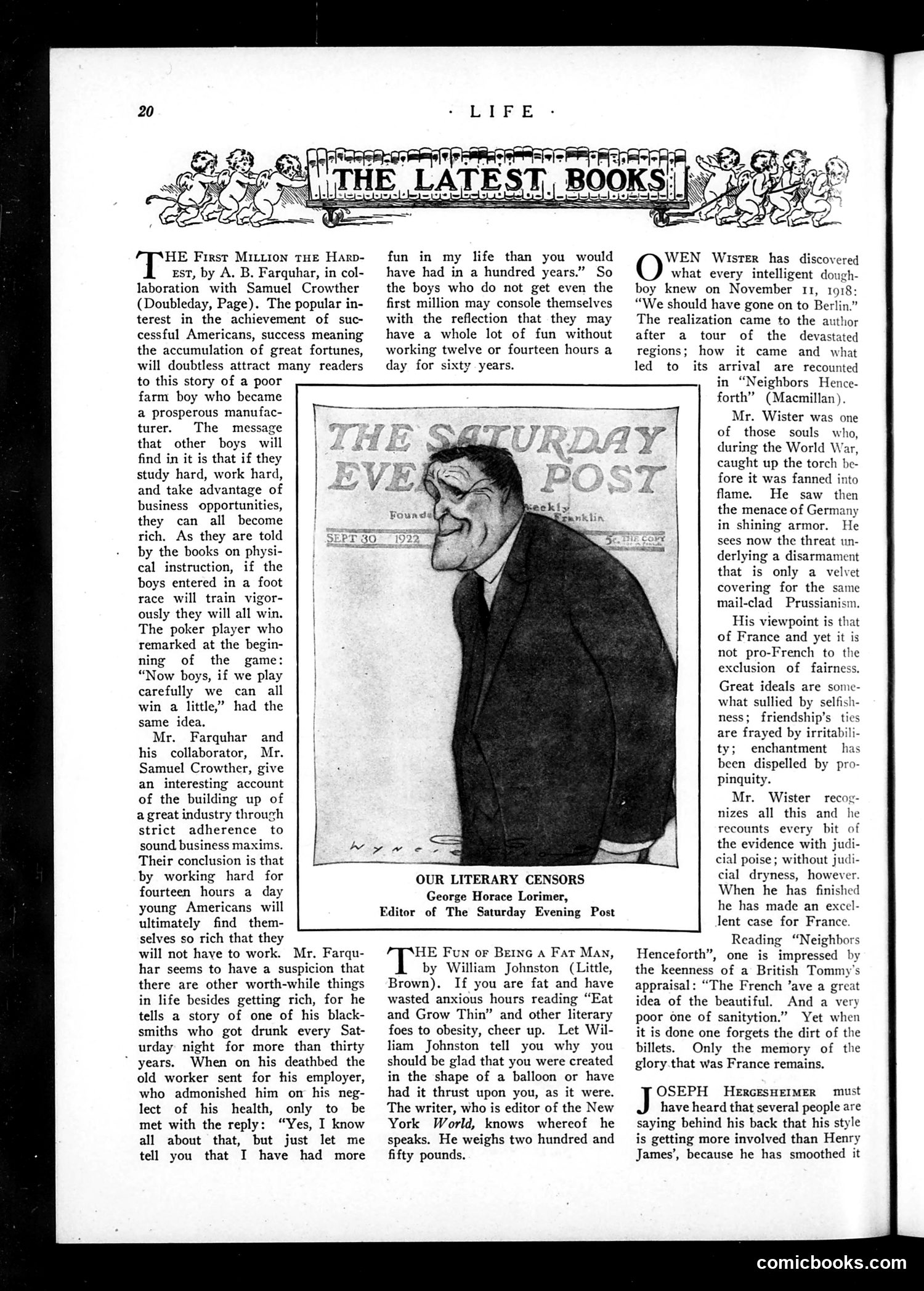
This page from Life magazine's "The Latest Books" section reviews recent publications, featuring a caricature of **George Horace Lorimer**, editor of The Saturday Evening Post, labeled "Our Literary Censors." The reviews mock self-help literature and its authors' contradictions. A.B. Farquhar's *The First Million the Hardest* is satirized for preaching that boys can all become rich through hard work—compared absurdly to a poker game where everyone claims they can "all win a little." The review notes the author himself acknowledges life has worth beyond wealth (citing a blacksmith's deathbed happiness despite poverty). William Johnston's *The Fun of Being a Fat Man* is ribbed for its author weighing 250 pounds while promoting obesity acceptance. Owen Wister's *Neighbors Henceforth* is reviewed more seriously, praising his post-WWI argument that Germany remains a threat despite disarmament—a pro-France position presented as balanced rather than partisan. The satire targets publishing's tendency to promote contradictory self-improvement narratives while authors embody opposite examples.
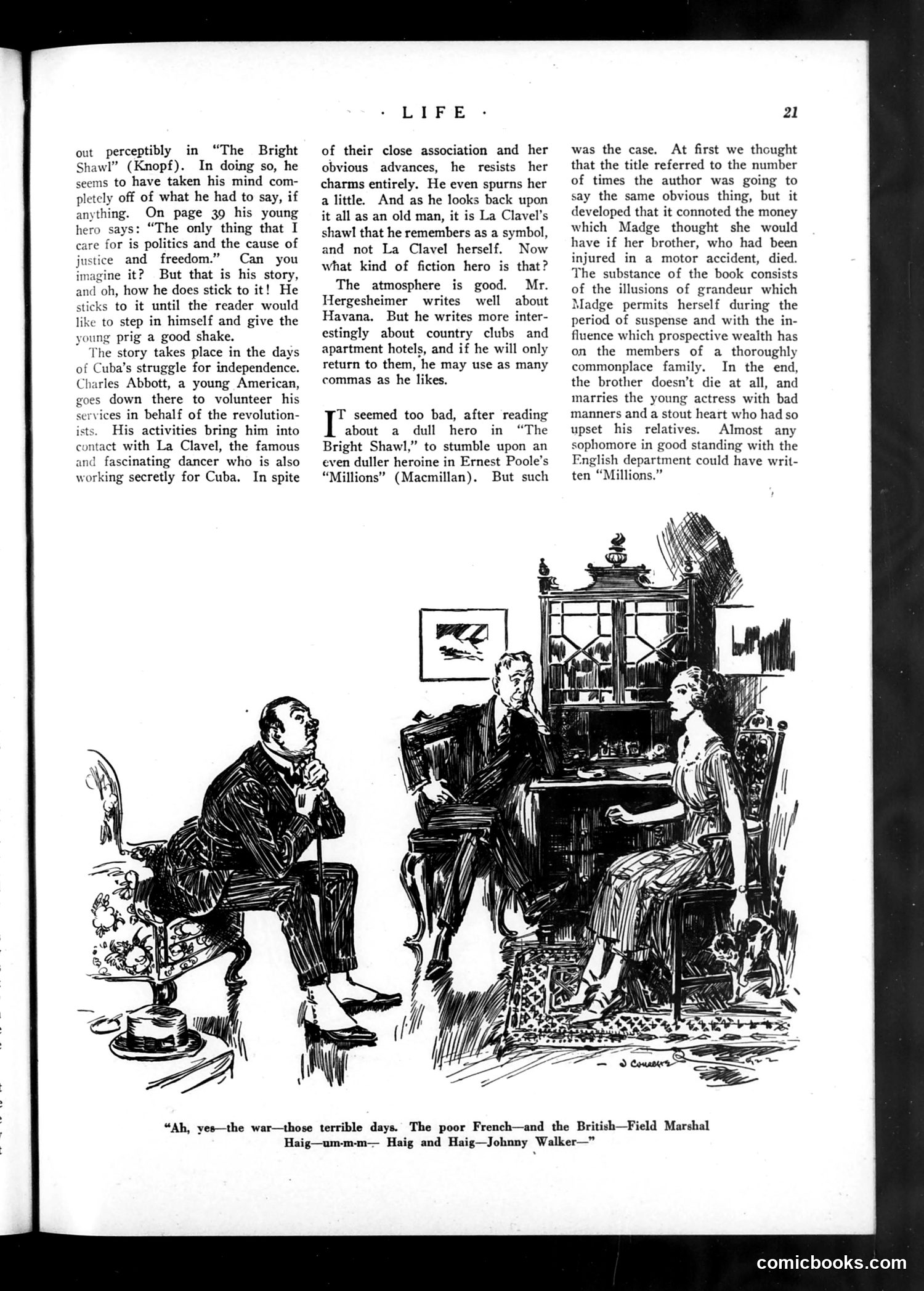
The page contains two literary reviews and a cartoon. The reviews critique two novels: Knopf's "The Bright Shawl" (set during Cuba's independence struggle) and Poole's "Millions," both judged as featuring dull protagonists and obvious plotting. The cartoon below satirizes post-war conversation. An older man reminisces about "terrible days" of World War I, naming British Field Marshal Haig—but then conflates his name with "Haig and Haig," a whiskey brand with that name. The joke suggests that wealthy people's war memories blend patriotic references with consumer products, or that alcohol has replaced genuine historical recollection. It mocks superficial nostalgia and the commercialization of serious historical events among the upper classes.
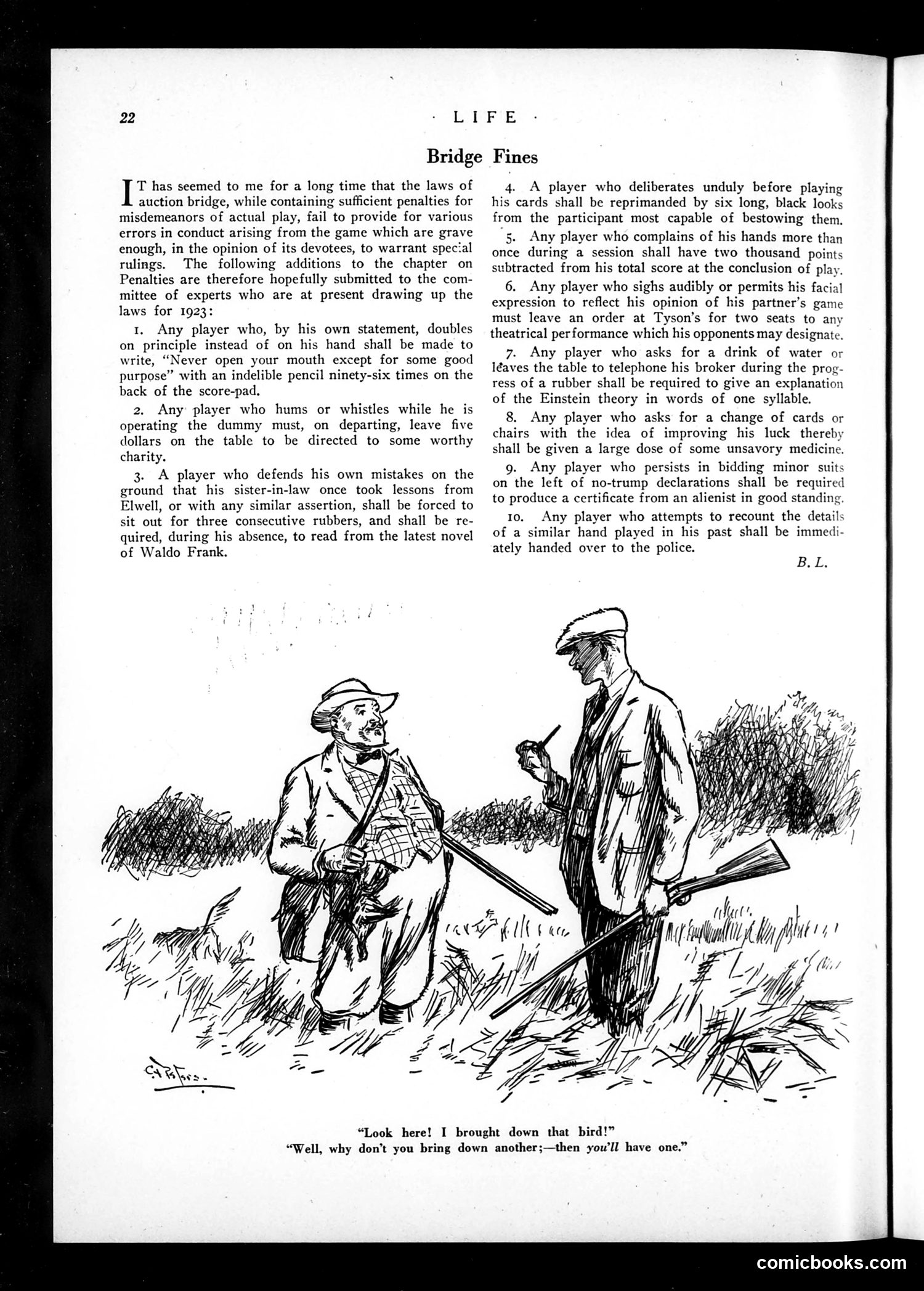
This page satirizes the obsessive rule-making and petty grievances of auction bridge players (a popular card game in the 1920s). The text humorously proposes absurd "fines" for common bridge annoyances: complaining about hands, humming while playing, defending mistakes by citing famous players like Elwell, asking for water during games, or recounting past hands. The cartoon below depicts two hunters, with one proudly showing a dead bird while the other deadpans: "Why don't you bring down another—then you'll have one?" This joke appears unrelated to bridge, likely illustrating the magazine's broader satirical commentary on self-deception and foolish logic—themes that echo the bridge fines above. The satire mocks bridge enthusiasts as pedantic, superstitious, and prone to elaborate justifications for their failures, while the hunting cartoon reinforces the absurdity of circular logic common to such social groups.
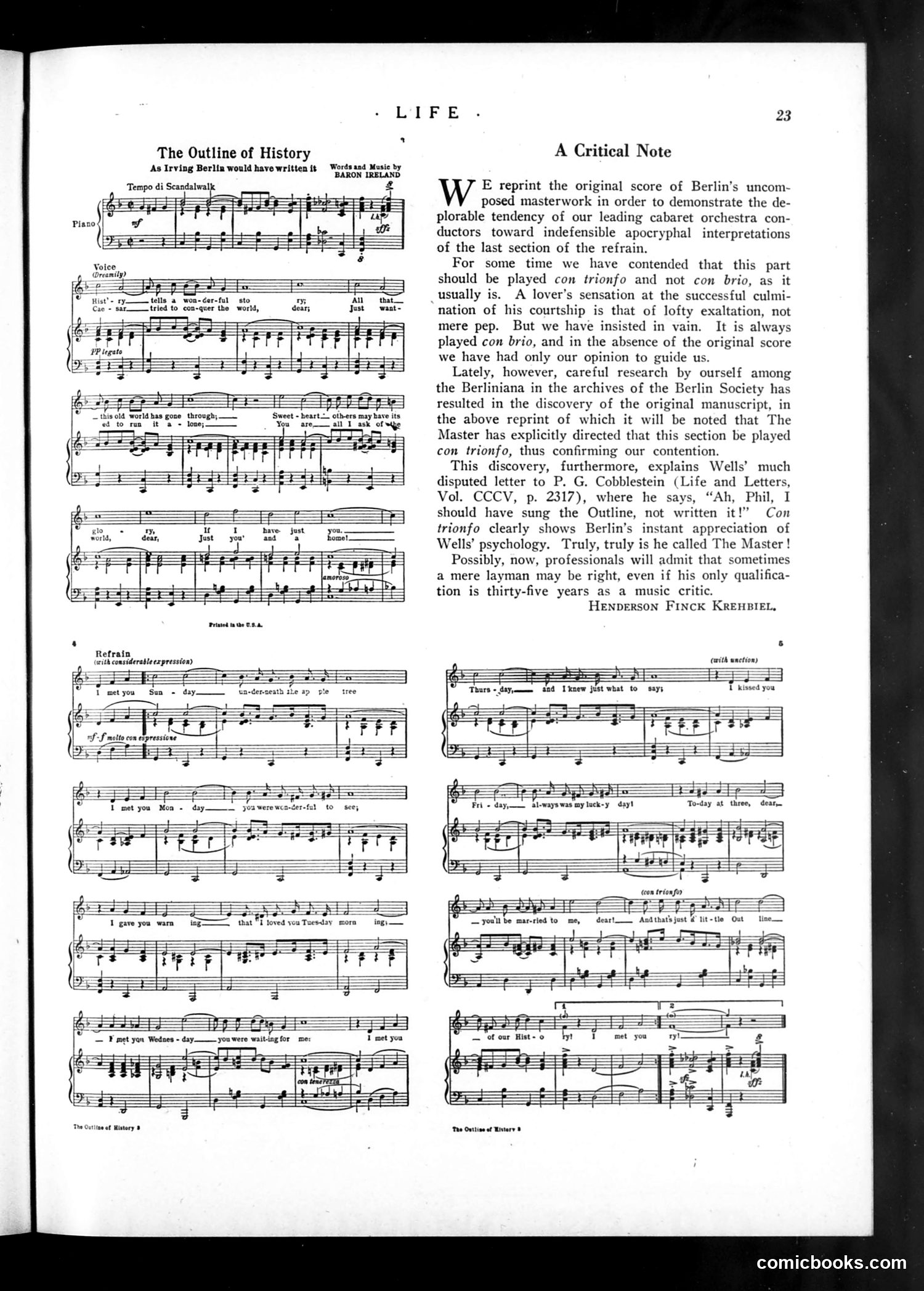
This page satirizes musical criticism and scholarly pretension. It's a mock-serious article by "Henderson Finck Krehibiel" (a fabricated critic name) debating whether Irving Berlin's "Outline of History" should be performed *con trionfo* (triumphantly) versus *con brio* (briskly). The joke: The author claims to have "discovered" Berlin's original manuscript in the "Berlin Society" archives, which vindicated his thirty-five-year crusade to correct how orchestras play the piece. He invokes a fake H.G. Wells letter (with absurd citation "Vol. CCCV, p. 2317") claiming Wells regretted writing *The Outline of History* instead of singing Berlin's song. **The satire targets:** - Pretentious music criticism obsessing over trivial interpretive details - Academic pomposity and fake scholarship (fabricated archives, invented letters) - The absurdity of a layman music critic demanding deference from professionals - Over-intellectualization of popular entertainment The accompanying sheet music excerpts show the actual Berlin composition. The humor relies on readers recognizing this as pure invented authority and ridiculous self-importance.
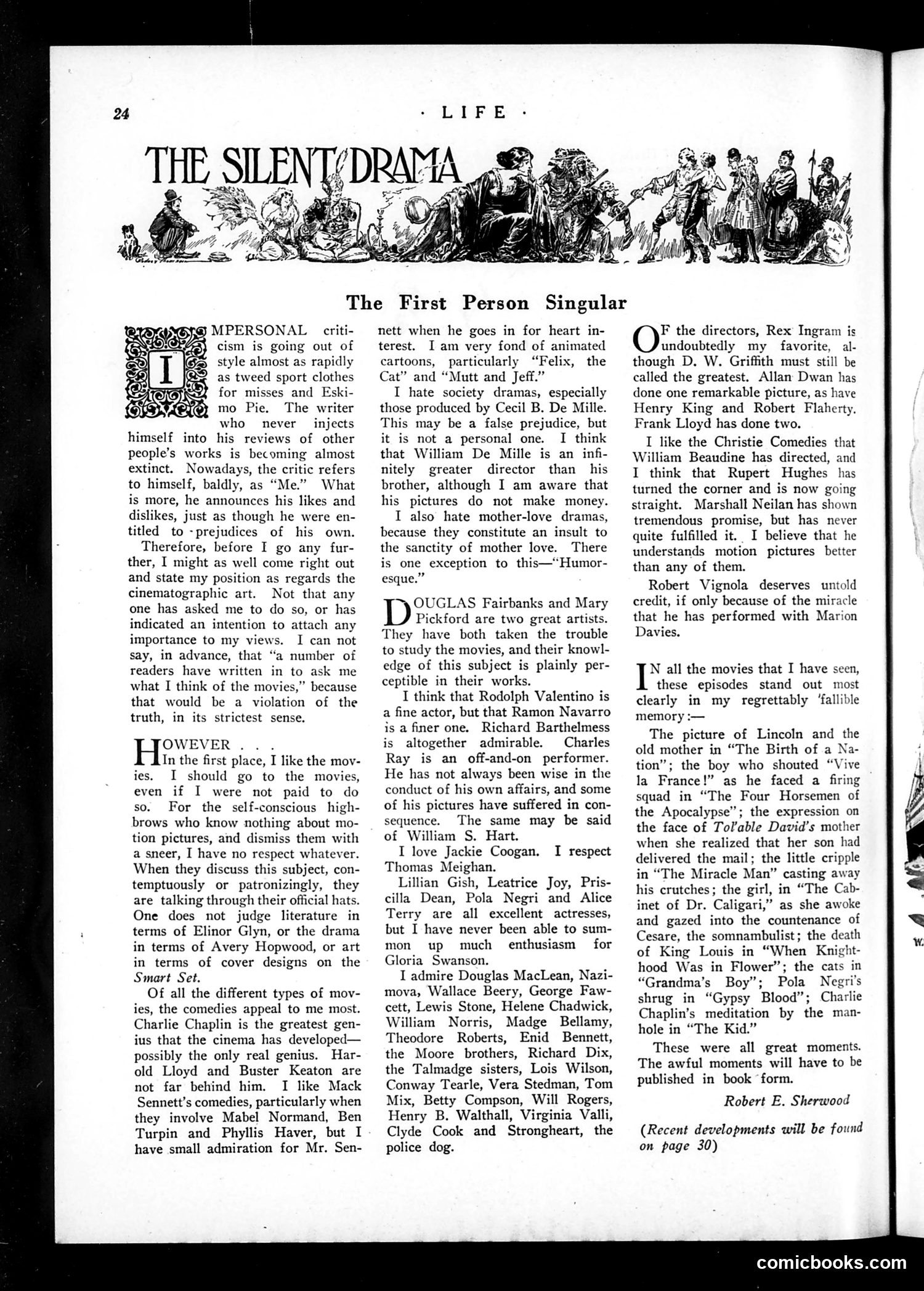
This is a film criticism essay by Robert E. Sherwood (bylined at bottom) reviewing silent cinema. The header illustration shows various silent film characters and scenes. The piece is a tongue-in-cheek *defense* of first-person critical opinion—mocking the trend of critics inserting personal preference into reviews while simultaneously doing exactly that. Sherwood rates contemporary silent film stars and directors: he loves Charlie Chaplin, Harold Lloyd, and Buster Keaton's comedies; admires Douglas Fairbanks and Mary Pickford; prefers William De Mille over his brother Cecil B.; dislikes Cecil B. De Mille's society dramas and "mother-love" melodramas; and ranks various actors from Rudolph Valentino to Will Rogers. The satire lies in Sherwood's self-aware contradiction: he criticizes critics for announcing personal tastes, then proceeds to list his own detailed preferences—presented as objective assessments—about now-obscure 1920s cinema figures, many of whom have faded into complete obscurity.
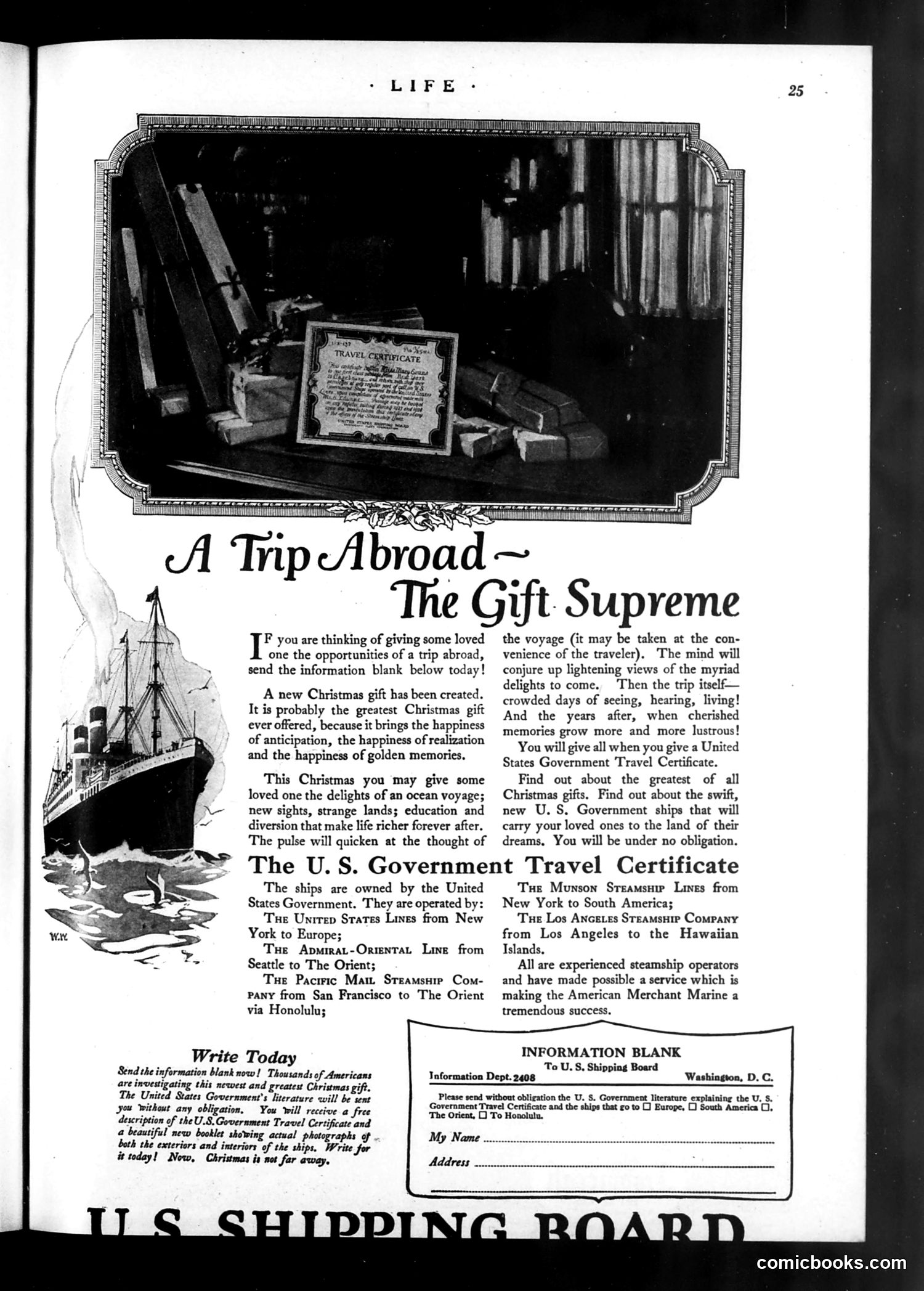
This is **not a cartoon or satire**, but rather a straightforward **advertisement** for government-subsidized ocean travel. The U.S. Shipping Board promotes "Travel Certificates" as Christmas gifts, emphasizing voyages on American merchant vessels to Europe, Asia, Hawaii, and South America. The ad's appeal centers on emotional benefits: anticipation, experience, and lasting memories—positioning international travel as the ultimate luxury gift. It prominently names five shipping lines the government operates or oversees, including the United States Lines and Munson Steamship Lines. The inset photograph shows travel documentation and luggage, reinforcing the gift's tangibility. The bottom includes a tear-out information blank. This reflects **post-WWI U.S. policy promoting American merchant marine strength** through passenger travel promotion. The casual mention of "no obligation" suggests modest consumer skepticism about government initiatives required addressing.
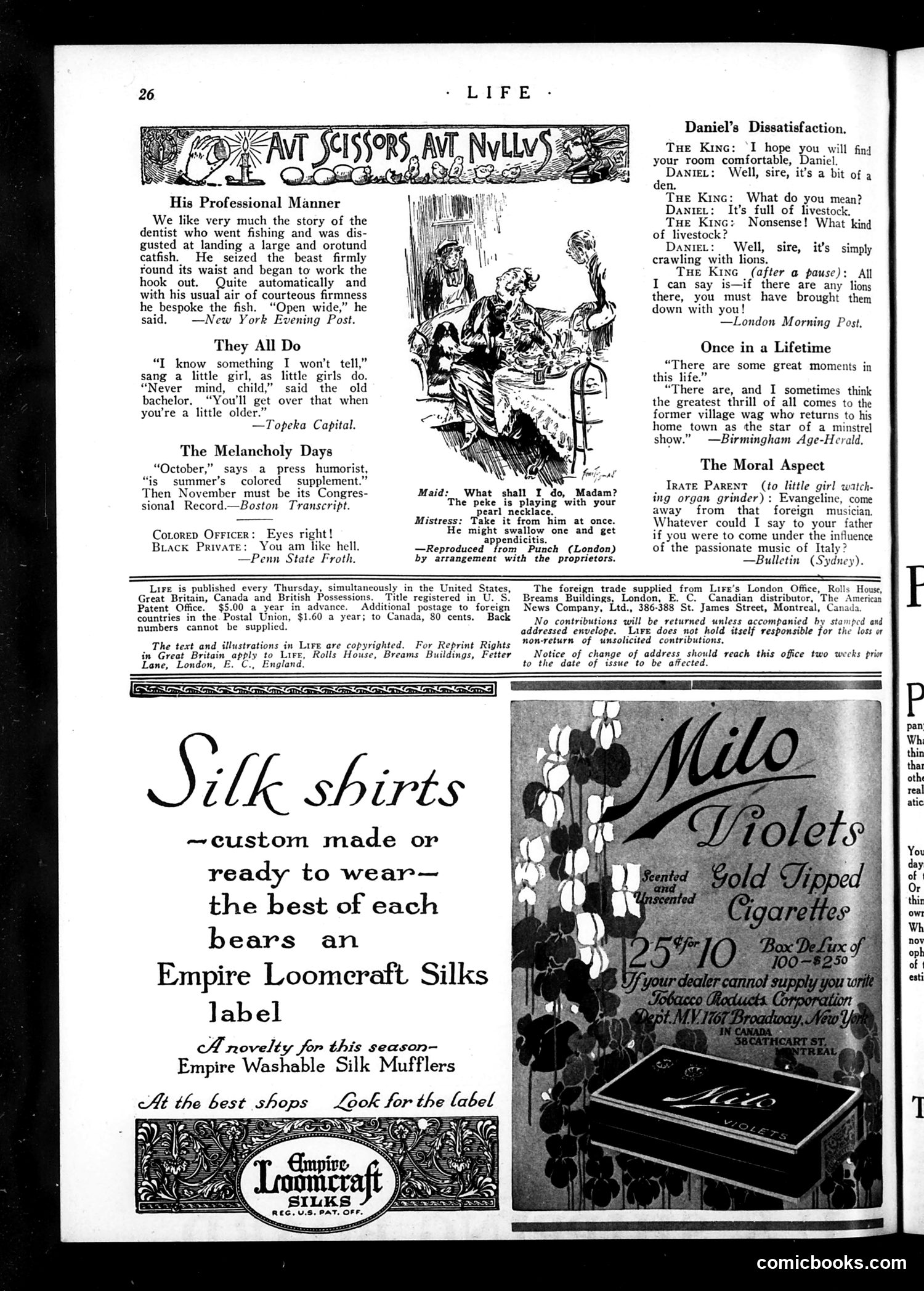
This page contains **short humorous anecdotes** rather than political cartoons, plus advertisements. The jokes satirize everyday human behavior: - **"His Professional Manner"**: A dentist automatically tells a fish to "open wide"—mocking professional habit and automaticity. - **"They All Do"**: An old bachelor's patronizing comment that a girl will "get over" keeping secrets when older—satirizing dismissive attitudes toward children and gender stereotypes. - **"The Melancholy Days"**: A pun comparing October to summer's "colored supplement" and November to the Congressional Record—suggesting Congress is as tedious and irrelevant as old news. - **"Daniel's Dissatisfaction"**: A servant complains his room has lions; the King retorts Daniel must have brought them himself—mocking servants' complaints and royal smugness. The page reflects early 20th-century Life magazine's focus: **light social satire** targeting pretension, workplace absurdity, and class dynamics, with ads for silk products interspersed.
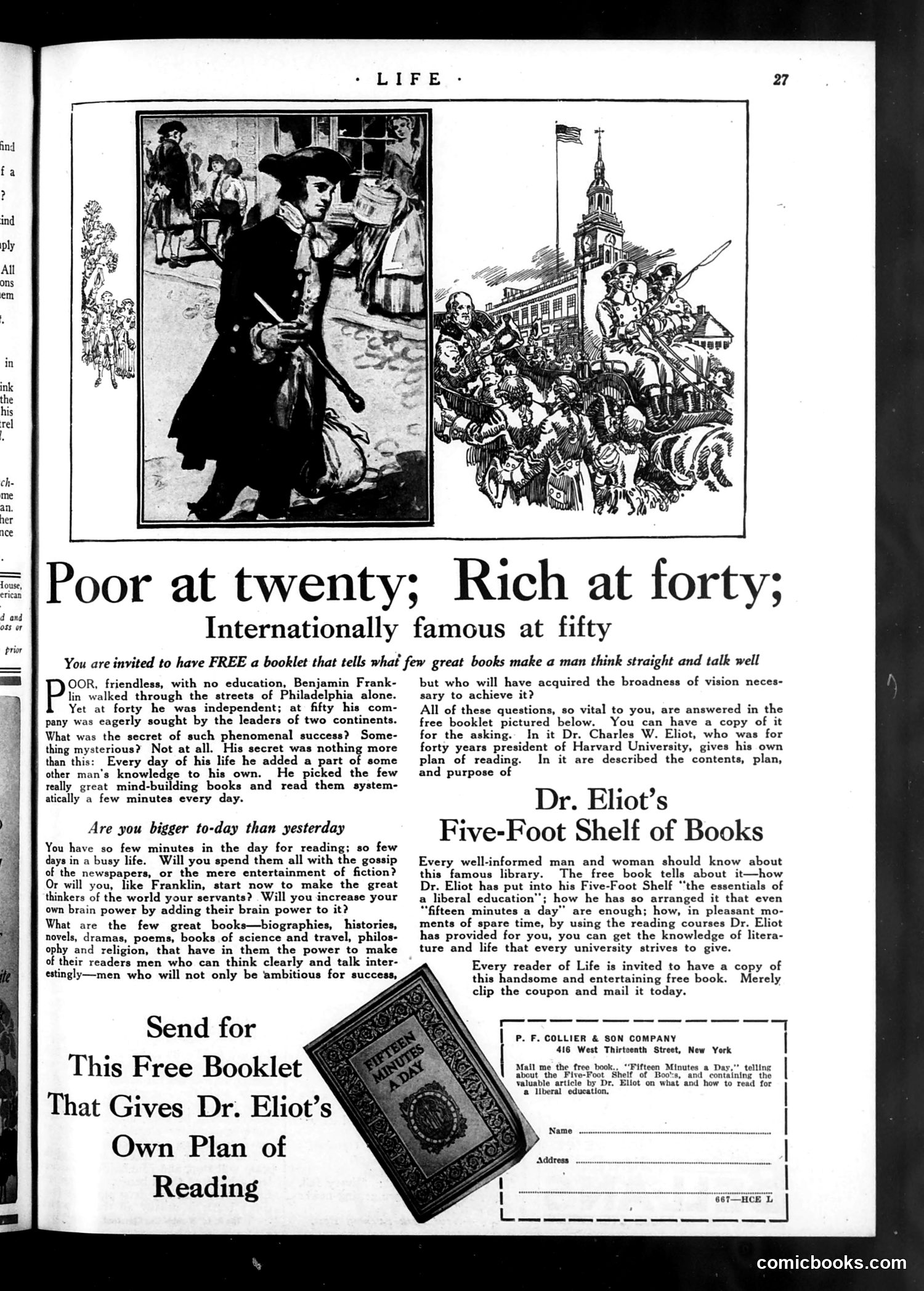
This page is primarily **advertising disguised as editorial content**—a promotional piece for Dr. Charles W. Eliot's "Five-Foot Shelf of Books," a famous curated library collection. The opening narrative references **Benjamin Franklin**, using him as an aspirational figure: a self-made man who achieved success through systematic self-education via great books. The implicit message: you too can rise from poverty to prominence through disciplined reading. The satirical angle—typical of Life's style—gently mocks American self-improvement culture and social climbing. The headline's progression ("Poor at twenty; Rich at forty; Internationally famous at fifty") is tongue-in-cheek about upward mobility mythology, though presented as inspirational. The illustrations show contrasting scenes: a solitary Franklin-like figure in period dress, and a crowded celebration with civic monuments, visualizing the promised trajectory from obscurity to prominence. **This is fundamentally a mail-order advertisement**, leveraging aspirational messaging and celebrity endorsement (Harvard president Eliot) to sell a standardized reading course to middle-class Americans seeking self-improvement.
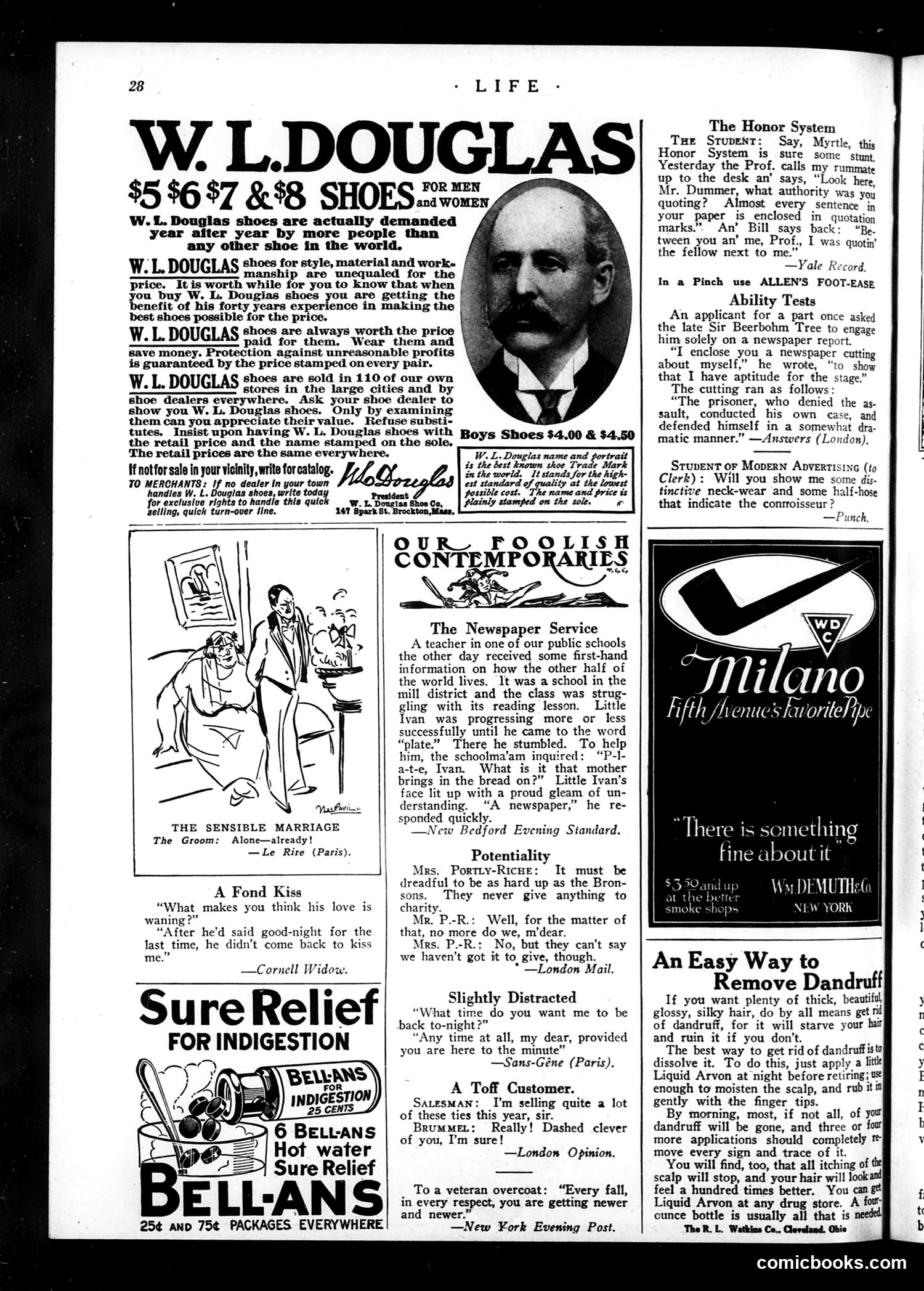
This page is primarily **advertising and humor content**, not political satire. The main elements: **W.L. Douglas Shoe Advertisement** (dominant): A major brand pitch emphasizing affordable quality shoes ($5-8), sold nationwide with price stamped on soles—a consumer protection against markup. **"The Honor System" (Yale Record)**: A college humor piece mocking academic integrity. A student caught plagiarizing admits to copying from the person sitting next to him, treating the "honor system" as a joke. **"The Sensible Marriage" (cartoon)**: A groom already alone on his wedding night—satirizing marriage as disappointing or lonely from the start. **"Our Foolish Contemporaries"** section: Brief satirical anecdotes including one where a poor mill-district child, asked to identify a "plate," answers "newspaper"—darkly implying families use newspapers as plates due to poverty. The cartoons target **social pretension and hypocrisy** among the wealthy and educated classes, while advertising reflects early 20th-century consumer culture and price transparency concerns.
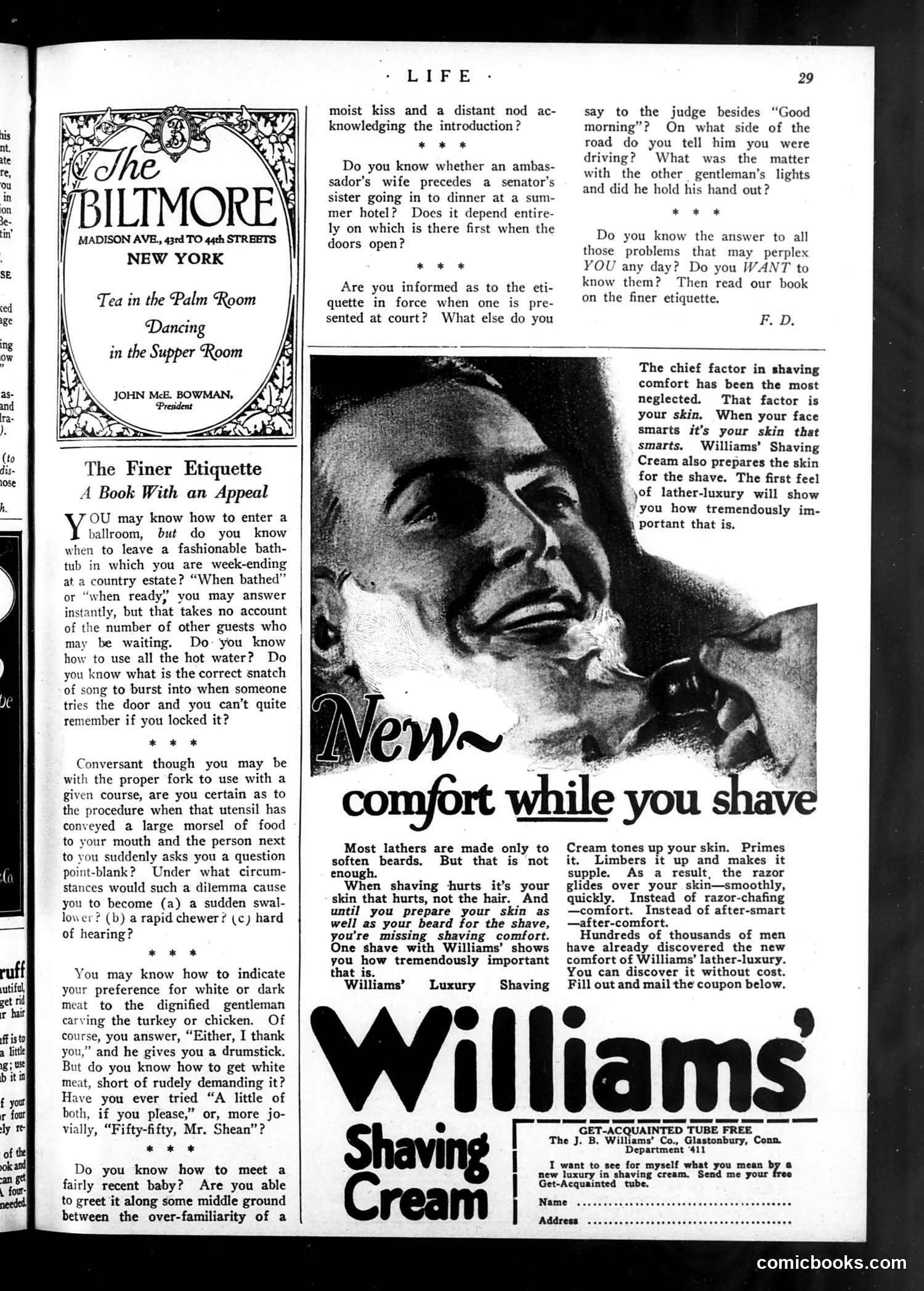
This page is primarily **advertising and etiquette advice**, not political satire. The left column features "The Finer Etiquette: A Book With an Appeal"—humorous social guidance mocking upper-class anxieties. The questions satirize excessive concern with trivial rules: when to leave a bathtub during house parties, proper fork usage, how to request white meat from poultry without seeming demanding, and how to greet babies appropriately. The satire targets the pretentiousness of rigid social codes among wealthy Americans. The dominant content is a **Williams' Shaving Cream advertisement** featuring a close-up photograph of a man's face during shaving. The ad emphasizes that skin comfort matters more than beard softening—a sales pitch highlighting the cream's skin-conditioning properties. This occupies roughly half the page and includes a coupon for a free sample tube. There is no political cartoon or caricature. The page reflects 1920s consumer culture and class anxiety about "proper" etiquette.
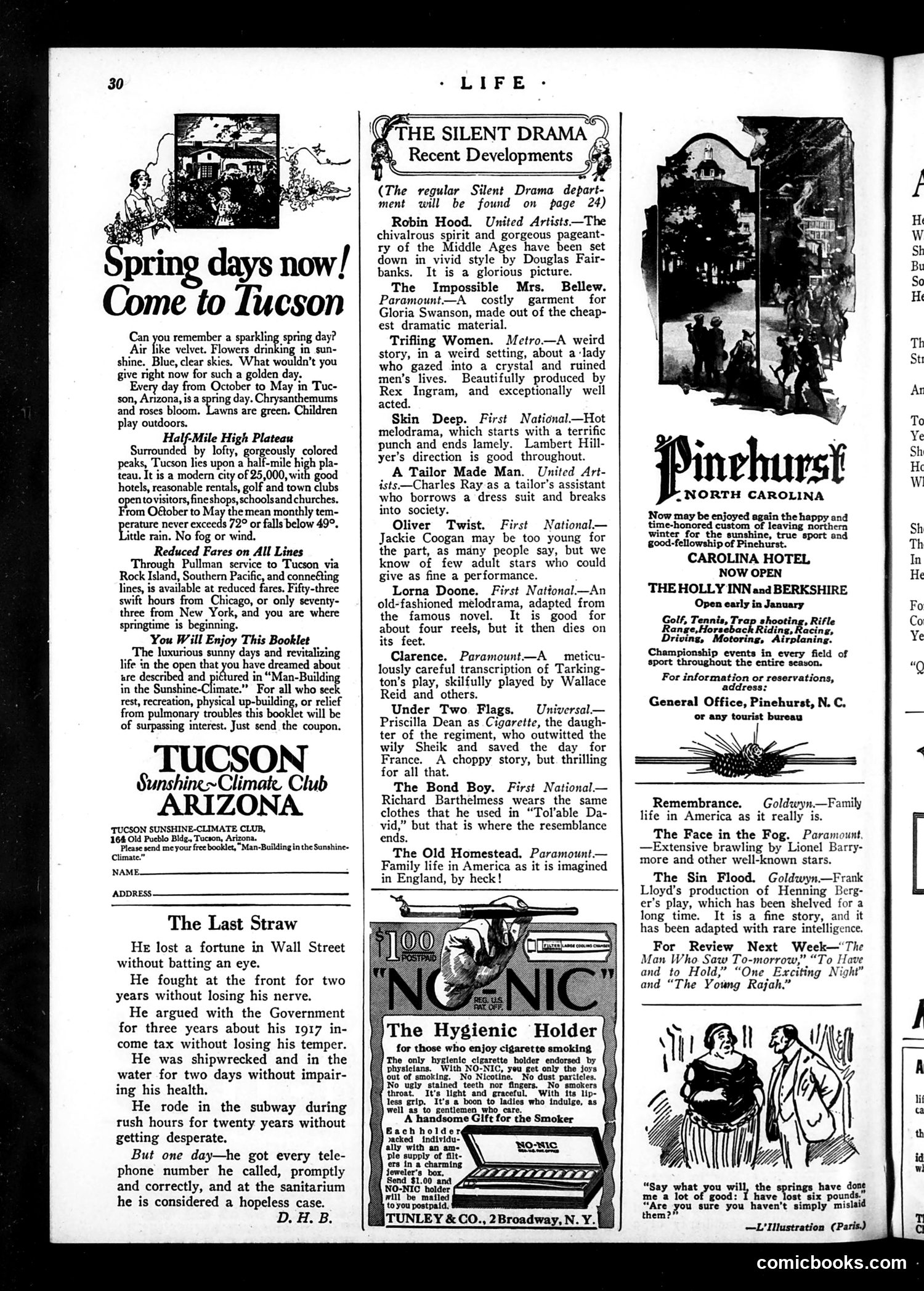
This page contains **movie reviews** for silent films (the "Silent Drama" section), not political cartoons. The content is straightforward entertainment criticism from Life magazine's film department. The reviews cover popular 1920s silent films: Douglas Fairbanks in *Robin Hood*, Gloria Swanson in *The Impossible Mrs. Bellew*, and Jackie Coogan in *Oliver Twist*. These were major stars of the era. The critics offer brief assessments—praising some films as "glorious" while dismissing others as poorly constructed melodramas. The page also includes **tourism advertising** for Tucson, Arizona and Pinehurst, North Carolina resorts, and a short satirical story titled "The Last Straw" about a man who endured financial ruin and war but broke under government bureaucracy—a light social commentary on modern frustrations. **No political cartoons appear on this page.** It's primarily entertainment and travel content typical of Life magazine's mixed editorial format.
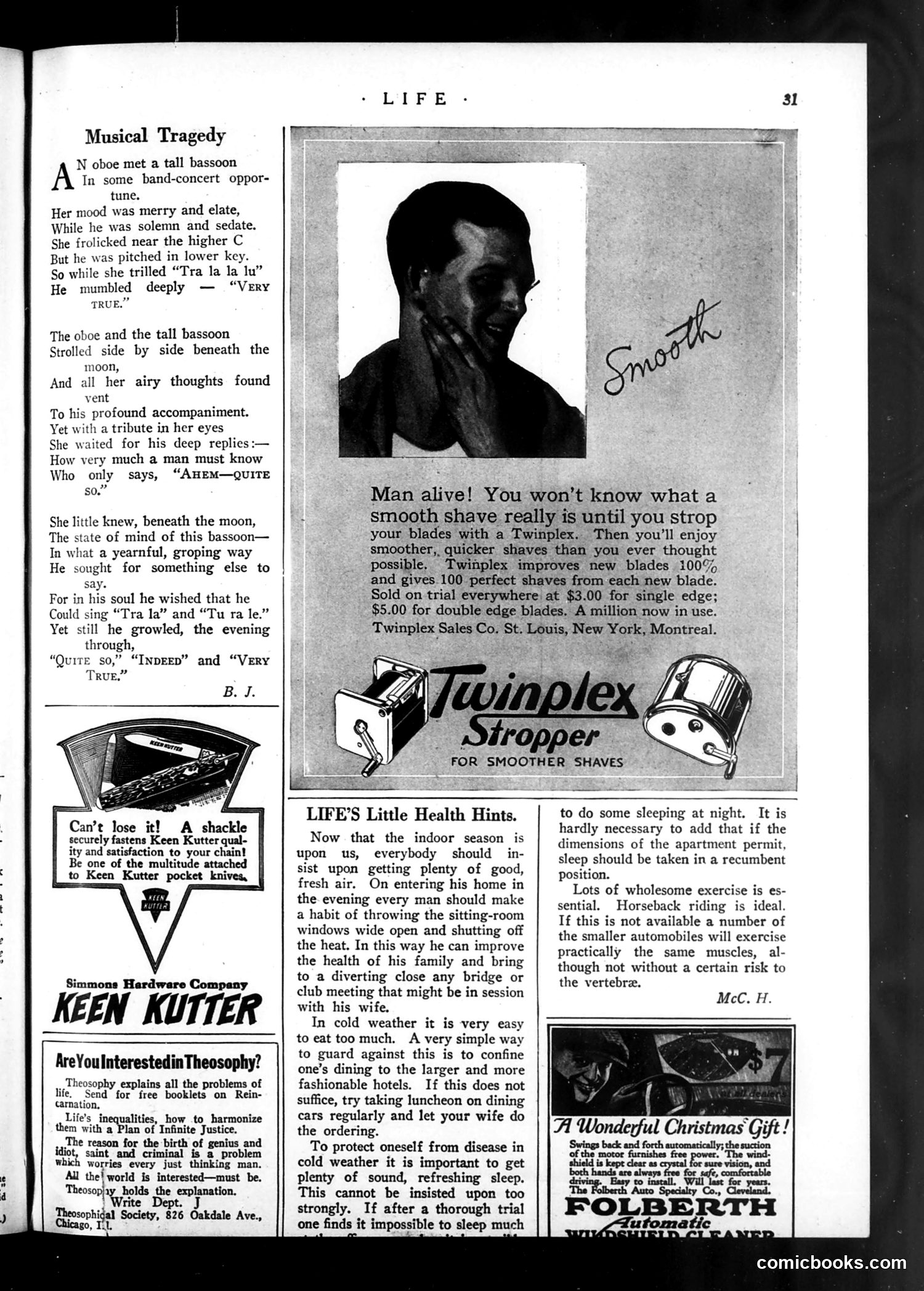
This page mixes a humorous poem with vintage ads, typical of *Life* magazine's satirical format. **"Musical Tragedy"** is a whimsical poem about courtship using musical metaphors. An oboe (cheerful, high-pitched) meets a bassoon (serious, low-pitched). She's lively and romantic; he's stolid and monosyllabic, only uttering "Very true," "Ahem—quite so," and "Indeed." The joke satirizes a common marital dynamic: women seeking intellectual or emotional engagement from taciturn men who offer only bland agreement. It's gentle social satire about gender expectations and communication gaps. **The ads** (Keen Kutter knives, Twinplex razors, Theosophy booklets) are era-appropriate. Most notably, "LIFE's Little Health Hints" is satirical advice—tongue-in-cheek suggestions like opening windows to end your wife's bridge games, and riding in "smaller automobiles" for exercise "without a certain risk to the vertebra" (obviously risky). This mocks wellness fads and marital dynamics of the period.
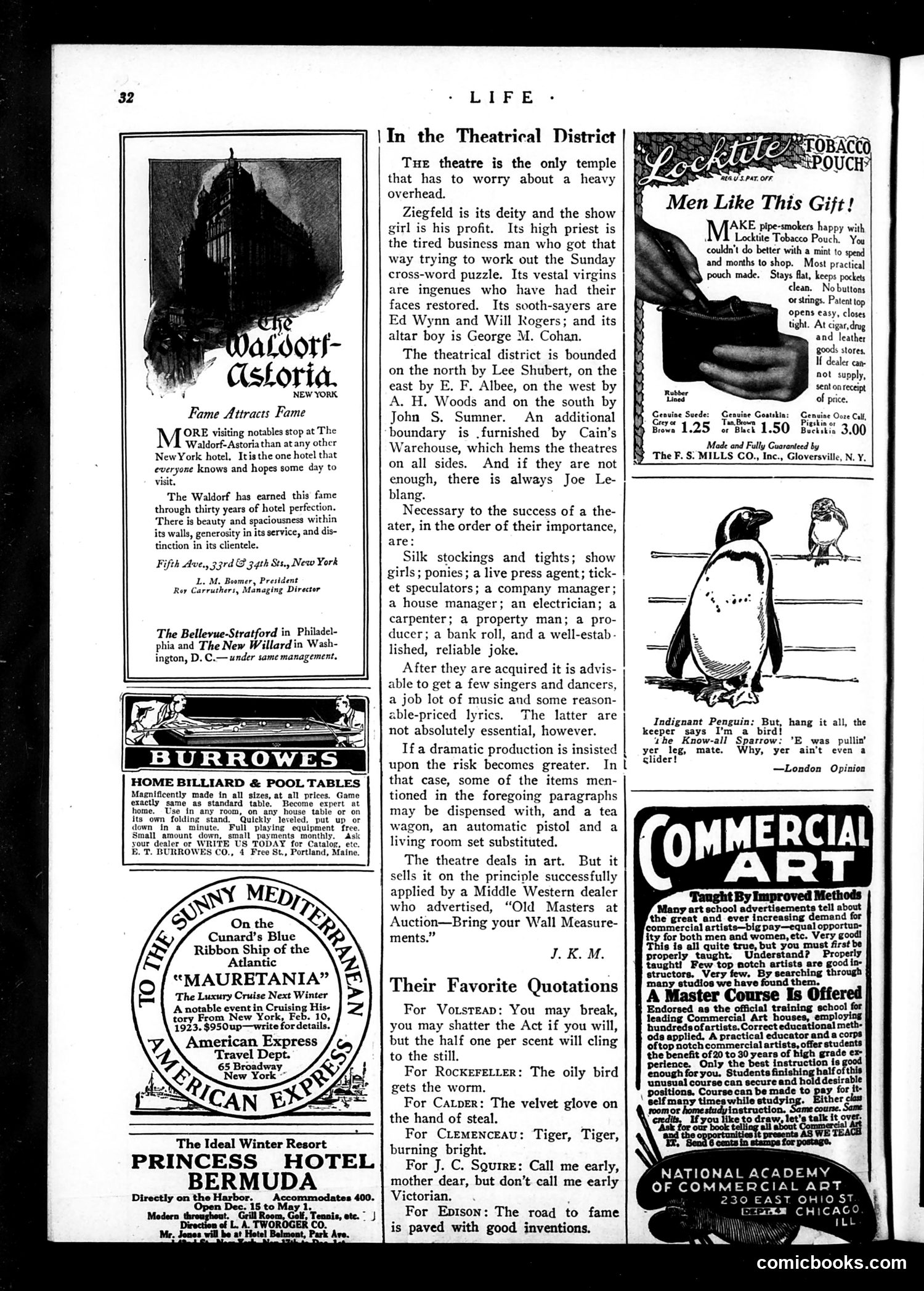
This page is primarily **advertising and satirical commentary** rather than political cartoons. The main content is a humorous essay about New York's theatrical district by J.K.M., which presents theater as a "temple" with Florenz Ziegfeld as its "deity," show girls as its profit, and weary businessmen as worshippers. The satire mocks theatrical priorities, listing essentials in this order: silk stockings, show girls, ponies, press agents—with "singers and dancers" coming only later, and actual dramatic productions being optional and risky. The piece cynically suggests substituting a tea wagon and pistol for legitimate drama. A secondary feature, "Their Favorite Quotations," humorously attributes famous literary quotes to contemporary figures (Volstead, Rockefeller, Clemenceau, Edison) with punning rewrites—suggesting these public figures are more defined by money, power, and personality than ideals. The remainder is hotel and luxury travel advertising typical of 1920s Life magazine.
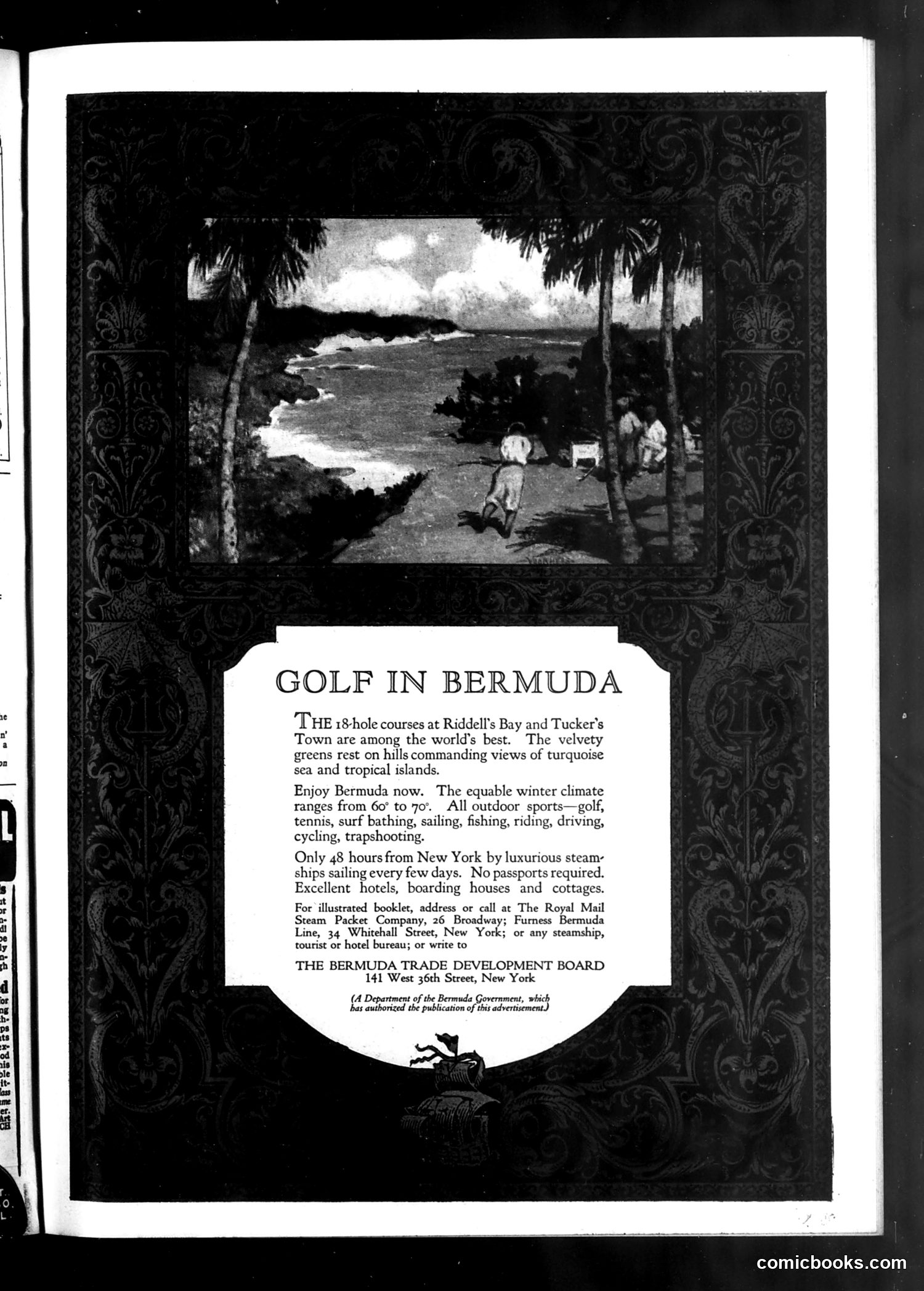
This page is **not a political cartoon or satire**—it's a **tourism advertisement** for Bermuda, placed in Life magazine. The image shows a scenic coastal landscape with palm trees and figures enjoying the beach, framed in an ornate decorative border typical of 1920s-30s magazine design. The text promotes Bermuda as a leisure destination, emphasizing its golf courses (Riddell's Bay and Tucker's Town), mild winter climate (60-70°F), proximity to New York (48 hours by steamship), and lack of passport requirements. It lists available activities (golf, tennis, sailing, fishing) and accommodations. The advertisement is authorized by the Bermuda Trade Development Board and distributed through shipping companies and travel agencies. This represents early 20th-century tourism marketing targeting wealthy American travelers seeking winter escape and outdoor recreation.
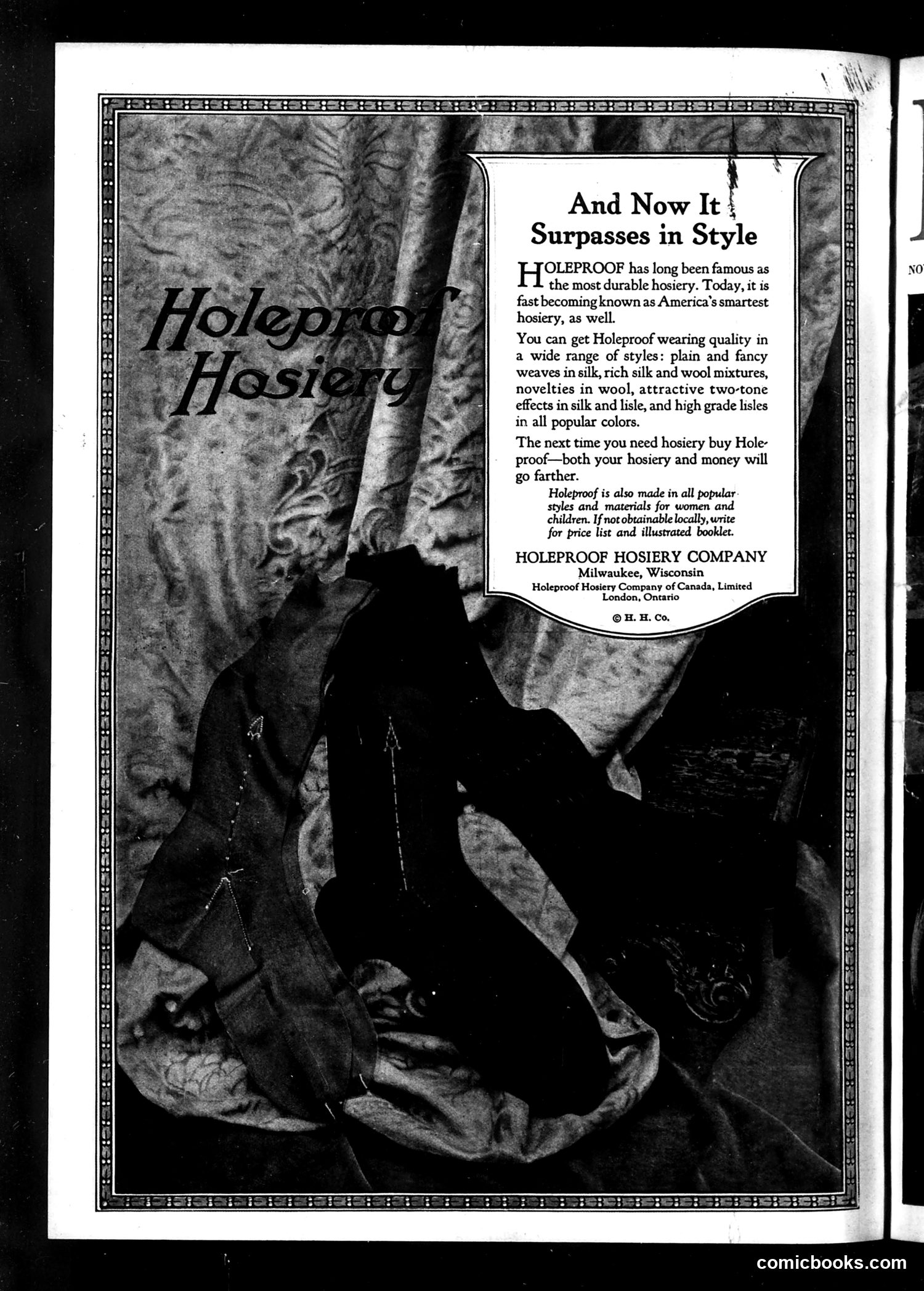
This is not political satire or commentary—it's a straightforward **product advertisement** for Holeproof brand hosiery (socks/stockings). The page features: - **Large photograph**: A silhouetted figure displaying hosiery, emphasizing the product's appearance and quality - **Sales pitch**: The ad positions Holeproof as both durable *and* stylish, addressing both practical value and fashion appeal - **Product range**: Lists various weave types and materials (silk, wool, lisle) in multiple colors - **Marketing angle**: "Your hosiery and money will go farther"—emphasizing durability and cost-effectiveness - **Distribution**: Notes availability in US and Canada, with instructions for those unable to find it locally This represents typical early 20th-century advertising strategy: combining product demonstration with lifestyle aspirations. There is no political commentary or satire intended on this page.