
Life, 1922-11-23 · page 24 of 36
Life — November 23, 1922 — page 24: what you’re looking at
What you’re looking at
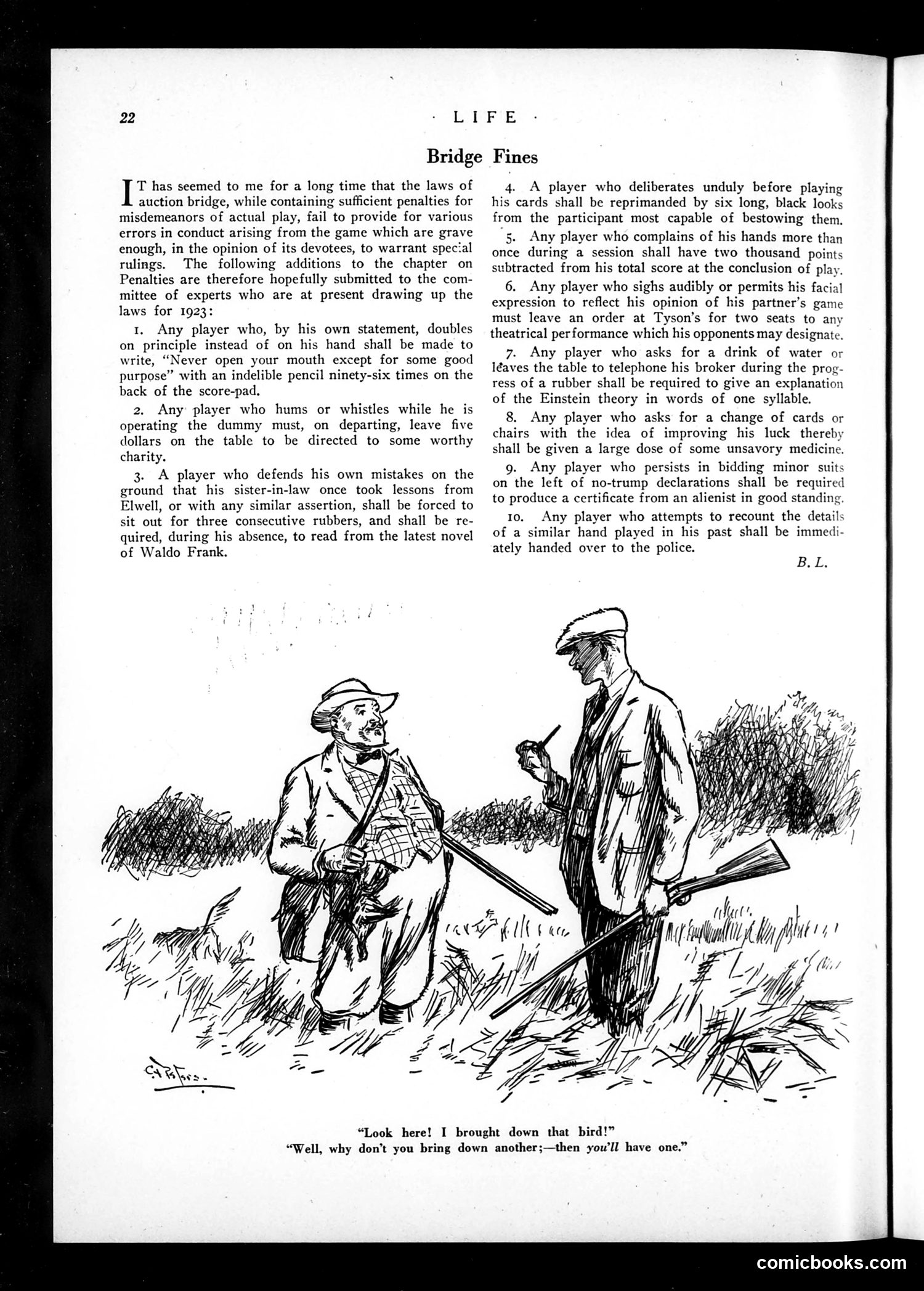
This page satirizes the obsessive rule-making and petty grievances of auction bridge players (a popular card game in the 1920s). The text humorously proposes absurd "fines" for common bridge annoyances: complaining about hands, humming while playing, defending mistakes by citing famous players like Elwell, asking for water during games, or recounting past hands. The cartoon below depicts two hunters, with one proudly showing a dead bird while the other deadpans: "Why don't you bring down another—then you'll have one?" This joke appears unrelated to bridge, likely illustrating the magazine's broader satirical commentary on self-deception and foolish logic—themes that echo the bridge fines above. The satire mocks bridge enthusiasts as pedantic, superstitious, and prone to elaborate justifications for their failures, while the hunting cartoon reinforces the absurdity of circular logic common to such social groups.
📄 Transcribed text from this page (OCR, searchable)
Machine-transcribed from the original scan — historical spelling and the odd misread are preserved.
LIF'E Bridge Fines T has seemed to me for a long time that the laws of auction bridge, while containing sufficient penalties for misdemeanors of actual play, fail to provide for various errors in conduct arising from the game which are grave enough, in the opinion of its devotees, to warrant special rulings. The following additions to the chapter on Penalties are therefore hopefully submitted to the com- mittee of experts who are at present drawing up the laws for 1923: 1. Any player who, by his own statement, doubles on principle instead of on his hand shall be made to write, “Never open your mouth except for some good purpose” with an indelible pencil ninety-six times on the back of the score-pad. 2. Any player who hums or whistles while he is operating the dummy must, on departing, leave five dollars on the table to be directed to some worthy charity. 3. A player who defends his own mistakes on the ground that his sister-in-law once took lessons from Elwell, or with any similar assertion, shall be forced to sit out for three consecutive rubbers, and shall be re- quired, during his absence, to read from the latest novel of Waldo Frank. 4. A player who deliberates unduly before playing his cards shall be reprimanded by six long, black looks from the participant most capable of bestowing them. 5. Any player who complains of his hands more than once during a session shall have two thousand points subtracted from his total score at the conclusion of play. 6. Any player who sighs audibly or permits his facial expression to reflect his opinion of his partner’s game must leave an order at Tyson’s for two seats to any theatrical performance which his opponents may designate. 7. Any player who asks for a drink of water or Iéaves the table to telephone his broker during the prog- ress of a rubber shall be required to give an explanation of the Einstein theory in words of one syllable. 8. Any player who asks for a change of cards or chairs with the idea of improving his luck thereby shall be given a large dose of some unsavory medicine. g. Any player who persists in bidding minor suits on the left of no-trump declarations shall be required to produce a certificate from an alienist in good standing. to. Any player who attempts to recount the details of a similar hand played in his past shall be immedi- ately handed over to the police. Bul, by ee fect ‘ “ull Mo yp iy! Sli / iL Wh “Look here! I brought down that bird!” “Well, why don’t you bring down another;—then you'll have one.” comicbooks.com