
Life, 1922-11-23 · page 12 of 36
Life — November 23, 1922 — page 12: what you’re looking at
What you’re looking at
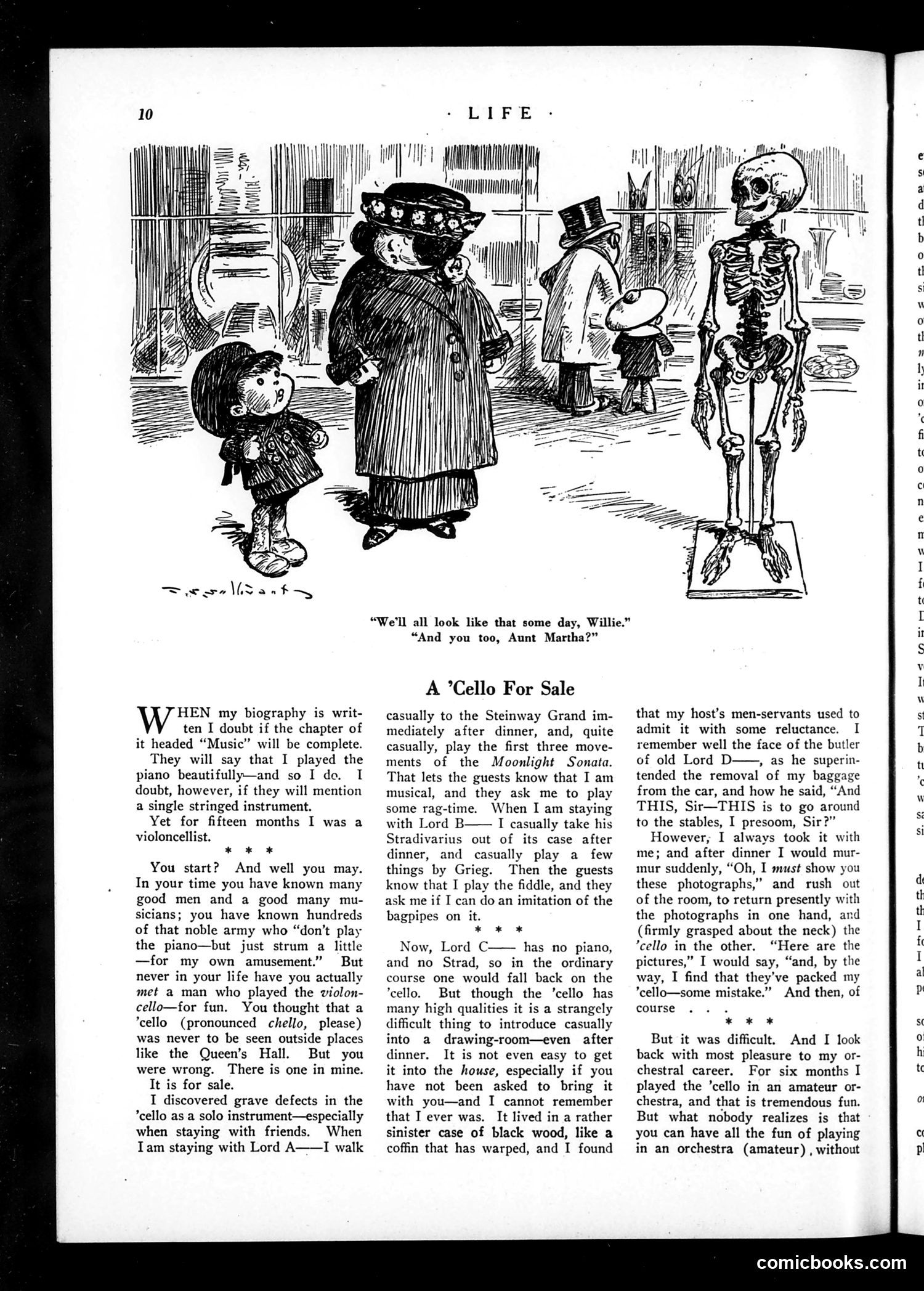
The cartoon depicts an adult showing a skeleton to a small child, with the caption: "We'll all look like that some day, Willie" / "And you too, Aunt Martha?" This is dark Victorian-era humor playing on morbid sentimentality. The joke relies on the child's innocent, literal-minded response to an adult's philosophical comment about mortality—by pointing out that "Aunt Martha" will also eventually become a skeleton, the child awkwardly highlights the uncomfortable truth the adult was making. The accompanying article discusses someone's experience as a cellist, mentioning they played a "cello for sale" and discovering defects in the instrument. The skeleton likely serves as a visual metaphor for a worn-out or damaged cello—hollow, stripped of its musical qualities, essentially "dead" as an instrument.
📄 Transcribed text from this page (OCR, searchable)
Machine-transcribed from the original scan — historical spelling and the odd misread are preserved.
Fees VMS anty HEN my biography is writ- ten I doubt if the chapter of it headed “Music” will be complete. They will say that I played the piano beautifully—and so I do. I doubt, however, if they will mention a single stringed instrument. Yet for fifteen months I was a violoncellist. * * * You start? And well you may. In your time you have known many good men and a good many mu- sicians; you have known hundreds of that noble army who “don’t play the piano—but just strum a little —for my own amusement.” But never in your life have you actually met a man who played the violon- cello—for fun. You thought that a ’cello (pronounced chello, please) was never to be seen outside places like the Queen’s Hall. But you were wrong. There is one in mine. It is for sale. I discovered grave defects in the ’cello as a solo instrument—especially when staying with friends. When Iam staying with Lord A I walk LIFE gn ~"ennit ‘ “We'll all look like that some day, Willie.” “And you too, Aunt Martha?” A ’Cello For Sale casually to the Steinway Grand im- mediately after dinner, and, quite casually, play the first three move- ments of the Moonlight Sonata. That lets the guests know that I am musical, and they ask me to play some rag-time. When I am staying with Lord B. I casually take his Stradivarius out of its case after dinner, and casually play a few things by Grieg. Then the guests know that I play the fiddle, and they ask me if I can do an imitation of the bagpipes on it. * * * Now, Lord C. has no piano, and no Strad, so in the ordinary course one would fall back on the ‘cello. But though the ’cello has many high qualities it is a strangely difficult thing to introduce casually into a drawing-room—even after dinner. It is not even easy to get it into the house, especially if you have not been asked to bring it with you—and I cannot remember that I ever was. It lived in a rather sinister case of black wood, like a coffin that has warped, and I found that my host’s men-servants used to admit it with some reluctance. I remember well the face of the butler of old Lord D. » as he superin- tended the removal of my baggage from the car, and how he said, “And THIS, Sir—THIS is to go around to the stables, I presoom, Sir?” However, I always took it with me; and after dinner I would mur- mur suddenly, “Oh, I must show you these photographs,” and rush out of the room, to return presently with the photographs in one hand, and (firmly grasped about the neck) the ‘cello in the other. “Here are the pictures,” I would say, “and, by the way, I find that they’ve packed my *cello—some mistake.” And then, of course é * * * But it was difficult. And I look back with most pleasure to my or- chestral career. For six months I played the ’cello in an amateur or- chestra, and that is tremendous fun. But what nobody realizes is that you can have all the fun of playing in an orchestra (amateur) , without comicbooks.com