
Life, 1922-11-23 · page 23 of 36
Life — November 23, 1922 — page 23: what you’re looking at
What you’re looking at
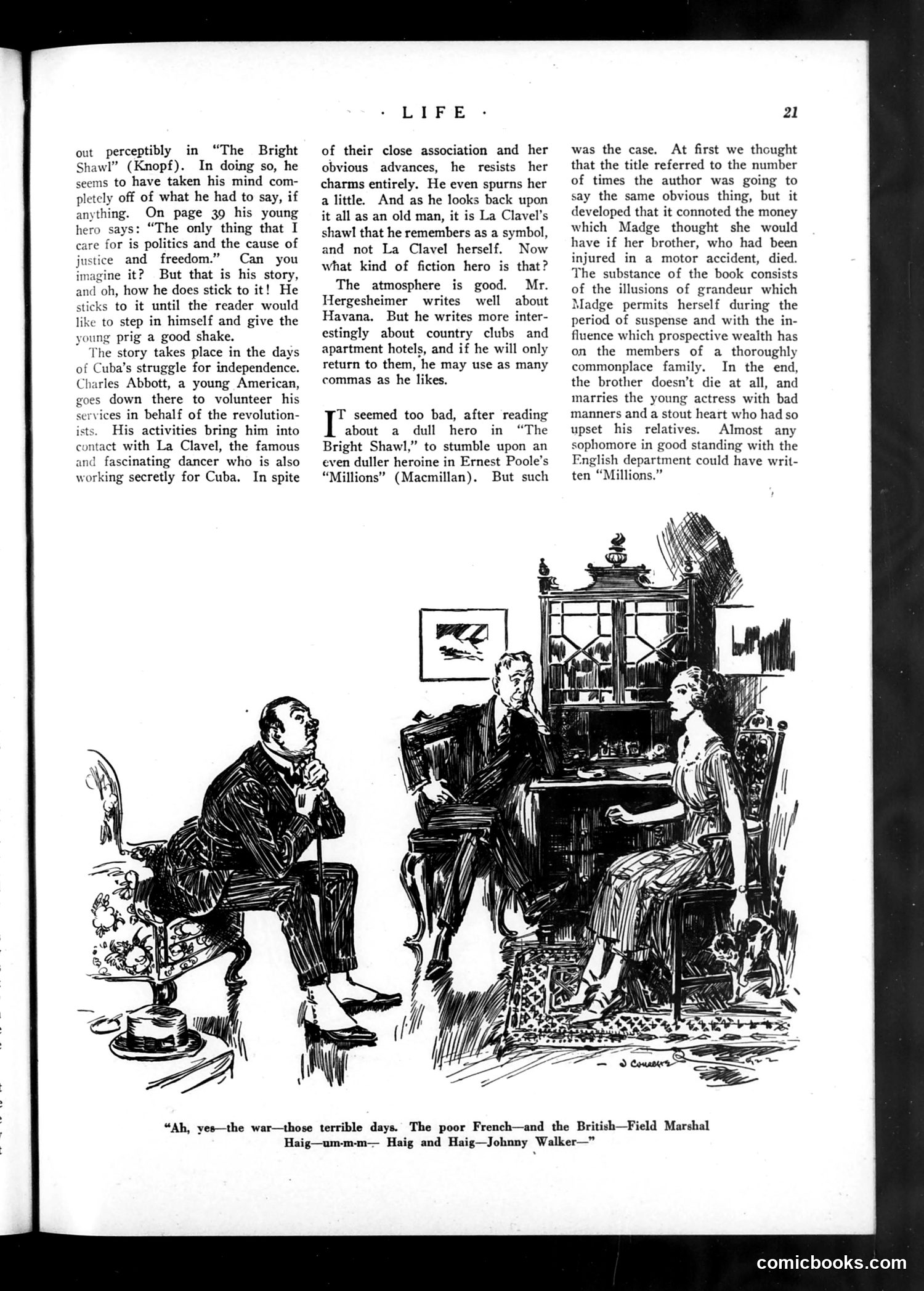
The page contains two literary reviews and a cartoon. The reviews critique two novels: Knopf's "The Bright Shawl" (set during Cuba's independence struggle) and Poole's "Millions," both judged as featuring dull protagonists and obvious plotting. The cartoon below satirizes post-war conversation. An older man reminisces about "terrible days" of World War I, naming British Field Marshal Haig—but then conflates his name with "Haig and Haig," a whiskey brand with that name. The joke suggests that wealthy people's war memories blend patriotic references with consumer products, or that alcohol has replaced genuine historical recollection. It mocks superficial nostalgia and the commercialization of serious historical events among the upper classes.
📄 Transcribed text from this page (OCR, searchable)
Machine-transcribed from the original scan — historical spelling and the odd misread are preserved.
out perceptibly in “The Bright Shawl” (Knopf). In doing so, he seems to have taken his mind com- pletely off of what he had to say, if anything. On page 39 his young hero says: “The only thing that I care for is politics and the cause of ice and freedom.” Can you imagine it? But that is his story, and oh, how he does stick to it! He sticks to it until the reader would like to step in himself and give the young prig a good shake. The story takes place in the days of Cuba’s struggle for independence. Charles Abbott, a young American, goes down there to volunteer his services in behalf of the revolution- ists. His activities bring him into contact with La Clavel, the famous and fascinating dancer who is also working secretly for Cuba, In spite LIFE of their close association and her obvious advances, he resists her charms entirely. He even spurns her a little. And as he looks back upon it all as an old man, it is La Clavel’s shawl that he remembers as a symbol, and not La Clavel herself. Now what kind of fiction hero is that? The atmosphere is good. Mr. Hergesheimer writes well about Havana. But he writes more inter- estingly about country clubs and apartment hotels, and if he will only return to them, he may use as many commas as he likes. T seemed too bad, after reading about a dull hero in “The Bright Shawl,” to stumble upon an even duller heroine in Ernest Poole’s “Millions” (Macmillan). But such 21 was the case. At first we thought that the title referred to the number of times the author was going to say the same obvious thing, but it developed that it connoted the money which Madge thought she would have if her brother, who had been injured in a motor accident, died. The substance of the book consists of the illusions of grandeur which Madge permits herself during the period of suspense and with the in- fluence which prospective wealth has on the members of a thoroughly commonplace family. In the end, the brother doesn’t die at all, and marries the young actress with bad manners and a stout heart who had so upset his relatives. Almost any sophomore in good standing with the English department could have writ- ten “Millions.” “Ah, yes—the war—those terrible days. The poor French—and the British—Field Marshal Haig—um-m-m— Haig and Haig—Johnny Walker—” comicbooks.com