
Life, 1922-11-23 · page 26 of 36
Life — November 23, 1922 — page 26: what you’re looking at
What you’re looking at
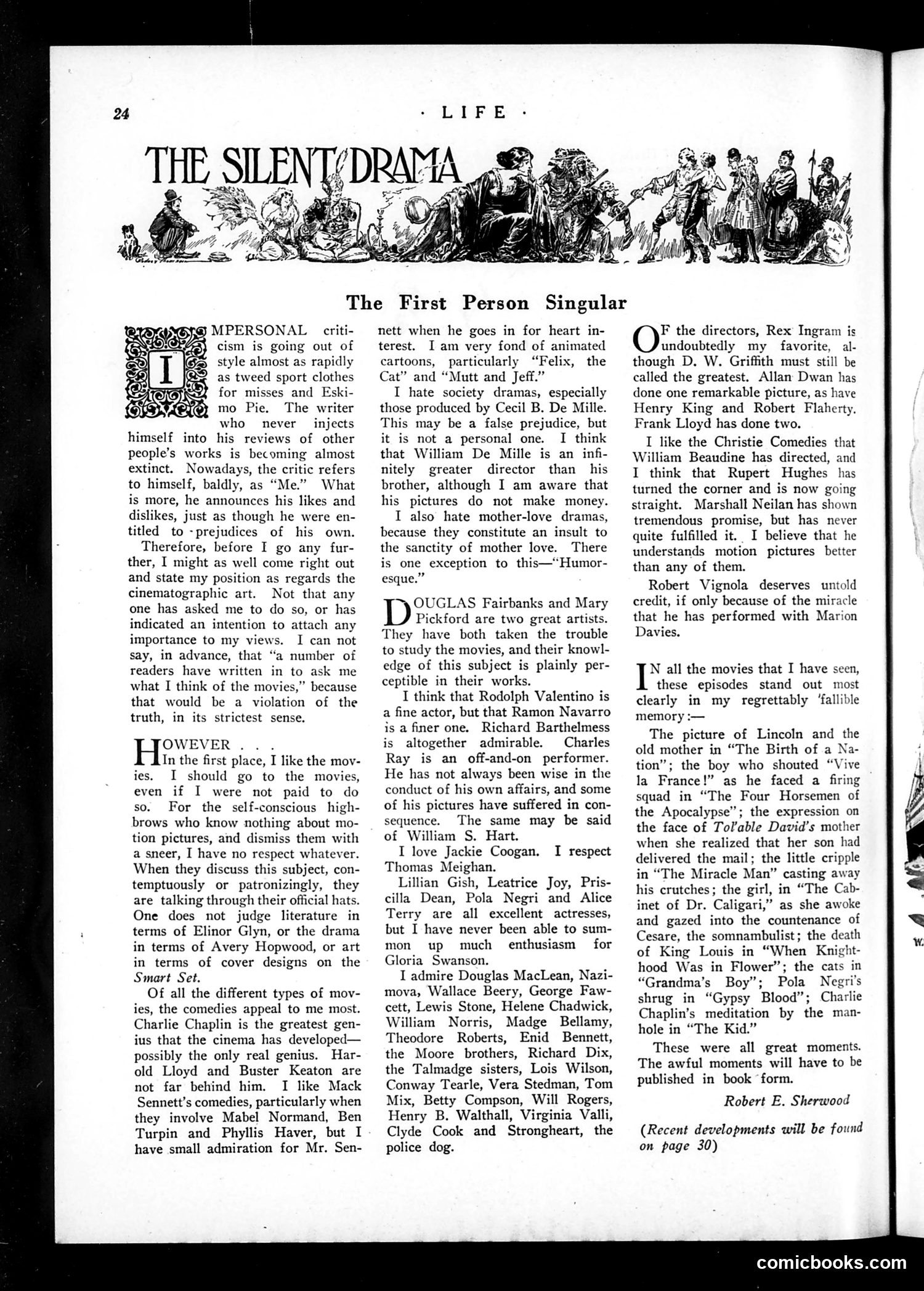
This is a film criticism essay by Robert E. Sherwood (bylined at bottom) reviewing silent cinema. The header illustration shows various silent film characters and scenes. The piece is a tongue-in-cheek *defense* of first-person critical opinion—mocking the trend of critics inserting personal preference into reviews while simultaneously doing exactly that. Sherwood rates contemporary silent film stars and directors: he loves Charlie Chaplin, Harold Lloyd, and Buster Keaton's comedies; admires Douglas Fairbanks and Mary Pickford; prefers William De Mille over his brother Cecil B.; dislikes Cecil B. De Mille's society dramas and "mother-love" melodramas; and ranks various actors from Rudolph Valentino to Will Rogers. The satire lies in Sherwood's self-aware contradiction: he criticizes critics for announcing personal tastes, then proceeds to list his own detailed preferences—presented as objective assessments—about now-obscure 1920s cinema figures, many of whom have faded into complete obscurity.
📄 Transcribed text from this page (OCR, searchable)
Machine-transcribed from the original scan — historical spelling and the odd misread are preserved.
The criti- cism is going out of style almost as rapidly as tweed sport clothes for misses and Eski- mo Pie. The writer who never __ injects himself into his reviews of other people’s works is becoming almost extinct. Nowadays, the critic refers to himself, baldly, as “Me.” What is more, he announces his likes and dislikes, just as though he were en- titled to -prejudices of his own. Therefore, before I go any fur- ther, I might as well come right out and state my position as regards the cinematographic art. Not that any one has asked me to do so, or has indicated an intention to attach any importance to my views. I can not say, in advance, that “a number of readers have written in to ask me what I think of the movies,” because that would be a violation of the truth, in its strictest sense. OWEVER... In the first place, I like the mov- ies. I should go to the movies, even if I were not paid to do so. For the self-conscious high- brows who know nothing about mo- tion pictures, and dismiss them with a sneer, I have no respect whatever. When they discuss this subject, con- temptuously or patronizingly, they are talking through their official hats. One does not judge literature in terms of Elinor Glyn, or the drama in terms of Avery Hopwood, or art in terms of cover designs on the Smart Set. Of all the different types of mov- ies, the comedies appeal to me most. Charlie Chaplin is the greatest gen- ius that the cinema has developed— possibly the only real genius. Har- old Lloyd and Buster Keaton are not far behind him. I like Mack Sennett’s comedies, particularly when they involve Mabel Normand, Ben Turpin and Phyllis Haver, but I have small admiration for Mr. Sen- First Person nett when he goes in for heart in- terest. I am very fond of animated cartoons, particularly “Felix, the Cat” and “Mutt and Jeff.” I hate society dramas, especially those produced by Cecil B. De Mille. This may be a false prejudice, but it is not a personal one. I think that William De Mille is an infi- nitely greater director than his brother, although I am aware that his pictures do not make money. I also hate mother-love dramas, because they constitute an insult to the sanctity of mother love. There is one exception to this—“Humor- esque.” OUGLAS Fairbanks and Mary Pickford are two great artists. They have both taken the trouble to study the movies, and their knowl- edge of this subject is plainly per- ceptible in their works, I think that Rodolph Valentino is a fine actor, but that Ramon Navarro is a finer one. Richard Barthelmess is altogether admirable. Charles Ray is an off-and-on performer. He has not always been wise in the conduct of his own affairs, and some of his pictures have suffered in con- sequence. The same may be said of William S. Hart. I love Jackie Coogan. Thomas Meighan. Lillian Gish, Leatrice Joy, Pris- cilla Dean, Pola Negri and Alice Terry are all excellent actresses, but I have never been able to sum- mon up much enthusiasm for Gloria Swanson. I admire Douglas MacLean, Nazi- mova, Wallace Beery, George Faw- cett, Lewis Stone, Helene Chadwick, William Norris, Madge Bellamy, Theodore Roberts, Enid Bennett, the Moore brothers, Richard Dix, the Talmadge sisters, Lois Wilson, Conway Tearle, Vera Stedman, Tom Mix, Betty Compson, Will Rogers, Henry B. Walthall, Virginia Valli, Clyde Cook and Strongheart, the police dog. I respect Singular F the directors, Rex Ingram is undoubtedly my favorite, al- though D. W. Griffith must still be called the greatest. Allan Dwan has done one remarkable picture, as have Henry King and Robert Flaherty, Frank Lloyd has done two. I like the Christie Comedies that William Beaudine has directed, and I think that Rupert Hughes has turned the corner and is now going straight. Marshall Neilan has shown tremendous promise, but has never quite fulfilled it. I believe that he understands motion pictures better than any of them. Robert Vignola deserves untold credit, if only because of the miracle that he has performed with Marion Davies. N all the movies that I have seen, these episodes stand out most clearly in my regrettably ‘fallible memory :— The picture of Lincoln and the old mother in “The Birth of a Na- tion”; the boy who shouted “Vive la France!” as he faced a firing squad in “The Four Horsemen of the Apocalypse”; the expression on the face of Tol’able David’s mother when she realized that her son had delivered the mail; the little cripple in “The Miracle Man” casting away his crutches; the girl, in “The Cab- inet of Dr. Caligari,” as she awoke and gazed into the countenance of Cesare, the somnambulist; the death of King Louis in “When Knight- hood Was in Flower”; the cats in “Grandma’s Boy”; Pola Negri’s shrug in “Gypsy Blood”; Charlie Chaplin’s meditation by the man- hole in “The Kid.” These were all great moments. The awful moments will have to be published in book “form. Robert E. Sherwood (Recent developments will be found on page 30) comicbooks.com z=f