
Life, 1922-11-23 · page 22 of 36
Life — November 23, 1922 — page 22: what you’re looking at
What you’re looking at
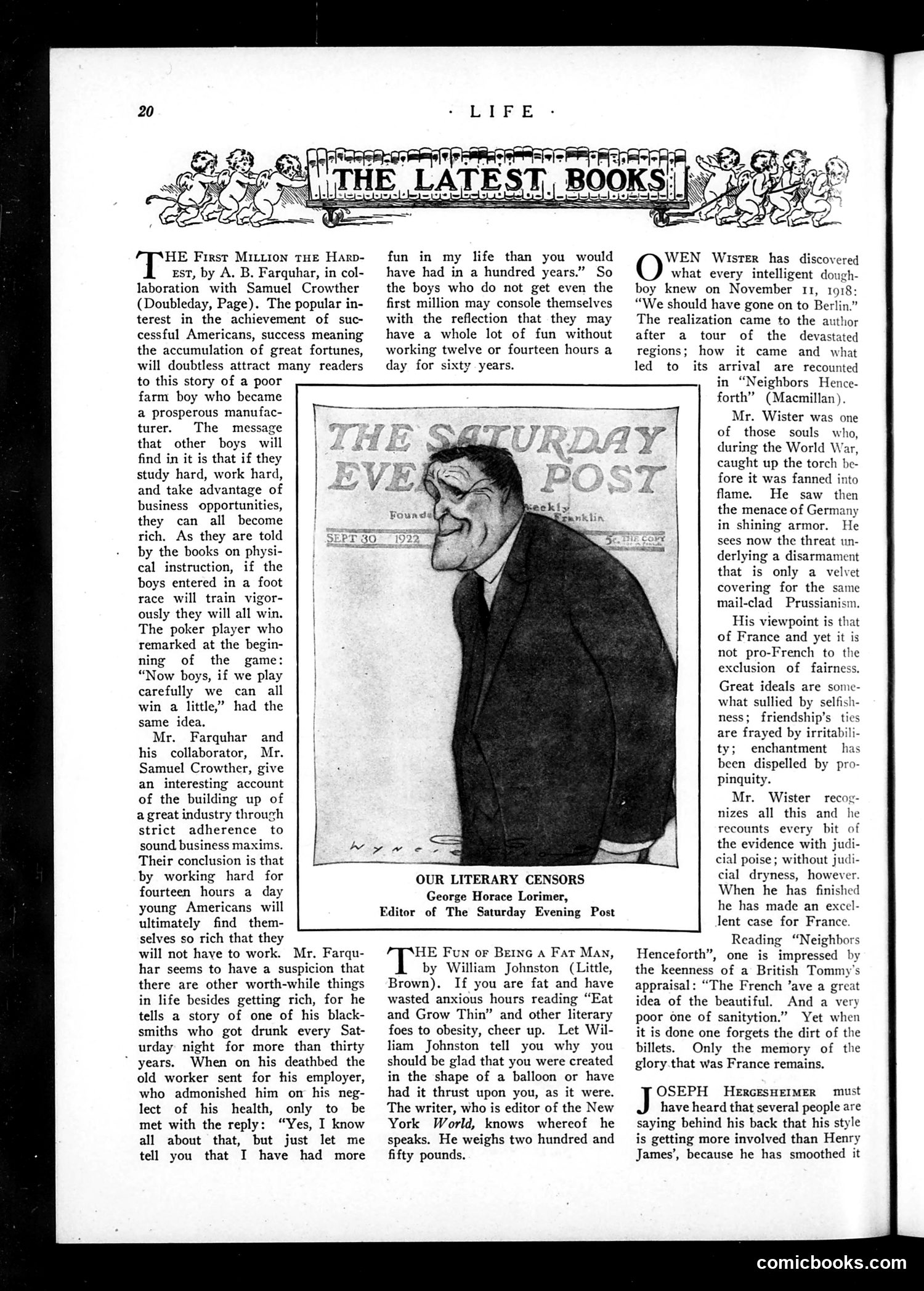
This page from Life magazine's "The Latest Books" section reviews recent publications, featuring a caricature of **George Horace Lorimer**, editor of The Saturday Evening Post, labeled "Our Literary Censors." The reviews mock self-help literature and its authors' contradictions. A.B. Farquhar's *The First Million the Hardest* is satirized for preaching that boys can all become rich through hard work—compared absurdly to a poker game where everyone claims they can "all win a little." The review notes the author himself acknowledges life has worth beyond wealth (citing a blacksmith's deathbed happiness despite poverty). William Johnston's *The Fun of Being a Fat Man* is ribbed for its author weighing 250 pounds while promoting obesity acceptance. Owen Wister's *Neighbors Henceforth* is reviewed more seriously, praising his post-WWI argument that Germany remains a threat despite disarmament—a pro-France position presented as balanced rather than partisan. The satire targets publishing's tendency to promote contradictory self-improvement narratives while authors embody opposite examples.
📄 Transcribed text from this page (OCR, searchable)
Machine-transcribed from the original scan — historical spelling and the odd misread are preserved.
HE First MItiion tHe Harp- Est, by A. B. Farquhar, in col- laboration with Samuel Crowther (Doubleday, Page). The popular in- terest in the achievement of suc- cessful Americans, success meaning the accumulation of great fortunes, will doubtless attract many readers to this story of a poor farm boy who became fun in my life than you would have had in a hundred years.” So the boys who do not get even the first million may console themselves with the reflection that they may have a whole lot of fun without working twelve or fourteen hours a day for sixty years. WEN Wister has discovered O what every intelligent dough- boy knew on November 11, 1918: “We should have gone on to Berlin.” The realization came to the author after a tour of the devastated regions; how it came and what led to its arrival are recounted in “Neighbors Hence- forth” (Macmillan). a prosperous manufac- turer. The message that other boys will find in it is that if they study hard, work hard, and take advantage of business opportunities, they can all become rich. As they are told by the books on physi- cal instruction, if the Dboys entered in a foot race will train vigor- ously they will all win. The poker player who remarked at the begin- ning of the game: “Now boys, if we play carefully we can all win a little,’ had the same idea. Mr. Farquhar and his collaborator, Mr. Samuel Crowther, give an interesting account of the building up of a great industry through strict adherence to sound business maxims. Their conclusion is that by working hard for fourteen hours a day young Americans will ultimately find them- selves so rich that they will not haye to work. Mr, Farqu- har seems to have a suspicion that there are other worth-while things in life besides getting rich, for he tells a story of one of his black- smiths who got drunk every Sat- urday night for more than thirty * years. When on his deathbed the old worker sent for his employer, who admonished him on his neg- lect of his health, only to be met with the reply: “Yes, I know all about that, but just let me tell you that I have had more OUR LITERARY CENSORS George Horace Lorimer, Editor of The Saturday Evening Post HE Fun or Berne a Fat Man, by William Johnston (Little, Brown). If you are fat and have wasted anxious hours reading “Eat and Grow Thin” and other literary foes to obesity, cheer up. Let Wil- liam Johnston tell you why you should be glad that you were created in the shape of a balloon or have had it thrust upon you, as it were. The writer, who is editor of the New York World, knows whereof he speaks. He weighs two hundred and fifty pounds, Mr. Wister was one of those souls who, during the World War, caught up the torch be- fore it was fanned into flame. He saw then the menace of Germany in shining armor. He sees now the threat un- derlying a disarmament that is only a velvet covering for the same mail-clad_ Prussianism. His viewpoint is that of France and yet it is not pro-French to the exclusion of fairness. Great ideals are some- what sullied by selfish- ness; friendship’s t are frayed by irritabili- ty; enchantment has been dispelled by pro- pinquity. Mr. Wister recog- nizes all this and he recounts every bit of the evidence with judi- cial poise ; without judi- cial dryness, however. When he has finished he has made an excel- lent case for France. Reading “Neighbors Henceforth”, one is impressed by the keenness of a British Tommy's appraisal: “The French ’ave a great idea of the beautiful. And a very poor one of sanitytion.” Yet when it is done one forgets the dirt of the billets. Only the memory of the glory.that was France remains. OSEPH HercEsHEIMER must have heard that several people are saying behind his back that his style is getting more involved than Henry James’, because he has smoothed it comicbooks.com