
Life, 1922-11-23 · page 16 of 36
Life — November 23, 1922 — page 16: what you’re looking at
What you’re looking at
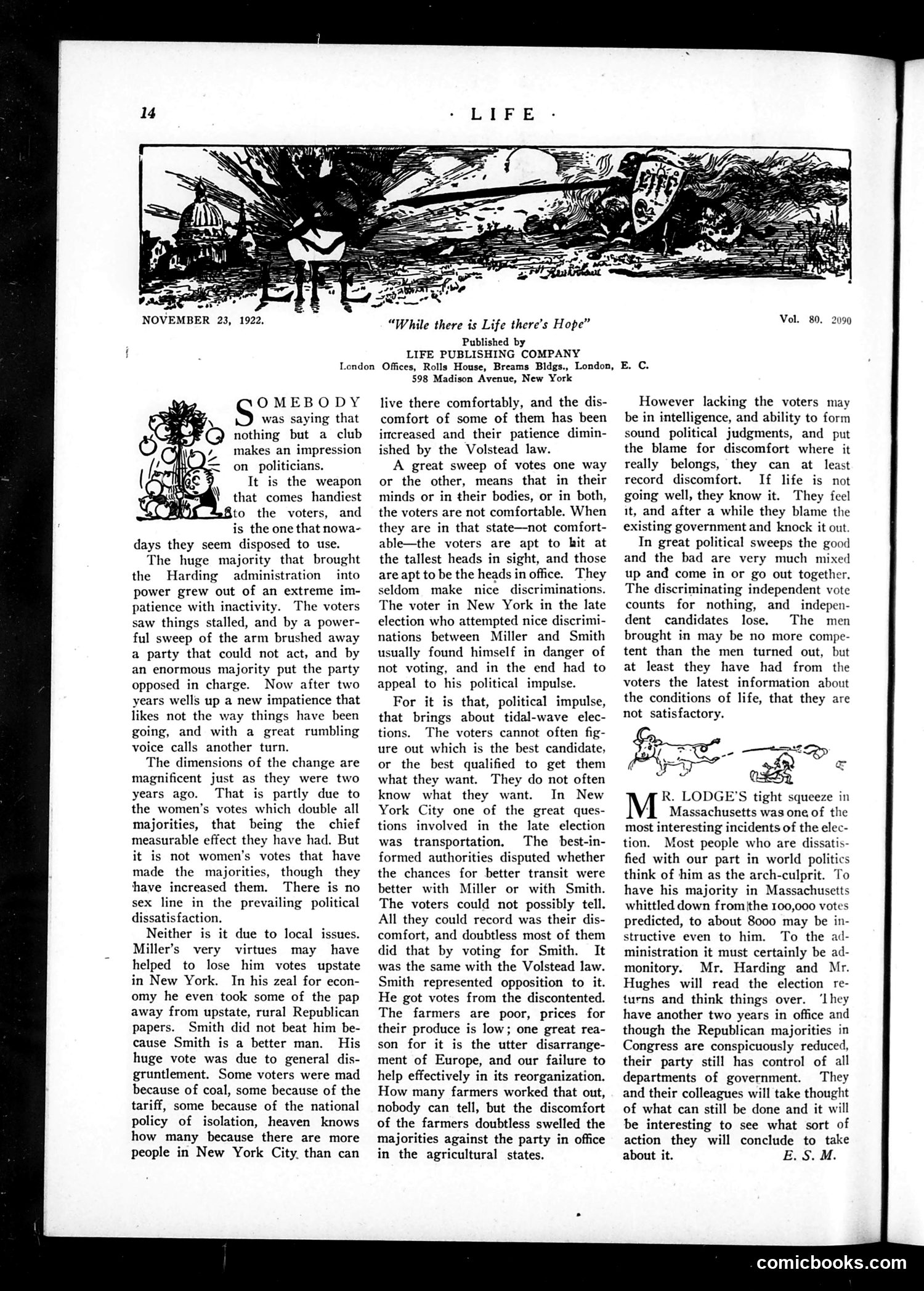
This *Life* magazine page contains editorial commentary on recent U.S. elections, likely referencing the 1922 midterms. The text criticizes voters' intelligence and political judgment, arguing that electoral outcomes reflect voter discomfort rather than rational choice. The article specifically discusses New York politics, mentioning candidates "Miller and Smith" (likely referring to a gubernatorial race). It critiques voters for making discriminatory choices based on impulse rather than knowledge of candidates' qualifications. The second section discusses Massachusetts politics and mentions Lodge (likely Henry Cabot Lodge), suggesting voter dissatisfaction with Republican leadership despite their congressional control. The illustrated header and decorative elements are typical of *Life's* satirical style, though specific figures are unclear from this reproduction.
📄 Transcribed text from this page (OCR, searchable)
Machine-transcribed from the original scan — historical spelling and the odd misread are preserved.
NOVEMBER 23, 1922, “While there is Life there’s Hope” Published by LIFE PUBLISHING COMPANY . 80. 2090 London Offices, Rolls House, Breams Bldgs., London, E. C. OMEBODY was saying that nothing but a club makes an impression on politicians. It is the weapon that comes handiest 8to the voters, and is the one that nowa- days they seem disposed to use. The huge majority that brought the Harding administration into power grew out of an extreme im- patience with inactivity. The voters saw things stalled, and by a power- ful sweep of the arm brushed away a party that could not act, and by an enormous majority put the party opposed in charge. Now after two years wells up a new impatience that likes not the way things have been going, and with a great rumbling voice calls another turn. The dimensions of the change are magnificent just as they were two years ago. That is partly due to the women’s votes which double all majorities, that being the chief measurable effect they have had. But it is not women’s votes that have made the majorities, though they thave increased them. There is no sex line in the prevailing political dissatisfaction. Neither is it due to local issues. Miller’s very virtues may have helped to lose him votes upstate in New York. In his zeal for econ- omy he even took some of the pap away from upstate, rural Republican papers. Smith did not beat him be- cause Smith is a better man. His huge vote was due to general dis- gruntlement. Some voters were mad because of coal, some because of the tariff, some because of the national policy of isolation, heaven knows how many because there are more people in New York City. than can 598 Madison Avenue, New York live there comfortably, and the dis- comfort of some of them has been increased and their patience dimin- ished by the Volstead law. A great sweep of votes one way or the other, means that in their minds or in their bodies, or in both, the voters are not comfortable. When they are in that state—not comfort- able—the voters are apt to hit at the tallest heads in sight, and those are apt to be the heads in office. They seldom make nice discriminations. The voter in New York in the late election who attempted nice discrimi- nations between Miller and Smith usually found himself in danger of not voting, and in the end had to appeal to his political impulse. For it is that, political impulse, that brings about tidal-wave elec- tions. The voters cannot often fig- ure out which is the best candidate, or the best qualified to get them what they want. They do not often know what they want. In New York City one of the great ques- tions involved in the late election was transportation, The best-in- formed authorities disputed whether the chances for better transit were better with Miller or with Smith. The voters could not possibly tell. All they could record was their dis- comfort, and doubtless most of them did that by voting for Smith, It was the same with the Volstead law. Smith represented opposition to it. He got votes from the discontented. The farmers are poor, prices for their produce is low; one great rea- son for it is the utter disarrange- ment of Europe, and our failure to help effectively in its reorganization. How many farmers worked that out, nobody can tell, but the discomfort of the farmers doubtless swelled the majorities against the party in office in the agricultural states. However lacking the voters may be in intelligence, and ability to form sound political judgments, and put the blame for discomfort where it really belongs, they can at least record discomfort. If life is not going well, they know it. They feel it, and after a while they blame the existing government and knock it out. In great political sweeps the good and the bad are very much mixed up and come in or go out together. The discriminating independent vote counts for nothing, and indepen- dent candidates lose. The men brought in may be no more compe- tent than the men turned out, but at least they have had from the voters the latest information about the conditions of life, that they are not satisfactory. es R. LODGE'S tight squeeze in Massachusetts was one of the most interesting incidents of the elec- tion. Most people who are dissatis- fied with our part in world politics think of him as the arch-culprit. To have his majority in Massachusetts whittled down fromthe 100,000 votes predicted, to about 8000 may be in- structive even to him. To the ad- ministration it must certainly be ad- monitory. Mr. Harding and Mr. Hughes will read the election re- turns and think things over. ‘Lhey have another two years in office and though the Republican majorities in Congress are conspicuously reduced, their party still has control of all departments of government. They and their colleagues will take thought of what can still be done and it will be interesting to see what sort of action they will conclude to take about it. E.S.M. comicbooks.com