
A complete issue · 36 pages · 1922
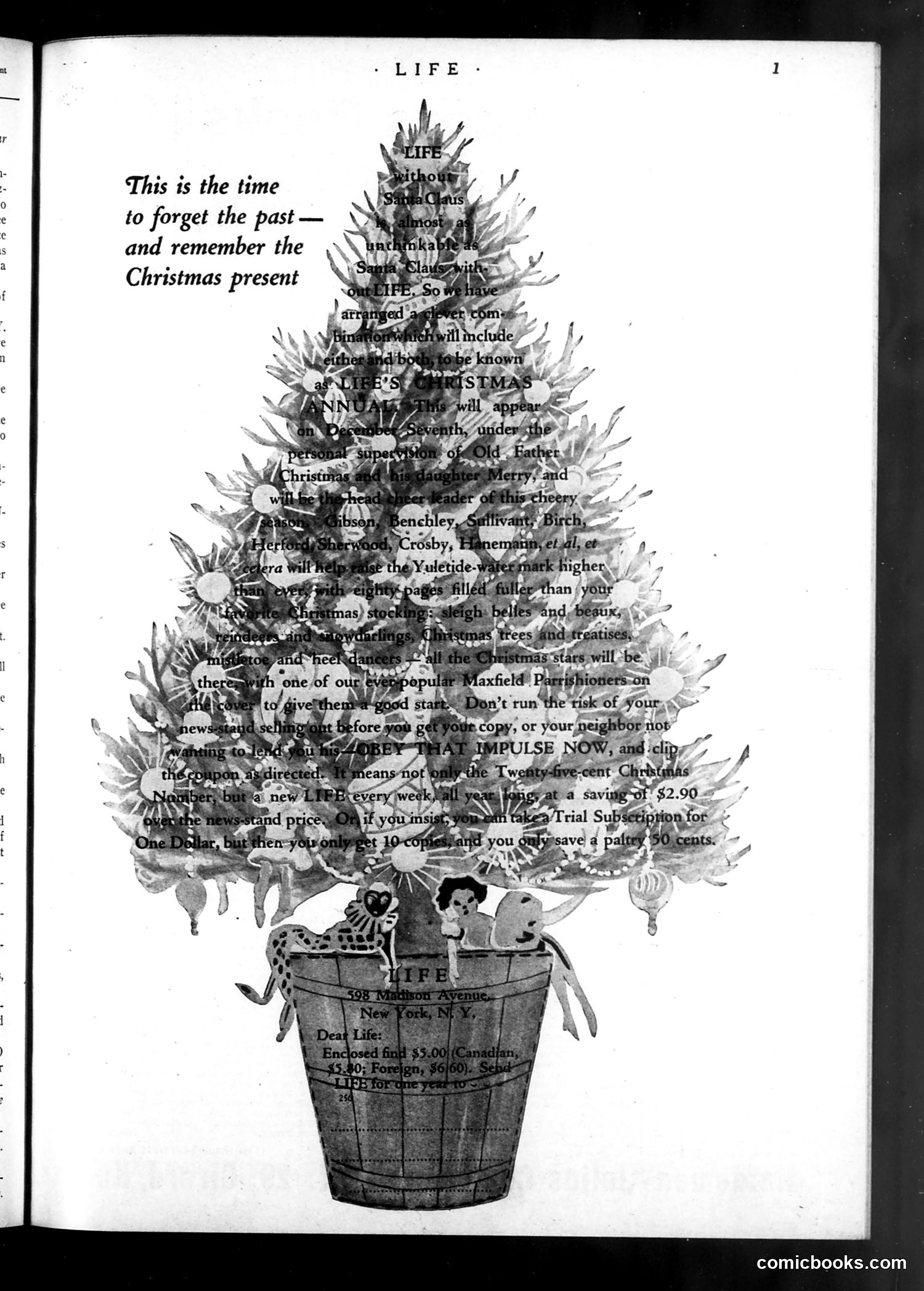
Life — November 16, 1922
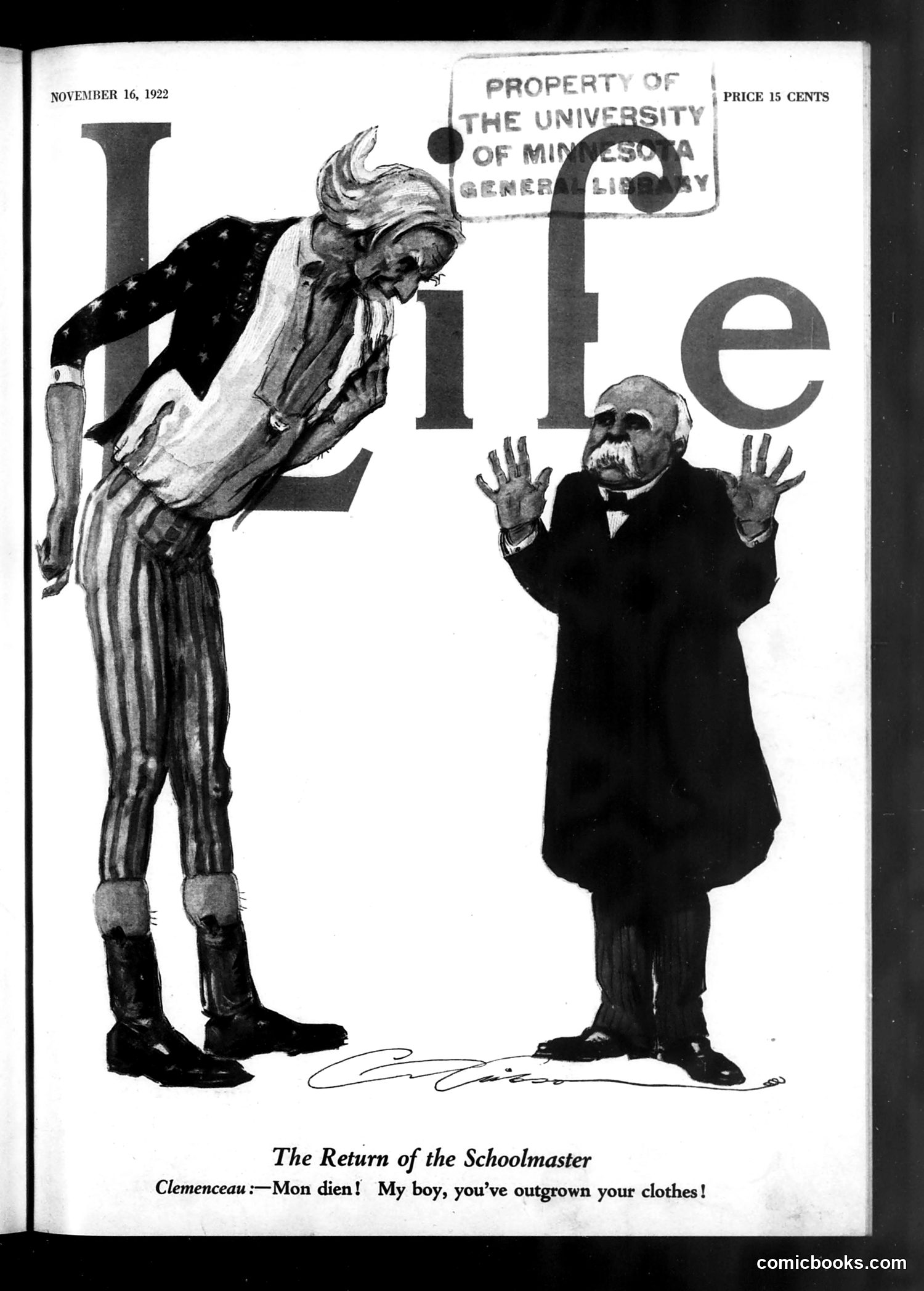
This November 1922 *Life* cartoon satirizes Georges Clemenceau, the French statesman (the man in the dark coat on the right). The figure on the left represents Uncle Sam, depicted as having "outgrown his clothes"—a visual metaphor suggesting America has become too large or powerful for its previous role. Clemenceau's comment—"Mon dieu! My boy, you've outgrown your clothes!"—references America's emergence as a major world power after World War I. The "schoolmaster" framing suggests France previously guided American foreign policy, but now America has grown beyond that tutelage. The satire mocks the idea that France could still control or advise the now-independent American giant on the world stage.
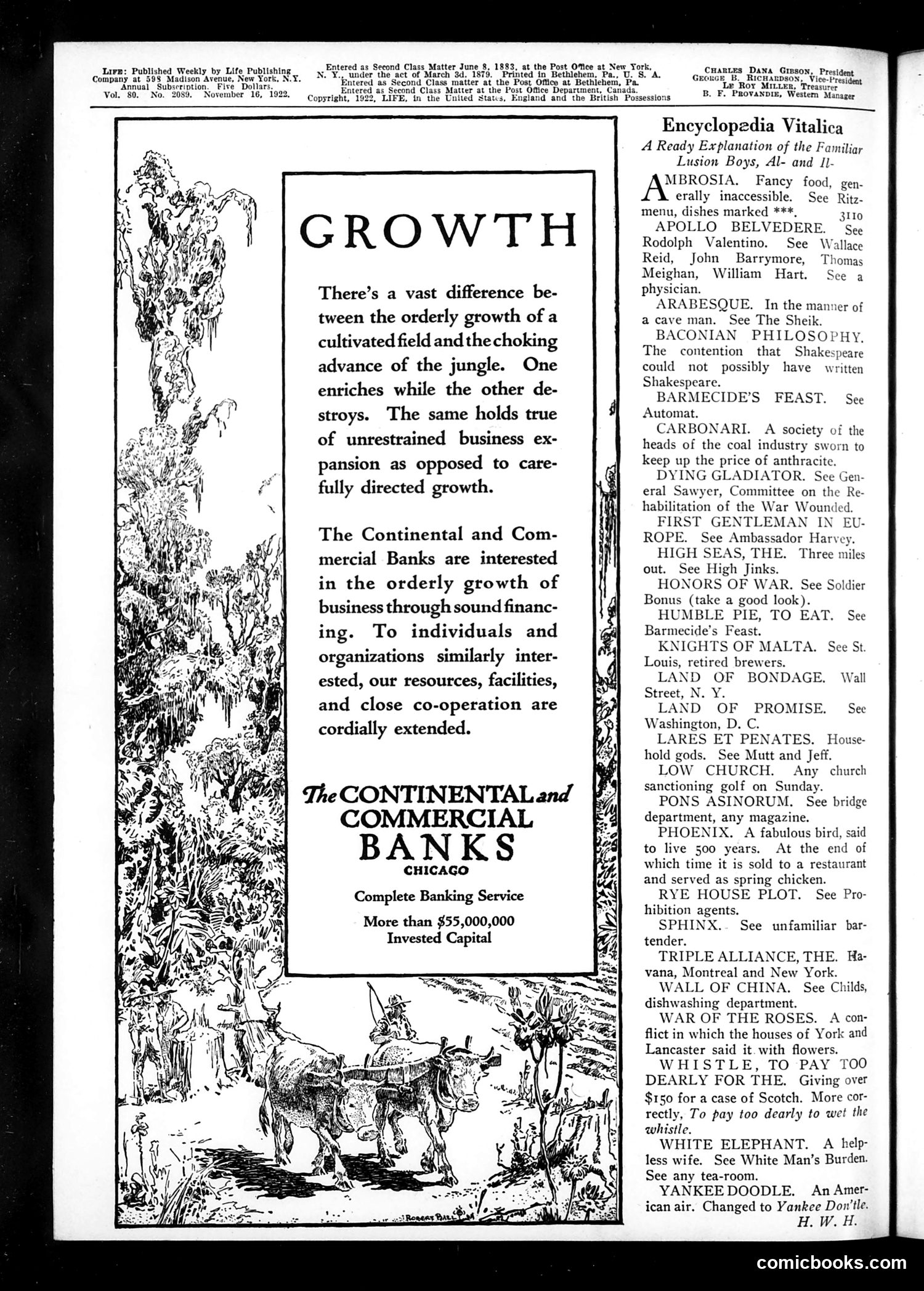
This page is primarily a **full-page advertisement** for the Continental and Commercial Banks of Chicago, not a political cartoon. The ad uses an allegorical illustration contrasting "orderly growth" (a cultivated field with organized rows) against "choking advance of the jungle" (wild, uncontrolled vegetation). The bank equates itself with rational, beneficial business expansion versus unrestrained, destructive growth. The imagery suggests the bank positions itself as a stabilizing financial force during what appears to be an era of rapid, sometimes chaotic economic expansion. The right column contains an "Encyclopedia Vitalica" — brief satirical definitions of obscure or absurd terms and literary references — which is typical Life magazine filler content, unrelated to the bank advertisement.
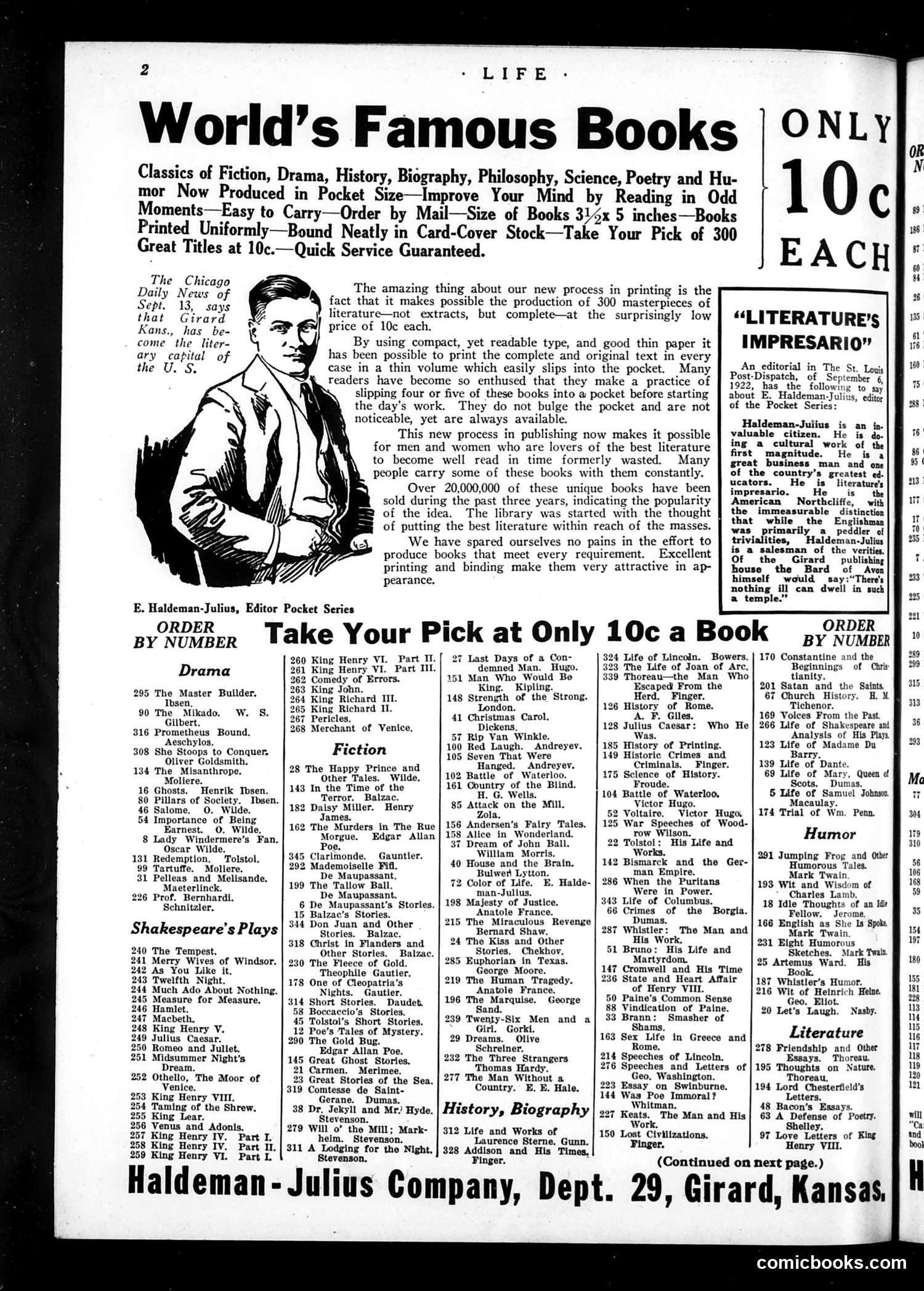
This page is primarily **advertising, not editorial content**. It contains a book catalog advertisement for the Haldeman-Julius Company's "World's Famous Books" pocket series. The only illustration is a portrait of **E. Haldeman-Julius**, the editor, shown as a well-dressed man in professional attire. The accompanying text describes his publishing venture: affordable pocket-sized editions of classic literature priced at 10 cents each. The small editorial box titled "Literature's Impresario" provides biographical context about Haldeman-Julius, praising him as a significant figure in making literature accessible to working people. There is **no political satire or cartooning** on this page—it is essentially a mail-order catalog with promotional content for an educational book series popular in the early 20th century.
This page is **primarily advertising**, not editorial content or cartoons. It's a book catalog from *Life* magazine advertising the Haldeman-Julius Company's "Ten Cent Pocket Series"—affordable paperback books sold at 10 cents each. The single image shown is a **book cover** for what appears to be a poetry or literature anthology, featuring a dark, artistic design with a silhouette figure. The page emphasizes that for $16.90, readers could obtain a complete 300-volume library set—marketed as democratizing access to literature and philosophy at Depression-era prices. The text promotes this as bringing "University in Print" to ordinary Americans. This reflects early 20th-century efforts to make classic literature accessible to working-class readers through cheap mass-market publishing.
This is a **Phoenix Hosiery advertisement**, not satire or a political cartoon. The page features ornate decorative framing around promotional text. The ad uses a philosophical appeal rather than humor: it argues that a person's worth should be measured by "what he has achieved," and that Phoenix stockings deserve recognition for their "long and honorable service" providing "great mileage at small cost." The text emphasizes that Phoenix hosiery comes from "a responsible merchant" and has achieved "first in world sales—and first in the esteem of those who know true worth." This represents typical early 20th-century advertising strategy: building brand prestige through claims of reliability, achievement, and social endorsement rather than through direct product description or price competition.
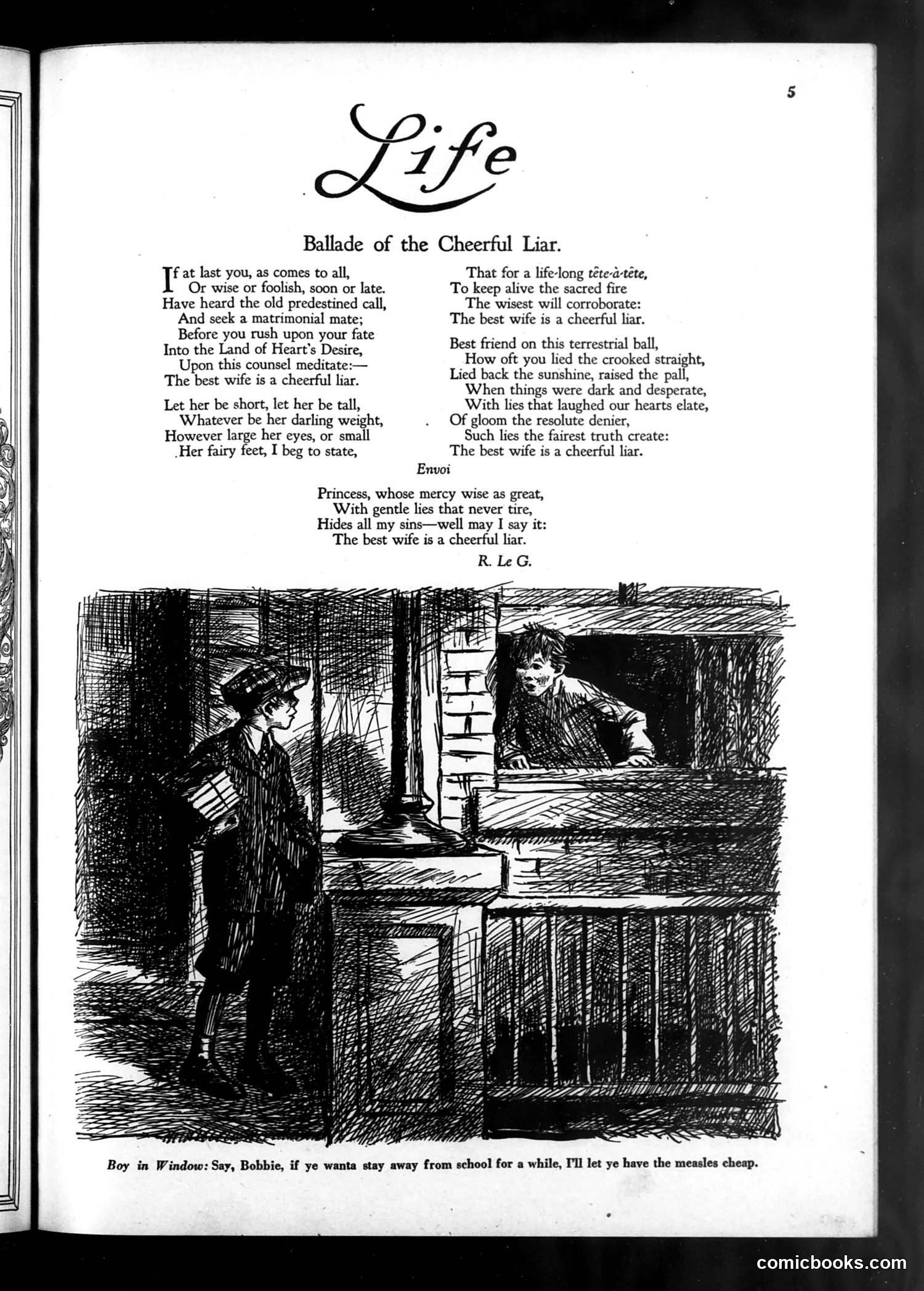
This page presents a satirical poem by R. Le G. celebrating "the best wife is a cheerful liar." The poem ironically praises a wife who uses deception to maintain domestic happiness—lying about her husband's faults, hiding financial troubles, and using humor to dispel gloom. The illustration depicts a boy at a window speaking to someone inside, proposing to skip school by claiming illness ("I'll let ye have the measles cheap"), a crude transaction of dishonesty. Together, text and image mock both domestic deception and youthful dishonesty as normalized social practices. The satire suggests early-20th-century anxieties about integrity in marriage and child-rearing, while humorously endorsing small lies as pragmatic solutions to life's difficulties.
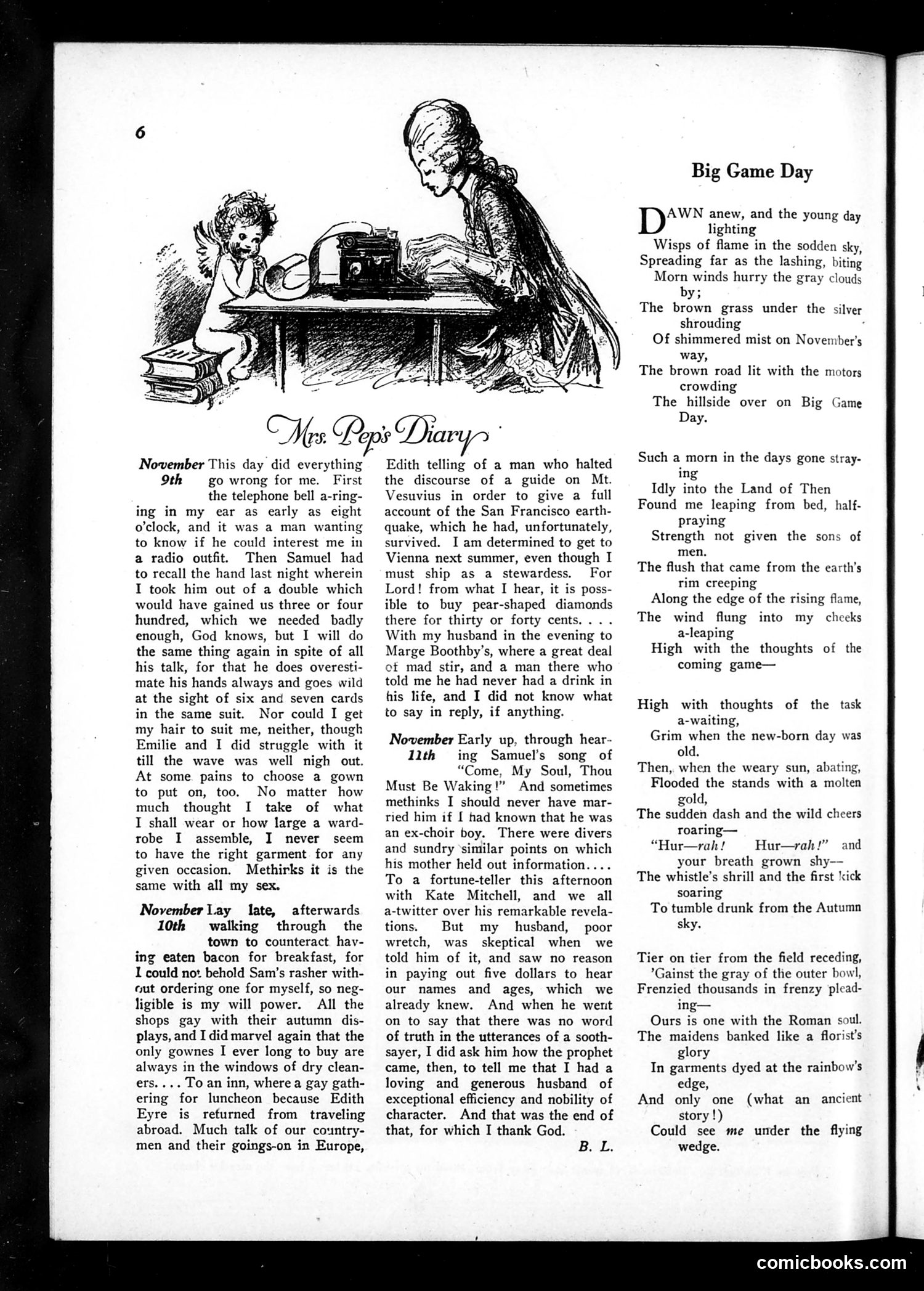
This page contains **Mrs. Pop's Diary**, a humorous domestic column, rather than political satire. The illustration shows a woman at a typewriter with a cherub figure—a common decorative motif in early 20th-century magazines. The diary entries (November 9th, 10th, 11th) humorously chronicle a woman's domestic frustrations: a broken telephone, dealing with servants' incompetence, and her husband's skepticism about spiritualist fortune-telling. The right side features a poem titled **"Big Game Day,"** likely referring to a major college football game. The humor derives from relatable domestic complaints and marital dynamics of the era rather than political commentary. This appears to be *Life* magazine's lighthearted women's interest content, focusing on everyday life and social observations rather than satire of current events.
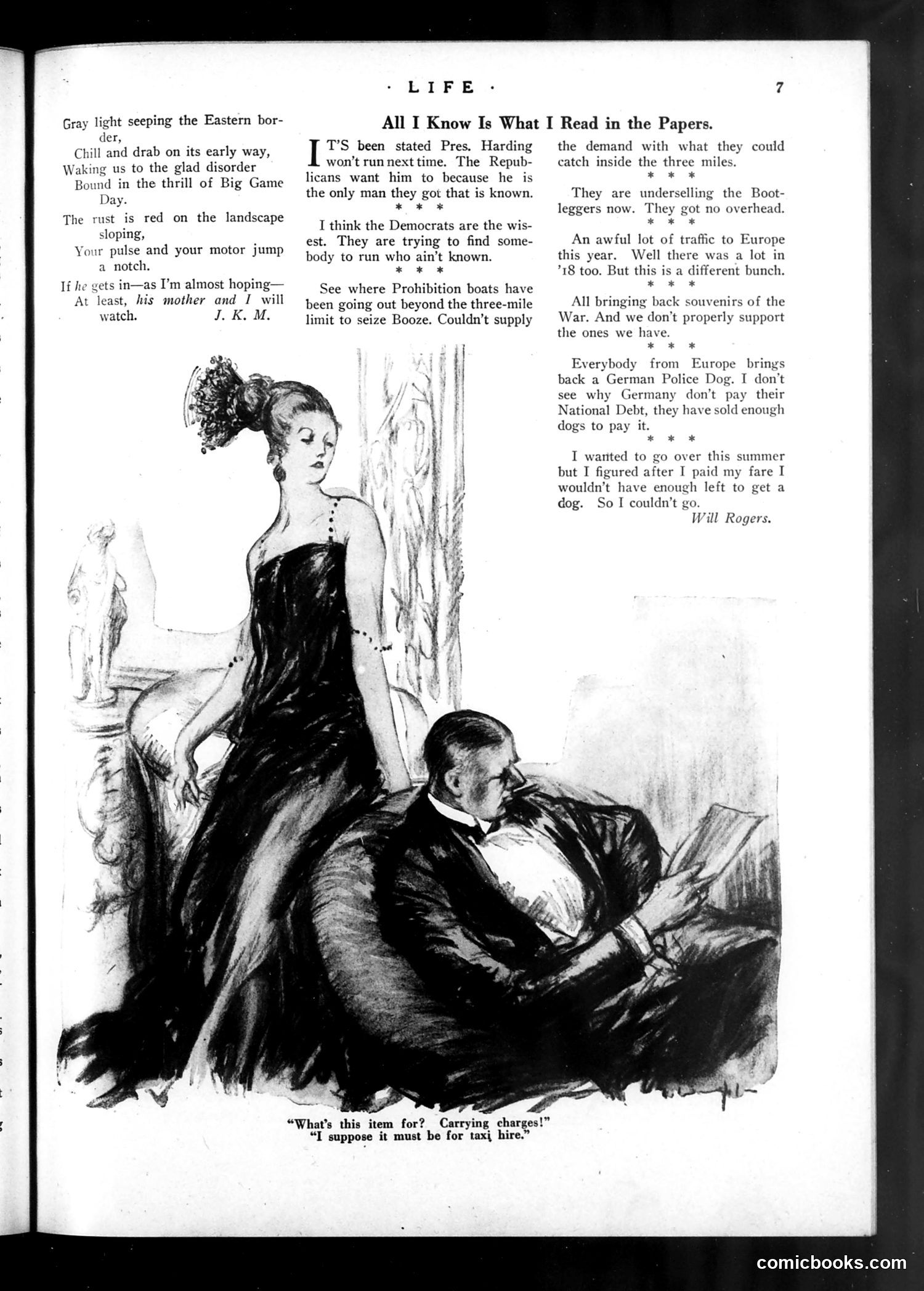
This page from *Life* magazine contains political commentary and a cartoon. The main piece, "All I Know Is What I Read in the Papers," attributes observations to Will Rogers (a famous humorist of the era). The commentary satirizes: - **Presidential politics**: References to President Harding and Republican/Democratic strategies for the upcoming election - **Prohibition**: Mocking enforcement efforts against illegal alcohol smuggling - **Post-WWI tourism**: Americans returning from Europe with German souvenirs (particularly German Police Dogs) - **Economic hardship**: A joke about insufficient funds for overseas travel or German dogs The cartoon below depicts a well-dressed couple where the woman presents a bill to the man, with his response "Carrying charges! I suppose it must be for taxi hire." This satirizes hidden costs and financial surprises in relationships—likely commentary on modern consumer culture and unexpected expenses.
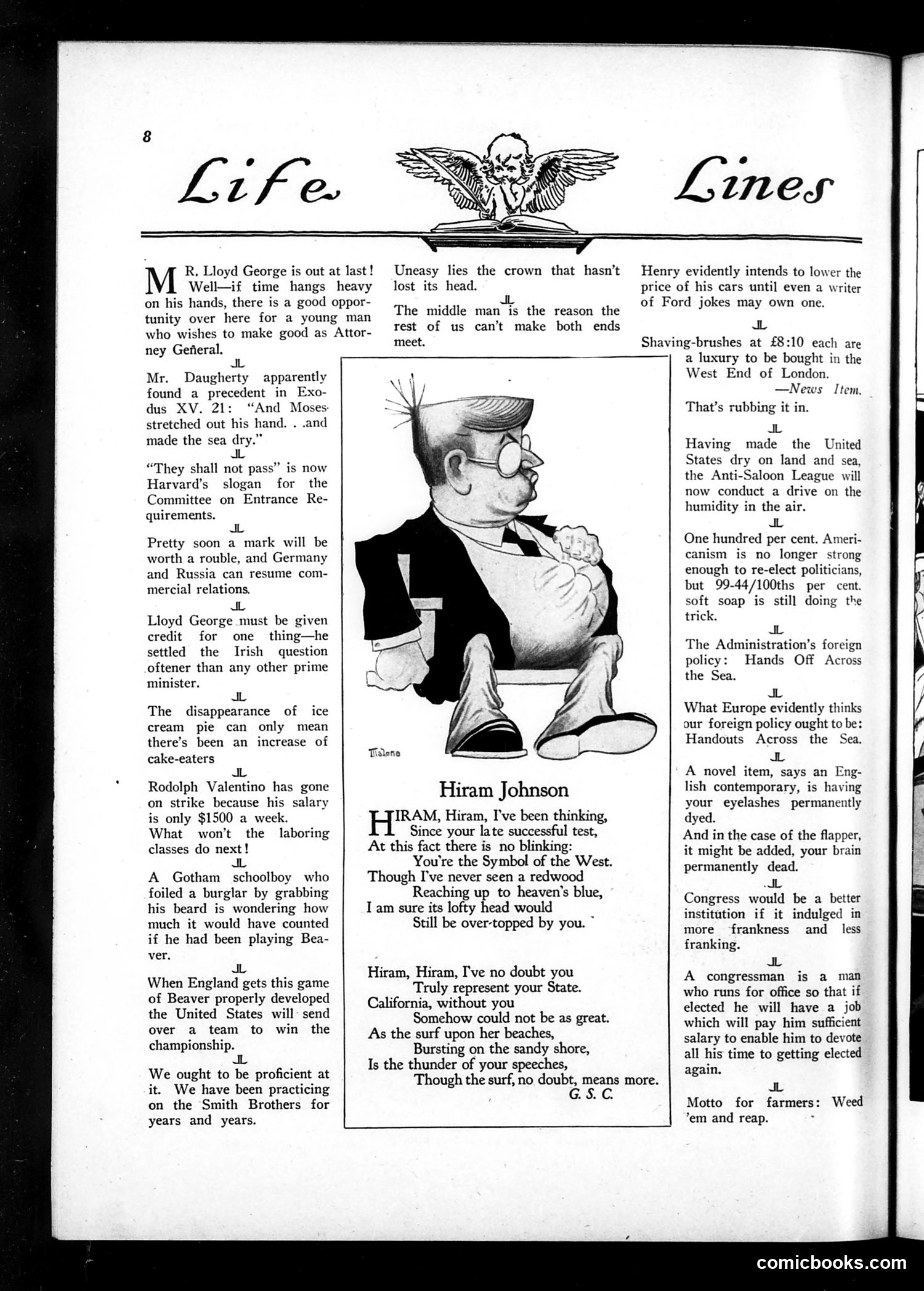
This page features satirical commentary on American politics and society, circa early 20th century. The central cartoon depicts **Hiram Johnson**, a prominent political figure (likely California governor/senator), portrayed with exaggerated features sitting prominently. The accompanying poem praises Johnson as "the Symbol of the West," referencing his regional political importance and suggesting he represents western interests and values. The surrounding "Life Lines" section contains brief satirical quips about contemporary issues: Lloyd George (British Prime Minister), Harvard entrance requirements, ice cream prices, Rudolph Valentino's salary disputes, and Congress's ineffectiveness. The overall tone mocks political figures and institutions while commenting on economic conditions and social trends of the era. The cartoonist uses caricature and witty one-liners to critique those in power.
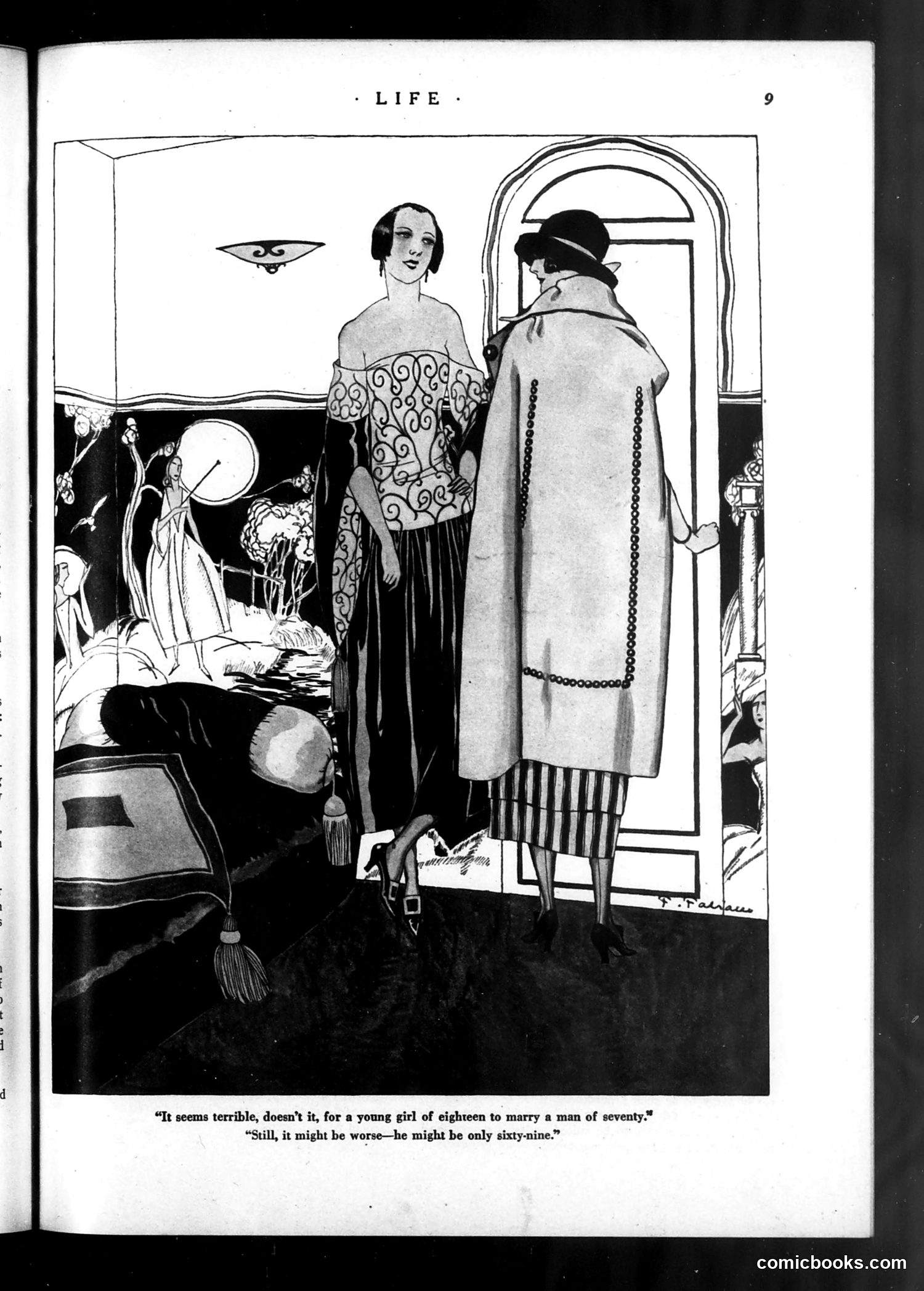
This is a single-panel cartoon from *Life* magazine satirizing marriage age gaps. The scene shows two women in an elegant interior—one departing in a coat and hat, the other in a patterned dress, apparently seeing her off. The dialogue expresses concern about "a young girl of eighteen" marrying "a man of seventy," with the darkly humorous rejoinder that it "might be worse—he might be only sixty-nine." The satire targets the social acceptance of marriages between young women and significantly older wealthy men—a practice that appears to have been common enough in the era to warrant mockery. The cartoon implies such age-gap marriages were normalized among certain social circles, despite their questionable nature. The joke's pessimism ("might be worse") underscores how socially acceptable even extreme age disparities were considered.
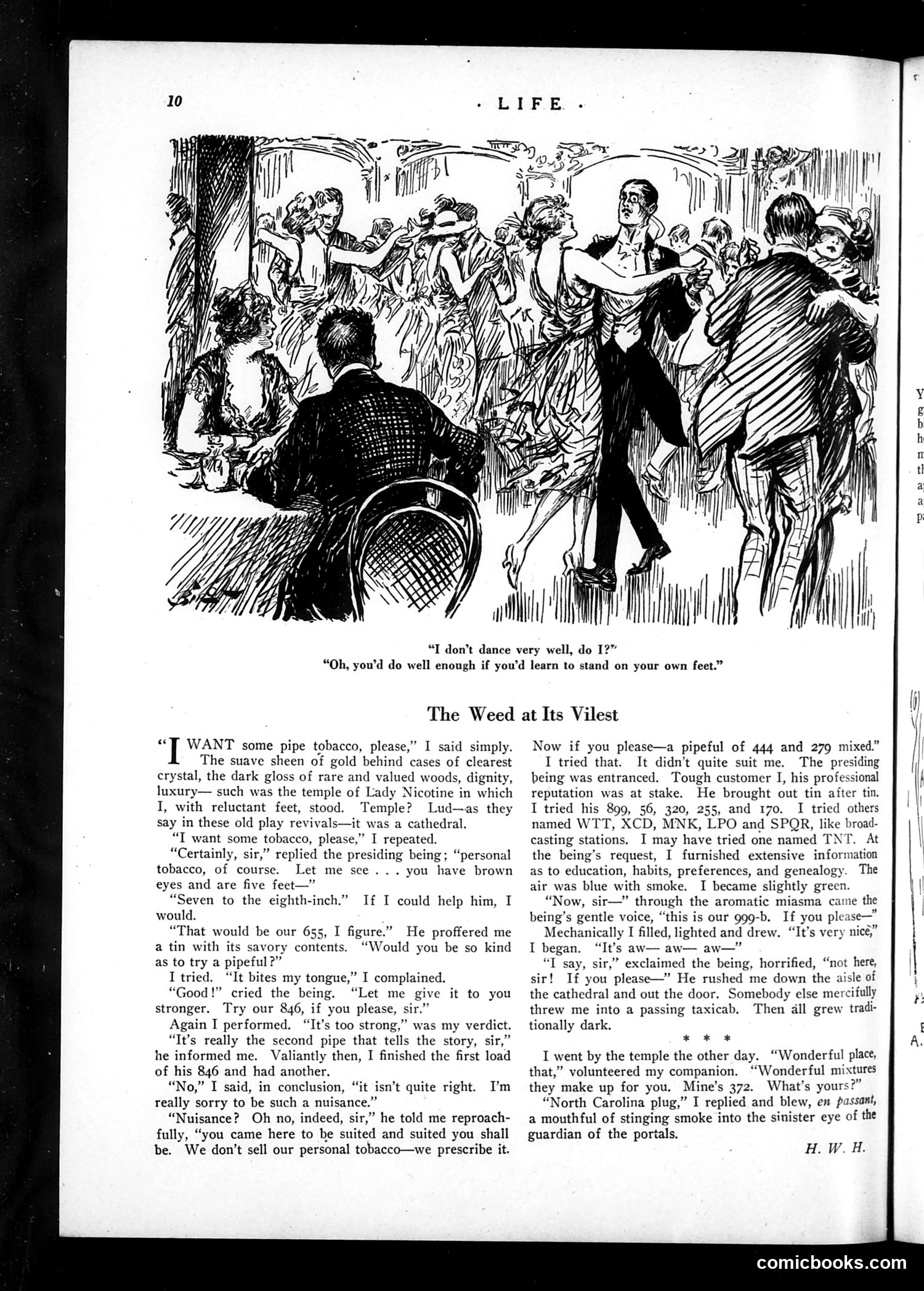
This satirical story mocks pretentious tobacco connoisseurship. The narrator visits an exclusive shop seeking pipe tobacco, only to encounter an insufferable tobacconist who treats it as rarefied luxury comparable to fine art or wines. The shopkeeper prescribes elaborate tobacco blends (referenced by cryptic codes like "655," "846," "WTT," "NMK," "SPQR") and lectures extensively about tobacco's genealogy and qualities. The humor derives from the absurd elevation of a common product into snobbish expertise. The cartoon above depicts a social gathering where someone asks "I don't dance very well, do I?" — a parallel to social insecurity that the story also plays upon. The satire targets early 20th-century American consumer culture's tendency to manufacture artificial sophistication around everyday goods.
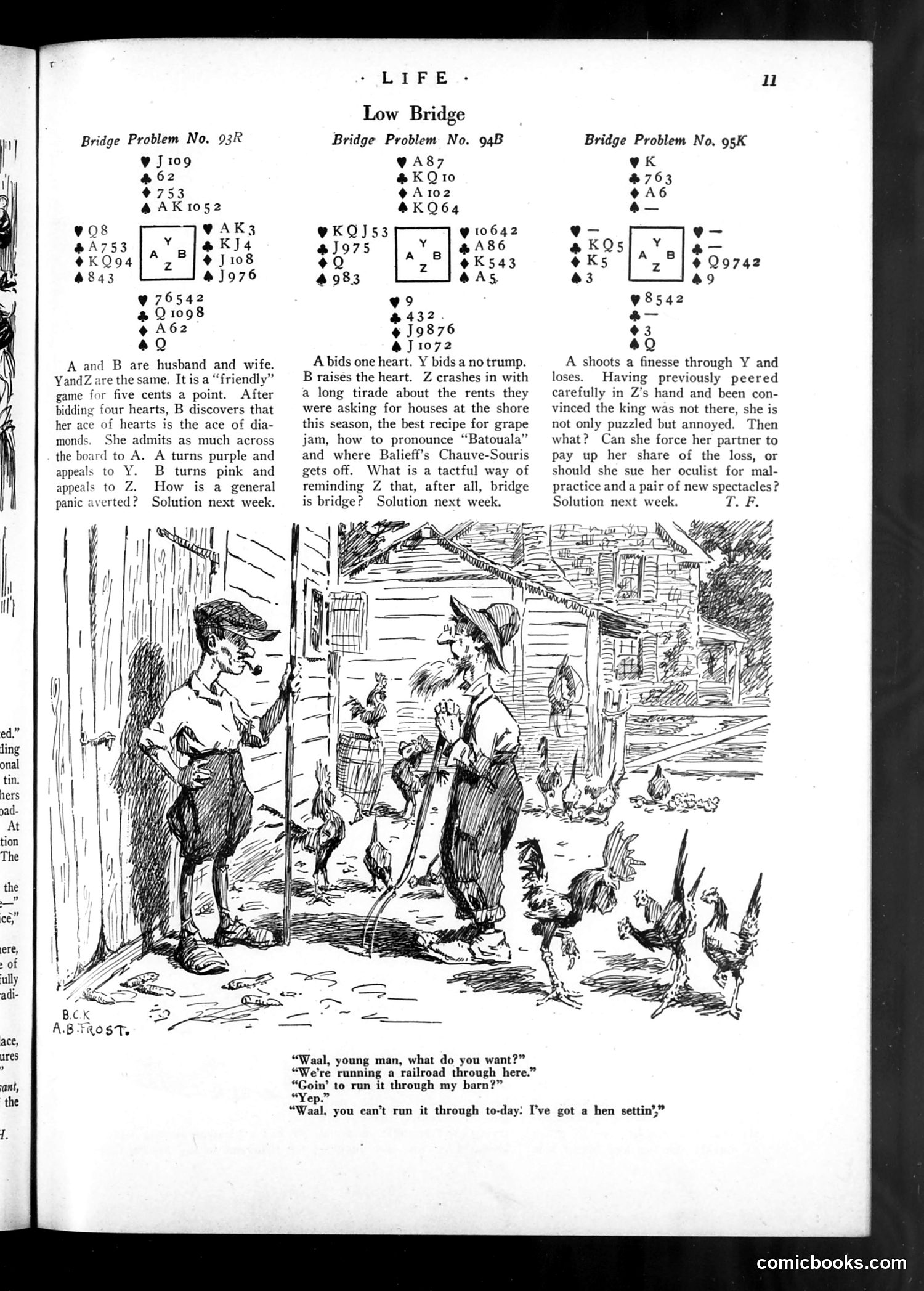
This page presents three bridge card game problems (numbered 93R, 94B, 95K) for readers to solve, followed by a humorous cartoon. The cartoon depicts two men in rural/farm attire discussing running a railroad through a barn. One man protests that he has "a hen settin'" (a brooding hen) and cannot allow it today. The joke satirizes the clash between modern industrial progress (railroad expansion) and traditional agricultural life. The farmer's concern for his hen's breeding schedule takes absurd priority over the railroad's construction needs—mocking rural resistance to industrialization, or perhaps the farmer's stubborn, narrow perspective when faced with major societal change. The casual, colloquial dialogue emphasizes the cultural gap between progress and agrarian tradition.
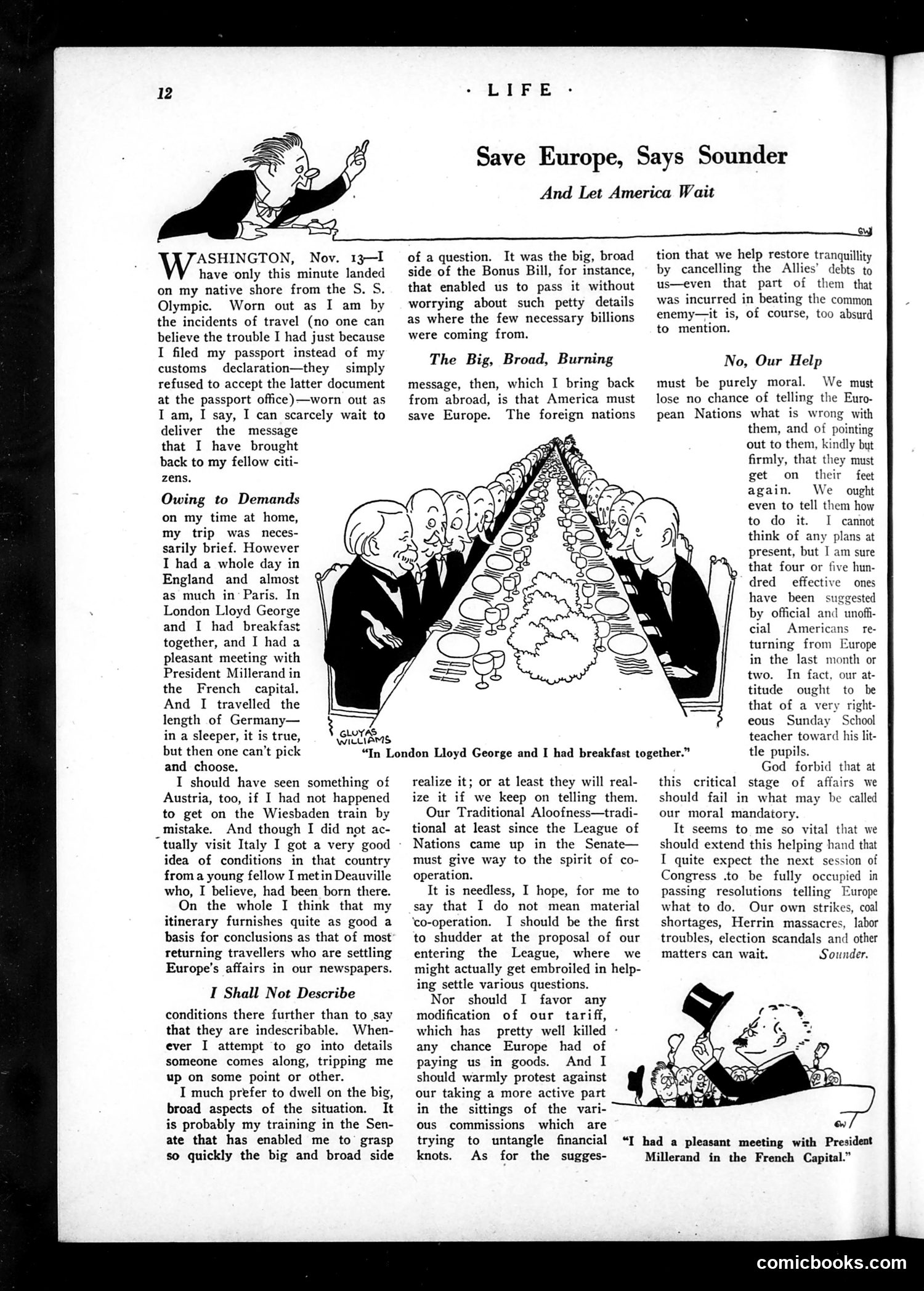
This **Life** magazine page features an article by "Sounder" arguing that America should focus on its own domestic problems rather than intervening in European affairs. The piece references recent travels through Europe, meetings with Lloyd George and President Millerand, and observations of Europe's desperate conditions. The central cartoon depicts a long dining table where European leaders appear to be at a meal together—likely representing peace negotiations or League of Nations discussions. The satire suggests European nations are engaged in their own affairs while America contemplates involvement. Sounder advocates **isolationism**, warning against American entanglement in European problems, particularly regarding the League of Nations. The headline's phrase "And Let America Wait" emphasizes prioritizing domestic concerns—strikes, coal shortages, and labor troubles mentioned in the text.
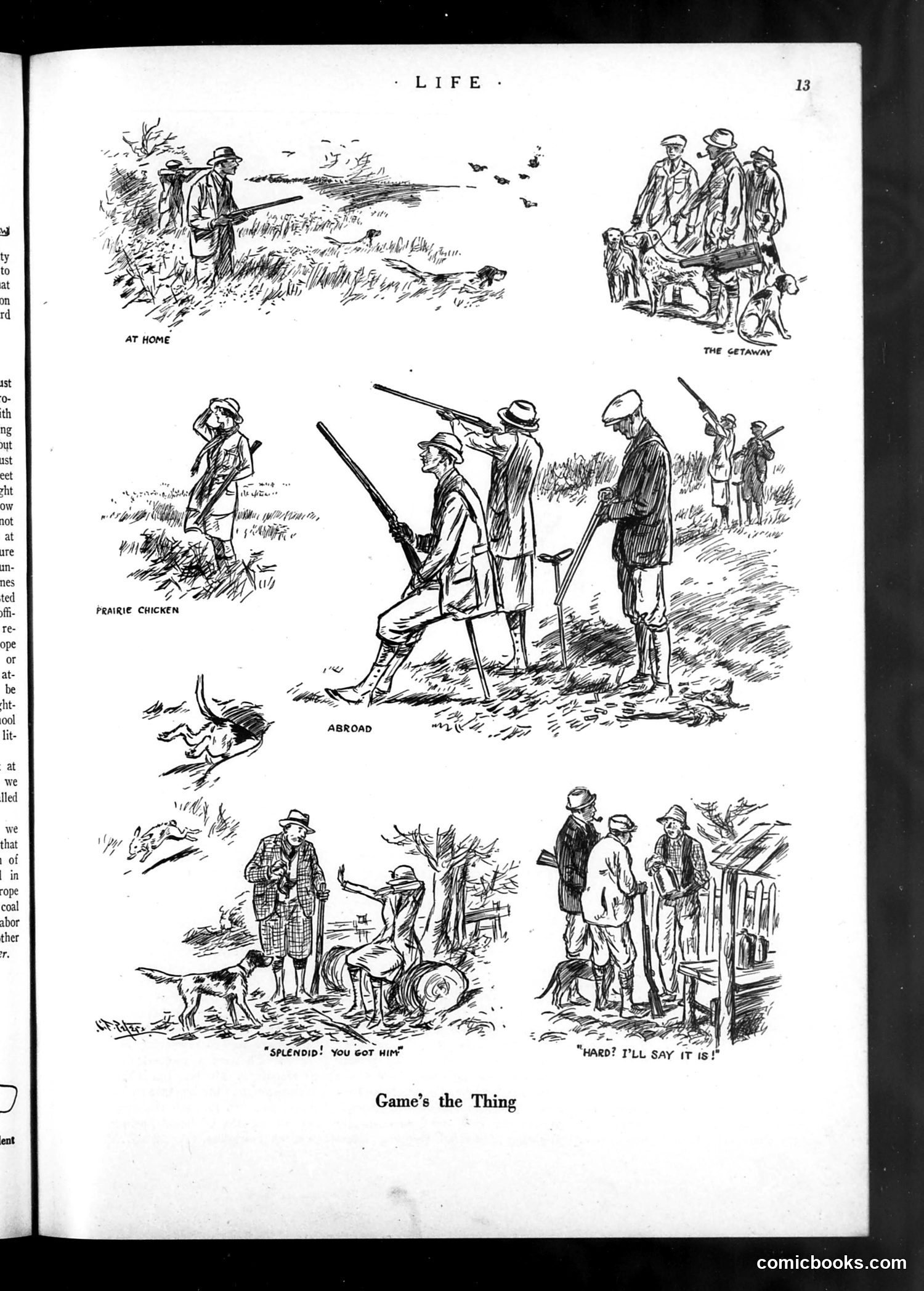
This page presents six sketches depicting hunting scenes, titled "Game's the Thing." The cartoons appear to satirize American hunting culture and the social attitudes surrounding it. The sketches show hunters in various scenarios: "At Home" (casual backyard shooting), "The Getaway" (departing for a hunting trip), "Prairie Chicken" (a specific hunt), "Abroad" (international hunting), and two bottom panels with dialogue—"Splendid! You got him!" and "Hard! I'll say it is!" The satire seems to mock hunters' pretensions and enthusiasm, the performative aspects of the hunting lifestyle, and possibly class distinctions between casual and serious sportsmen. The varied settings suggest commentary on hunting as both everyday activity and prestigious leisure pursuit for the wealthy.
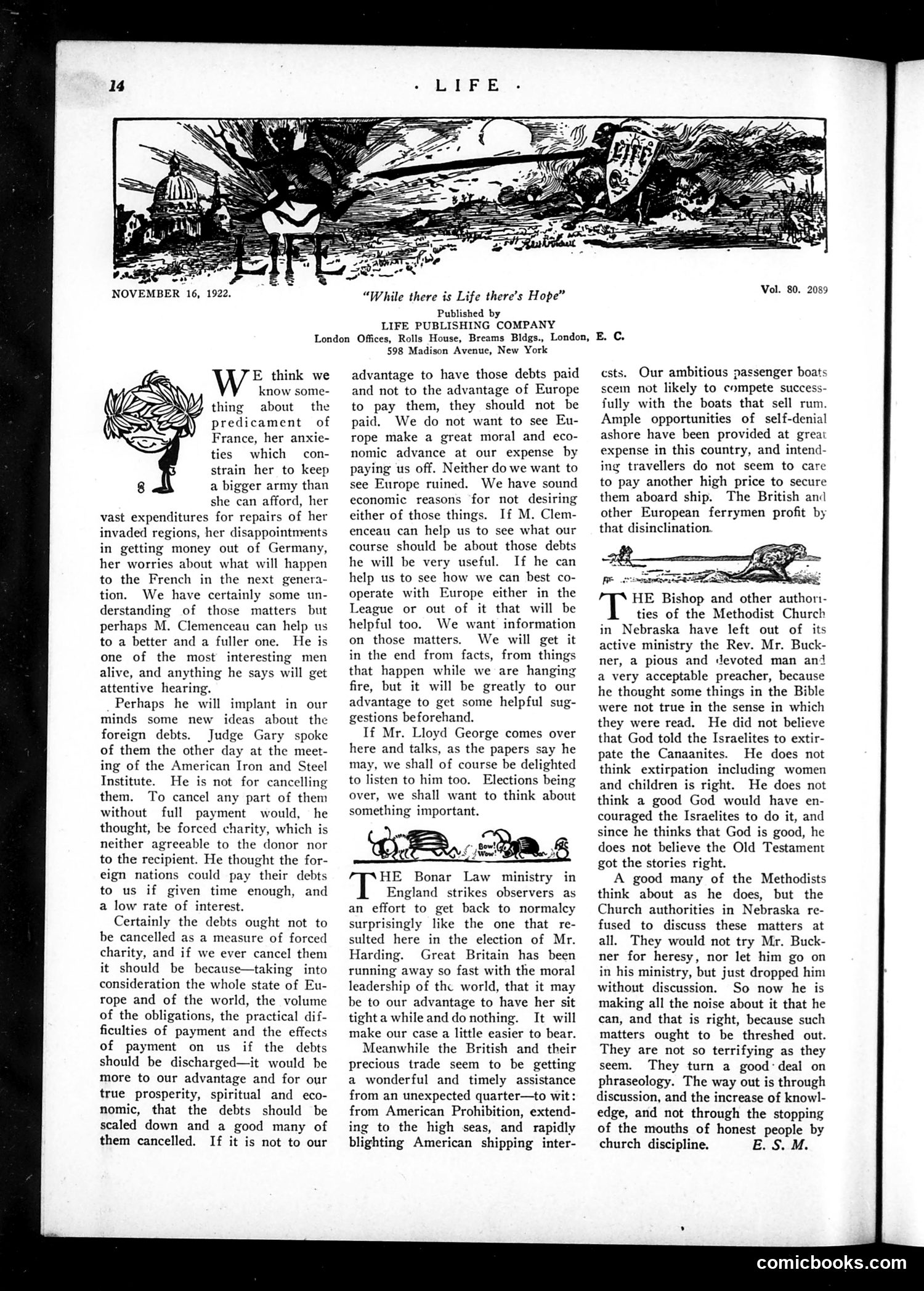
This page contains editorial commentary rather than political cartoons. The main article discusses post-World War I European war debts and reparations, referencing French premier M. Clemenceau and American Judge Gary. The author argues against canceling Allied debts while cautioning against excessive demands on Germany—balancing compassion for war-ravaged Europe with American economic self-interest. A secondary piece critiques Methodist Church leadership in Nebraska for avoiding discussion of controversial matters like Biblical interpretation. The author suggests that open debate and "church discipline" would better serve congregants than silence. The illustrated header and small decorative sketches are generic satirical vignettes unrelated to the specific content, typical of Life's design aesthetic of this era.
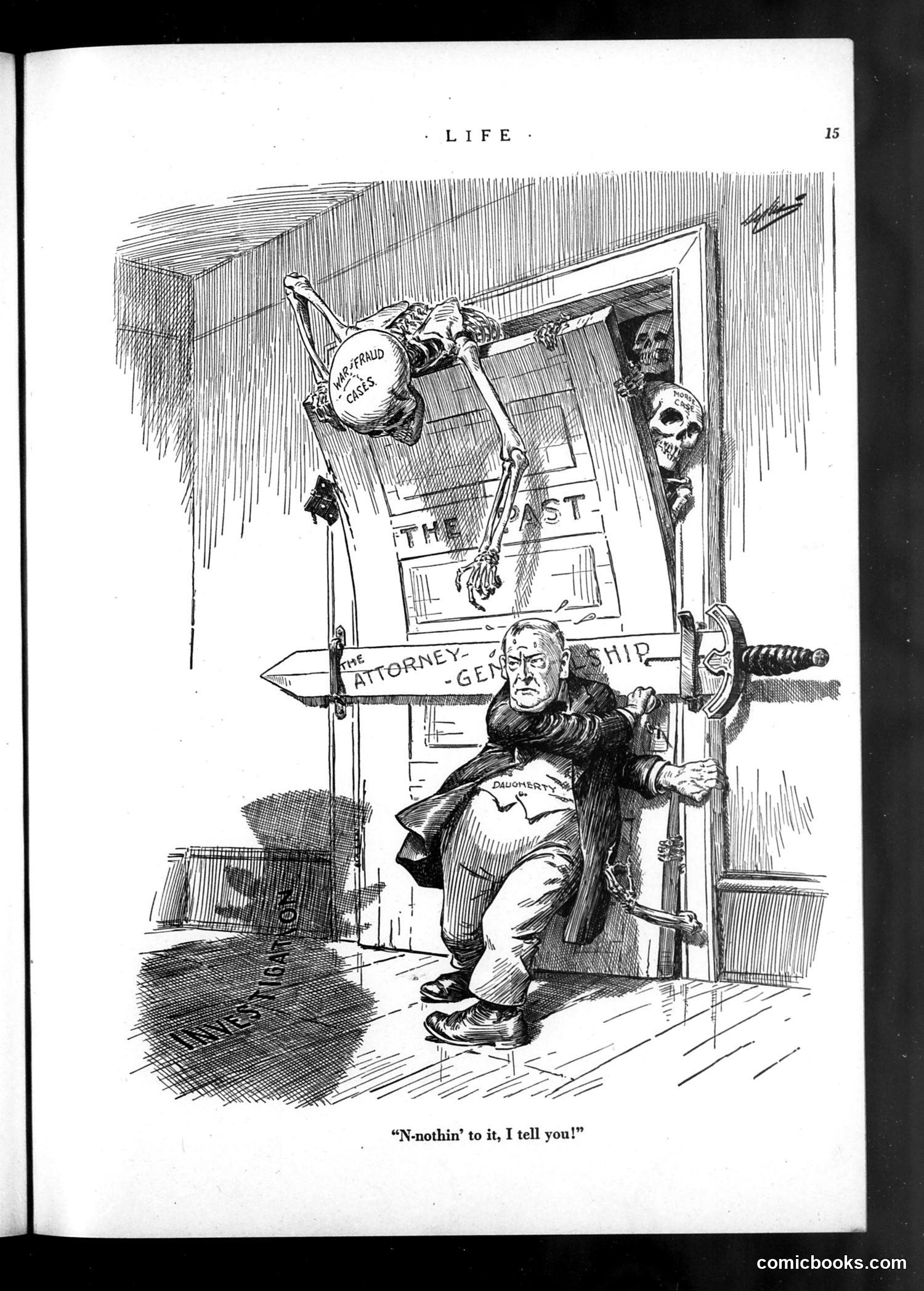
This satirical cartoon depicts a rotund man labeled "ATTORNEY-GENERAL" confidently gesturing while surrounded by threatening skeletal figures labeled "FRAUD" and "CALLS." The skeleton above holds a ball marked "FRAUD CALLS," while death's heads peer menacingly from doorways and windows marked with legal terms like "SHIP." The cartoon criticizes an Attorney General (likely from the early 20th century based on Life magazine's era) for dismissing serious concerns about fraud despite obvious evidence of criminal activity surrounding him. The skeletons represent death, danger, or consequences he's ignoring. His caption—"N-nothin' to it, I tell you!"—conveys false confidence in the face of clear wrongdoing, satirizing governmental complacency or corruption.
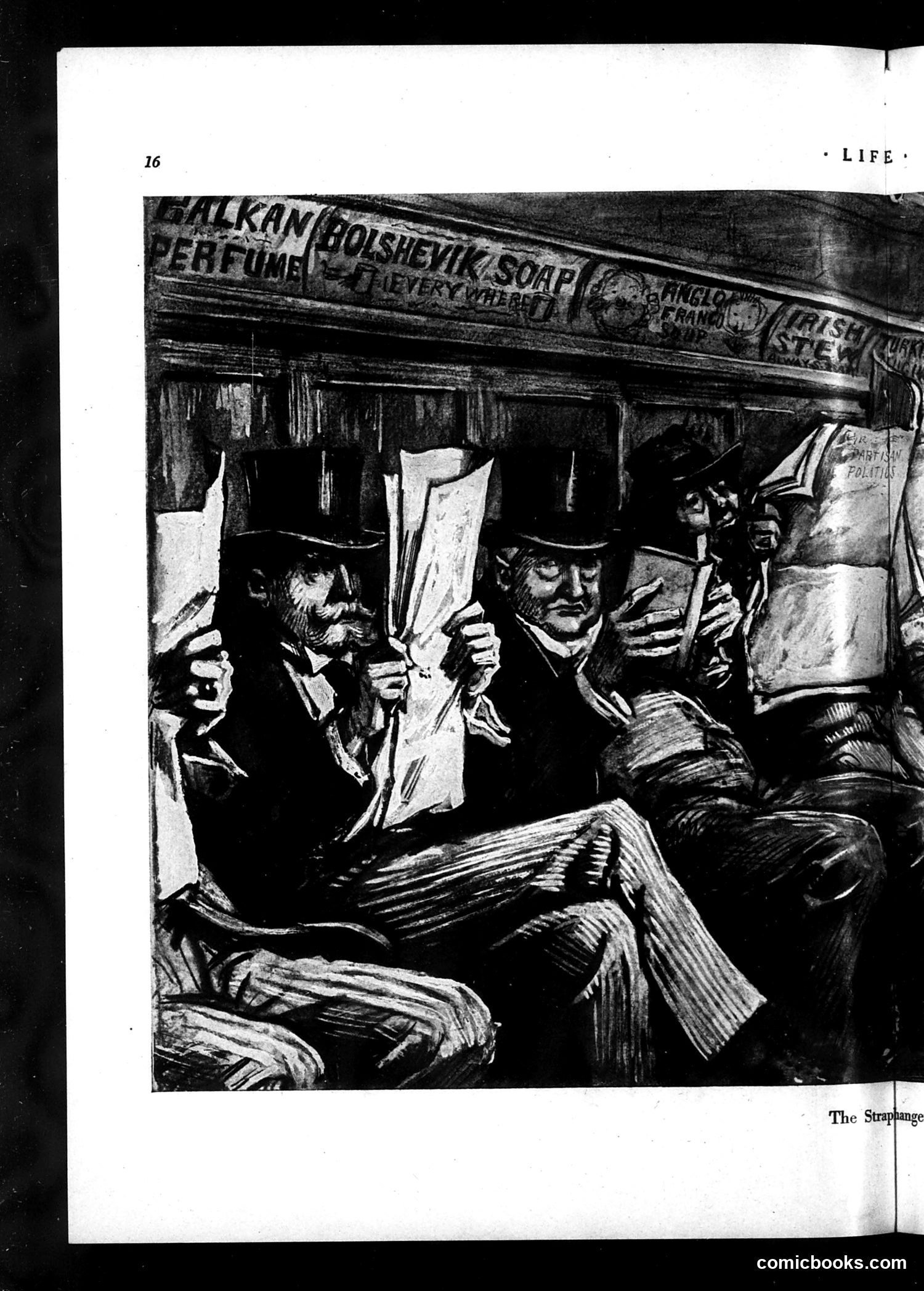
This appears to be a satirical illustration from *Life* magazine depicting a crowded public transit scene, likely a subway or trolley car. The image shows several working-class men in period dress (hats, coats) packed tightly together in what appears to be uncomfortable conditions—hence the caption's pun on "straphanger" (commuters holding overhead straps). The storefront sign visible above reads "BALKAN BOLSHEVIK SOAP" and other partially visible text, suggesting this cartoon may be satirizing contemporary anxieties about immigrant communities, Eastern European workers, or socialist/radical political movements during the early 20th century. The cramped, chaotic scene itself mocks urban commuting experiences and working-class life.
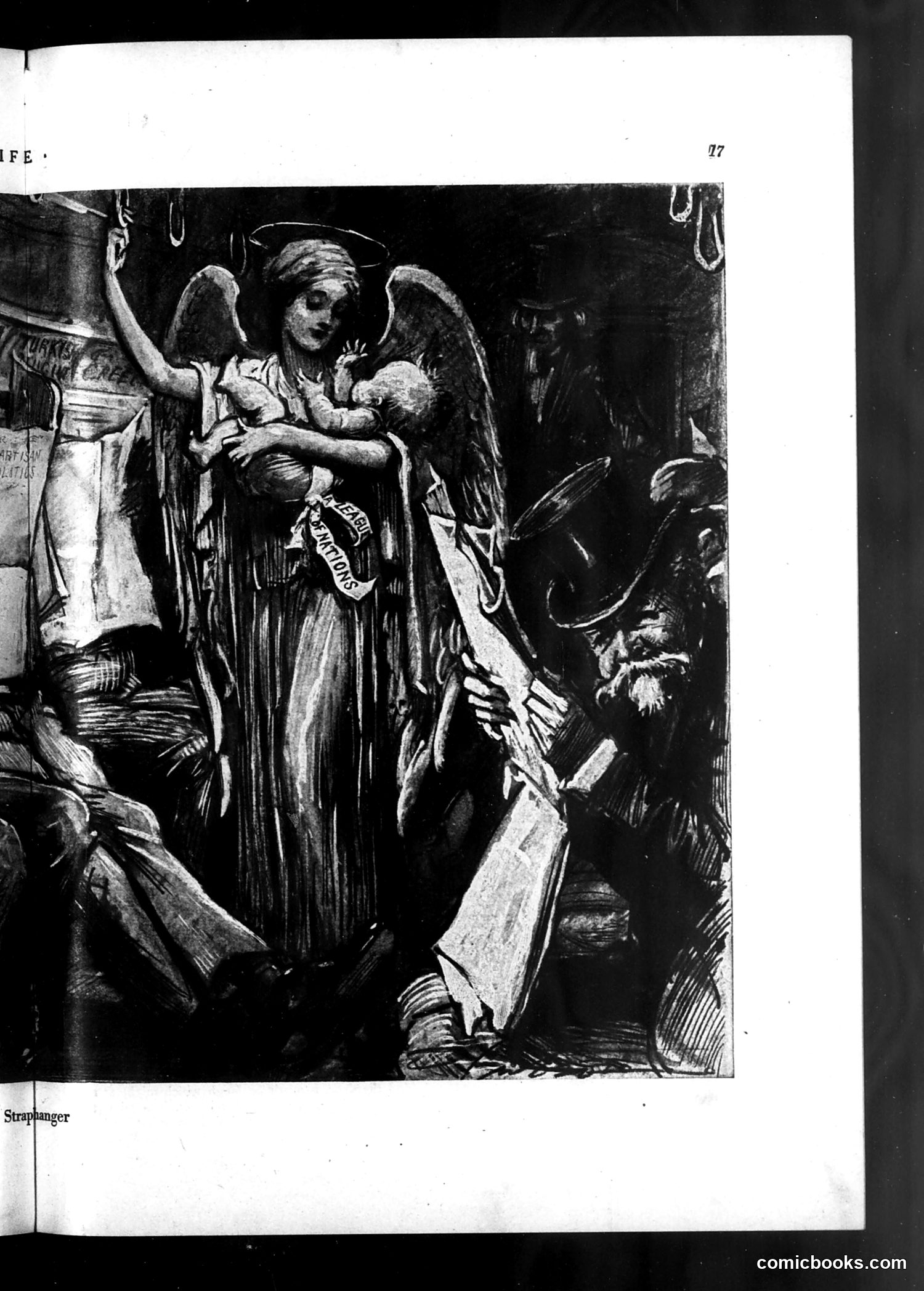
This appears to be a satirical engraving showing an angel figure holding what looks like a ballot or document, surrounded by demonic or devilish figures. The artist's name appears to be "Straphanger" (visible at bottom left). The central allegorical figure—winged and ethereal—seems to represent virtue, democracy, or the voting process itself, while the grotesque figures around her likely represent corruption, vice, or political opposition. The document she holds suggests this concerns elections or legislation. Without the publication date or clearer text, I cannot definitively identify the specific political event or figures being satirized. However, the composition uses classic allegorical symbolism common to 19th-century American political satire, contrasting noble ideals against darker forces threatening them.
This theater review critiques the current season's Music Box Revue, produced by Irving Berlin (implied as "Mr. Berlin"). The satire targets the show's reliance on expensive spectacle over substance. **Key figures mentioned:** - Irving Berlin (producer/composer) - Hassard Short (director/designer) - Bobby Clark (performer, noted as funny) - The Rath Brothers, John Steel, Grace LaRue, Charlotte Greenwood, and the Fairbanks Twins (supporting performers) **The satire's point:** Despite lavish spending on mechanical effects, costumes, and stage machinery ("solid gold dumbwaiters," "freight elevators"), the underlying show is mediocre. The reviewer mocks the irony that expensive technical failures (malfunctioning electric effects, awkward staircases) actually damage the production more than simpler, cheaper designs would. **Social context:** This reflects 1920s Broadway's trend toward increasingly elaborate musical revues. The critique suggests audiences were becoming sophisticated enough to recognize when spectacle masked poor artistic quality—that money alone cannot guarantee entertainment. The tone is witty and somewhat dismissive of Berlin's excessive production choices.
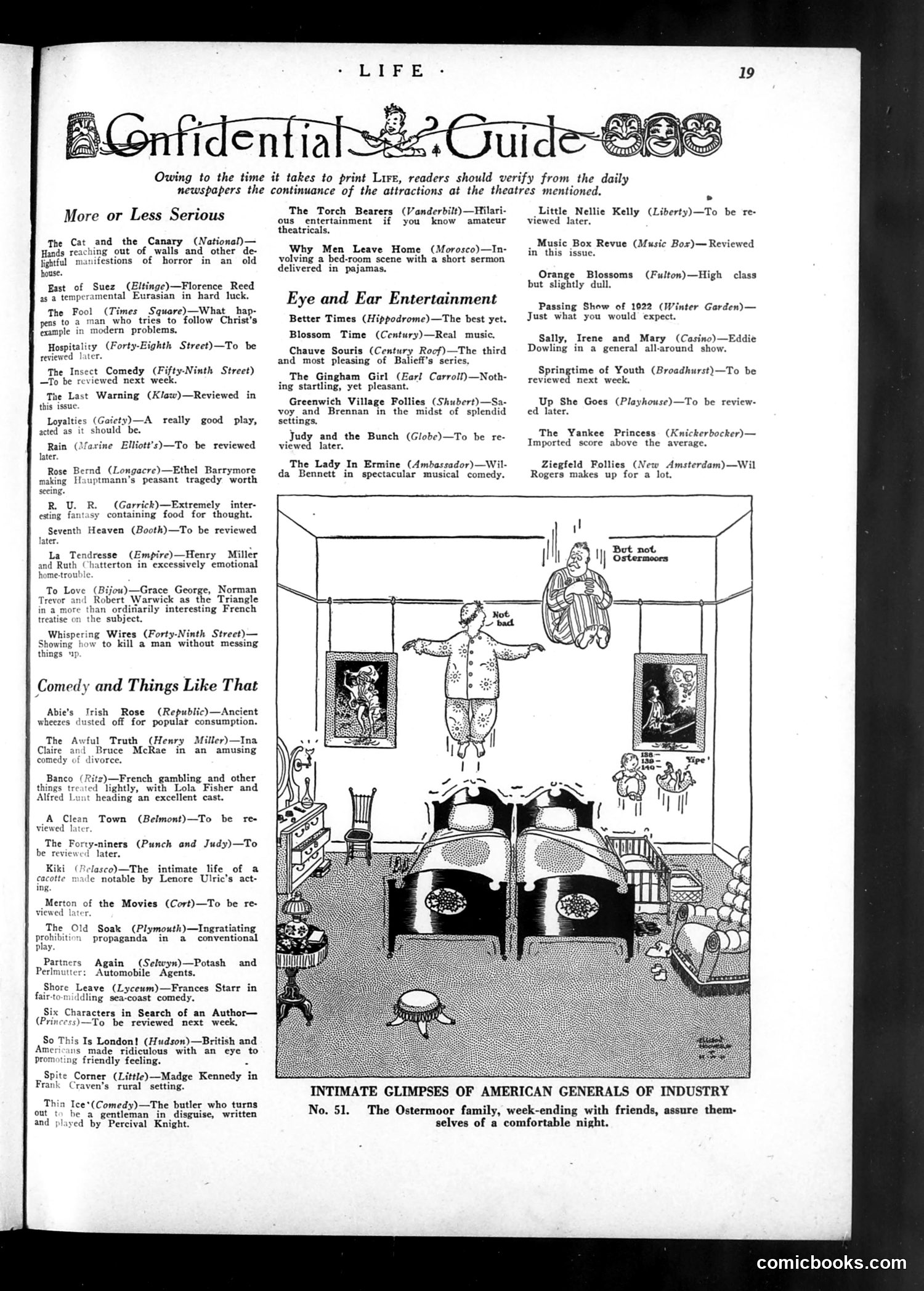
This is a theater guide from *Life* magazine reviewing current Broadway productions (approximately 1922, based on show titles like "The Old Soak," which references Prohibition). The main illustration satirizes wealthy industrialists—"American Generals of Industry"—as bloated, self-satisfied figures lounging comfortably in an oversized bedroom, surrounded by servants and luxuries. The cartoon mocks the excess and comfort of America's industrial elite during the prosperous post-war 1920s. The exaggerated proportions and domestic leisure setting suggest satirical commentary on their isolation from ordinary people's concerns. The left column lists theatrical reviews, ranging from serious dramatic productions (Ethel Barrymore in "Rose Bernd") to light comedies and musical revues, reflecting the diverse entertainment available to affluent New Yorkers of the era.
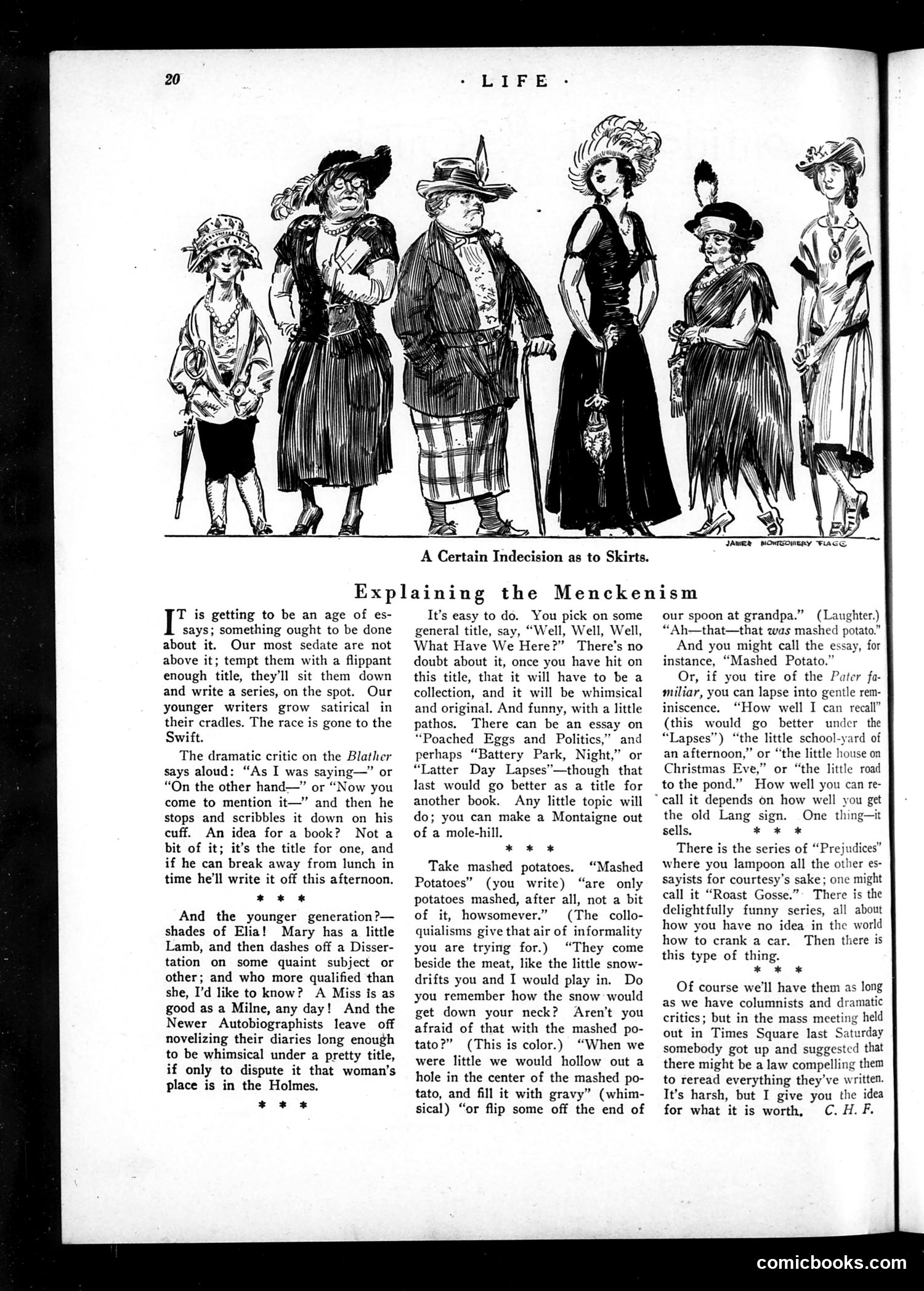
This page from *Life* magazine satirizes the early 20th-century essay craze, particularly the influence of H.L. Mencken's satirical style ("Menckenism"). The article mocks writers who churn out whimsical, pseudo-profound essay collections with clever titles drawn from everyday subjects—like "Mashed Potatoes" or "Poached Eggs and Politics." The cartoon at top shows six women in different skirt styles, illustrating the article's opening about fashion indecision. The satire targets essayists who adopt false profundity and affected nostalgia to elevate trivial topics. The piece ridicules both established critics and "younger writers" who adopt this formulaic approach—pick a title, write something personal and quirky, sprinkle in colloquialisms for "informality," and publish as a collection. The author suggests these essays follow predictable patterns: childhood reminiscence, gentle whimsy, or attacking other essayists. The Times Square reference suggests this was a widespread cultural phenomenon worthy of public mockery.
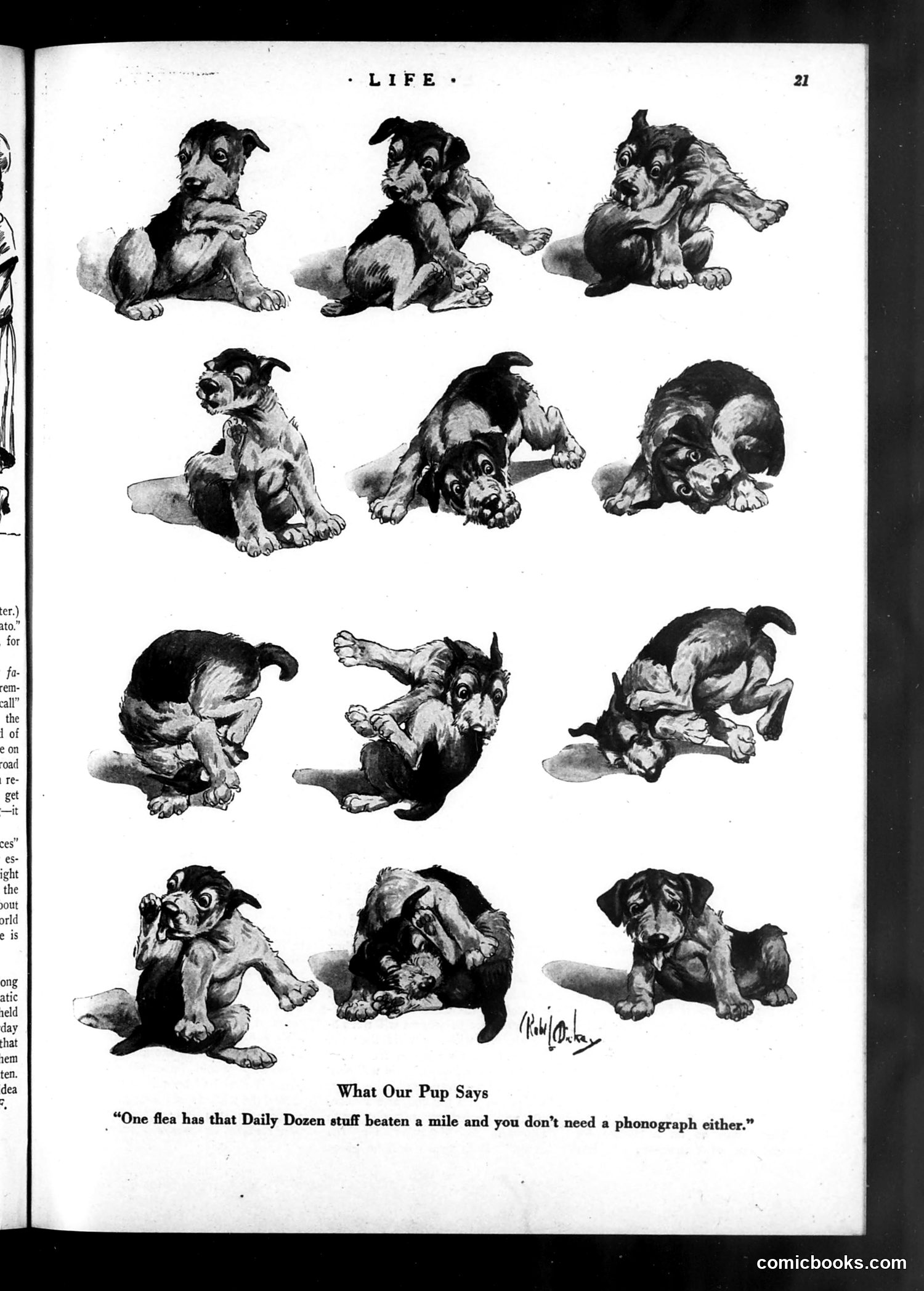
This page presents a humorous illustrated series titled "What Our Pup Says," featuring twelve sketches of dogs in various playful and expressive poses. The accompanying caption is a joke attributed to a dog character, making a comedic comparison about exercise. The humor references two 1920s-era fitness trends: the "Daily Dozen"—a popular exercise routine promoted through radio broadcasts and phonograph records—and flea scratching. The joke suggests that a dog being bitten by a single flea provides more vigorous, amusing physical activity than the trendy Daily Dozen workout routine, and requires no phonograph record to accompany it. The cartoonist, likely addressing readers interested in both pet humor and contemporary wellness fads, uses the dog's perspective to gently satirize the era's obsession with systematic exercise programs.
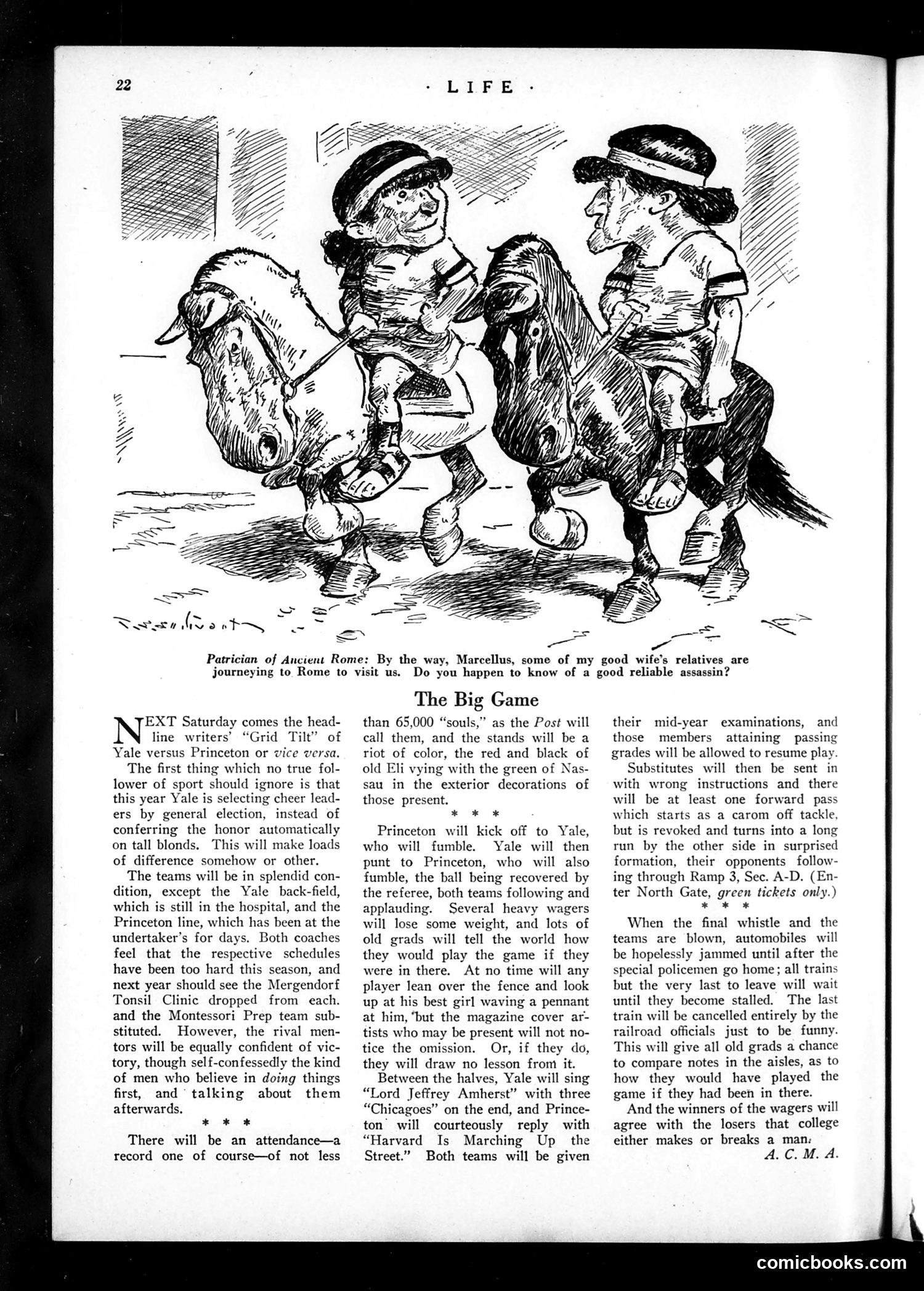
The cartoon depicts two rotund, caricatured figures on horseback—likely representing Yale and Princeton—in ancient Roman dress, making a joke about the upcoming football rivalry. The article satirizes college football culture with heavy irony. It mocks the predictable nature of the Yale-Princeton game: fumbles, incompetent play, overcrowded attendance, and old graduates claiming they could play better. The satire targets multiple targets: the superficiality of cheerleader selection ("instead of conferring the honor automatically on tall blonds"), the physical state of players ("hospital," "undertaker's"), excessive wagering, and the ritualistic post-game complaints by alumni. The caption's reference to "a good reliable assassin" continues the Roman-era joke, sardonically suggesting the game's violence or absurdity warrants such measures. Throughout, the author (A.C.M.A.) employs deadpan sarcasm to critique college sports excess and the predictable mythology surrounding this annual rivalry.
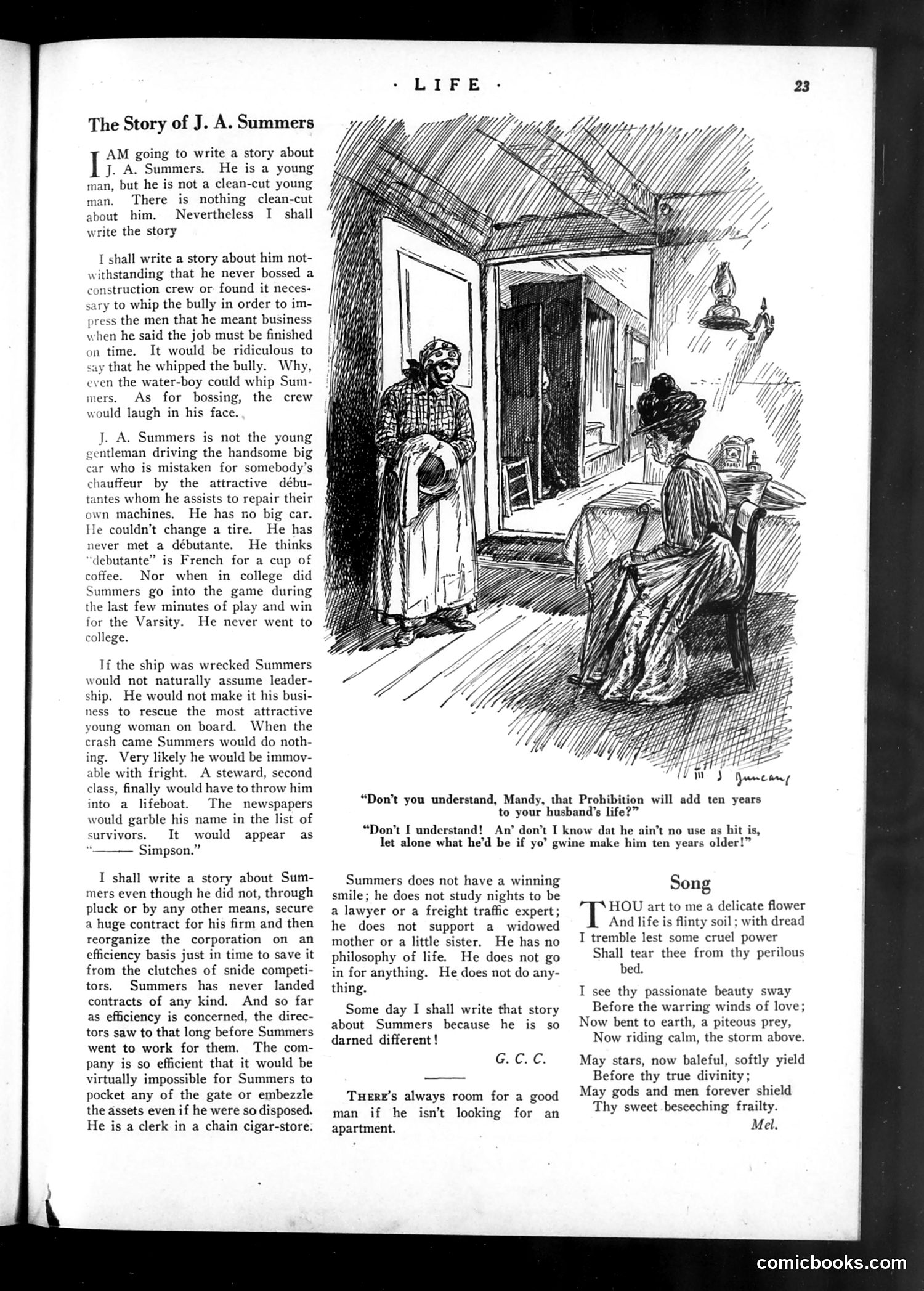
This page satirizes the formulaic "success story" popular in early 20th-century American literature and magazines. The author announces he will write about J. A. Summers—not despite his ordinariness, but *because* of it. The satire mocks conventional protagonist archetypes: the tough construction boss, the wealthy gentleman, the college sports hero, the shipwreck rescuer. Summers is none of these. He's an unremarkable cigar-store clerk who couldn't change a tire, knows nothing of "debutantes," and would freeze in a crisis. The humor lies in the contrast between literary convention (where ordinary men prove themselves through dramatic action) and reality (where most people accomplish nothing remarkable). The accompanying cartoon shows a domestic scene about Prohibition—a contemporary social issue—reinforcing the magazine's satirical tone about everyday life versus heroic narratives. The piece champions anti-heroic realism, suggesting worthy stories exist about genuinely ordinary people precisely *because* they're different from stock characters.
This page contains **film reviews**, not political cartoons. The large "Silent Drama" header indicates this is a cinema critique section. The reviews discuss two movies: 1. **"Robin Hood"** — Praised as an exceptional film starring Douglas Fairbanks. The reviewer celebrates it as superior entertainment, noting Fairbanks invested heavily in this production as a "do-or-die" artistic venture. Wallace Beery is singled out for his performance as Richard the Lionheart. The review emphasizes the film's quality craftsmanship and entertainment value during a period when "the general trend of the silent drama has been steadily downward." 2. **"The Impossible Mrs. Bellew"** — A dismissive review of a Gloria Swanson film, sarcastically described as essentially "a succession of close-ups of Gloria Swanson's eyelids" with minimal plot substance. The page reflects early 1920s cinema criticism, celebrating artistic ambition while mocking vapid star vehicles. No political satire is present—this is straightforward entertainment journalism.
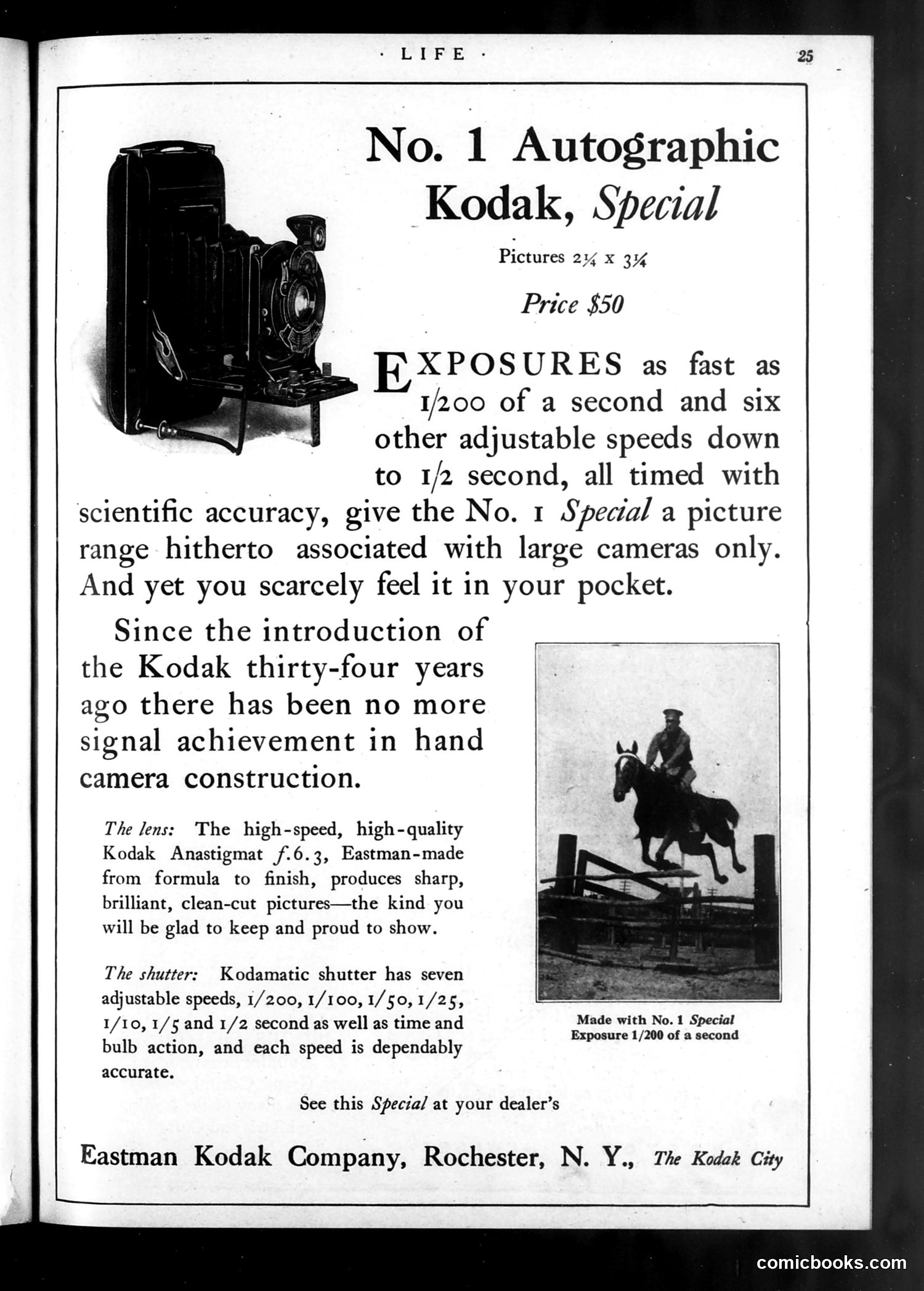
This is a **product advertisement**, not political satire. It promotes Eastman Kodak's "No. 1 Autographic Kodak, Special" camera, priced at $50. The page features the camera itself on the left and a sample photograph on the right—an action shot of a horse and rider jumping a fence, captioned as taken at 1/200th of a second exposure. This image serves as proof of the camera's technical capabilities. The ad emphasizes the camera's portability ("scarcely feel it in your pocket") while offering fast shutter speeds and sharp optics previously available only in larger cameras. The text highlights Kodak's 34-year history and touts the high-quality Anastigmat lens and accurate Kodamatic shutter with seven adjustable speeds. The humor (if any) lies in the dramatic contrast between the camera's small size and its professional-grade performance—a selling point for consumers transitioning from bulky equipment.
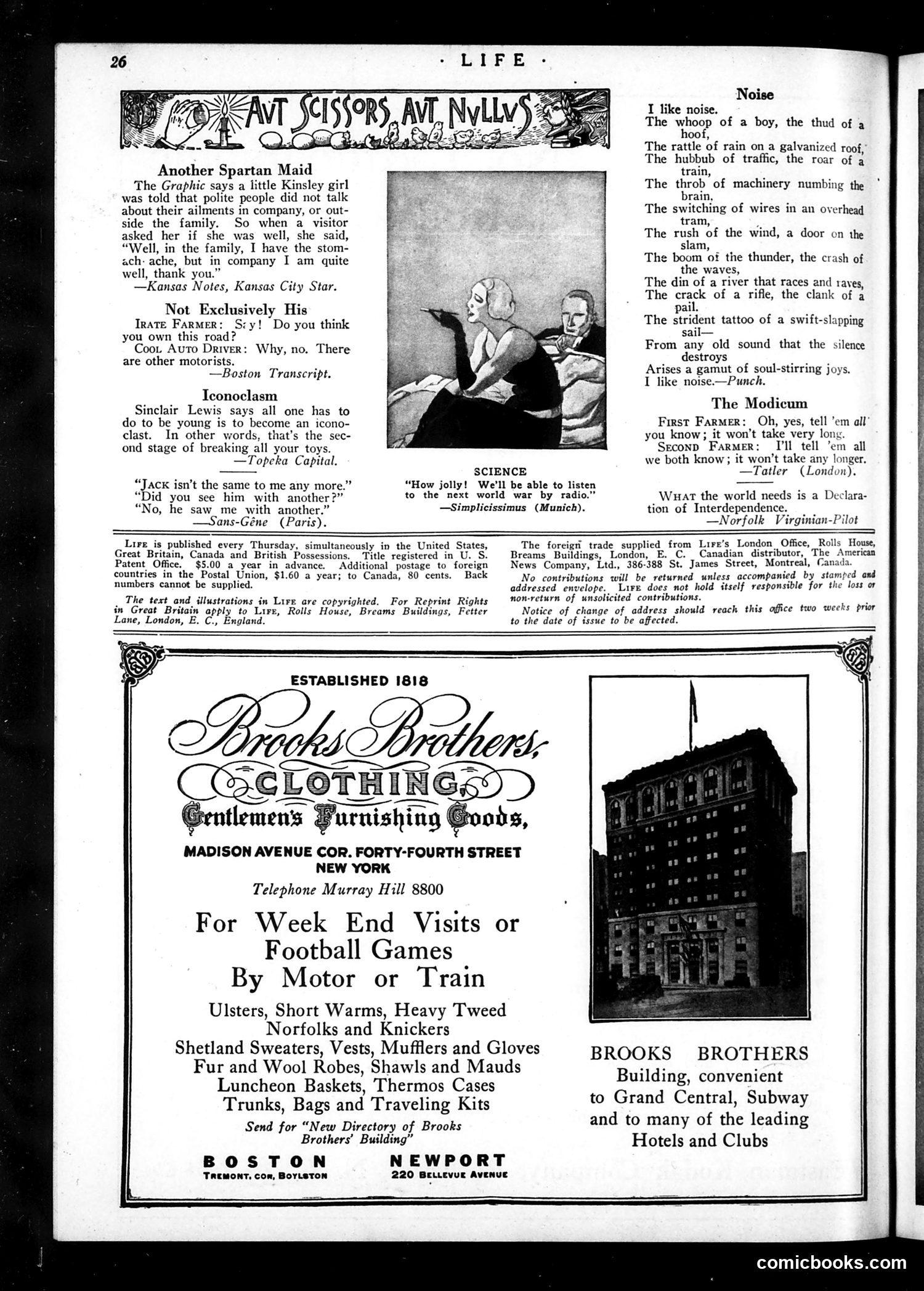
This page contains **short humorous anecdotes and satirical commentary** rather than political cartoons. The main content includes: **Featured Jokes:** - "Another Spartan Maid": A child's innocent misunderstanding of politeness etiquette—she distinguishes between family and public behavior regarding ailments - "Not Exclusively His": A rural farmer confronted by an early automobile driver; humor derives from the farmer's outdated assumption he owns the road - "Iconoclasm": Commentary on Sinclair Lewis's definition of youth as rule-breaking **Miscellaneous Satire:** - A Munich publication jokes about future radio broadcasts of wars - A Parisian anecdote about infidelity - A poem celebrating urban industrial noise (published in Punch) - Two farmers' exchange mocking rural ignorance **Context**: This represents Life's style of reprinting international humor and social commentary. The anecdotes mock rural attitudes, changing technology (automobiles), and modern industrial society—reflecting 1920s urban sophistication looking down on traditional American life. The page is primarily **advertising** (Brooks Brothers clothing dominates the lower half).
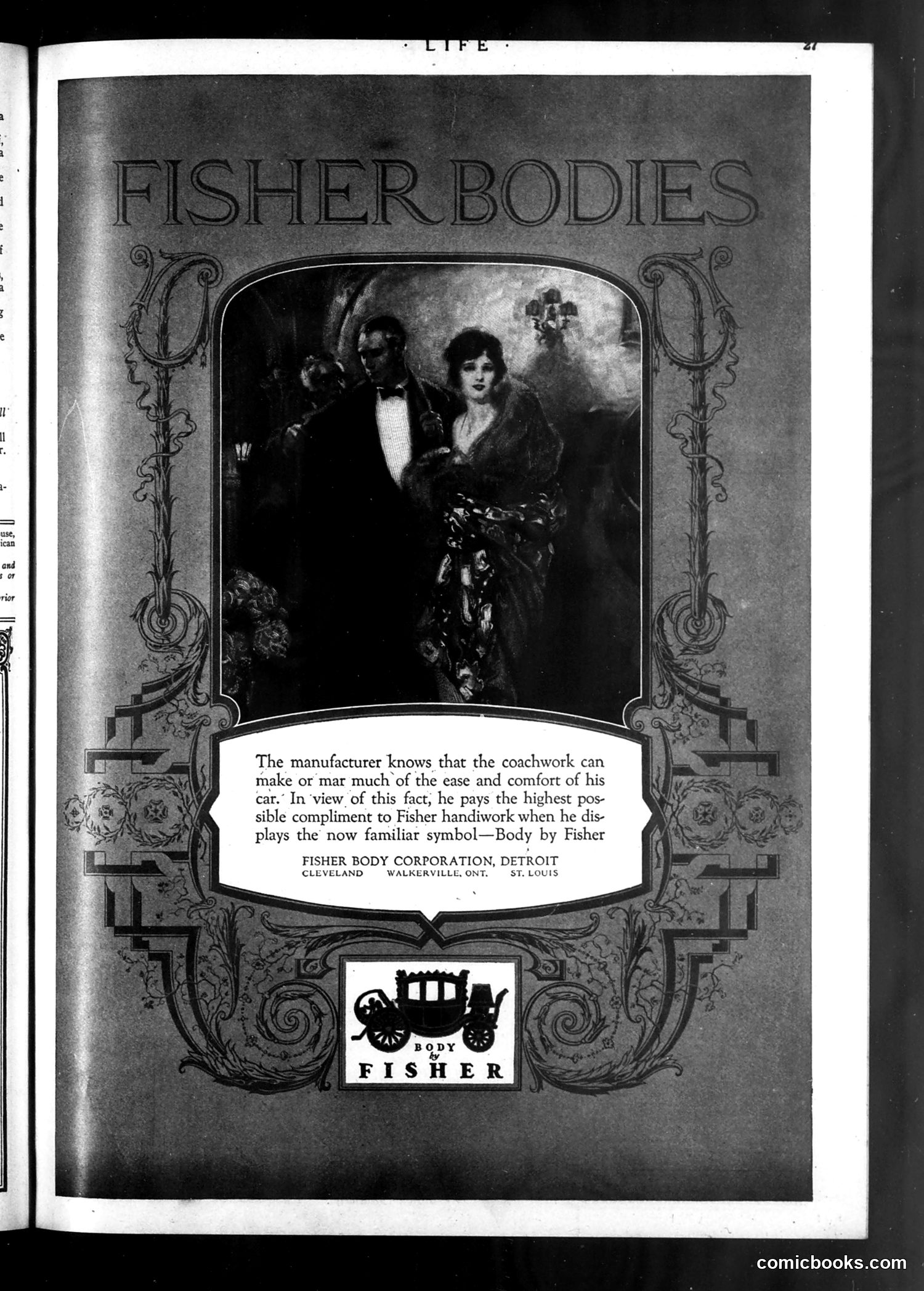
This is a **Fisher Body Corporation advertisement**, not satire. It appears in Life magazine promoting Fisher's automobile body manufacturing. The ad features an elegantly dressed couple in formal attire, illustrating the quality and sophistication associated with Fisher-built car bodies. The text argues that manufacturers trust Fisher's craftsmanship to enhance their vehicles' comfort and appeal—so much so that displaying the "Body by Fisher" trademark becomes a mark of prestige. The ornate decorative border and dramatic photograph suggest luxury and refinement, positioning Fisher bodies as a premium component comparable to a designer label. This represents early automotive branding, when car body construction was a distinct specialty often marketed separately from engine manufacturers.
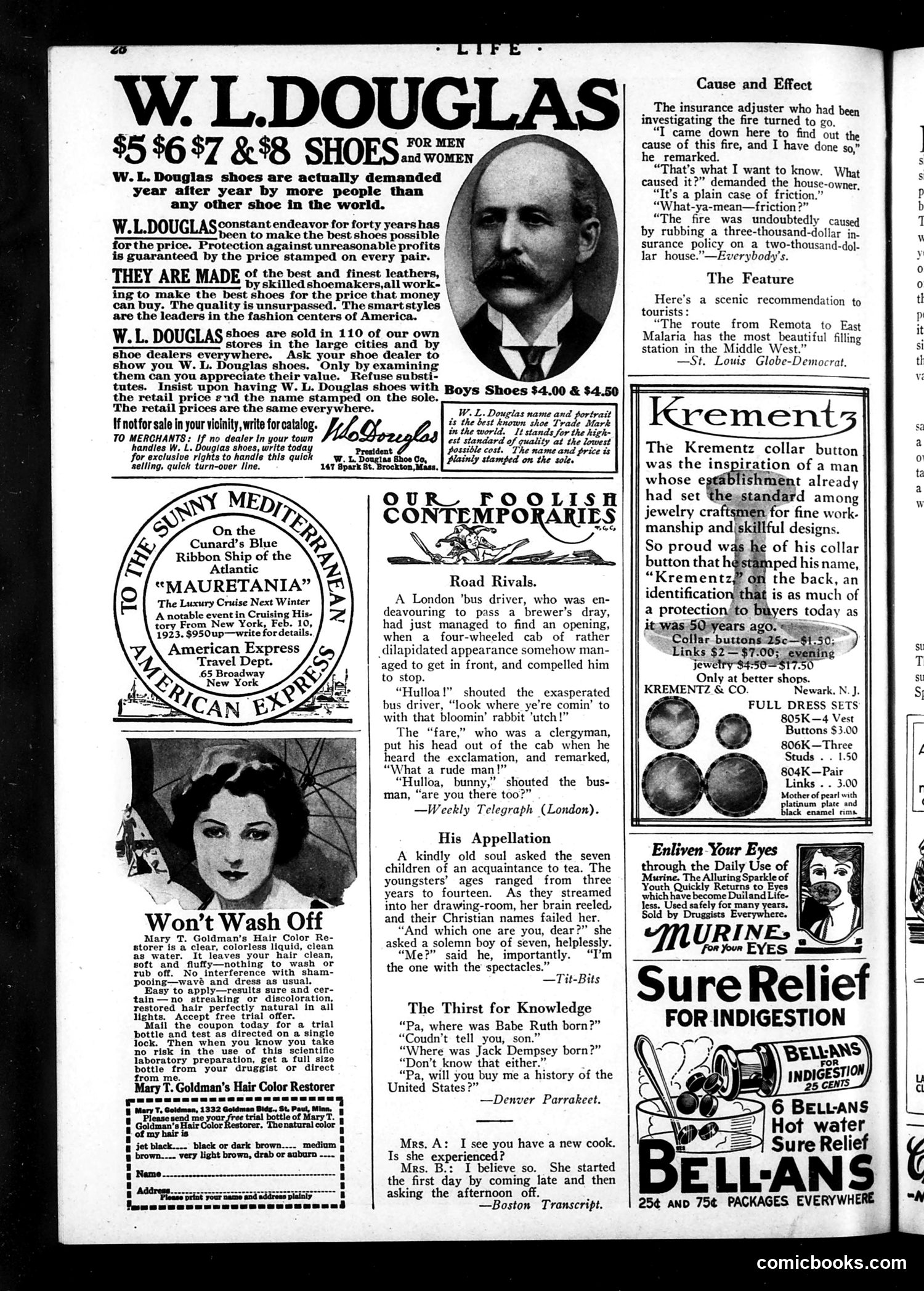
This brief joke satirizes insurance fraud and dishonest claims. An insurance adjuster investigates a house fire and tells the owner he's found "the cause"—but his explanation is a cynical pun: the fire resulted from "friction" between the property's actual value ($2,000) and its inflated insurance coverage ($3,000). The joke mocks both parties: the owner for over-insuring property (suggesting intentional fraud), and the adjuster for implying the discrepancy itself caused the fire. It's a veiled accusation of arson motivated by profit—a common concern during this era of insurance abuse. The satire works by presenting the "cause" as deliberately obtuse wordplay rather than actual investigation, highlighting the moral hazard created when insurance payouts exceed real property value.
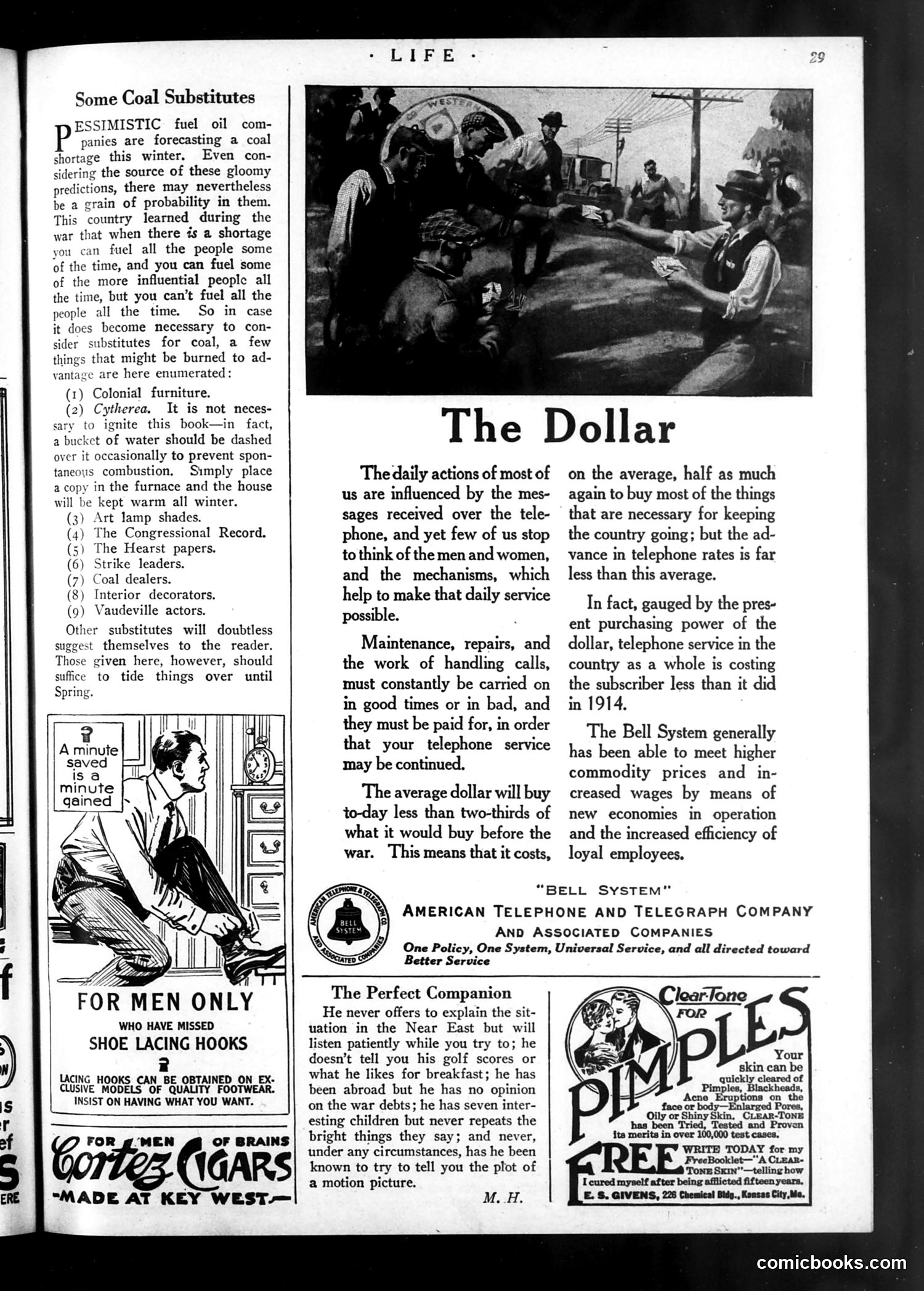
This humorous article mocks potential coal shortages by proposing absurd alternatives to burn for fuel. The satire targets unpopular figures and institutions of the era: - **Congressional Record** and **Hearst papers** mock politicians and yellow journalism - **Strike leaders** and **coal dealers** jab at labor agitators and profiteering suppliers - **Interior decorators** and **Vaudeville actors** are trivial luxury figures - **Colonial furniture** and the book *Cytherea* (apparently risqué) represent disposable upper-class possessions The joke's premise—that you can't fuel "all the people all the time"—references wartime rationing lessons. By suggesting burning these targets instead of coal, Life satirizes contemporary annoyances: corrupt politicians, sensationalist media, labor unrest, and frivolous wealth. The piece reflects post-WWI anxieties about shortages and class tensions, using dark humor to critique society's priorities.
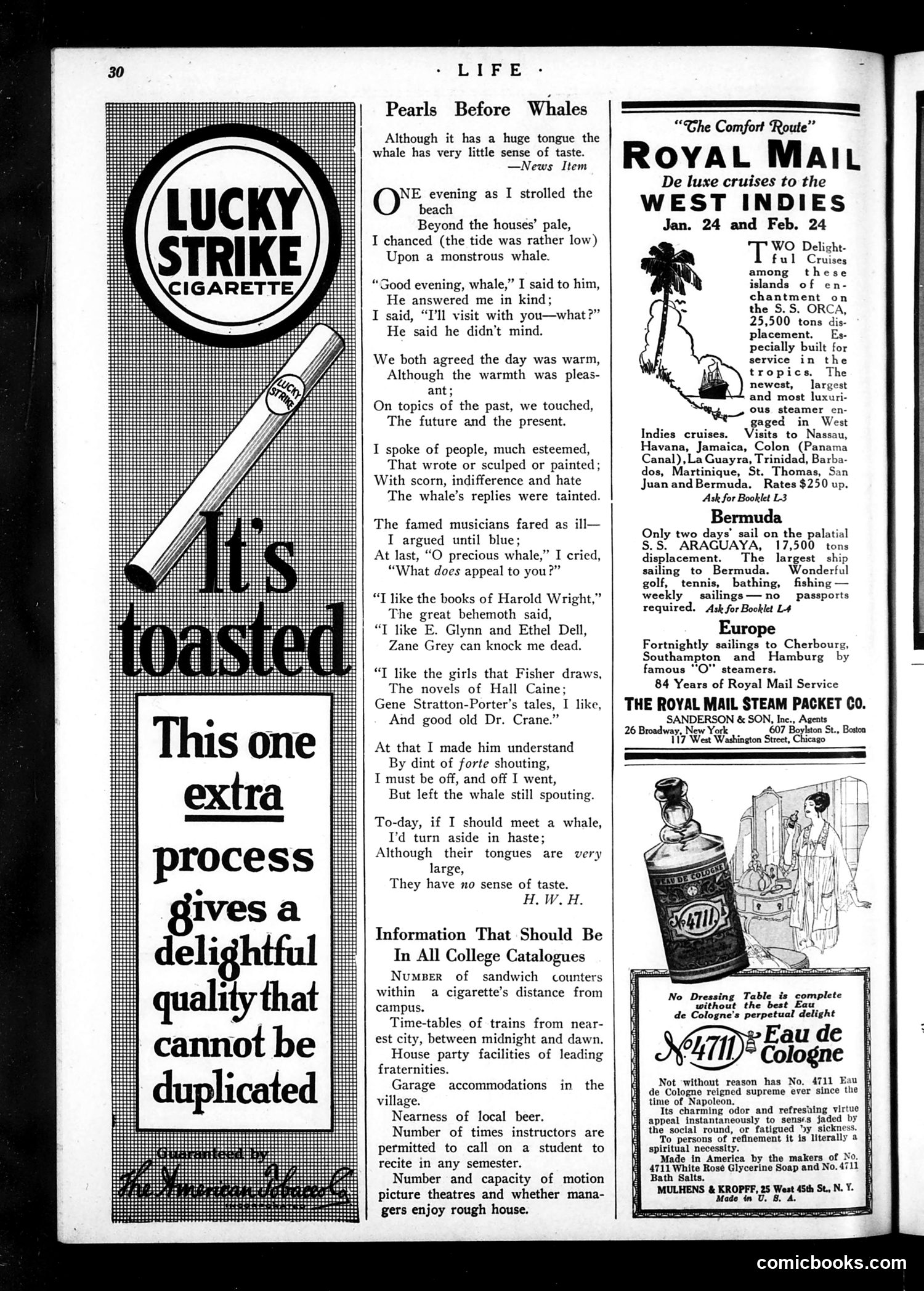
This humorous poem satirizes poor literary taste. A narrator encounters a whale and attempts to impress it by discussing esteemed artists, musicians, and serious authors. The whale, however, dismisses these cultural figures with scorn and instead enthusiastically praises popular, commercially successful but critically dismissed writers: Harold Wright, Elinor Glyn, Ethel Dell, and Zane Grey. The joke relies on a biblical reference—"pearls before swine"—suggesting that refined culture is wasted on those incapable of appreciating it. By making the whale represent lowbrow tastes, the poem mockingly compares readers of pulp fiction and romance novels to animals lacking refined sensibility. The title's wordplay (whales have large tongues but "no sense of taste") reinforces this critique of mass-market literary preferences versus elite cultural standards—a common modernist-era anxiety about democratized publishing.
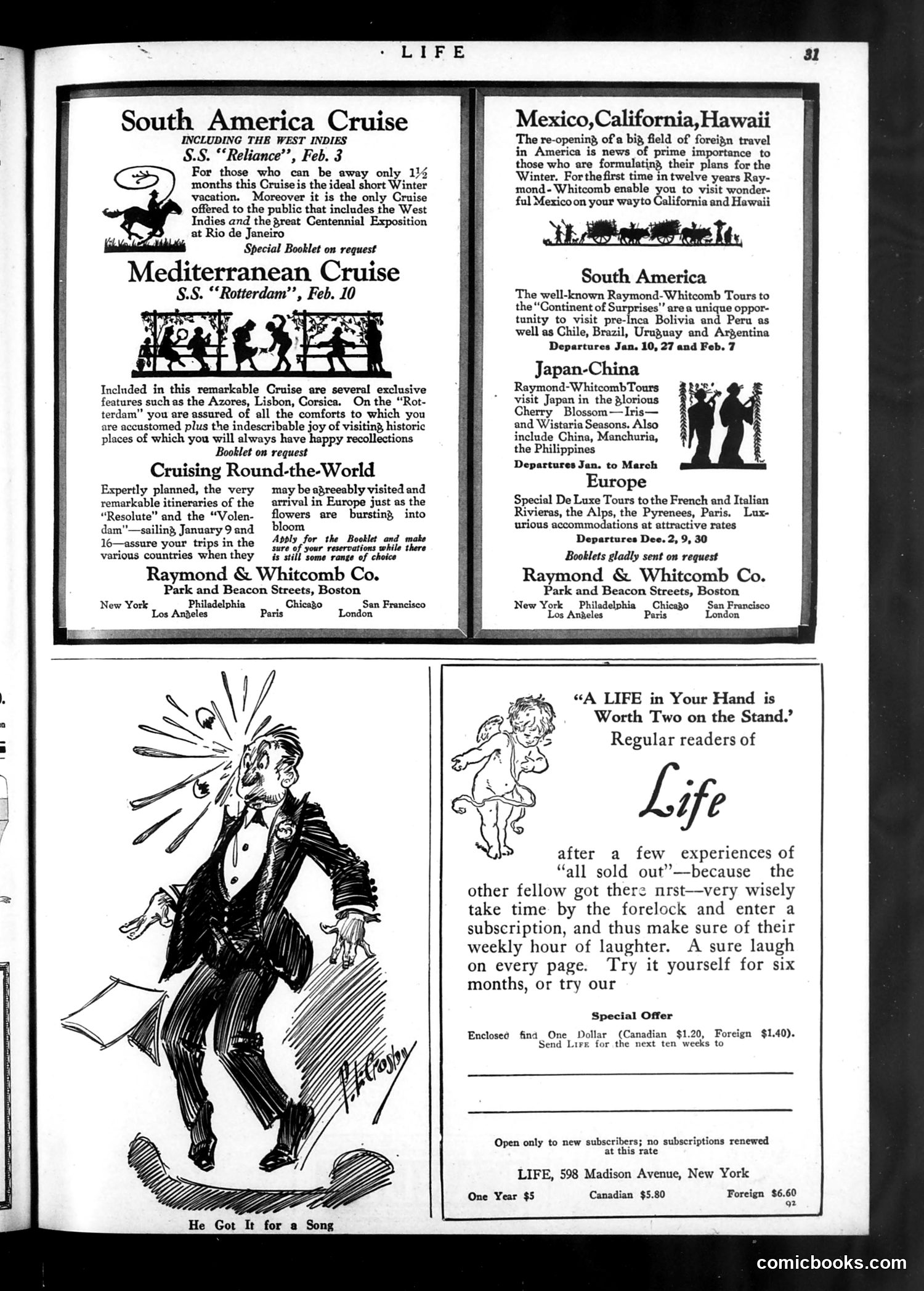
This is primarily a **travel advertisement page** from Life magazine, featuring cruise and tour offerings from Raymond & Whitcomb Co. The advertisements promote luxury vacations to exotic destinations (South America, Mediterranean, Japan, Europe, Mexico, Hawaii) during the winter season—appealing to affluent readers planning leisure travel. The only cartoon on the page is titled **"He Got It for a Song,"** showing a frantic businessman being struck by papers. This illustrates Life's subscription pitch: the cartoon suggests that missing out on issues causes frustration ("all sold out"), so readers should subscribe to guarantee weekly access to the magazine's humor and satire. The page reflects early 20th-century American leisure culture, when international cruising was luxury entertainment for the wealthy. The emphasis on "re-opening" Mexico and the West Indies suggests recent travel restrictions (likely post-WWI), making these routes newly accessible again to American travelers.
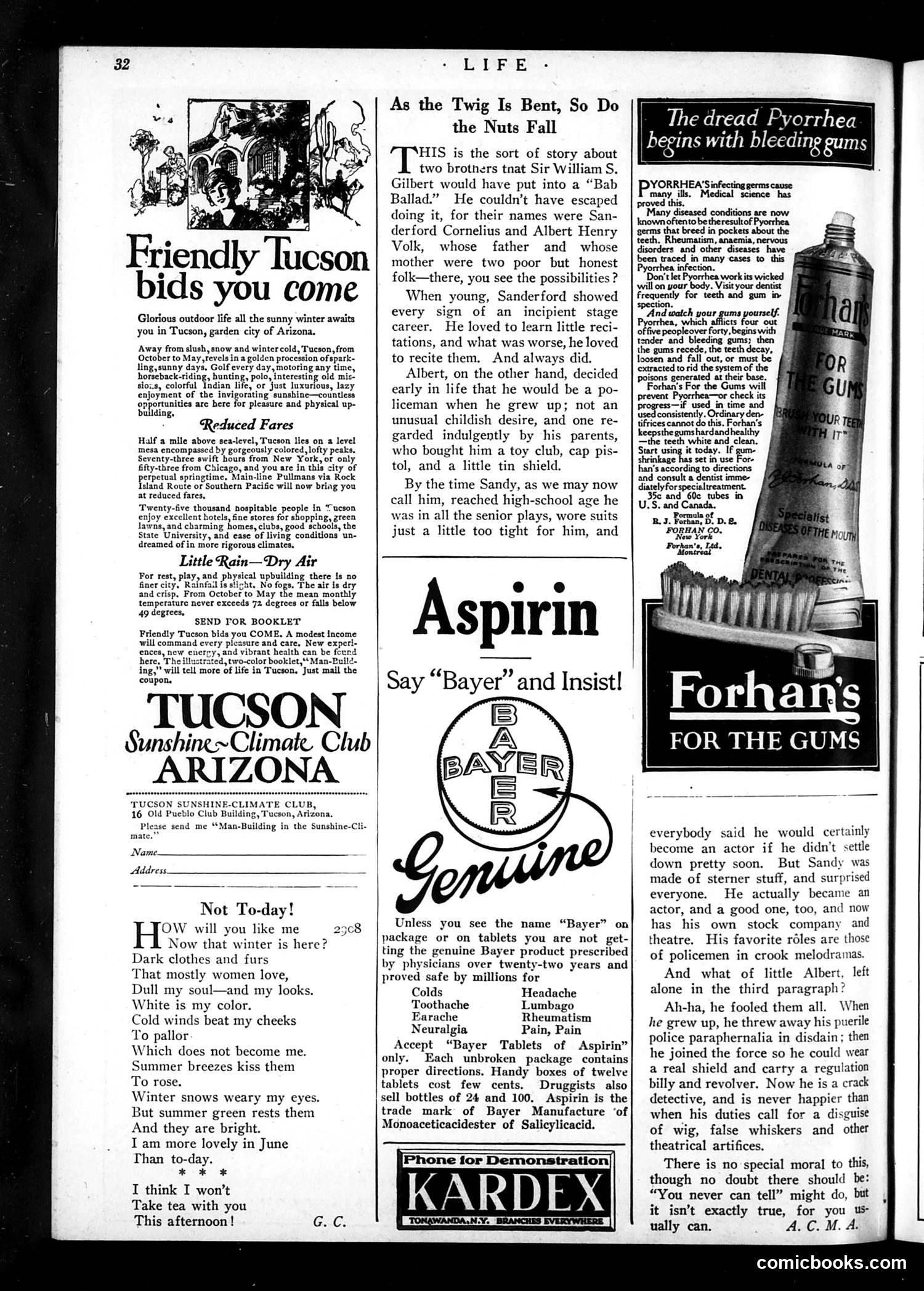
This page contains mostly **advertisements and travel promotion** rather than political cartoons or satire requiring historical context. The main content includes: 1. **Tucson tourism ad** - promoting Arizona's winter climate and reduced railroad fares to attract wealthy tourists and retirees seeking health benefits 2. **A poem titled "Not To-day!"** - personifying winter/summer in romantic verse; unclear satirical intent 3. **"As the Twig Is Bent, So Do the Nuts Fall"** - a humorous short story comparing two brothers: one becomes a theatrical performer (Sandy), the other aspires to be a policeman (Albert). The narrative appears to satirize childhood aspirations and how parental indulgence shapes adult outcomes 4. **Product advertisements** for Bayer Aspirin and Forhan's toothpaste (for gum disease) The page is primarily **commercial in nature** rather than political satire. The story about the brothers uses gentle humor but lacks clear social commentary beyond typical turn-of-the-century attitudes toward ambition and respectability.
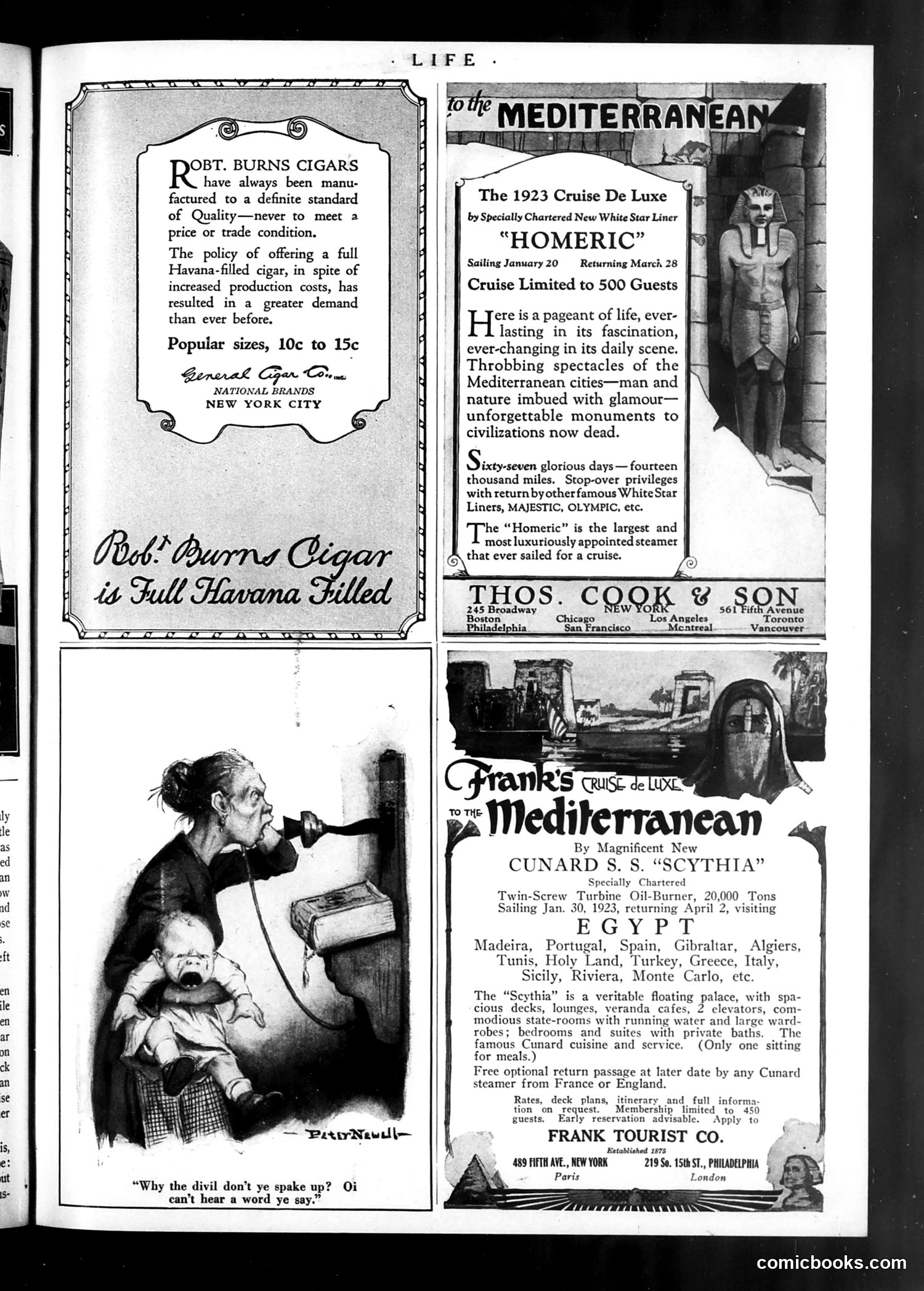
This page mixes advertisements with one cartoon. The main comic depicts an Irish immigrant (identifiable by the dialect caption and working-class clothing) speaking into an early telephone receiver while holding a child. The joke plays on the stereotype of Irish immigrants' difficulty understanding telephone technology and their characteristic accent ("divil," "Oi," "spake"). The humor relies on period-typical ethnic caricature—portraying Irish-Americans as unfamiliar with modern communication devices. The surrounding advertisements promote luxury Mediterranean cruises (1923) and Robt. Burns cigars, reflecting the magazine's upscale readership. The contrast between the crude ethnic stereotype and the advertisements targeting affluent travelers reveals Life's dual nature: sophisticated satire for educated readers who enjoyed laughing at working-class immigrant "types."
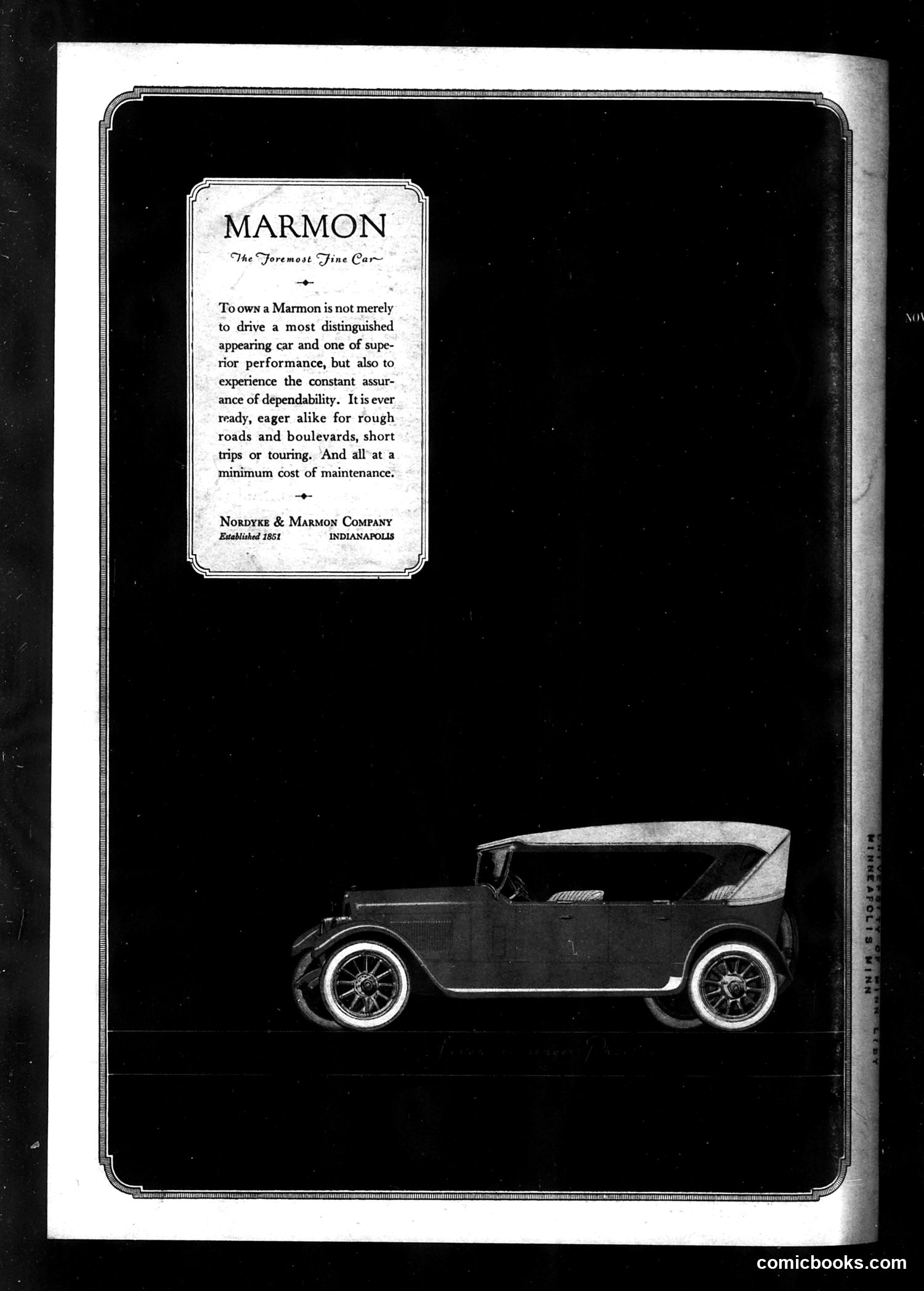
This is a **full-page advertisement**, not a cartoon or satire. It promotes the Marmon automobile, manufactured by Nordyke & Marmon Company in Indianapolis (established 1851). The ad targets affluent buyers by emphasizing that owning a Marmon provides not merely transportation but social distinction—"a most distinguished appearing car" with "superior performance" and guaranteed "dependability." The appeal promises versatility ("rough roads and boulevards") and economy ("minimum cost of maintenance"), positioning the vehicle as a practical luxury good. The illustration shows a touring car (open-air convertible style), typical of 1910s-1920s automobiles. This appears to be vintage advertising when automobiles were still luxury items marketed to the wealthy as status symbols and reliable machines.