
Life, 1922-11-16 · page 22 of 36
Life — November 16, 1922 — page 22: what you’re looking at
What you’re looking at
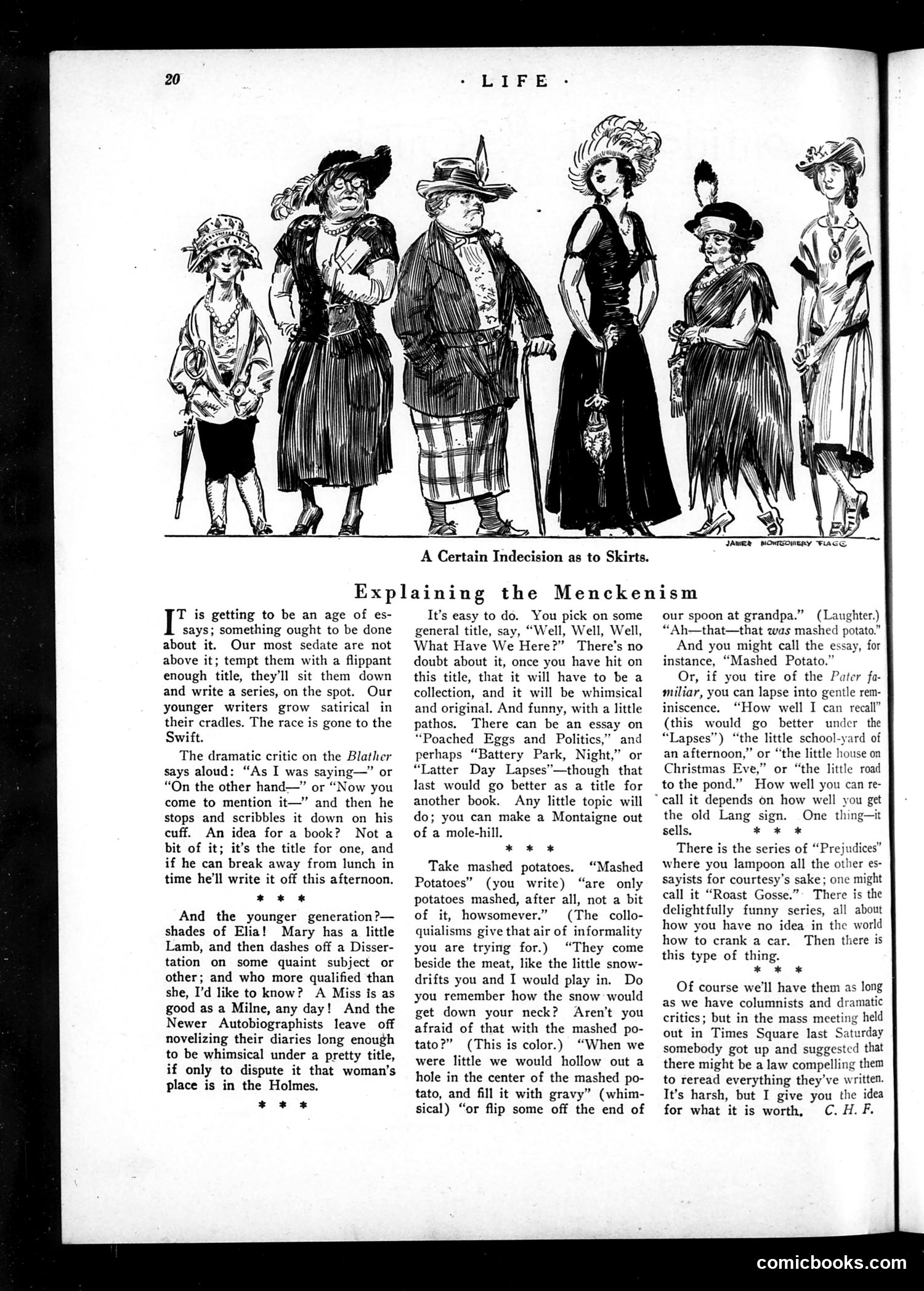
This page from *Life* magazine satirizes the early 20th-century essay craze, particularly the influence of H.L. Mencken's satirical style ("Menckenism"). The article mocks writers who churn out whimsical, pseudo-profound essay collections with clever titles drawn from everyday subjects—like "Mashed Potatoes" or "Poached Eggs and Politics." The cartoon at top shows six women in different skirt styles, illustrating the article's opening about fashion indecision. The satire targets essayists who adopt false profundity and affected nostalgia to elevate trivial topics. The piece ridicules both established critics and "younger writers" who adopt this formulaic approach—pick a title, write something personal and quirky, sprinkle in colloquialisms for "informality," and publish as a collection. The author suggests these essays follow predictable patterns: childhood reminiscence, gentle whimsy, or attacking other essayists. The Times Square reference suggests this was a widespread cultural phenomenon worthy of public mockery.
📄 Transcribed text from this page (OCR, searchable)
Machine-transcribed from the original scan — historical spelling and the odd misread are preserved.
A Certain Indecision as to Skirts. VANES NOMGONERY FAGS Explaining the Menckenism T is getting to be an age of es- says; something ought to be done about it. Our most sedate are not above it; tempt them with a flippant enough title, they'll sit them down and write a series, on the spot. Our younger writers grow satirical in their cradles. The race is gone to the Swift. The dramatic critic on the Blather says aloud: “As I was saying—” or “On the other hand—” or “Now you come to mention it—” and then he stops and scribbles it down on his cuff. An idea for a book? Not a bit of it; it’s the title for one, and if he can break away from lunch in time he'll write it off this afternoon. ee t And the younger generation?— shades of Elia! Mary has a little Lamb, and then dashes off a Disser- tation on some quaint subject or other; and who more qualified than she, I’d like to know? A Miss is as good as a Milne, any day! And the Newer Autobiographists leave off novelizing their diaries long enough to be whimsical under a pretty title, if only to dispute it that woman’s place is in the Holmes. + * * It’s easy to do. You pick on some general title, say, “Well, Well, Well, What Have We Here?” There’s no doubt about it, once you have hit on this title, that it will have to be a collection, and it will be whimsical and original. And funny, with a little pathos. There can be an essay on “Poached Eggs and Politics,” and perhaps “Battery Park, Night,” or “Latter Day Lapses’—though that last would go better as a title for another book. Any little topic will do; you can make a Montaigne out of a mole-hill. x kK OK Take mashed potatoes. “Mashed Potatoes” (you write) “are only potatoes mashed, after all, not a bit of it, howsomever.” (The collo- quialisms give that air of informality you are trying for.) “They come beside the meat, like the little snow- drifts you and I would play in. Do you remember how the snow would get down your neck? Aren't you afraid of that with the mashed po- tato?” (This is color.) “When we were little we would hollow out a hole in the center of the mashed po- tato, and fill it with gravy” (whim- sical) “or flip some off the end of our spoon at grandpa.” (Laughter.) “Ah—that—that was mashed potato.” And you might call the essay, for instance, “Mashed Potato.” Or, if you tire of the Pater fa- miliar, you can lapse into gentle rem- iniscence. “How well I can recall” (this would go better under the “Lapses”) “the little school-yard of an afternoon,” or “the little house on Christmas Eve,” or “the little road to the pond.” How well you can re- “call it depends on how well you get the old Lang sign. sells. * *e * There is the series of “Prejudices” where you lampoon all the other es- sayists for courtesy’s sake; one might call it “Roast Gosse.” There is the delightfully funny series, all about how you have no idea in the world how to crank a car. Then there is this type of thing. + * Of course we'll have them as long as we have columnists and dramatic critics; but in the mass meeting held out in Times Square last Saturday somebody got up and suggested that there might be a law compelling them to reread everything they’ve written. It's harsh, but I give you the idea for what it is worth, C. H. F. One thing—it comicbooks.com