
Life, 1922-11-16 · page 26 of 36
Life — November 16, 1922 — page 26: what you’re looking at
What you’re looking at
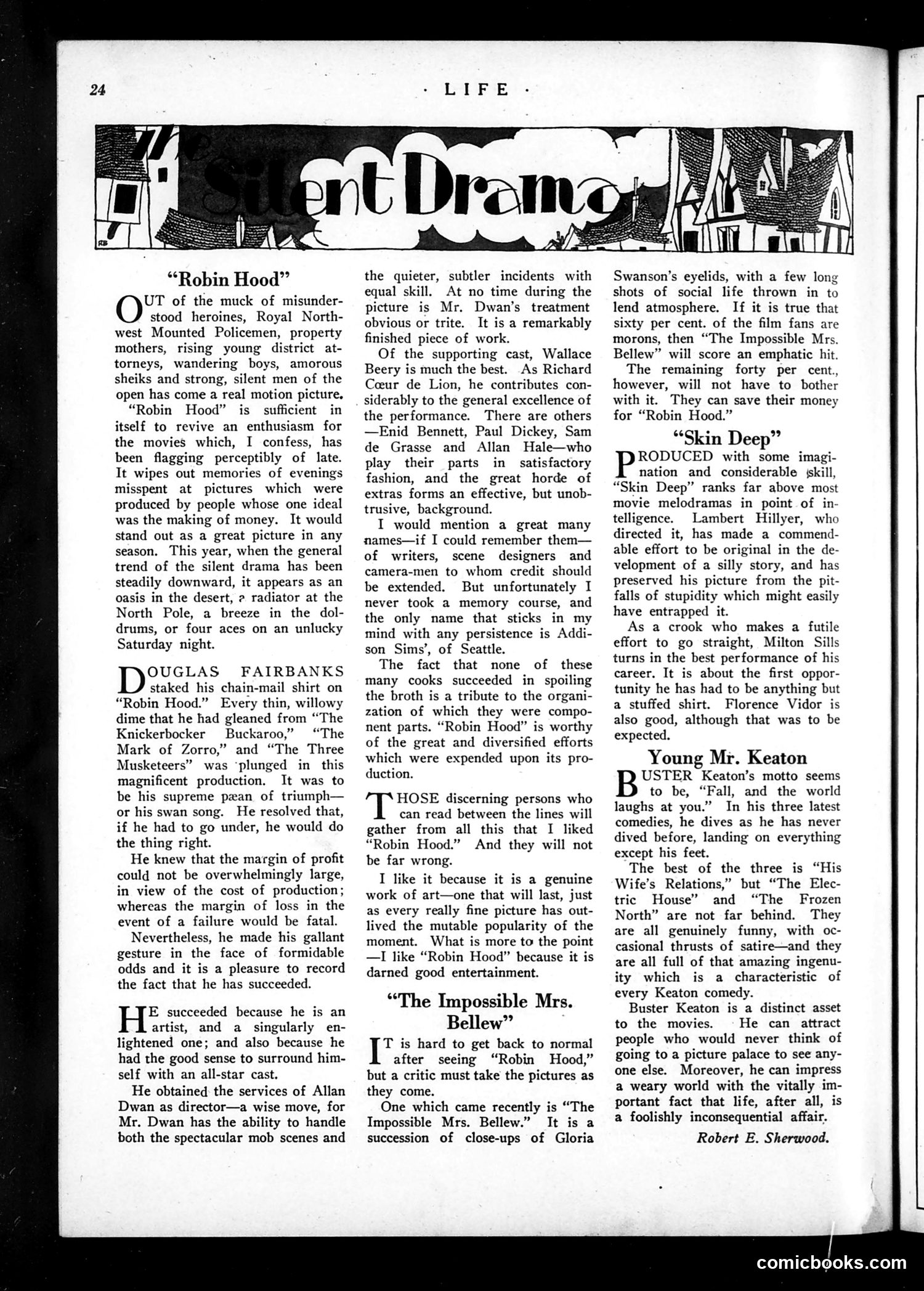
This page contains **film reviews**, not political cartoons. The large "Silent Drama" header indicates this is a cinema critique section. The reviews discuss two movies: 1. **"Robin Hood"** — Praised as an exceptional film starring Douglas Fairbanks. The reviewer celebrates it as superior entertainment, noting Fairbanks invested heavily in this production as a "do-or-die" artistic venture. Wallace Beery is singled out for his performance as Richard the Lionheart. The review emphasizes the film's quality craftsmanship and entertainment value during a period when "the general trend of the silent drama has been steadily downward." 2. **"The Impossible Mrs. Bellew"** — A dismissive review of a Gloria Swanson film, sarcastically described as essentially "a succession of close-ups of Gloria Swanson's eyelids" with minimal plot substance. The page reflects early 1920s cinema criticism, celebrating artistic ambition while mocking vapid star vehicles. No political satire is present—this is straightforward entertainment journalism.
📄 Transcribed text from this page (OCR, searchable)
Machine-transcribed from the original scan — historical spelling and the odd misread are preserved.
“Robin Hood” UT of the muck of misunder- stood heroines, Royal North- west Mounted Policemen, property mothers, rising young district at- torneys, wandering boys, amorous sheiks and strong, silent men of the open has come a real motion picture, “Robin Hood” is sufficient in itself to revive an enthusiasm for the movies which, I confess, has been flagging perceptibly of late. It wipes out memories of evenings misspent at pictures which were produced by people whose one ideal was the making of money. It would stand out as a great picture in any season. This year, when the general trend of the silent drama has been steadily downward, it appears as an oasis in the desert, 2 radiator at the North Pole, a breeze in the dol- drums, or four aces on an unlucky Saturday night. OUGLAS FAIRBANKS staked his chain-mail shirt on “Robin Hood.” Every thin, willowy dime that he had gleaned from “The Knickerbocker Buckaroo,” “The Mark of Zorro,” and “The Three Musketeers” was ‘plunged in this magnificent production. It was to be his supreme pan of triumph— or his swan song. He resolved that, if he had to go under, he would do the thing right. He knew that the margin of profit could not be overwhelmingly large, in view of the cost of production; whereas the margin of loss in the event of a failure would be fatal. Nevertheless, he made his gallant gesture in the face of formidable odds and it is a pleasure to record the fact that he has succeeded. E succeeded because he is an artist, and a singularly en- lightened one; and also because he had the good sense to surround him- self with an all-star cast. He obtained the services of Allan Dwan as director—a wise move, for Mr. Dwan has the ability to handle both the spectacular mob scenes and the quieter, subtler incidents with equal skill. At no time during the picture is Mr. Dwan’s treatment obvious or trite. It is a remarkably finished piece of work. Of the supporting cast, Wallace Beery is much the best. As Richard Ceeur de Lion, he contributes con- siderably to the general excellence of the performance. There are others —Enid Bennett, Paul Dickey, Sam de Grasse and Allan Hale—who play their parts in satisfactory fashion, and the great horde of extras forms an effective, but unob- trusive, background. I would mention a great many names—if I could remember them— of writers, scene designers and camera-men to whom credit should be extended. But unfortunately I never took a memory course, and the only name that sticks in my mind with any persistence is Addi- son Sims’, of Seattle. The fact that none of these many cooks succeeded in spoiling the broth is a tribute to the organi- zation of which they were compo- nent parts. “Robin Hood” is worthy of the great and diversified efforts which were expended upon its pro- duction. HOSE discerning persons who can read between the lines will gather from all this that I liked “Robin Hood.” And they will not be far wrong. I like it because it is a genuine work of art—one that will last, just as every really fine picture has out- lived the mutable popularity of the moment. What is more to the point —I like “Robin Hood” because it is darned good entertainment. “The Impossible Mrs. Bellew” T is hard to get back to normal after seeing “Robin Hood,” but a critic must take the pictures as they come. One which came recently is “The Impossible Mrs. Bellew.” It is a succession of close-ups of Gloria Swanson’s eyelids, with a few long shots of social life thrown in to lend atmosphere. If it is true that sixty per cent. of the film fans are morons, then “The Impossible Mrs. Bellew” will score an emphatic hit. The remaining forty per cent., however, will not have to bother with it. They can save their money for “Robin Hood.” “Skin Deep” RODUCED with some imagi- nation and considerable skill, “Skin Deep” ranks far above most movie melodramas in point of in- telligence. Lambert Hillyer, who directed it, has made a commend- able effort to be original in the de- velopment of a silly story, and has preserved his picture from the pit- falls of stupidity which might easily have entrapped it. As a crook who makes a futile effort to go straight, Milton Sills turns in the best performance of his career. It is about the first oppor- tunity he has had to be anything but a stuffed shirt. Florence Vidor is also good, although that was to be expected. Young Mr. Keaton USTER Keaton’s motto seems to be, “Fall, and the world laughs at you.” In his three latest comedies, he dives as he has never dived before, landing on everything except his feet. The best of the three is “His Wife’s Relations,” but “The Elec- tric House” and “The Frozen North” are not far behind. They are all genuinely funny, with oc- casional thrusts of satire—and they are all full of that amazing ingenu- ity which is a characteristic of every Keaton comedy. Buster Keaton is a distinct asset to the movies. He can attract people who would never think of going to a picture palace to see any- one else. Moreover, he can impress a weary world with the vitally im- portant fact that life, after all, is a foolishly inconsequential affair. Robert E. Sherwood. comicbooks.com