
Life, 1922-11-16 · page 20 of 36
Life — November 16, 1922 — page 20: what you’re looking at
What you’re looking at
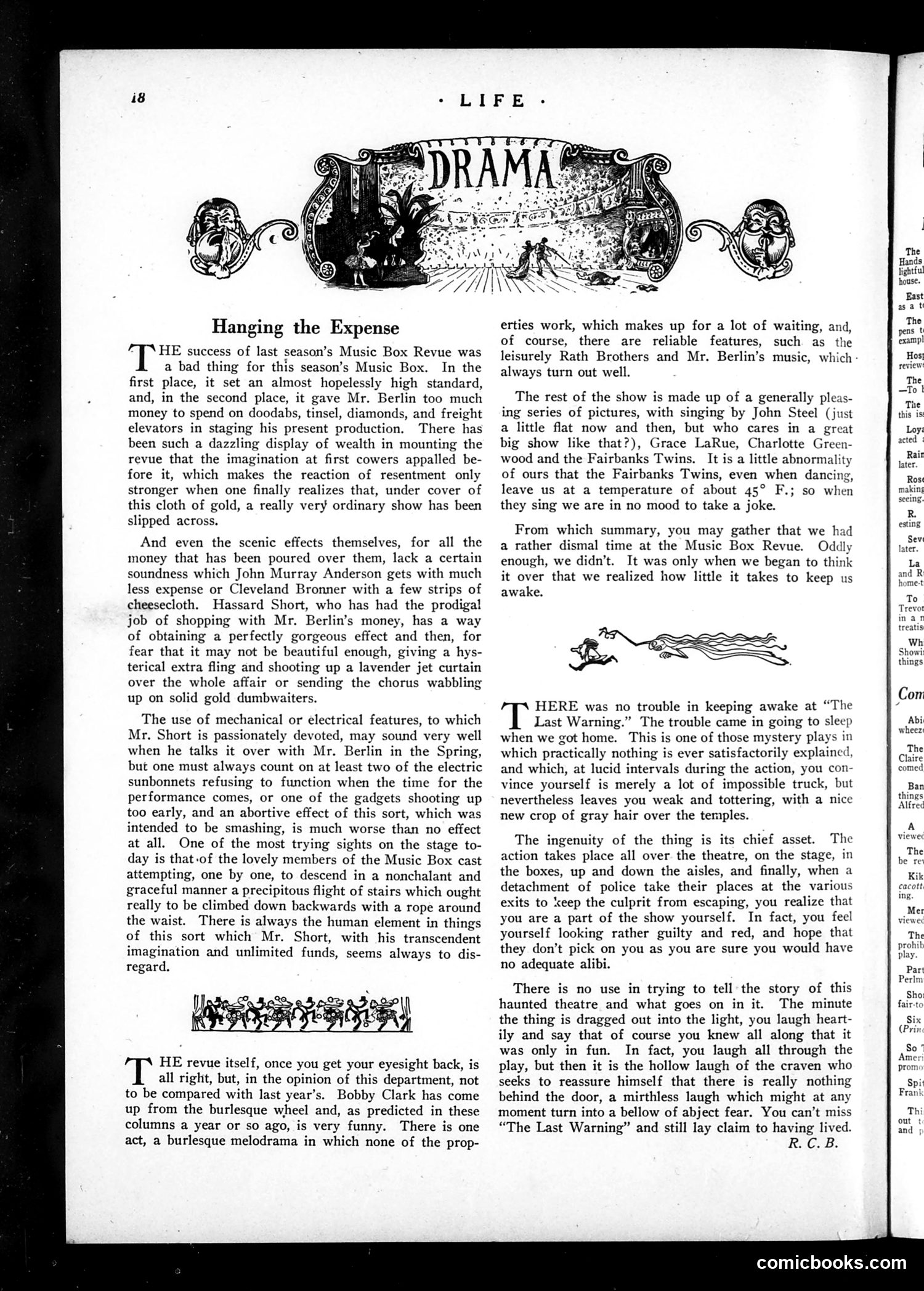
This theater review critiques the current season's Music Box Revue, produced by Irving Berlin (implied as "Mr. Berlin"). The satire targets the show's reliance on expensive spectacle over substance. **Key figures mentioned:** - Irving Berlin (producer/composer) - Hassard Short (director/designer) - Bobby Clark (performer, noted as funny) - The Rath Brothers, John Steel, Grace LaRue, Charlotte Greenwood, and the Fairbanks Twins (supporting performers) **The satire's point:** Despite lavish spending on mechanical effects, costumes, and stage machinery ("solid gold dumbwaiters," "freight elevators"), the underlying show is mediocre. The reviewer mocks the irony that expensive technical failures (malfunctioning electric effects, awkward staircases) actually damage the production more than simpler, cheaper designs would. **Social context:** This reflects 1920s Broadway's trend toward increasingly elaborate musical revues. The critique suggests audiences were becoming sophisticated enough to recognize when spectacle masked poor artistic quality—that money alone cannot guarantee entertainment. The tone is witty and somewhat dismissive of Berlin's excessive production choices.
📄 Transcribed text from this page (OCR, searchable)
Machine-transcribed from the original scan — historical spelling and the odd misread are preserved.
Hanging the Expense HE success of last season’s Music Box Revue was a bad thing for this season’s Music Box. In the first place, it set an almost hopelessly high standard, and, in the second place, it gave Mr. Berlin too much money to spend on doodabs, tinsel, diamonds, and freight elevators in staging his present production. There has been such a dazzling display of wealth in mounting the revue that the imagination at first cowers appalled be- fore it, which makes the reaction of resentment only stronger when one finally realizes that, under cover of this cloth of gold, a really very ordinary show has been slipped across. And even the scenic effects themselves, for all the money that has been poured over them, lack a certain soundness which John Murray Anderson gets with much less expense or Cleveland Bronner with a few strips of cheesecloth. Hassard Short, who has had the prodigal job of shopping with Mr. Berlin’s money, has a way of obtaining a perfectly gorgeous effect and then, for fear that it may not be beautiful enough, giving a hys- terical extra fling and shooting up a lavender jet curtain over the whole affair or sending the chorus wabbling up on solid gold dumbwaiters. The use of mechanical or electrical features, to which Mr. Short is passionately devoted, may sound very well when he talks it over with Mr. Berlin in the Spring, but one must always count on at least two of the electric sunbonnets refusing to function when the time for the performance comes, or one of the gadgets shooting up too early, and an abortive effect of this sort, which was intended to be smashing, is much worse than no effect at all. One of the most trying sights on the stage to- day is that-of the lovely members of the Music Box cast attempting, one by one, to descend in a nonchalant and graceful manner a precipitous flight of stairs which ought really to be climbed down backwards with a rope around the waist. There is always the human element in things of this sort which Mr. Short, with his transcendent imagination and unlimited funds, seems always to dis- regard, HE revue itself, once you get your eyesight back, is all right, but, in the opinion of this department, not to be compared with last year’s. Bobby Clark has come up from the burlesque wheel and, as predicted in these columns a year or so ago, is very funny. There is one act, a burlesque melodrama in which none of the prop- erties work, which makes up for a lot of waiting, and, of course, there are reliable features, such as the leisurely Rath Brothers and Mr. Berlin’s music, which - always turn out well. The rest of the show is made up of a generally pleas- ing series of pictures, with singing by John Steel (just a little flat now and then, but who cares in a great big show like that?), Grace LaRue, Charlotte Green- wood and the Fairbanks Twins. It is a little abnormality of ours that the Fairbanks Twins, even when dancing, leave us at a temperature of about 45° F.; so when they sing we are in no mood to take a joke. From which summary, you may gather that we had a rather dismal time at the Music Box Revue. Oddly enough, we didn’t. It was only when we began to think it over that we realized how little it takes to keep us awake. HERE was no trouble in keeping awake at “The Last Warning.” The trouble came in going to sleep when we got home. This is one of those mystery plays in which practically nothing is ever satisfactorily explained, and which, at lucid intervals during the action, you con- vince yourself is merely a lot of impossible truck, but nevertheless leaves you weak and tottering, with a nice new crop of gray hair over the temples. The ingenuity of the thing is its chief asset. The action takes place all over the theatre, on the stage, in the boxes, up and down the aisles, and finally, when a detachment of police take their places at the various exits to keep the culprit from escaping, you realize that you are a part of the show yourself. In fact, you feel yourself looking rather guilty and red, and hope that they don’t pick on you as you are sure you would have no adequate alibi. There is no use in trying to tell the story of this haunted theatre and what goes on in it. The minute the thing is dragged out into the light, you laugh heart- ily and say that of course you knew all along that it was only in fun. In fact, you laugh all through the play, but then it is the hollow laugh of the craven who seeks to reassure himself that there is really nothing behind the door, a mirthless laugh which might at any moment turn into a bellow of abject fear. You can’t miss “The Last Warning” and still lay claim to having lived. R.C.B. The Hands lightful house. East asat The pens ti exampl Hos review The —Tot The this is Loy: acted Rair later. Rost makin; Trevor in an treatis Wh Showi things Con Abi wheez Ban things Alfred vA viewer The be rer Kik cacott ing. Mer viewed The prohib play, Par Perlm Sho fai (Prin So’ Ame prom Spi Frank Thi out ¢ and comicbooks.com