
Life, 1922-11-16 · page 25 of 36
Life — November 16, 1922 — page 25: what you’re looking at
What you’re looking at
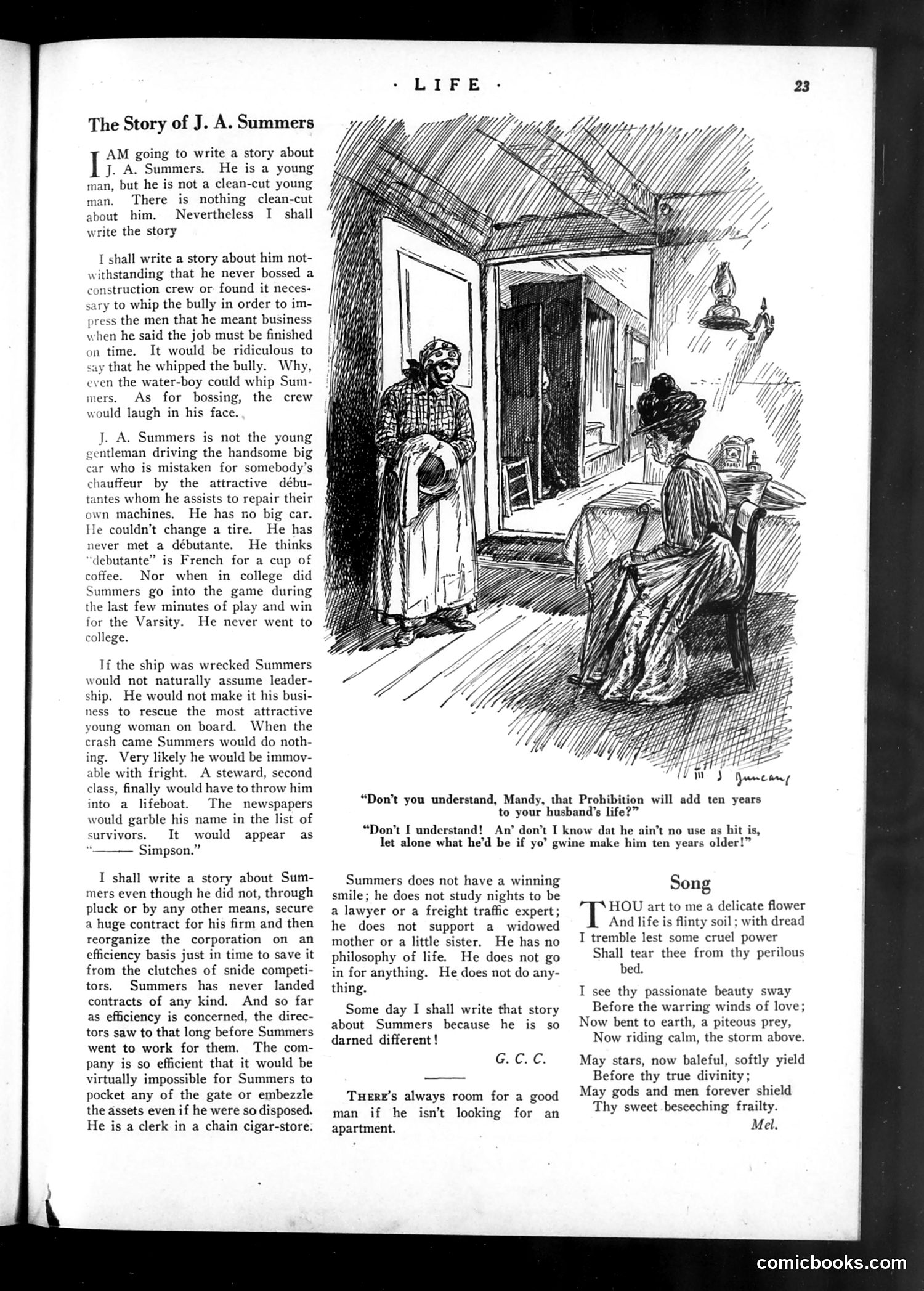
This page satirizes the formulaic "success story" popular in early 20th-century American literature and magazines. The author announces he will write about J. A. Summers—not despite his ordinariness, but *because* of it. The satire mocks conventional protagonist archetypes: the tough construction boss, the wealthy gentleman, the college sports hero, the shipwreck rescuer. Summers is none of these. He's an unremarkable cigar-store clerk who couldn't change a tire, knows nothing of "debutantes," and would freeze in a crisis. The humor lies in the contrast between literary convention (where ordinary men prove themselves through dramatic action) and reality (where most people accomplish nothing remarkable). The accompanying cartoon shows a domestic scene about Prohibition—a contemporary social issue—reinforcing the magazine's satirical tone about everyday life versus heroic narratives. The piece champions anti-heroic realism, suggesting worthy stories exist about genuinely ordinary people precisely *because* they're different from stock characters.
📄 Transcribed text from this page (OCR, searchable)
Machine-transcribed from the original scan — historical spelling and the odd misread are preserved.
The Story of J. A. Summers AM going to write a story about J. A. Summers. He is a young man, but he is not a clean-cut young man. There is nothing clean-cut about him. Nevertheless I shall write the story I shall write a story about him not- withstanding that he never bossed a construction crew or found it neces- sary to whip the bully in order to im- press the men that he meant business when he said the job must be finished on time. It would be ridiculous to say that he whipped the bully. Why, even the water-boy could whip Sum- mers. As for bossing, the crew would laugh in his face. J. A. Summers is not the young gentleman driving the handsome big ar who is mistaken for somebody’s chauffeur by the attractive débu- tantes whom he assists to repair their own machines. He has no big car. He couldn’t change a tire. He has never met a débutante. He thinks “debutante” is French for a cup of coffee. Nor when in college did Summers go into the game during the last few minutes of play and win for the Varsity. college. If the ship was wrecked Summers would not naturally assume leader- ship. He would not make it his busi- ness to rescue the most attractive young woman on board. When the crash came Summers would do noth- ing. Very likely he would be immoy- able with fright. A steward, second class, finally would have to throw him into a lifeboat. The newspapers would garble his name in the list of survivors. It would appear as : Simpson.” I shall write a story about Sum- mers even though he did not, through pluck or by any other means, secure a huge contract for his firm and then reorganize the corporation on an efficiency basis just in time to save it from the clutches of snide competi- tors. Summers has never landed contracts of any kind. And so far as efficiency is concerned, the direc- tors saw to that long before Summers went to work for them. The com- pany is so efficient that it would be virtually impossible for Summers to pocket any of the gate or embezzle the assets even if he were so disposed. He is a clerk in a chain cigar-store. He never went to / “Don’t you understand, Mandy, that Prohi to your husband’s life?” “Don’t I understand! An’ don’t I know dat he ain’t no use as hit is, let alone what he’d be if yo’ gwine make him ten years older!” Summers does not have a winning smile; he does not study nights to be a lawyer or a freight traffic expert; he does not support a widowed mother or a little sister. He has no philosophy of life. He does not go in for anything. He does not do any- thing. Some day I shall write that story about Summers because he is so darned different! G.C. C. TuHeERE’s always room for a good man if he isn’t looking for an apartment. Song HOU art to me a delicate flower And life is flinty soil ; with dread I tremble lest some cruel power Shall tear thee from thy perilous bed. I see thy passionate beauty sway Before the warring winds of love; Now bent to earth, a piteous prey, Now riding calm, the storm above. May stars, now baleful, softly yield Before thy true divinity ; May gods and men forever shield Thy sweet beseeching frailty. Mel. comicbooks.com