
A complete issue · 36 pages · 1922
Life — August 31, 1922
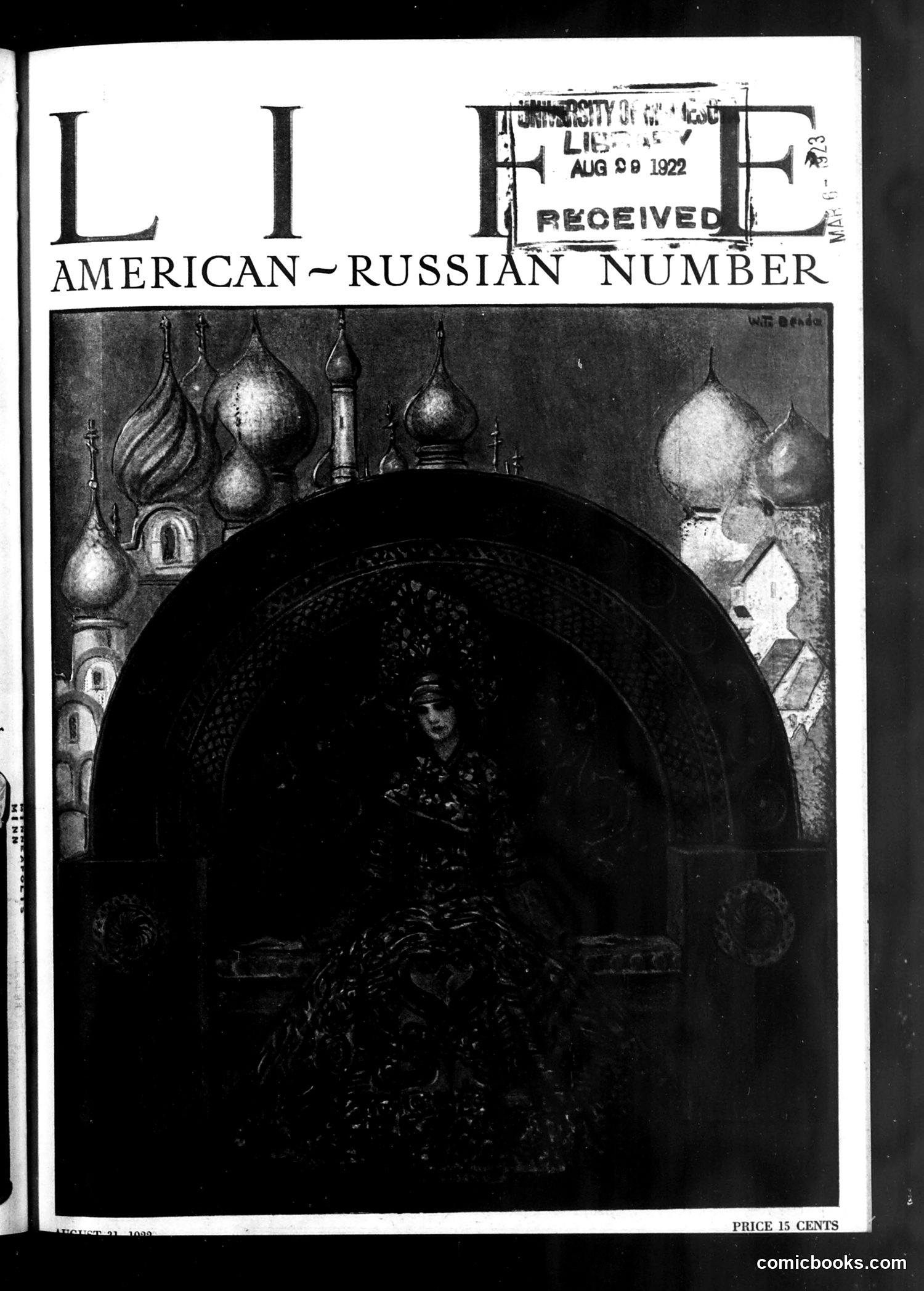
This is the cover of Life's "American-Russian Number," priced at 15 cents. The central image depicts a figure (likely representing a Russian leader or Bolshevik revolutionary) seated within an ornate Russian Orthodox church interior, complete with distinctive onion domes visible in the background. The satire appears to critique Bolshevism's relationship with Russian Orthodox Christianity and traditional Russian culture. By positioning a Soviet figure in a sacred religious space, the cartoonist likely suggests either the appropriation of Russian identity by communist leadership, or perhaps the threat communism posed to traditional Russian institutions during the early Soviet period. The 1922 date places this during the Russian Civil War's aftermath and the early Soviet consolidation of power.
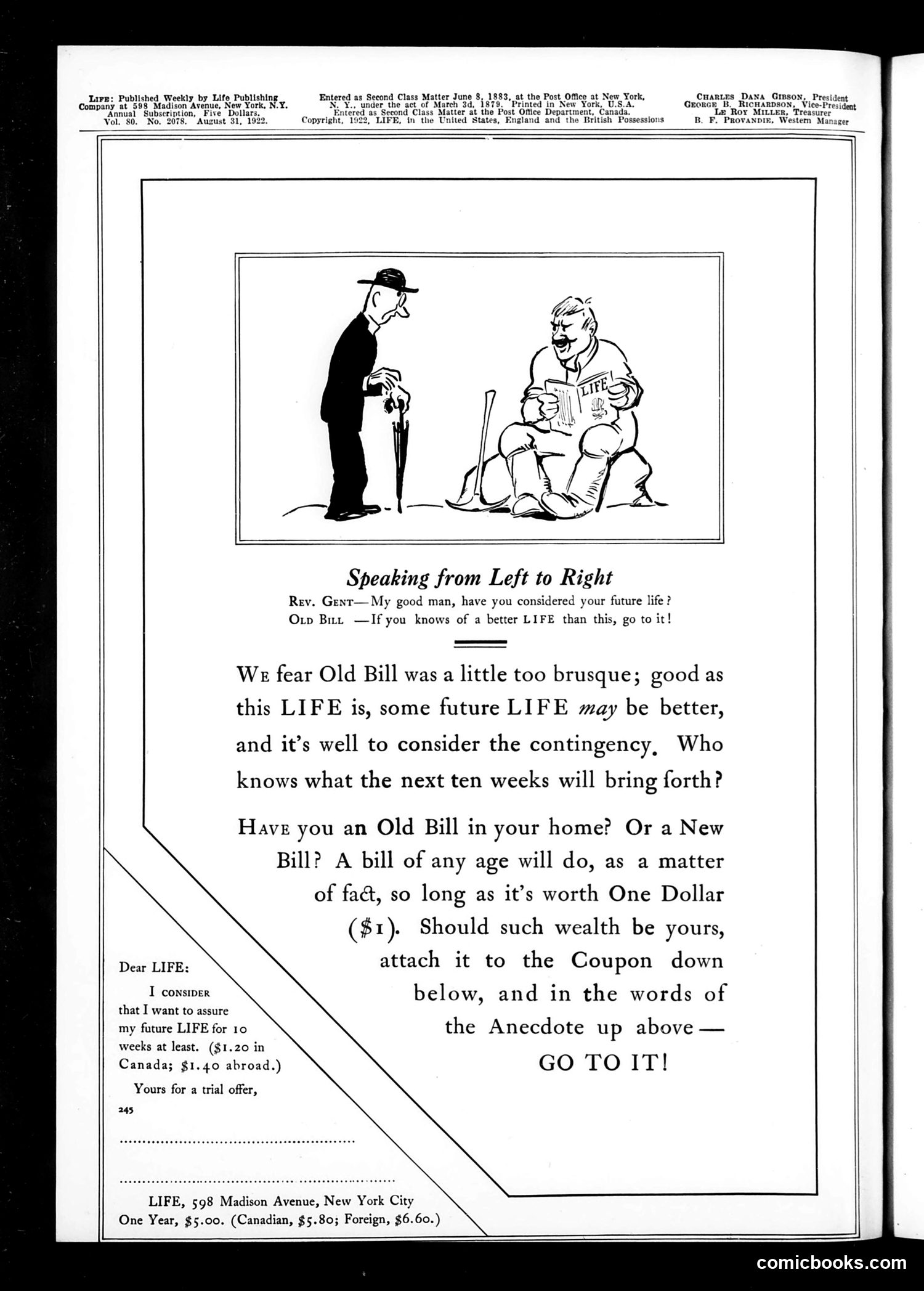
This is primarily a **LIFE magazine advertisement** (not a political cartoon), using humor to promote magazine subscriptions. The cartoon depicts two figures: a clergy member (labeled "REV. GENT") offering existential advice to a vagrant or laborer ("OLD BILL"), who is contentedly reading LIFE magazine. The joke plays on irony: a reverend urges the man to consider his future, but Old Bill dismisses the suggestion, implying he's satisfied with his present circumstances and LIFE magazine. The advertisement's pitch follows: LIFE argues that even satisfied readers should consider subscribing for ten weeks ($1) as contingency planning for uncertain futures. It's a tongue-in-cheek sales pitch—if Old Bill can be happy with LIFE, shouldn't you secure your own subscription? This reflects early 1920s consumer advertising, where magazines marketed themselves as essential life amenities.
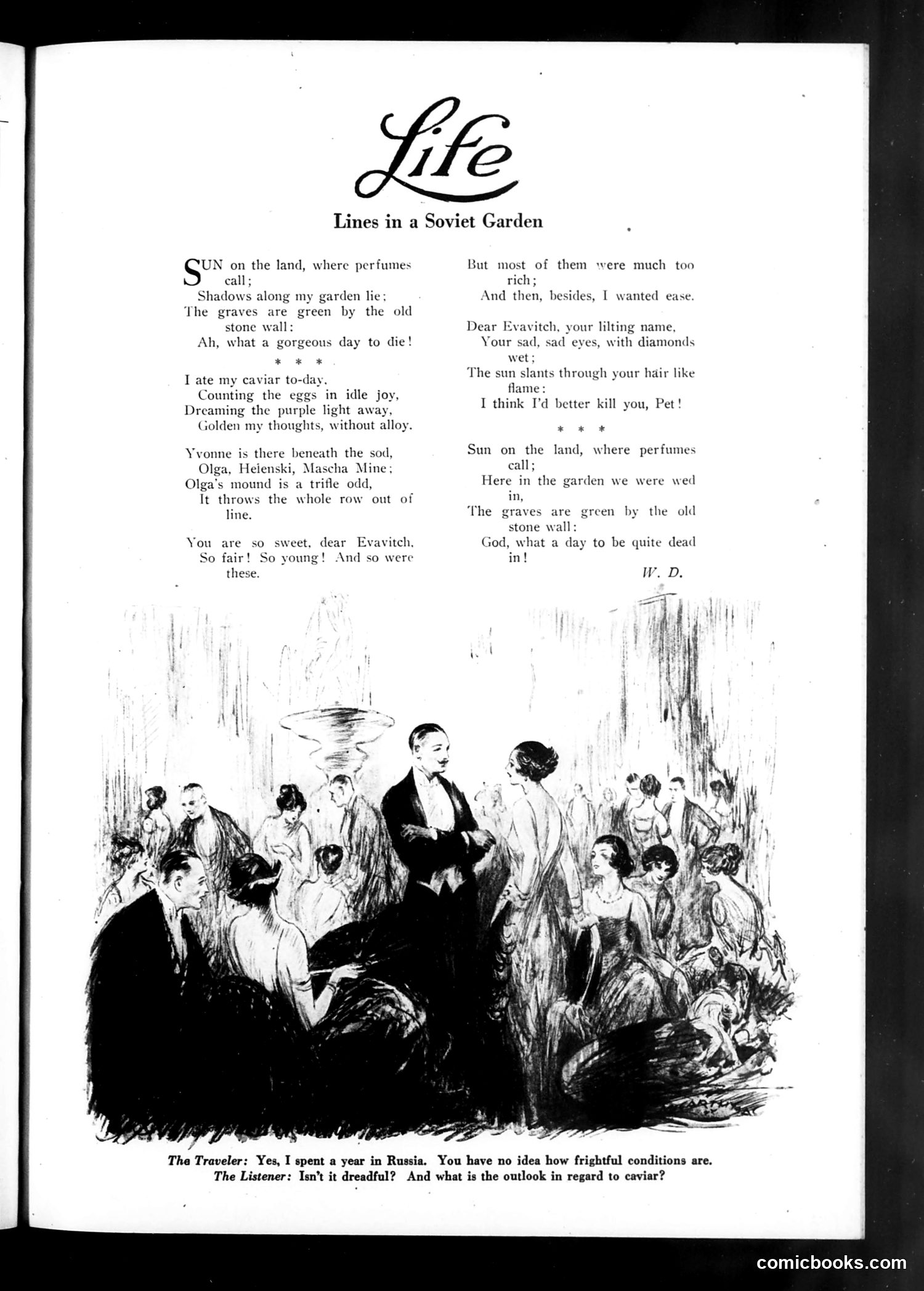
This poem by W.D. satirizes Soviet Russia through dark humor about death and deprivation. The verses reference a "Soviet garden" where graves lie and people have died (Yvonne, Heletski, Mascha, Olga mentioned by name). The speaker ate caviar while "counting eggs in idle joy"—suggesting Soviet wealth disparity or propaganda about abundance. The poem threatens "Evavitch" with murder ("I think I'd better kill you, Pet!"), likely satirizing Soviet violence and political purges. The illustration shows a gathering in what appears to be a Russian setting, consistent with the grim subject matter. The caption's dialogue about "frightful conditions" and caviar outlook reinforces the cartoon's critique: Soviet Russia presents itself as prosperous while actually characterized by fear, death, and hardship.
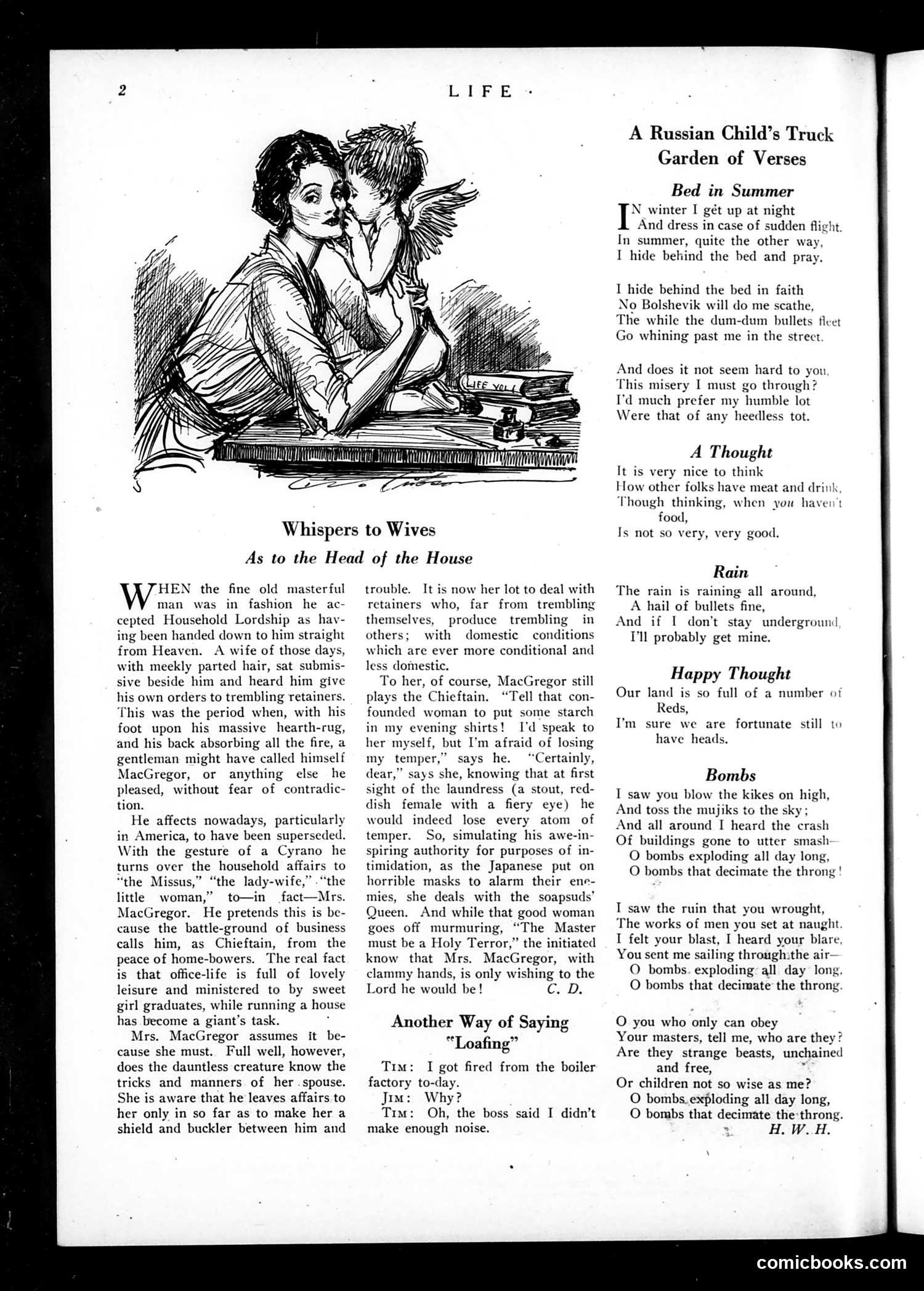
This satirical piece mocks the traditional Victorian domestic hierarchy. The illustration shows a woman whispering to her husband while reading, suggesting she manipulates household decisions despite his formal authority. The text parodies how wives subtly control their husbands through indirect influence—the "lady-wife" manages domestic affairs while the husband postures as "Chieftain" and "Holy Terror." The satire reveals the gap between men's claimed dominance and actual household governance. A contemporary reader would recognize this as commentary on gender dynamics: wives wielded real power through manipulation and wit, while husbands maintained the fiction of control. The piece gently ridicules both spouses—men for their pretense, women for requiring deception rather than direct authority. It's lighthearted social criticism of marriage conventions.
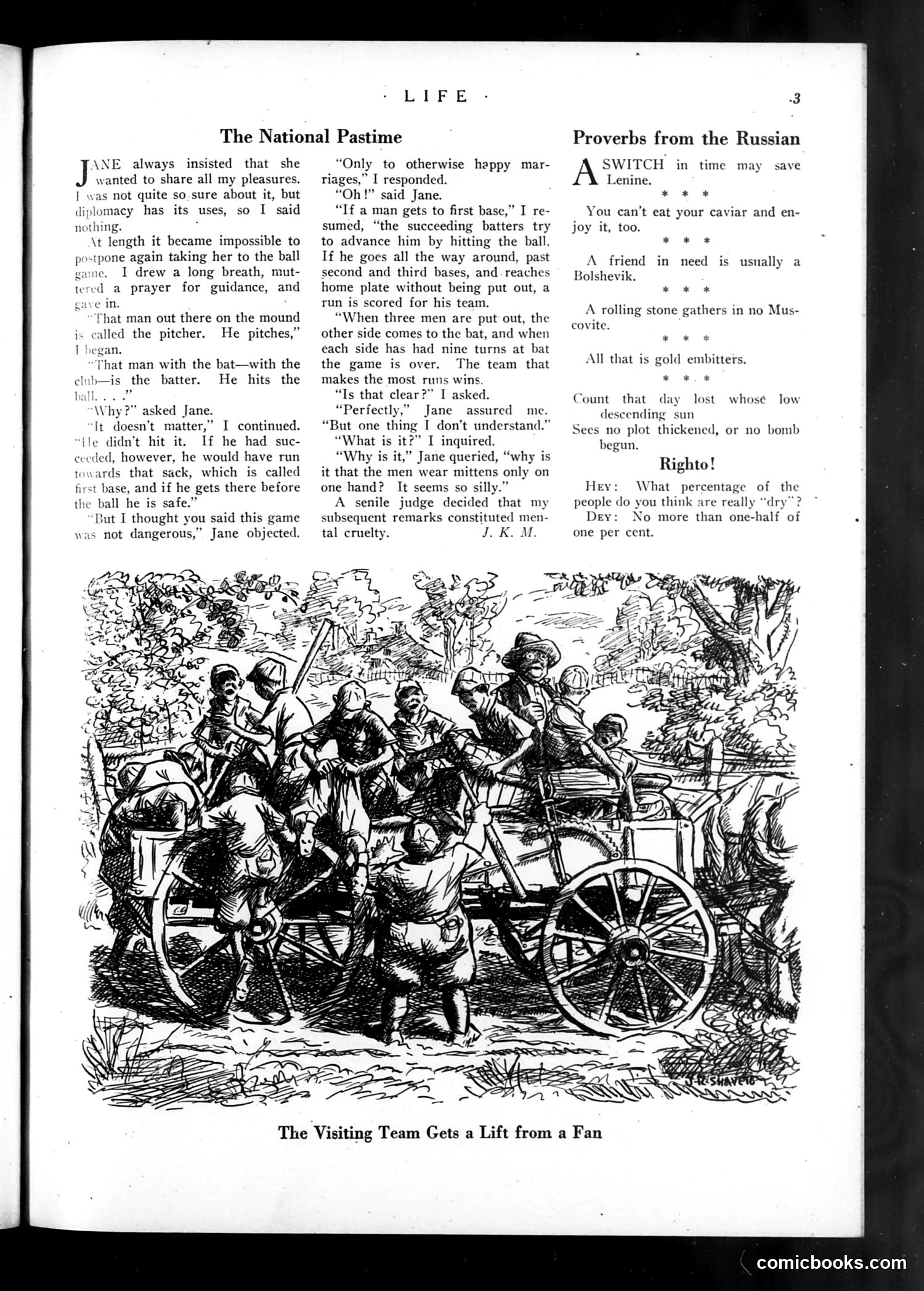
This page contains two distinct sections: **"The National Pastime"** (left column) is a dialogue between Jane and an unnamed male speaker explaining baseball rules. Jane asks basic questions about the sport—why a man with a bat stands alone, why only one hand is used—and the speaker patiently explains positions, base-running, and scoring. The tone is gently satirical, portraying Jane as unfamiliar with baseball, a quintessentially American sport. This likely reflects early 20th-century attitudes about women's perceived lack of interest in sports. **The cartoon below** titled "The Visiting Team Gets a Lift from a Fan" shows spectators helping a horse-drawn wagon carrying a baseball team. It's a humorous scene about fan enthusiasm for visiting athletes. The right column contains "Proverbs from the Russian," unrelated aphorisms, and a brief exchange titled "Right!" about perceptions of "dry" people—likely referring to Prohibition-era attitudes.
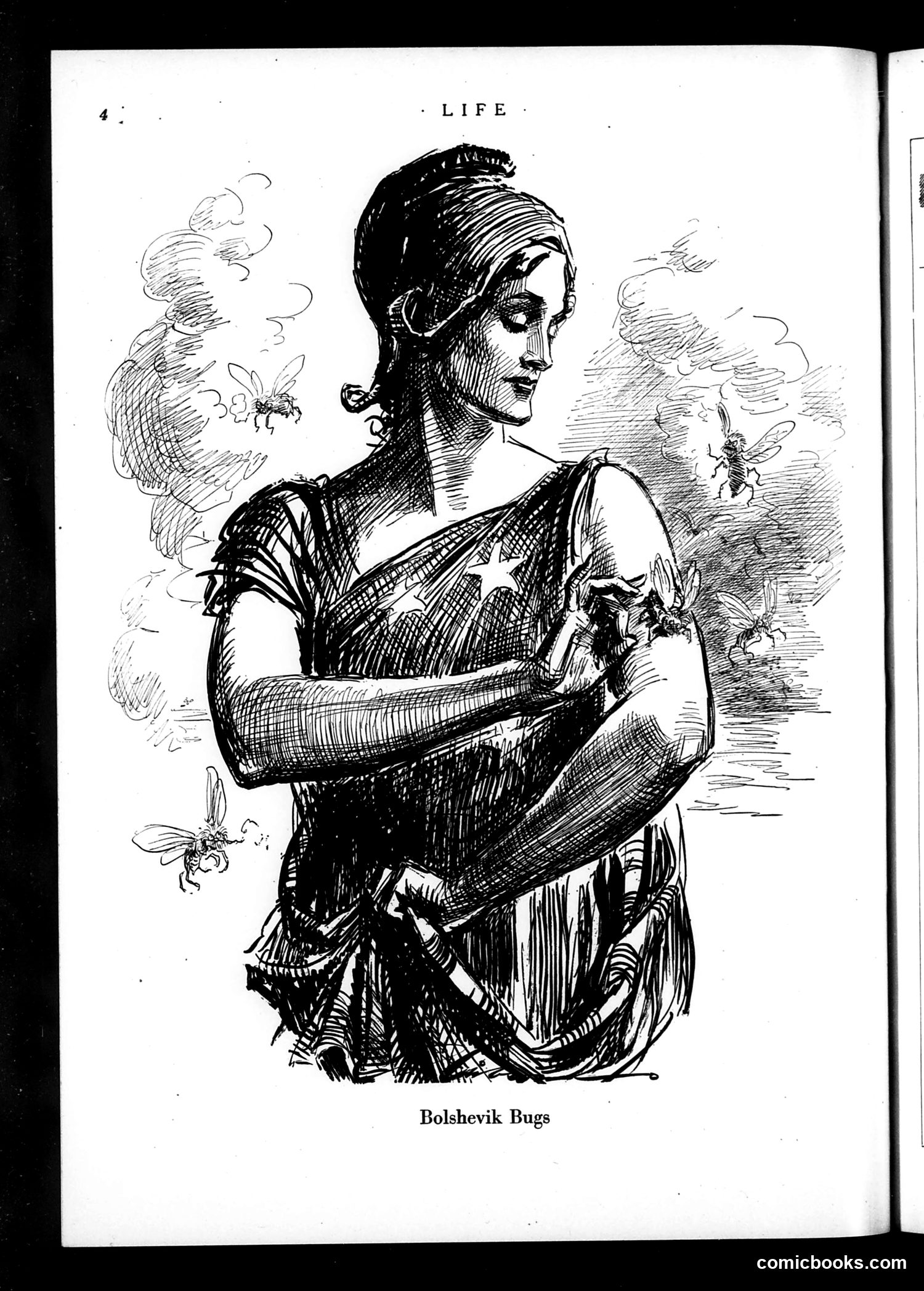
This political cartoon from *Life* magazine uses a woman as an allegorical figure—likely representing either America or Western civilization—infested with insects labeled "Bolshevik Bugs." The insects swarming around her body represent Bolshevism (Soviet communism) portrayed as a literal plague or infestation. This reflects the anti-communist "Red Scare" sentiment prevalent in America during the early 1920s, when Bolshevism was widely feared as a dangerous, spreading ideology threatening American society. The cartoon equates communist ideology with disease and parasites—dehumanizing propaganda meant to stoke public anxiety about Bolshevik influence infiltrating the country. The satirical message warns of communism as an existential threat requiring urgent action.
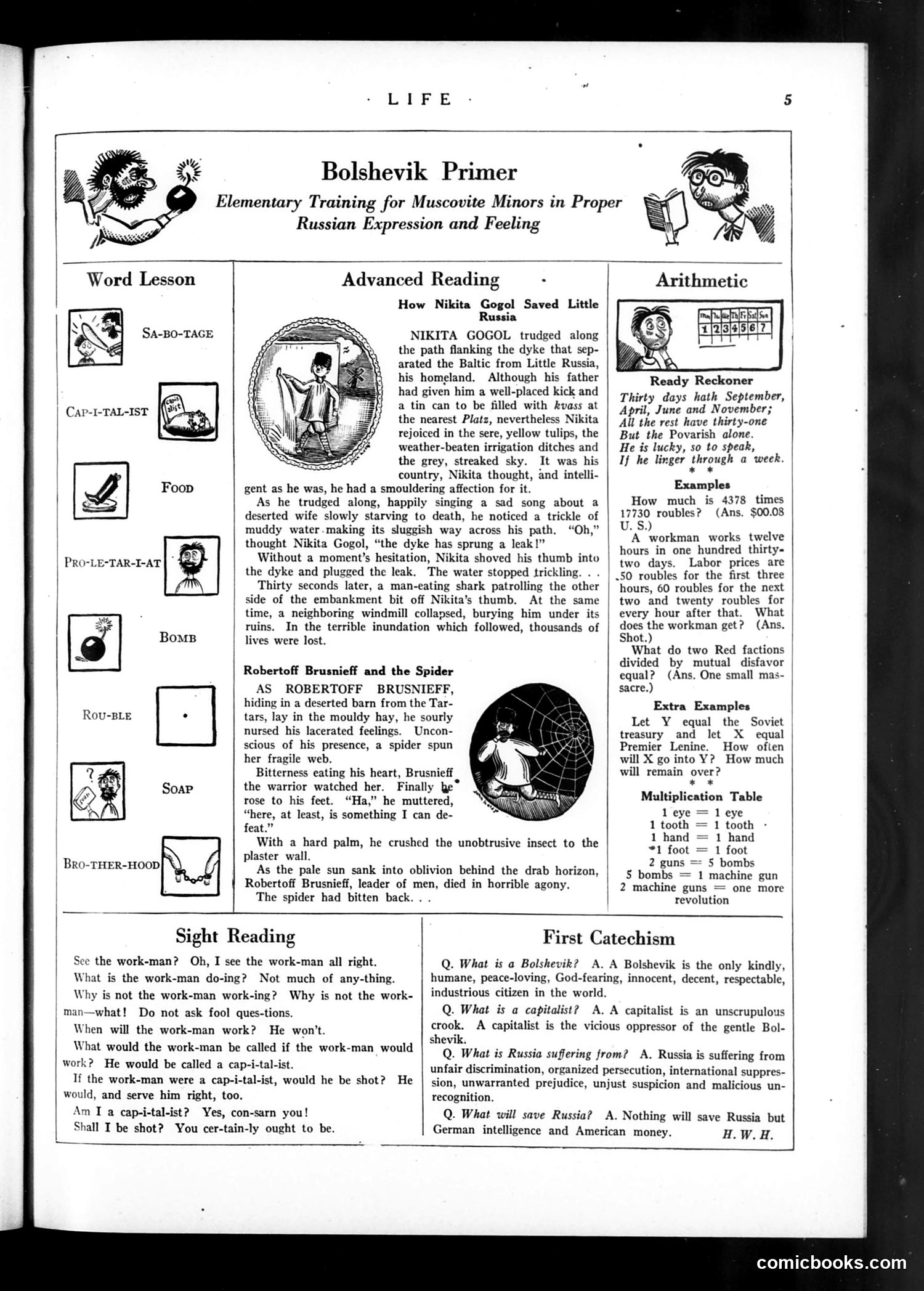
This is a satirical attack on Bolshevism (Soviet communism) disguised as an educational primer for children. The title mockingly presents communist ideology as something taught to "Moscovite Minors." The page parodies legitimate educational content—including word lessons, arithmetic problems, and a catechism—but fills them with anti-communist propaganda. The "First Catechism" section defines Bolsheviks as "kindly, humane, peace-loving" (sarcastic), while depicting capitalists as "unscrupulous crooks" and Russia as "suffering from unfair discrimination." The "Advanced Reading" story about Nikita Gogol appears designed to mock Soviet hardship. The "Multiplication Table" equates Soviet concepts: "5 bombs = 1 machine gun" and "2 machine guns = one more revolution." This reflects 1920s American anti-communist sentiment, using satire to mock Bolshevik ideology and present it as dangerous indoctrination.
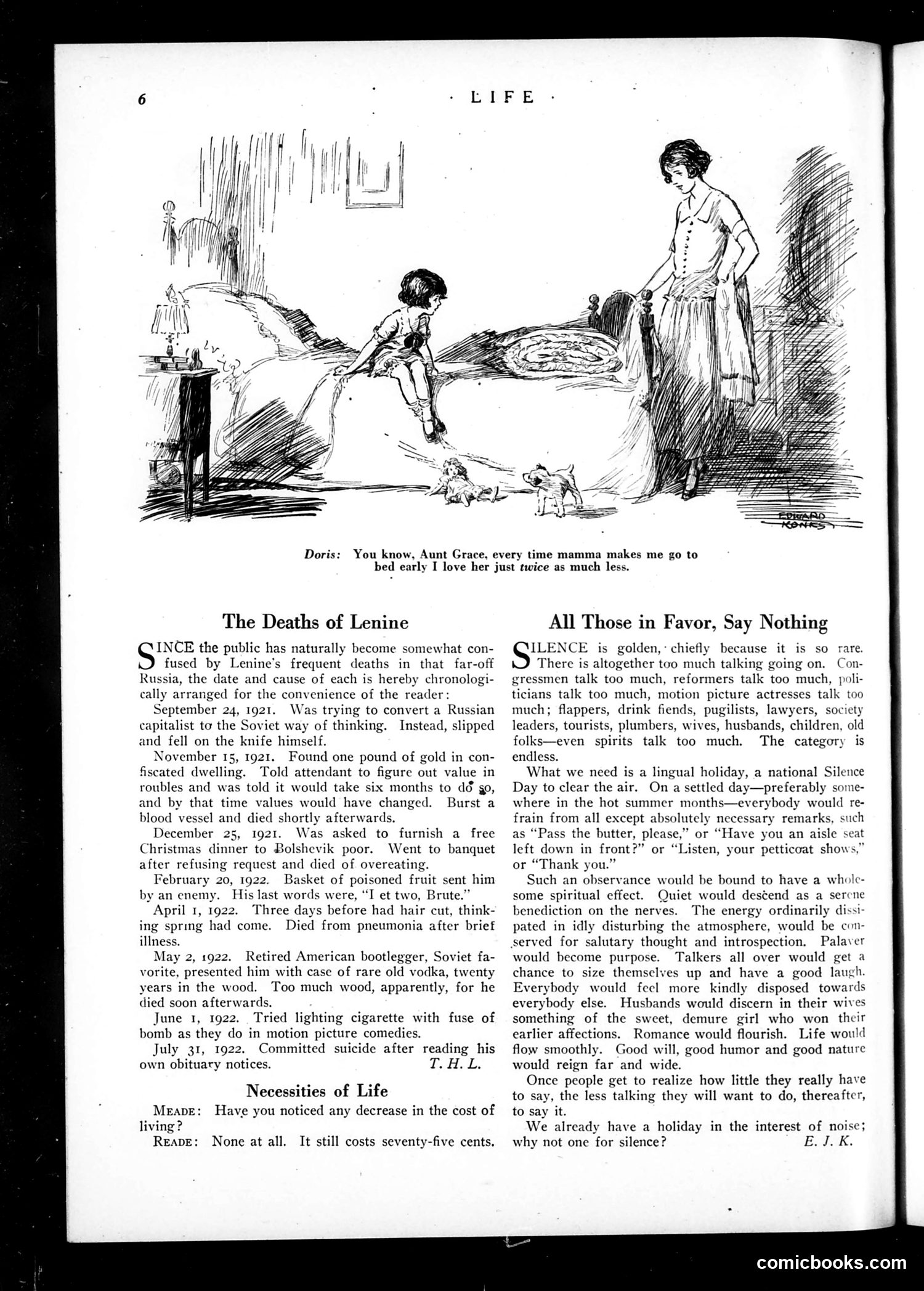
The top illustration shows a child (Doris) talking to an adult woman (Aunt Grace) in a bedroom scene. Doris complains that her mother sends her to bed early, which she dislikes. The joke satirizes parental discipline and childhood resistance to bedtime—a timeless domestic scenario. Below are three short pieces: "The Deaths of Lenin" catalogues the Soviet leader's alleged deaths via various means (poisoning, starvation, suicide) during 1921-1922, satirizing anti-Soviet propaganda circulating in the West. "All Those in Favor, Say Nothing" argues for a "Silence Day"—a humorous proposal for national quiet to counter excessive talk by politicians, reformers, and society figures. "Necessities of Life" is a brief dialogue questioning whether living costs have decreased.
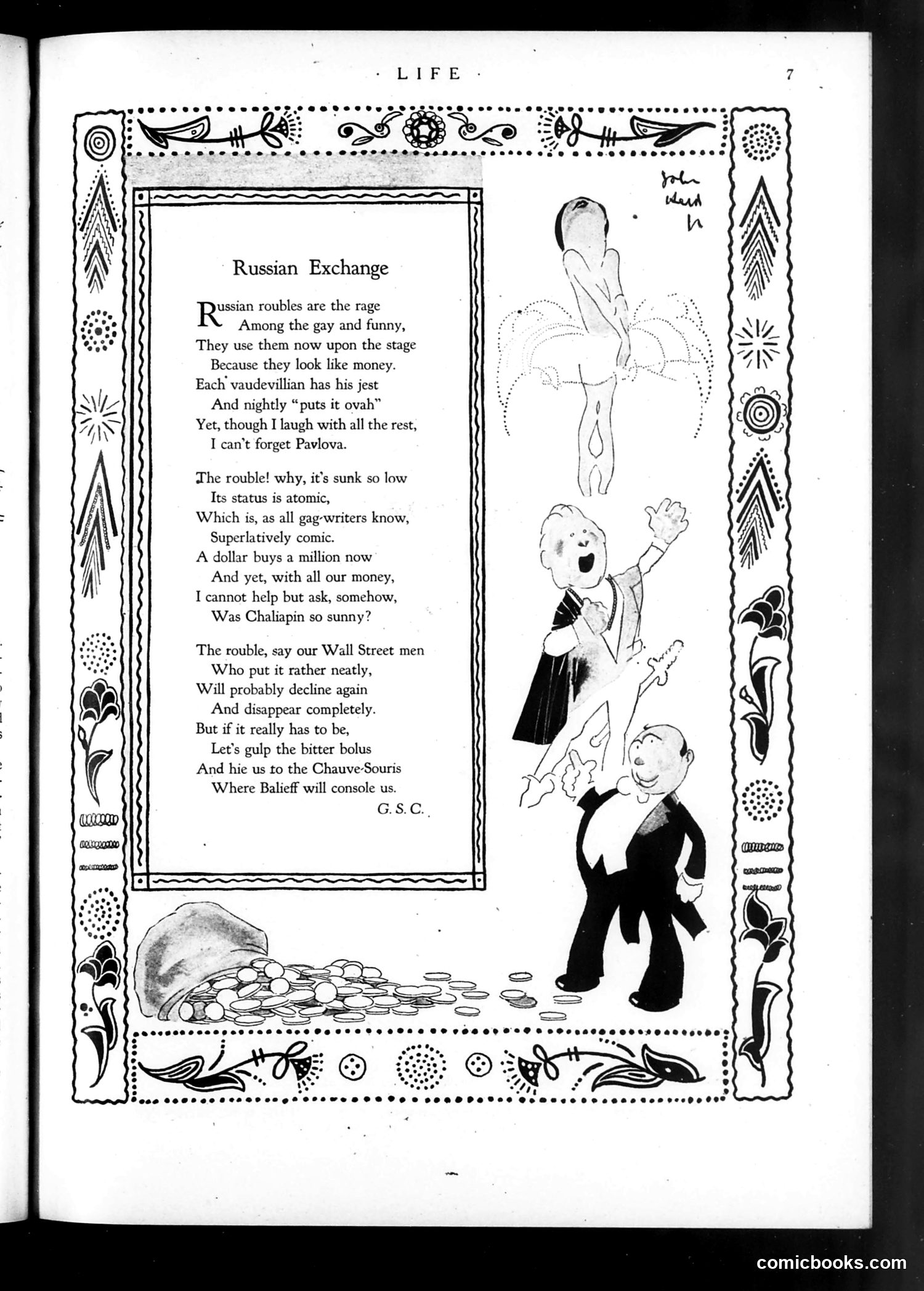
This poem by G.S.C. satirizes the collapse of the Russian ruble following the Bolshevik Revolution. The text mocks how Russian currency became worthless—theater performers used rubles as stage props because they "look like money" but held no real value. The accompanying cartoons illustrate the absurdity: a man spills coins carelessly, while others celebrate wildly, suggesting the currency's worthlessness made people treat it as a joke. The poem references Wall Street's prediction that the ruble "will probably decline again / And disappear completely," and suggests depositing the ruined currency at the "Chauve-Souris" nightclub (a famous Russian émigré cabaret in Paris) where impresario Balieff could "console us." The satire captures American amusement at—and schadenfreude over—Soviet economic disaster.
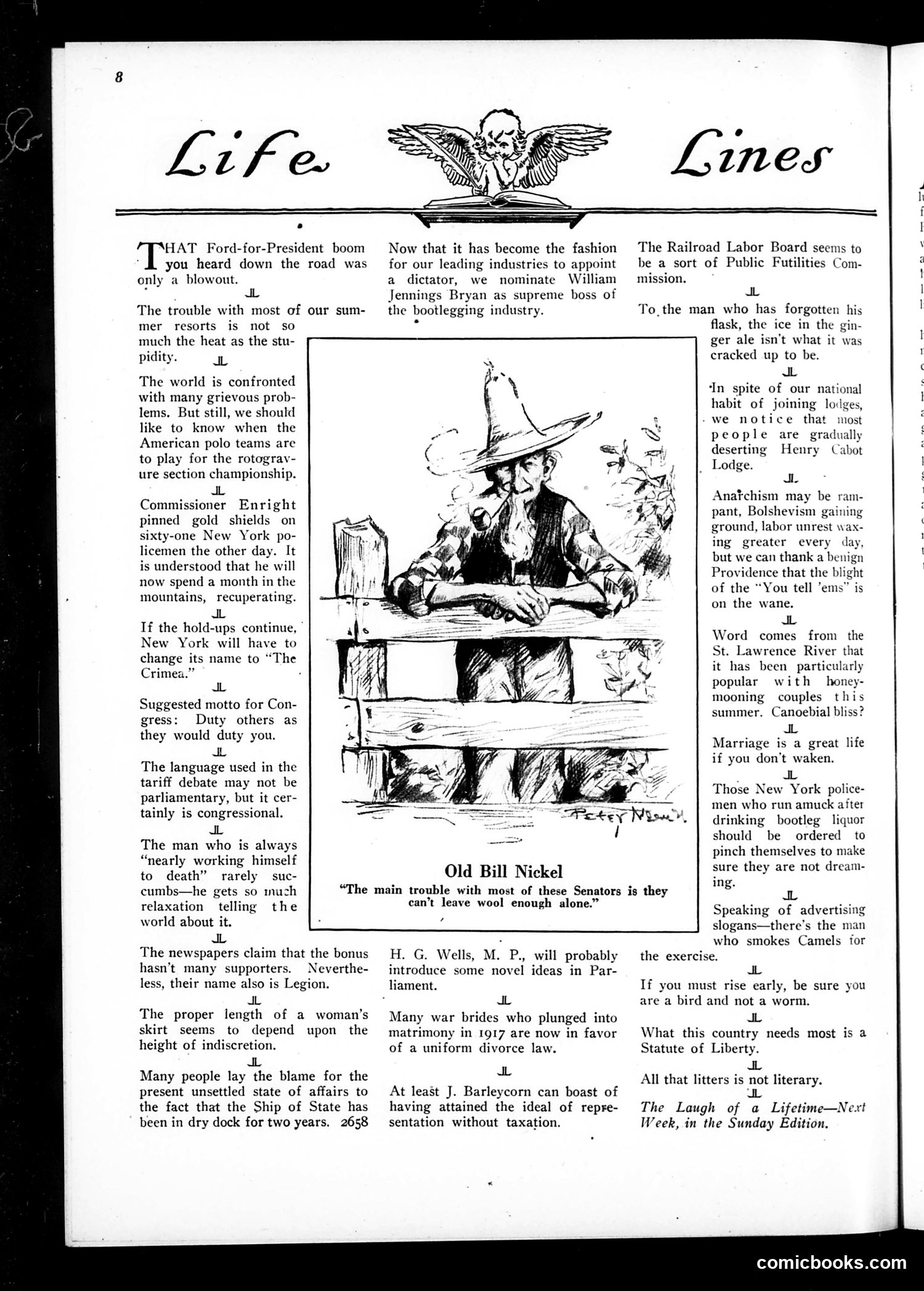
The central cartoon depicts a disheveled man in a large hat sitting at a table with a bottle, illustrating the caption: "The main trouble with most of these Senators is they can't leave wool enough alone." This is political satire about U.S. Senators allegedly profiting from wool tariffs. "Old Bill Nickel" appears to be a stock character representing rural/working-class America. The cartoon criticizes senators for excessive protectionism regarding wool—they "can't leave wool enough alone," suggesting they continuously manipulate tariffs for personal gain rather than the public good. The surrounding "Life Lines" commentary discusses various contemporary issues (labor unrest, divorce law, prohibition bootlegging), typical of this satirical magazine's format.
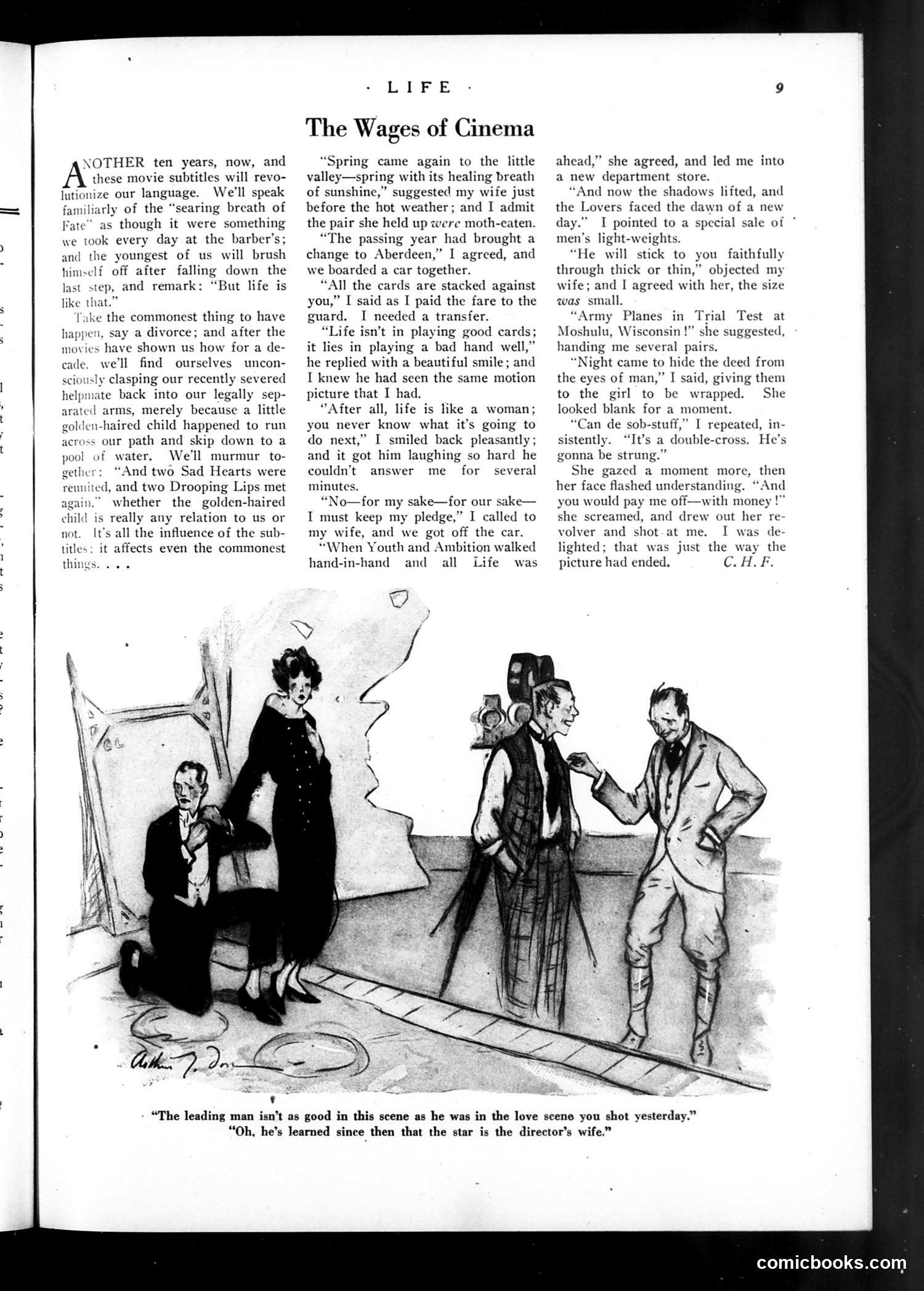
This satirical piece critiques early cinema's influence on language and culture. The title essay argues that movie subtitles are reshaping everyday speech—people now use film clichés in casual conversation. The cartoon below illustrates this theme: a film director complains to a colleague that the leading actor performed poorly in a dramatic scene, but "he's learned since then that the star is the director's wife." This joke targets nepotism in the film industry—specifically how actors improve their performances when they discover personal relationships with authority figures matter more than talent. It's satirizing both the corruption of merit-based casting and the absurdity of actors prioritizing connections over craft.
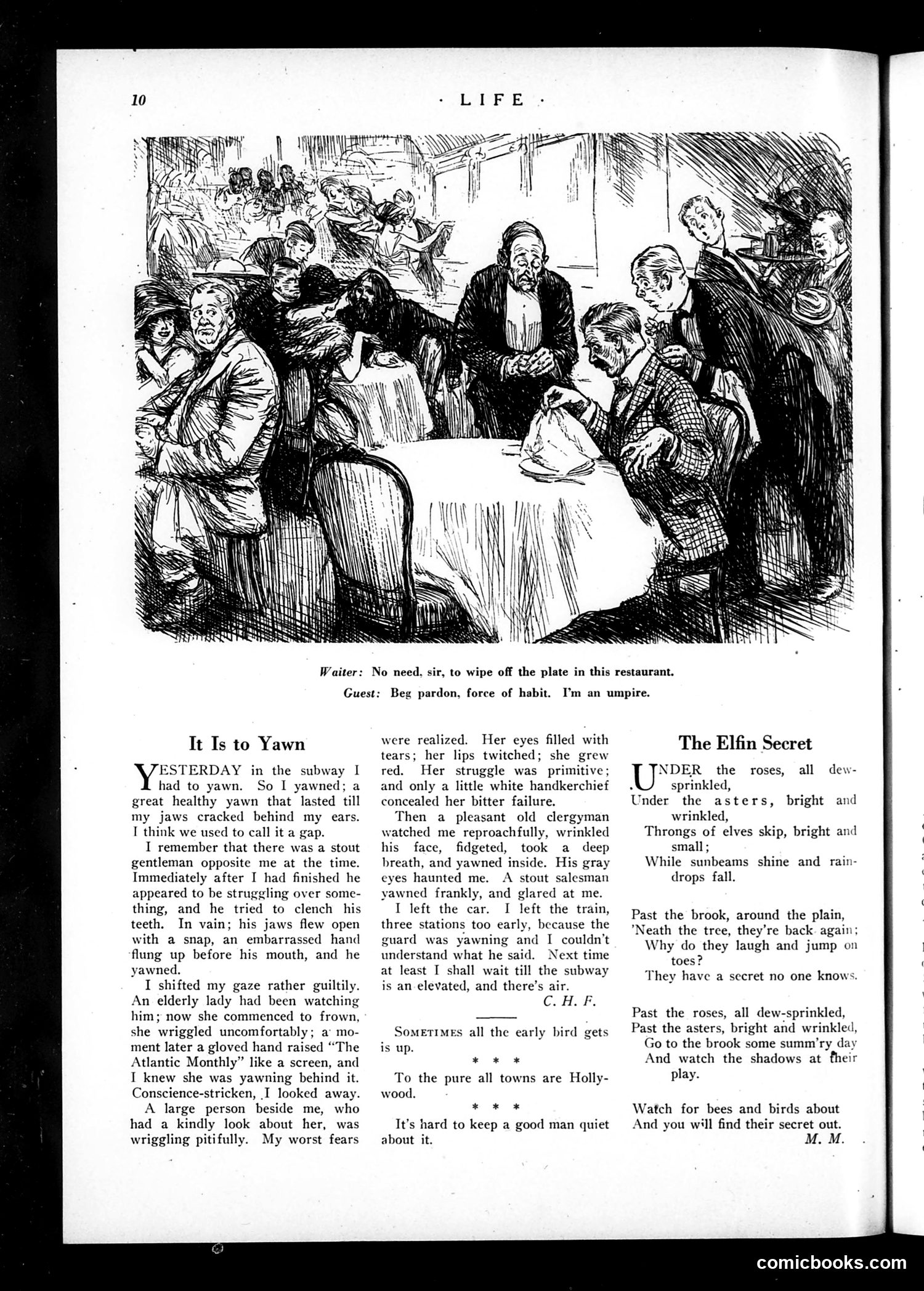
The single cartoon at the top depicts a restaurant scene where a waiter approaches a table with a dirty plate. The guest responds defensively: "Beg pardon, force of habit. I'm an umpire." This is a straightforward joke playing on the stereotype of baseball umpires. The humor relies on the implication that umpires are accustomed to making dismissive gestures (the wiping motion) as part of their job calling plays—specifically, calling runners "out." The cartoon suggests the guest unconsciously mimicked this habitual gesture while handling the plate, conflating his professional role with everyday dining etiquette. The page also contains two poems: "It Is to Yawn" and "The Elfin Secret," which are unrelated to the cartoon.
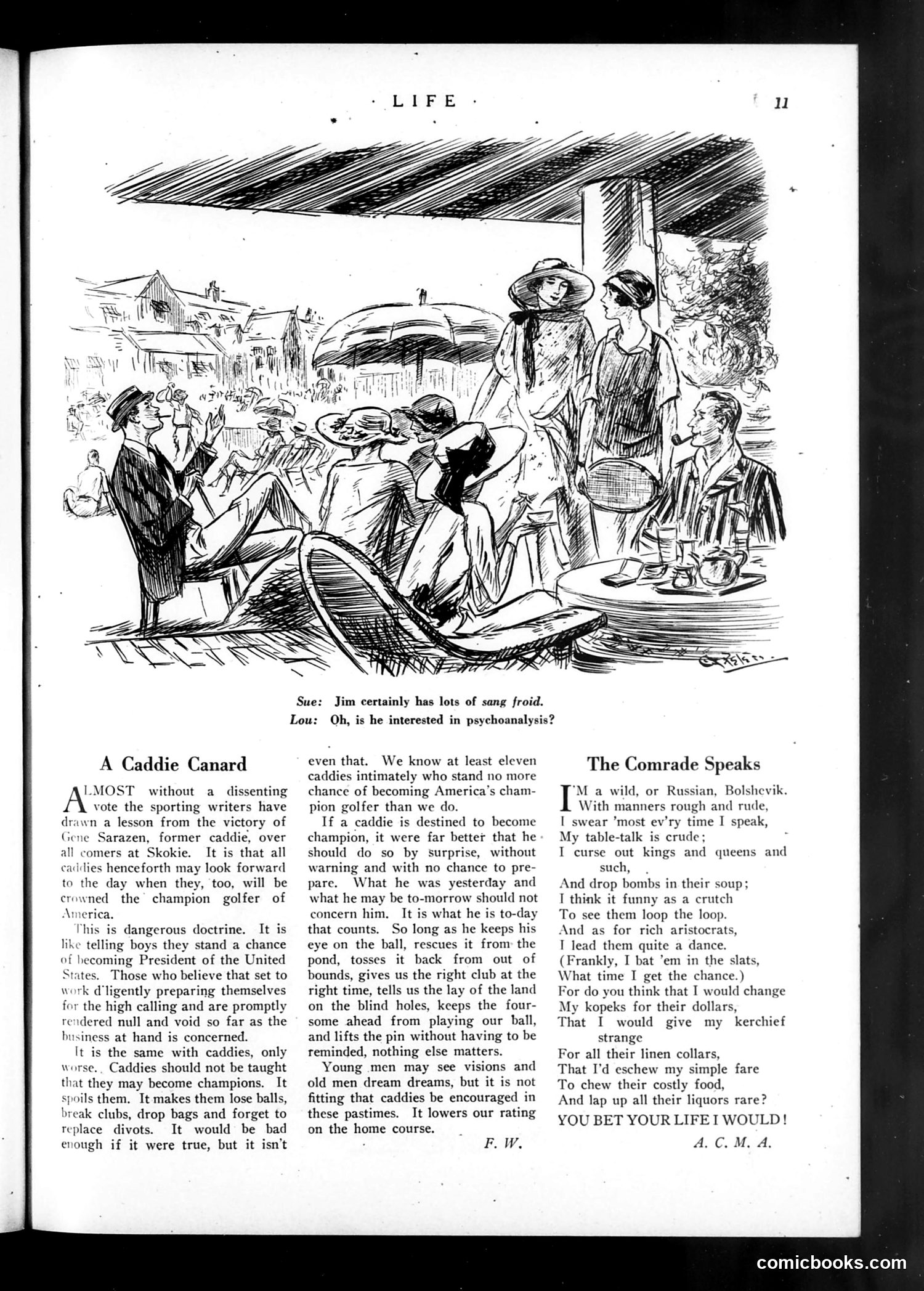
This page contains two satirical pieces about golf and social behavior circa early 20th century. **"A Caddie Canard"** criticizes the idea that caddies should aspire to become golf champions. The author argues caddies should focus on their actual job—keeping their "eye on the ball" and maintaining the course—rather than being encouraged to abandon their role through unrealistic dreams of advancement. **"The Comrade Speaks"** features a Russian character (indicated by "Bolshevik" reference) expressing crude, materialistic values—preferring money and food to aristocratic refinement. This appears to satirize Russian revolutionary ideology and working-class attitudes as vulgar or uncultured. The cartoon above depicts a beach or social scene, with dialogue about someone named Jim having "lots of sang froid" (composure) and being "interested in psychoanalysis"—contemporary intellectual trends being mocked.
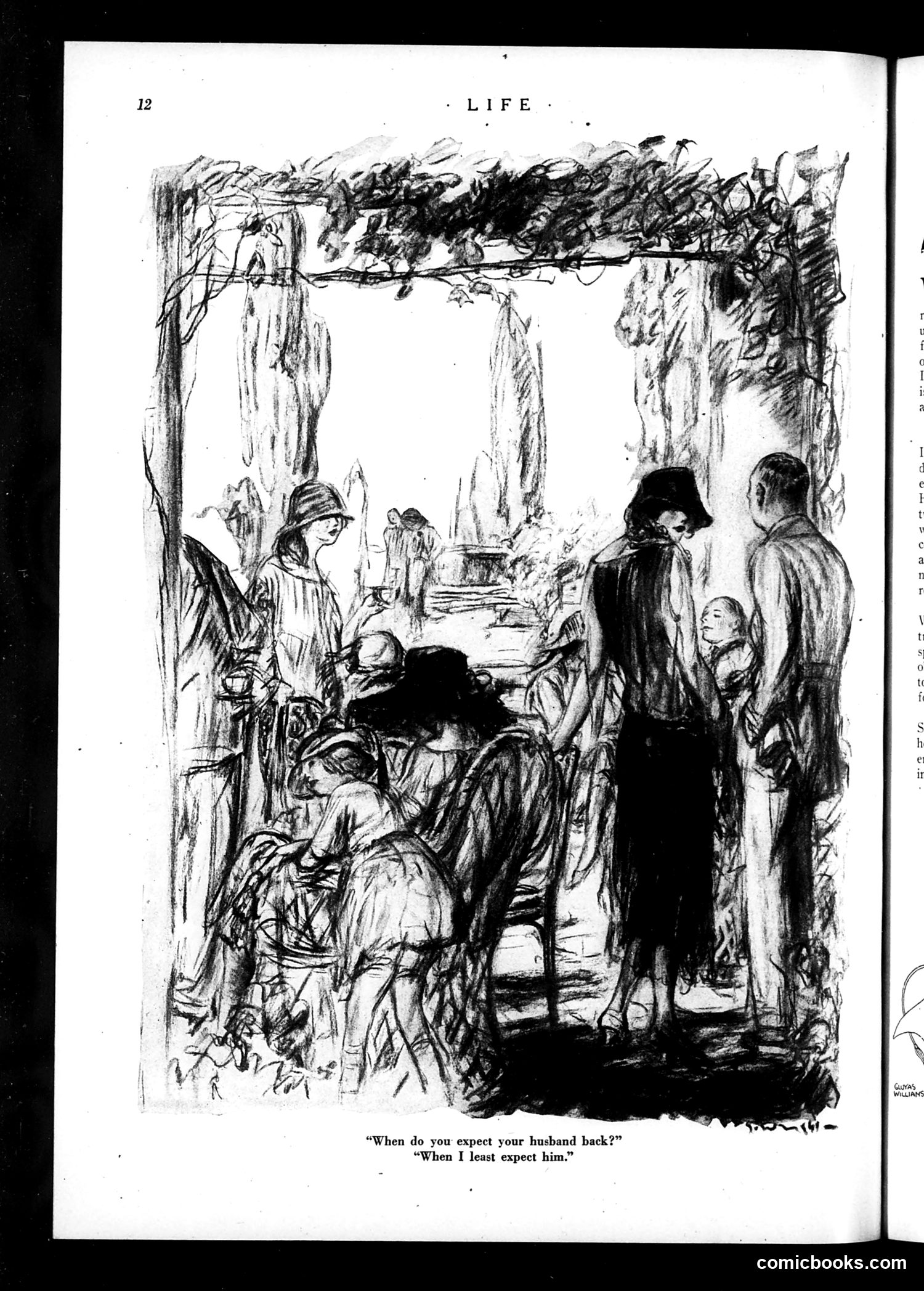
This sketch depicts a domestic scene, likely from the early 20th century based on the artistic style. A woman (center) responds to another's question about her husband's return with dry wit: she expects him "when I least expect him"—a humorous complaint about his unpredictable arrivals home. The cartoon satirizes the anxiety of wives waiting for husbands, and their husbands' unreliable schedules. The crowded, casual interior setting (possibly a tenement or modest home) and multiple figures suggest working-class domesticity. The joke plays on marital tension and the woman's resigned frustration with her spouse's unpredictability, reflecting early 20th-century attitudes toward domestic life and gender relations.
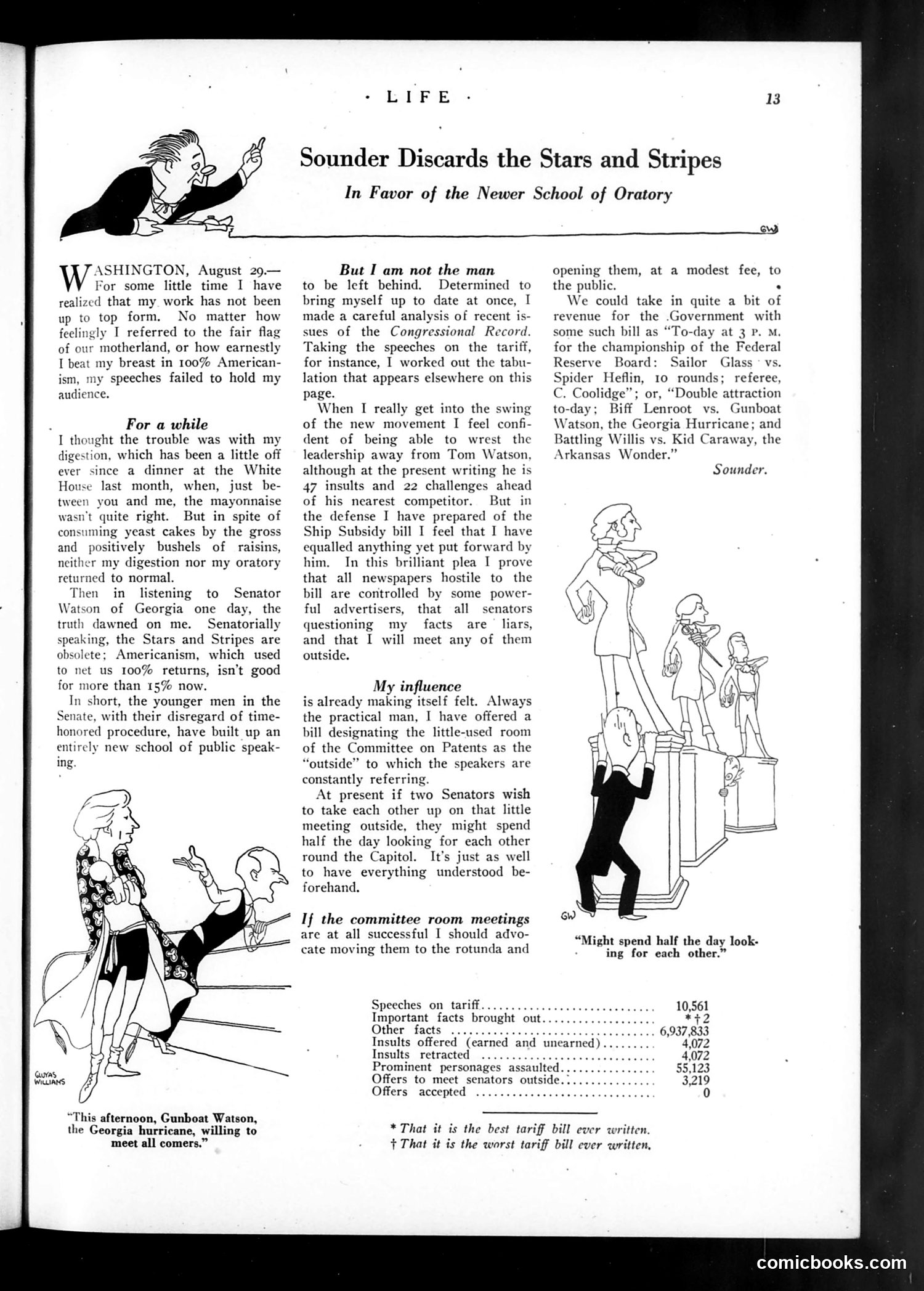
This 1920s Life magazine page satirizes Senator **Sounder** (a fictional character), who claims to have abandoned old-fashioned oratory ("Stars and Stripes" patriotic speeches) for a newer, more sophisticated speaking style. The satire works on multiple levels: Sounder boasts of intellectual superiority while actually pursuing trivial Senate politics—moving committee meetings around, squabbling with rival Tom Watson, and generating hollow disputes. The cartoons mock his pretensions: one shows him struggling physically with an opponent; another depicts him struggling to hoist a crowd of eager office-seekers. The statistics at bottom (insults offered, facts presented) suggest he's accomplished little of substance despite his grandiose claims about reforming Senate oratory.
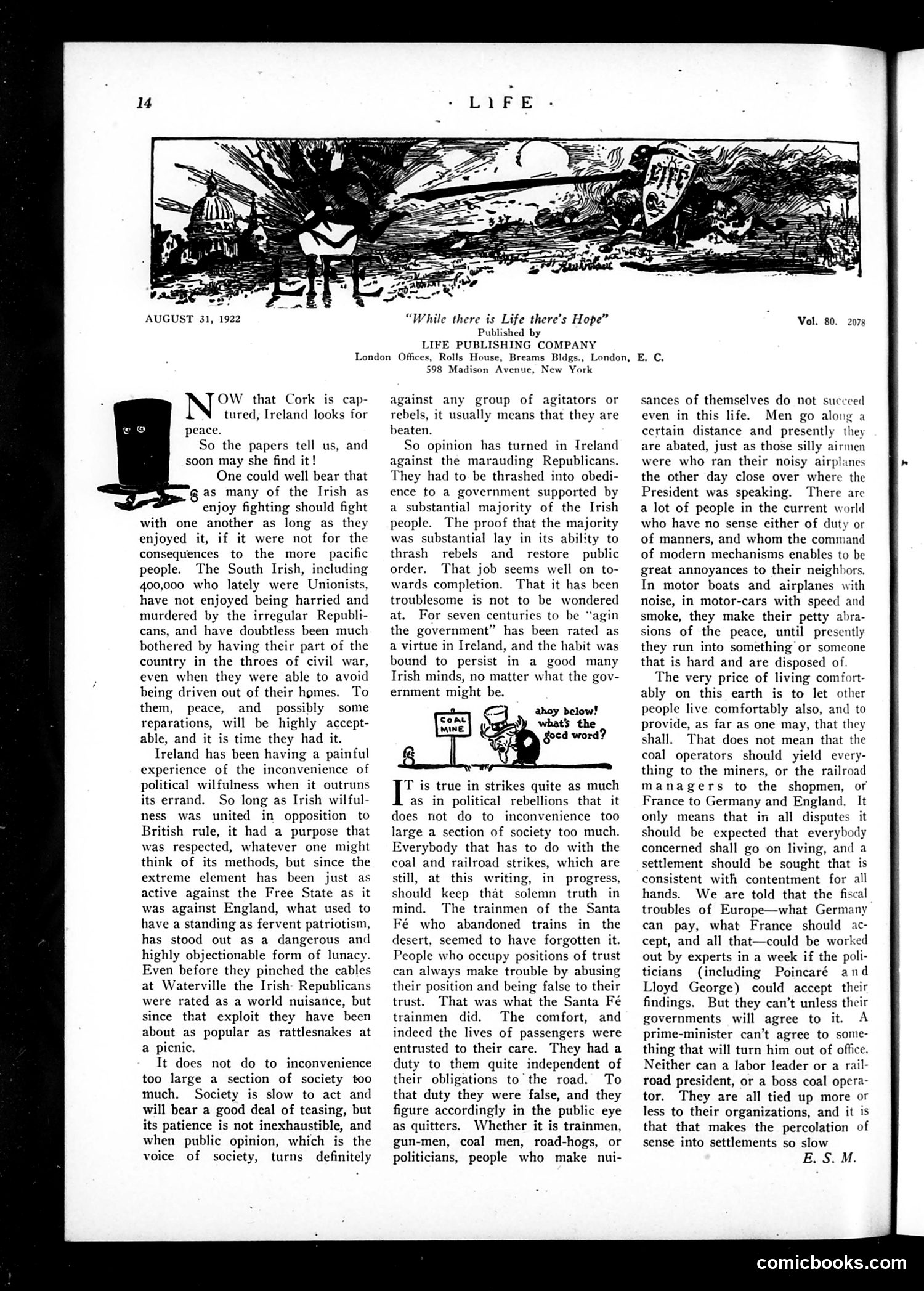
This page contains political commentary on Irish independence and labor strikes. The main illustration shows a figure (likely representing Ireland or Irish Republicans) emerging from conflict, celebrating capture or control. The editorial discusses Ireland's recent painful transition to independence, praising the Irish majority's ability to restore order after Republican agitation. It criticizes both violent Republicans and those who exploited patriotism. A small cartoon depicts someone asking "what's the good word?" — likely commentary on labor disputes then ongoing in Britain and America (coal and railroad strikes mentioned in the text). The broader argument defends societal institutions against both extremist violence and labor unrest, arguing for gradual reform through proper channels rather than strikes or rebellion.
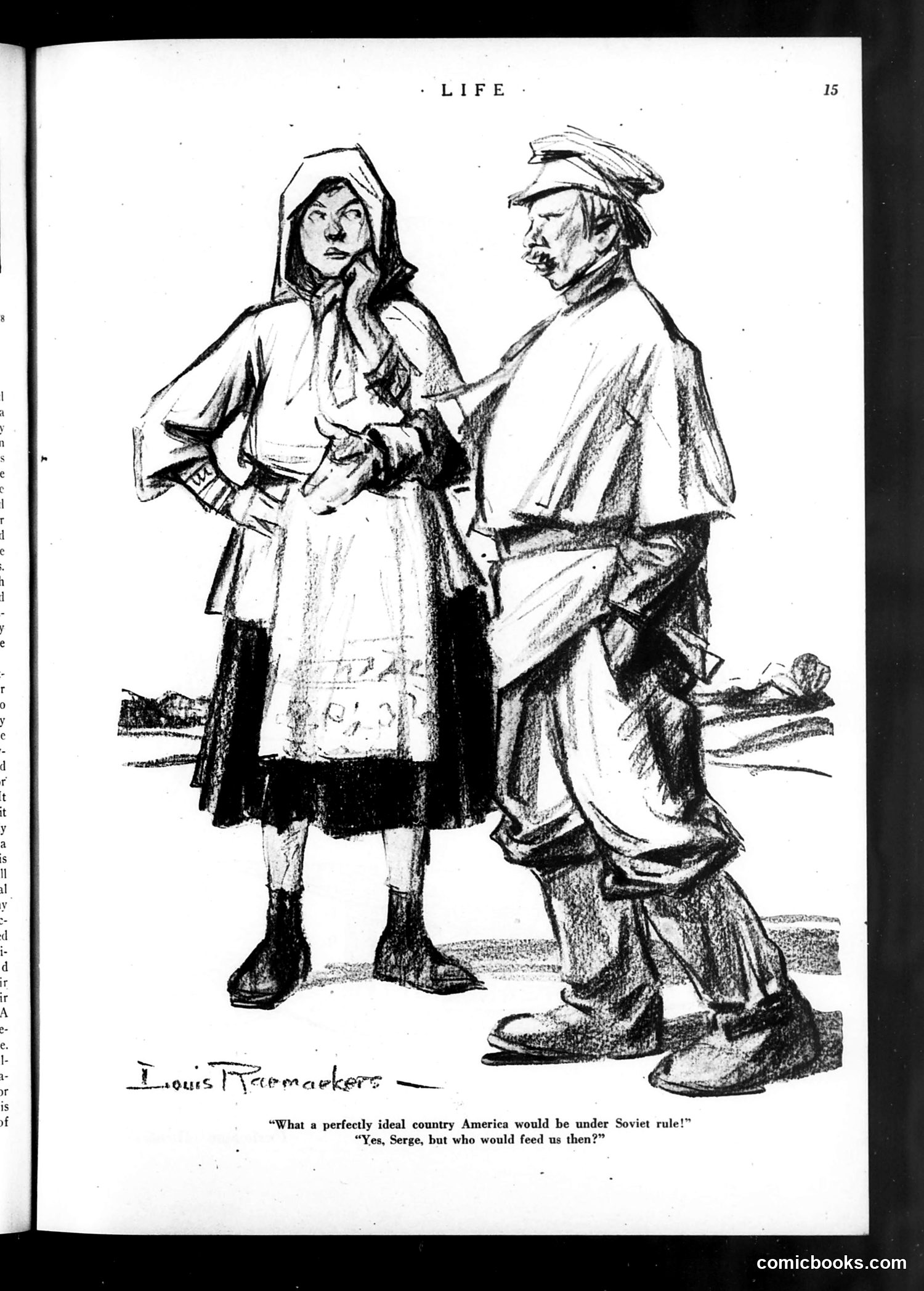
This is a satirical cartoon by LouisImore that mocks Soviet communism through dialogue between two figures—apparently a Russian woman and a man named "Serge" (a Russian name). The woman expresses admiration for how perfect America would be under Soviet rule. Serge responds with a practical objection: who would provide food under such a system? The joke targets communist ideology by suggesting that while Soviet rule might sound theoretically ideal, it would create economic collapse and starvation—implying the Soviet system itself suffered from food scarcity and economic failure. This reflects Cold War-era American skepticism about communist economics and likely references historical Soviet famines or chronic food shortages that were known to Western audiences at the time of publication.
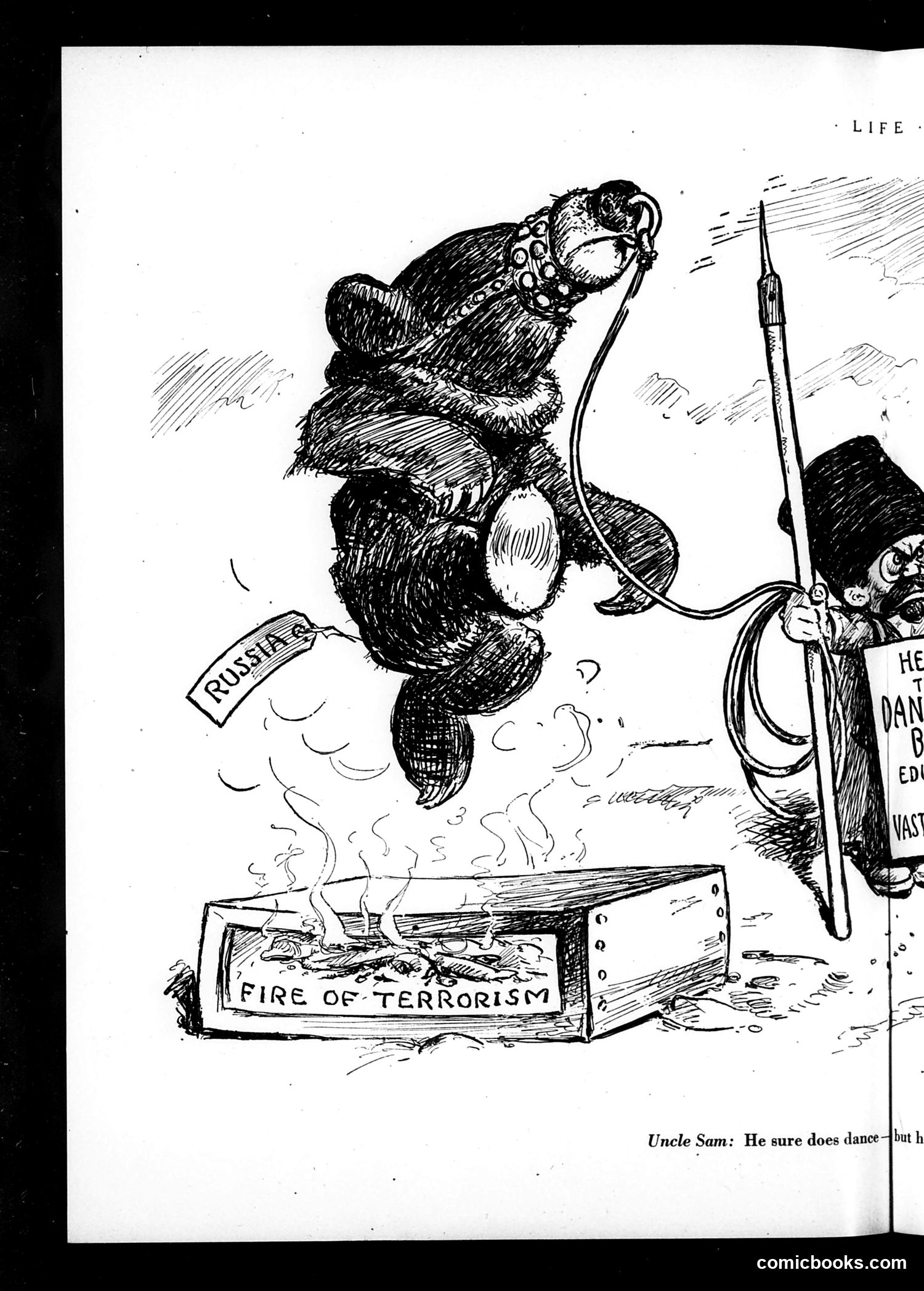
This is a satirical cartoon depicting **Uncle Sam** (representing the United States) being forced to dance on a fire labeled "FIRE OF TERRORISM" while a figure labeled "RUSSIA" pulls the strings like a puppet master. The Russian figure holds a rope attached to Uncle Sam, controlling his movements. The cartoon satirizes Cold War anxieties, suggesting that Russian actions or threats are manipulating American policy and forcing the U.S. into unwanted military engagements or responses. The "fire of terrorism" reference indicates fears of communist insurgency or sabotage being used as leverage against American interests. The caption's incomplete text ("He sure does dance—but h...") reinforces the theme of forced compliance rather than independent action.
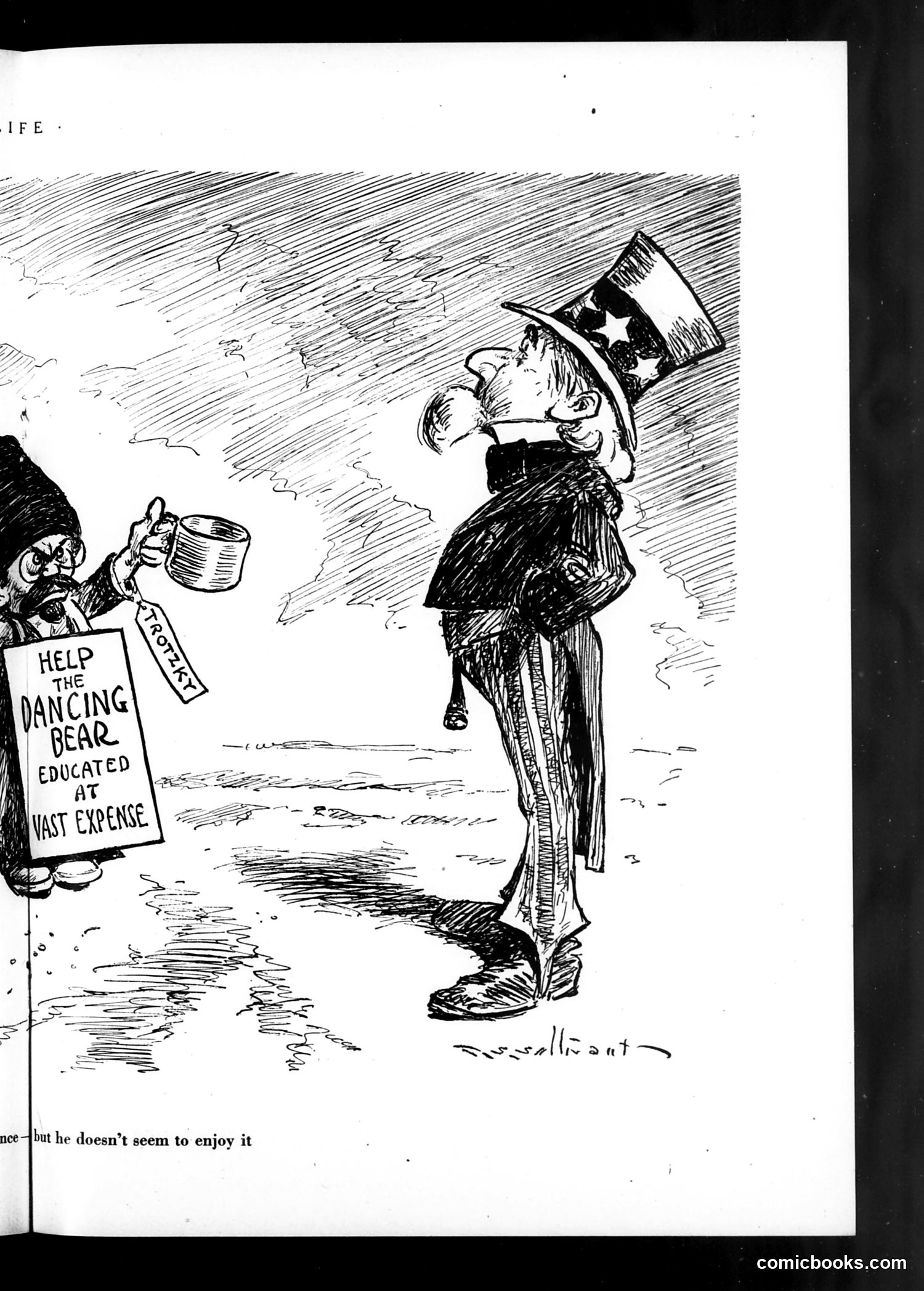
This political cartoon satirizes American foreign aid spending. Uncle Sam (identifiable by his star-spangled top hat) appears reluctant or sorrowful while holding a bucket, presumably of money. A figure on the left holds a sign reading "HELP THE DANCING BEAR EDUCATED AT VAST EXPENSE," offering him a bucket labeled "POCKET." The "dancing bear" likely represents a foreign nation or ally receiving substantial American financial support for education or development. The satire suggests that despite America's costly investment in this nation's advancement, the recipient seems ungrateful or unappreciative—doesn't "enjoy it," as the caption states. This reflects Cold War-era frustration with foreign aid programs that appeared wasteful or produced insufficient goodwill toward the United States.
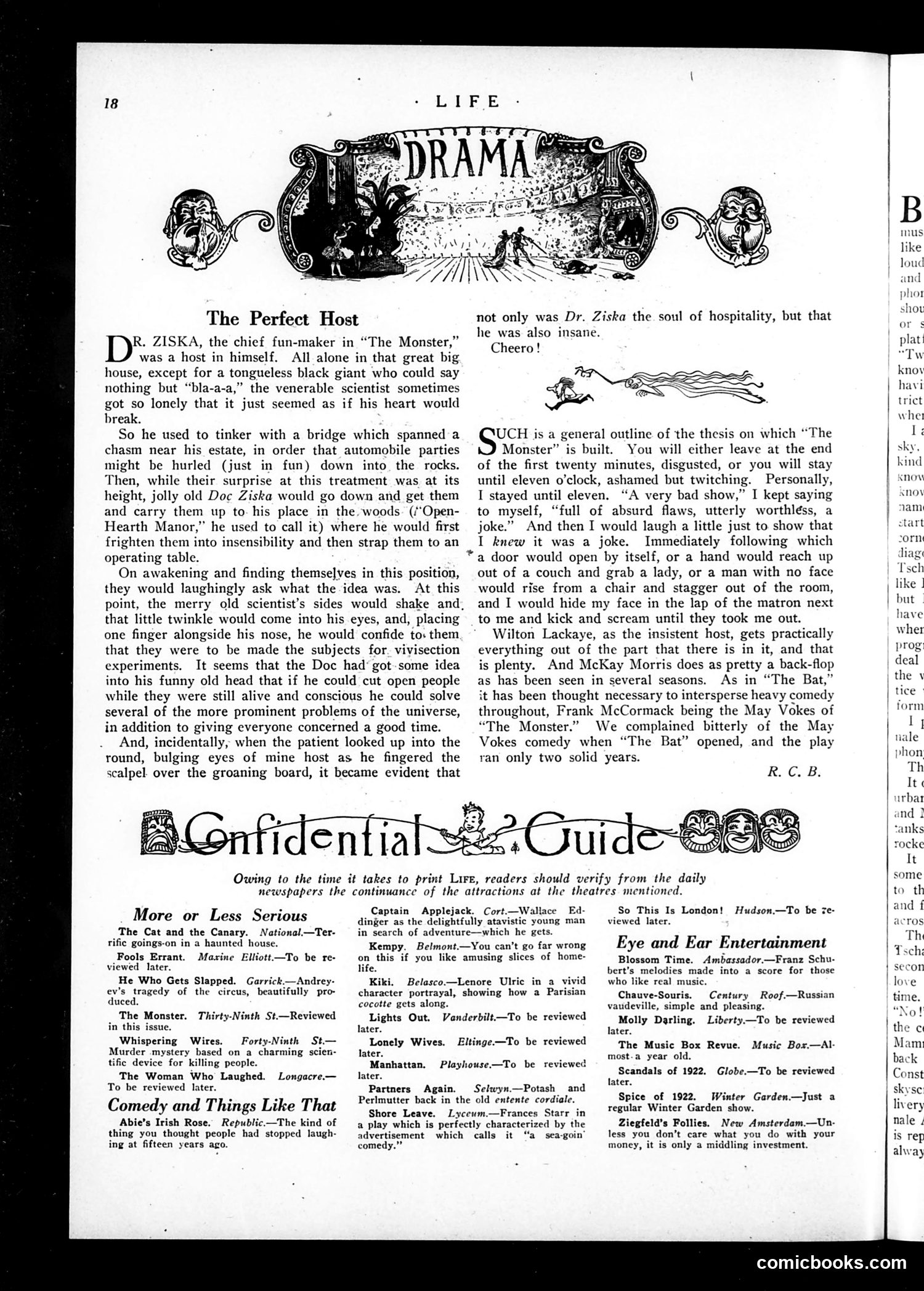
This is a theater review of the horror film *The Monster*, focusing on its protagonist Dr. Ziska (played by Wilton Lackaye), a mad scientist who entertains guests with darkly absurd hospitality. The satire works on multiple levels: Ziska is presented as the "perfect host" — he goes to elaborate, murderous lengths to entertain visitors, from sabotaging their car over a bridge to strapping them to an operating table for vivisection experiments. The joke is the grotesque inversion of hospitality; his "entertainment" is genuinely terrifying yet framed with comic timing. The reviewer acknowledges the film's "absurd flaws" and inconsistent tone — it oscillates between deliberate comedy and genuine horror. The criticism extends to unnecessary comic relief (Frank McCormack's character), comparing it unfavorably to earlier horror-comedy *The Bat*. The reviewer admits being both intellectually dismissive and emotionally terrified by the film's jump scares, capturing the era's early horror-comedy genre conventions.
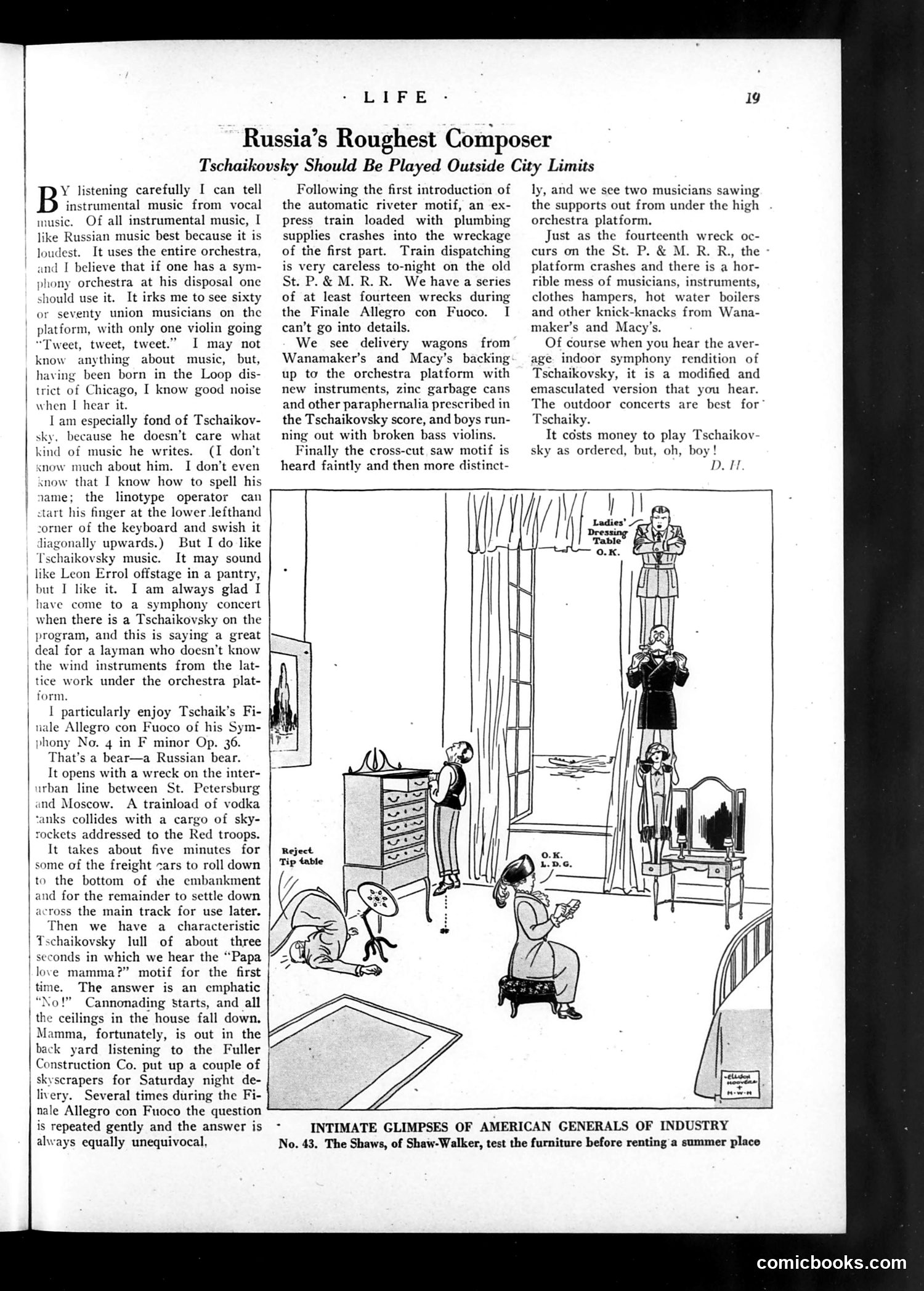
This is a humorous essay mocking Tchaikovsky's music as absurdly loud and chaotic. The author (writing from a Chicagoan's perspective valuing noise over refinement) humorously "describes" the composer's Fourth Symphony as literally depicting industrial catastrophes—trainloads of vodka colliding with skyrockets, multiple wrecks, falling ceilings, delivery trucks, and ultimately the orchestra platform itself collapsing. The satire works on multiple levels: it skewers both highbrow concert culture (treating classical music as pretentious) and Tchaikovsky's actual dramatic, bombastic orchestration. The joke is that his music sounds so violent and chaotic that the author imagines actual physical destruction occurring, making the point that performing it "properly" (as Tchaikovsky intended) would require literal destruction of the concert hall. The accompanying cartoon shows a chaotic domestic interior, likely illustrating the "destruction" theme. The piece gently mocks both Russophilia in American culture and those who claim to understand sophisticated music they actually don't.
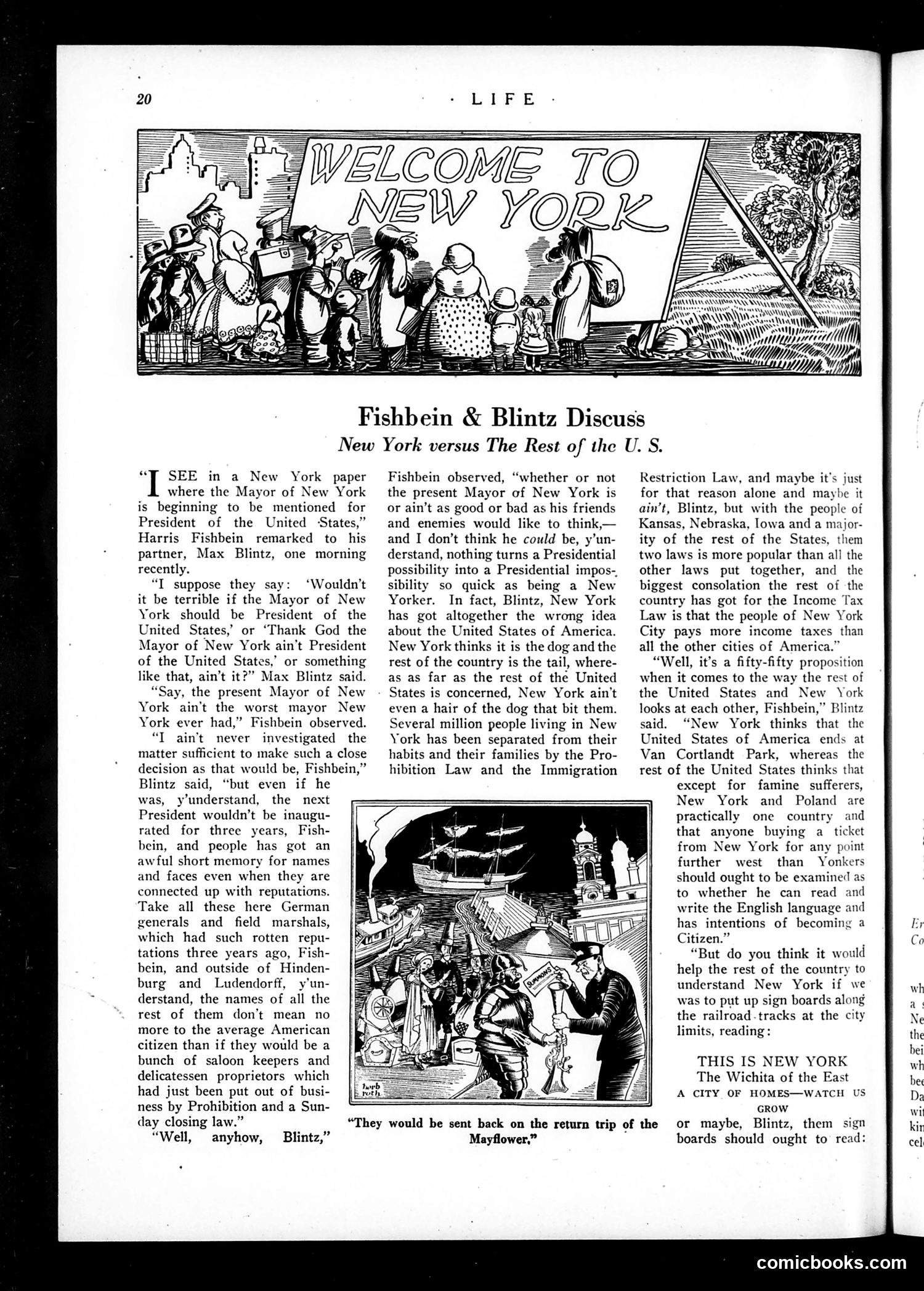
This dialogue between Jewish characters Fishbein and Blintz satirizes the mutual contempt between New York City and the rest of America in the 1920s. The piece addresses several contemporary tensions: **Main themes:** - New York's perceived arrogance ("the dog" while other states are "the tail") - Regional resentment: Kansas, Nebraska, Iowa favor Prohibition and Immigration Restriction laws—policies New Yorkers oppose because they've separated families - New York's outsized wealth (highest income tax contributions) versus cultural isolation - The closing joke suggests posting signs welcoming visitors while sarcastically calling NYC "the Wichita of the East"—mocking New York's self-importance **Context:** The 1920s saw genuine friction between cosmopolitan, immigrant-heavy cities and rural/small-town America over Prohibition, immigration quotas, and cultural values. The satire suggests both regions misunderstand each other, with New York dismissively isolated and America resentfully provincial. The Mayflower reference (bottom illustration) jokes that only deportation could solve these divisions.
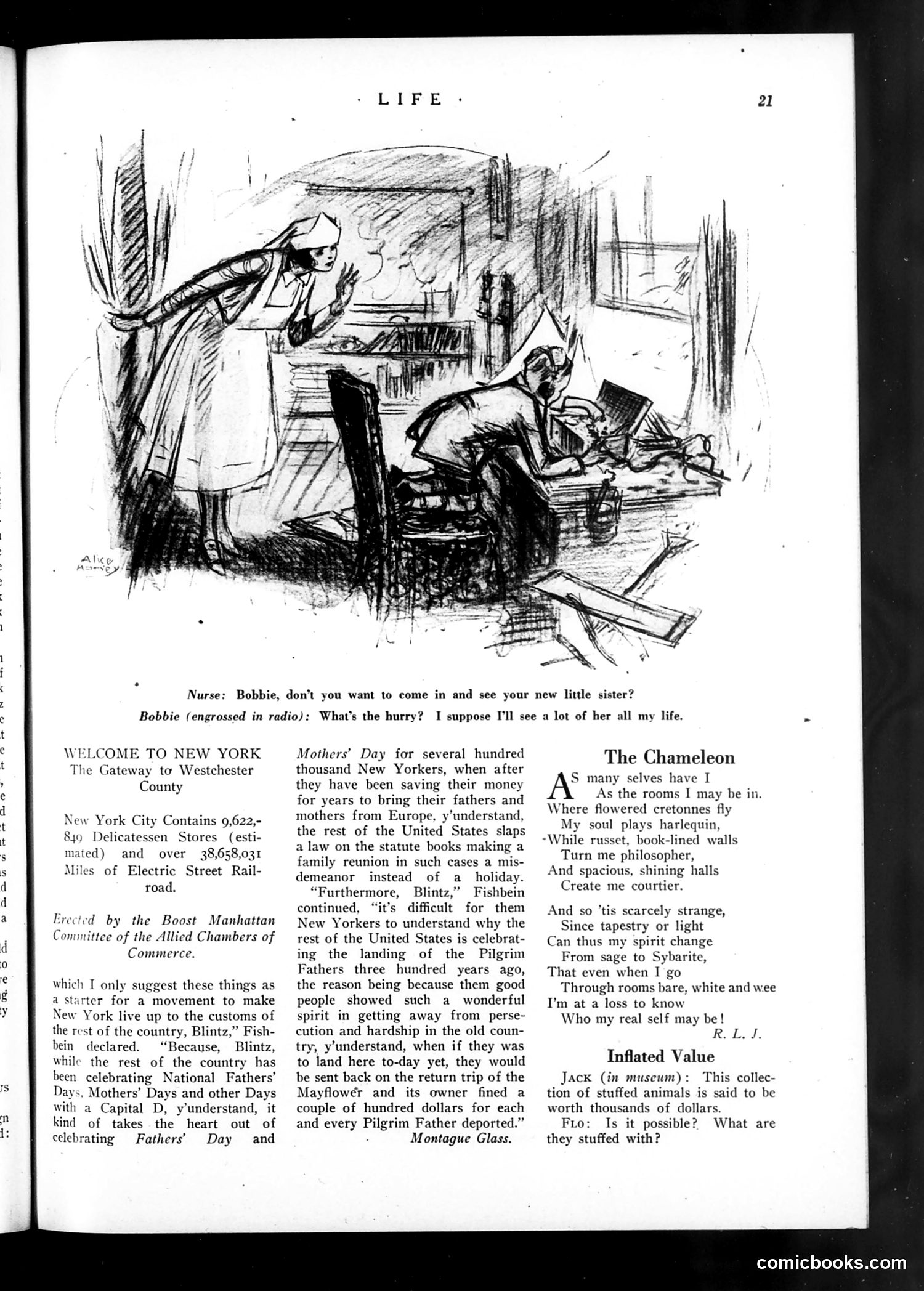
**Main Cartoon:** A boy named Bobbie, absorbed in radio programming, dismisses his mother's invitation to meet his newborn sister with "What's the hurry? I suppose I'll see a lot of her all my life." The satire mocks how radio—a relatively new mass medium in the early 20th century—captivated children's attention, making them indifferent to real-life events. **Secondary Content:** The page includes humorous commentary on New York immigration policy (via Montague Glass's character Fishbein), criticizing laws that prevented European immigrants from reuniting with family members. There's also a poem, "The Chameleon," about adaptability, and a brief joke about museum exhibits. **Historical Context:** This reflects 1920s-30s concerns about radio's influence on youth and contemporary debates over U.S. immigration restrictions, particularly affecting Eastern European Jewish immigrants to New York.
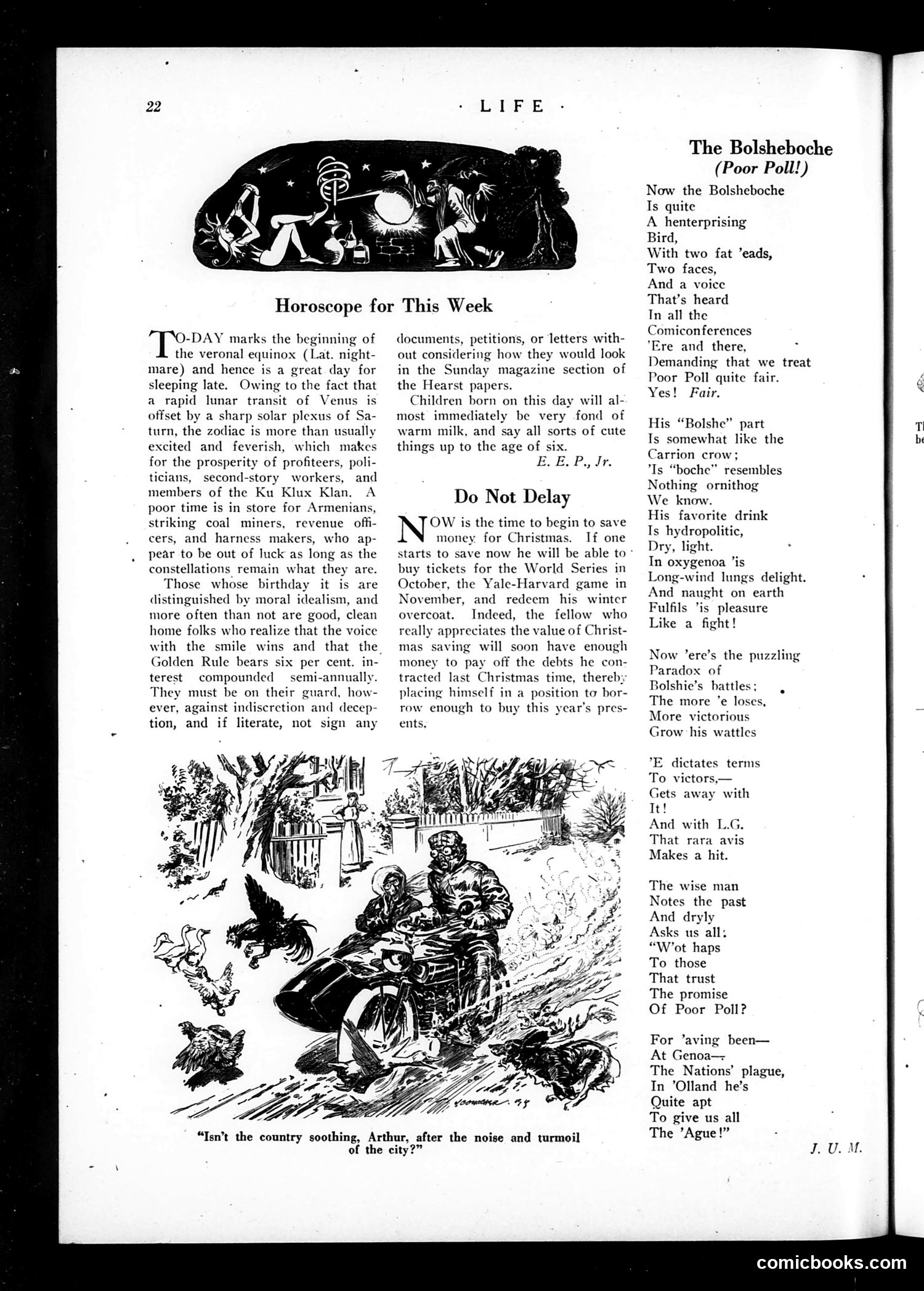
This Life magazine page contains political satire from the early 1920s targeting Bolshevism and its leaders. "The Bolsheboche" poem mockingly describes a hybrid creature combining Bolshevik and "boche" (German) characteristics—representing fear that revolutionary communism and German militarism were allied threats to Western democracies. The poem satirizes what the author saw as the paradox of Bolshevism: despite military defeats, it gained diplomatic influence, particularly through negotiations at Genoa and the Netherlands. The reference to "L.G." (likely Lloyd George, British Prime Minister) suggests Western leaders were being manipulated by communist negotiators. The illustration below shows people on a motorcycle, likely a period joke about escaping urban chaos—contrasting with the political anxieties expressed above. The "Horoscope" and "Do Not Delay" sections offer lighter satirical commentary on contemporary American life, profiteering, and the Ku Klux Klan, but the page's central focus is anti-Bolshevik propaganda typical of post-WWI Western publications.
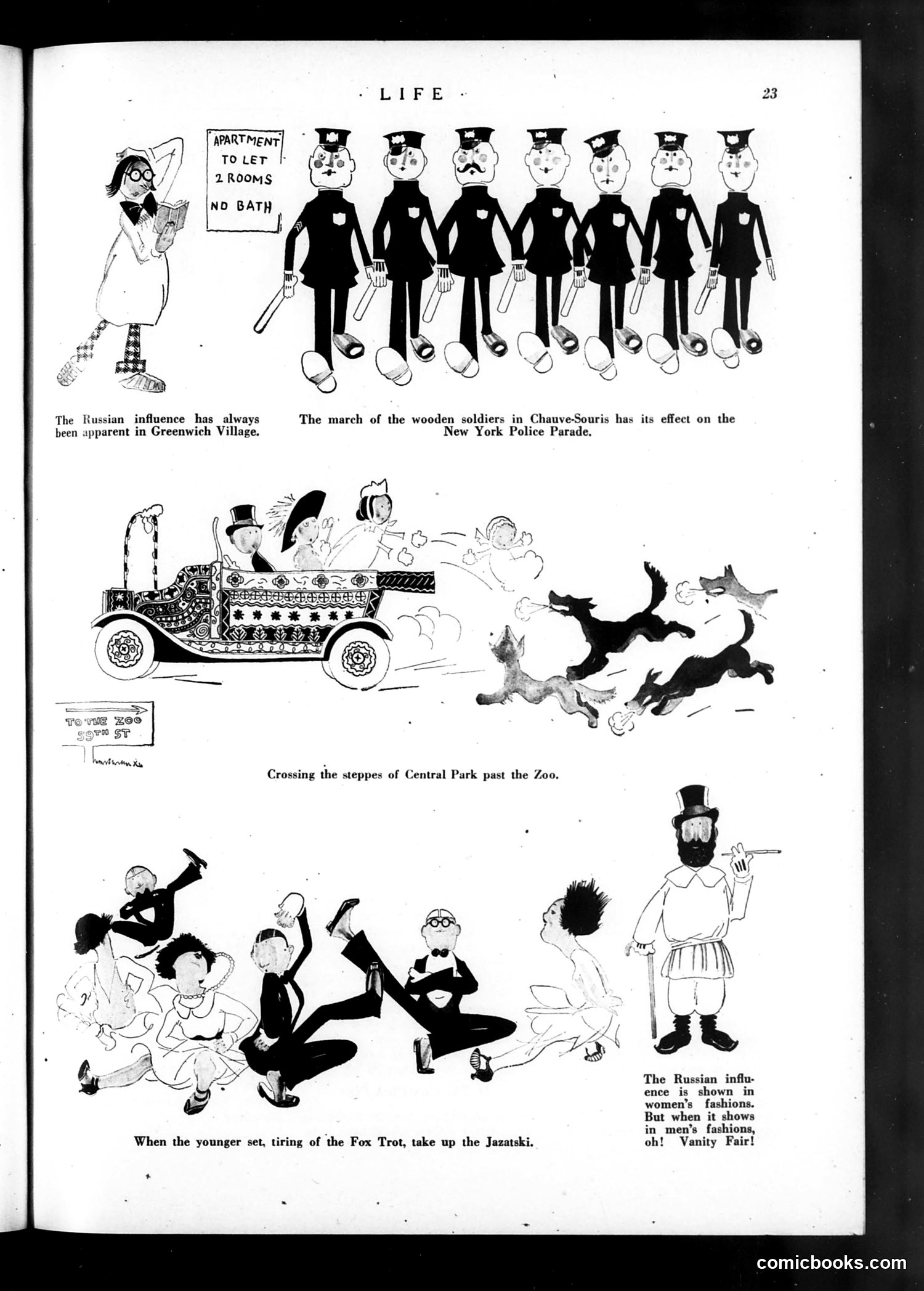
This page satirizes the "Russian craze" sweeping 1920s America, particularly affecting Greenwich Village bohemians and high society. The cartoons mock how Russian cultural imports—from the avant-garde theater revue "Chauve-Souris" to jazz-influenced dance (the "Jazatski")—were reshaping American style and behavior. The top panel jokes that Russian aesthetics even influenced the NYC Police Parade (wooden-soldier rigidity). The Central Park scene references Russian steppes imagery pervading popular culture. The final panels contrast women adopting Russian fashions (presented acceptably) versus men doing so, which the caption sarcastically condemns as excessive vanity. The overall satire targets how eagerly Americans, especially fashionable urbanites, embraced Russian cultural trends as markers of sophistication, while simultaneously viewing such adoptions as absurd affectation.
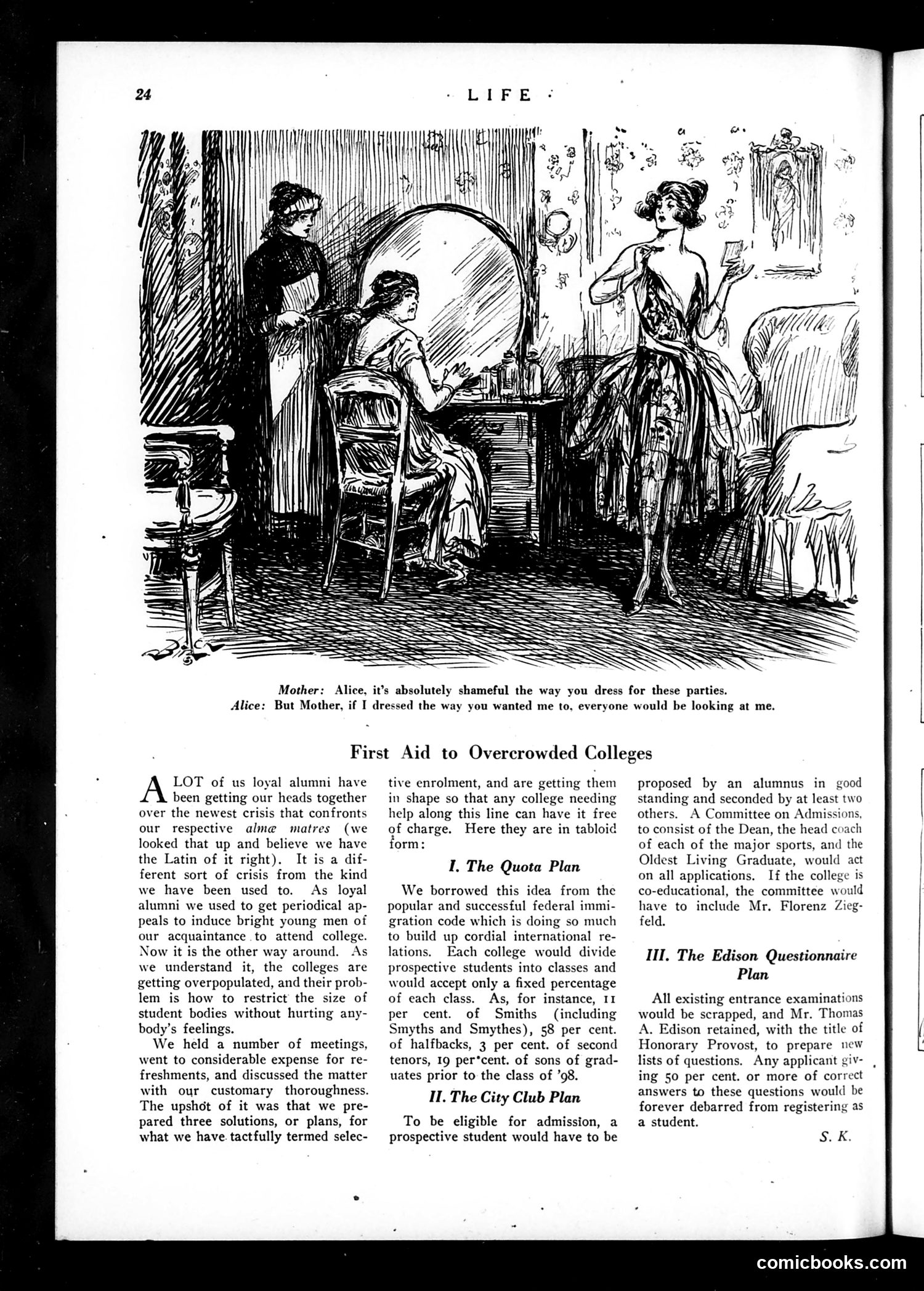
This page contains two separate pieces of satire: **The Cartoon:** A mother scolds her daughter Alice for immodest party dress. Alice's witty retort—that dressing conservatively would paradoxically draw *more* attention—is a joke about social expectations and female attention-seeking behavior, likely reflecting 1920s debates about women's changing fashion and social roles. **The Article:** "First Aid to Overcrowded Colleges" satirizes the sudden problem of college *over*enrollment (reversing the traditional alumni recruitment crisis). The writer proposes three absurdly bureaucratic solutions: 1. **The Quota Plan** mockingly parallels the restrictive federal immigration quotas of the era, reducing admissions to mathematical percentages 2. **The City Club Plan** invokes snobbish social gatekeeping, bizarrely including theatrical impresario Florenz Ziegfeld for co-ed admissions decisions 3. **The Edison Questionnaire Plan** proposes Thomas Edison design entrance exams so difficult that passing actually *disqualifies* applicants The satire targets both institutional pretension and the absurdity of admissions gatekeeping, suggesting these "solutions" are deliberately worse than the original problem.
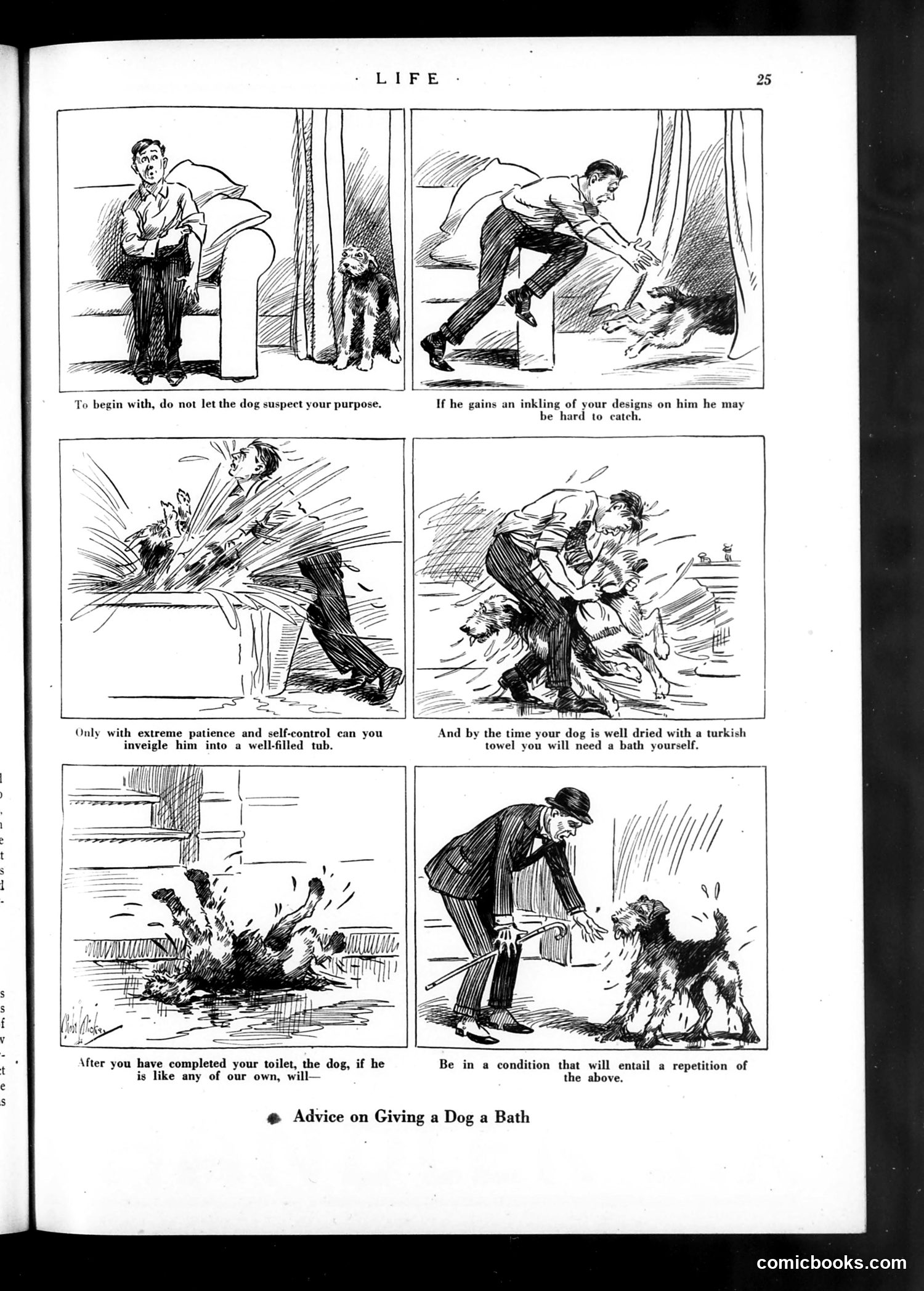
This is a humorous instructional comic strip, not political satire. It depicts the comical challenges of bathing a dog—a relatable domestic scenario for Life magazine's readers. The sequence shows: a man planning to bathe his dog; the dog evading capture; the man struggling to get the dog into a tub while getting soaked; the chaotic aftermath requiring the man himself to bathe; and finally, the dog emerging dirty again, necessitating the entire process repeat. The joke is the ironic futility: bathing a dog creates more mess for the owner than for the pet, and the dog undoes all progress immediately. The satire mocks the impracticality of pet ownership and the absurd effort expended on a task that accomplishes nothing. It's observational humor about domestic life rather than commentary on broader social issues.
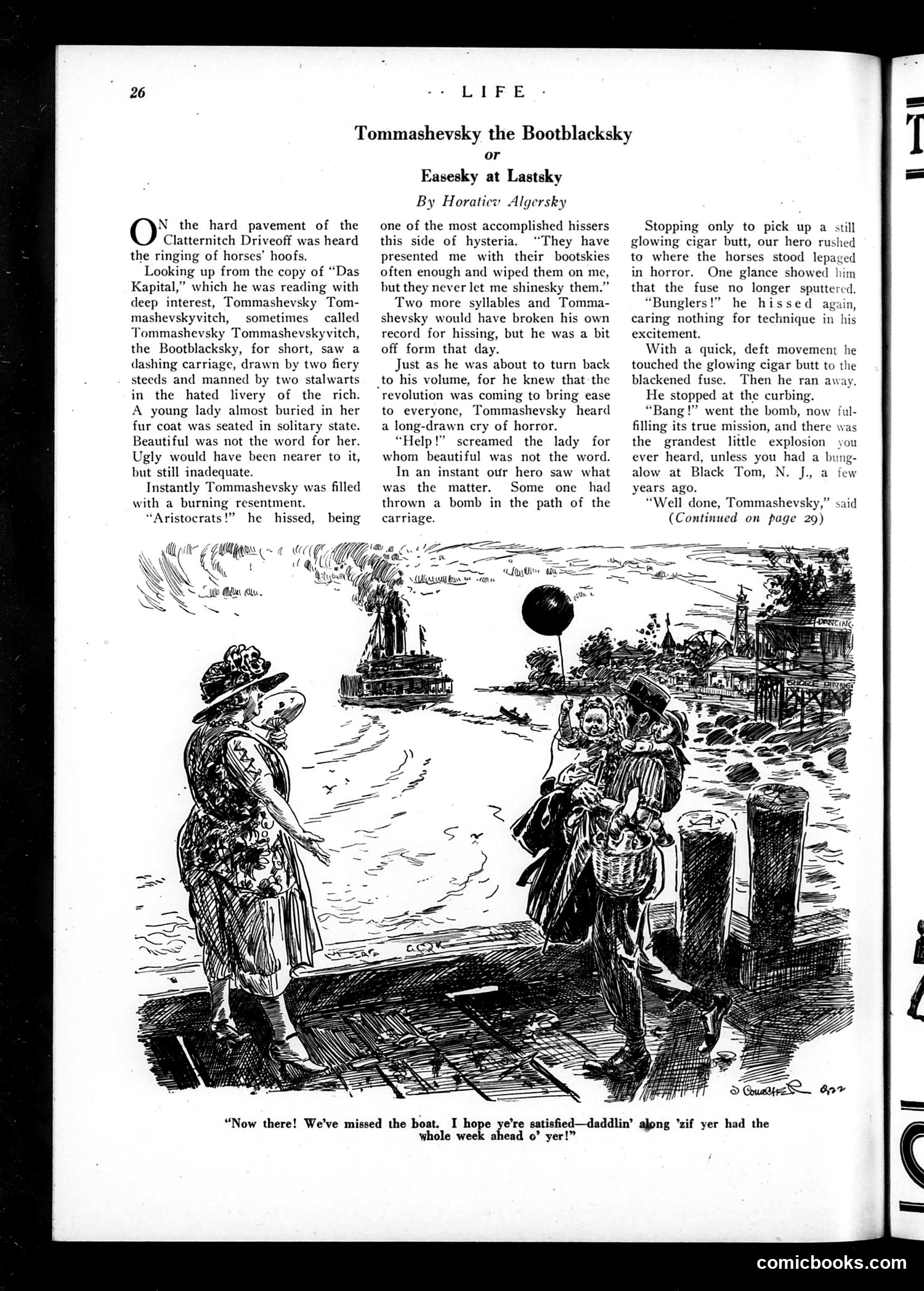
This is a satirical story mocking Russian revolutionary anarchists through exaggerated ethnic caricature and broken English dialect ("bootskies," "shinesky"). The protagonist Tommashevsky is a radical bootblack who reads Marx and resents the wealthy. When a bomb meant to assassinate a rich lady fails to detonate, he ironically completes the assassination attempt himself. The satire targets early 20th-century anarchist violence in America, likely referencing real bombing campaigns. The humor relies on portraying revolutionaries as simultaneously idealistic and incompetent—Tommashevsky criticizes other bombers as "bunglers" while accidentally succeeding where they failed. The joke cuts both ways: mocking both the terrorists' ineptitude and the absurdity of their cause. The reference to "Black Tom, N. J." appears to reference an actual 1916 German sabotage incident, grounding the satire in contemporary concerns about radical violence and immigration.
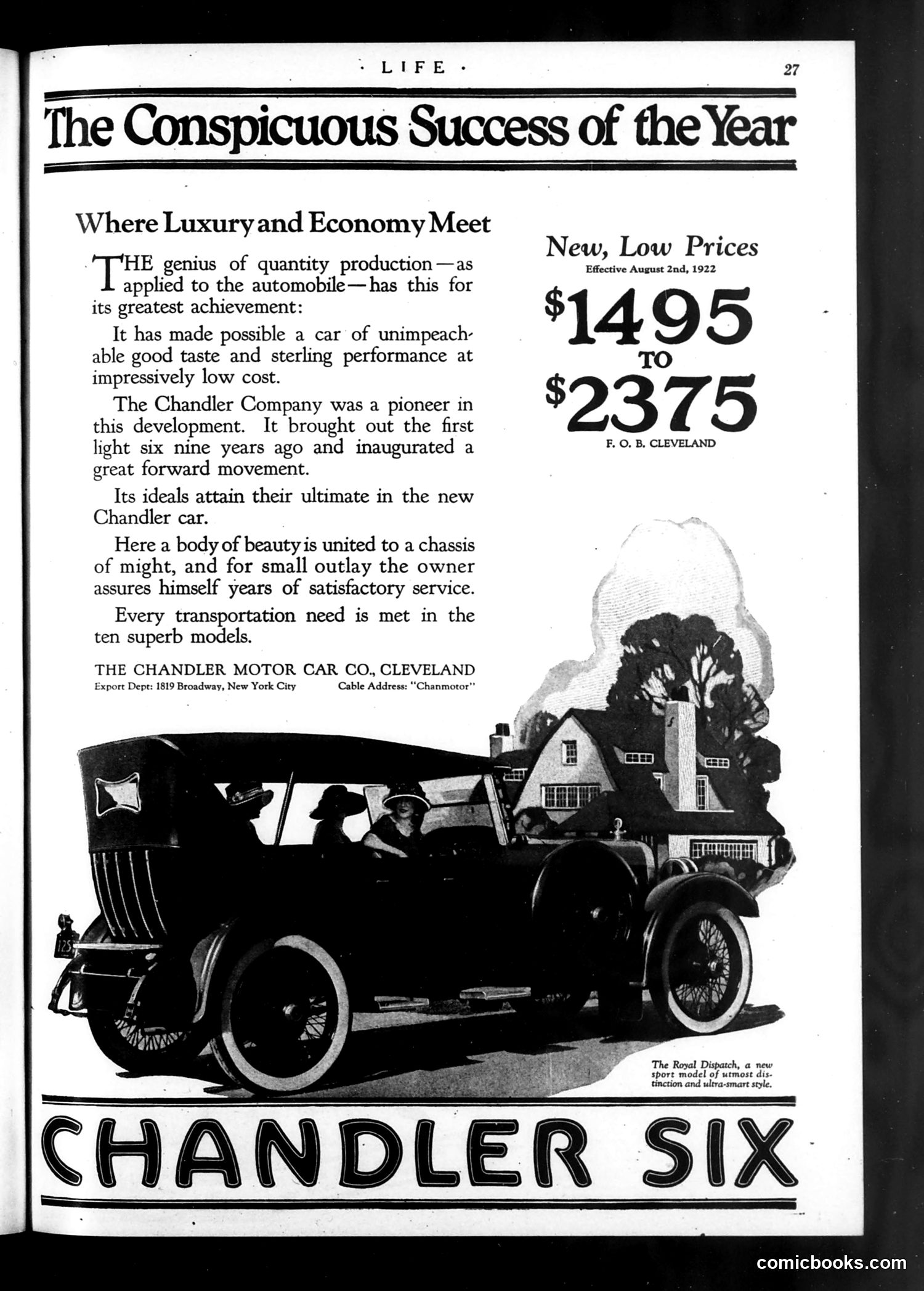
This is **not satire or political commentary**—it's a straightforward automobile advertisement from Life magazine's August 2, 1922 issue. The ad promotes the Chandler Six, a luxury car manufactured in Cleveland. The key appeal combines contradictory concepts: it promises "luxury and economy" by offering a well-crafted, prestigious vehicle at surprisingly low prices ($1,495–$2,375). The illustration depicts an elegant open-air touring car with well-dressed passengers driving past a comfortable suburban home, symbolizing prosperity and middle-class aspiration. The text emphasizes "quantity production" as enabling this price-to-quality ratio—mass manufacturing allows luxury features at accessible costs. For modern readers: this reflects 1920s optimism about manufacturing efficiency (the "genius of quantity production") making upscale living attainable for middle-class Americans—a pre-Depression sales pitch emphasizing affordability without sacrificing prestige.
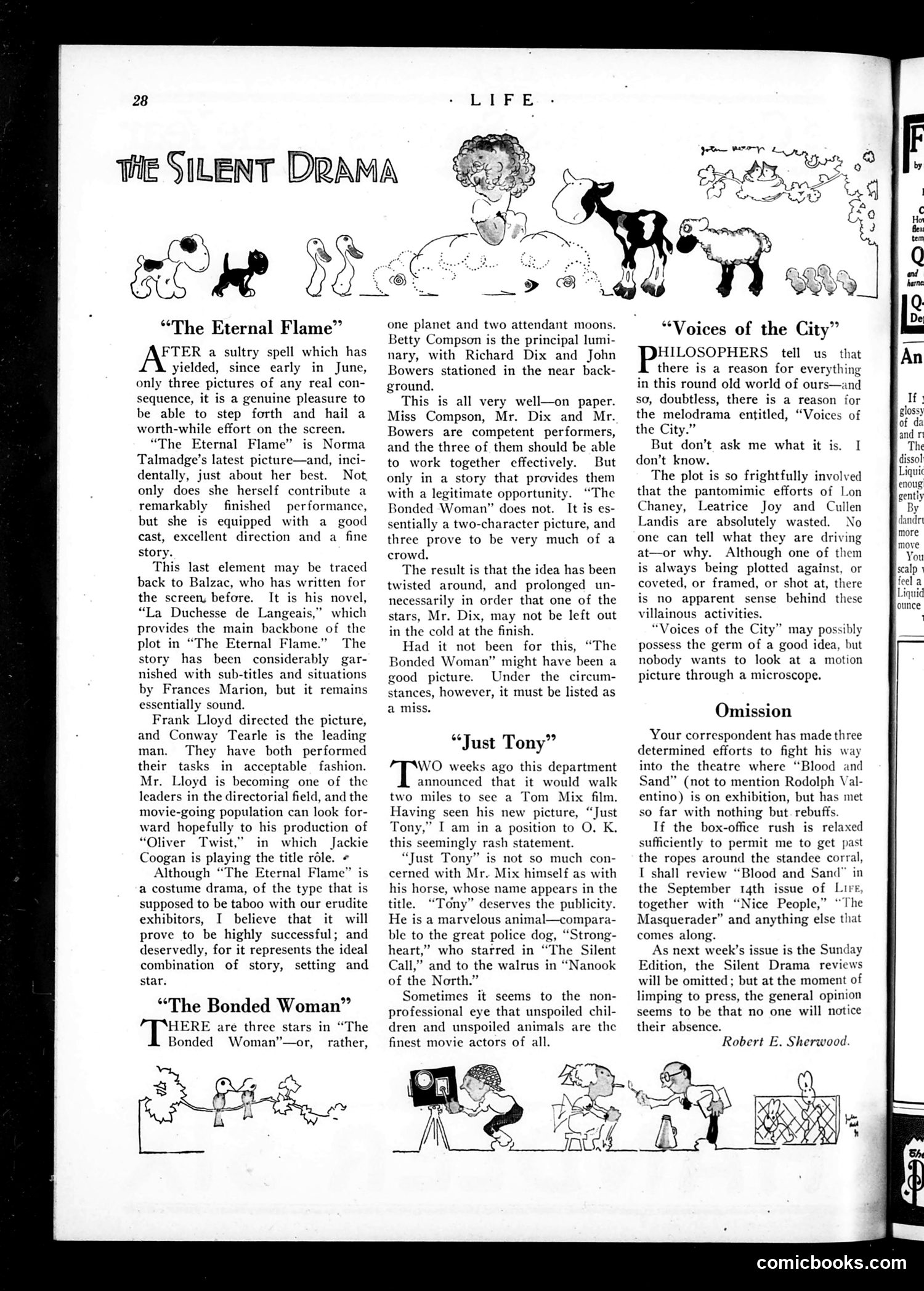
This page contains film reviews from Life magazine's entertainment section. The critic reviews three silent films: **"The Eternal Flame"** (starring Norma Talmadge) receives praise as a well-crafted costume drama adapted from Balzac, directed by Frank Lloyd with Conway Tearle. **"The Bonded Woman"** is criticized as poorly constructed—despite featuring competent actors Betty Compson, Richard Dix, and John Bowers, the plot awkwardly stretches to include all three stars equally, when it's naturally a two-character story. The reviewer calls it "a miss." **"Just Tony"** receives qualified approval. The title character is Tom Mix's horse, not Mix himself. The critic praises the animal's performance, comparing it to other famous animal actors like the dog "Strongheart," suggesting unspoiled animals are surprisingly effective movie performers. **"Voices of the City"** (with Lon Chaney) is dismissed as incomprehensibly plotted melodrama where the pantomime acting cannot overcome a confusing narrative.
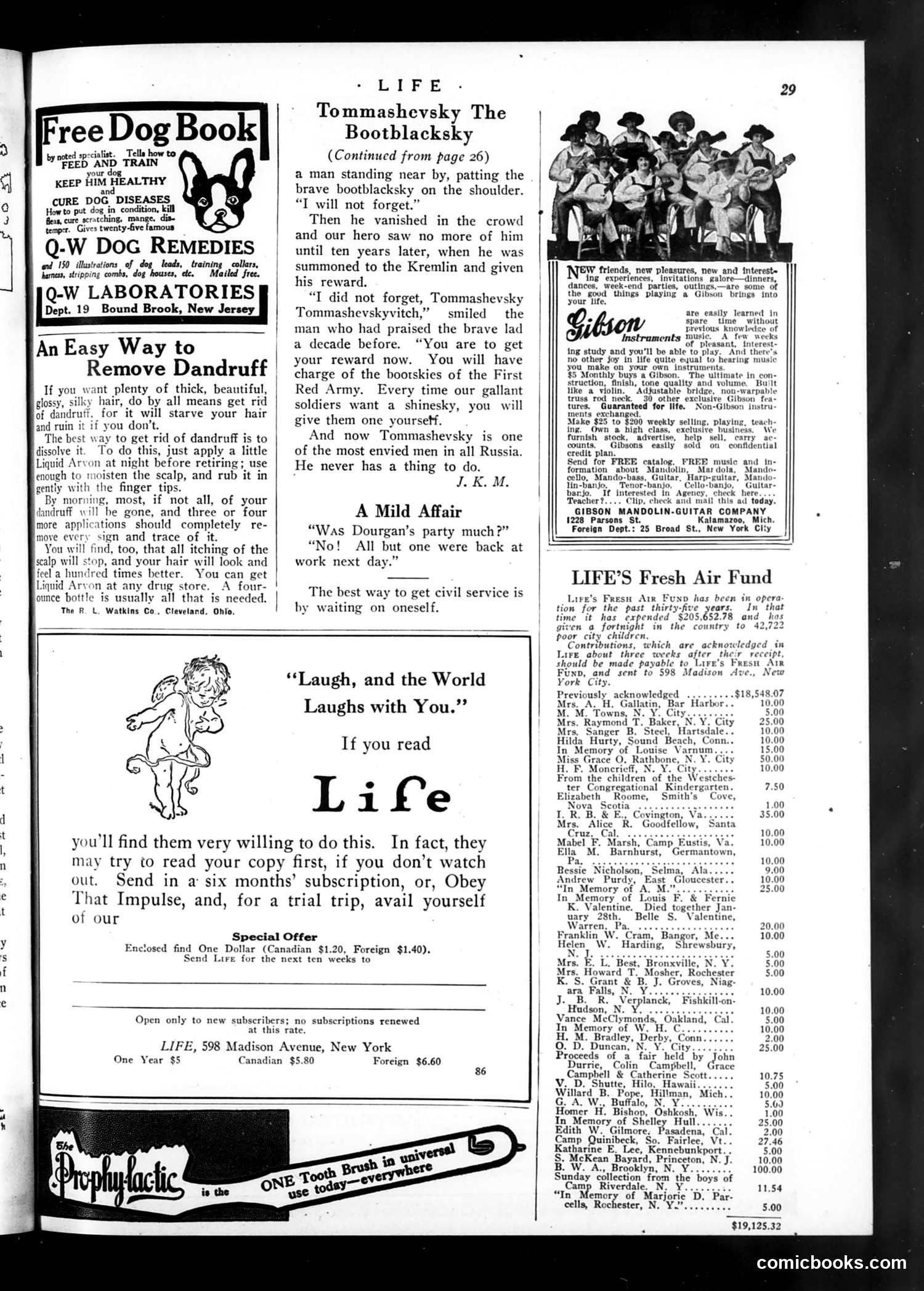
This page is primarily **advertisements and administrative content** rather than political satire or editorial cartooning. The notable content includes: 1. **"Tommashevsky the Bootblacksky"** (a serialized story continuation): A satirical tale employing heavy Russian-inflected English ("bootskies," "shinesky," "yoursetf") to mock both Russian communism and the novelty of Soviet terminology. The plot—a bootblack rewarded by the Kremlin with appointment to a cushy, work-free government position—satirizes Soviet bureaucratic inefficiency and corruption. 2. **"A Mild Affair"** and **"Laugh and the World Laughs with You"**: Brief joke/caption pieces typical of Life's lighter content. 3. **Bulk content**: Dog books, dandruff remedies, Gibson instruments, and Life magazine's Fresh Air Fund (a charitable drive). The small cherub illustration is generic era-appropriate decoration, not political commentary. The Tommashevsky piece is the only overtly satirical element, mocking both Russian naming conventions and Soviet government absurdity through exaggerated accent humor—common 1920s-era anti-communist material.
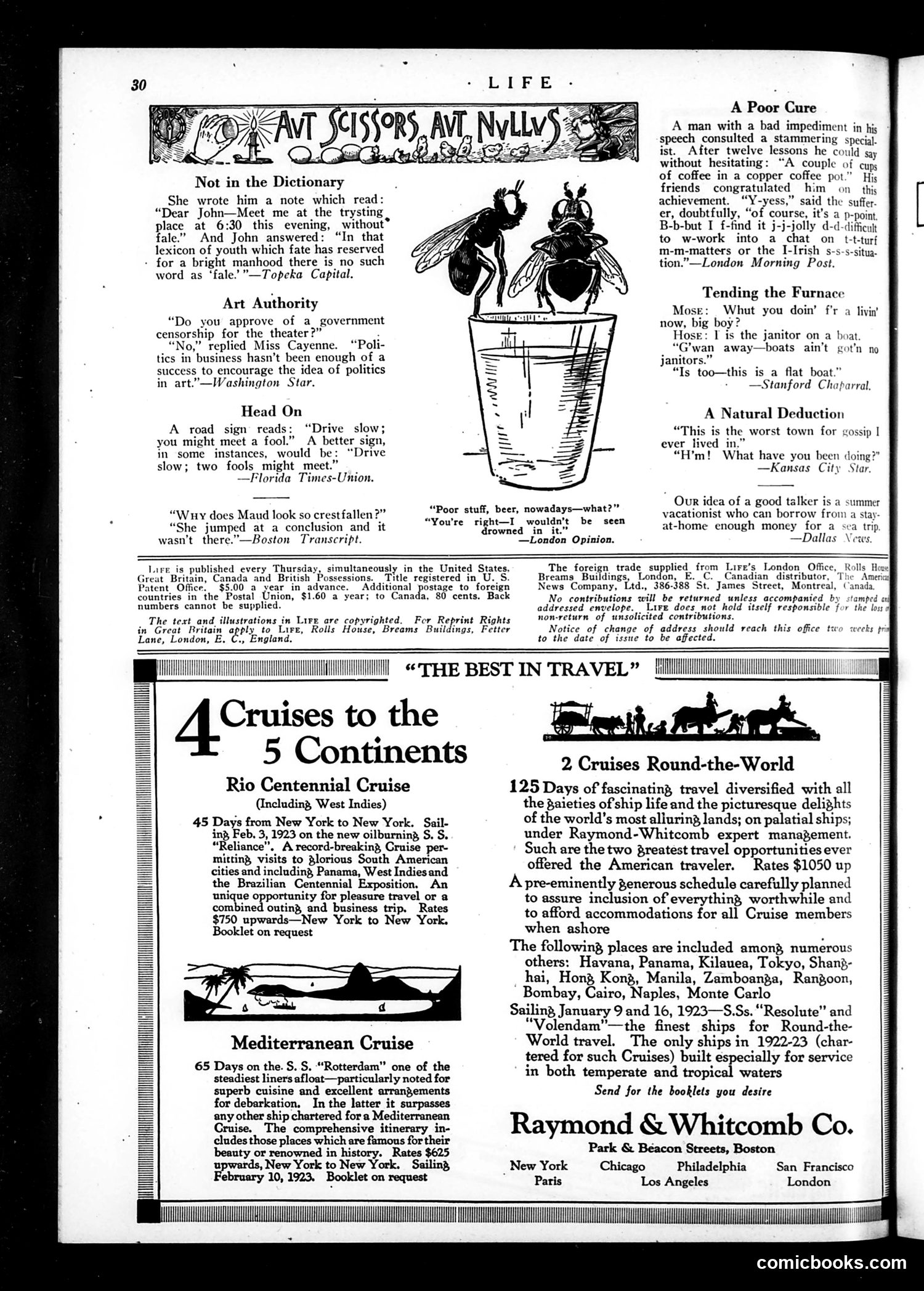
This page contains **short humor pieces and advertisements** rather than political cartoons. The jokes are light social satire typical of 1920s magazines: **Content includes:** - **"Not in the Dictionary"**: A mild romance joke about lovers' coded language - **"Art Authority"**: Satirizes government theater censorship by having a character argue politics has failed in business, so why apply it to art? - **"A Poor Cure"**: A stammering man's speech therapy succeeds at one phrase but remains useless for actual conversation—absurdist humor about impractical solutions - **"Head On" and others**: Brief, punchy jokes about road signs, gossip, and talkers The **cartoon illustration** shows two insects (appears to be a fly and a beetle) in a glass, captioned with dialogue about drowning in beer—a commentary on Prohibition-era drinking habits. **The lower half is travel advertising** for Raymond & Whitcomb cruise lines, offering round-the-world voyages to exotic locations (Tokyo, Hong Kong, Cairo, etc.), reflecting 1920s leisure tourism for the wealthy. The satire is gentle, domestic, and non-political—typical of Life's entertainment function alongside its satirical reputation.
This is a **promotional page**, not a political cartoon. It announces an upcoming special edition of *Life* magazine—a "Sunday Edition" scheduled for September 3rd (year unclear from image), described as "Another Burlesque Number." The humor appears to be **self-referential and light**: the phrase "oddly enough, on Sunday" contains gentle mockery of the obvious—that a Sunday edition would naturally appear on Sunday. The "burlesque" reference suggests the issue will contain satirical or comedic content. The price of "a mere fifteen cents" uses tongue-in-cheek language typical of early 20th-century advertising. Readers are urged to pre-order from newsdealers. This is essentially a **teaser advertisement** for a forthcoming special issue, relying on *Life* magazine's reputation for humor and satire to generate interest.
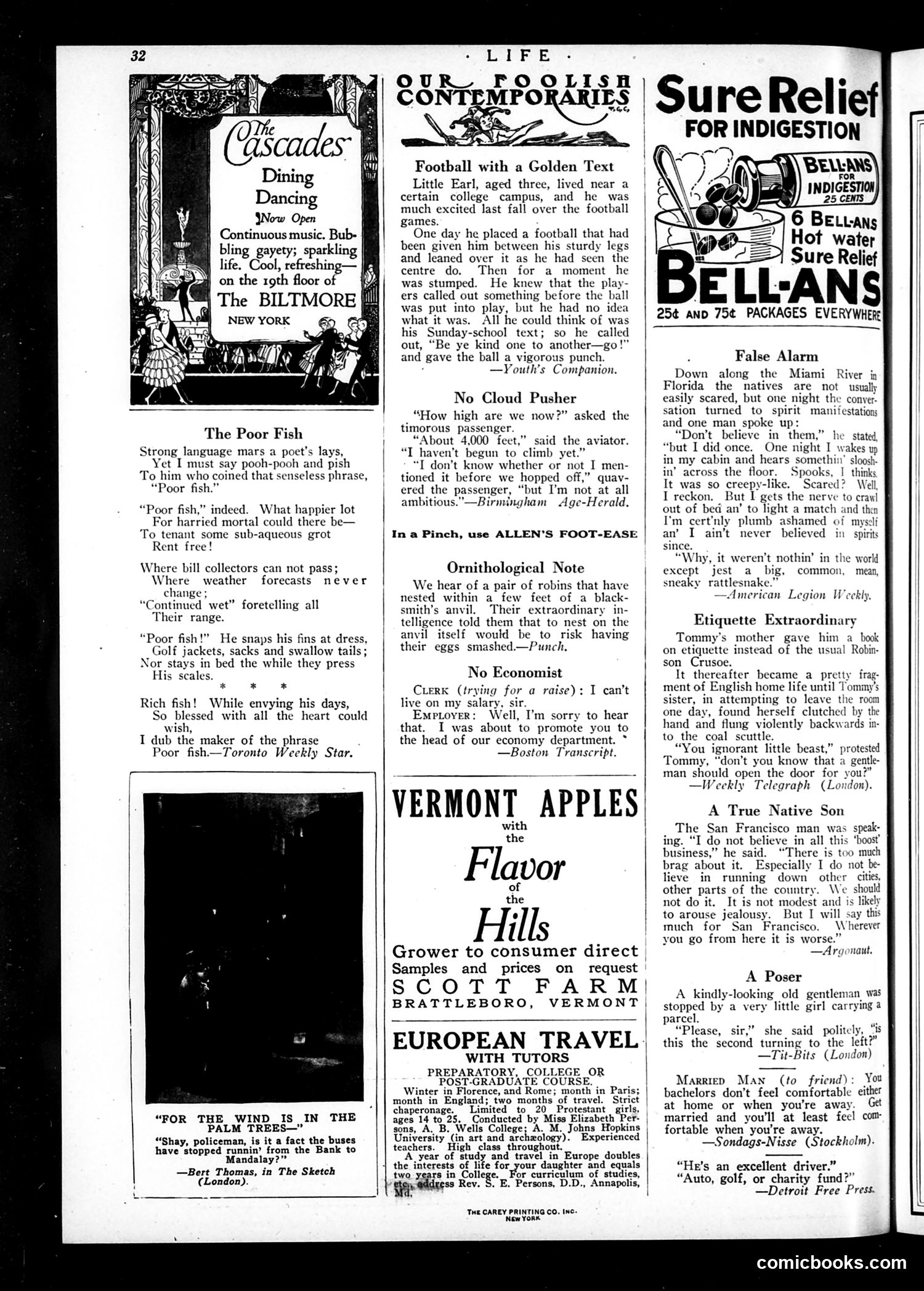
This page is primarily **advertising and humor pieces** rather than political cartoons. The main content includes: **"The Poor Fish"** — a humorous poem satirizing the phrase "poor fish," arguing that fish actually live ideal lives free from bills, weather worries, and formal dress codes. It's gentle social satire about human anxieties. **Short comic anecdotes** about: a three-year-old mixing football terminology with Sunday school lessons; an aviator and nervous passenger; robins nesting near a blacksmith's anvil; a clerk requesting a raise; a Floridian's false alarm about a rattlesnake he mistook for a ghost. **Advertisements** dominate the right side, including Bell-ans indigestion remedy, Vermont apples, and European travel tours. The humor is mild, family-friendly satire typical of Life magazine's era — poking fun at everyday situations, human nature, and social pretensions rather than political figures or events. The page reflects early-to-mid 20th century American middle-class concerns and sensibilities.
This is **not a cartoon but an advertisement/editorial pitch** from Life magazine's advertising department. It uses Abraham Lincoln as a rhetorical device to promote advertising itself. The piece argues that Lincoln, famously self-educated and hungry for any printed material as a poor frontier boy, would have marveled at modern advertisements. It frames ads as evidence of progress—showing how products and services have made life easier compared to "rough pioneer days." The satire is subtle: by comparing modern conveniences to what pioneers lacked, the piece attempts to make readers appreciate (and thus read and use) advertisements. It's essentially a meta-advertisement defending advertising's social value. **The historical irony a modern reader might miss**: This earnest defense of advertising's role in progress was published during Life's era when magazines genuinely believed in advertising as a democratizing force bringing innovation to ordinary people—before widespread skepticism about consumer culture and manipulative marketing.
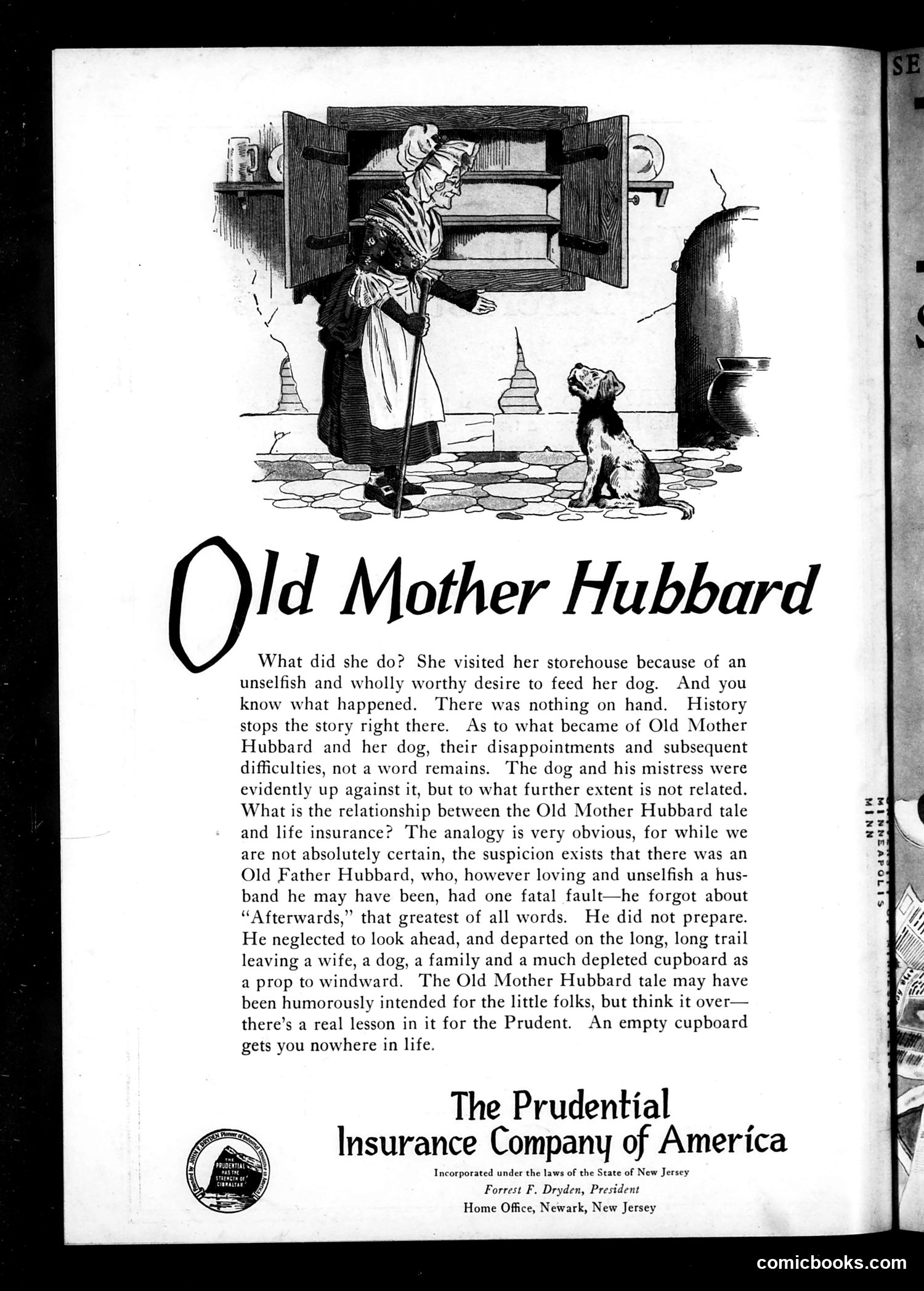
This is a **Prudential Insurance advertisement** using the nursery rhyme "Old Mother Hubbard" as a moral lesson about financial preparedness. **The satire/argument:** The ad reinterprets the children's tale as a cautionary story about lack of foresight. It suggests "Old Father Hubbard" failed to prepare for his family's future by neglecting life insurance—the word "Afterwards" being paramount. His death left the wife, children, and dog facing an empty cupboard (destitution). **The illustration** shows Old Mother Hubbard at her bare storehouse with her hungry dog, visualizing the poverty resulting from her husband's failure to insure himself. **For modern readers:** This is early life-insurance marketing, using familiar folklore to argue that responsible men should purchase policies to protect dependents. The "empty cupboard" is a metaphor for financial ruin. The advertisement conflates prudent financial planning with basic decency and love for one's family—a common insurance-industry rhetorical strategy. The tone treats a nursery rhyme as containing genuine life lessons about mortality and obligation.