
Life, 1922-08-31 · page 20 of 36
Life — August 31, 1922 — page 20: what you’re looking at
What you’re looking at
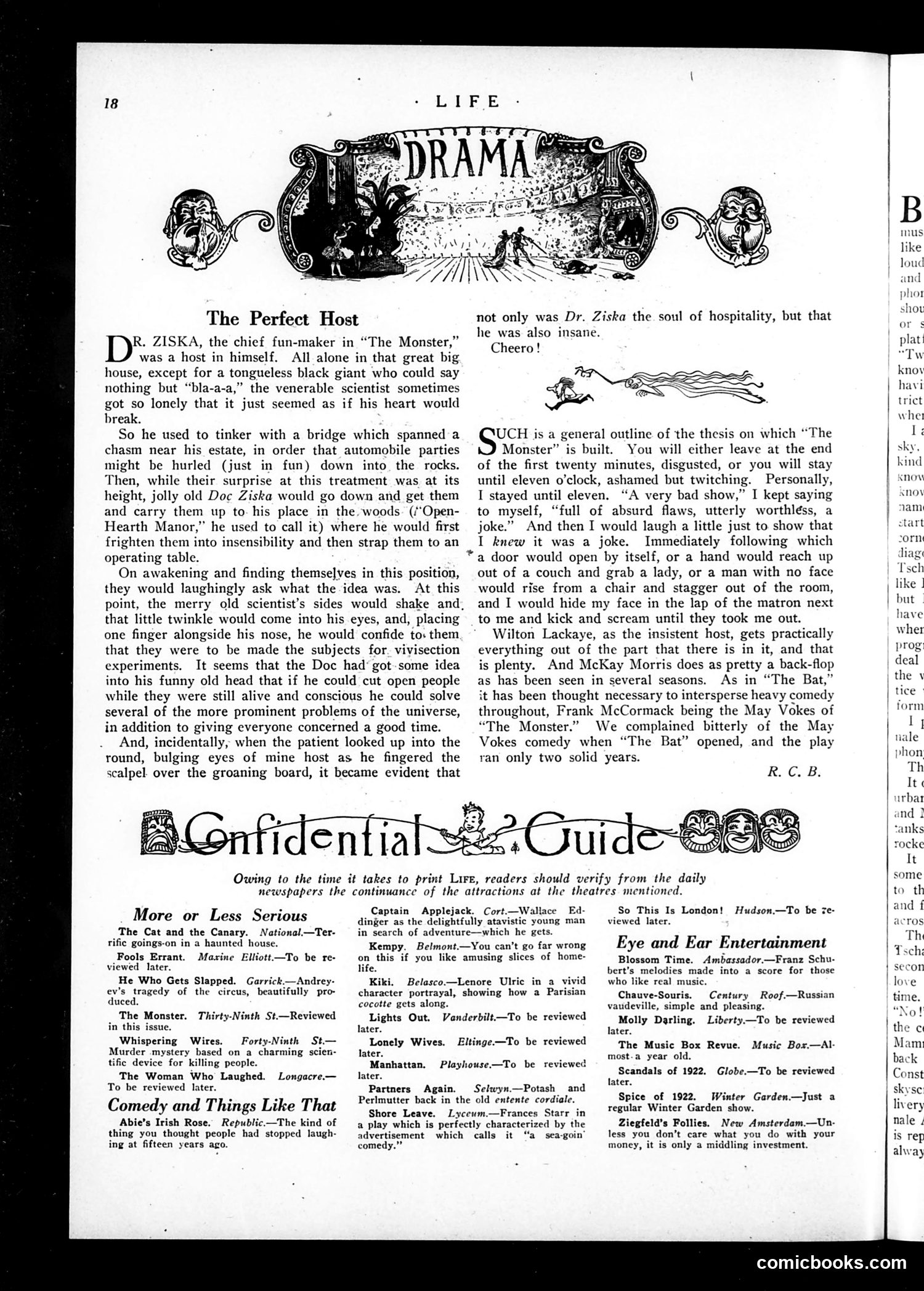
This is a theater review of the horror film *The Monster*, focusing on its protagonist Dr. Ziska (played by Wilton Lackaye), a mad scientist who entertains guests with darkly absurd hospitality. The satire works on multiple levels: Ziska is presented as the "perfect host" — he goes to elaborate, murderous lengths to entertain visitors, from sabotaging their car over a bridge to strapping them to an operating table for vivisection experiments. The joke is the grotesque inversion of hospitality; his "entertainment" is genuinely terrifying yet framed with comic timing. The reviewer acknowledges the film's "absurd flaws" and inconsistent tone — it oscillates between deliberate comedy and genuine horror. The criticism extends to unnecessary comic relief (Frank McCormack's character), comparing it unfavorably to earlier horror-comedy *The Bat*. The reviewer admits being both intellectually dismissive and emotionally terrified by the film's jump scares, capturing the era's early horror-comedy genre conventions.
📄 Transcribed text from this page (OCR, searchable)
Machine-transcribed from the original scan — historical spelling and the odd misread are preserved.
The Perfect Host R. ZISKA, the chief fun-maker in “The Monster,” was a host in himself. All alone in that great big house, except for a tongueless black giant who could say nothing but “bla-a-a,” the venerable scientist sometimes got so lonely that it just seemed as if his heart would break. So he used to tinker with a bridge which spanned a chasm near his estate, in order that automobile parties might be hurled (just in fun) down into the rocks. Then, while their surprise at this treatment was at its height, jolly old Doc Ziska would go down and get them and carry them up to. his place in the. woods. (/*Open- Hearth Manor,” he used to call it) where he would first frighten them into insensibility and then strap them to an operating table. On awakening and finding themselves in this position, they would laughingly ask what the idea was. At this point, the merry old scientist’s sides would shake and, that little twinkle would come into his eyes, and, placing one finger alongside his nose, he would confide to: them that they were to be made the subjects for. vivisection experiments. It seems that the Doc had‘ got-some idea into his funny old head that if he could cut open people while they were still alive and conscious he could solve several of the more prominent problems of the universe, in addition to giving everyone concerned a good time. And, incidentally, when the patient looked up into the round, bulging eyes of mine host as he fingered the scalpel. over the groaning board, it became evident that * not only was Dr. Ziska the. soul of hospitality, but that he was also insane. Cheero! 'UCH is a general outline of the thesis on which “The Monster” is built. You will either leave at the end of the first twenty minutes, disgusted, or you will stay until eleven o’clock, ashamed but twitching. Personally, I stayed until eleven. “A very bad show,” I kept saying to myself, “full of absurd flaws, utterly worthléss, a joke.” And then I would laugh a little just to show that I knew it was a joke. Immediately following which a door would open by itself, or a hand would reach up out of a couch and grab a lady, or a man with no face would rise from a chair and stagger out of the room, and I would hide my face in the lap of the matron next to me and kick and scream until they took me out. Wilton Lackaye, as the insistent host, gets practically everything out of the part that there is in it, and that is plenty. And McKay Morris does as pretty a back-flop as has been seen in several seasons. As in “The Bat,” it has been thought necessary to intersperse heavy comedy throughout, Frank McCormack being the May Vokes of “The Monster.” We complained bitterly of the May Vokes comedy when “The Bat” opened, and the play ran only two solid years. R. C. B. Owing to the time it takes to print Lire, readers should verify from the daily newspapers the continuance of the attractions at the theatres mentioned. Captain Applejack. Cort.—Wallace Ed- So This Is London! Hudson.—To be ze- More or Less Serious The Cat and the Canary. National._—Ter- rific goings-on in a haunted house. Fools Errant. Marine Elliott—To be re- viewed later. He Who Gets Slapped. Garrick.—Andrey- ev’s tragedy of the circus, beautifully pro- duced. The Monster. in this issue. Whispering Wires. Forty-Ninth St— Murder mystery based on a charming scien- tific device for killing people. The Woman Who Laughed. To be reviewed later. Comedy and Things Like That Abie’s Irish Rose. Republic.—The kind of thing you thought people had stopped laugh- ing at fifteen years ago. Thirty-Ninth St.—Reviewed Longacre.— dinger as the delightfully atavistic young man in search of adventure—which he gets. Kempy. Belmont.—You can’t go far wrong on this if you like amusing slices of home- life. Kiki. Belasco.—Lenore Ulric in a vivid character portrayal, showing how a Parisian cocotte gets along. Lights Out. Vanderbilt—To be reviewed later. Lonely Wives. Eltinge—To be reviewed later. Manhattan. Playhouse——To be reviewed later. Partners Again. Selwyn.—Potash and Perlmutter back in the old entente cordiale. Shore Leave. Lyceum.—Frances Starr in a play which is perfectly characterized by the advertisement which calls it “a sea-goin’ comedy.” viewed later. Eye and Ear Entertainment Blossom Time. Ambassador.—Franz Schu- bert’s melodies made into a score for those who like real music. Chauve-Souris. Century Roof.—Russian vaudeville, simple and pleasing. Molly Darling. Liberty.—To be reviewed later. The Music Box Revue. most.a year old. Scandals of 1922. Globe.—To be reviewed later. Spice of 1922. Winter Garden—Just a regular Winter Garden show. Ziegfeld’s Follies. New Amsterdam.—Un- less you don’t care what you do with your money, it is only a middling investment. Music Box,—Al- B mus like loud and pl phot shou or s plat! “Tw knov havi trict whet li sky. kind Know <nov rami start corn li I'sch like | but have wher prog’ deal the v | tice form 1 nale phon Th It irbar and ] sank rocke It some to th and acros Th Tschi secon livery nale 4 is rep alway comicbooks.com