
Life, 1922-08-31 · page 16 of 36
Life — August 31, 1922 — page 16: what you’re looking at
What you’re looking at
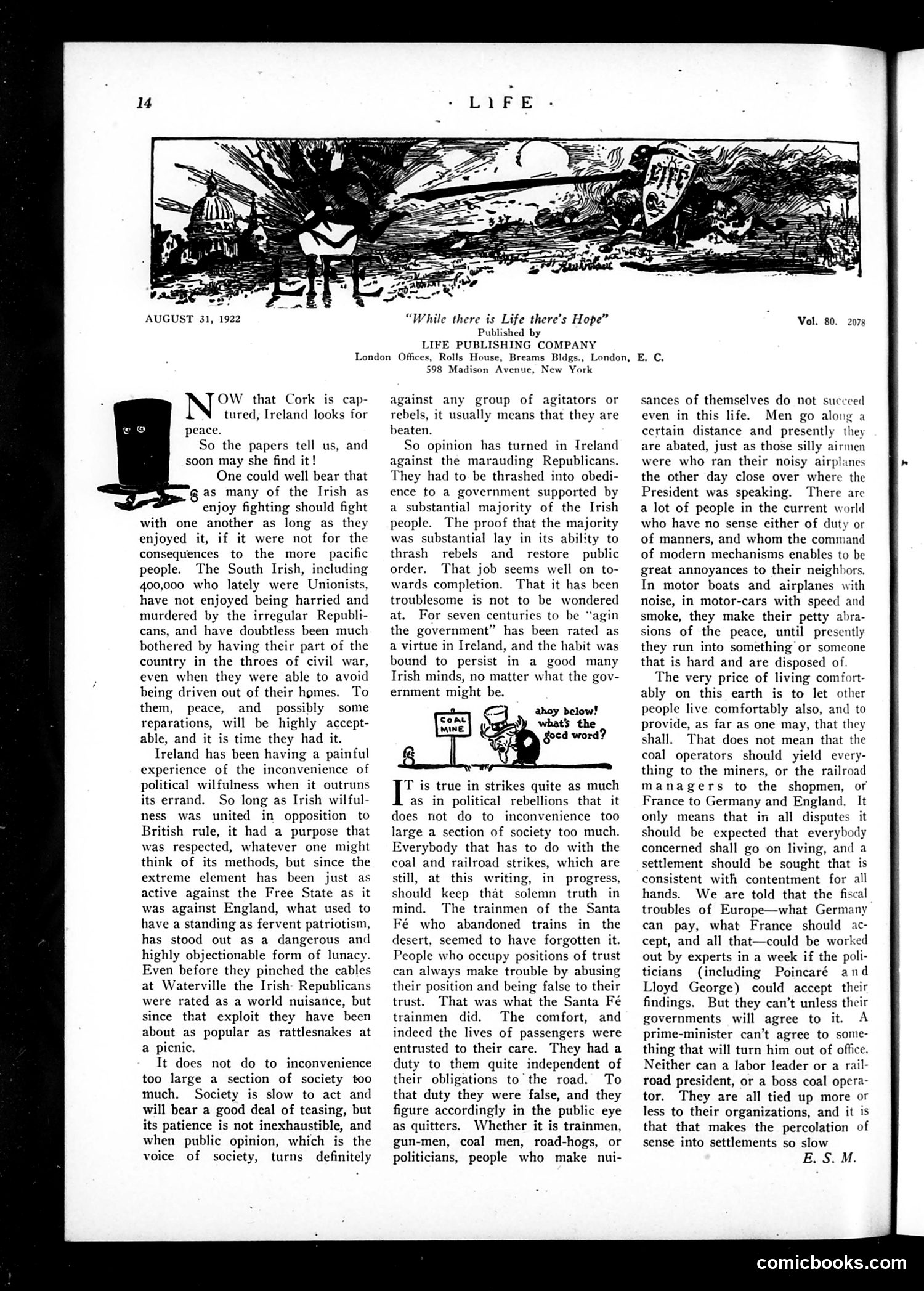
This page contains political commentary on Irish independence and labor strikes. The main illustration shows a figure (likely representing Ireland or Irish Republicans) emerging from conflict, celebrating capture or control. The editorial discusses Ireland's recent painful transition to independence, praising the Irish majority's ability to restore order after Republican agitation. It criticizes both violent Republicans and those who exploited patriotism. A small cartoon depicts someone asking "what's the good word?" — likely commentary on labor disputes then ongoing in Britain and America (coal and railroad strikes mentioned in the text). The broader argument defends societal institutions against both extremist violence and labor unrest, arguing for gradual reform through proper channels rather than strikes or rebellion.
📄 Transcribed text from this page (OCR, searchable)
Machine-transcribed from the original scan — historical spelling and the odd misread are preserved.
AUGUST 31, 1922 “While there is Life there’s Hope” Published by LIFE PUBLISHING COMPANY Vol. 80. 2078 London Offices, Rolls House, Breams Bldgs., London, E. C. OW that Cork is cap- tured, Ireland looks for peace. So the papers tell us, and soon may she find it! One could well bear that gas many of the Irish as enjoy fighting should fight with one another as long as they enjoyed it, if it were not for the consequences to the more pacific people. The South Irish, including 400,000 who lately were Unionists, have not enjoyed being harried and murdered by the irregular Republi- cans, and have doubtless been much bothered by having their part of the country in the throes of civil war, even when they were able to avoid being driven out of their homes. To them, peace, and possibly some reparations, will be highly accept- able, and it is time they had it. Ireland has been having a painful experience of the inconvenience of political wilfulness when it outruns its errand. So long as Irish wilful- ness was united in opposition to British rule, it had a purpose that was respected, whatever one might think of its methods, but since the extreme element has been just as active against the Free State as it was against England, what used to have a standing as fervent patriotism, has stood out as a dangerous and highly objectionable form of lunacy. Even before they pinched the cables at Waterville the Irish- Republicans were rated as a world nuisance, but since that exploit they have been about as popular as rattlesnakes at a picnic. It does not do to inconvenience too large a section of society too much. Society is slow to act and will bear a good deal of teasing, but its patience is not inexhaustible, and when public opinion, which is the voice of society, turns definitely 598 Madison Avenue, New York against any group of agitators or rebels, it usually means that they are beaten. So opinion has turned in Ireland against the marauding Republicans. They had to. be thrashed into obedi- ence to a government supported by a substantial majority of the Irish people. The proof that the majority was substantial lay in its ability to thrash rebels and_ restore public order. That job seems well on to- wards completion. That it has been troublesome is not to be wondered at. For seven centuries to be “agin the government” has been rated as a virtue in Ireland, and the habit was bound to persist in a good many Irish minds, no matter what the gov- ernment might be. whats the Bocd word? T is true in strikes quite as much as in political rebellions that it does not do to inconvenience too large a section of society too much. Everybody that has to do with the coal and railroad strikes, which are still, at this writing, in progress, should keep that solemn truth in mind. The trainmen of the Santa Fé who abandoned trains in the desert, seemed to have forgotten it. People who occupy positions of trust can always make trouble by abusing their position and being false to their trust. That was what the Santa Fé trainmen did. The comfort, and indeed the lives of passengers were entrusted to their care. They had a duty to them quite independent of their obligations to the road. To that duty they were false, and they figure accordingly in the public eye as quitters. Whether it is trainmen, gun-men, coal men, road-hogs, or politicians, people who make nui- sances of themselves do not suceced even in this life. Men go along a certain distance and presently they are abated, just as those silly airmen were who ran their noisy airplanes the other day close over where the President was speaking. There arc a lot of people in the current world who have no sense either of duty or of manners, and whom the command of modern mechanisms enables to be great annoyances to their neighbors. In motor boats and airplanes with noise, in motor-cars with speed and smoke, they make their petty abra- sions of the peace, until presently they run into something or someone that is hard and are disposed of The very price of living comfort- ably on this earth is to let other people live comfortably also, and to provide, as far as one may, that they shall. That does not mean that the coal operators should yield every- thing to the miners, or the railroad managers to the shopmen, or France to Germany and England. It only means that in all disputes it should be expected that everybody concerned shall go on living, and a settlement should be sought that is consistent with contentment for all hands. We are told that the fiscal troubles of Europe—what Germany can pay, what France should ac- cept, and all that—could be worked out by experts in a week if the poli- ticians (including Poincaré and Lloyd George) could accept their findings. But they can’t unless their governments will agree to it. A prime-minister can’t agree to some- thing that will turn him out of office. Neither can a labor leader or a rail- road president, or a boss coal opera- tor. They are all tied up more or less to their organizations, and it is that that makes the percolation of sense into settlements so slow E..S. M. comicbooks.com