
Life, 1922-08-31 · page 8 of 36
Life — August 31, 1922 — page 8: what you’re looking at
What you’re looking at
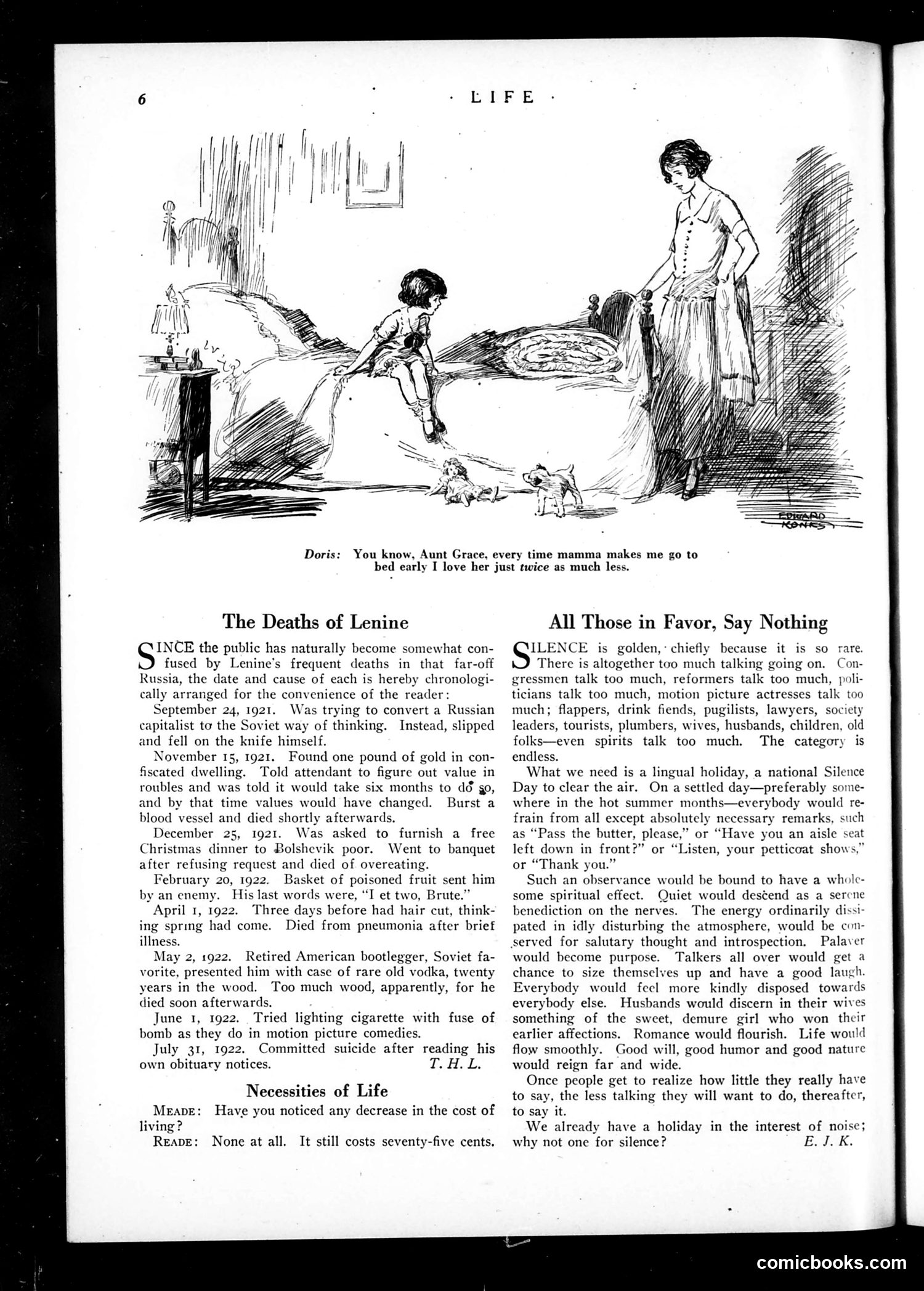
The top illustration shows a child (Doris) talking to an adult woman (Aunt Grace) in a bedroom scene. Doris complains that her mother sends her to bed early, which she dislikes. The joke satirizes parental discipline and childhood resistance to bedtime—a timeless domestic scenario. Below are three short pieces: "The Deaths of Lenin" catalogues the Soviet leader's alleged deaths via various means (poisoning, starvation, suicide) during 1921-1922, satirizing anti-Soviet propaganda circulating in the West. "All Those in Favor, Say Nothing" argues for a "Silence Day"—a humorous proposal for national quiet to counter excessive talk by politicians, reformers, and society figures. "Necessities of Life" is a brief dialogue questioning whether living costs have decreased.
📄 Transcribed text from this page (OCR, searchable)
Machine-transcribed from the original scan — historical spelling and the odd misread are preserved.
Doris: The Deaths of Lenine INCE the public has naturally become somewhat con- fused by Lenine’s frequent deaths in that far-off Russia, the date and cause of each is hereby chronologi- arranged for the convenience of the reader: ptember 24, 1921. Was trying to convert a Russian capitalist to the Soviet way of thinking. Instead, slipped and fell on the knife himself. November 15, 1921. Found one pound of gold in con- fiscated dwelling. Told attendant to figure out value in roubles and was told it would take six months to dd go, and by that time values would have changed. Burst a blood vessel and died shortly afterwards. December 25, 1921. Was asked to furnish a free Christmas dinner to Bolshevik poor. Went to banquet after refusing request and died of overeating. February 20, 1922. Basket of poisoned fruit sent him by an enemy. His last words were, “I et two, Brute.” April 1, 1922. Three days before had hair cut, think- ing spring had come. Died from pneumonia after brief illness. May 2, 1922. Retired American bootlegger, Soviet fa- vorite, presented him with case of rare old vodka, twenty years in the wood. Too much wood, apparently, for he died soon afterwards, June 1, 1922. Tried lighting cigarette with fuse of bomb as they do in motion picture comedies. July 31, 1922. Committed suicide after reading his own obituary notices. TAL. Necessities of Life Meave: Have you noticed any decrease in the cost of living ? READE: None at all. It still costs seventy-five cents. served for salutary thought and introspection. You know, Aunt Grace, every time mamma makes me go to bed early I love her just twice as much less. All Those in Favor, Say Nothing ILENCE is golden, chiefly because it is so rare. There is altogether too much talking going on. Con- gressmen talk too much, reformers talk too much, poli- ticians talk too much, motion picture actresses talk too much; flappers, drink fiends, pugilists, lawyers, society leaders, tourists, plumbers, wives, husbands, children, old folks—even spirits talk too much. The category is endless. What we need is a lingual holiday, a national Silence Day to clear the air. On a settled day—preferably some- where in the hot summer months—everybody would re- frain from all except absolutely necessary remarks, such as “Pass the butter, please,” or “Have you an aisle seat left down in front?” or “Listen, your petticoat shows,” or “Thank you.” Such an observance would be bound to have a whole- some spiritual effect. Quiet would destend as a sercne benediction on the nerves. The energy ordinarily dissi- pated in idly disturbing the atmosphere, would be con- Palaver would become purpose. Talkers all over would get a chance to size themselves up and have a good laugh. Everybody would feel more kindly disposed towar everybody else. Husbands would discern in their wives something of the sweet, demure girl who won their earlier affections. Romance would flourish. Life would flow smoothly. Good will, good humor and good nature would reign far and wide. Once people get to realize how little they really have to say, the less talking they will want to do, thereafter, to say it. We already have a holiday in the interest of noise; why not one for silence? IESIAK, comicbooks.com