
Life, 1922-08-31 · page 22 of 36
Life — August 31, 1922 — page 22: what you’re looking at
What you’re looking at
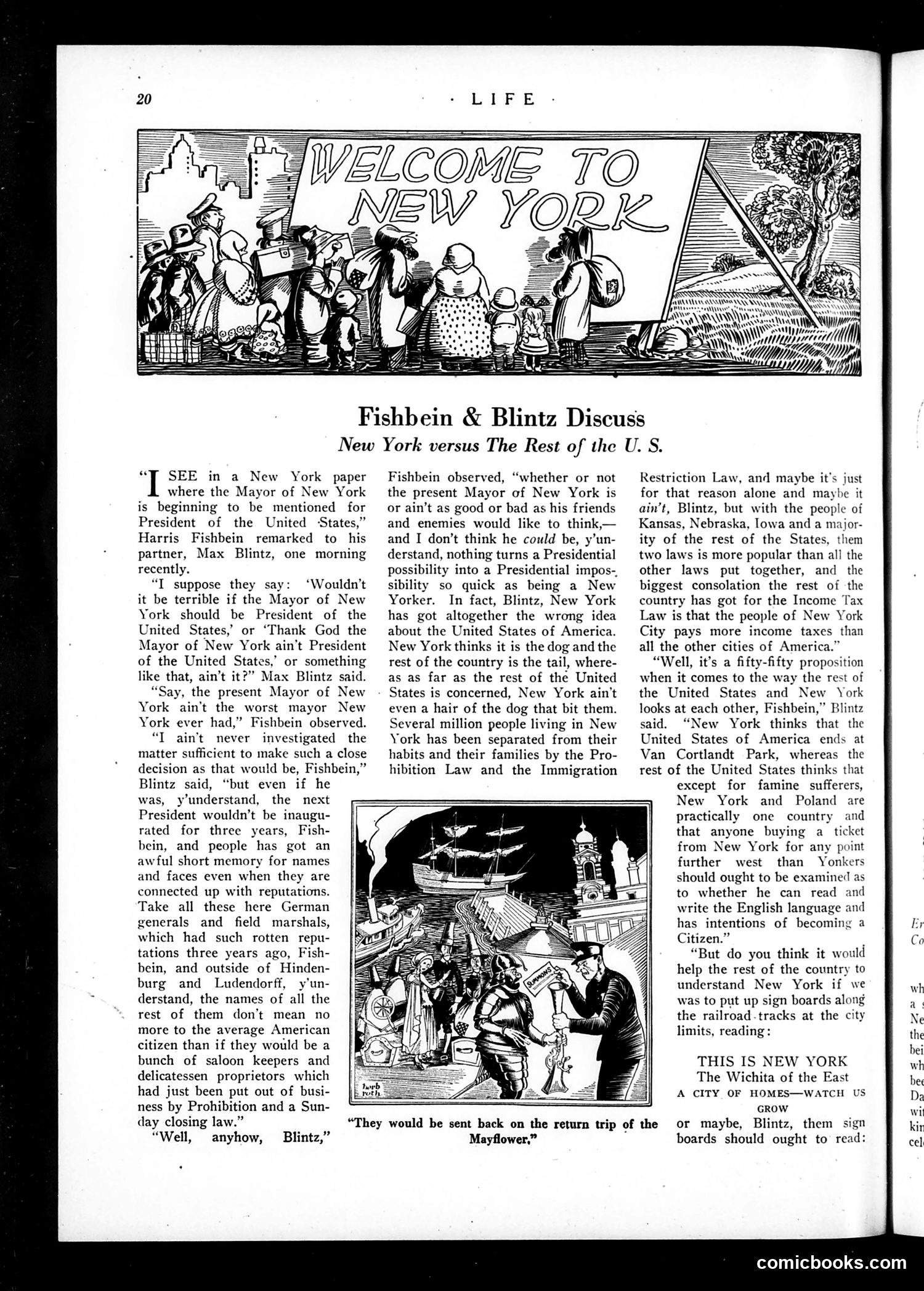
This dialogue between Jewish characters Fishbein and Blintz satirizes the mutual contempt between New York City and the rest of America in the 1920s. The piece addresses several contemporary tensions: **Main themes:** - New York's perceived arrogance ("the dog" while other states are "the tail") - Regional resentment: Kansas, Nebraska, Iowa favor Prohibition and Immigration Restriction laws—policies New Yorkers oppose because they've separated families - New York's outsized wealth (highest income tax contributions) versus cultural isolation - The closing joke suggests posting signs welcoming visitors while sarcastically calling NYC "the Wichita of the East"—mocking New York's self-importance **Context:** The 1920s saw genuine friction between cosmopolitan, immigrant-heavy cities and rural/small-town America over Prohibition, immigration quotas, and cultural values. The satire suggests both regions misunderstand each other, with New York dismissively isolated and America resentfully provincial. The Mayflower reference (bottom illustration) jokes that only deportation could solve these divisions.
📄 Transcribed text from this page (OCR, searchable)
Machine-transcribed from the original scan — historical spelling and the odd misread are preserved.
NM Sat N) Wn ececen MM yp al MWY LAD) y == Mpg ff ELLY Fishbein & Blintz Discuss New York versus The Rest of the U. S. “VT SEE in a New York paper where the Mayor of New York is beginning to be mentioned for President of the United States,” Harris Fishbein remarked to his partner, Max Blintz, one morning recently. “I suppose they say: ‘Wouldn't it be terrible if the Mayor of New York should be President of the United States,’ or ‘Thank God the Mayor of New York ain't President of the United States,’ or something like that, ain’t it?” Max Blintz said. “Say, the present Mayor of New York ain't the worst mayor New York ever had,” Fishbein observed. “I ain't never investigated the matter sufficient to make such a close decision as that would be, Fishbein,” Blintz said, “but even if he was, y’understand, the next Fishbein observed, “whether or not the present Mayor of New York is or ain’t as good or bad as his friends and enemies would like to think,— and I don’t think he could be, y’un- derstand, nothing turns a Presidential possibility into a Presidential impos- sibility so quick as being a New Yorker. In fact, Blintz, New York has got altogether the wrong idea about the United States of America. New York thinks it is the dog and the rest of the country is the tail, where- as as far as the rest of the United States is concerned, New York ain't even a hair of the dog that bit them. Several million people living in New York has been separated from their habits and their families by the Pro- hibition Law and the Immigration Restriction Law, and maybe it’s just for that reason alone and maybe it ain’t, Blintz, but with the people of Kansas, Nebraska, Iowa and a major- ity of the rest of the States, them two laws is more popular than all the other laws put together, and the biggest consolation the rest of the country has got for the Income Tax Law is that the people of New York City pays more income taxes than all the other cities of America.” “Well, it’s a fifty-fifty proposition when it comes to the way the rest of the United States and New York looks at each other, Fishbein,” Blintz said. “New York thinks that the United States of America ends at Van Cortlandt Park, whereas the rest of the United States thinks that except for famine sufferers, New York and Poland are President wouldn’t be inaugu- rated for three years, Fish- bein, and people has got an awful short memory for names and faces even when they are connected up with reputations. Take all these here German generals and field marshals, which had such rotten repu- tations three years ago, Fish- bein, and outside of Hinden- burg and Ludendorff, y'un- derstand, the names of all the rest of them don’t mean no more to the average American citizen than if they would be a bunch of saloon keepers and delicatessen proprietors which had just been put out of busi- ness by Prohibition and a Sun- day closing law.” “Well, anyhow, Blintz,” “They would be sent back on the return trip of the Mayflower,” practically one country and that anyone buying a_ ticket from New York for any point further west than Yonkers should ought to be examined as to whether he can read and write the English language and has intentions of becoming a Citizen.” . “But do you think it would help the rest of the country to understand New York if we was to put up sign boards along the railroad-tracks at the city limits, reading: THIS IS NEW YORK The Wichita of the East A CITY OF HOMES—WATCH US GRow or maybe, Blintz, them sign boards should ought to read: comicbooks.com