
Life, 1922-08-31 · page 30 of 36
Life — August 31, 1922 — page 30: what you’re looking at
What you’re looking at
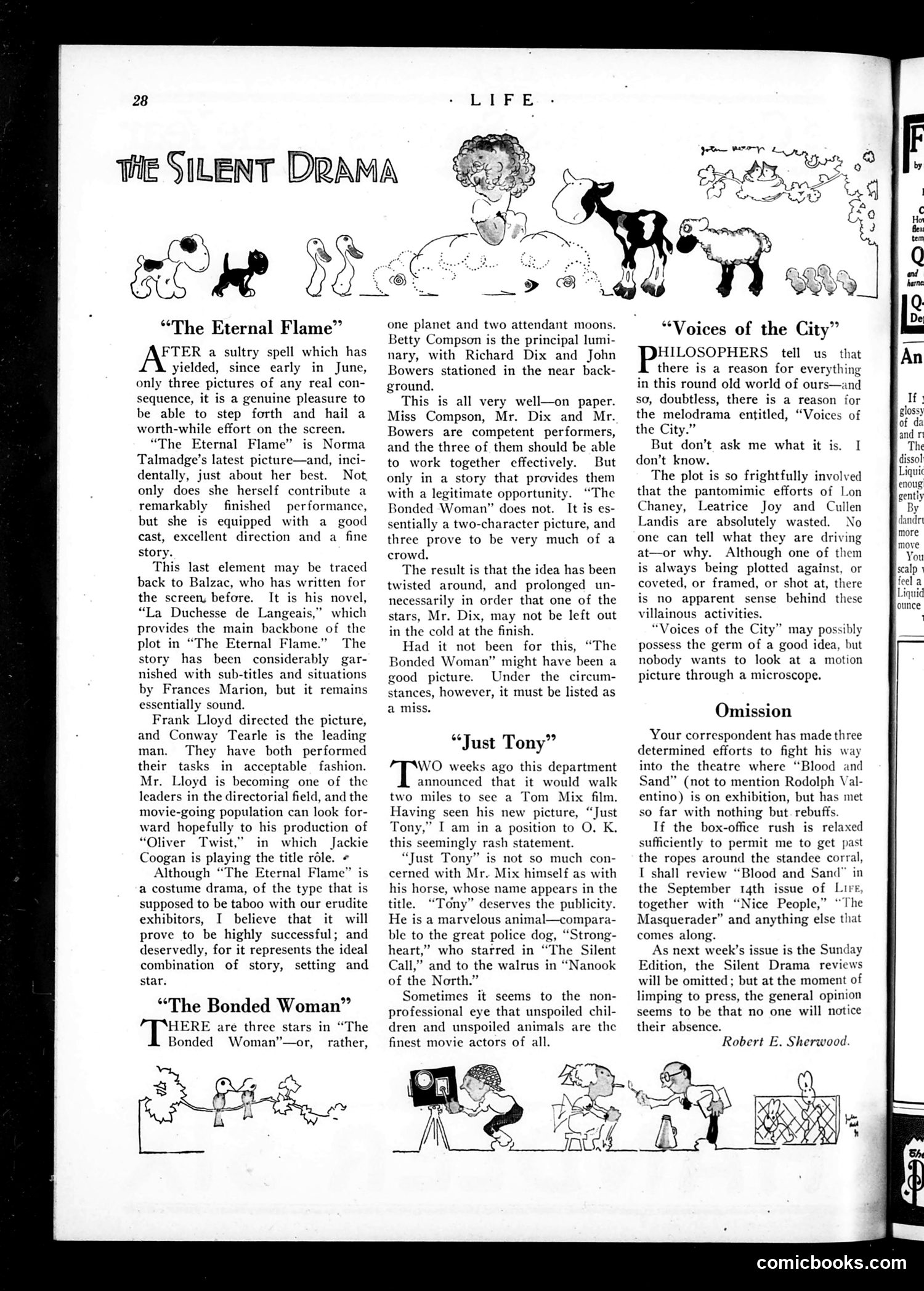
This page contains film reviews from Life magazine's entertainment section. The critic reviews three silent films: **"The Eternal Flame"** (starring Norma Talmadge) receives praise as a well-crafted costume drama adapted from Balzac, directed by Frank Lloyd with Conway Tearle. **"The Bonded Woman"** is criticized as poorly constructed—despite featuring competent actors Betty Compson, Richard Dix, and John Bowers, the plot awkwardly stretches to include all three stars equally, when it's naturally a two-character story. The reviewer calls it "a miss." **"Just Tony"** receives qualified approval. The title character is Tom Mix's horse, not Mix himself. The critic praises the animal's performance, comparing it to other famous animal actors like the dog "Strongheart," suggesting unspoiled animals are surprisingly effective movie performers. **"Voices of the City"** (with Lon Chaney) is dismissed as incomprehensibly plotted melodrama where the pantomime acting cannot overcome a confusing narrative.
📄 Transcribed text from this page (OCR, searchable)
Machine-transcribed from the original scan — historical spelling and the odd misread are preserved.
Tie SILENT DRAMA “The Eternal Flame” FTER a sultry spell which has yielded, since early in June, only three pictures of any real con- sequence, it is a genuine pleasure to be able to step forth and hail a worth-while effort on the screen. “The Eternal Flame” is Norma Talmadge’s latest picture—and, inci- dentally, just about her best. Not, only does she herself contribute a remarkably finished performance, but she is equipped with a good cast, excellent direction and a fine story. This last element may be traced back to Balzac, who has written for the screen, before. It is his novel, “La Duchesse de Langeais,” which provides the main backbone of the plot in “The Eternal Flame.” The story has been considerably gar- nished with sub-titles and situations by Frances Marion, but it remains essentially sound. Frank Lloyd directed the picture, and Conway Tearle is the leading man. They have both performed their tasks in acceptable fashion. Mr. d is becoming one of the leaders in the directorial field, and the movie-going population can look for- ward hopefully to his production of “Oliver Twist,” in which Jackie Coogan is playing the title rdle. + Although “The Eternal Flame” is a costume drama, of the type that is supposed to be taboo with our erudite exhibitors, I believe that it will prove to be highly successful; and deservedly, for it represents the ideal combination of story, setting and star. “The Bonded Woman” HERE are three stars in “The Bonded Woman”—or, rather, one planet and two attendant moons. Betty Compson is the principal lumi- nary, with Richard Dix and John Bowers stationed in the near back- ground. This is all very well—on paper. Miss Compson, Mr. Dix and Mr. Bowers are competent performers, and the three of them should be able to work together effectively. But only in a story that provides them with a legitimate opportunity. “The Bonded Woman” does not. It is es- sentially a two-character picture, and three prove to be very much of a crowd. The result is that the idea has been twisted around, and prolonged un- necessarily in order that one of the stars, Mr. Dix, may not be left out in the cold at the finish. Had it not been for this, “The Bonded Woman” might have been a good picture. Under the circum- stances, however, it must be listed as a miss. “Just Tony” WO weeks ago this department announced that it would walk two miles to see a Tom Mix film. Having seen his new picture, “Just Tony,” I am in a position to O. K. this seemingly rash statement. “Just Tony” is not so much con- cerned with Mr. Mix himself as with his horse, whose name appears in the title. “Tony” deserves the publicity. He is a marvelous animal—compara- ble to the great police dog, “Strong- heart,” who starred in “The Silent Call,” and to the walrus in “Nanook of the North.” Sometimes it seems to the non- professional eye that unspoiled chil- dren and unspoiled animals are the finest movie actors of all. Zy oa ; “als “Voices of the City” HILOSOPHERS tell us_ that there is a reason for everything in this round old world of ours—and so, doubtless, there is a reason for the melodrama entitled, “Voices of the City.” But don’t ask me what it is. I don’t know. The plot is so frightfully involved that the pantomimic efforts of Lon Chaney, Leatrice Joy and Cullen Landis are absolutely wasted. No one can tell what they are driving at—or why. Although one of them is always being plotted against, or coveted, or framed, or shot at, there is no apparent sense behind these villainous activities. “Voices of the City” may possibly possess the germ of a good idea, but nobody wants to look at a motion picture through a microscope. Omission Your correspondent has made three determined efforts to fight his way into the theatre where “Blood and Sand” (not to mention Rodolph Val- entino) is on exhibition, but has met so far with nothing but. rebuffs. If the box-office rush is relaxed sufficiently to permit me to get past the ropes around the standee corral, I shall review “Blood and Sand” in the September 14th issue of Lire, together with “Nice People,” “The Masquerader” and anything else that comes along. As next week’s issue is the Sunday Edition, the Silent Drama reviews will be omitted; but at the moment of limping to press, the general opinion seems to be that no one will notice their absence. Robert E. Sherwood. \ we m G coal comicbooks.com