
Life, 1922-08-31 · page 9 of 36
Life — August 31, 1922 — page 9: what you’re looking at
What you’re looking at
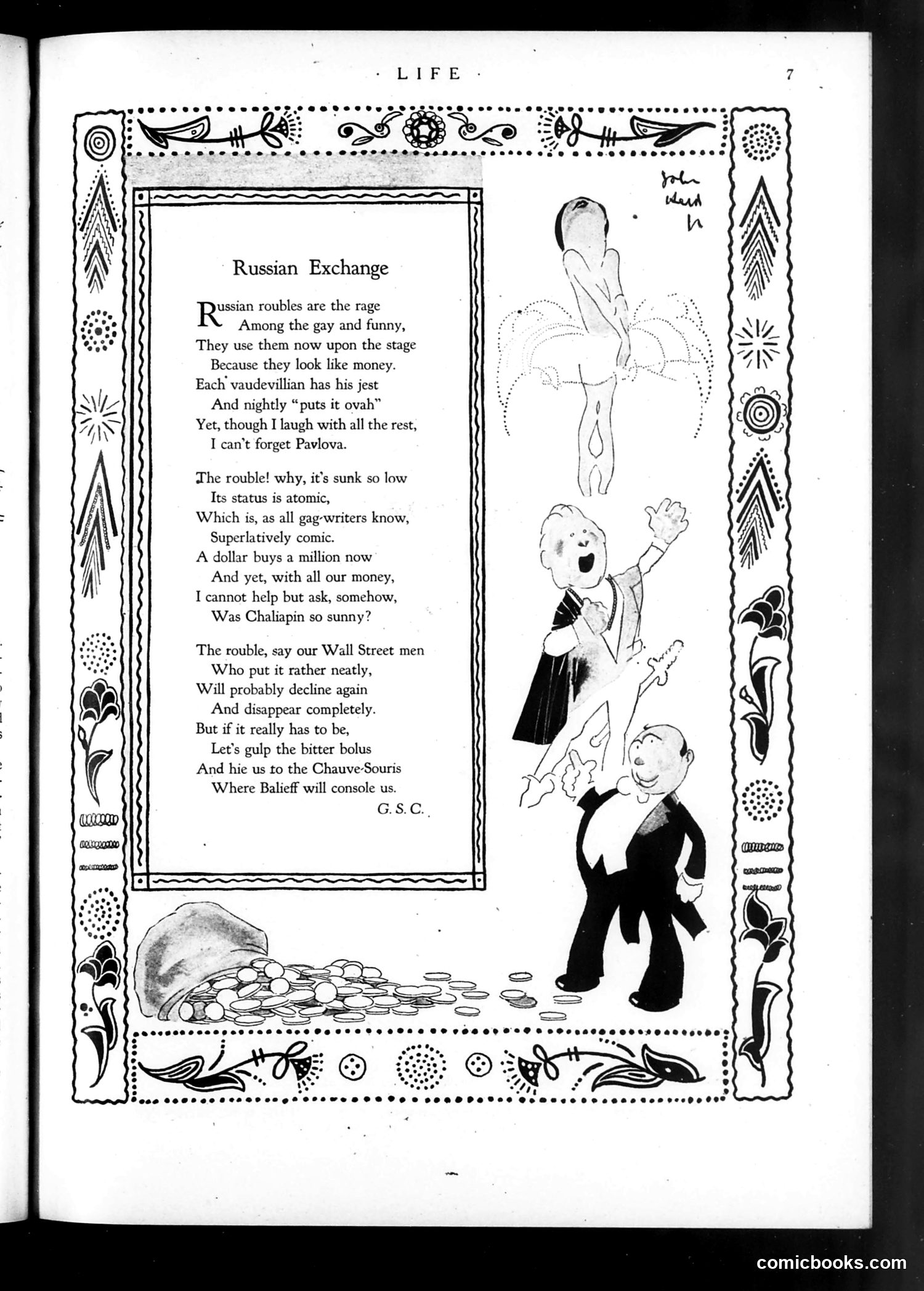
This poem by G.S.C. satirizes the collapse of the Russian ruble following the Bolshevik Revolution. The text mocks how Russian currency became worthless—theater performers used rubles as stage props because they "look like money" but held no real value. The accompanying cartoons illustrate the absurdity: a man spills coins carelessly, while others celebrate wildly, suggesting the currency's worthlessness made people treat it as a joke. The poem references Wall Street's prediction that the ruble "will probably decline again / And disappear completely," and suggests depositing the ruined currency at the "Chauve-Souris" nightclub (a famous Russian émigré cabaret in Paris) where impresario Balieff could "console us." The satire captures American amusement at—and schadenfreude over—Soviet economic disaster.
📄 Transcribed text from this page (OCR, searchable)
Machine-transcribed from the original scan — historical spelling and the odd misread are preserved.
POO SSO RS Se ASOD COSTE He OEP ECGs Oe Onn COL CD eT Gere LeOEE Et UES via ks Russian Exchange | ae roubles are the rage Among the gay and funny, They use them now upon the stage Because they look like money. Each vaudevillian has his jest And nightly “puts it ovah” Yet, though I laugh with all the rest, I can’t forget Pavlova. The rouble! why, it’s sunk so low Tts status is atomic, Which is, as all gag-writers know, Superlatively comic. A dollar buys a million now And yet, with all our money, I cannot help but ask, somehow, Was Chaliapin so sunny? The rouble, say our Wall Street men Who put it rather neatly, Will probably decline again And disappear completely. But if it really has to be, Let's gulp the bitter bolus And hie us to the Chauve-Souris Where Balieff will console us. comicbooks.com